service FORD EXPLORER 1997 2.G Owner's Manual
[x] Cancel search | Manufacturer: FORD, Model Year: 1997, Model line: EXPLORER, Model: FORD EXPLORER 1997 2.GPages: 236, PDF Size: 2.43 MB
Page 155 of 236
Relay number Circuits protected
1 Wiper run relay
2 Horn relay
3 Wiper HI/LO relay
4 WOT A/C relay
5 PCM power relay
6 Fuel pump relay
Diode number Circuits protected
1 ABS diode
2 PCM diode
CHANGING TIRES
Tire change procedure
1. Park on a level surface.
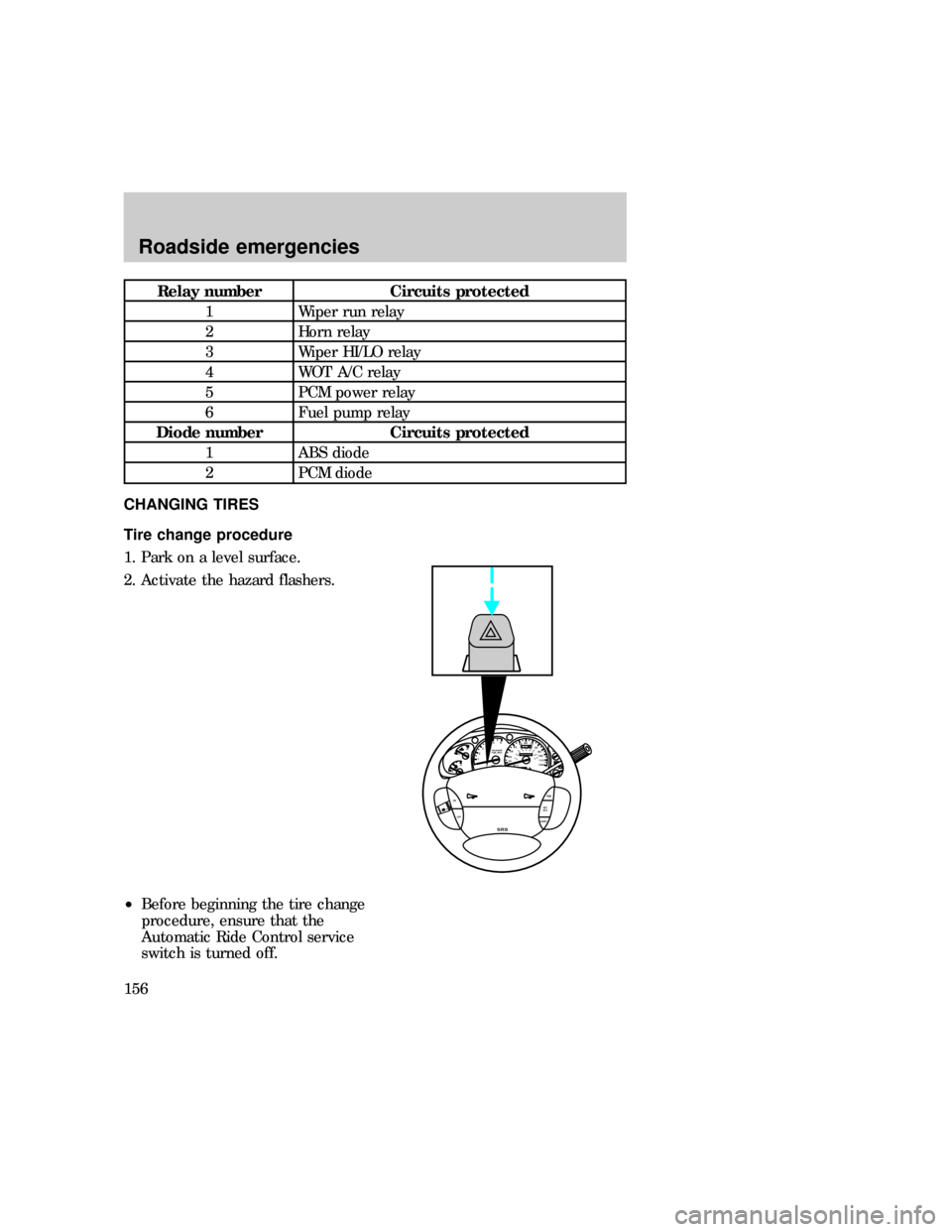
2. Activate the hazard flashers.
²Before beginning the tire change
procedure, ensure that the
Automatic Ride Control service
switch is turned off.
0P RND21
UNLEADED
FUEL ONLY
RPM x 100012345
6H
C
F
E
RSM
SET
ACC
COAST OFF ON
SRS
- +H
H
L L020
1030405060
70
80
90
110
120000000oooo
km/h10020406080100
120
140
160
180
uno_tire_change_procedure
Roadside emergencies
156
Page 163 of 236

for all authorized tow truck
operators. Have your tow truck
driver refer to this manual for
proper hook-up and towing
procedures.
Neutral tow kit accessory
Neutral tow feature is an option
which can be activated at any
dealership that has a Service Bay
Diagnostic System (SBDS). When
activated the feature may be
enabled by following the
instruction located on the visor or
the headliner.
The feature is available on vehicles
with Control Trac and automatic
transmission only. It is not
available on vehicles with
All-Wheel Drive.
There are no wrecker or
recreational vehicle towing
restrictions on method or distance
if the above feature is activated
and enabled.
See your dealer for more
information.
uno_tow-kit
Roadside emergencies
164
Page 164 of 236

SERVICE RECOMMENDATIONS
To help you service your vehicle:
²We highlight do-it-yourself items
in the engine compartment for
easy location.
²As possible, we design parts that
can be replaced without tools.
²We provide you with a ªService
Guideº which makes tracking
routine service for your vehicle
easy.
If your vehicle requires
professional service, your
dealership can provide necessary
parts and service. Check your
ªWarranty Information Bookletº to
find out which parts and services
are covered.
Use only recommended fuels,
lubricants, fluids and service parts
conforming to specifications.
Motorcraft parts are designed and
built to provide the best
performance in your vehicle.
Steps to take before performing
maintenance
Precautions when servicing
your vehicle
Be especially careful when
inspecting or servicing your
vehicle. Here are some general
precautions for your safety:
²Do not work on a hot engine.
²If you must work with the
engine running, avoid wearing
loose clothing or jewelry that
com_service_recommendations.01
uno_servicing_title
com_precautions_servicing.01
Maintenance and care
165
Page 172 of 236
CHECKING AND ADDING
ENGINE OIL
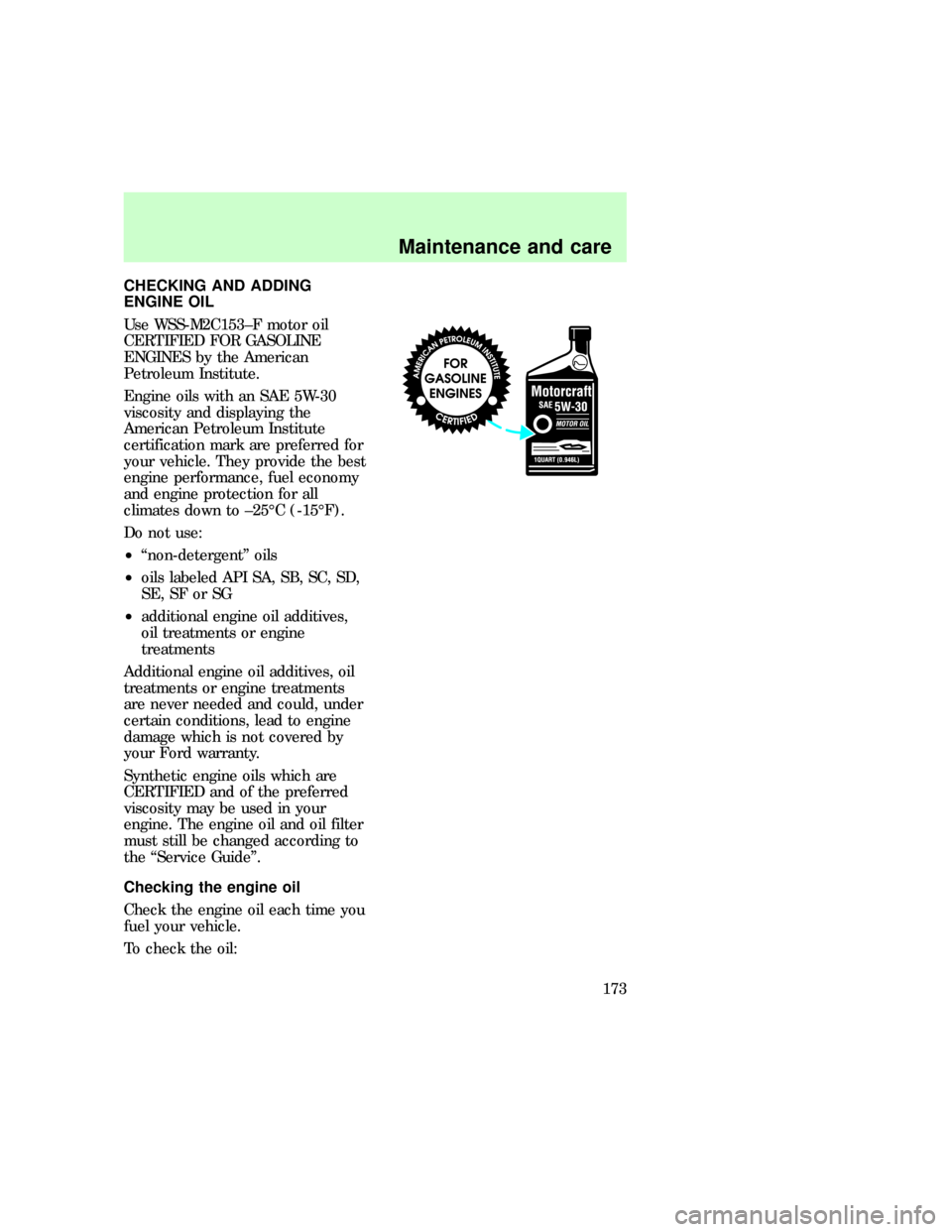
Use WSS-M2C153±F motor oil
CERTIFIED FOR GASOLINE
ENGINES by the American
Petroleum Institute.
Engine oils with an SAE 5W-30
viscosity and displaying the
American Petroleum Institute
certification mark are preferred for
your vehicle. They provide the best
engine performance, fuel economy
and engine protection for all
climates down to ±25ÉC (-15ÉF).
Do not use:
²ªnon-detergentº oils
²oils labeled API SA, SB, SC, SD,
SE, SF or SG
²additional engine oil additives,
oil treatments or engine
treatments
Additional engine oil additives, oil
treatments or engine treatments
are never needed and could, under
certain conditions, lead to engine
damage which is not covered by
your Ford warranty.
Synthetic engine oils which are
CERTIFIED and of the preferred
viscosity may be used in your
engine. The engine oil and oil filter
must still be changed according to
the ªService Guideº.
Checking the engine oil
Check the engine oil each time you
fuel your vehicle.
To check the oil:
uno_checking_engine_oil
Maintenance and care
173
Page 173 of 236
1. Make sure the vehicle is on level
ground. If the engine is warm, turn
the engine off and wait a few
minutes for the oil to drain into
the oil pan.
2. Set the parking brake and
ensure the gearshift is securely
latched in P (Park).
3. Open the hood. Protect yourself
from engine heat.
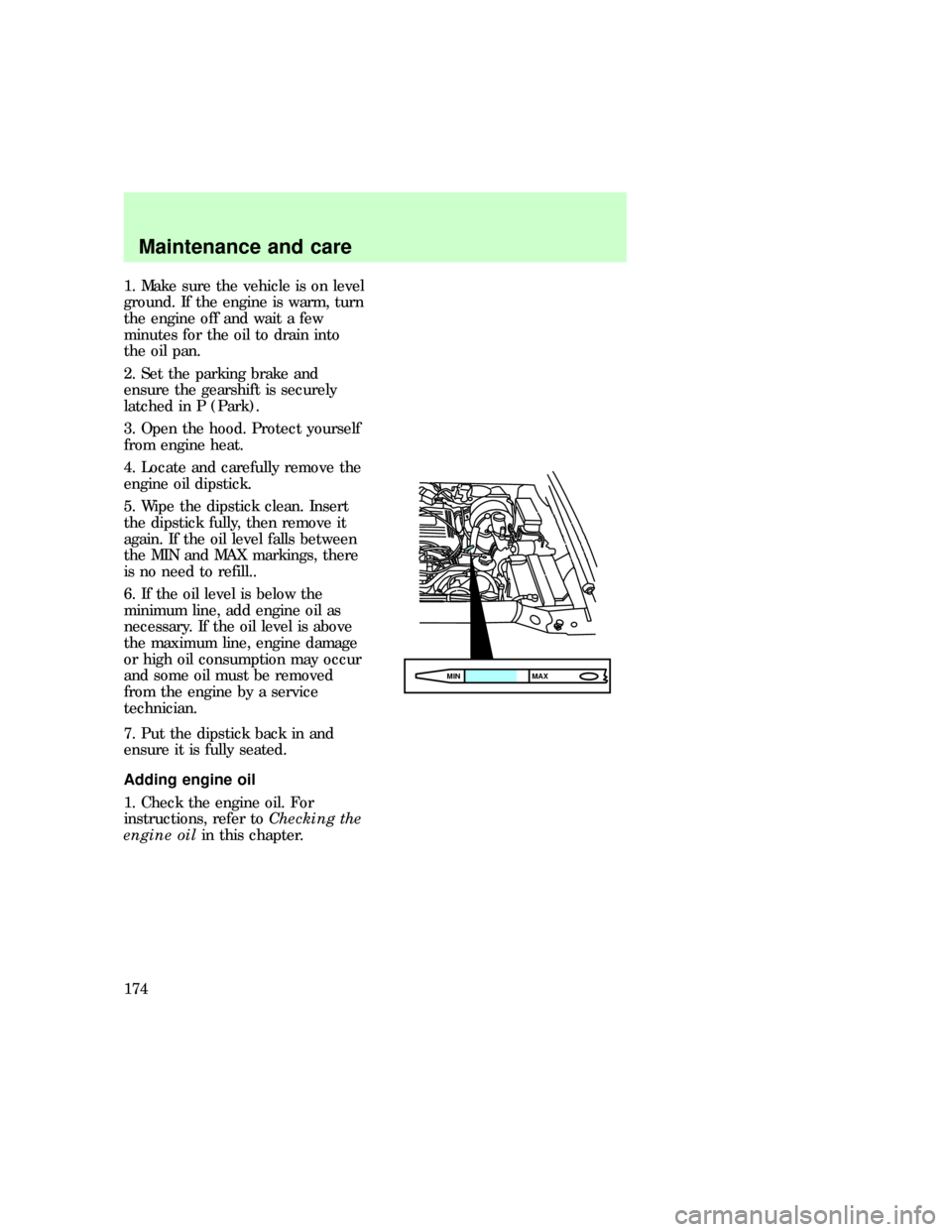
4. Locate and carefully remove the
engine oil dipstick.
5. Wipe the dipstick clean. Insert
the dipstick fully, then remove it
again. If the oil level falls between
the MIN and MAX markings, there
is no need to refill..
6. If the oil level is below the
minimum line, add engine oil as
necessary. If the oil level is above
the maximum line, engine damage
or high oil consumption may occur
and some oil must be removed
from the engine by a service
technician.
7. Put the dipstick back in and
ensure it is fully seated.
Adding engine oil
1. Check the engine oil. For
instructions, refer toChecking the
engine oilin this chapter.
MAX MIN
com_adding_engine_oil.01
Maintenance and care
174
Page 175 of 236

kilometers (mileage) and time
requirements, whichever occurs
first:
²Normal Schedule ± 8,000 km
(5,000 miles) or six months.
²Severe Duty Schedule ± 5,000
km (3,000 miles) or three
months. Severe duty operation
would include extensive idling,
trailer towing, driving in severe
dust and police, taxi or delivery
service.
Ford production and aftermarket
(Motorcraft) oil filters are designed
for added engine protection and
long life. If a replacement oil filter
is used that does not meet Ford
material and design specifications,
startup engine noises or knock
may be experienced.
It is recommended you use the
appropriate Motorcraft oil filter (or
another brand meeting Ford
specifications) for your engine
application.
DRIVELINE UNIVERSAL JOINT
AND SLIP YOKE
The universal joints standard with
your vehicle do not require
lubrication. If the original
equipment universal joints are
replaced with universal joints
equipped with grease fittings,
lubrication will be necessary at the
intervals shown in the ªService
Guideº supplement.
com_universal_joint.01
com_checking-adding_fluid.01
Maintenance and care
176
Page 176 of 236
CHECKING AND ADDING
BRAKE FLUID
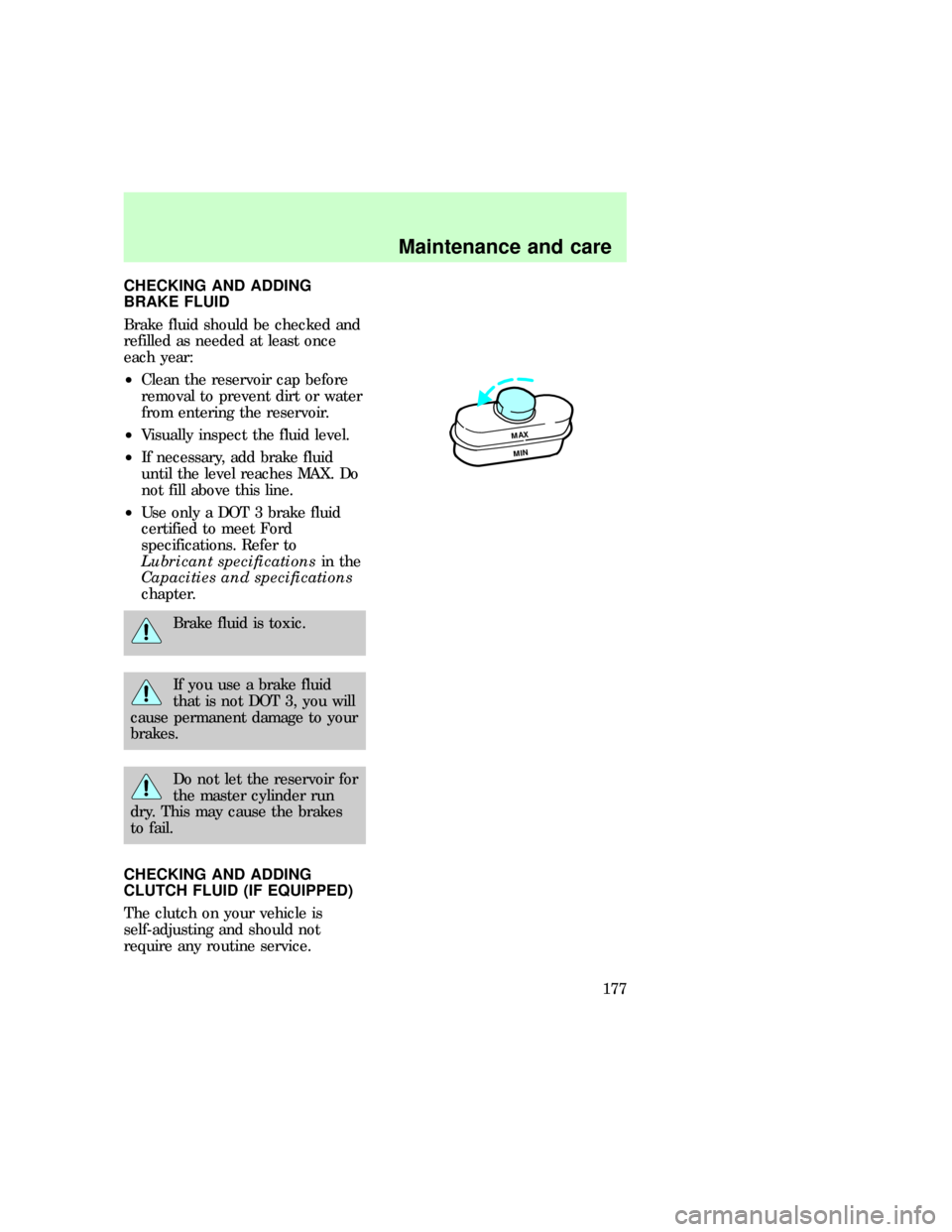
Brake fluid should be checked and
refilled as needed at least once
each year:
²Clean the reservoir cap before
removal to prevent dirt or water
from entering the reservoir.
²Visually inspect the fluid level.
²If necessary, add brake fluid
until the level reaches MAX. Do
not fill above this line.
²Use only a DOT 3 brake fluid
certified to meet Ford
specifications. Refer to
Lubricant specificationsin the
Capacities and specifications
chapter.
Brake fluid is toxic.
If you use a brake fluid
that is not DOT 3, you will
cause permanent damage to your
brakes.
Do not let the reservoir for
the master cylinder run
dry. This may cause the brakes
to fail.
CHECKING AND ADDING
CLUTCH FLUID (IF EQUIPPED)
The clutch on your vehicle is
self-adjusting and should not
require any routine service.
MAX
MIN
uno_checking_adding_clutch
Maintenance and care
177
Page 182 of 236
freeze at the temperature level in
which you drive during winter
months. Never increase the engine
coolant concentration above 60%.
Leave a 50/50 mixture of engine
coolant and water in your vehicle
year-round in non-extreme
climates.
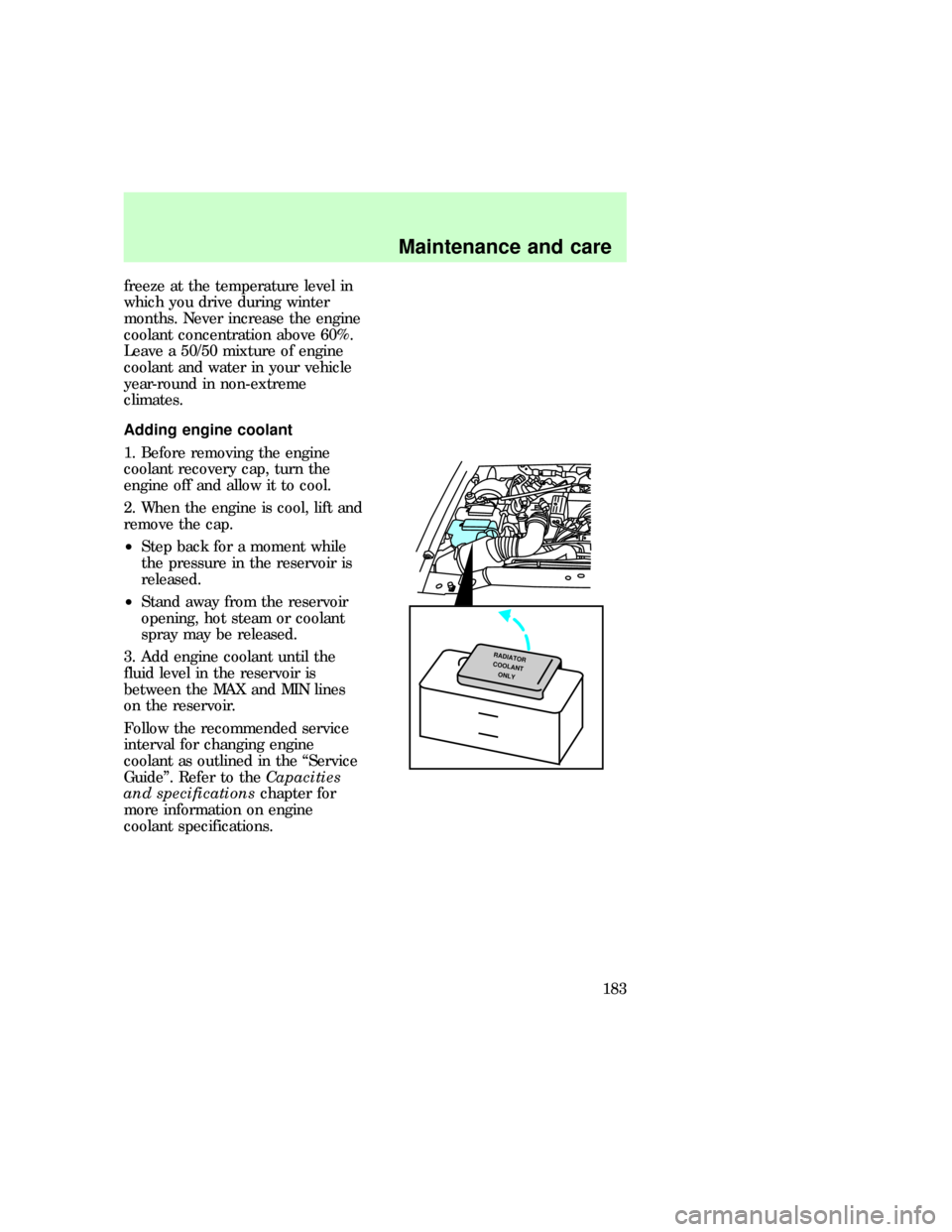
Adding engine coolant
1. Before removing the engine
coolant recovery cap, turn the
engine off and allow it to cool.
2. When the engine is cool, lift and
remove the cap.
²Step back for a moment while
the pressure in the reservoir is
released.
²Stand away from the reservoir
opening, hot steam or coolant
spray may be released.
3. Add engine coolant until the
fluid level in the reservoir is
between the MAX and MIN lines
on the reservoir.
Follow the recommended service
interval for changing engine
coolant as outlined in the ªService
Guideº. Refer to theCapacities
and specificationschapter for
more information on engine
coolant specifications.
RADIATOR
COOLANT
ONLY
uno_adding_engine_coolant
com_checking_hoses.01
Maintenance and care
183
Page 185 of 236
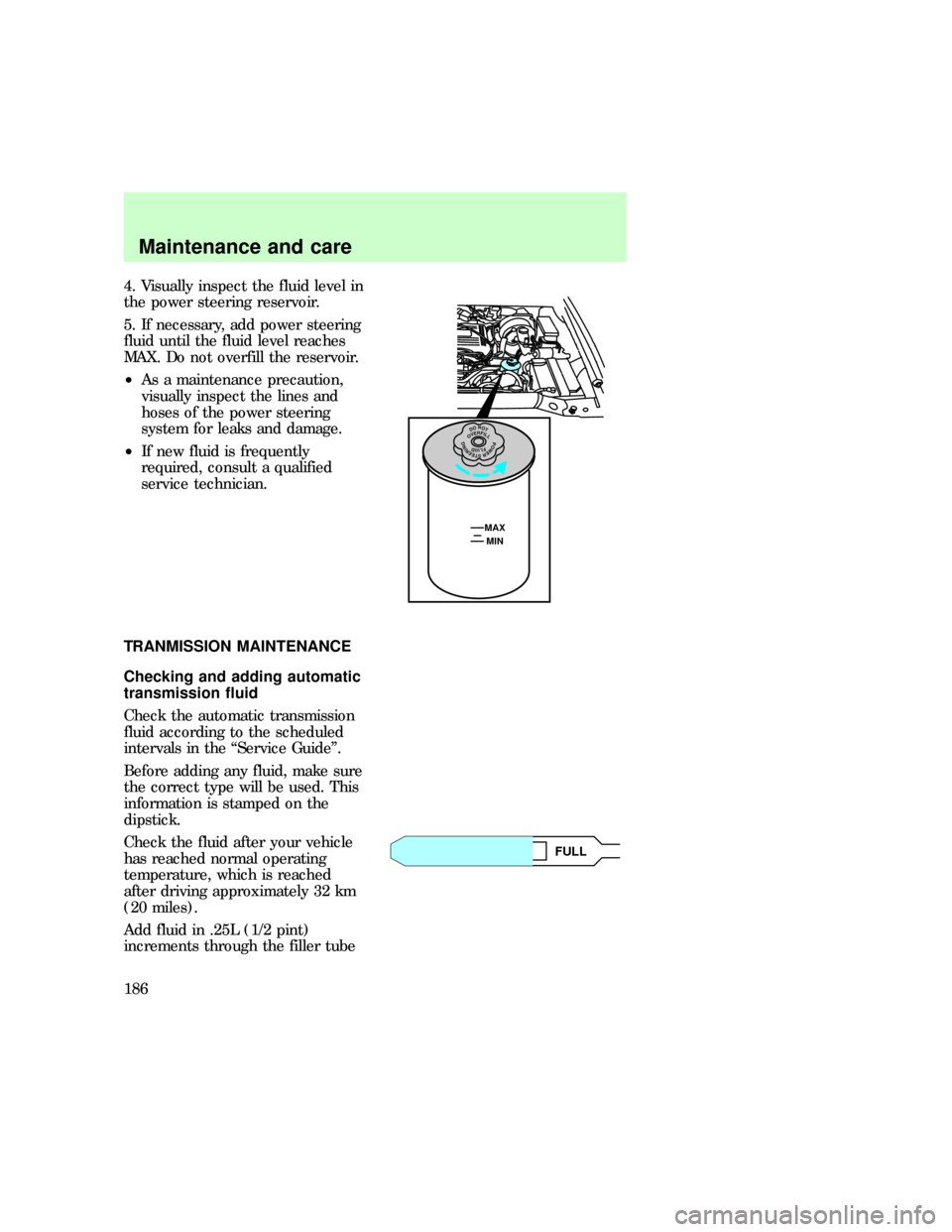
4. Visually inspect the fluid level in
the power steering reservoir.
5. If necessary, add power steering
fluid until the fluid level reaches
MAX. Do not overfill the reservoir.
²As a maintenance precaution,
visually inspect the lines and
hoses of the power steering
system for leaks and damage.
²If new fluid is frequently
required, consult a qualified
service technician.
TRANMISSION MAINTENANCE
Checking and adding automatic
transmission fluid
Check the automatic transmission
fluid according to the scheduled
intervals in the ªService Guideº.
Before adding any fluid, make sure
the correct type will be used. This
information is stamped on the
dipstick.
Check the fluid after your vehicle
has reached normal operating
temperature, which is reached
after driving approximately 32 km
(20 miles).
Add fluid in .25L (1/2 pint)
increments through the filler tube
MAX
MIN
DONOTOVERFILLPOWERSTEERINGFLUID
ADD FULL
uno_trans_fluid_title
com_checking-adding_fluid.02
Maintenance and care
186
Page 186 of 236

until the level is at the correct
area on the dipstick. If an overfill
occurs, excess fluid should be
removed by a qualified technician.
Checking and adding manual
transmission fluid (if equipped)
1. Clean the filler plug.
2. Remove the filler plug and
inspect the fluid level.
²The fluid level should be at the
bottom of the opening.
3. Add enough fluid through the
filler opening so that the fluid level
is at the bottom of the opening.
Use only fluid that meets Ford
specifications. Refer to the
Capacities and specifications
chapter for more information on
manual transmission fluid.
Driveline universal joint and slip
yoke
The universal joints standard with
your vehicle do not require
lubrication. If the original
equipment universal joints are
replaced with universal joints
equipped with grease fittings,
lubrication will be necessary at the
intervals shown in theService
Guidesupplement.
Constant velocity or double
carden joint (if equipped)
This component may be fitted with
a flush-type grease fitting that
requires an adaptor to permit
proper lubrication. If replaced,
uno_manual_trans_fluid
uno_driveline1
uno_constant_velocity
Maintenance and care
187