maintenance FORD EXPLORER 1997 2.G Workshop Manual
[x] Cancel search | Manufacturer: FORD, Model Year: 1997, Model line: EXPLORER, Model: FORD EXPLORER 1997 2.GPages: 236, PDF Size: 2.43 MB
Page 204 of 236

Fuel quality
If you are experiencing starting,
rough idle or hesitation problems
try a different brand of fuel. If the
condition persists, see your dealer
or a qualified service technician.
The American Automobile
Manufacturers Association (AAMA)
issued a gasoline specification to
provide information on high quality
fuels that optimize the
performance of your vehicle. We
recommend the use of gasolines
that meet the AAMA specification
if they are available.
It should not be necessary to add
any aftermarket products to your
fuel tank if you continue to use a
high-quality fuel.
Choosing the right fuel
Use only UNLEADED FUEL. The
use of leaded fuel is prohibited by
law and could damage your
vehicle. The damage may not be
covered by your warranty.
Your vehicle was not designed to
use fuel containing
manganese-based additives such as
MMT. Additionally, vehicles
certified to California emission
standards (indicated on the
underhood Vehicle Emissions
Control Information label) are
designed to operate on California
reformulated gasolines. If
California reformulated gasoline is
not available when you refuel, your
vehicle can be operated on
non-California fuels. However, even
com_choosing_fuel.01
Maintenance and care
205
Page 205 of 236
though your engine will perform
adequately on other gasolines, the
performance of the emission
control devices and systems may
be adversely affected. Repair of
damage caused by using a fuel that
your vehicle was not designed for
may not be covered by your
warranty.
Calculating fuel economy
To accurately calculate your
vehicle's fuel economy:
1. Fill the tank completely and
record the initial odometer
reading.
2. Each time you fill the tank,
record the amount of fuel added
(in liters or gallons).
3. After at least three to five fuel
tank fill-ups, fill the fuel tank and
record the current mileage
reading.
4. Use one of the following
equations to calculate fuel
economy.
Liters used x 1004Total
kilometers traveled
Total miles traveled4Total
gallons used
Keep a record for at least one
month. This will provide an
accurate estimate of the vehicle's
fuel economy.
EMISSION CONTROL SYSTEM
Your vehicle is equipped with
various emission control
com_calculating_economy.01
com_emission.ses
Maintenance and care
206
Page 206 of 236

components and a catalytic
converter which will enable your
vehicle to comply with applicable
exhaust emission standards. To
make sure that the catalytic
converter and other emission
control components continue to
work properly:
²Use only unleaded fuel.
²Avoid running out of fuel.
²Do not turn off the ignition
while your vehicle is moving,
especially at high speeds.
²Have the services listed in your
ªService Guideº performed
according to the specified
schedule.
The Scheduled Maintenance
Services listed in the ªService
Guideº are required because they
are considered essential to the life
and performance of your vehicle
and to its emissions system.
If other than Ford, Motorcraft or
Ford authorized parts are used for
maintenance replacements or for
service of components affecting
emission control such non-Ford
parts should be equivalent to
genuine Ford Motor Company
parts in performance and
durability.
Do not park, idle, or drive
your vehicle in dry grass
or other dry ground cover. The
emission system heats up the
engine compartment and exhaust
system, which can start a fire.
Maintenance and care
207
Page 207 of 236
Watch for fluid leaks, strange
odors, smoke, loss of oil pressure,
the charging system warning light,
the ªService Engine Soonº light or
the temperature warning light.
These events could indicate that
the emission control system is not
working properly.
If you smell exhaust fumes
of any kind inside your
vehicle, have the dealer inspect
and fix your vehicle immediately.
Do not drive if you smell exhaust
fumes. These fumes are harmful
and could kill you.
Do not make any unauthorized
changes to your vehicle or engine.
By law, vehicle owners and anyone
who manufactures, repairs,
services, sells, leases, trades
vehicles, or supervises a fleet of
vehicles are not permitted to
intentionally remove an emission
control device or prevent it from
working. Information about your
vehicle's emission system is on the
Vehicle Emission Control
Information Decal located on or
near the engine. This decal
identifies engine displacement and
gives some tune up specifications.
Please consult your ªWarranty
Guideº for complete emission
warranty information.
Readiness for
inspection/maintenance testing
In some localities, it may be a legal
requirement to pass an I/M test of
com_ready-test
Maintenance and care
208
Page 208 of 236
the on-board diagnostic (OBD-II)
system. If your ªcheck
engine/service engine soonº light is
on, reference the applicable light
description in theWarning Lights
and Gaugessection of your
owners guide. Your vehicle may
not pass the I/M test with the
ªcheck engine/service engine soonº
light on.
If the vehicle's powertrain system
or its battery has just been
serviced, the OBD-II system is
reset to a ªnot ready for I/M testº
condition. To ready the OBD-II
system for I/M testing, a minimum
of 30 minutes of city and highway
driving is necessary as described
below:
²First, at least ten minutes of
driving on an expressway or
highway.
²Next, at least twenty minutes
driving in stop and go, city type
traffic with at least four idle
periods.
Allow the vehicle to sit for at least
8 hours without starting the
engine. Then, start the engine and
complete the above driving cycle.
The engine must warm up to it's
normal operating temperature.
Once started, do not turn off the
engine until the above driving
cycle is complete.
Maintenance and care
209
Page 209 of 236
REPLACING VEHICLE BULBS
Replacing the exterior bulbs
Check the operation of the
following exterior lamps
frequently:
²headlamps
²foglamps (if equipped)
²high-mount brakelamp
²license plate lamp
²tail lamps
²back-up lamps
Do not remove lamp bulbs unless
they will be replaced immediately
with new ones. If a bulb is
removed for an extended period of
time, contaminants may enter the
lamp-housings and affect lamp
performance.
Handle a halogen
headlamp bulb carefully
and keep out of children's reach.
Grasp the bulb only by its plastic
base and do not touch the glass.
The oil from your hand could
cause the bulb to break the next
time the headlamps are
operated.
uno_exterior_bulbs
uno_headlamps
Maintenance and care
210
Page 210 of 236
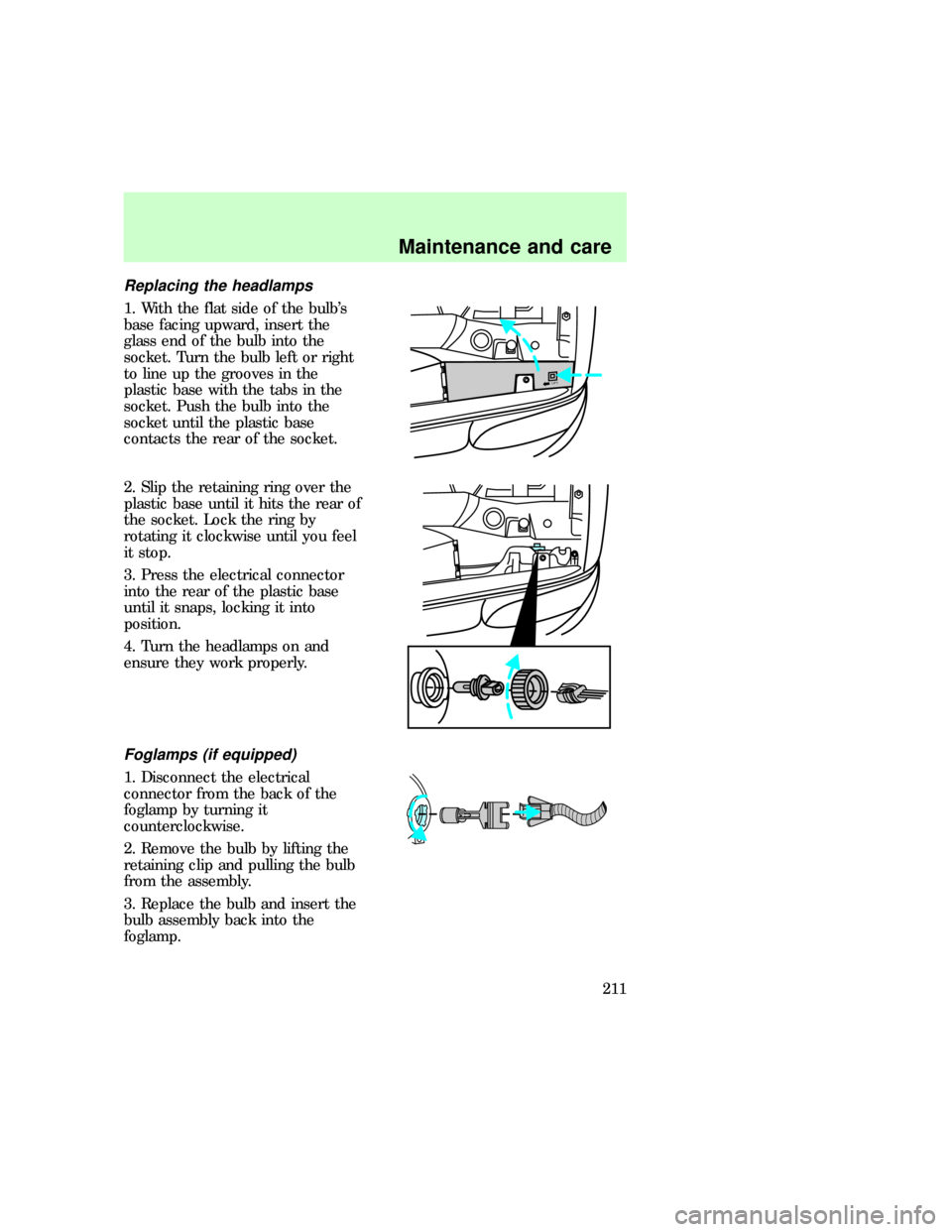
Replacing the headlamps
1. With the flat side of the bulb's
base facing upward, insert the
glass end of the bulb into the
socket. Turn the bulb left or right
to line up the grooves in the
plastic base with the tabs in the
socket. Push the bulb into the
socket until the plastic base
contacts the rear of the socket.
2. Slip the retaining ring over the
plastic base until it hits the rear of
the socket. Lock the ring by
rotating it clockwise until you feel
it stop.
3. Press the electrical connector
into the rear of the plastic base
until it snaps, locking it into
position.
4. Turn the headlamps on and
ensure they work properly.
Foglamps (if equipped)
1. Disconnect the electrical
connector from the back of the
foglamp by turning it
counterclockwise.
2. Remove the bulb by lifting the
retaining clip and pulling the bulb
from the assembly.
3. Replace the bulb and insert the
bulb assembly back into the
foglamp.
LIFT
uno_foglamps
Maintenance and care
211
Page 211 of 236
4. Lock the bulb assembly into
place by turning it clockwise until
it stops.
Highmount brakelamp
The highmount brakelamp is
located just above the rear liftgate
window. For bulb replacement, see
a dealer or qualified service
technician.
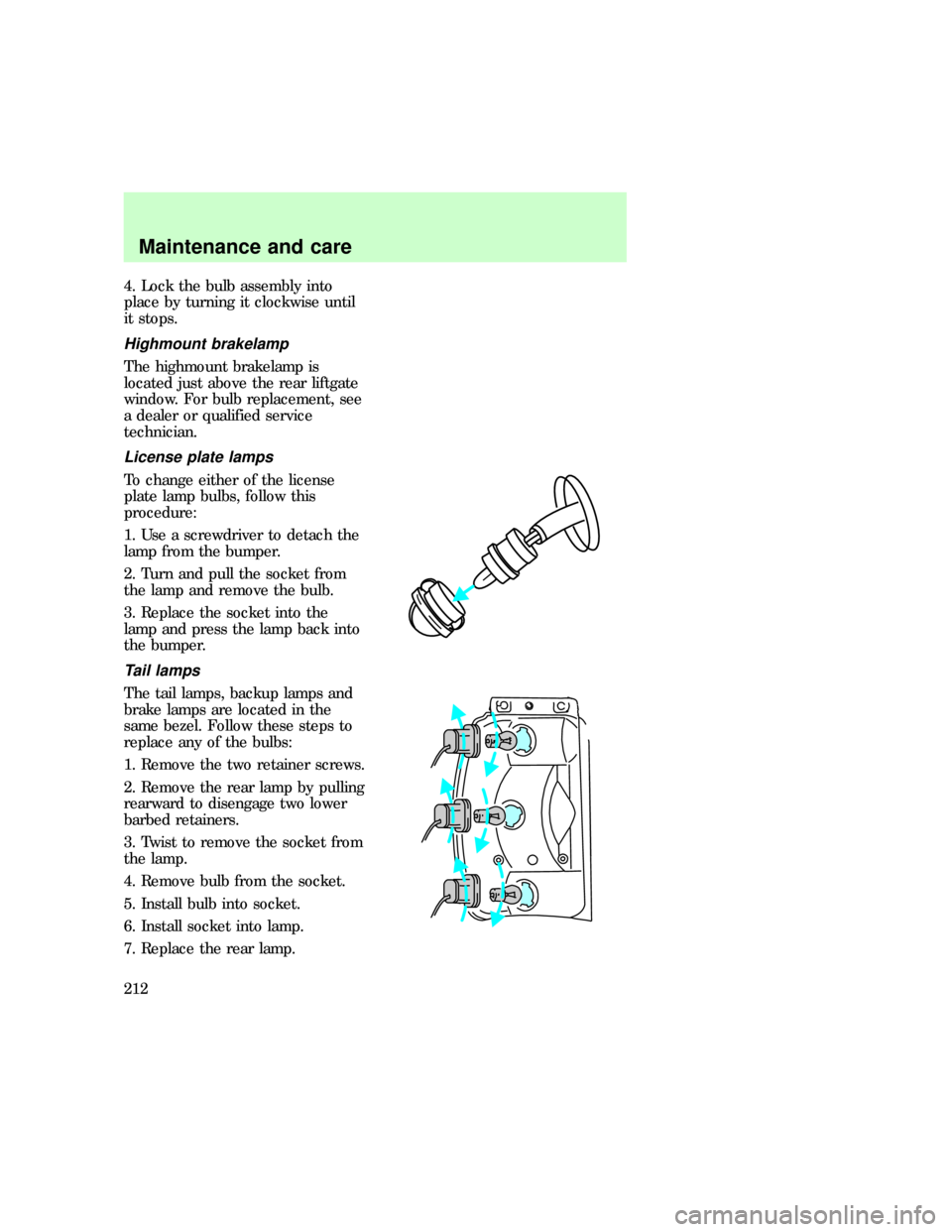
License plate lamps
To change either of the license
plate lamp bulbs, follow this
procedure:
1. Use a screwdriver to detach the
lamp from the bumper.
2. Turn and pull the socket from
the lamp and remove the bulb.
3. Replace the socket into the
lamp and press the lamp back into
the bumper.
Tail lamps
The tail lamps, backup lamps and
brake lamps are located in the
same bezel. Follow these steps to
replace any of the bulbs:
1. Remove the two retainer screws.
2. Remove the rear lamp by pulling
rearward to disengage two lower
barbed retainers.
3. Twist to remove the socket from
the lamp.
4. Remove bulb from the socket.
5. Install bulb into socket.
6. Install socket into lamp.
7. Replace the rear lamp.
uno_highmount
uno_license_plate
uno_tail_lamps
uno_interior_bulbs
Maintenance and care
212
Page 212 of 236
Replacing the interior bulbs
Check the operation of the
following interior bulbs frequently:
²interior overhead lamp
²map lamp
²courtesy and cargo lamps
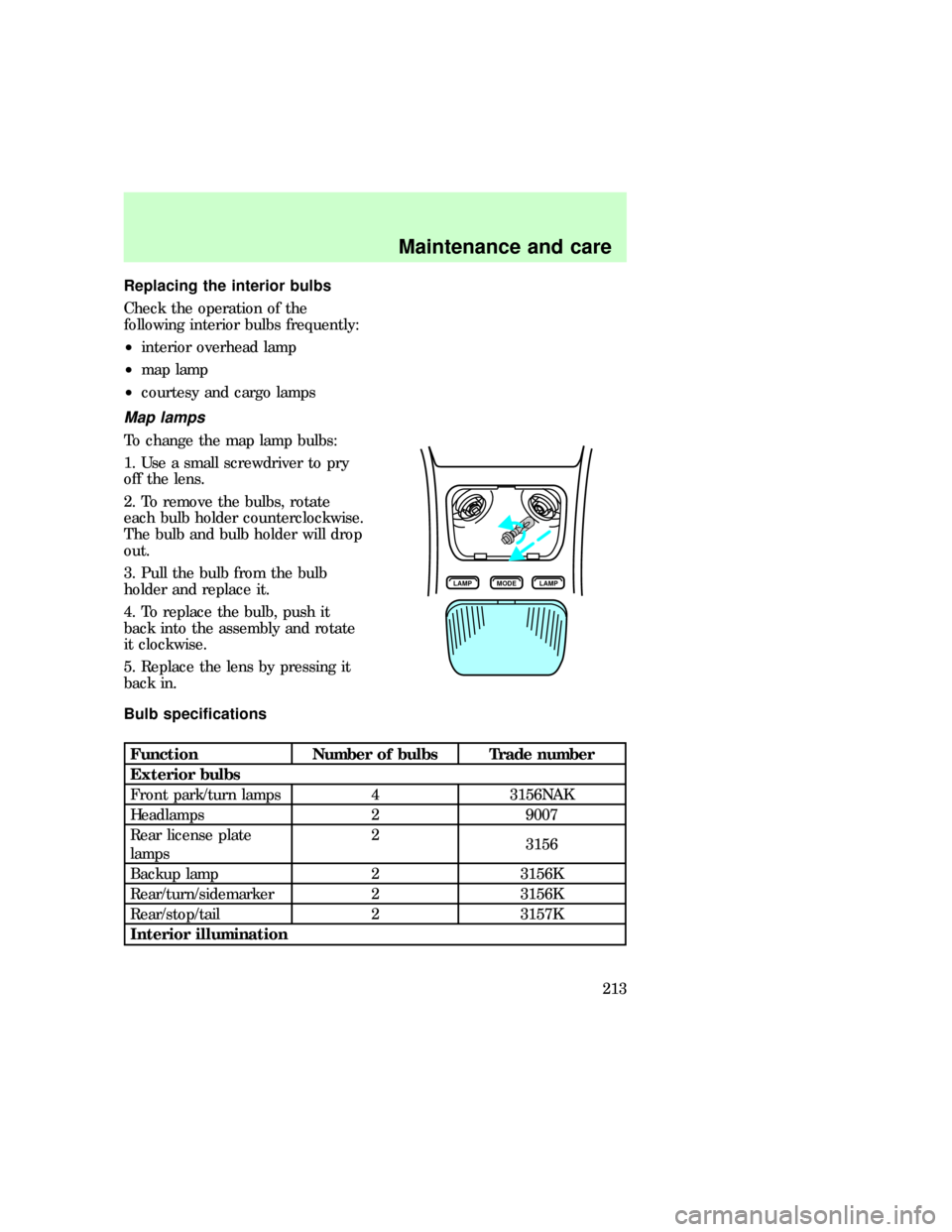
Map lamps
To change the map lamp bulbs:
1. Use a small screwdriver to pry
off the lens.
2. To remove the bulbs, rotate
each bulb holder counterclockwise.
The bulb and bulb holder will drop
out.
3. Pull the bulb from the bulb
holder and replace it.
4. To replace the bulb, push it
back into the assembly and rotate
it clockwise.
5. Replace the lens by pressing it
back in.
Bulb specifications
Function Number of bulbs Trade number
Exterior bulbs
Front park/turn lamps 4 3156NAK
Headlamps 2 9007
Rear license plate
lamps2
3156
Backup lamp 2 3156K
Rear/turn/sidemarker 2 3156K
Rear/stop/tail 2 3157K
Interior illumination
LAMP LAMPMODE
uno_maplamps
uno_bulb_spec_chart
Maintenance and care
213
Page 213 of 236
Function Number of bulbs Trade number
Cargo lamp 1 211-2
Interior overhead lamp 1 912 (906)
Front door courtesy
lamp1
168
Map lamps 2 168 (T10)
Ashtray lamp 1 161
Glove compartment
lamp1
194
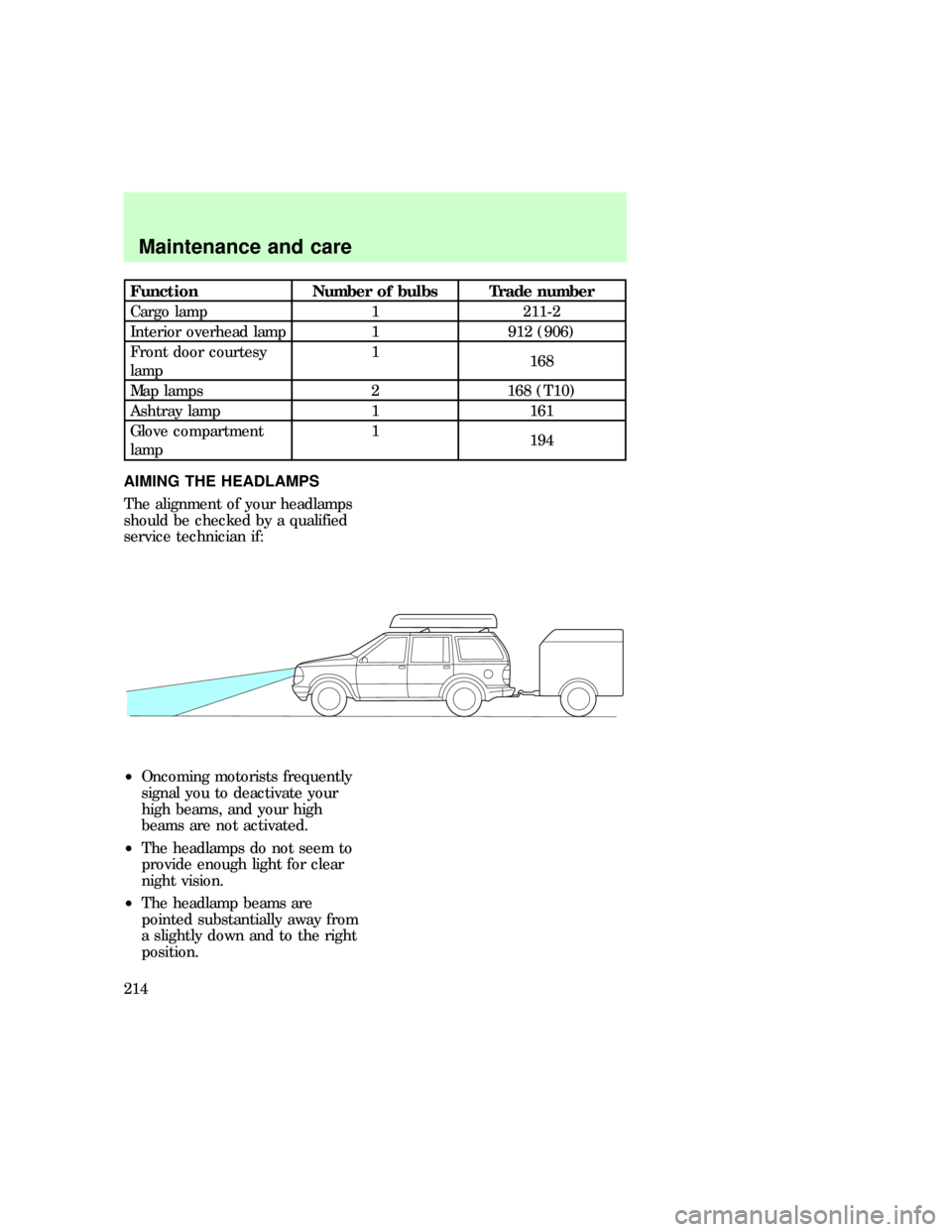
AIMING THE HEADLAMPS
The alignment of your headlamps
should be checked by a qualified
service technician if:
²Oncoming motorists frequently
signal you to deactivate your
high beams, and your high
beams are not activated.
²The headlamps do not seem to
provide enough light for clear
night vision.
²The headlamp beams are
pointed substantially away from
a slightly down and to the right
position.
uno_aiming_headlamps
com_cleaning_caring.01
Maintenance and care
214