air condition FORD EXPLORER 1998 2.G User Guide
[x] Cancel search | Manufacturer: FORD, Model Year: 1998, Model line: EXPLORER, Model: FORD EXPLORER 1998 2.GPages: 210, PDF Size: 1.65 MB
Page 133 of 210

²Allow more distance for stopping with a trailer attached.
²The trailer tongue weight should be 10±15% of the loaded trailer
weight.
²After you have traveled 80 km (50 miles), thoroughly check your
hitch, electrical connections and trailer wheel lug nuts.
²When stopped in traffic for long periods of time in hot weather, place
the gearshift in P (Park) (automatic transmissions) or 1 (First)
(manual transmissions) and increase idle speed. This aids engine
cooling and air conditioner efficiency.
²Vehicles with trailers should not be parked on a grade. If you must
park on a grade, place wheel chocks under the trailer's wheels.
Launching or retrieving a boat
When backing down a ramp during boat launching or retrieval,
²Do not allow the static water level to rise above the bottom edge of
the rear bumper and
²Do not allow waves to break higher than 15 cm (six inches) above the
bottom edge of the rear bumper.
Exceeding these limits may allow water to enter critical vehicle
components, adversely affecting driveability, emissions and reliability.
If the rear axle is submerged in water, the rear axle lubricant should be
checked and changed, if necessary. The rear axle is filled with a
synthetic lubricant and does not normally require a lubricant change for
the life of the vehicle. Rear axle lubricant quantities should not need to
be checked unless a leak is suspected.
Recreational towing (all wheels on the ground)
(Neutral tow kit accessory)
On vehicles equipped with a 4.0L engine, an accessory is available that
allows you to tow your vehicle, behind another vehicle, with all the
wheels on the ground. Contact your dealer for more details. Do not tow
your vehicle with all wheels on the ground unless you install the neutral
tow kit as vehicle damage may occur.
LUGGAGE RACK
Maximum load is 45 kg (100 lbs), evenly distributed. If it is not possible
to distribute the load, position it as far rearward as possible. Adjustable
tie down loops must be used to secure the load.
Driving
133
Page 156 of 210

SERVICE RECOMMENDATIONS
To help you service your vehicle:
²We highlight do-it-yourself items in the engine compartment for easy
location.
²We provide a ``Service Guide'' which makes tracking routine service
easy.
If your vehicle requires professional service, your dealership can provide
necessary parts and service. Check your ``Warranty Guide'' to find out
which parts and services are covered.
Use only recommended fuels, lubricants, fluids and service parts
conforming to specifications. Motorcraft parts are designed and built to
provide the best performance in your vehicle.
PRECAUTIONS WHEN SERVICING YOUR VEHICLE
Be especially careful when inspecting or servicing your vehicle.
²Do not work on a hot engine.
²When the engine is running, make sure that loose clothing, jewelry or
long hair does not get caught up in moving parts.
²Do not work on a vehicle with the engine running in an enclosed
space, unless you are sure you have enough ventilation.
²Keep all lit cigarettes, open flames and other lit material away from
the battery and all fuel related parts.
If you disconnect the battery, the engine must ``relearn'' its idle
conditions before your vehicle will drive properly, as explained inBattery
in this chapter.
Working with the engine off
²Automatic transmission:
1. Set the parking brake and
ensure the gearshift is securely latched in P (Park).
2. Turn off the engine and remove the key.
3. Block the wheels to prevent the vehicle from moving unexpectedly.
²Manual transmission:
1. Set the parking brake.
2. Depress the clutch and place the gearshift in 1 (First).
Maintenance and care
156
Page 183 of 210
²If fuel is splashed in the eyes, remove contact lenses, flush with water
for 15 minutes and seek medical attention.
²Be particularly careful if you are taking ``Antabuse'' or other forms of
disulfiram for the treatment of alcoholism. Breathing gasoline vapors
or skin contact could cause an adverse reaction. Consult a physician
immediately.
Choosing the right fuel
Use only UNLEADED FUEL. The use of leaded fuel is prohibited by law
and could damage your vehicle.
Your vehicle was not designed to use fuel or fuel additives with metallic
compounds, including manganese-based compounds containing MMT.
Vehicles certified to California emission standards (indicated on the
underhood Vehicle Emissions Control Information label) are designed to
operate on California reformulated gasolines. If California reformulated
gasoline is not available when you refuel, your vehicle can be operated
on non-California fuels. However, even though your engine will perform
adequately on other gasolines, the performance of the emission control
devices and systems may be adversely affected.
Repair of damage caused by using a fuel that your vehicle was not
designed for may not be covered by your warranty.
Octane recommendations
Your vehicle is designed to use
``Regular'' unleaded with an (R+M)/2
octane rating of 87. We do not
recommend gasolines labeled as
``Regular'' in high altitude areas that
are sold with octane ratings of 86 or
even less.
Do not be concerned if your vehicle sometimes knocks lightly. However,
if it knocks heavily under most driving conditions on fuel with the
87
Maintenance and care
183
Page 189 of 210

AIMING THE HEADLAMPS
Your vehicle is equipped with a
Vehicle Headlamp Aim Device
(VHAD) on each headlamp. Each
headlamp may be properly aimed in
the vertical (up/down) and the
horizontal (left/right) directions
using your VHAD system. The
headlamps on your vehicle are
properly aimed at the assembly
plant, and vertical and horizontal
indicators of the VHAD system are
calibrated.
A bubble (vertical indicator) that is
not centered between the two red
lines does not necessarily indicate
out-of-aim headlamps. If your
vehicle is not positioned on a level surface, the slope will be included in
the vertical indication. Therefore, vertical and horizontal headlamp
adjustment should be performed only when the beam direction appears
to be incorrect.
You will need one 4 mm wrench or socket with ratchet to make the
adjustments.
The following procedure assumes that the factory set horizontal indicator
reference has not changed and the vehicle's front structure is in its
factory alignment condition. If the vehicle has been in an accident
requiring the front end of the vehicle to be repaired, the horizontal
indicator should be recalibrated by the servicing facility according to
instructions in the vehicle's Workshop Manual.
U
D
Maintenance and care
189
Page 192 of 210
Waxing your vehicle
Wax when water stops beading on the surface. This could be every three
or four months, depending on operating conditions.
Use only carnauba or synthetic-based waxes. Remove any bugs and tar
before waxing vehicle. Use cleaning fluid or alcohol with a clean cloth to
remove. Use tar remover to remove any tar spots.
Repairing paint chips
Minor scratches or paint damage from road debris may be repaired with
touch-up paint, repair foil or aerosol paint spray from the Ford accessory
line. Observe the application instructions on the products.
Remove particles such as bird droppings, tree sap, insect remains, tar
spots, road salt and industrial fallout immediately.
Cleaning the engine
Engines are more efficient when they are clean because grease and dirt
buildup keep the engine warmer than normal. When washing:
²Take care when using a power washer to clean the engine. The high
pressure fluid could penetrate the sealed parts and cause damage.
²Do not spray with cold water to avoid cracking the engine block or
other engine components.
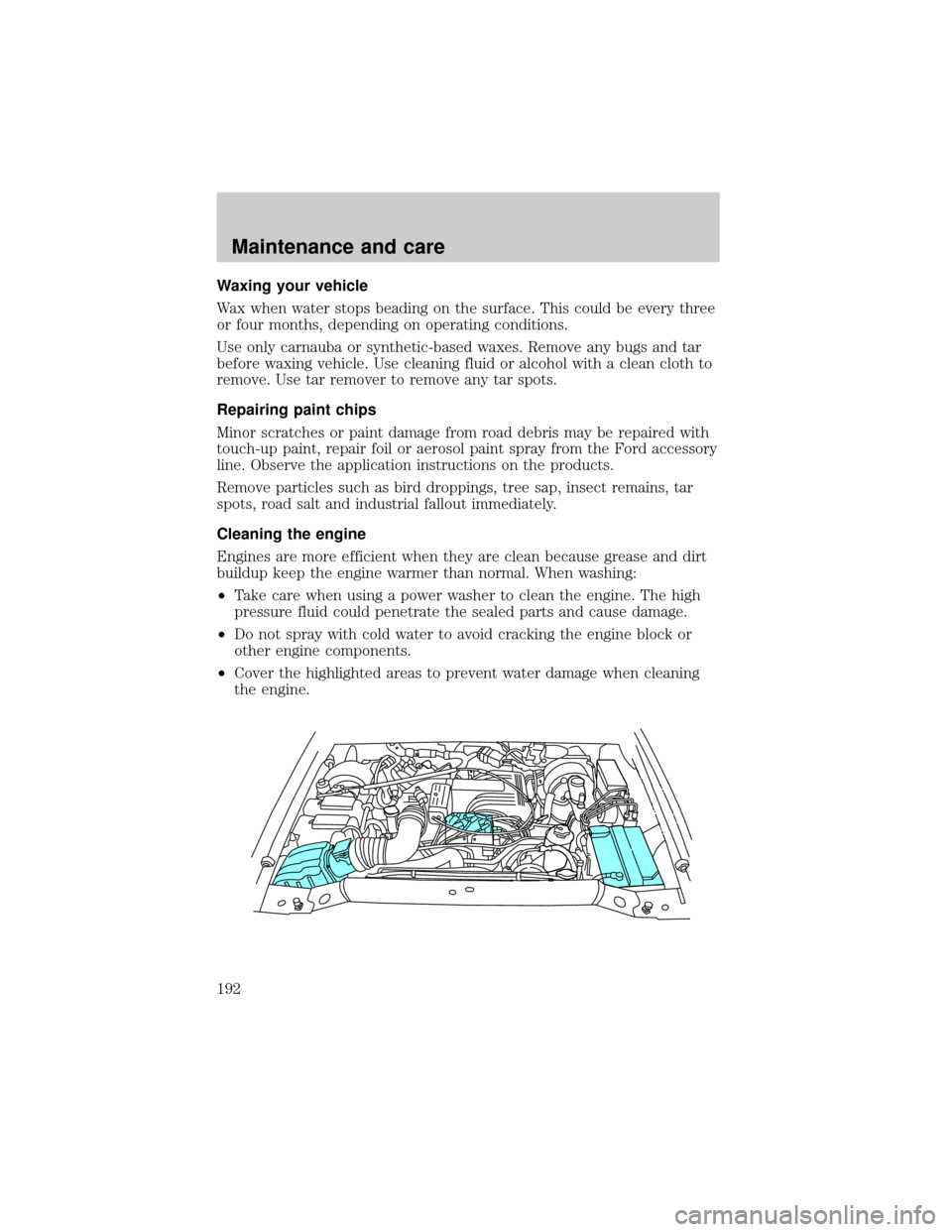
²Cover the highlighted areas to prevent water damage when cleaning
the engine.
Maintenance and care
192
Page 206 of 210

Air bag supplemental
restraint system ........................82
and child safety seats ..............83
description ................................82
disposal ......................................86
indicator light ...........................85
passenger air bag .....................84
Air conditioning
manual heating and air
conditioning system ............23,25
Air suspension
description ..............................106
All wheel drive (AWD) .............121
Ambulance packages ....................3
Anti-lock brake system (ABS)
description ..............................104
Anti-theft system ........................67
Autolamp system (see
Headlamps) .................................48
Automatic dimming mirror ...48,49
Battery .......................................175
voltage gauge ............................14
Brake fluid
checking and adding ..............164
Brakes ........................................104
anti-lock ...................................104
anti-lock brake system (ABS)
warning light ...........................104
fluid, checking and adding ....164
Brake-shift interlock .................107
Break-in period .............................2
Bulbs, replacing ........................186
headlamps ...............................187
specifications ..........................188
Cargo cover .................................57
Changing a tire .........................144
Child safety seats ........................87
built-in child seat ......91,92,96,97
Childproof locks ..........................52
Chime
headlamps on ............................11
Cleaning your vehicle ...............191built-in child seat ...................195
engine compartment ..............192
fabric ........................................194
instrument panel ....................194
plastic parts ............................194
safety belts ..............................194
tail lamps .................................194
washing ....................................191
waxing .....................................192
wheels ......................................194
windows ..................................196
woodtone trim ........................196
Climate control system
automatic temperature
control .........26,27,28,29,30,31,32
Clutch
fluid ..........................................165
Compass, electronic ...............45,46
calibration .................................48
set zone adjustment .................47
Console, description ...................54
Control trac 4WD system .........116
Controls ..................................53,54
Cupholder (s) .............................55
Defrost
rear window ..............................34
Driving under special
conditions .........................120,122
high water ........................120,123
slippery roads ....120,121,123,124
Emission control system ..........185
Engine ........................................202
service points ............158,159,160
Engine block heater .................102
Engine coolant
checking and adding .......166,167
disposal ....................................168
refill capacities ........................168
Engine oil ...........................160,163
changing oil and oil filter .......163
checking and adding .......160,162
Exhaust fumes ..........................103
Index
206