change time FORD EXPLORER 1998 2.G User Guide
[x] Cancel search | Manufacturer: FORD, Model Year: 1998, Model line: EXPLORER, Model: FORD EXPLORER 1998 2.GPages: 210, PDF Size: 1.65 MB
Page 163 of 210
Engine oil recommendations
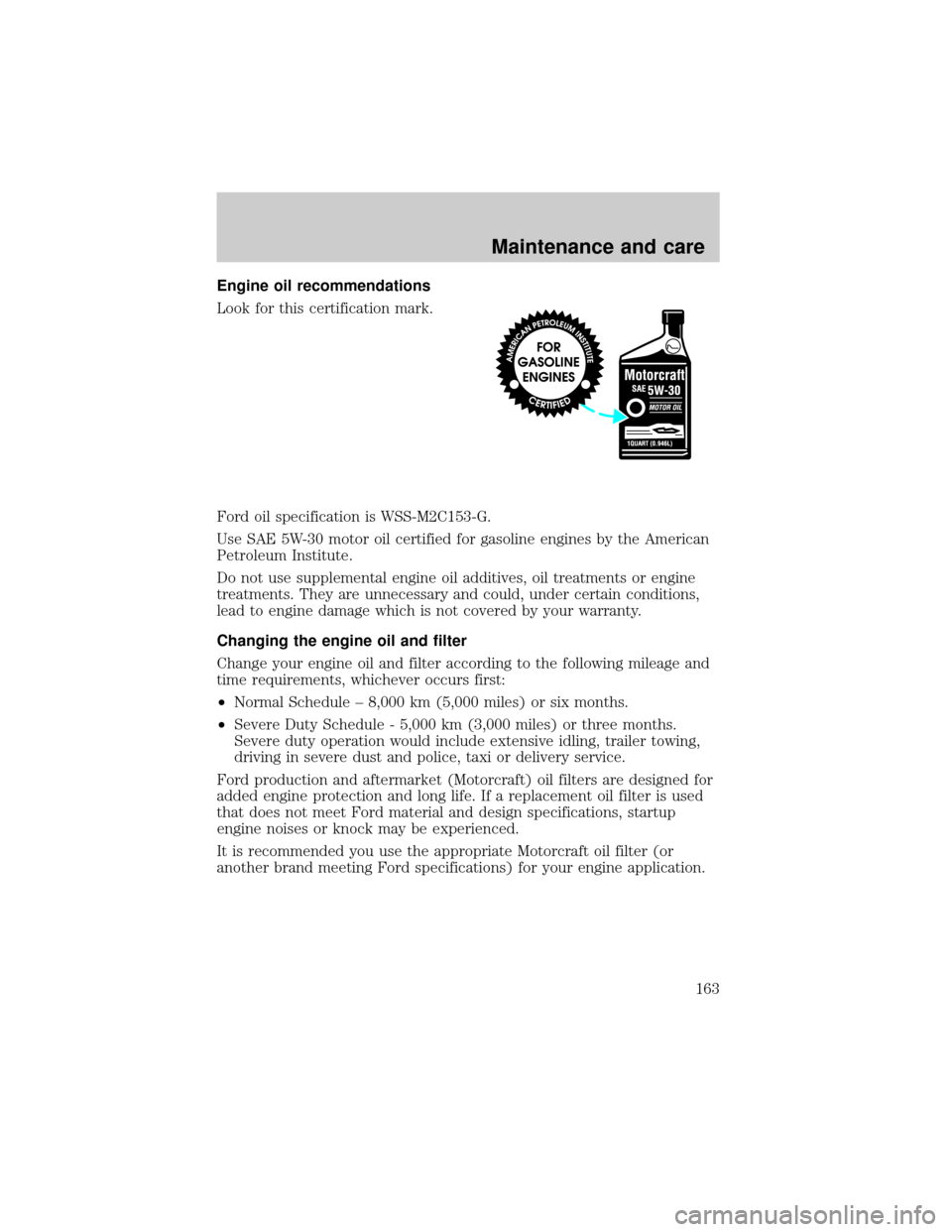
Look for this certification mark.
Ford oil specification is WSS-M2C153-G.
Use SAE 5W-30 motor oil certified for gasoline engines by the American
Petroleum Institute.
Do not use supplemental engine oil additives, oil treatments or engine
treatments. They are unnecessary and could, under certain conditions,
lead to engine damage which is not covered by your warranty.
Changing the engine oil and filter
Change your engine oil and filter according to the following mileage and
time requirements, whichever occurs first:
²Normal Schedule ± 8,000 km (5,000 miles) or six months.
²Severe Duty Schedule - 5,000 km (3,000 miles) or three months.
Severe duty operation would include extensive idling, trailer towing,
driving in severe dust and police, taxi or delivery service.
Ford production and aftermarket (Motorcraft) oil filters are designed for
added engine protection and long life. If a replacement oil filter is used
that does not meet Ford material and design specifications, startup
engine noises or knock may be experienced.
It is recommended you use the appropriate Motorcraft oil filter (or
another brand meeting Ford specifications) for your engine application.
Maintenance and care
163
Page 167 of 210
If the engine coolant has not been checked for a long period of time, the
engine coolant reservoir may eventually empty. If this occurs, add engine
coolant to the coolant reservoir. For more information on engine coolant
maintenance, refer toAdding engine coolantin this chapter.
Automotive fluids are not interchangeable; do not use engine coolant,
antifreeze or windshield washer fluid outside of its specified function and
vehicle location.
Adding engine coolant
Do not put engine coolant in the container for the windshield
washer fluid.
If sprayed on the windshield, engine coolant could make it difficult to see
through the windshield.
When the engine is cool, add a 50/50 mixture of engine coolant and
water to the engine coolant recovery reservoir-DO NOT ADD DIRECTLY
TO THE RADIATOR. Add straight water only in an emergency, but you
should replace it with a 50/50 mixture of coolant and distilled water as
soon as possible.
Check the coolant level in the coolant recovery reservoir the next few
times you drive the vehicle. If necessary, add enough of a 50/50 mixture
of coolant and water to bring the liquid level to the fill line on the
reservoir.
Never remove the coolant recovery cap while the engine is
running or hot.
If you must remove the coolant recovery cap, follow these steps to avoid
personal injury:
1. Before you remove the cap, turn the engine off and let it cool.
2. When the engine is cool, wrap a thick cloth around the cap. Slowly
turn cap counterclockwise until pressure begins to release.
3. Step back while the pressure releases.
4. When you are sure that all the pressure has been released, use the
cloth to turn it counterclockwise and remove the cap.
Use Ford Premium Cooling System Fluid E2FZ-19549±AA (in Canada,
Motorcraft CXC-8±B) or an equivalent premium engine coolant that
Maintenance and care
167
Page 191 of 210
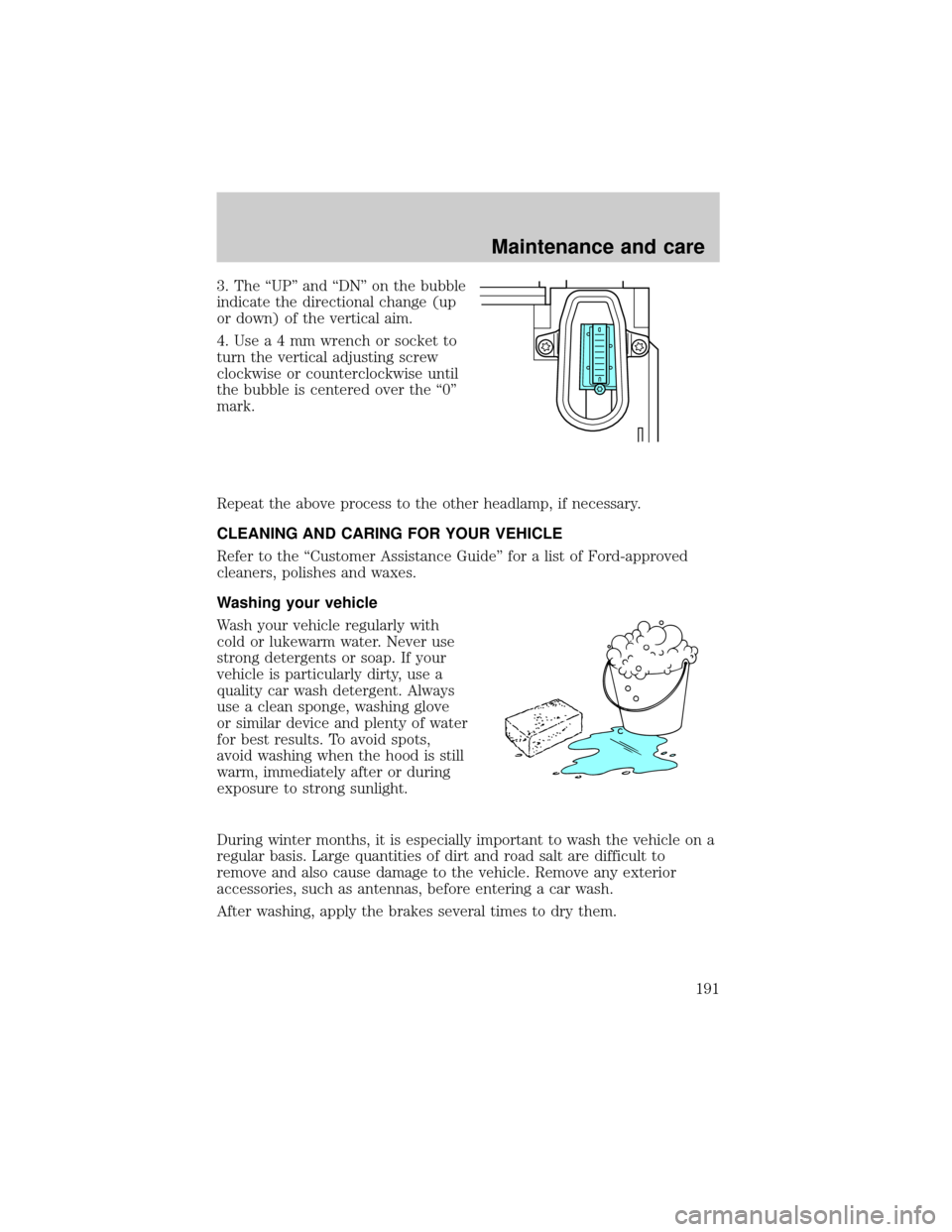
3. The ``UP'' and ``DN'' on the bubble
indicate the directional change (up
or down) of the vertical aim.
4.Usea4mmwrench or socket to
turn the vertical adjusting screw
clockwise or counterclockwise until
the bubble is centered over the ``0''
mark.
Repeat the above process to the other headlamp, if necessary.
CLEANING AND CARING FOR YOUR VEHICLE
Refer to the ``Customer Assistance Guide'' for a list of Ford-approved
cleaners, polishes and waxes.
Washing your vehicle
Wash your vehicle regularly with
cold or lukewarm water. Never use
strong detergents or soap. If your
vehicle is particularly dirty, use a
quality car wash detergent. Always
use a clean sponge, washing glove
or similar device and plenty of water
for best results. To avoid spots,
avoid washing when the hood is still
warm, immediately after or during
exposure to strong sunlight.
During winter months, it is especially important to wash the vehicle on a
regular basis. Large quantities of dirt and road salt are difficult to
remove and also cause damage to the vehicle. Remove any exterior
accessories, such as antennas, before entering a car wash.
After washing, apply the brakes several times to dry them.
U
D
Maintenance and care
191
Page 199 of 210
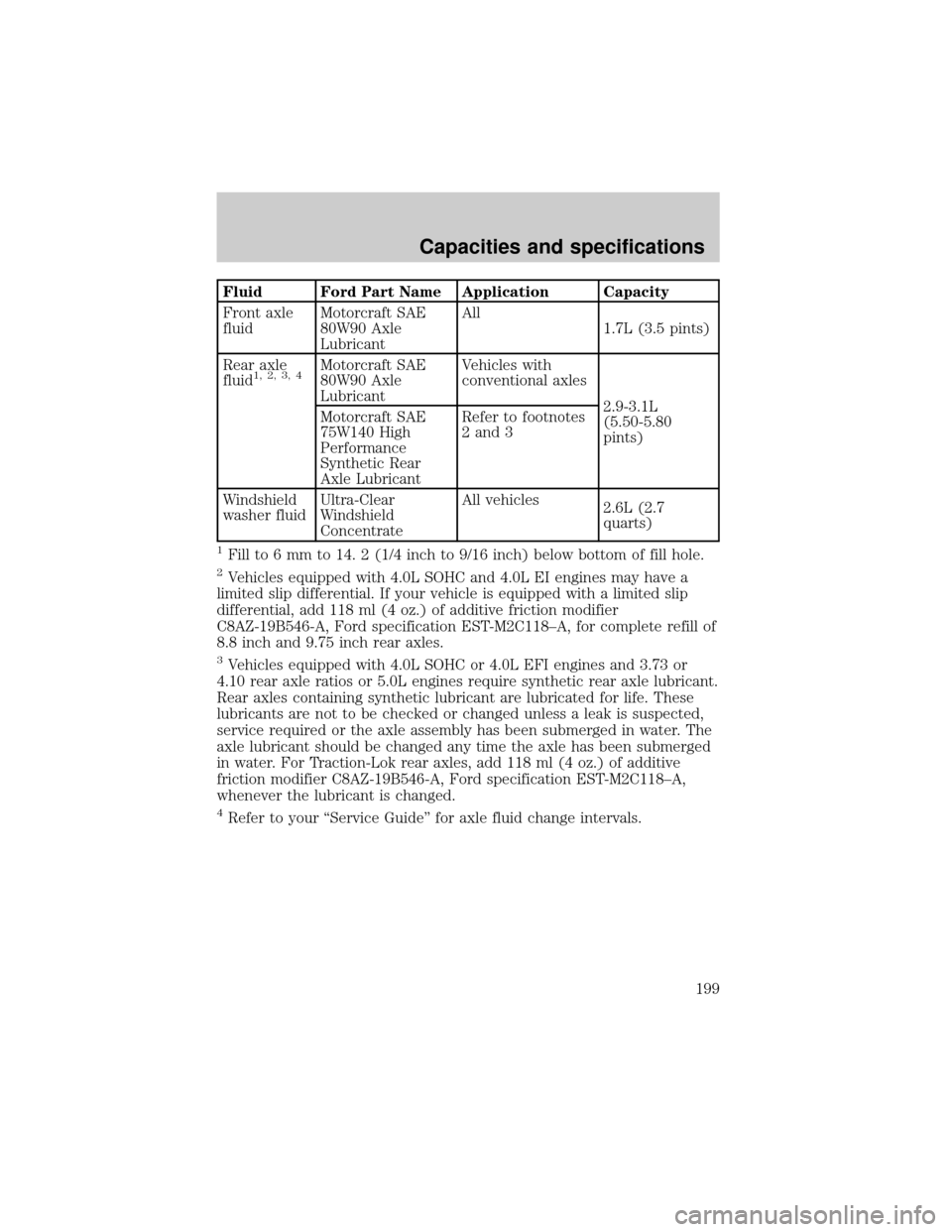
Fluid Ford Part Name Application Capacity
Front axle
fluidMotorcraft SAE
80W90 Axle
LubricantAll
1.7L (3.5 pints)
Rear axle
fluid
1, 2, 3, 4Motorcraft SAE
80W90 Axle
LubricantVehicles with
conventional axles
2.9-3.1L
(5.50-5.80
pints) Motorcraft SAE
75W140 High
Performance
Synthetic Rear
Axle LubricantRefer to footnotes
2 and 3
Windshield
washer fluidUltra-Clear
Windshield
ConcentrateAll vehicles
2.6L (2.7
quarts)
1Fill to 6 mm to 14. 2 (1/4 inch to 9/16 inch) below bottom of fill hole.
2Vehicles equipped with 4.0L SOHC and 4.0L EI engines may have a
limited slip differential. If your vehicle is equipped with a limited slip
differential, add 118 ml (4 oz.) of additive friction modifier
C8AZ-19B546-A, Ford specification EST-M2C118±A, for complete refill of
8.8 inch and 9.75 inch rear axles.
3Vehicles equipped with 4.0L SOHC or 4.0L EFI engines and 3.73 or
4.10 rear axle ratios or 5.0L engines require synthetic rear axle lubricant.
Rear axles containing synthetic lubricant are lubricated for life. These
lubricants are not to be checked or changed unless a leak is suspected,
service required or the axle assembly has been submerged in water. The
axle lubricant should be changed any time the axle has been submerged
in water. For Traction-Lok rear axles, add 118 ml (4 oz.) of additive
friction modifier C8AZ-19B546-A, Ford specification EST-M2C118±A,
whenever the lubricant is changed.
4Refer to your ``Service Guide'' for axle fluid change intervals.
Capacities and specifications
199