oil FORD EXPLORER 1998 2.G User Guide
[x] Cancel search | Manufacturer: FORD, Model Year: 1998, Model line: EXPLORER, Model: FORD EXPLORER 1998 2.GPages: 210, PDF Size: 1.65 MB
Page 161 of 210
3. Set the parking brake and ensure the gearshift is securely latched in P
(Park) (automatic transmissions) or 1 (First) (manual transmissions).
4. Open the hood. Protect yourself from engine heat.
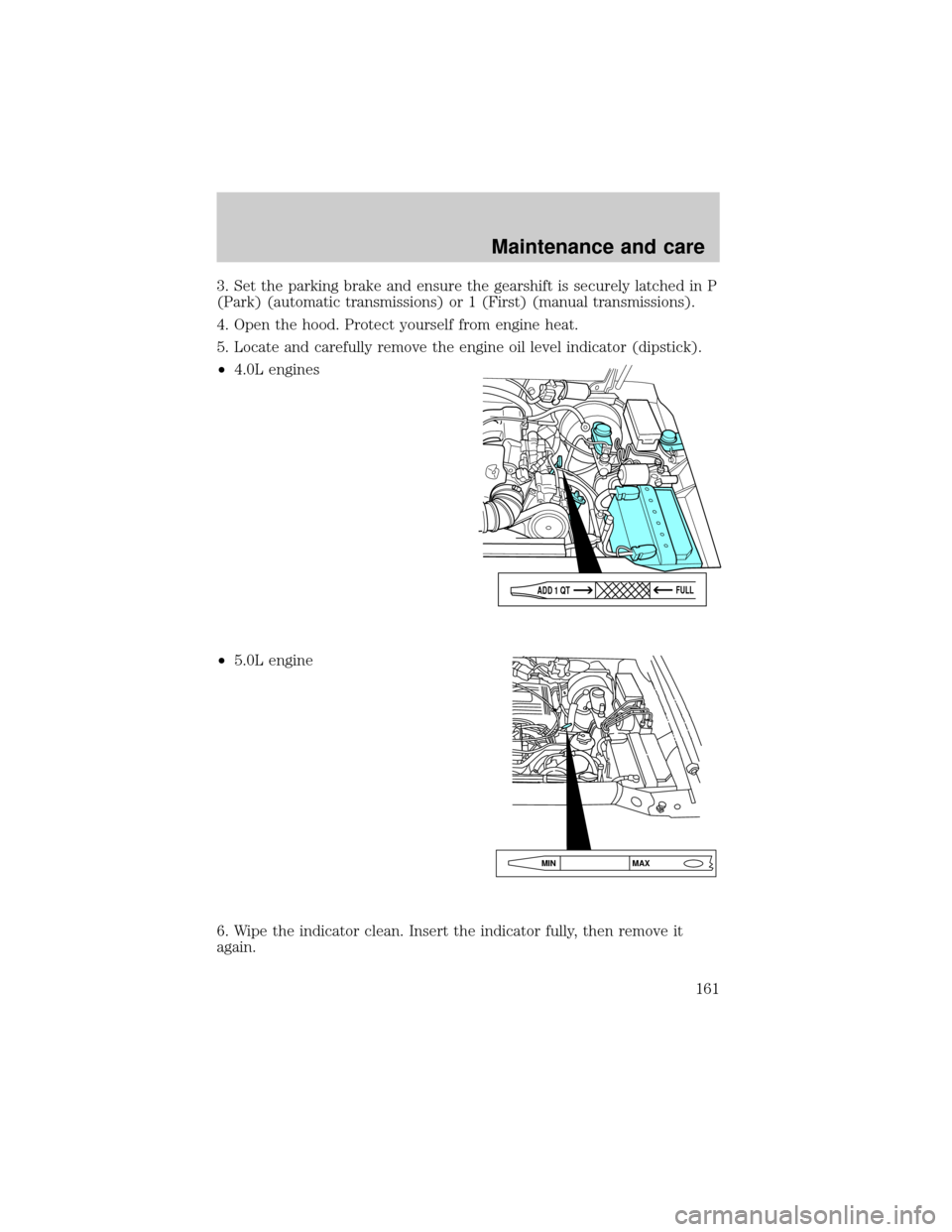
5. Locate and carefully remove the engine oil level indicator (dipstick).
²4.0L engines
²5.0L engine
6. Wipe the indicator clean. Insert the indicator fully, then remove it
again.
ADD 1 QTFULL
MAX MIN
Maintenance and care
161
Page 162 of 210
²If the oil level isbetween the ADD and FULL marks (4.0L
engines)orbetween the MIN and MAX marks (5.0L engines)
the oil level is acceptable.DO NOT ADD OIL.
²If the oil level is below the ADD
mark (4.0L engines) or MIN mark
(5.0L engines), add enough oil to
raise the level within the
ADD-FULL range (4.0L engines)
or MIN-MAX range (5.0L
engines).
²Oil levels above the letter F in FULL (4.0L engines) or the MAX mark
(5.0L engines) may cause engine damage. Some oil must be removed
from the engine by a service technician.
7. Put the indicator back in and ensure it is fully seated.
Adding engine oil
1. Check the engine oil. For instructions, refer toChecking the engine
oilin this chapter.
2. If the fluid level is not within the normal range, add only certified
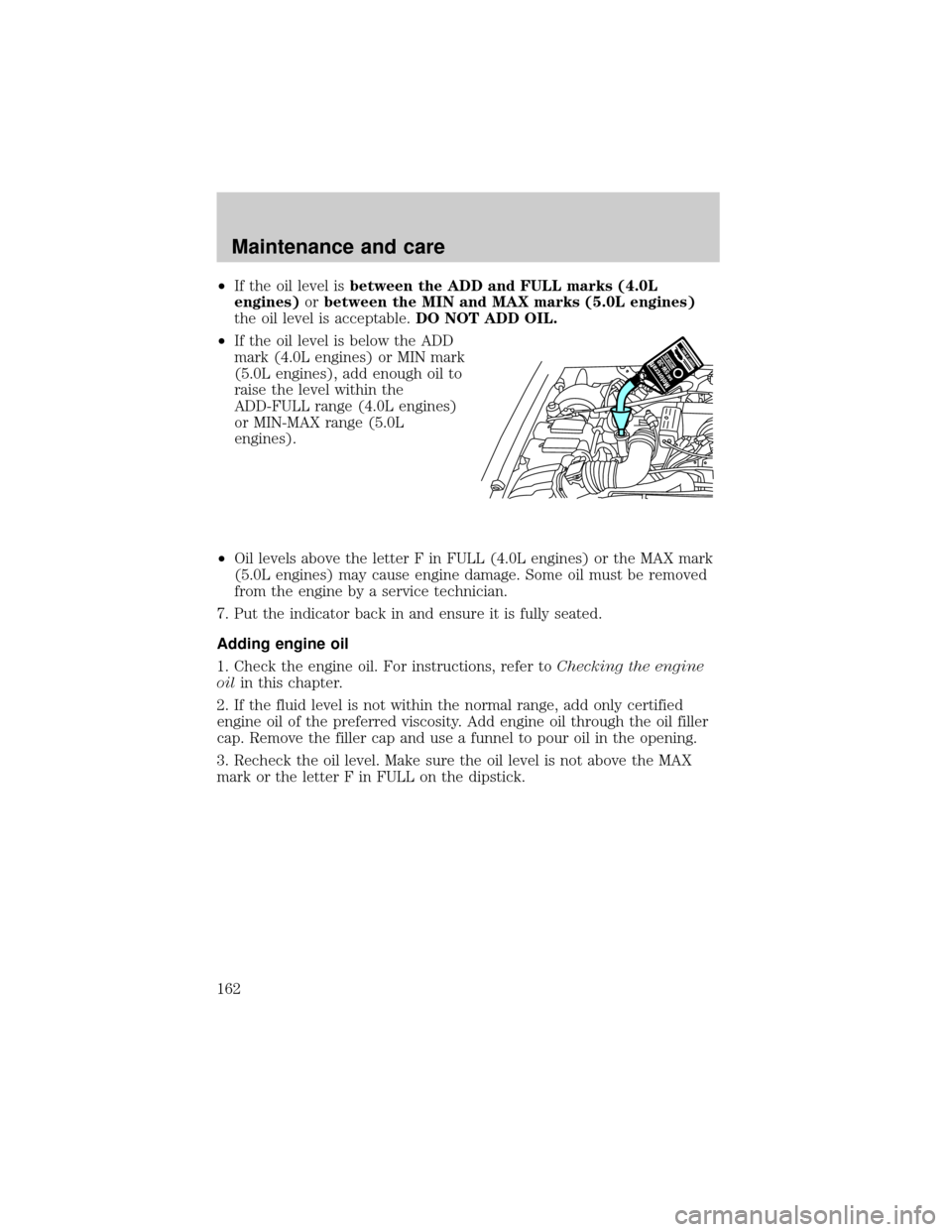
engine oil of the preferred viscosity. Add engine oil through the oil filler
cap. Remove the filler cap and use a funnel to pour oil in the opening.
3. Recheck the oil level. Make sure the oil level is not above the MAX
mark or the letter F in FULL on the dipstick.
Maintenance and care
162
Page 163 of 210
Engine oil recommendations
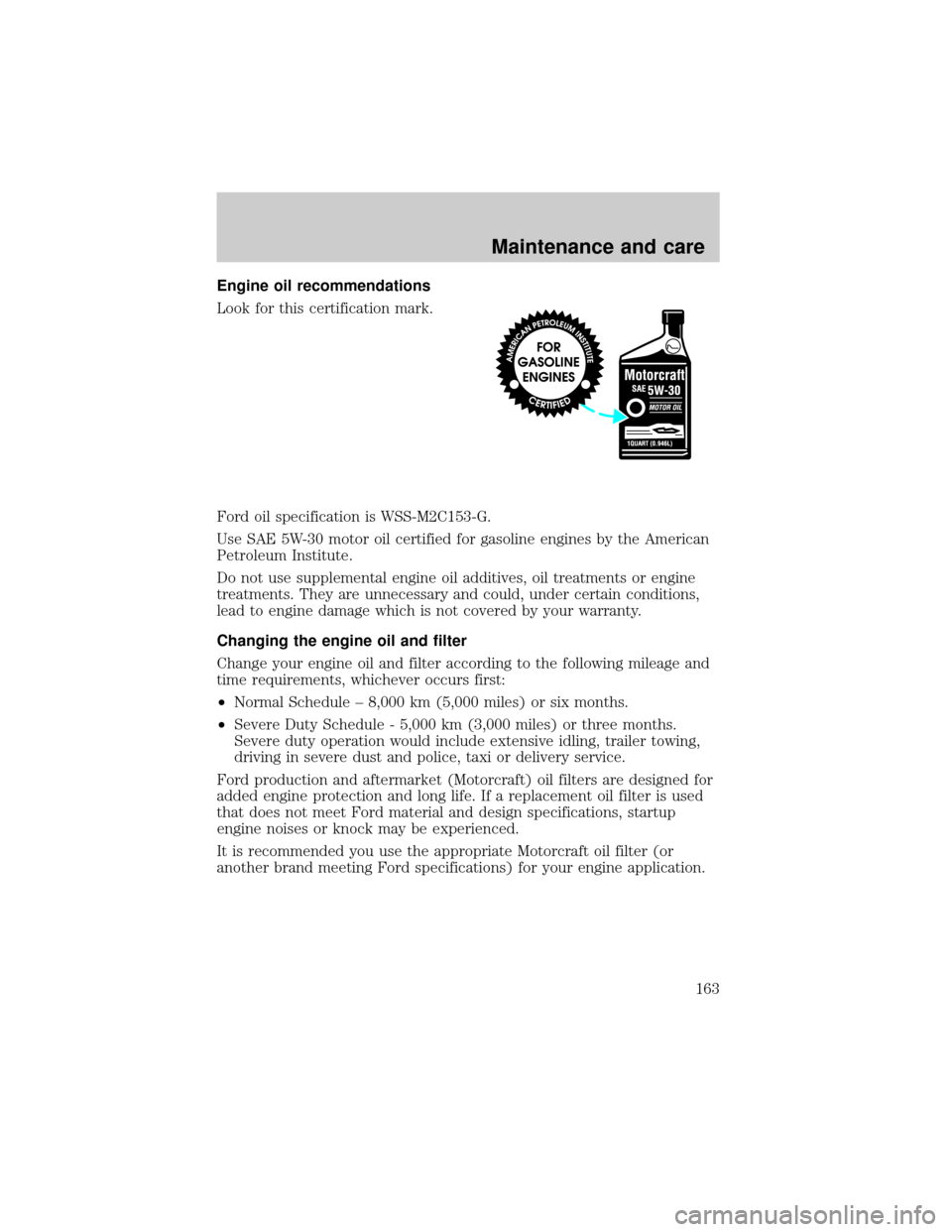
Look for this certification mark.
Ford oil specification is WSS-M2C153-G.
Use SAE 5W-30 motor oil certified for gasoline engines by the American
Petroleum Institute.
Do not use supplemental engine oil additives, oil treatments or engine
treatments. They are unnecessary and could, under certain conditions,
lead to engine damage which is not covered by your warranty.
Changing the engine oil and filter
Change your engine oil and filter according to the following mileage and
time requirements, whichever occurs first:
²Normal Schedule ± 8,000 km (5,000 miles) or six months.
²Severe Duty Schedule - 5,000 km (3,000 miles) or three months.
Severe duty operation would include extensive idling, trailer towing,
driving in severe dust and police, taxi or delivery service.
Ford production and aftermarket (Motorcraft) oil filters are designed for
added engine protection and long life. If a replacement oil filter is used
that does not meet Ford material and design specifications, startup
engine noises or knock may be experienced.
It is recommended you use the appropriate Motorcraft oil filter (or
another brand meeting Ford specifications) for your engine application.
Maintenance and care
163
Page 185 of 210
EMISSION CONTROL SYSTEM
Your vehicle is equipped with various emission control components and a
catalytic converter which will enable your vehicle to comply with
applicable exhaust emission standards. To make sure that the catalytic
converter and other emission control components continue to work
properly:
²Use only unleaded fuel.
²Avoid running out of fuel.
²Do not turn off the ignition while your vehicle is moving, especially at
high speeds.
²Have the services listed in your ``Service Guide'' performed according
to the specified schedule.
The Scheduled Maintenance Services listed in the ``Service Guide'' are
required because they are considered essential to the life and
performance of your vehicle and to its emissions system.
If other than Ford, Motorcraft or Ford authorized parts are used for
maintenance replacements or for service of components affecting
emission control such non-Ford parts should be equivalent to genuine
Ford Motor Company parts in performance and durability.
Do not park, idle, or drive your vehicle in dry grass or other dry
ground cover. The emission system heats up the engine
compartment and exhaust system, which can start a fire.
Watch for fluid leaks, strange odors, smoke, loss of oil pressure, the
charging system warning light, the ``Check Engine'' light or the
temperature warning light. These events could indicate that the emission
control system is not working properly.
If you smell exhaust fumes of any kind inside your vehicle, have
the dealer inspect and fix your vehicle immediately. Do not drive
if you smell exhaust fumes. These fumes are harmful and could kill
you.
Do not make any unauthorized changes to your vehicle or engine. By
law, vehicle owners and anyone who manufactures, repairs, services,
sells, leases, trades vehicles, or supervises a fleet of vehicles are not
permitted to intentionally remove an emission control device or prevent
it from working. Information about your vehicle's emission system is on
Maintenance and care
185
Page 187 of 210
²back-up lamps
Do not remove lamp bulbs unless they can be replaced immediately with
new ones. If a bulb is removed for an extended period of time,
contaminants may enter the lamp housings and affect lamp performance.
Replacing headlamp bulbs
Handle a halogen headlamp bulb carefully and keep out of
children's reach. Grasp the bulb only by its plastic base and do
not touch the glass. The oil from your hand could cause the bulb to
break the next time the headlamps are operated.
If the bulb is accidentally touched, it should be cleaned with rubbing
alcohol before being used.
To remove the headlamp bulb:
1. Make sure headlamp switch is in OFF position, then open the hood. If
you are replacing the driver side headlamp, unclip the electronic module
on the right side of the battery and move it out of the way.
2. Locate the headlamp bulb through the hole in the upper radiator
support assembly.
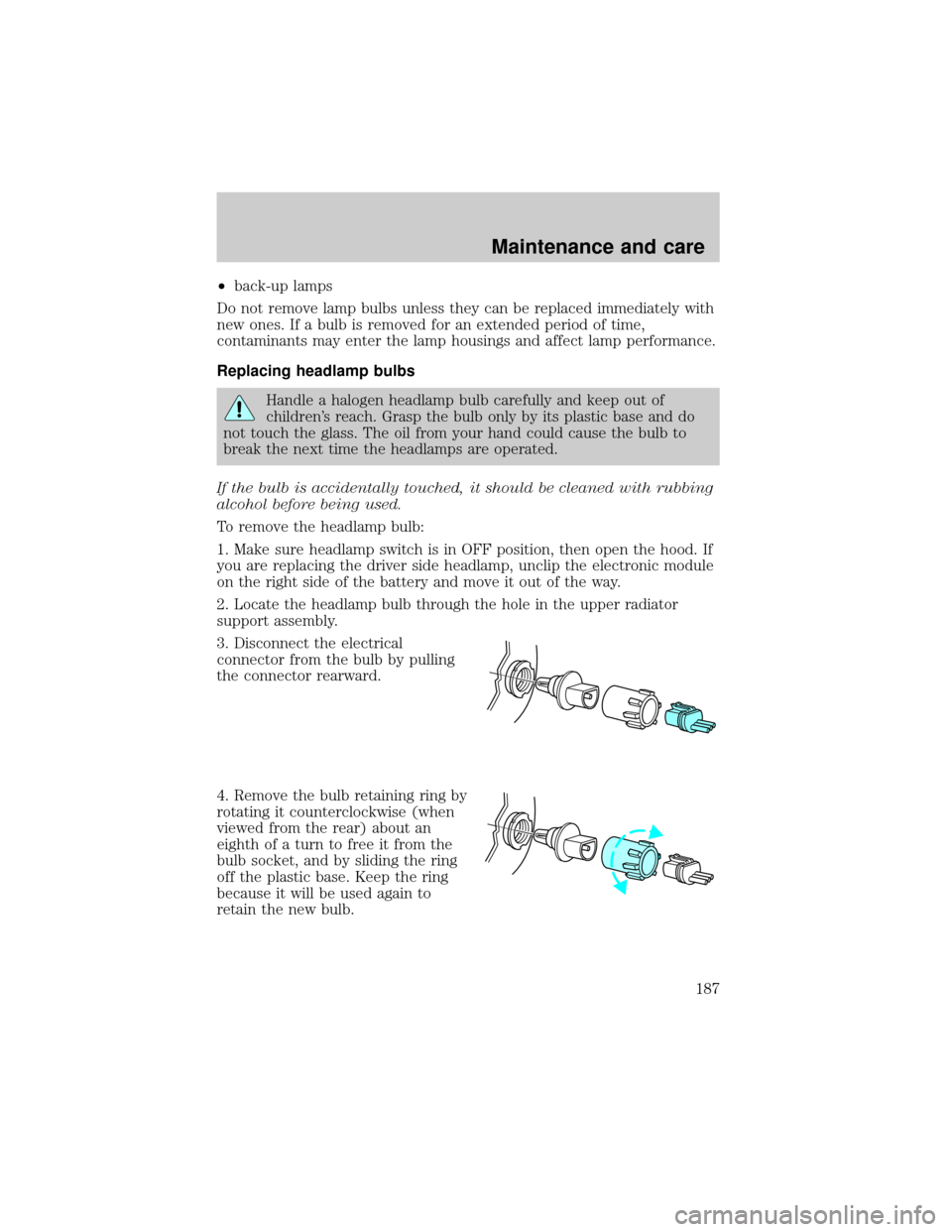
3. Disconnect the electrical
connector from the bulb by pulling
the connector rearward.
4. Remove the bulb retaining ring by
rotating it counterclockwise (when
viewed from the rear) about an
eighth of a turn to free it from the
bulb socket, and by sliding the ring
off the plastic base. Keep the ring
because it will be used again to
retain the new bulb.
Maintenance and care
187
Page 192 of 210
Waxing your vehicle
Wax when water stops beading on the surface. This could be every three
or four months, depending on operating conditions.
Use only carnauba or synthetic-based waxes. Remove any bugs and tar
before waxing vehicle. Use cleaning fluid or alcohol with a clean cloth to
remove. Use tar remover to remove any tar spots.
Repairing paint chips
Minor scratches or paint damage from road debris may be repaired with
touch-up paint, repair foil or aerosol paint spray from the Ford accessory
line. Observe the application instructions on the products.
Remove particles such as bird droppings, tree sap, insect remains, tar
spots, road salt and industrial fallout immediately.
Cleaning the engine
Engines are more efficient when they are clean because grease and dirt
buildup keep the engine warmer than normal. When washing:
²Take care when using a power washer to clean the engine. The high
pressure fluid could penetrate the sealed parts and cause damage.
²Do not spray with cold water to avoid cracking the engine block or
other engine components.
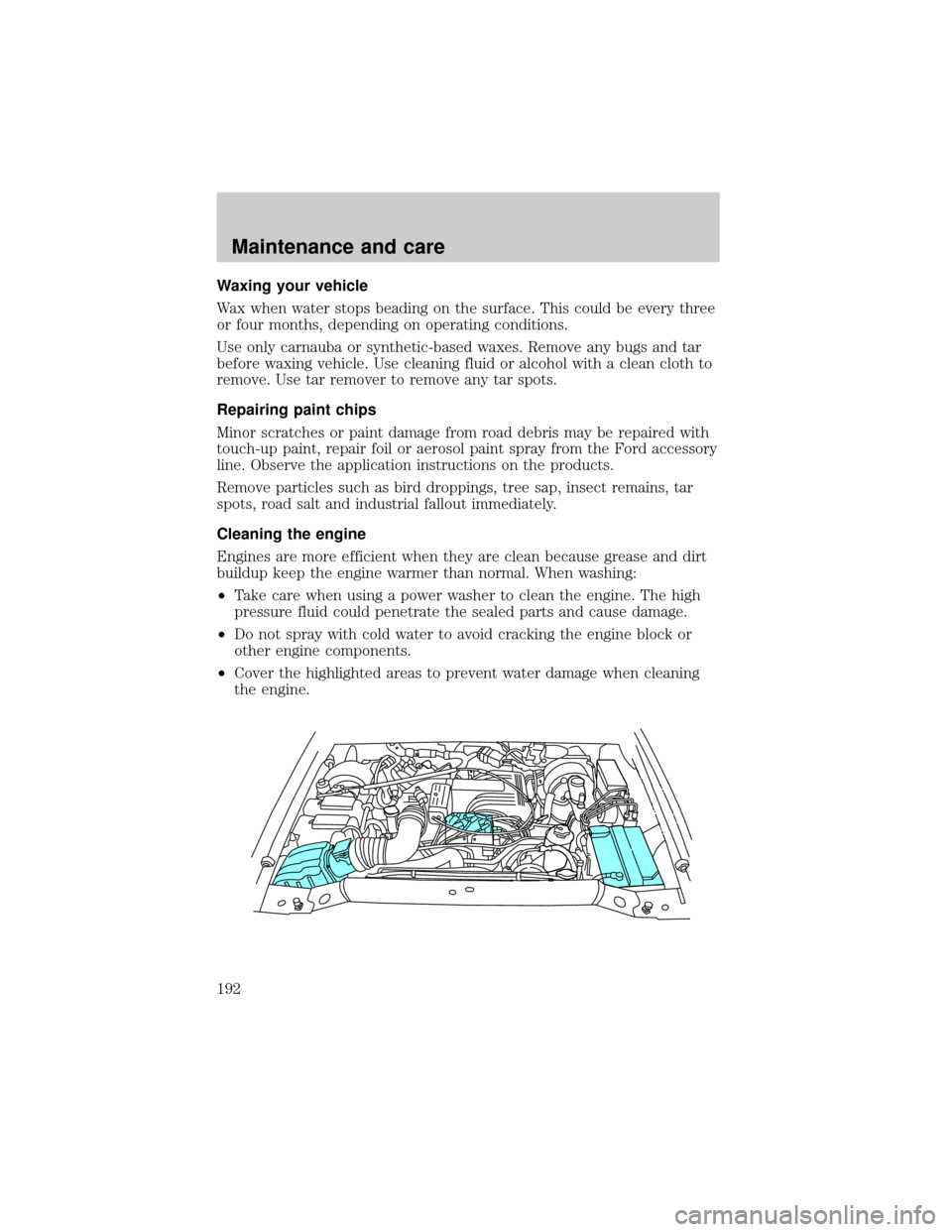
²Cover the highlighted areas to prevent water damage when cleaning
the engine.
Maintenance and care
192
Page 195 of 210
Check the safety belt system periodically to make sure there are no
nicks, wear or cuts. If your vehicle has been involved in an accident,
refer to theSafety belt maintenancesection in theSeating and safety
restraintschapter.
Cleaning the built-in child seat (if equipped)
Clean with mild soap and water. Do not use household cleaning products
because they may weaken the safety belt webbing or damage the vinyl
parts of the seat.
The child seat liner is removable and may be machine-washed and air
dried.
Underbody
Flush the complete underside of vehicle frequently. Keep body drain
holes unplugged. Inspect for road damage.
Cleaning leather seats (if equipped)
For routine cleaning, wipe the surface with a soft, damp cloth. For more
thorough cleaning, wipe the surface with a mild soap.
If the leather cannot be completely cleaned using a mild soap and water
solution, the leather may be cleaned using a commercially available
cleaning product ``Tanners Preserve Leather Cleaner'' and a 3M ``Type T''
scrubbing pad by using the following steps;
The type of scrubbing pad is very critical because the common 3M
``Scotch Brite'' green pad is too aggressive and will damage the
leather surface
²Spray a small amount of the leather cleaner on the pad and rub the
area to be cleaned with the pad using a circular motion. Only clean 1/4
of the area at a time. For heavily soiled areas, spray the cleaner
directly onto the leather (two squirts should be adequate) and rub
with the pad. Repeat if necessary.
²Use a soft, damp cloth to remove the loosened dirt and foam.
²Dry with a soft cloth.
Do not use household cleaners, glass cleaner, alcohol solutions or
cleaner intended for vinyl, rubber or plastics. These products can
damage the leather.
In some instances, color or dye transfer can occur when wet
clothing (wool, denim, leathers or other non-colorfast garments)
Maintenance and care
195
Page 197 of 210
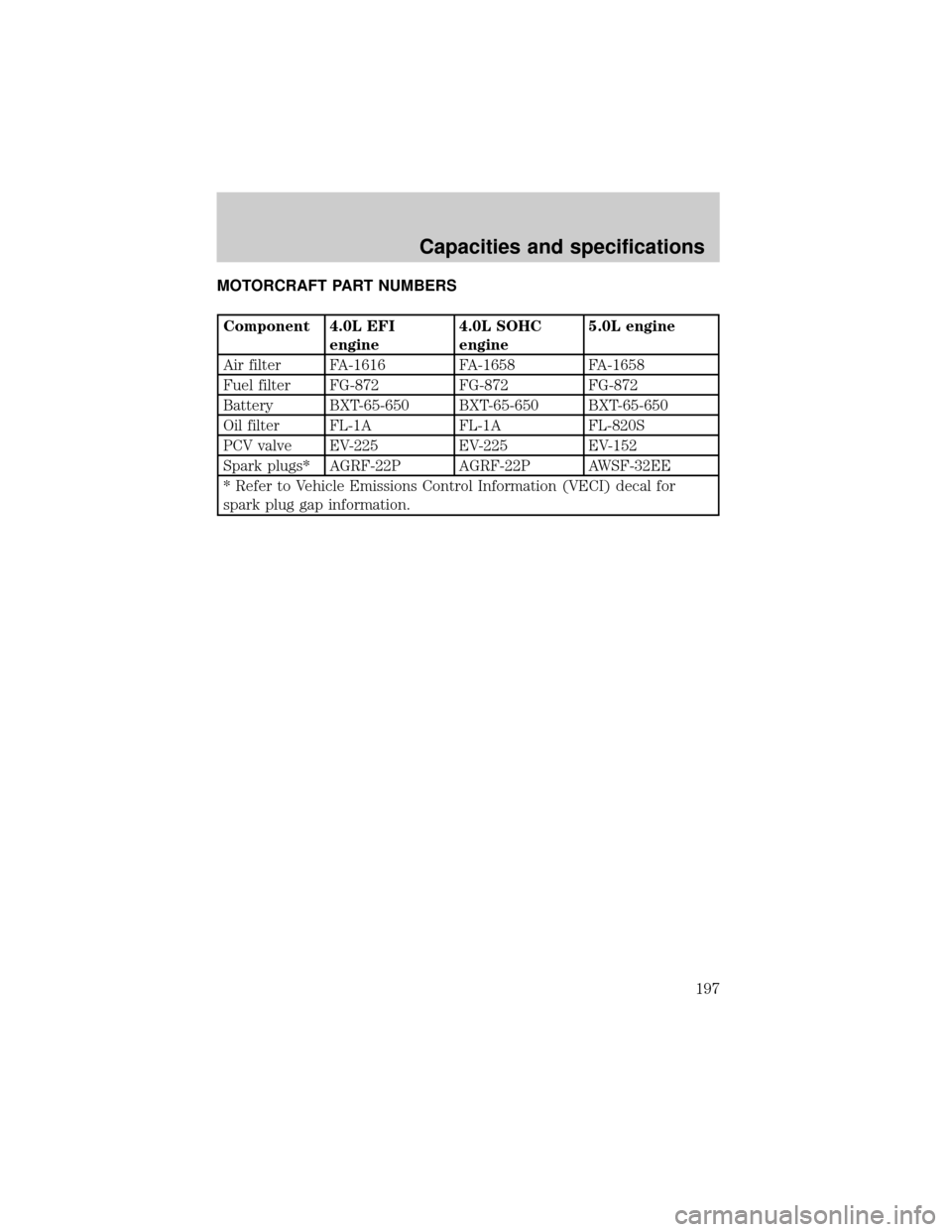
MOTORCRAFT PART NUMBERS
Component 4.0L EFI
engine4.0L SOHC
engine5.0L engine
Air filter FA-1616 FA-1658 FA-1658
Fuel filter FG-872 FG-872 FG-872
Battery BXT-65-650 BXT-65-650 BXT-65-650
Oil filter FL-1A FL-1A FL-820S
PCV valve EV-225 EV-225 EV-152
Spark plugs* AGRF-22P AGRF-22P AWSF-32EE
* Refer to Vehicle Emissions Control Information (VECI) decal for
spark plug gap information.
Capacities and specifications
197
Page 198 of 210
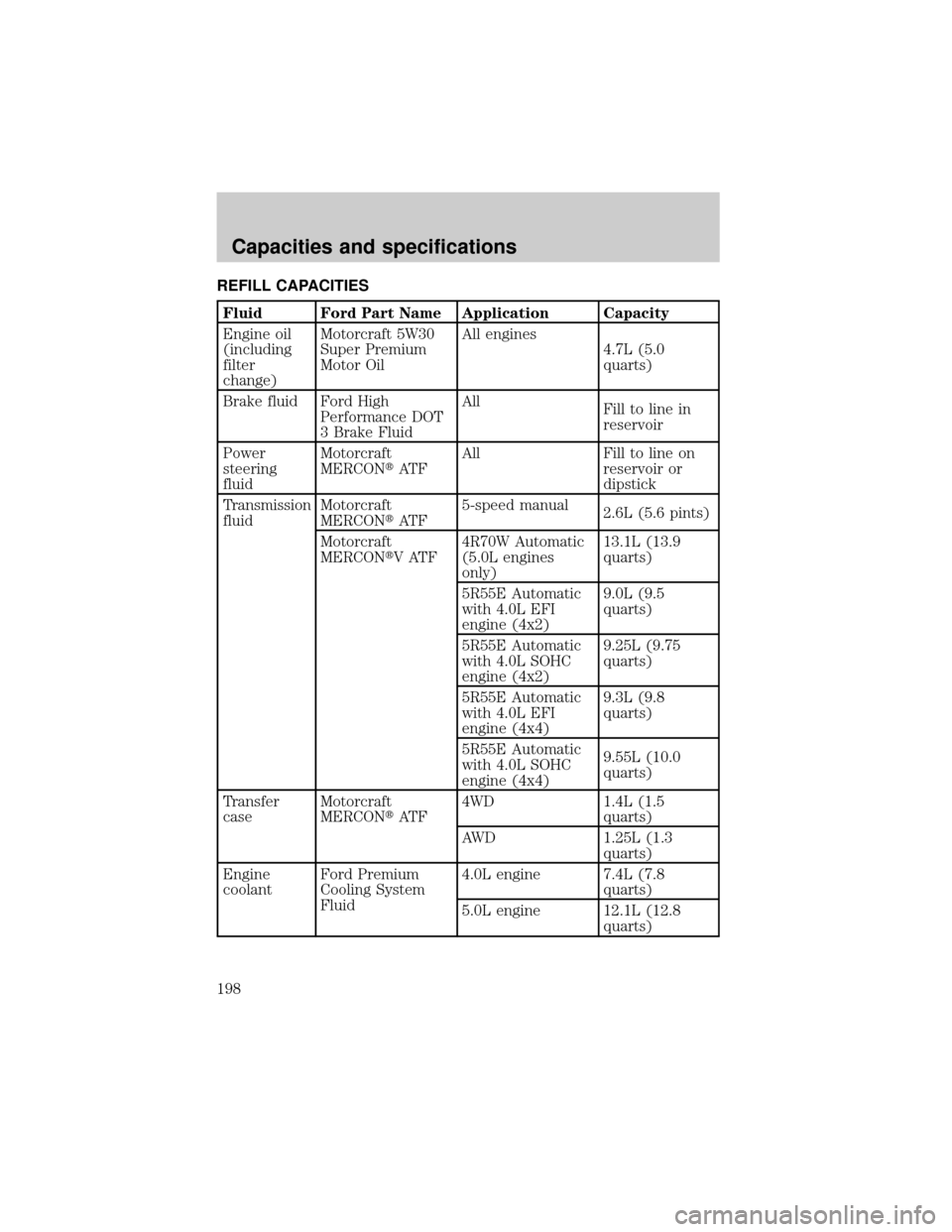
REFILL CAPACITIES
Fluid Ford Part Name Application Capacity
Engine oil
(including
filter
change)Motorcraft 5W30
Super Premium
Motor OilAll engines
4.7L (5.0
quarts)
Brake fluid Ford High
Performance DOT
3 Brake FluidAll
Fill to line in
reservoir
Power
steering
fluidMotorcraft
MERCONtAT FAll Fill to line on
reservoir or
dipstick
Transmission
fluidMotorcraft
MERCONtAT F5-speed manual
2.6L (5.6 pints)
Motorcraft
MERCONtVATF4R70W Automatic
(5.0L engines
only)13.1L (13.9
quarts)
5R55E Automatic
with 4.0L EFI
engine (4x2)9.0L (9.5
quarts)
5R55E Automatic
with 4.0L SOHC
engine (4x2)9.25L (9.75
quarts)
5R55E Automatic
with 4.0L EFI
engine (4x4)9.3L (9.8
quarts)
5R55E Automatic
with 4.0L SOHC
engine (4x4)9.55L (10.0
quarts)
Transfer
caseMotorcraft
MERCONtAT F4WD 1.4L (1.5
quarts)
AWD 1.25L (1.3
quarts)
Engine
coolantFord Premium
Cooling System
Fluid4.0L engine 7.4L (7.8
quarts)
5.0L engine 12.1L (12.8
quarts)
Capacities and specifications
198
Page 200 of 210
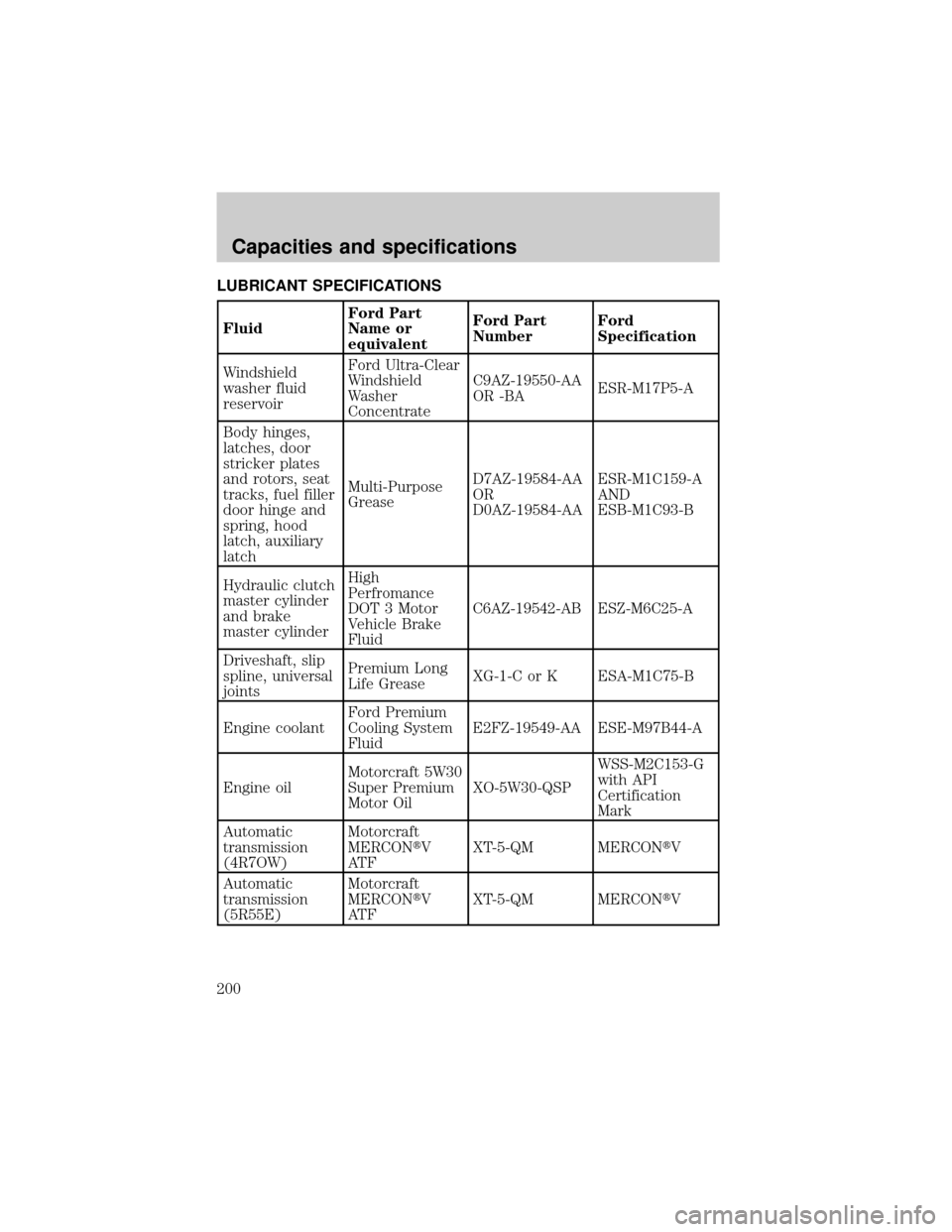
LUBRICANT SPECIFICATIONS
FluidFord Part
Name or
equivalentFord Part
NumberFord
Specification
Windshield
washer fluid
reservoirFord Ultra-Clear
Windshield
Washer
ConcentrateC9AZ-19550-AA
OR -BAESR-M17P5-A
Body hinges,
latches, door
stricker plates
and rotors, seat
tracks, fuel filler
door hinge and
spring, hood
latch, auxiliary
latchMulti-Purpose
GreaseD7AZ-19584-AA
OR
D0AZ-19584-AAESR-M1C159-A
AND
ESB-M1C93-B
Hydraulic clutch
master cylinder
and brake
master cylinderHigh
Perfromance
DOT 3 Motor
Vehicle Brake
FluidC6AZ-19542-AB ESZ-M6C25-A
Driveshaft, slip
spline, universal
jointsPremium Long
Life GreaseXG-1-C or K ESA-M1C75-B
Engine coolantFord Premium
Cooling System
FluidE2FZ-19549-AA ESE-M97B44-A
Engine oilMotorcraft 5W30
Super Premium
Motor OilXO-5W30-QSPWSS-M2C153-G
with API
Certification
Mark
Automatic
transmission
(4R7OW)Motorcraft
MERCONtV
AT FXT-5-QM MERCONtV
Automatic
transmission
(5R55E)Motorcraft
MERCONtV
AT FXT-5-QM MERCONtV
Capacities and specifications
200