steering wheel FORD EXPLORER 1998 2.G User Guide
[x] Cancel search | Manufacturer: FORD, Model Year: 1998, Model line: EXPLORER, Model: FORD EXPLORER 1998 2.GPages: 210, PDF Size: 1.65 MB
Page 121 of 210

reduces strain on the engine and the possibility of stalling.
When descending a steep hill, avoid sudden braking. Rapid pumping of
the brake pedal will help slow the vehicle and still maintain steering
control.
When speed control is on and you are driving uphill, your vehicle speed
may drop considerably, especially if you are carrying a heavy load.
If vehicle speed drops more than 16 km/h (10 mph), the speed control
will cancel automatically. Resume speed with accelerator pedal.
If speed control cancels after climbing the hill, reset speed by pressing
and holding the SET ACCEL button (to resume speeds over 50 km/h (30
mph).
Automatic transmissions may shift frequently while driving up steep
grades. Eliminate frequent shifting by shifting out of
(Overdrive) into
D (Drive).
Driving on snow and ice
A 4WD vehicle has advantages over 2WD vehicles in snow and ice but
can skid like any other vehicle.
Avoid sudden applications of power and quick changes of direction on
snow and ice. Apply the accelerator slowly and steadily when starting
from a full stop.
When braking, apply the brakes as you normally would. In order to allow
the anti-lock brake system (ABS) to operate properly, keep steady
pressure on the brake pedal.
Allow more stopping distance and drive slower than usual. Consider
using one of the lower gears.
ALL WHEEL DRIVE (AWD) SYSTEM (IF EQUIPPED)
(5.0L ENGINES ONLY)
Your vehicle is equipped with a full-time All Wheel Drive (AWD) transfer
case. Power is supplied to all four wheels all the time with no need to
shift between two-wheel drive and four-wheel drive.
For the lubricant specification and refill capacity of the AWD transfer
case refer toCapacities and specificationschapter.
Driving
121
Page 122 of 210
Utility and four-wheel drive vehicles arenotdesigned for
cornering at speeds as high as passenger cars any more than
low-slung sports cars are designed to perform satisfactorily under
off-road conditions. Avoid sharp turns or abrupt maneuvers in these
vehicles.
Driving off-road with AWD
Your vehicle is specially equipped for driving on sand, snow, mud and
rough terrain and has operating characteristics that are somewhat
different from conventional vehicles, both on and off the road.
Maintain steering wheel control at all times, especially in rough terrain.
Since sudden changes in terrain can result in abrupt steering wheel
motion, make sure you grip the steering wheel from the outside. Do not
grip the spokes.
Drive cautiously to avoid vehicle damage from concealed objects such as
rocks and stumps.
You should either know the terrain or examine maps of the area before
driving. Map out your route before driving in the area. For more
information on driving off-road, read the ``Four Wheeling'' supplement in
your owner's portfolio.
If your vehicle gets stuck
If the vehicle is stuck, shift the transmission in a steady motion between
forward and reverse gears. Allow the transmission to engage, then press
lightly on the accelerator.
Do not rock the vehicle for more than a few minutes. The
transmission and tires may be damaged or the engine can
overheat.
Do not spin the wheels at over 56 km/h (35 mph). The tires may
fail and injure a passenger or bystander.
Sand
When driving over sand, try to keep all four wheels on the most solid
area of the trail. Do not reduce the tire pressures but shift to a lower
gear and drive steadily through the terrain. Apply the accelerator slowly
and avoid spinning the wheels.
Driving
122
Page 144 of 210
CHANGING THE TIRES
If you get a flat tire while driving, do not apply the brake heavily.
Instead, gradually decrease your speed. Hold the steering wheel firmly
and slowly move to a safe place on the side of the road.
Spare tire information
Your vehicle is equipped with a spare tire that may be used as a spare or
a regular tire. The spare tire is not equipped with wheel trim. The wheel
trim from the original wheel/tire may be used on the spare.
If your vehicle is equipped with 4WD or AWD, a spare tire of a
different size than the road tires should not be used. Such a tire
could result in damage to driveline components and make the
vehicle difficult to control.
Location of the spare tire and tools
The spare tire and tools for your vehicle are stowed in the following
locations:
Tool Location
Spare tire Under the vehicle, just in front of the rear
bumper
Jack, lug nut wrench Left rear quarter panel behind interior trim
Jack handle Behind rear seats, under carpet
Removing the spare tire
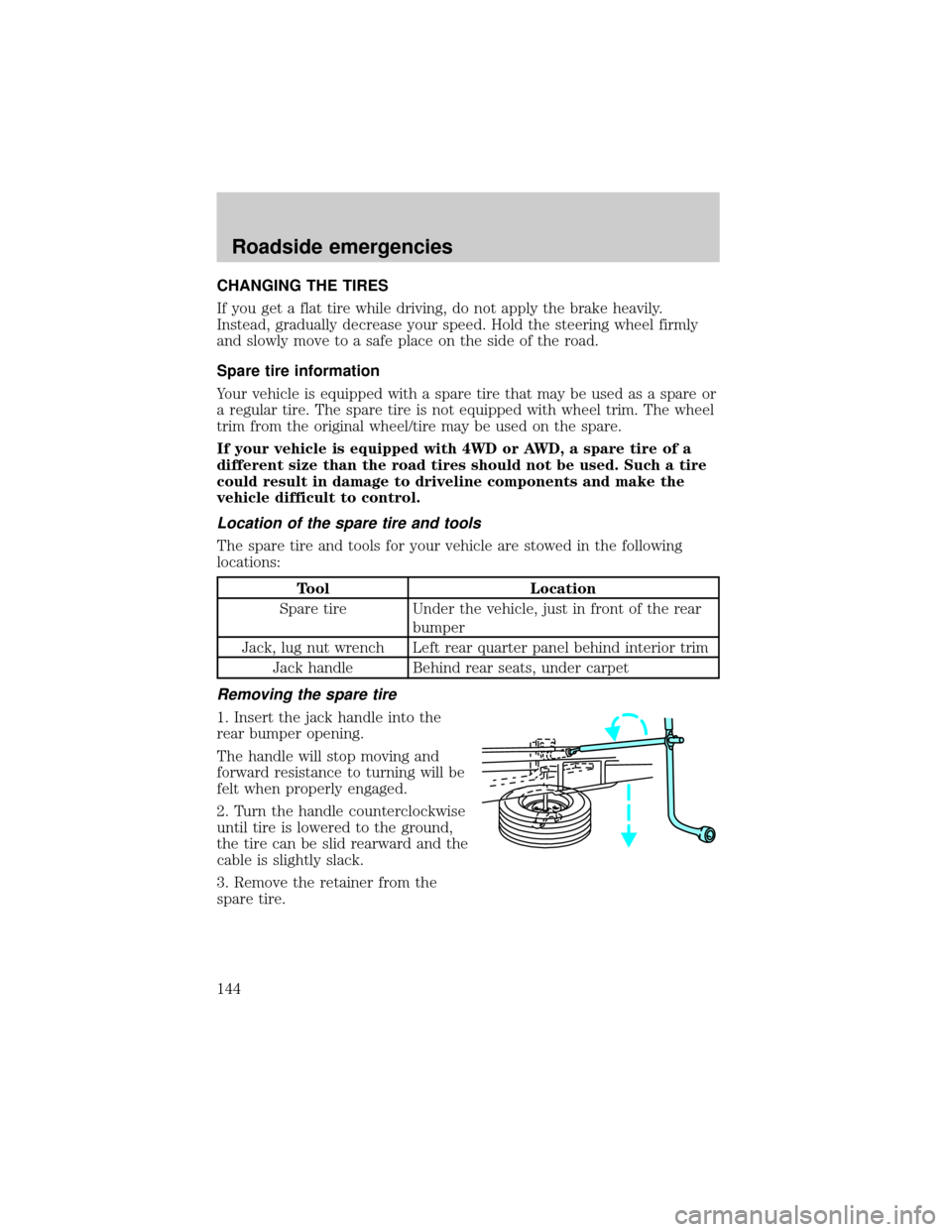
1. Insert the jack handle into the
rear bumper opening.
The handle will stop moving and
forward resistance to turning will be
felt when properly engaged.
2. Turn the handle counterclockwise
until tire is lowered to the ground,
the tire can be slid rearward and the
cable is slightly slack.
3. Remove the retainer from the
spare tire.
Roadside emergencies
144
Page 157 of 210
3. Turn off the engine and remove the key.
4. Block the wheels to prevent the vehicle from moving unexpectedly.
Working with the engine on
²Automatic transmission:
1. Set the parking brake and
ensure the gearshift is securely latched in P (Park).
2. Block the wheels to prevent the vehicle from moving unexpectedly.
Do not start your engine with the air cleaner removed and do
not remove it while the engine is running.
²Manual transmission:
1. Set the parking brake,
depress the clutch and place the gearshift in N (Neutral).
2. Block the wheels to prevent the vehicle from moving unexpectedly.
Do not start your engine with the air cleaner removed and do
not remove it while the engine is running.
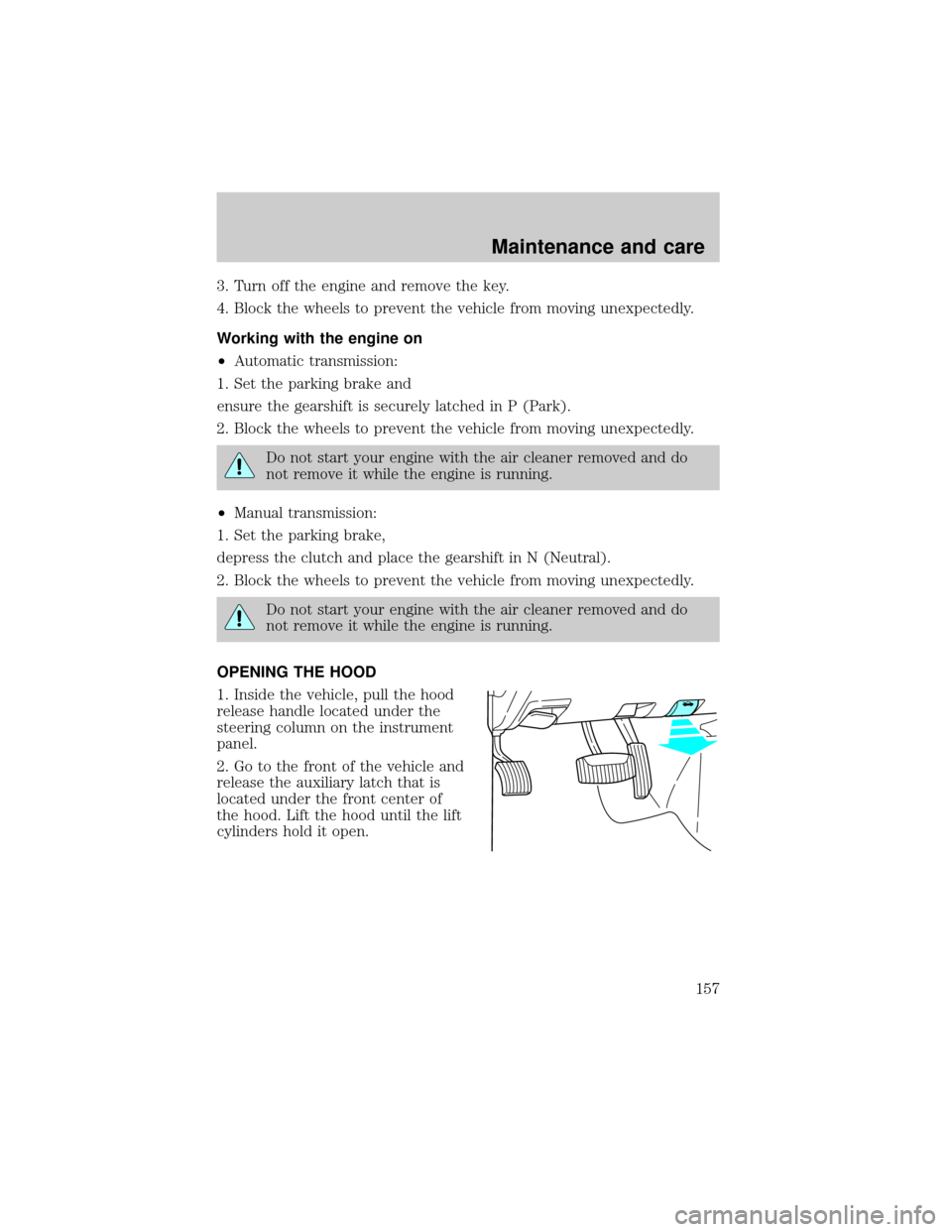
OPENING THE HOOD
1. Inside the vehicle, pull the hood
release handle located under the
steering column on the instrument
panel.
2. Go to the front of the vehicle and
release the auxiliary latch that is
located under the front center of
the hood. Lift the hood until the lift
cylinders hold it open.
Maintenance and care
157
Page 170 of 210

²5.0L engine
1. Start the engine and let it run until it reaches normal operating
temperature (the engine coolant temperature gauge will be near the
center of the NORMAL band).
2. While the engine idles, turn the steering wheel left and right several
times.
3. Turn the engine off.
4. Check the fluid level in the reservoir.
5.If your vehicle is equipped with a 4.0L EFI engine,the fluid level
should be in the FULL HOT range. Do not add fluid if the level is in this
range.
6.If your vehicle is equipped with a 4.0L SOHC engine or a 5.0L
engine,the fluid level should be between the MIN and MAX lines. Do
not add fluid if the level is in this range.
7. If the fluid is low, add fluid in small amounts, continuously checking
the level until it reaches the correct operating range. Be sure to put the
cap back on the reservoir.
TRANSMISSION FLUID
Checking and adding automatic transmission fluid
Follow the scheduled service intervals outlined in the ``Service Guide''.
Before adding any fluid, make sure the correct type is used. The type of
fluid used is normally indicated on the dipstick and/or dipstick handle
and also in theLubricant specificationssection in theCapacities and
specificationschapter.
Maintenance and care
170
Page 201 of 210

FluidFord Part
Name or
equivalentFord Part
NumberFord
Specification
Power steering
reservoirMotorcraft
MERCONtAT FXT-2-QDX MERCONt
Ford
conventional and
traction lok rear
axlesRefer to
footnotes 1, 2
and 3Refer to
footnotes 1, 2
and 3Refer to
footnotes 1, 2
and 3
Front axle 4x4 Gear Oil F1TZ-19580-A WSL-M2C191-A
Transfer case -
Four wheel
driveMotorcraft
MERCONtAT FXT-2-QDX MERCONt
5-speed manual
transmissionMotorcraft
MERCONtAT FXT-2-QDX MERCONt
Transfer case
Front Output
Slip ShaftPremium
Long-Life GreaseXG-1-G or K ESA-M1C75-B
14.0L vehicles with conventional and Traction-lok rear axles are filled
with Motorcraft SAE 80W90 Premium Rear Axle Lube, part number
XY-80W90±QL, Ford specification WSP-M2C197±A.
24.0L vehicles with limited slip differentials and all 5.0L applications use
rear axles that are filled with Motorcraft SAE 75W140 High Performance
Synthetic Rear Axle Lube, part number F1TZ-19580±B, Ford
specification WSL-M2C192±A.
34.0L vehicles with limited slip differentials and all 5.0L applications
must add 118 ml (4 oz) of additive friction modifier C8AZ-19B546±A,
Ford specification EST-M2C118±A to the rear axle whenever the axle has
been serviced.
Capacities and specifications
201
Page 208 of 210

Overhead console
compass/temperature display ..44
storage compartment ...............44
Panic alarm feature, remote
entry system ................................60
Parking brake ............................105
Power door locks ........................51
Power steering
fluid, checking and adding ....169
Rear window
washer .......................................42
Recreational towing, all wheels
on the ground ...........................133
Refill capacities for fluids ........198
Relays ........................................136
Remote entry system .................58
illuminated entry ......................63
locking/unlocking doors ...........59
replacement/additional
transmitters ..........................62,63
replacing the batteries .............62
Reporting safety defects ..........205
Safety restraints
automatic locking mode
(retractor) ............................78,79
extension assembly ..................80
for children ...............................86
lap and shoulder belts ........77,78
maintenance ..............................81
proper use .................................76
warning light and chime .........11,
80,81
Safety seats for children
attaching with tether straps ....91
automatic locking mode
(retractor) .................................88
tether anchorage hardware .....91
Seats ............................................72
adjusting the seat, power ........72
folding rear seats ......................75
lumbar support .........................74
rear seat access ........................74Servicing your vehicle ..............156
precautions when servicing ...156
Snowplowing .................................3
Special notice
utility-type vehicles ....................3
Speed control ..............................36
canceling a set speed ...............39
indicator light ...........................40
resuming a set speed ...............40
tap up/tap down .......................38
turning off .................................36
Speedometer ...............................12
Starting your vehicle ...........99,102
Storage compartments
overhead storage
compartment .............................44
Tachometer
mechanical cluster ...................14
Tilt steering wheel ......................41
Tires ....................................177,178
checking the pressure ............178
replacing ..................................180
rotating ....................................179
snow tires and chains ............181
treadwear ................................177
Traction-lok rear axle ........124,175
Trailer towing ............................126
tips ...........................................132
Transaxle
fluid, checking and adding
(manual) .................................173
Transfer case
fluid checking .........................174
Transmission .............................170
automatic operation .......107,108,
109,110,111,112
fluid, checking and adding
(automatic) .............................170
Trip odometer .............................14
Turn signal
lever ...........................................35
Vehicle dimensions ...................202
Index
208