brake light FORD EXPLORER 2001 2.G Owner's Manual
[x] Cancel search | Manufacturer: FORD, Model Year: 2001, Model line: EXPLORER, Model: FORD EXPLORER 2001 2.GPages: 288, PDF Size: 1.98 MB
Page 215 of 288
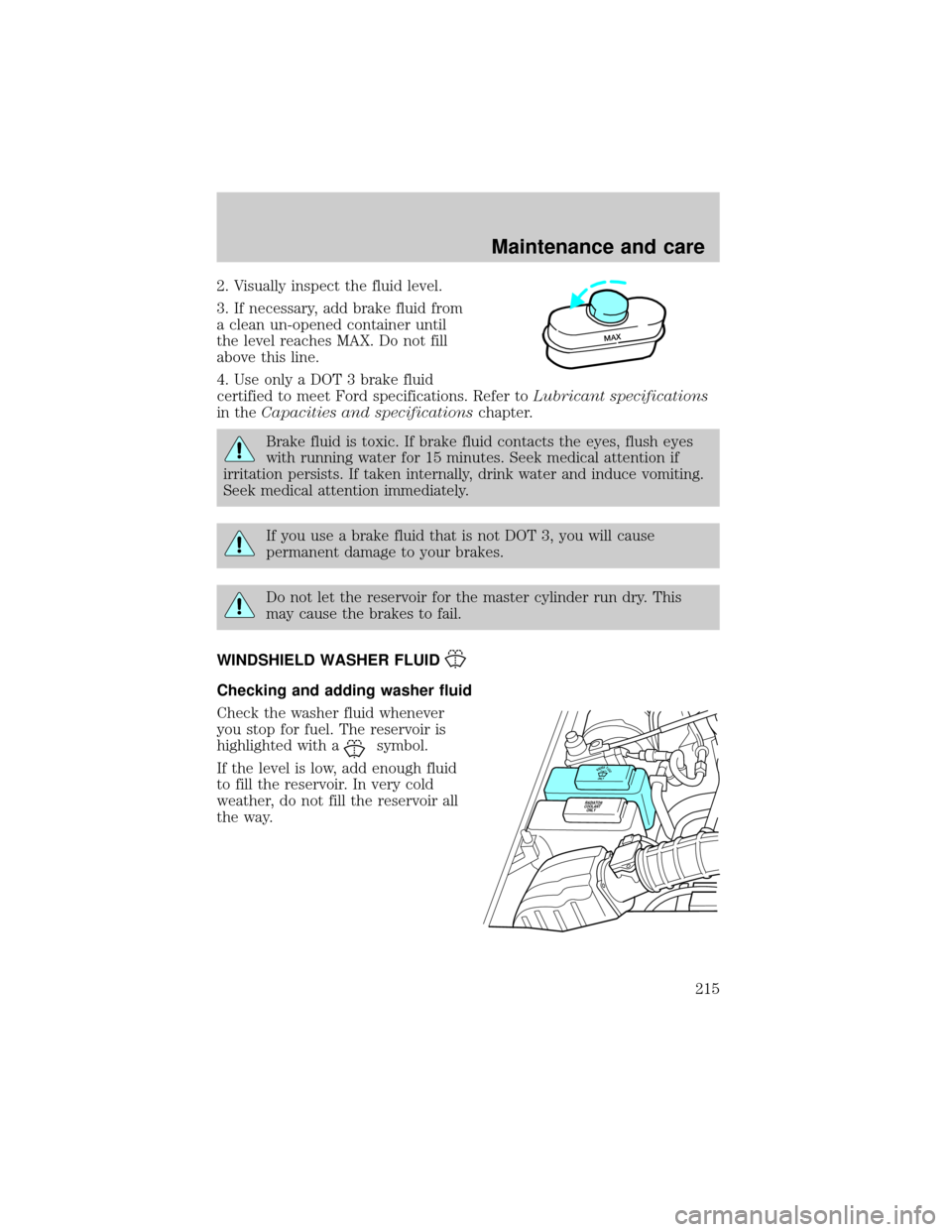
2. Visually inspect the fluid level.
3. If necessary, add brake fluid from
a clean un-opened container until
the level reaches MAX. Do not fill
above this line.
4. Use only a DOT 3 brake fluid
certified to meet Ford specifications. Refer toLubricant specifications
in theCapacities and specificationschapter.
Brake fluid is toxic. If brake fluid contacts the eyes, flush eyes
with running water for 15 minutes. Seek medical attention if
irritation persists. If taken internally, drink water and induce vomiting.
Seek medical attention immediately.
If you use a brake fluid that is not DOT 3, you will cause
permanent damage to your brakes.
Do not let the reservoir for the master cylinder run dry. This
may cause the brakes to fail.
WINDSHIELD WASHER FLUID
Checking and adding washer fluid
Check the washer fluid whenever
you stop for fuel. The reservoir is
highlighted with a
symbol.
If the level is low, add enough fluid
to fill the reservoir. In very cold
weather, do not fill the reservoir all
the way.
MAX
RADIATOR
COOLANT
ONLY
WASHERFLUIDONLY
Maintenance and care
215
Page 243 of 288

Please consult your ªWarranty Guideº for complete emission warranty
information.
Readiness for Inspection/Maintenance (I/M) testing
In some localities, it may be a legal requirement to pass an I/M test of
the on-board diagnostics system. If your ªCheck Engine/Service Engine
Soonº light is on, refer to the description in theWarning Lights and
Chimessection of theInstrumentationchapter. Your vehicle may not
pass the I/M test with the ªCheck Engine/Service Engine Soonº light on.
If the vehicle's powertrain system or its battery has just been serviced,
the on-board diagnostics system is reset to a ªnot ready for I/M testº
condition. To ready the on-board diagnostics system for I/M testing, a
minimum of 30 minutes of city and highway driving is necessary as
described below:
²First, at least 10 minutes of driving on an expressway or highway.
²Next, at least 20 minutes driving in stop-and-go, city-type traffic with
at least four idle periods.
Allow the vehicle to sit for at least eight hours without starting the
engine. Then, start the engine and complete the above driving cycle. The
engine must warm up to its normal operating temperature. Once started,
do not turn off the engine until the above driving cycle is complete.
BULBS
Replacing exterior bulbs
Check the operation of the following lamps frequently:
²Headlamps
²Foglamps
²High-mount brakelamp
²Brakelamps
²Turn signals
²License plate lamp
²Tail lamps
²Back-up lamps
Do not remove lamp bulbs unless they can be replaced immediately with
new ones. If a bulb is removed for an extended period of time,
contaminants may enter the lamp housings and affect lamp performance.
Maintenance and care
243
Page 249 of 288
Washing your vehicle
Wash your vehicle regularly with
cold or lukewarm water. Never use
strong detergents or soap. If your
vehicle is particularly dirty, use a
quality car wash detergent. Always
use a clean sponge, washing glove
or similar device and plenty of water
for best results. To avoid spots,
avoid washing when the hood is still
warm, immediately after or during
exposure to strong sunlight.
During winter months, it is especially important to wash the vehicle on a
regular basis. Large quantities of dirt and road salt are difficult to
remove and also cause damage to the vehicle.
Any gasoline spilled on the vehicle or deposits such as bird droppings
should be washed and sponged off as soon as possible. Deposits not
removed promptly can cause damage to the vehicle's paintwork.
Remove any exterior accessories, such as antennas, before entering a car
wash. If you have wax applied to the vehicle at a commercial car wash, it
is recommended that you clean the wiper blades and windshield as
described inCleaning the wiper blades and windshield.
After washing, apply the brakes several times to dry them.
Waxing your vehicle
Waxing your vehicle on a regular basis will reduce minor scratches and
paint damage.
Wax when water stops beading on the surface. This could be every three
or four months, depending on operating conditions.
Use only carnauba or synthetic-based waxes. Use a cleaning fluid with a
clean cloth to remove any bugs before waxing your vehicle. Use tar
remover to remove any tar spots.
Avoid getting wax on the windshield, or on any surfaces which appear
coarse or bumpy. If you have wax applied at a commercial car wash, it is
recommended that you clean the wiper blades and windshield as
described inCleaning the wiper blades and windshield.
Maintenance and care
249
Page 276 of 288

A
Air bag supplemental restraint
system ................................137, 141
and child safety seats ............139
description ......................137, 141
disposal ....................................144
driver air bag ..................139, 142
indicator light ...........10, 141, 143
operation .........................139, 142
passenger air bag ...........139, 142
side air bag ..............................141
Air cleaner filter .......................255
Air conditioning ..........................23
automatic temperature
control system ..........................27
rear seat controls .....................32
Air suspension ...........................160
description ..............................160
warning light .............................12
All Wheel Drive (AWD),
driving off road .........................173
Ambulance packages ....................3
Antifreeze (see Engine
coolant) .....................................216
Anti-lock brake system
(see Brakes) ......................157±158
Anti-theft system
warning light .............................11
Armrests ....................................107
Audio system (see Radio) .........36
Automatic transmission
driving an automatic
overdrive .........................162, 165
fluid, adding ............................222
fluid, checking ........................222
fluid, refill capacities ..............255fluid, specification ..................260
Auxiliary power point ...............106
Axle
lubricant specifications ..258, 260
refill capacities ........................255
traction lok ..............................175
B
Battery .......................................225
acid, treating emergencies .....225
charging system warning
light ............................................11
jumping a disabled battery ....199
maintenance-free ....................225
replacement, specifications ...255
servicing ..................................225
voltage gauge ............................16
Belt minder ...............................133
Brakes ........................................157
anti-lock ...........................157±158
anti-lock brake system (ABS)
warning light .....................10, 158
brake warning light ..................10
fluid, checking and adding ....214
fluid, refill capacities ..............255
fluid, specifications .........258, 260
lubricant specifications ..258, 260
parking ....................................158
shift interlock ..........................161
Break-in period .............................3
C
Capacities for refilling fluids ....255
Cargo area shade ......................108
Cargo cover ...............................108
CD changer .................................78
Index
276
Page 280 of 288

air bag ........................................10
anti-lock brakes (ABS) ....10, 158
anti-theft ...................................11
brake ..........................................10
charging system ........................11
check coolant ............................11
check engine ...............................8
cruise indicator .........................13
door ajar ....................................12
fuel cap light ...............................9
high beam .................................11
overdrive off ..............................12
safety belt .................................10
speed control ............................88
turn signal indicator .................11
Load limits .................................176
GAWR ......................................176
GVWR ......................................176
trailer towing ..........................176
Loading instructions .................177
Locks
autolock ...................................116
childproof ................................104
Lubricant specifications ...258, 260
Lumbar support, seats .....124±125
M
Manual transmission
fluid capacities ........................255
lubricant specifications ..........260
Message center ...........................17
english/metric button ...............17
reset button ..............................19
system check button ................19
Mirrors
automatic dimming rearview
mirror ......................................102
cleaning ...................................254fold away .................................105
heated ......................................105
side view mirrors (power) .....104
Moon roof ....................................93
Motorcraft parts ................238, 255
O
Octane rating ............................236
Odometer .....................................15
Off-Road Driving .......................173
Oil (see Engine oil) ..................210
P
Panic alarm feature, remote
entry system ..............................110
Parking brake ............................158
Parts (see Motorcraft parts) ....255
Power distribution box (see
Fuses) ........................................192
Power door locks ......................103
Power steering ..........................159
fluid, checking and adding ....220
fluid, refill capacity ................255
fluid, specifications .........258, 260
Preparing to drive your
vehicle ........................................161
R
Radio ............................................36
Relays ........................................187
Remote entry system .......109±110
illuminated entry ....................113
locking/unlocking doors .........110
panic alarm .............................110
Index
280