fuel pump FORD EXPLORER 2003 3.G User Guide
[x] Cancel search | Manufacturer: FORD, Model Year: 2003, Model line: EXPLORER, Model: FORD EXPLORER 2003 3.GPages: 272, PDF Size: 4.64 MB
Page 242 of 272
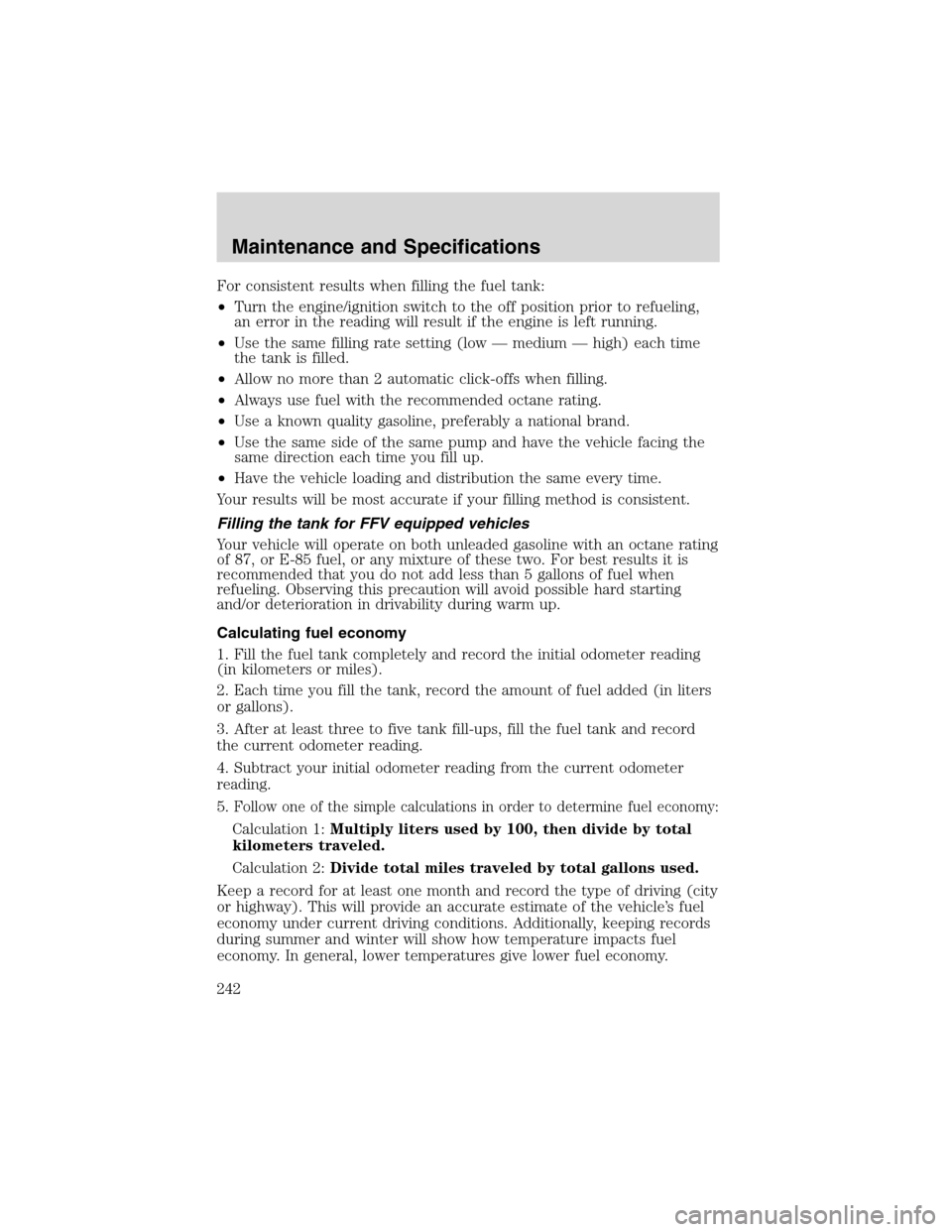
For consistent results when filling the fuel tank:
•Turn the engine/ignition switch to the off position prior to refueling,
an error in the reading will result if the engine is left running.
•Use the same filling rate setting (low—medium—high) each time
the tank is filled.
•Allow no more than 2 automatic click-offs when filling.
•Always use fuel with the recommended octane rating.
•Use a known quality gasoline, preferably a national brand.
•Use the same side of the same pump and have the vehicle facing the
same direction each time you fill up.
•Have the vehicle loading and distribution the same every time.
Your results will be most accurate if your filling method is consistent.
Filling the tank for FFV equipped vehicles
Your vehicle will operate on both unleaded gasoline with an octane rating
of 87, or E-85 fuel, or any mixture of these two. For best results it is
recommended that you do not add less than 5 gallons of fuel when
refueling. Observing this precaution will avoid possible hard starting
and/or deterioration in drivability during warm up.
Calculating fuel economy
1. Fill the fuel tank completely and record the initial odometer reading
(in kilometers or miles).
2. Each time you fill the tank, record the amount of fuel added (in liters
or gallons).
3. After at least three to five tank fill-ups, fill the fuel tank and record
the current odometer reading.
4. Subtract your initial odometer reading from the current odometer
reading.
5.
Follow one of the simple calculations in order to determine fuel economy:
Calculation 1:Multiply liters used by 100, then divide by total
kilometers traveled.
Calculation 2:Divide total miles traveled by total gallons used.
Keep a record for at least one month and record the type of driving (city
or highway). This will provide an accurate estimate of the vehicle’s fuel
economy under current driving conditions. Additionally, keeping records
during summer and winter will show how temperature impacts fuel
economy. In general, lower temperatures give lower fuel economy.
Maintenance and Specifications
242
Page 269 of 272
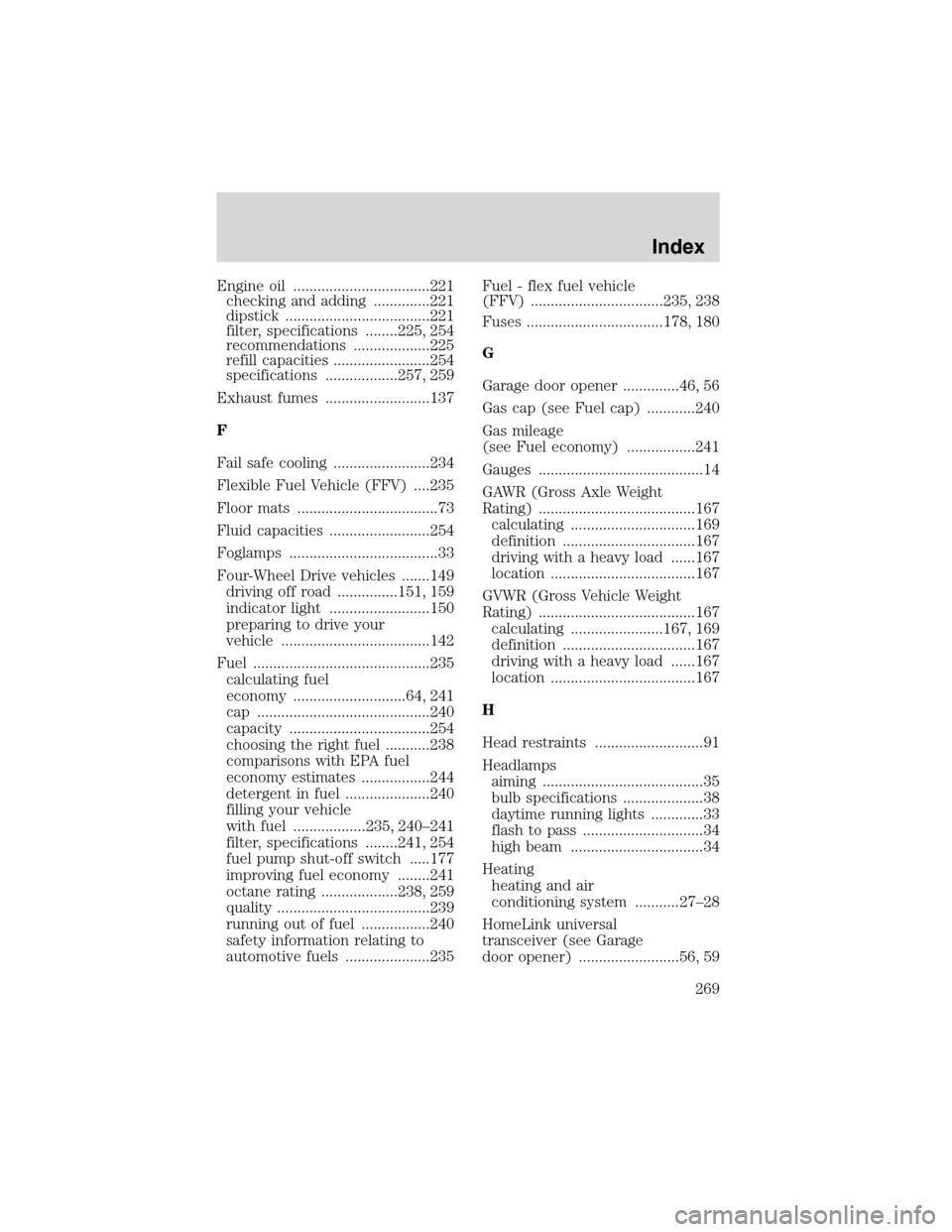
Engine oil ..................................221
checking and adding ..............221
dipstick ....................................221
filter, specifications ........225, 254
recommendations ...................225
refill capacities ........................254
specifications ..................257, 259
Exhaust fumes ..........................137
F
Fail safe cooling ........................234
Flexible Fuel Vehicle (FFV) ....235
Floor mats ...................................73
Fluid capacities .........................254
Foglamps .....................................33
Four-Wheel Drive vehicles .......149
driving off road ...............151, 159
indicator light .........................150
preparing to drive your
vehicle .....................................142
Fuel ............................................235
calculating fuel
economy ............................64, 241
cap ...........................................240
capacity ...................................254
choosing the right fuel ...........238
comparisons with EPA fuel
economy estimates .................244
detergent in fuel .....................240
filling your vehicle
with fuel ..................235, 240–241
filter, specifications ........241, 254
fuel pump shut-off switch .....177
improving fuel economy ........241
octane rating ...................238, 259
quality ......................................239
running out of fuel .................240
safety information relating to
automotive fuels .....................235Fuel - flex fuel vehicle
(FFV) .................................235, 238
Fuses ..................................178, 180
G
Garage door opener ..............46, 56
Gas cap (see Fuel cap) ............240
Gas mileage
(see Fuel economy) .................241
Gauges .........................................14
GAWR (Gross Axle Weight
Rating) .......................................167
calculating ...............................169
definition .................................167
driving with a heavy load ......167
location ....................................167
GVWR (Gross Vehicle Weight
Rating) .......................................167
calculating .......................167, 169
definition .................................167
driving with a heavy load ......167
location ....................................167
H
Head restraints ...........................91
Headlamps
aiming ........................................35
bulb specifications ....................38
daytime running lights .............33
flash to pass ..............................34
high beam .................................34
Heating
heating and air
conditioning system ...........27–28
HomeLink universal
transceiver (see Garage
door opener) .........................56, 59
Index
269