headlamp FORD EXPLORER 2003 3.G User Guide
[x] Cancel search | Manufacturer: FORD, Model Year: 2003, Model line: EXPLORER, Model: FORD EXPLORER 2003 3.GPages: 272, PDF Size: 4.64 MB
Page 88 of 272
9. Remove the newly programmed coded key from the ignition.
If the key has been successfully programmed it will start the vehicle’s
engine and the theft indicator light will illuminate for three seconds and
then go out.
If the key was not successfully programmed, it will not start your
vehicle’s engine and the theft indicator light will flash on and off, or stay
on for more than three seconds. If failure repeats, bring your vehicle to
your dealer to have the new key(s) programmed.
To program additional new unprogrammed key(s), repeat this procedure
from step 1 for each additional key.
PERIMETER ALARM SYSTEM (IF EQUIPPED)
The perimeter anti-theft system will help prevent your vehicle from
unauthorized entry.
If there is any potential perimeter anti-theft problem with your vehicle,
ensureALL remote entry transmittersare taken to the dealership to
aid in troubleshooting.
ARMING THE SYSTEM
When unauthorized entry occurs, the system will flash the headlamps
and/or parking lamps, and will chirp the horn.
The system is ready to arm whenever the key is removed from the
ignition. Any of the following actions will prearm the alarm system:
•Open any door, liftgate or liftgate window and press the power door
lock control to lock the doors.
•Press the
on the remote transmitter (doors opened or closed).
When you press the lock control twice within three seconds on your
remote entry transmitter, the horn will chirp once to let you know that
all doors/hood/liftgate and liftgate window are closed.Note:If any of
these are not closed, the horn will chirp twice to warn you that a
door/hood/liftgate or liftgate window is still open.
•Press 7•8 and the 9•0 controls on the keyless entry pad at the
same time to lock the doors (driver’s door must be closed).
There is a 20 second countdown when any of the above actions occur
before the vehicle becomes ARMED.
Each door/hood/liftgate or liftgate window is armed individually, and if
any are open, they must be closed for the system to enter the 20 second
countdown.
Locks and Security
88
Page 111 of 272
Reasons given... Consider...
“Traffic is light”Nearly 1 of 2 deaths occur in single-vehicle
crashes,many when no other vehicles are around.
“Belts wrinkle my
clothes”Possibly, but a serious crash can do much more
than wrinkle your clothes, particularly if you are
unbelted.
“The people I’m
with don’t wear
belts”Set the example, teen deaths occur 4 times more
often in vehicles with TWO or MORE people.
Children and younger brothers/sisters imitate
behavior they see.
“I have an air bag”Air bags offer greater protection when used with
safety belts. Frontal airbags are not designed to
inflate in rear and side crashes or rollovers.
“I’d rather be
thrown clear”Not a good idea.Peoplewho areejected are 40
times more likely to DIE.Safety belts help
prevent ejection, WE CAN’T“PICK OUR CRASH”.
Do not sit on top of a buckled safety belt to avoid the Belt
Minder chime. Sitting on the safety belt will increase the risk of
injury in an accident. To disable (one-time) or deactivate the Belt
Minder feature please follow the directions stated below.
One time disable
Any time the safety belt is buckled and then unbuckled during an
ignition ON cycle, BeltMinder will be disabled for that ignition cycle only.
Deactivating/activating the BeltMinder feature
Before following the procedure, make sure that:
•the parking brake is set
•the gearshift is in P (Park) (automatic transmission) or the neutral
position (manual transmission).
•the ignition switch is in the OFF position
•all vehicle doors are closed
•the driver’s safety belt is unbuckled
•the parklamps/headlamps are in OFF position (If vehicle is equipped
with Autolamps, the Autolamps featureMUSTbe turned off.)
Read steps1-9thoroughly before proceeding with the
deactivation/activation programming procedure.
Seating and Safety Restraints
111
Page 112 of 272
BeltMinder deactivation/activation procedure
To reduce the risk of injury, do not deactivate/activate the Belt
Minder feature while driving the vehicle.
1. Turn the ignition switch to the RUN (or ON) position. (DO NOT
START THE ENGINE)
2. Wait until the safety belt warning light turns off. (Approximately 1–2
minutes)
•Steps 3–5 must be completed within 60 seconds or the procedure will
have to be repeated.
3. Buckle then unbuckle the safety belt three times, ending with the
safety belt unbuckled. This can be done before or during BeltMinder
warning activation.
4. Turn on the parklamps/headlamps, turn off the parklamps/headlamps.
5. Buckle then unbuckle the safety belt three times, ending with the
safety belt unbuckled.
•After step 5 the safety belt warning light will be turned on for three
seconds.
6. Within seven seconds of the safety belt warning light turning off,
buckle then unbuckle the safety belt.
•This will disable BeltMinder if it is currently enabled, or enable
BeltMinder if it is currently disabled.
7. Confirmation of disabling BeltMinder is provided by flashing the safety
belt warning light four times per second for three seconds.
8. Confirmation of enabling BeltMinder is provided by flashing the safety
belt warning light four times per second for three seconds, followed by
three seconds with the safety belt warning light off, then followed by
flashing the safety belt warning light four times per second for three
seconds again.
9. After receiving confirmation, the deactivation/activation procedure is
complete.
Safety belt maintenance
Inspect the safety belt systems periodically to make sure they work
properly and are not damaged. Inspect the safety belts to make sure
there are no nicks, tears or cuts. Replace if necessary. All safety belt
assemblies, including retractors, buckles, front seat belt buckle
Seating and Safety Restraints
112
Page 134 of 272
STARTING
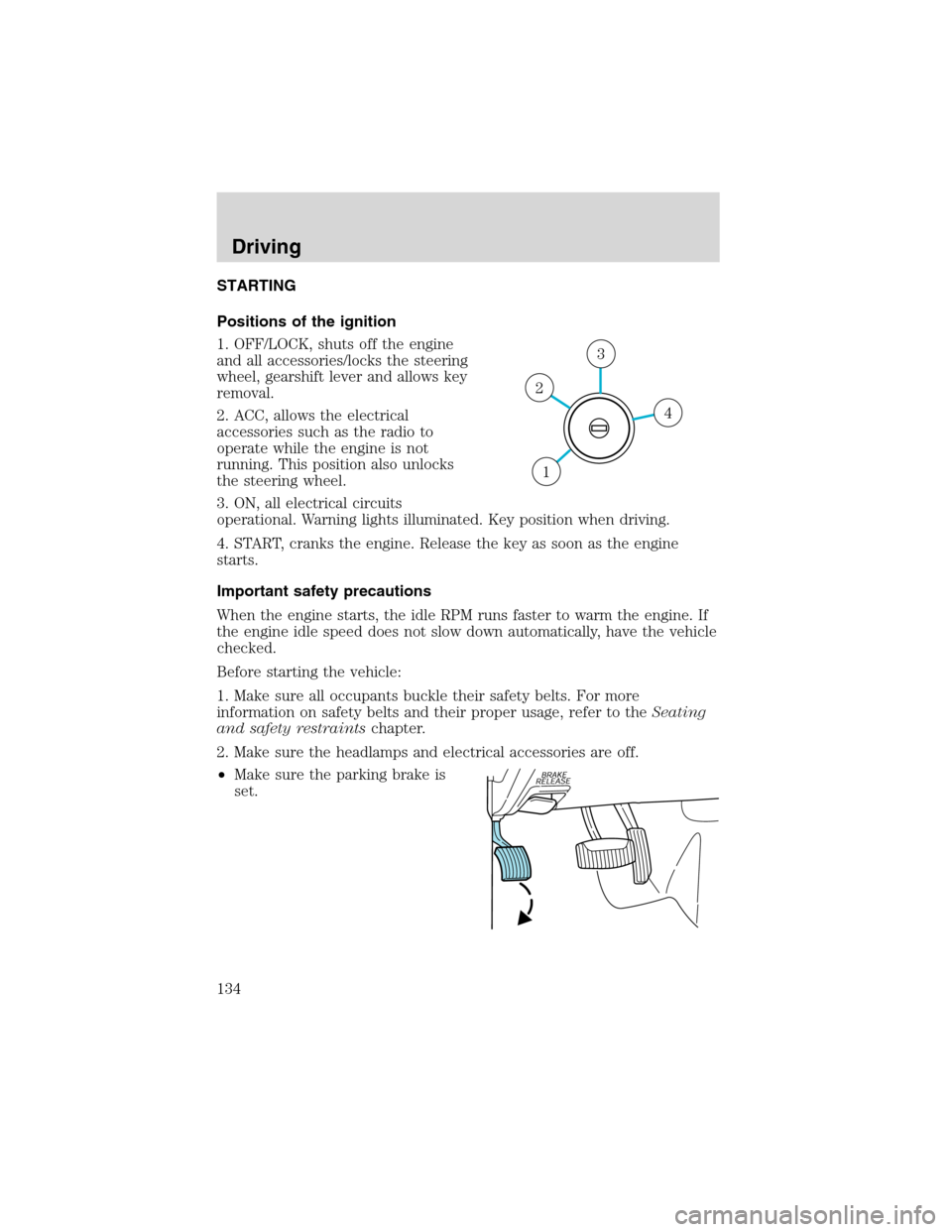
Positions of the ignition
1. OFF/LOCK, shuts off the engine
and all accessories/locks the steering
wheel, gearshift lever and allows key
removal.
2. ACC, allows the electrical
accessories such as the radio to
operate while the engine is not
running. This position also unlocks
the steering wheel.
3. ON, all electrical circuits
operational. Warning lights illuminated. Key position when driving.
4. START, cranks the engine. Release the key as soon as the engine
starts.
Important safety precautions
When the engine starts, the idle RPM runs faster to warm the engine. If
the engine idle speed does not slow down automatically, have the vehicle
checked.
Before starting the vehicle:
1. Make sure all occupants buckle their safety belts. For more
information on safety belts and their proper usage, refer to theSeating
and safety restraintschapter.
2. Make sure the headlamps and electrical accessories are off.
•Make sure the parking brake is
set.
4
3
2
1
Driving
134
Page 184 of 272
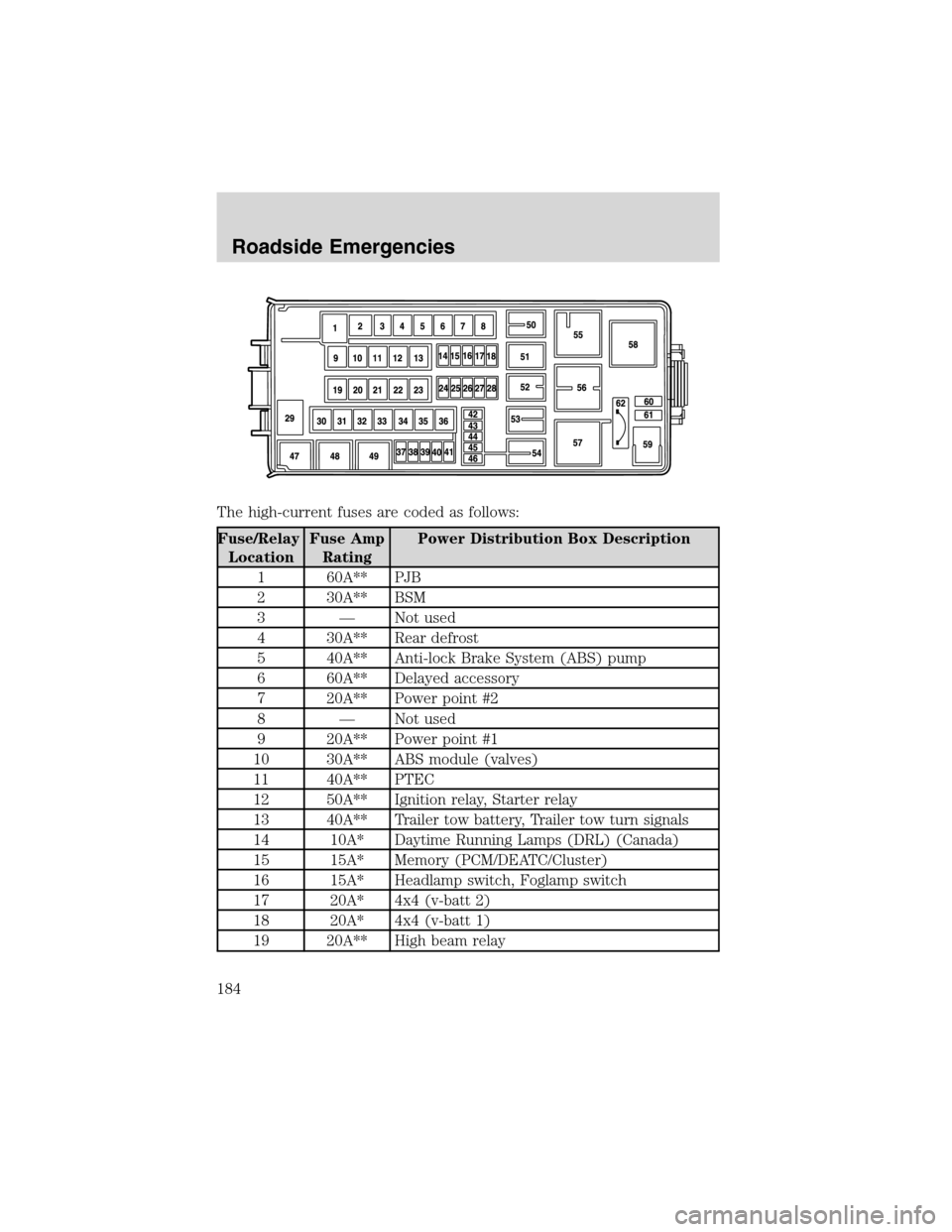
The high-current fuses are coded as follows:
Fuse/Relay
LocationFuse Amp
RatingPower Distribution Box Description
1 60A** PJB
2 30A** BSM
3—Not used
4 30A** Rear defrost
5 40A** Anti-lock Brake System (ABS) pump
6 60A** Delayed accessory
7 20A** Power point #2
8—Not used
9 20A** Power point #1
10 30A** ABS module (valves)
11 40A** PTEC
12 50A** Ignition relay, Starter relay
13 40A** Trailer tow battery, Trailer tow turn signals
14 10A* Daytime Running Lamps (DRL) (Canada)
15 15A* Memory (PCM/DEATC/Cluster)
16 15A* Headlamp switch, Foglamp switch
17 20A* 4x4 (v-batt 2)
18 20A* 4x4 (v-batt 1)
19 20A** High beam relay
Roadside Emergencies
184
Page 264 of 272
Travel equipment
Ash cup
Automatic headlamps with daytime running lights (DRL)
Cargo Organizer
Cellular phone holder
Cellular phone hands free system with voice recognition
Daytime running lights (DRL)
Dog guard
Factory luggage rack adaptors (bike and ski)
First aid kit
Fog lamps
Full vehicle cover
Highway safety kit
Inside mirror, electrochromic compass (with and without temperature
display)
Luggage/Cargo basket
Luggage basket light bracket
Luggage divider
Luggage rack cross bars
Navigation system
Neutral towing transfer case kit
Remote start system
Removable luggage rack adapters (bike and ski)
Running boards/bars
Seatback storage
Scuff plates
Smoker’s package
Soft luggage cover
Track rider bars (for luggage rack)
Trailer hitch (Class III)
Trailer hitch (Class IV)
Trailer hitch bars and balls
Accessories
264
Page 269 of 272
Engine oil ..................................221
checking and adding ..............221
dipstick ....................................221
filter, specifications ........225, 254
recommendations ...................225
refill capacities ........................254
specifications ..................257, 259
Exhaust fumes ..........................137
F
Fail safe cooling ........................234
Flexible Fuel Vehicle (FFV) ....235
Floor mats ...................................73
Fluid capacities .........................254
Foglamps .....................................33
Four-Wheel Drive vehicles .......149
driving off road ...............151, 159
indicator light .........................150
preparing to drive your
vehicle .....................................142
Fuel ............................................235
calculating fuel
economy ............................64, 241
cap ...........................................240
capacity ...................................254
choosing the right fuel ...........238
comparisons with EPA fuel
economy estimates .................244
detergent in fuel .....................240
filling your vehicle
with fuel ..................235, 240–241
filter, specifications ........241, 254
fuel pump shut-off switch .....177
improving fuel economy ........241
octane rating ...................238, 259
quality ......................................239
running out of fuel .................240
safety information relating to
automotive fuels .....................235Fuel - flex fuel vehicle
(FFV) .................................235, 238
Fuses ..................................178, 180
G
Garage door opener ..............46, 56
Gas cap (see Fuel cap) ............240
Gas mileage
(see Fuel economy) .................241
Gauges .........................................14
GAWR (Gross Axle Weight
Rating) .......................................167
calculating ...............................169
definition .................................167
driving with a heavy load ......167
location ....................................167
GVWR (Gross Vehicle Weight
Rating) .......................................167
calculating .......................167, 169
definition .................................167
driving with a heavy load ......167
location ....................................167
H
Head restraints ...........................91
Headlamps
aiming ........................................35
bulb specifications ....................38
daytime running lights .............33
flash to pass ..............................34
high beam .................................34
Heating
heating and air
conditioning system ...........27–28
HomeLink universal
transceiver (see Garage
door opener) .........................56, 59
Index
269