tire pressure FORD EXPLORER 2009 4.G Owner's Guide
[x] Cancel search | Manufacturer: FORD, Model Year: 2009, Model line: EXPLORER, Model: FORD EXPLORER 2009 4.GPages: 407, PDF Size: 3.47 MB
Page 324 of 407
Location of the spare tire and tools
The spare tire and tools for your vehicle are stowed in the following
locations:
Tool Location
Spare tire Under the vehicle, just in front of
the rear bumper. The spare tire
winch drive nut is located at the
rear center of the cargo area
under a lid.
Jack, lug nut wrench, jack handle,
wheel chockBehind the rear seat under the
carpeted floor lid in the cargo
floor. The tools are located in a
bag attached to the jack.
Removing the jack and tools
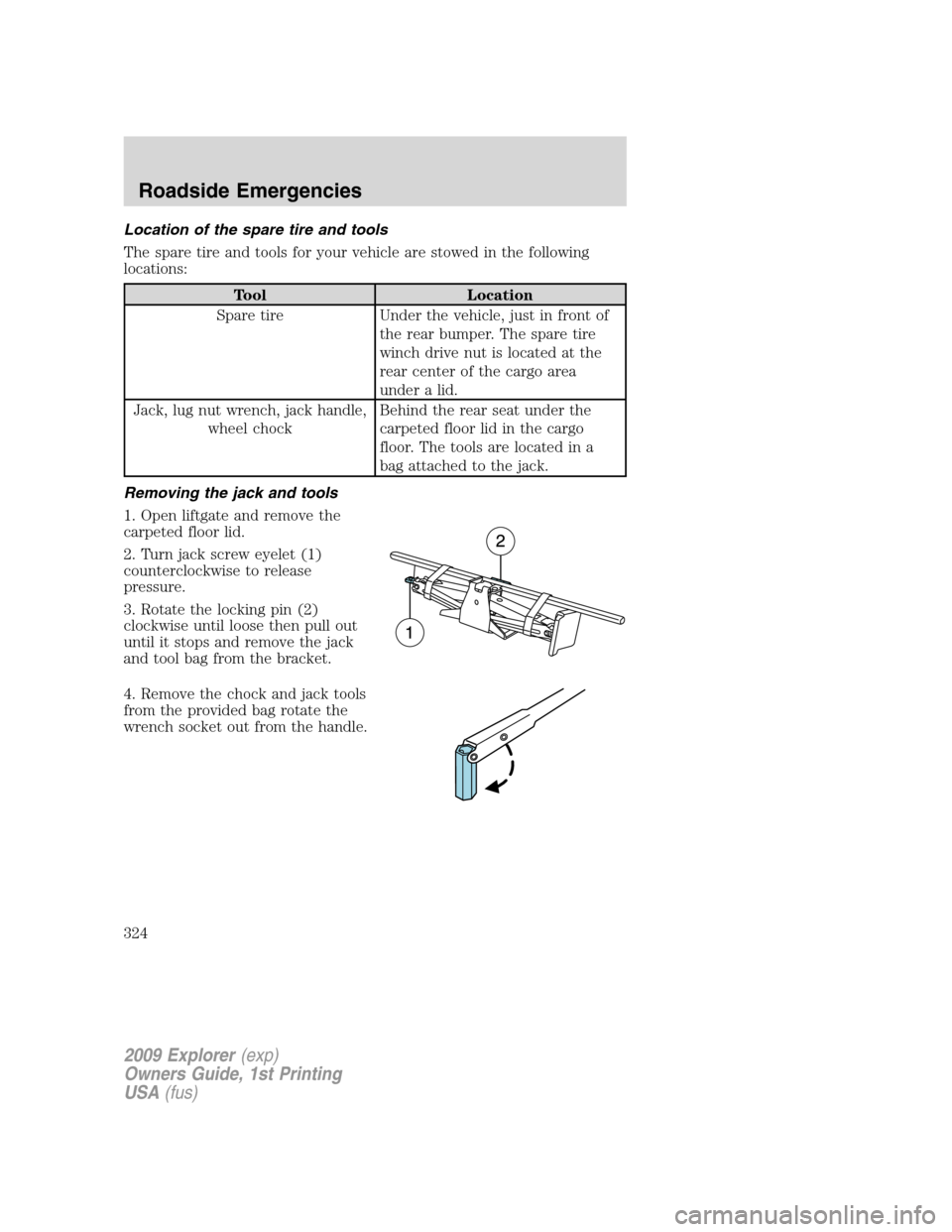
1. Open liftgate and remove the
carpeted floor lid.
2. Turn jack screw eyelet (1)
counterclockwise to release
pressure.
3. Rotate the locking pin (2)
clockwise until loose then pull out
until it stops and remove the jack
and tool bag from the bracket.
4. Remove the chock and jack tools
from the provided bag rotate the
wrench socket out from the handle.
2009 Explorer(exp)
Owners Guide, 1st Printing
USA(fus)
Roadside Emergencies
324
Page 329 of 407
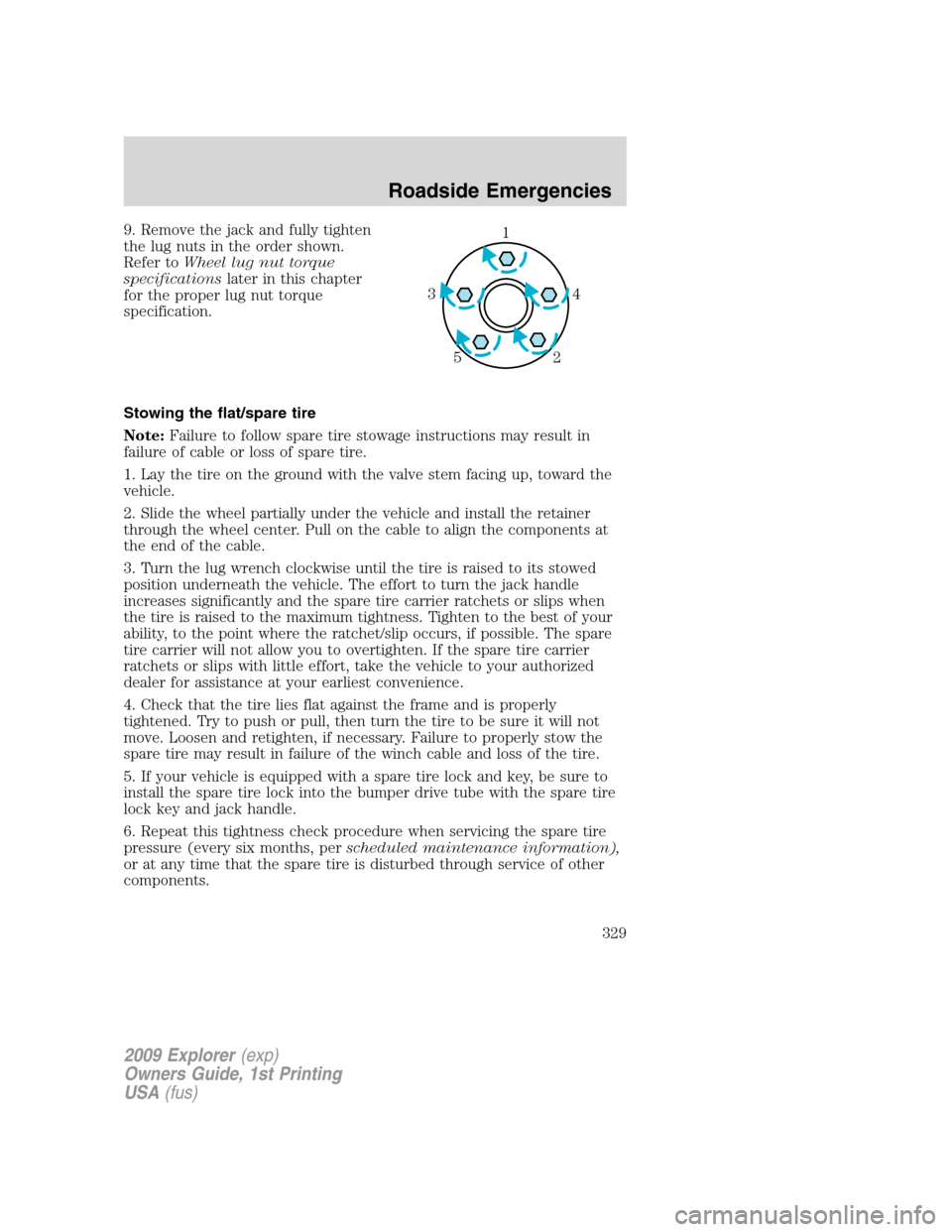
9. Remove the jack and fully tighten
the lug nuts in the order shown.
Refer toWheel lug nut torque
specificationslater in this chapter
for the proper lug nut torque
specification.
Stowing the flat/spare tire
Note:Failure to follow spare tire stowage instructions may result in
failure of cable or loss of spare tire.
1. Lay the tire on the ground with the valve stem facing up, toward the
vehicle.
2. Slide the wheel partially under the vehicle and install the retainer
through the wheel center. Pull on the cable to align the components at
the end of the cable.
3. Turn the lug wrench clockwise until the tire is raised to its stowed
position underneath the vehicle. The effort to turn the jack handle
increases significantly and the spare tire carrier ratchets or slips when
the tire is raised to the maximum tightness. Tighten to the best of your
ability, to the point where the ratchet/slip occurs, if possible. The spare
tire carrier will not allow you to overtighten. If the spare tire carrier
ratchets or slips with little effort, take the vehicle to your authorized
dealer for assistance at your earliest convenience.
4. Check that the tire lies flat against the frame and is properly
tightened. Try to push or pull, then turn the tire to be sure it will not
move. Loosen and retighten, if necessary. Failure to properly stow the
spare tire may result in failure of the winch cable and loss of the tire.
5. If your vehicle is equipped with a spare tire lock and key, be sure to
install the spare tire lock into the bumper drive tube with the spare tire
lock key and jack handle.
6. Repeat this tightness check procedure when servicing the spare tire
pressure (every six months, perscheduled maintenance information),
or at any time that the spare tire is disturbed through service of other
components.1
4 3
2 5
2009 Explorer(exp)
Owners Guide, 1st Printing
USA(fus)
Roadside Emergencies
329
Page 383 of 407
•You may want to turn off the speed control in hilly terrain if
unnecessary shifting between the top gears occurs. Unnecessary
shifting of this type could result in reduced fuel economy.
•Warming up a vehicle on cold mornings is not required and may
reduce fuel economy.
•Resting your foot on the brake pedal while driving may reduce fuel
economy.
•Combine errands and minimize stop-and-go driving.
Maintenance
•Keep tires properly inflated and use only recommended size.
•Operating a vehicle with the wheels out of alignment will reduce fuel
economy.
•Use recommended engine oil. Refer toMaintenance product
specifications and capacitiesin this chapter.
•Perform all regularly scheduled maintenance items. Follow the
recommended maintenance schedule and owner maintenance checks
found inscheduled maintenance information.
Conditions
•Heavily loading a vehicle or towing a trailer may reduce fuel economy
at any speed.
•Carrying unnecessary weight may reduce fuel economy (approximately
1 mpg [0.4 km/L] is lost for every 400 lb [180 kg] of weight carried).
•Adding certain accessories to your vehicle (for example; bug
deflectors, rollbars/light bars, running boards, ski/luggage racks) may
reduce fuel economy.
•Fuel economy may decrease with lower temperatures during the first
8–10 miles (12–16 km) of driving.
•Driving on flat terrain offers improved fuel economy as compared to
driving on hilly terrain.
•Transmissions give their best fuel economy when operated in the top
cruise gear and with steady pressure on the gas pedal.
•Four-wheel-drive operation (if equipped) is less fuel efficient than
two-wheel-drive operation.
•Close windows for high speed driving.
2009 Explorer(exp)
Owners Guide, 1st Printing
USA(fus)
Maintenance and Specifications
383
Page 406 of 407
SecuriLock passive anti-theft
system ........................................166
Setting the clock
AM/FM single CD .....................27
AM/FM/In-dash 6 CD ................35
Snowplowing .................................8
Spark plugs,
specifications .....................391, 396
Special notice
ambulance conversions ..............8
utility-type vehicles ....................7
Specification chart,
lubricants ...................................392
Speed control ............................111
Starting your
vehicle ........................274–275, 277
jump starting ..........................331
Steering wheel
controls ....................................114
tilting .......................................101
SYNC ............................................81
T
Tilt steering wheel ....................101
Tire Pressure Monitoring
System (TPMS)
Driving .....................................305
Roadside Emergencies ...........321
Tires, Wheels and Loading ....255
Warning Displays ......12, 131, 146
Tires ...........................240–241, 321
alignment ................................249
care ..........................................245
changing ..........................321, 326
checking the pressure ............245
inflating ...................................242
label .........................................254replacing ..........................246, 326
rotating ....................................249
safety practices .......................248
sidewall information ...............250
snow tires and chains ............260
spare tire .................321, 324–325
terminology .............................242
tire grades ...............................241
treadwear ........................241, 245
Towing .......................................267
recreational towing .................273
trailer towing ..........................267
wrecker ....................................337
Transfer case
fluid checking .........................388
Transmission .............................289
brake-shift interlock (BSI) ....289
fluid, checking and adding
(automatic) .............................388
fluid, refill capacities ..............392
lubricant specifications ..........392
Turn signal ..................................93
U
USB port ......................................43
V
Vehicle Identification Number
(VIN) ..........................................397
Vehicle loading ..........................260
Ventilating your vehicle ...........277
W
Warning lights (see Lights) .......12
Washer fluid ..............................359
Water, Driving through .............309
Windows ....................................161
2009 Explorer(exp)
Owners Guide, 1st Printing
USA(fus)
Index
406