snow chains FORD EXPLORER 2009 4.G Owners Manual
[x] Cancel search | Manufacturer: FORD, Model Year: 2009, Model line: EXPLORER, Model: FORD EXPLORER 2009 4.GPages: 407, PDF Size: 3.47 MB
Page 260 of 407
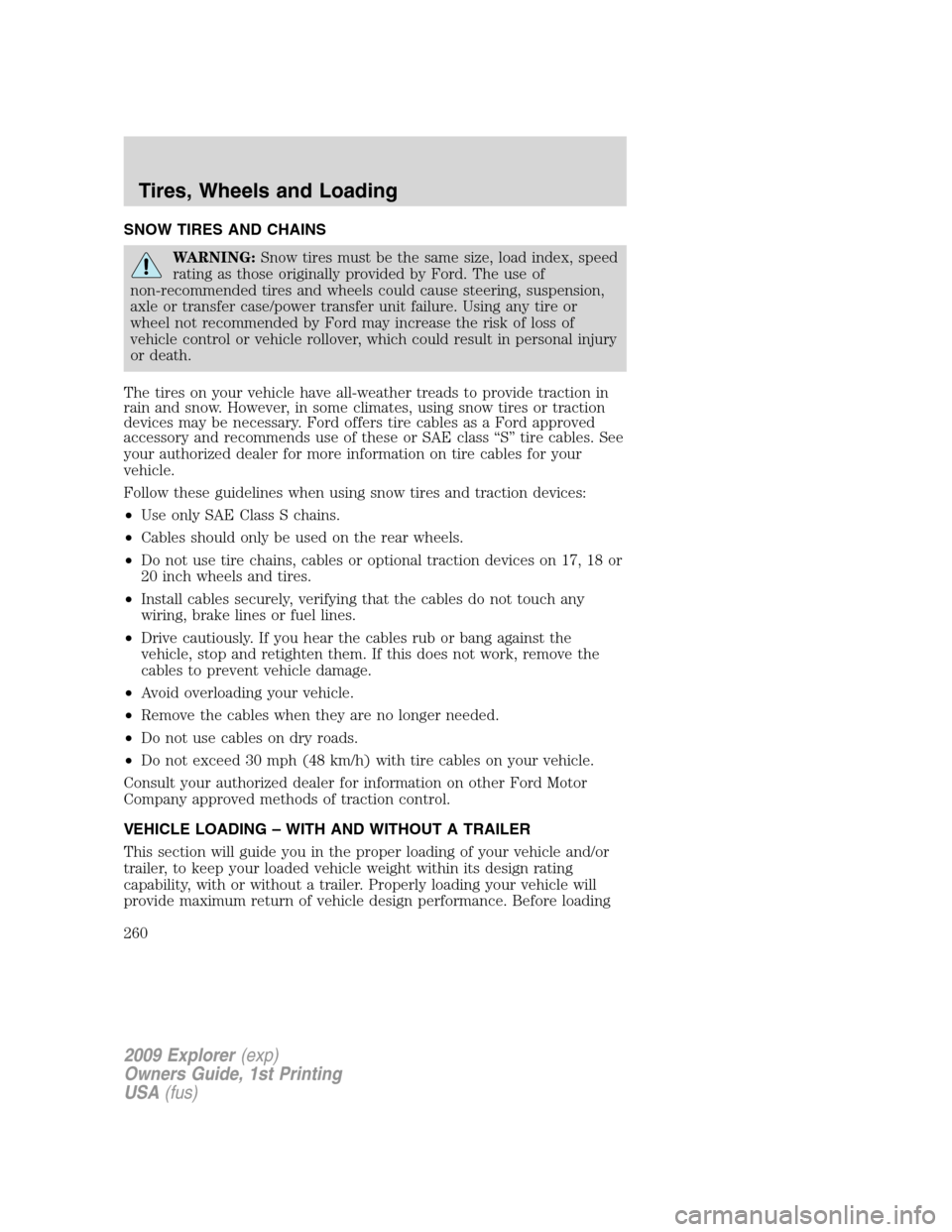
SNOW TIRES AND CHAINS
WARNING:Snow tires must be the same size, load index, speed
rating as those originally provided by Ford. The use of
non-recommended tires and wheels could cause steering, suspension,
axle or transfer case/power transfer unit failure. Using any tire or
wheel not recommended by Ford may increase the risk of loss of
vehicle control or vehicle rollover, which could result in personal injury
or death.
The tires on your vehicle have all-weather treads to provide traction in
rain and snow. However, in some climates, using snow tires or traction
devices may be necessary. Ford offers tire cables as a Ford approved
accessory and recommends use of these or SAE class “S” tire cables. See
your authorized dealer for more information on tire cables for your
vehicle.
Follow these guidelines when using snow tires and traction devices:
•Use only SAE Class S chains.
•Cables should only be used on the rear wheels.
•Do not use tire chains, cables or optional traction devices on 17, 18 or
20 inch wheels and tires.
•Install cables securely, verifying that the cables do not touch any
wiring, brake lines or fuel lines.
•Drive cautiously. If you hear the cables rub or bang against the
vehicle, stop and retighten them. If this does not work, remove the
cables to prevent vehicle damage.
•Avoid overloading your vehicle.
•Remove the cables when they are no longer needed.
•Do not use cables on dry roads.
•Do not exceed 30 mph (48 km/h) with tire cables on your vehicle.
Consult your authorized dealer for information on other Ford Motor
Company approved methods of traction control.
VEHICLE LOADING – WITH AND WITHOUT A TRAILER
This section will guide you in the proper loading of your vehicle and/or
trailer, to keep your loaded vehicle weight within its design rating
capability, with or without a trailer. Properly loading your vehicle will
provide maximum return of vehicle design performance. Before loading
2009 Explorer(exp)
Owners Guide, 1st Printing
USA(fus)
Tires, Wheels and Loading
260
Page 308 of 407
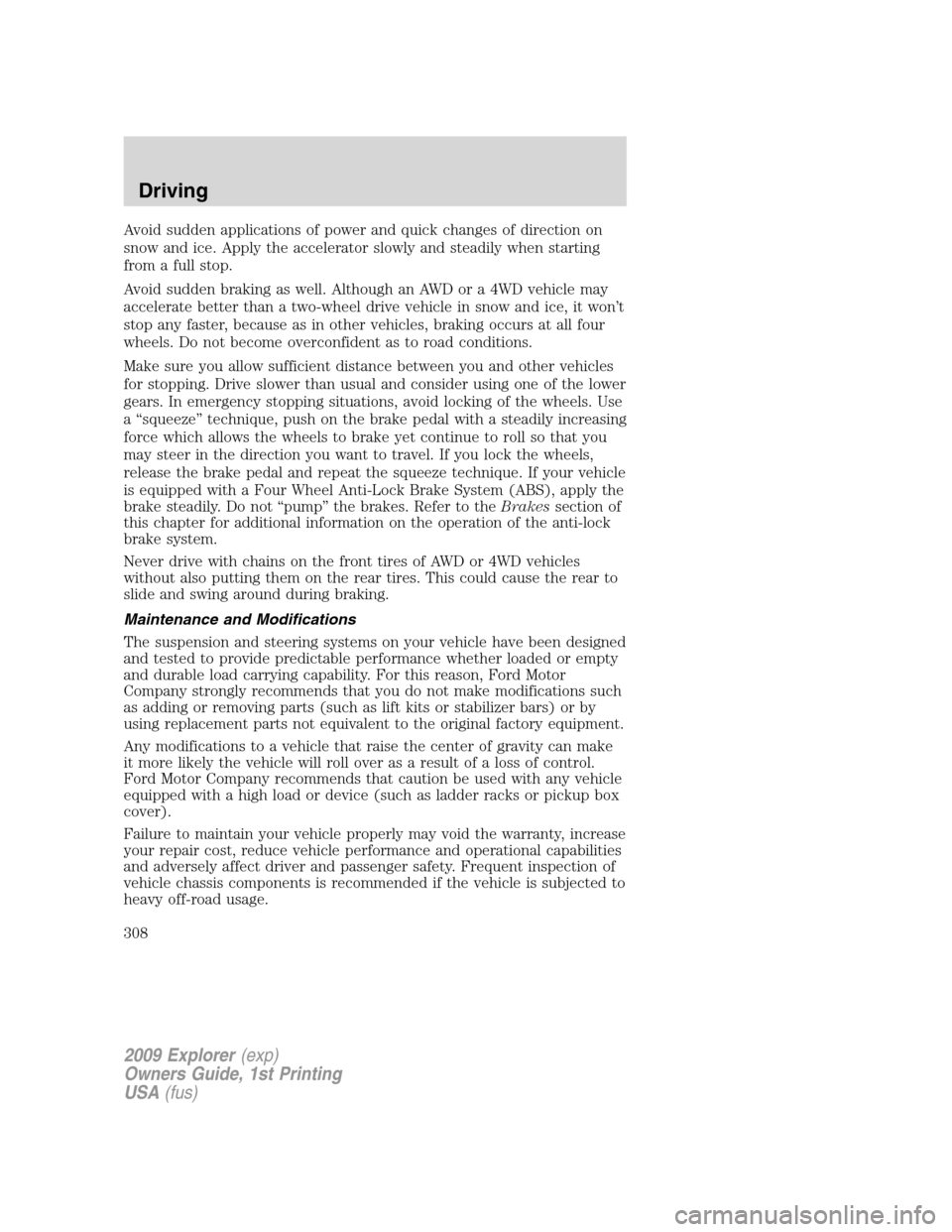
Avoid sudden applications of power and quick changes of direction on
snow and ice. Apply the accelerator slowly and steadily when starting
from a full stop.
Avoid sudden braking as well. Although an AWD or a 4WD vehicle may
accelerate better than a two-wheel drive vehicle in snow and ice, it won’t
stop any faster, because as in other vehicles, braking occurs at all four
wheels. Do not become overconfident as to road conditions.
Make sure you allow sufficient distance between you and other vehicles
for stopping. Drive slower than usual and consider using one of the lower
gears. In emergency stopping situations, avoid locking of the wheels. Use
a “squeeze” technique, push on the brake pedal with a steadily increasing
force which allows the wheels to brake yet continue to roll so that you
may steer in the direction you want to travel. If you lock the wheels,
release the brake pedal and repeat the squeeze technique. If your vehicle
is equipped with a Four Wheel Anti-Lock Brake System (ABS), apply the
brake steadily. Do not “pump” the brakes. Refer to theBrakessection of
this chapter for additional information on the operation of the anti-lock
brake system.
Never drive with chains on the front tires of AWD or 4WD vehicles
without also putting them on the rear tires. This could cause the rear to
slide and swing around during braking.
Maintenance and Modifications
The suspension and steering systems on your vehicle have been designed
and tested to provide predictable performance whether loaded or empty
and durable load carrying capability. For this reason, Ford Motor
Company strongly recommends that you do not make modifications such
as adding or removing parts (such as lift kits or stabilizer bars) or by
using replacement parts not equivalent to the original factory equipment.
Any modifications to a vehicle that raise the center of gravity can make
it more likely the vehicle will roll over as a result of a loss of control.
Ford Motor Company recommends that caution be used with any vehicle
equipped with a high load or device (such as ladder racks or pickup box
cover).
Failure to maintain your vehicle properly may void the warranty, increase
your repair cost, reduce vehicle performance and operational capabilities
and adversely affect driver and passenger safety. Frequent inspection of
vehicle chassis components is recommended if the vehicle is subjected to
heavy off-road usage.
2009 Explorer(exp)
Owners Guide, 1st Printing
USA(fus)
Driving
308
Page 322 of 407
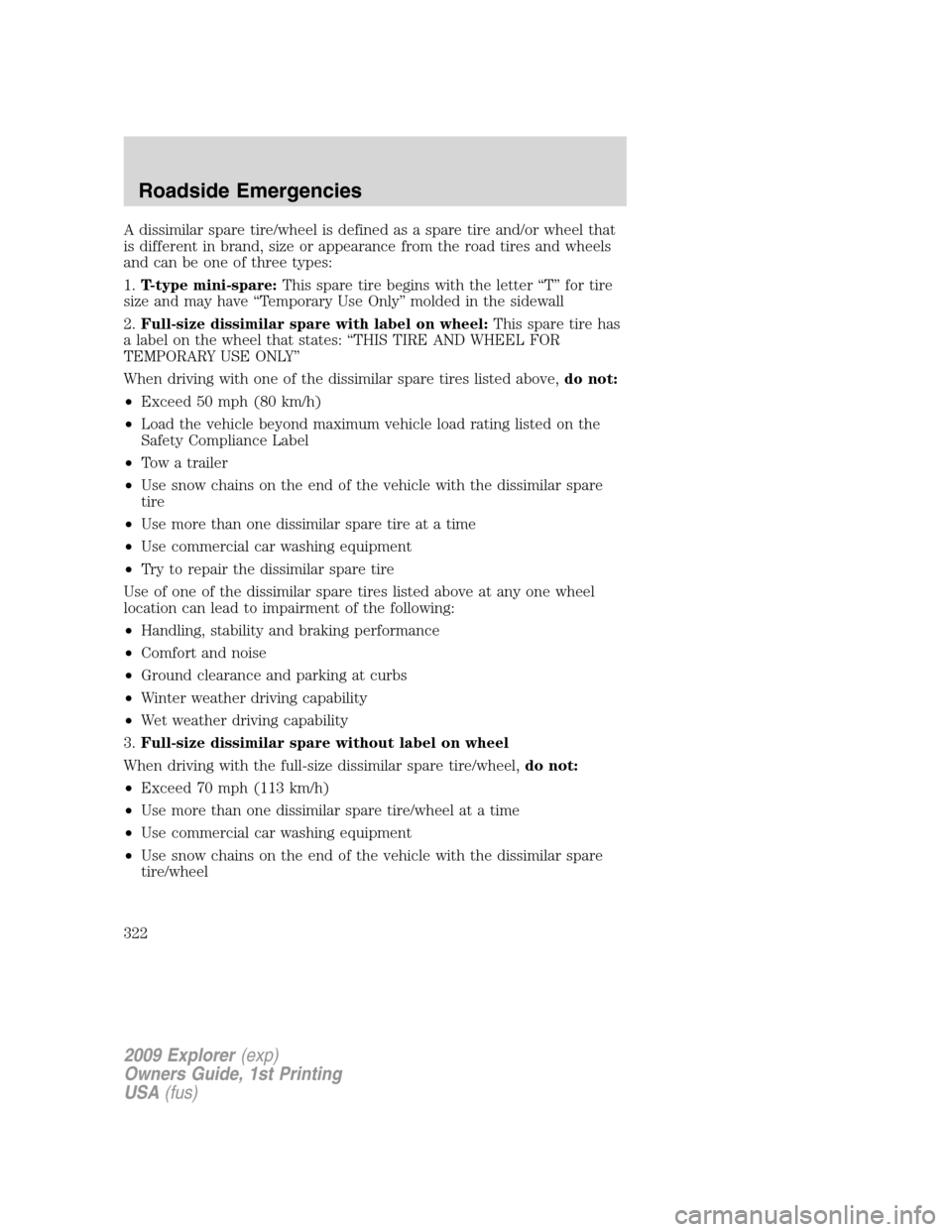
A dissimilar spare tire/wheel is defined as a spare tire and/or wheel that
is different in brand, size or appearance from the road tires and wheels
and can be one of three types:
1.T-type mini-spare:This spare tire begins with the letter “T” for tire
size and may have “Temporary Use Only” molded in the sidewall
2.Full-size dissimilar spare with label on wheel:This spare tire has
a label on the wheel that states: “THIS TIRE AND WHEEL FOR
TEMPORARY USE ONLY”
When driving with one of the dissimilar spare tires listed above,do not:
•Exceed 50 mph (80 km/h)
•Load the vehicle beyond maximum vehicle load rating listed on the
Safety Compliance Label
•Tow a trailer
•Use snow chains on the end of the vehicle with the dissimilar spare
tire
•Use more than one dissimilar spare tire at a time
•Use commercial car washing equipment
•Try to repair the dissimilar spare tire
Use of one of the dissimilar spare tires listed above at any one wheel
location can lead to impairment of the following:
•Handling, stability and braking performance
•Comfort and noise
•Ground clearance and parking at curbs
•Winter weather driving capability
•Wet weather driving capability
3.Full-size dissimilar spare without label on wheel
When driving with the full-size dissimilar spare tire/wheel,do not:
•Exceed 70 mph (113 km/h)
•Use more than one dissimilar spare tire/wheel at a time
•Use commercial car washing equipment
•Use snow chains on the end of the vehicle with the dissimilar spare
tire/wheel
2009 Explorer(exp)
Owners Guide, 1st Printing
USA(fus)
Roadside Emergencies
322
Page 406 of 407
SecuriLock passive anti-theft
system ........................................166
Setting the clock
AM/FM single CD .....................27
AM/FM/In-dash 6 CD ................35
Snowplowing .................................8
Spark plugs,
specifications .....................391, 396
Special notice
ambulance conversions ..............8
utility-type vehicles ....................7
Specification chart,
lubricants ...................................392
Speed control ............................111
Starting your
vehicle ........................274–275, 277
jump starting ..........................331
Steering wheel
controls ....................................114
tilting .......................................101
SYNC ............................................81
T
Tilt steering wheel ....................101
Tire Pressure Monitoring
System (TPMS)
Driving .....................................305
Roadside Emergencies ...........321
Tires, Wheels and Loading ....255
Warning Displays ......12, 131, 146
Tires ...........................240–241, 321
alignment ................................249
care ..........................................245
changing ..........................321, 326
checking the pressure ............245
inflating ...................................242
label .........................................254replacing ..........................246, 326
rotating ....................................249
safety practices .......................248
sidewall information ...............250
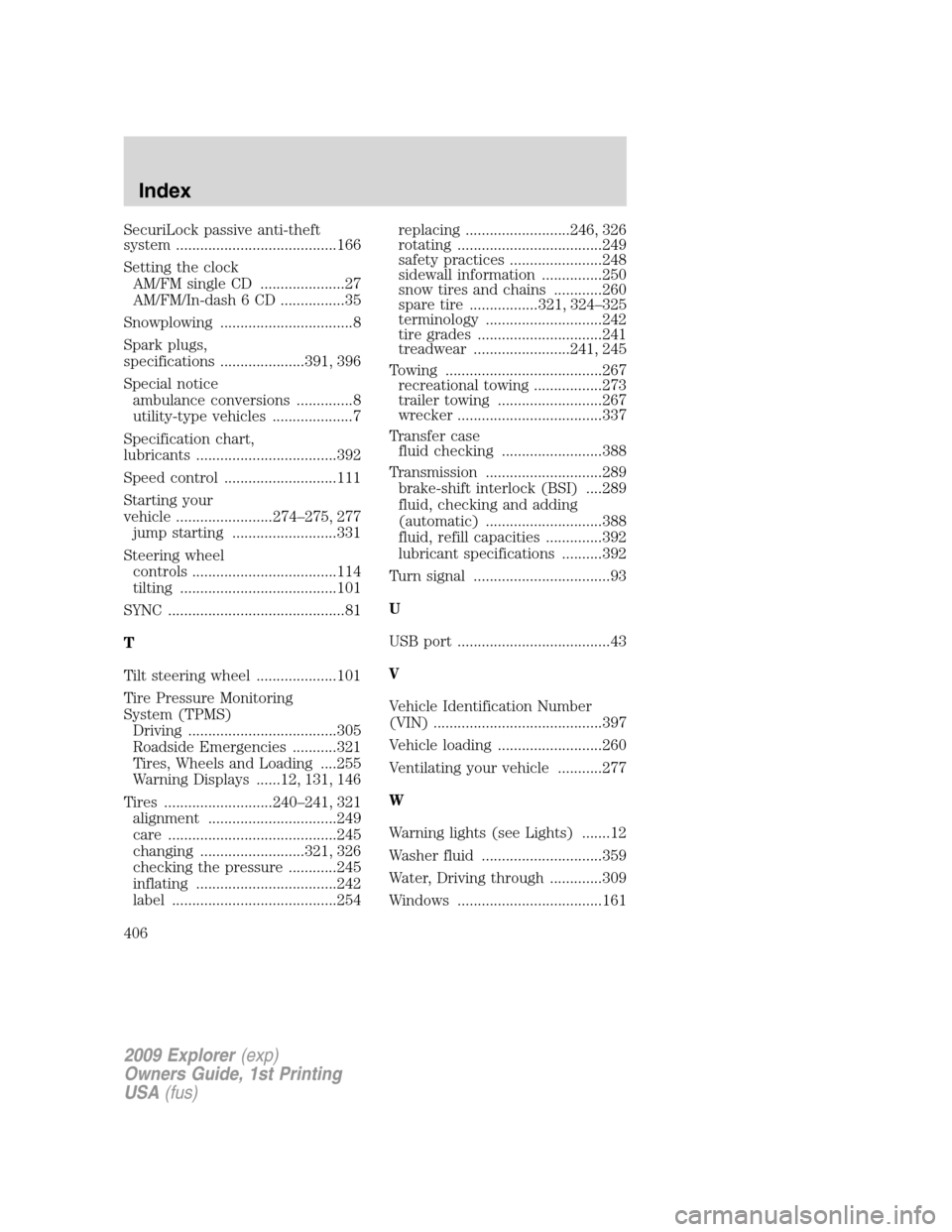
snow tires and chains ............260
spare tire .................321, 324–325
terminology .............................242
tire grades ...............................241
treadwear ........................241, 245
Towing .......................................267
recreational towing .................273
trailer towing ..........................267
wrecker ....................................337
Transfer case
fluid checking .........................388
Transmission .............................289
brake-shift interlock (BSI) ....289
fluid, checking and adding
(automatic) .............................388
fluid, refill capacities ..............392
lubricant specifications ..........392
Turn signal ..................................93
U
USB port ......................................43
V
Vehicle Identification Number
(VIN) ..........................................397
Vehicle loading ..........................260
Ventilating your vehicle ...........277
W
Warning lights (see Lights) .......12
Washer fluid ..............................359
Water, Driving through .............309
Windows ....................................161
2009 Explorer(exp)
Owners Guide, 1st Printing
USA(fus)
Index
406