4WD FORD EXPLORER 2013 5.G User Guide
[x] Cancel search | Manufacturer: FORD, Model Year: 2013, Model line: EXPLORER, Model: FORD EXPLORER 2013 5.GPages: 576, PDF Size: 6.87 MB
Page 289 of 576
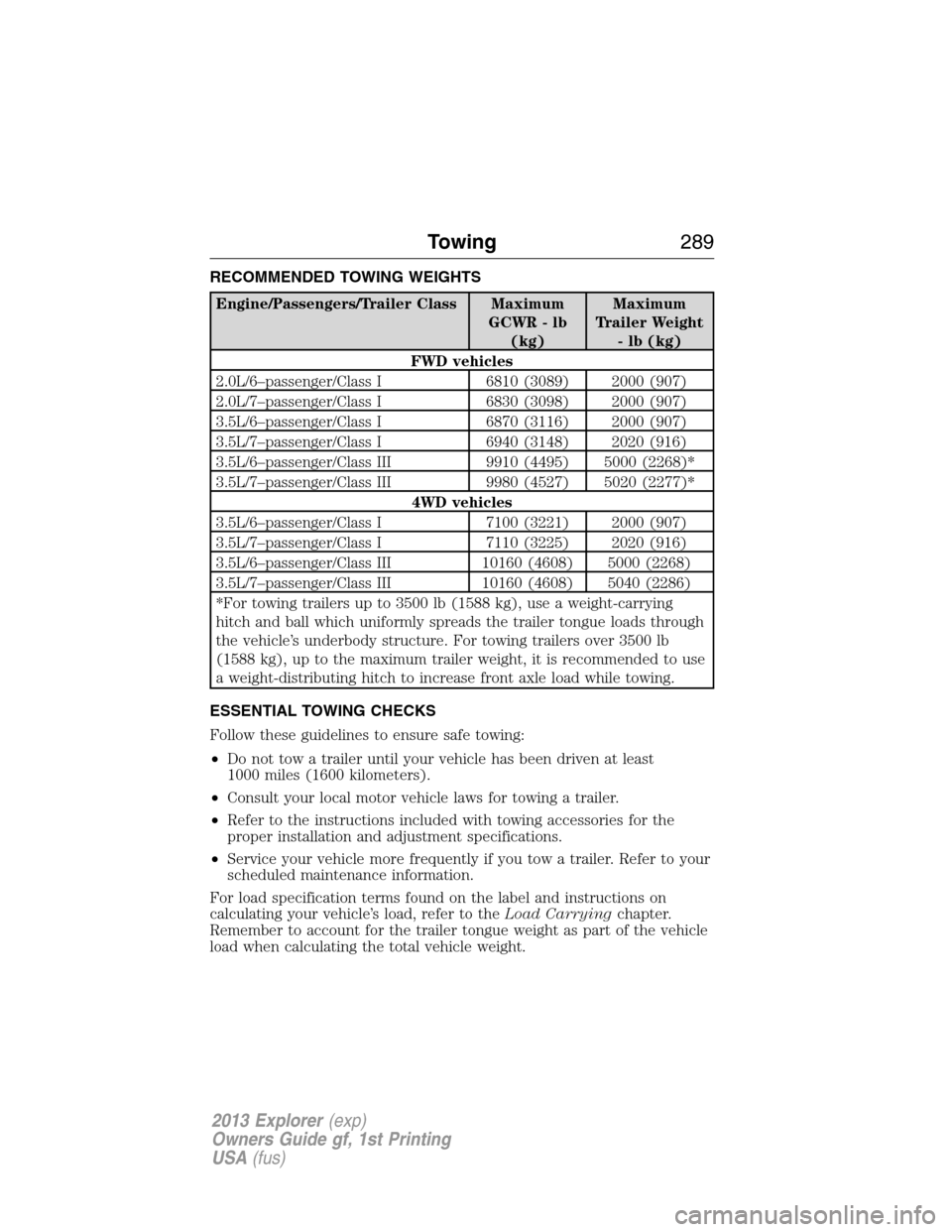
RECOMMENDED TOWING WEIGHTS
Engine/Passengers/Trailer Class Maximum
GCWR - lb
(kg)Maximum
Trailer Weight
- lb (kg)
FWD vehicles
2.0L/6–passenger/Class I 6810 (3089) 2000 (907)
2.0L/7–passenger/Class I 6830 (3098) 2000 (907)
3.5L/6–passenger/Class I 6870 (3116) 2000 (907)
3.5L/7–passenger/Class I 6940 (3148) 2020 (916)
3.5L/6–passenger/Class III 9910 (4495) 5000 (2268)*
3.5L/7–passenger/Class III 9980 (4527) 5020 (2277)*
4WD vehicles
3.5L/6–passenger/Class I 7100 (3221) 2000 (907)
3.5L/7–passenger/Class I 7110 (3225) 2020 (916)
3.5L/6–passenger/Class III 10160 (4608) 5000 (2268)
3.5L/7–passenger/Class III 10160 (4608) 5040 (2286)
*For towing trailers up to 3500 lb (1588 kg), use a weight-carrying
hitch and ball which uniformly spreads the trailer tongue loads through
the vehicle’s underbody structure. For towing trailers over 3500 lb
(1588 kg), up to the maximum trailer weight, it is recommended to use
a weight-distributing hitch to increase front axle load while towing.
ESSENTIAL TOWING CHECKS
Follow these guidelines to ensure safe towing:
•Do not tow a trailer until your vehicle has been driven at least
1000 miles (1600 kilometers).
•Consult your local motor vehicle laws for towing a trailer.
•Refer to the instructions included with towing accessories for the
proper installation and adjustment specifications.
•Service your vehicle more frequently if you tow a trailer. Refer to your
scheduled maintenance information.
For load specification terms found on the label and instructions on
calculating your vehicle’s load, refer to theLoad Carryingchapter.
Remember to account for the trailer tongue weight as part of the vehicle
load when calculating the total vehicle weight.
Towing289
2013 Explorer(exp)
Owners Guide gf, 1st Printing
USA(fus)
Page 360 of 576
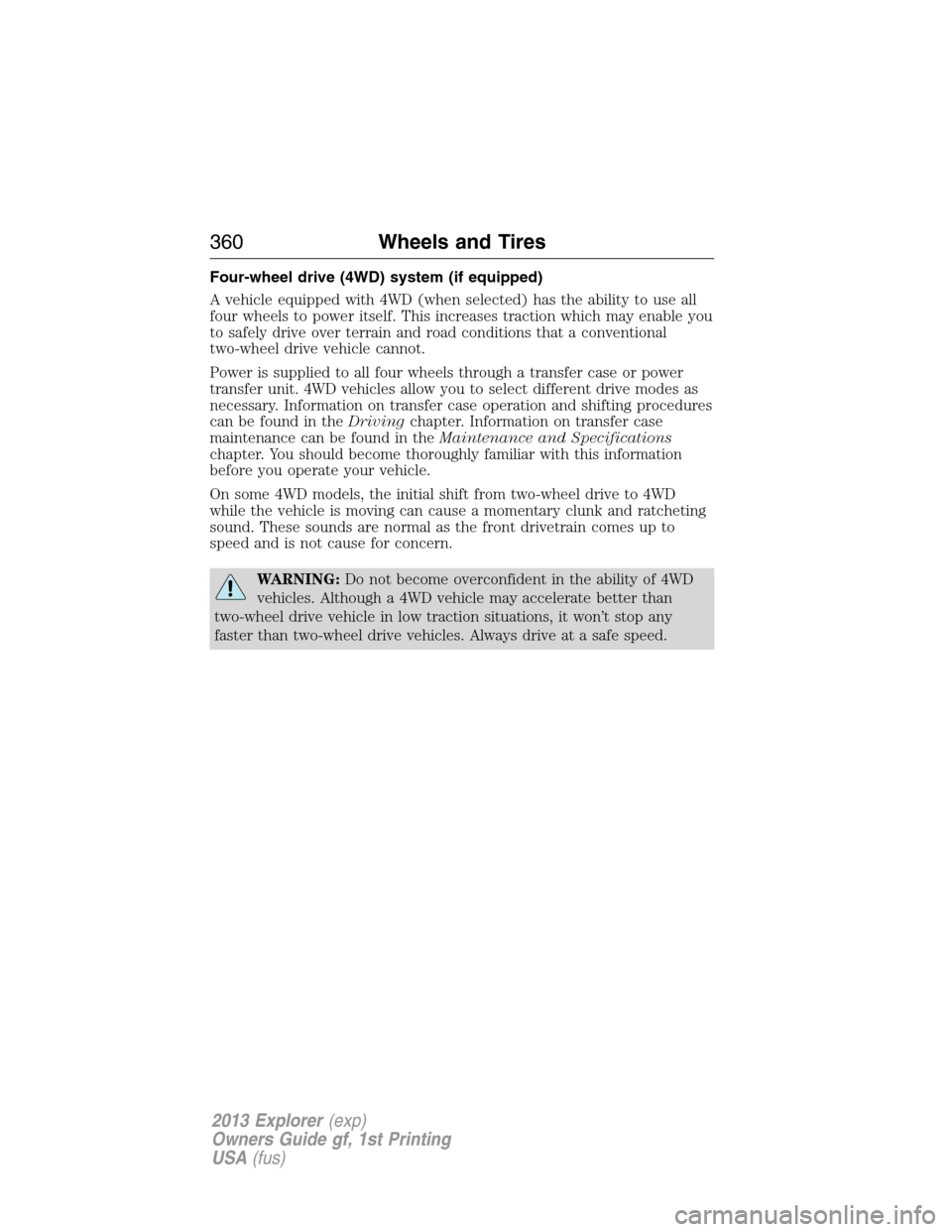
Four-wheel drive (4WD) system (if equipped)
A vehicle equipped with 4WD (when selected) has the ability to use all
four wheels to power itself. This increases traction which may enable you
to safely drive over terrain and road conditions that a conventional
two-wheel drive vehicle cannot.
Power is supplied to all four wheels through a transfer case or power
transfer unit. 4WD vehicles allow you to select different drive modes as
necessary. Information on transfer case operation and shifting procedures
can be found in theDrivingchapter. Information on transfer case
maintenance can be found in theMaintenance and Specifications
chapter. You should become thoroughly familiar with this information
before you operate your vehicle.
On some 4WD models, the initial shift from two-wheel drive to 4WD
while the vehicle is moving can cause a momentary clunk and ratcheting
sound. These sounds are normal as the front drivetrain comes up to
speed and is not cause for concern.
WARNING:Do not become overconfident in the ability of 4WD
vehicles. Although a 4WD vehicle may accelerate better than
two-wheel drive vehicle in low traction situations, it won’t stop any
faster than two-wheel drive vehicles. Always drive at a safe speed.
360Wheels and Tires
2013 Explorer(exp)
Owners Guide gf, 1st Printing
USA(fus)