seats FORD EXPLORER SPORT 2002 1.G Owners Manual
[x] Cancel search | Manufacturer: FORD, Model Year: 2002, Model line: EXPLORER SPORT, Model: FORD EXPLORER SPORT 2002 1.GPages: 184, PDF Size: 2.8 MB
Page 5 of 184
Warning symbols on your vehicle
When you see this symbol, it is
imperative that you consult the relevant
section of this guide before touching or
attempting adjustment of any kind.
Protecting the environment
We must all play our part in protecting the
environment. Correct vehicle usage and the
authorized disposal of waste cleaning and
lubrication materials are significant steps
towards this aim. Information in this respect
is highlighted in this guide with the tree symbol.
SPECIAL NOTICES
Special instructions
For your added safety, your vehicle is fitted with sophisticated electronic
controls.
By operating other electronic equipment (e.g. mobile telephone
without exterior aerial) electromagnetic fields can occur which
can cause malfunctions of the vehicle electronics. Therefore you should
observe the instructions of the equipment manufacturers.
Please read the sectionAir bagin theSeating and safety
restraintschapter. Failure to follow the specific warnings and
instructions could result in personal injury.
Front seat mounted rear-facing child or infant seats should
NEVERbe used in front of a passenger side air bag.
MIDDLE EAST/NORTH AFRICA VEHICLE SPECIFIC INFORMATION
For your particular global region, your vehicle may be equipped with
features and options that are different from the ones that are described
in this Owner Guide; therefore, a supplement has been supplied that
complements this book. By referring to the pages in the provided
supplement, you can properly identify those features, recommendations
and specifications that are unique to your vehicle.Refer to this Owner
Guide for all other required information and warnings.
Introduction
5
Page 20 of 184
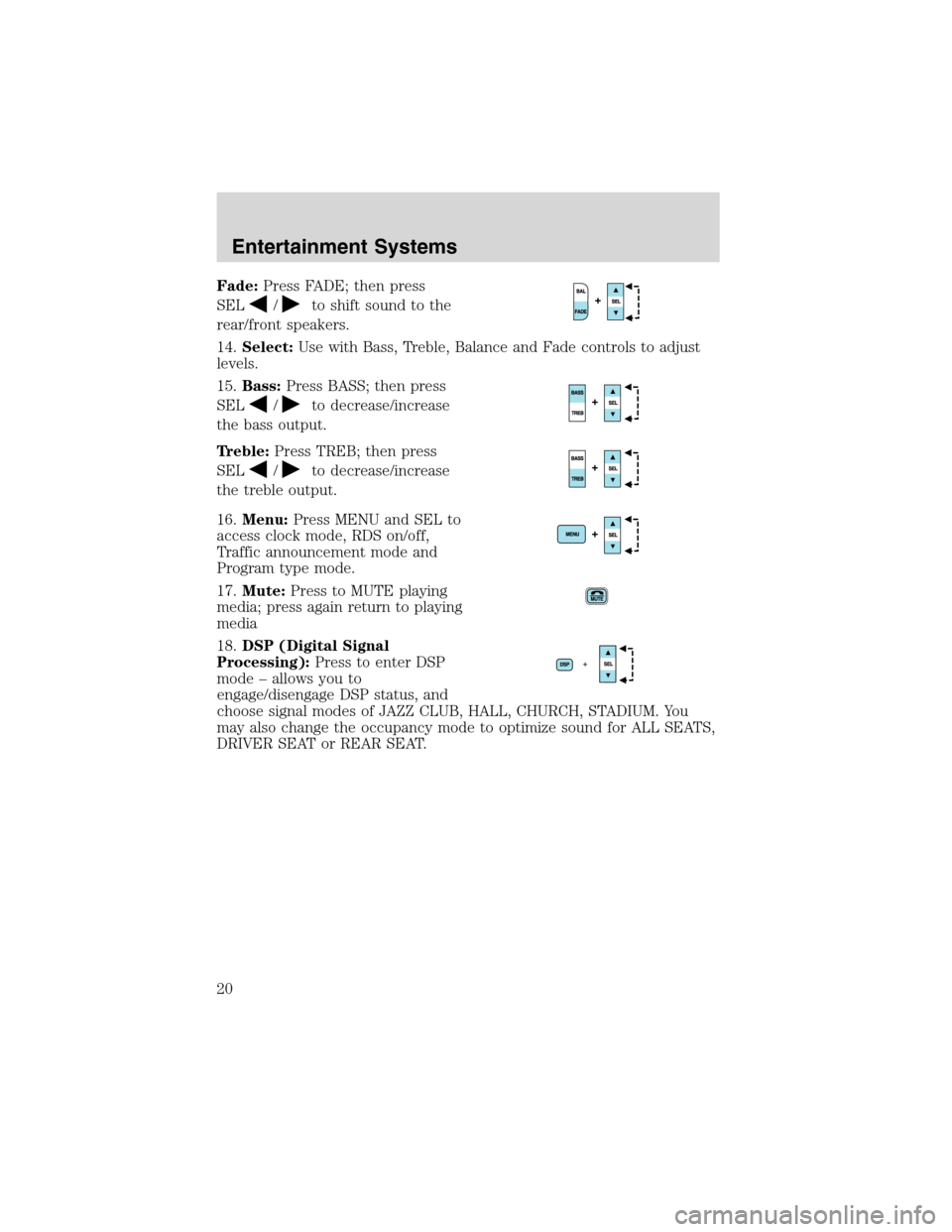
Fade:Press FADE; then press
SEL
/to shift sound to the
rear/front speakers.
14.Select:Use with Bass, Treble, Balance and Fade controls to adjust
levels.
15.Bass:Press BASS; then press
SEL
/to decrease/increase
the bass output.
Treble:Press TREB; then press
SEL
/to decrease/increase
the treble output.
16.Menu:Press MENU and SEL to
access clock mode, RDS on/off,
Traffic announcement mode and
Program type mode.
17.Mute:Press to MUTE playing
media; press again return to playing
media
18.DSP (Digital Signal
Processing):Press to enter DSP
mode–allows you to
engage/disengage DSP status, and
choose signal modes of JAZZ CLUB, HALL, CHURCH, STADIUM. You
may also change the occupancy mode to optimize sound for ALL SEATS,
DRIVER SEAT or REAR SEAT.
Entertainment Systems
20
Page 22 of 184
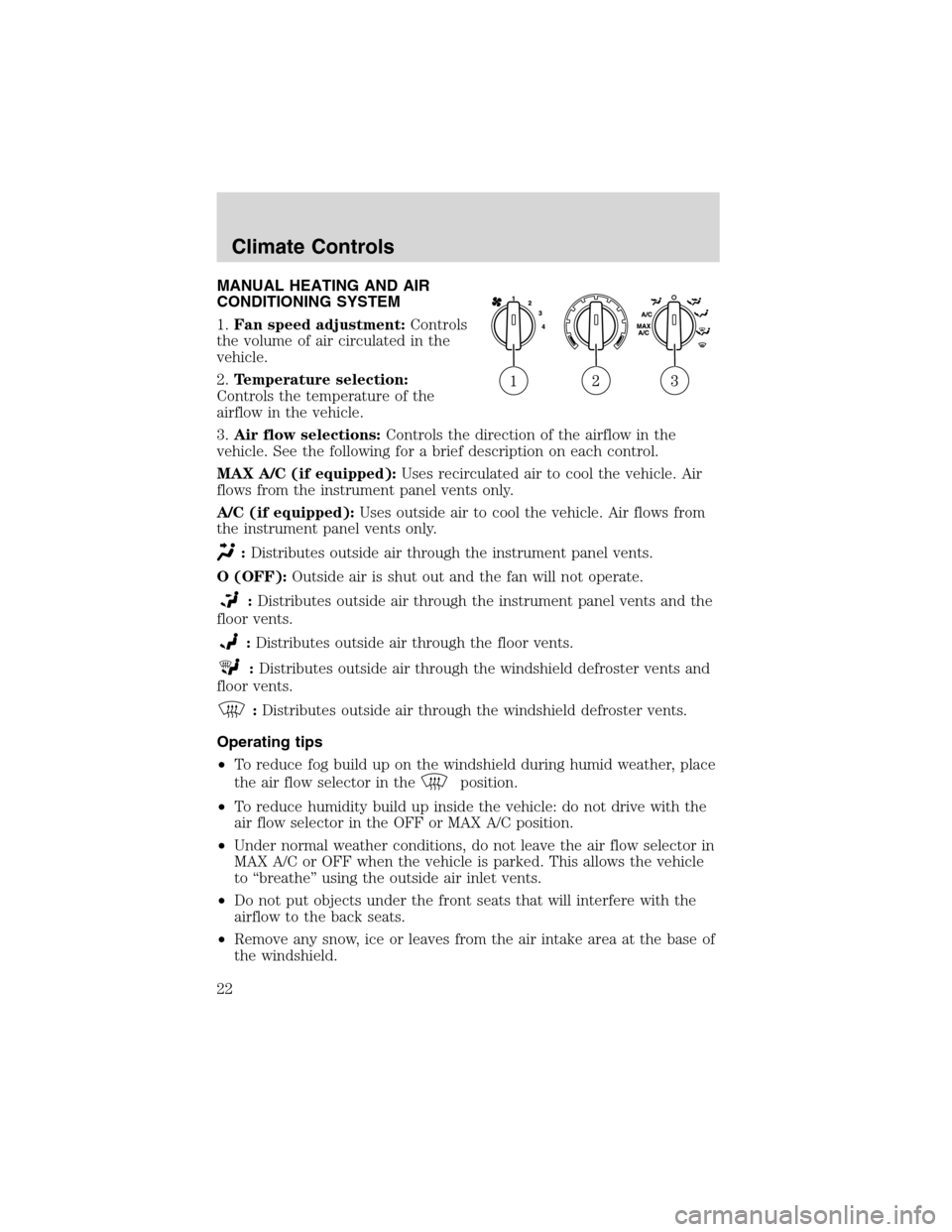
MANUAL HEATING AND AIR
CONDITIONING SYSTEM
1.Fan speed adjustment:Controls
the volume of air circulated in the
vehicle.
2.Temperature selection:
Controls the temperature of the
airflow in the vehicle.
3.Air flow selections:Controls the direction of the airflow in the
vehicle. See the following for a brief description on each control.
MAX A/C (if equipped):Uses recirculated air to cool the vehicle. Air
flows from the instrument panel vents only.
A/C (if equipped):Uses outside air to cool the vehicle. Air flows from
the instrument panel vents only.
:Distributes outside air through the instrument panel vents.
O (OFF):Outside air is shut out and the fan will not operate.
:Distributes outside air through the instrument panel vents and the
floor vents.
:Distributes outside air through the floor vents.
:Distributes outside air through the windshield defroster vents and
floor vents.
:Distributes outside air through the windshield defroster vents.
Operating tips
•To reduce fog build up on the windshield during humid weather, place
the air flow selector in the
position.
•To reduce humidity build up inside the vehicle: do not drive with the
air flow selector in the OFF or MAX A/C position.
•Under normal weather conditions, do not leave the air flow selector in
MAX A/C or OFF when the vehicle is parked. This allows the vehicle
to“breathe”using the outside air inlet vents.
•Do not put objects under the front seats that will interfere with the
airflow to the back seats.
•Remove any snow, ice or leaves from the air intake area at the base of
the windshield.
Climate Controls
22
Page 55 of 184
FRONT SEATS
Notes:
Reclining the seatback can cause an occupant to slide under the
seat’s safety belt, resulting in severe personal injuries in the
event of a collision.
Do not pile cargo higher than the seatbacks to avoid injury in a
collision or sudden stop.
Adjustable head restraints (if equipped)
Head restraints help to limit head motion in the event of a rear collision.
The seats in your vehicle may have adjustable head restraints. Adjust
your head restraint so that it is located directly or as close as possible
behind your head.
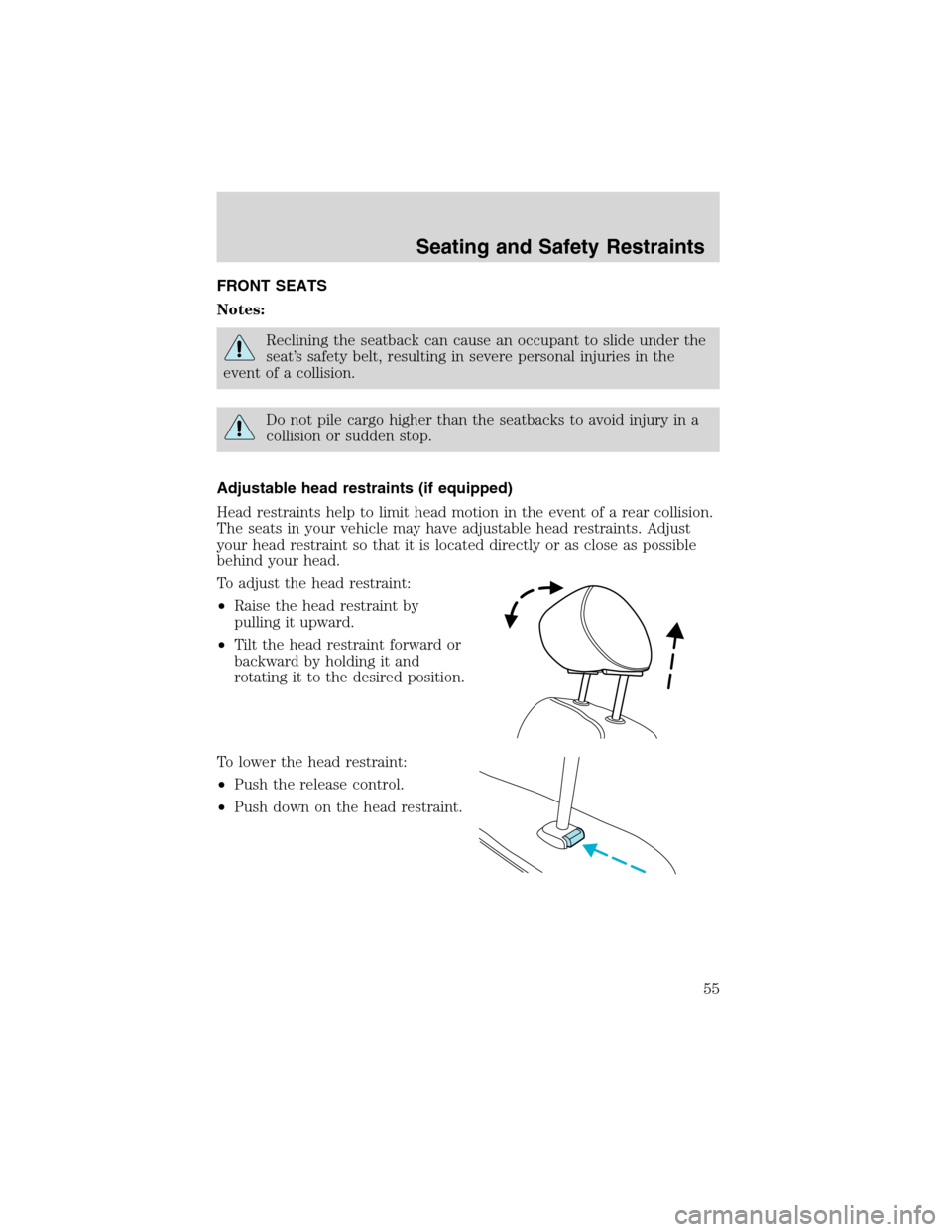
To adjust the head restraint:
•Raise the head restraint by
pulling it upward.
•Tilt the head restraint forward or
backward by holding it and
rotating it to the desired position.
To lower the head restraint:
•Push the release control.
•Push down on the head restraint.
Seating and Safety Restraints
55
Page 57 of 184
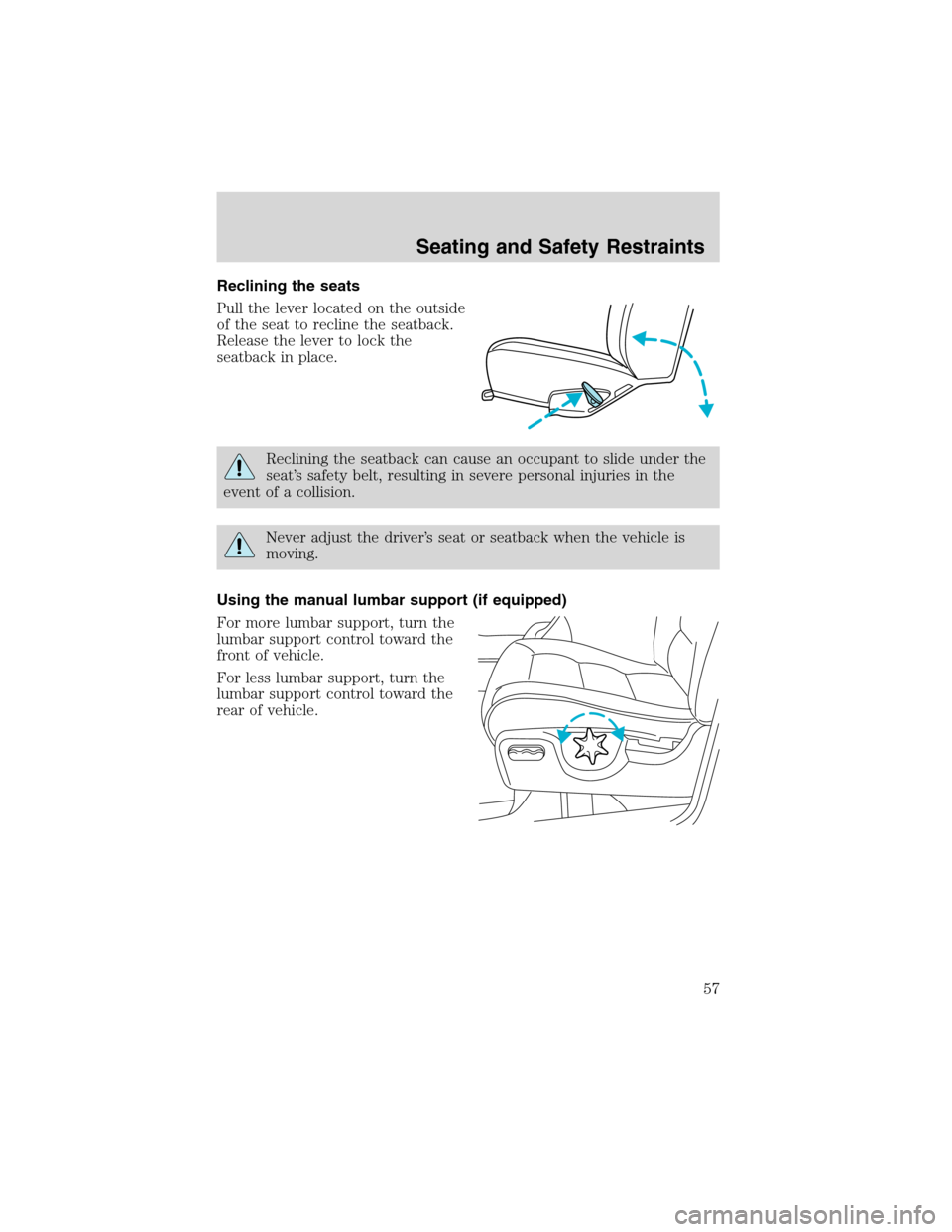
Reclining the seats
Pull the lever located on the outside
of the seat to recline the seatback.
Release the lever to lock the
seatback in place.
Reclining the seatback can cause an occupant to slide under the
seat’s safety belt, resulting in severe personal injuries in the
event of a collision.
Never adjust the driver’s seat or seatback when the vehicle is
moving.
Using the manual lumbar support (if equipped)
For more lumbar support, turn the
lumbar support control toward the
front of vehicle.
For less lumbar support, turn the
lumbar support control toward the
rear of vehicle.
Seating and Safety Restraints
57
Page 58 of 184
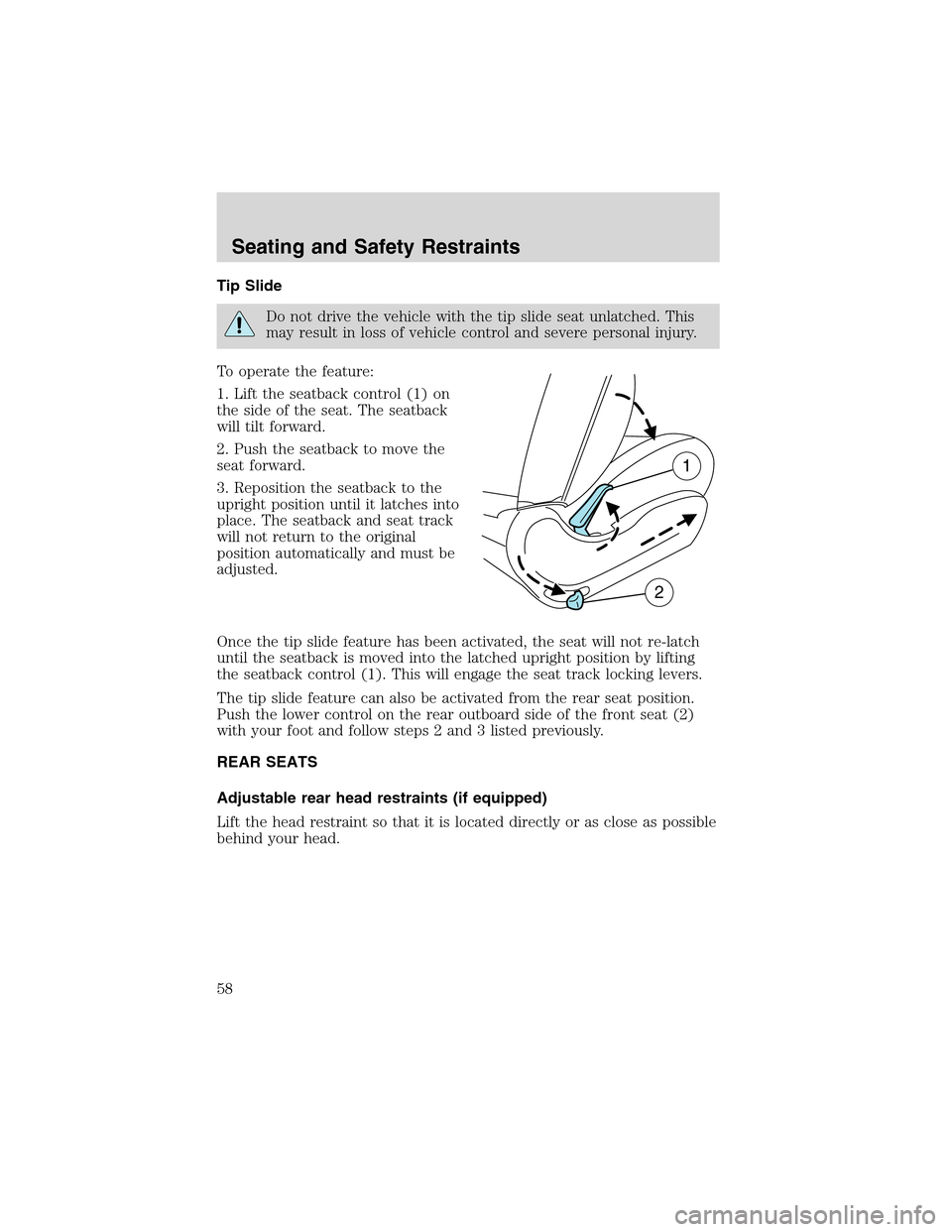
Tip Slide
Do not drive the vehicle with the tip slide seat unlatched. This
may result in loss of vehicle control and severe personal injury.
To operate the feature:
1. Lift the seatback control (1) on
the side of the seat. The seatback
will tilt forward.
2. Push the seatback to move the
seat forward.
3. Reposition the seatback to the
upright position until it latches into
place. The seatback and seat track
will not return to the original
position automatically and must be
adjusted.
Once the tip slide feature has been activated, the seat will not re-latch
until the seatback is moved into the latched upright position by lifting
the seatback control (1). This will engage the seat track locking levers.
The tip slide feature can also be activated from the rear seat position.
Push the lower control on the rear outboard side of the front seat (2)
with your foot and follow steps 2 and 3 listed previously.
REAR SEATS
Adjustable rear head restraints (if equipped)
Lift the head restraint so that it is located directly or as close as possible
behind your head.
1
2
Seating and Safety Restraints
58
Page 59 of 184
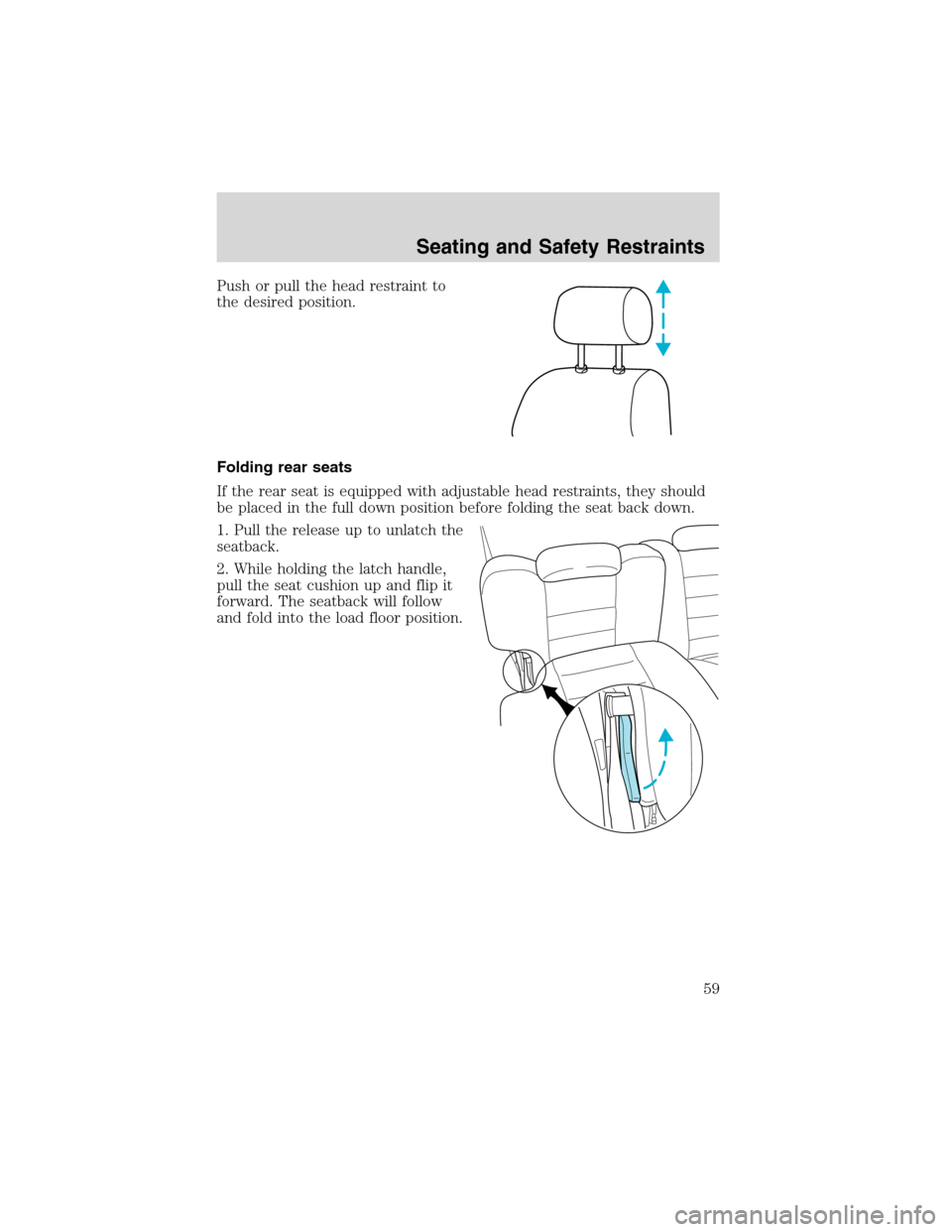
Push or pull the head restraint to
the desired position.
Folding rear seats
If the rear seat is equipped with adjustable head restraints, they should
be placed in the full down position before folding the seat back down.
1. Pull the release up to unlatch the
seatback.
2. While holding the latch handle,
pull the seat cushion up and flip it
forward. The seatback will follow
and fold into the load floor position.
Seating and Safety Restraints
59
Page 61 of 184
Never let a passenger hold a child on his or her lap while the
vehicle is moving. The passenger cannot protect the child from
injury in a collision.
All occupants of the vehicle, including the driver, should always
properly wear their safety belts, even when an air bag (SRS) is
provided.
It is extremely dangerous to ride in a cargo area, inside or
outside of a vehicle. In a collision, people riding in these areas
are more likely to be seriously injured or killed. Do not allow people to
ride in any area of your vehicle that is not equipped with seats and
safety belts. Be sure everyone in your vehicle is in a seat and using a
safety belt properly.
In a rollover crash, an unbelted person is significantly more likely
to die than a person wearing a safety belt.
Each seating position in your vehicle has a specific safety belt
assembly which is made up of one buckle and one tongue that
are designed to be used as a pair. 1) Use the shoulder belt on the
outside shoulder only. Never wear the shoulder belt under the arm. 2)
Never swing the safety belt around your neck over the inside shoulder.
3) Never use a single belt for more than one person.
Always transport children 12 years old and under in the back
seat and always properly use appropriate child restraints.
Safety belts and seats can become hot in a vehicle that has been
closed up in sunny weather; they could burn a small child. Check
seat covers and buckles before you place a child anywhere near them.
Energy Management Feature
•This vehicle has a safety belt system with an energy management
feature at the front seating positions to help further reduce the risk of
injury in the event of a head-on collision.
Seating and Safety Restraints
61
Page 63 of 184
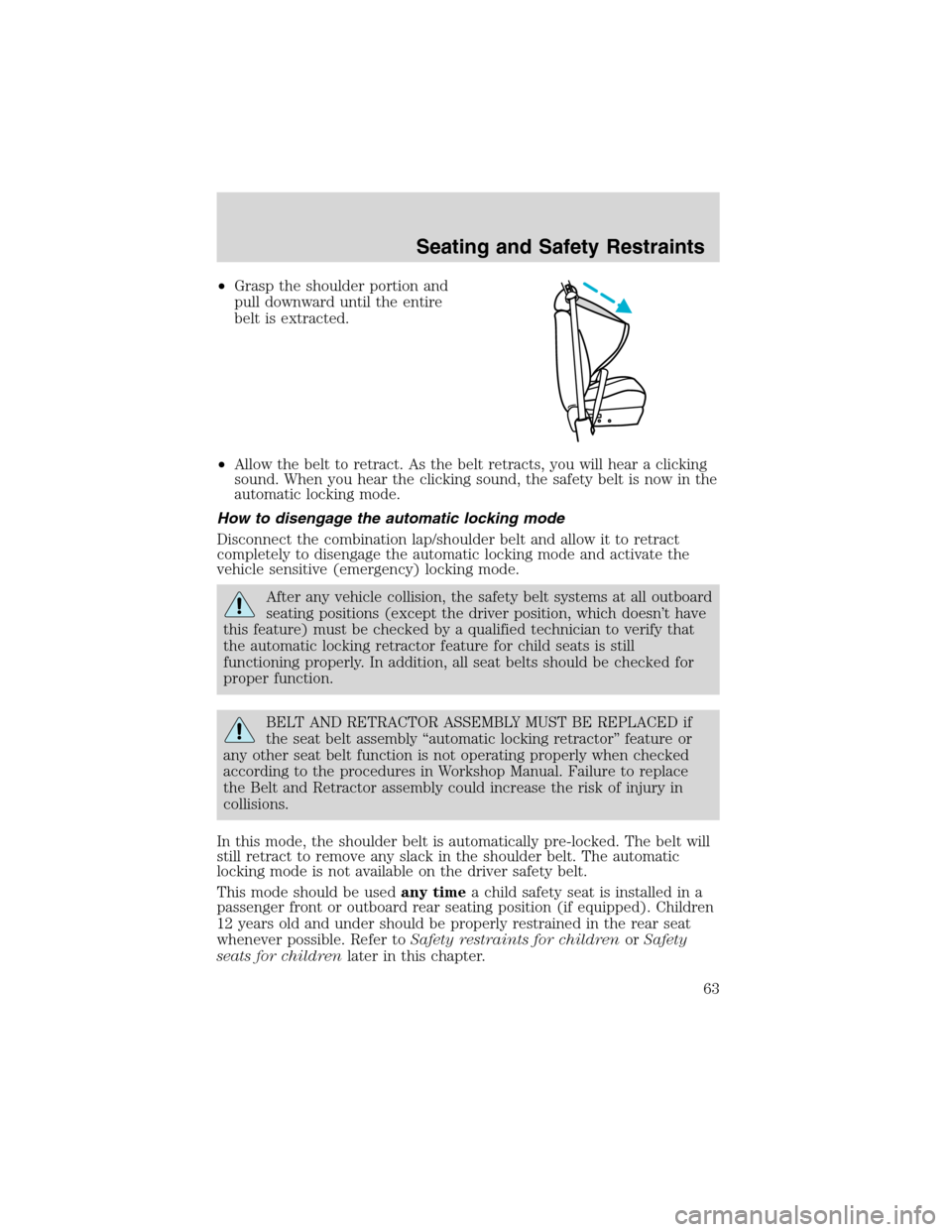
•Grasp the shoulder portion and
pull downward until the entire
belt is extracted.
•Allow the belt to retract. As the belt retracts, you will hear a clicking
sound. When you hear the clicking sound, the safety belt is now in the
automatic locking mode.
How to disengage the automatic locking mode
Disconnect the combination lap/shoulder belt and allow it to retract
completely to disengage the automatic locking mode and activate the
vehicle sensitive (emergency) locking mode.
After any vehicle collision, the safety belt systems at all outboard
seating positions (except the driver position, which doesn’t have
this feature) must be checked by a qualified technician to verify that
the automatic locking retractor feature for child seats is still
functioning properly. In addition, all seat belts should be checked for
proper function.
BELT AND RETRACTOR ASSEMBLY MUST BE REPLACED if
the seat belt assembly“automatic locking retractor”feature or
any other seat belt function is not operating properly when checked
according to the procedures in Workshop Manual. Failure to replace
the Belt and Retractor assembly could increase the risk of injury in
collisions.
In this mode, the shoulder belt is automatically pre-locked. The belt will
still retract to remove any slack in the shoulder belt. The automatic
locking mode is not available on the driver safety belt.
This mode should be usedany timea child safety seat is installed in a
passenger front or outboard rear seating position (if equipped). Children
12 years old and under should be properly restrained in the rear seat
whenever possible. Refer toSafety restraints for childrenorSafety
seats for childrenlater in this chapter.
Seating and Safety Restraints
63
Page 74 of 184
•a readiness light and tone
•a diagnostic module
•and the electrical wiring which connects the components
Several air bag system components get hot after inflation. Do not
touch them after inflation.
If the air bag has deployed,the air bag will not function
again and must be replaced immediately.If the air bag is not
replaced, the unrepaired area will increase the risk of injury in a
collision.
Determining if the system is operational
The SRS uses a readiness light in the instrument cluster or a tone to
indicate the status of the system. Refer toAir bag readinesssection in
theInstrument clusterchapter. Routine maintenance of the air bag is
not required.
A difficulty with the system is indicated by one or more of the following:
•The readiness light will either
flash or stay lit.
•The readiness light will not
illuminate immediately after
ignition is turned on.
•A series of five beeps will be heard. The tone pattern will repeat
periodically until the problem and/or light are repaired.
If any of these things happen, even intermittently, have the SRS serviced
at your dealership or by a qualified technician immediately. Unless
serviced, the system may not function properly in the event of a
collision.
Side air bag system (if equipped)
Do not place objects or mount equipment on or near the air bag
cover on the side of the seatbacks of the front seats or in front
seat areas that may come into contact with a deploying air bag. Failure
to follow these instructions may increase the risk of personal injury in
the event of a collision.
Seating and Safety Restraints
74