wheel FORD EXPLORER SPORT TRAC 2003 Owner's Manual
[x] Cancel search | Manufacturer: FORD, Model Year: 2003, Model line: EXPLORER SPORT TRAC, Model: FORD EXPLORER SPORT TRAC 2003Pages: 216, PDF Size: 1.75 MB
Page 134 of 216
4x2 vehicles with an automatic transmission and 4x4 vehicles
with an automatic transmission but without the Neutral tow kit
accessory:
•Release parking brake.
•Place the transmission in N (Neutral).
•Maximum speed is 56 km/h (35 mph).
•Maximum distance is 80 km (50 miles).
If a distance of 80 km (50 miles) or a speed of 56 km/h (35 mph) must
be exceeded, you must disconnect the front (on 4x4 vehicles) and rear
driveshafts. Ford recommends the driveshaft(s) be removed/installed
only by a qualified technician. See your local dealer for driveshaft
removal/installation.
Improper removal/installation of the driveshaft can cause
transmission fluid loss, damage to the driveshaft and internal
transmission components.
4x4 vehicles with automatic transmission and the Neutral tow kit
accessory:
•Release the parking brake.
•Place transmission in N (Neutral).
•Engage the neutral tow.
On vehicles equipped with 4WD, an accessory is available that allows you
to tow your vehicle, with unlimited mileage (maximum speed of 88 km/h
[55 mph]) behind another vehicle, with all the wheels on the ground.
Contact your dealer for more details. Do not tow your vehicle with all
wheels on the ground more than 80 km (50 miles) (with a maximum
speed of 56 km/h [35 mph]) unless you install the neutral tow kit as
vehicle damage may occur.
2003 P207 Explorer Sport Trac(p27)
Owners Guide (post-2002-fmt)
USA English(fus)
Driving
134
Page 136 of 216
Canadian customers who need to obtain reimbursement information, call
1–800–665–2006.
Roadside coverage beyond basic warranty
In the United States, you may purchase additional roadside assistance
coverage beyond this period through the Ford Auto Club by contacting
your Ford or Lincoln Mercury dealer.
Similarly in Canada, for uninterrupted Roadside Assistance coverage, you
may purchase extended coverage prior to your Basic Warranty’s Roadside
Assistance expiring. For more information and enrollment, contact
1–877–294–2582 or visit our website at www.ford.ca.
HAZARD FLASHER
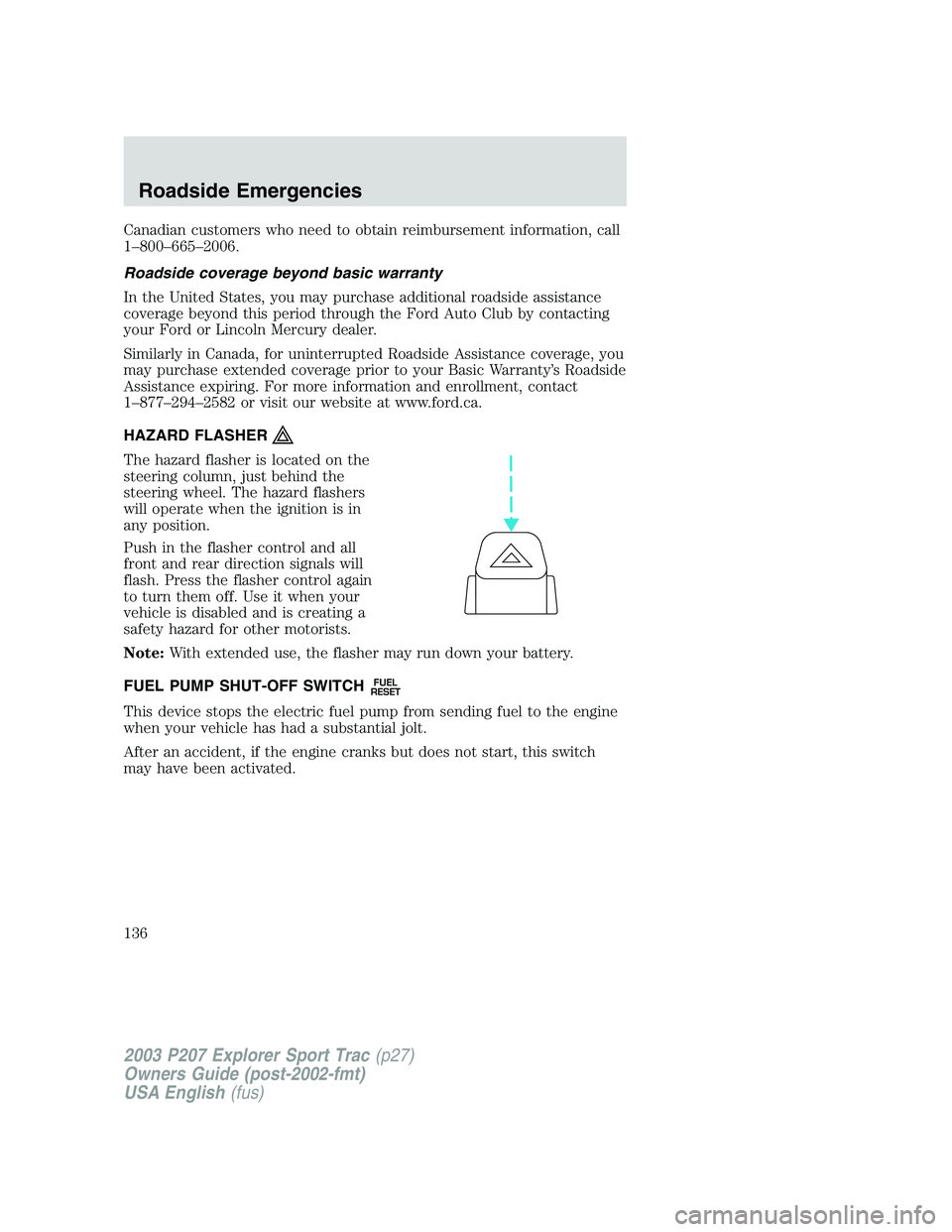
The hazard flasher is located on the
steering column, just behind the
steering wheel. The hazard flashers
will operate when the ignition is in
any position.
Push in the flasher control and all
front and rear direction signals will
flash. Press the flasher control again
to turn them off. Use it when your
vehicle is disabled and is creating a
safety hazard for other motorists.
Note:With extended use, the flasher may run down your battery.
FUEL PUMP SHUT-OFF SWITCH
FUEL
RESET
This device stops the electric fuel pump from sending fuel to the engine
when your vehicle has had a substantial jolt.
After an accident, if the engine cranks but does not start, this switch
may have been activated.
2003 P207 Explorer Sport Trac(p27)
Owners Guide (post-2002-fmt)
USA English(fus)
Roadside Emergencies
136
Page 145 of 216
Fuse/Relay
LocationFuse Amp
RatingPower Distribution Box Description
47A 20A Circuit
breakerWindows
47B – Not used
48 – Window safety relay
49 – Starter relay
50A – Not used
50B – Fuel pump relay
51 – Not used
52 – Not used
53 – PCM diode
54 – PCM relay
55 – Blower relay
56A – Horn relay
56B – A/C clutch solenoid
CHANGING A FLAT TIRE
If you get a flat tire while driving:
•do not brake heavily.
•gradually decrease the vehicle’s speed.
•hold the steering wheel firmly.
•slowly move to a safe place on the side of the road.
The use of tire sealants is not recommended and may
compromise the integrity of your tires.
Spare tire information
The spare tire can be used as a spare or a regular tire.
2003 P207 Explorer Sport Trac(p27)
Owners Guide (post-2002-fmt)
USA English(fus)
Roadside Emergencies
145
Page 146 of 216
Location of the spare tire and tools
The spare tire and tools for your vehicle are stowed in the following
locations:
Tool Location
Spare tire Under the vehicle, just in front of
the rear bumper
Jack, Jack handle, jack handle
extension, wheel lug nut wrenchIn the passenger side rear cab
compartment behind the access
door in trim panel
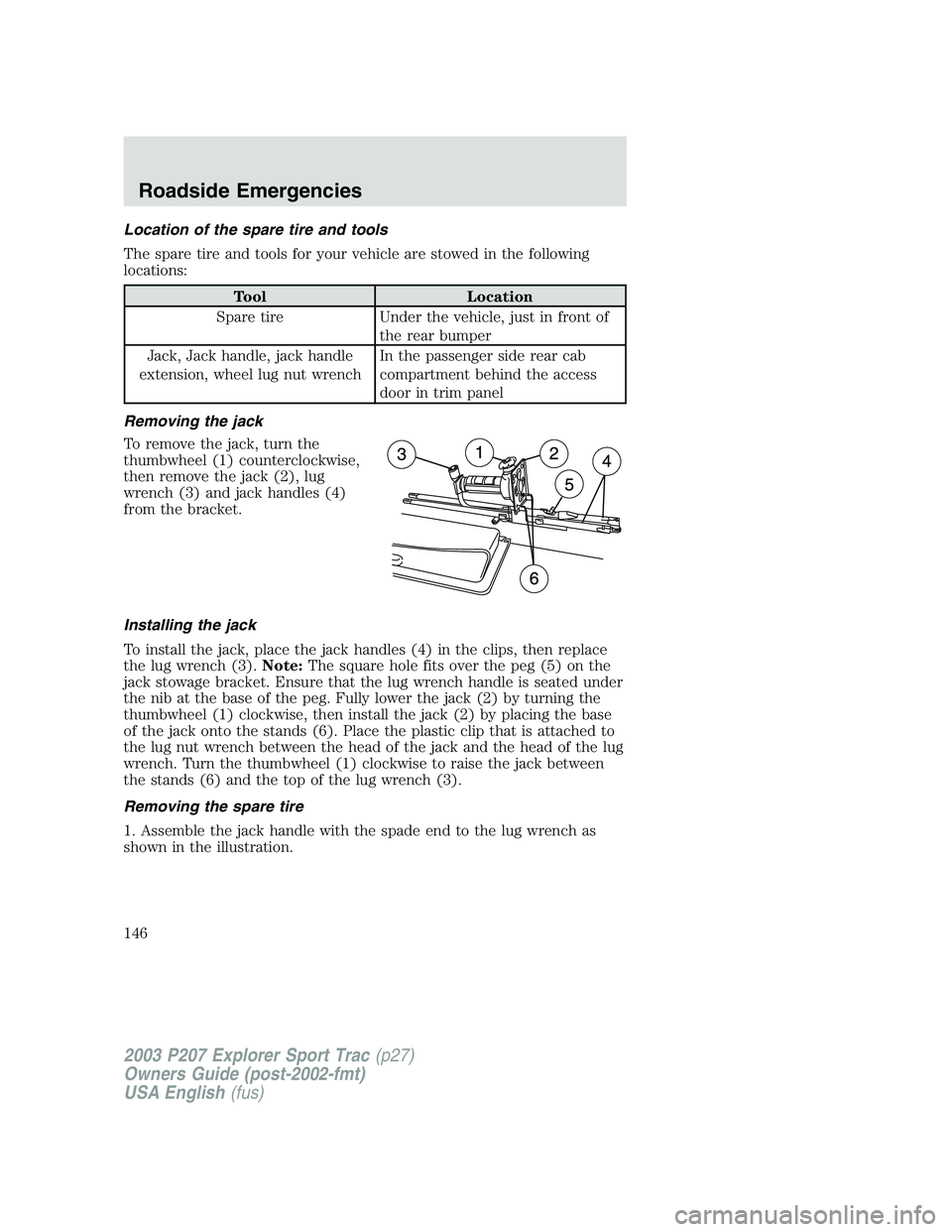
Removing the jack
To remove the jack, turn the
thumbwheel (1) counterclockwise,
then remove the jack (2), lug
wrench (3) and jack handles (4)
from the bracket.
Installing the jack
To install the jack, place the jack handles (4) in the clips, then replace
the lug wrench (3).Note:The square hole fits over the peg (5) on the
jack stowage bracket. Ensure that the lug wrench handle is seated under
the nib at the base of the peg. Fully lower the jack (2) by turning the
thumbwheel (1) clockwise, then install the jack (2) by placing the base
of the jack onto the stands (6). Place the plastic clip that is attached to
the lug nut wrench between the head of the jack and the head of the lug
wrench. Turn the thumbwheel (1) clockwise to raise the jack between
the stands (6) and the top of the lug wrench (3).
Removing the spare tire
1. Assemble the jack handle with the spade end to the lug wrench as
shown in the illustration.
2003 P207 Explorer Sport Trac(p27)
Owners Guide (post-2002-fmt)
USA English(fus)
Roadside Emergencies
146
Page 147 of 216
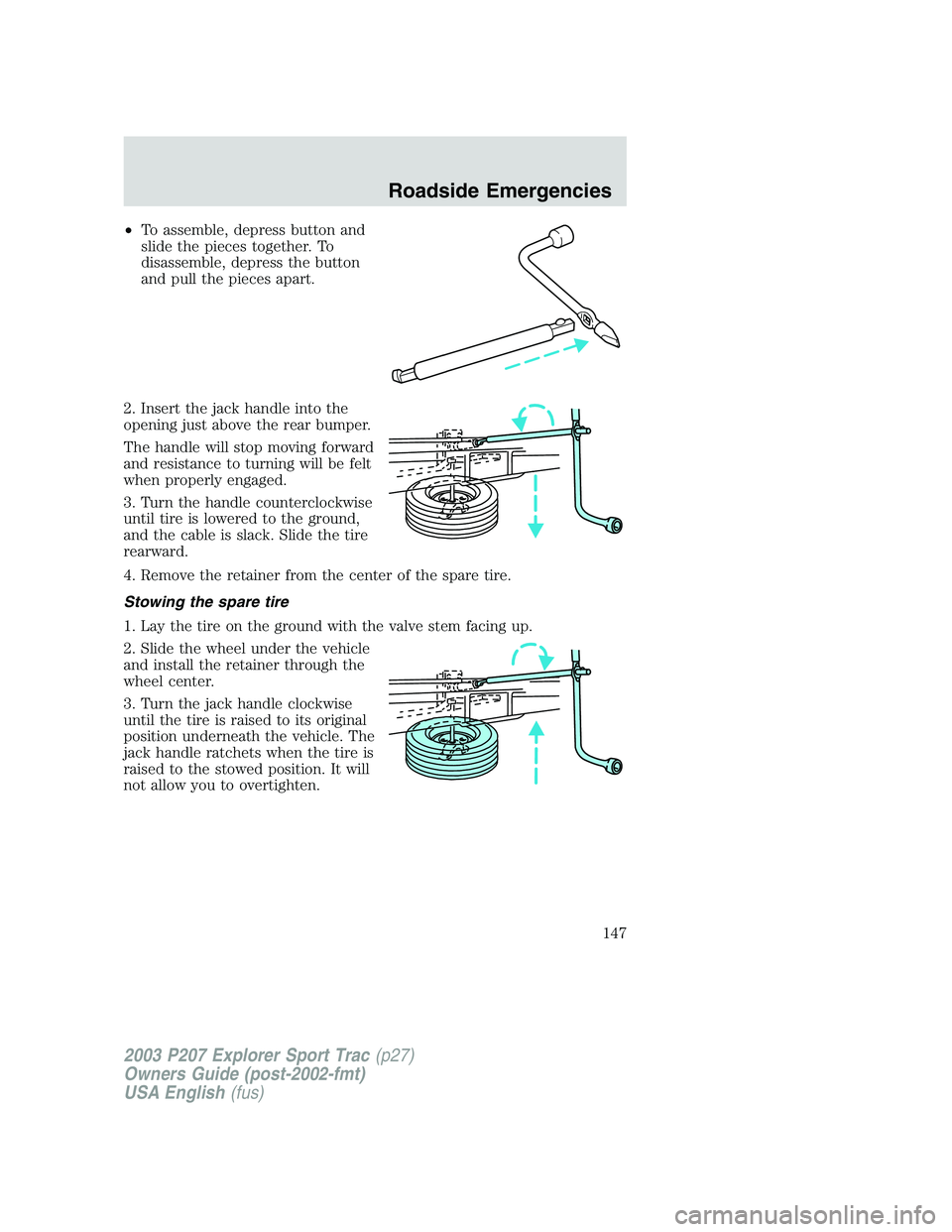
•To assemble, depress button and
slide the pieces together. To
disassemble, depress the button
and pull the pieces apart.
2. Insert the jack handle into the
opening just above the rear bumper.
The handle will stop moving forward
and resistance to turning will be felt
when properly engaged.
3. Turn the handle counterclockwise
until tire is lowered to the ground,
and the cable is slack. Slide the tire
rearward.
4. Remove the retainer from the center of the spare tire.
Stowing the spare tire
1. Lay the tire on the ground with the valve stem facing up.
2. Slide the wheel under the vehicle
and install the retainer through the
wheel center.
3. Turn the jack handle clockwise
until the tire is raised to its original
position underneath the vehicle. The
jack handle ratchets when the tire is
raised to the stowed position. It will
not allow you to overtighten.
2003 P207 Explorer Sport Trac(p27)
Owners Guide (post-2002-fmt)
USA English(fus)
Roadside Emergencies
147
Page 148 of 216
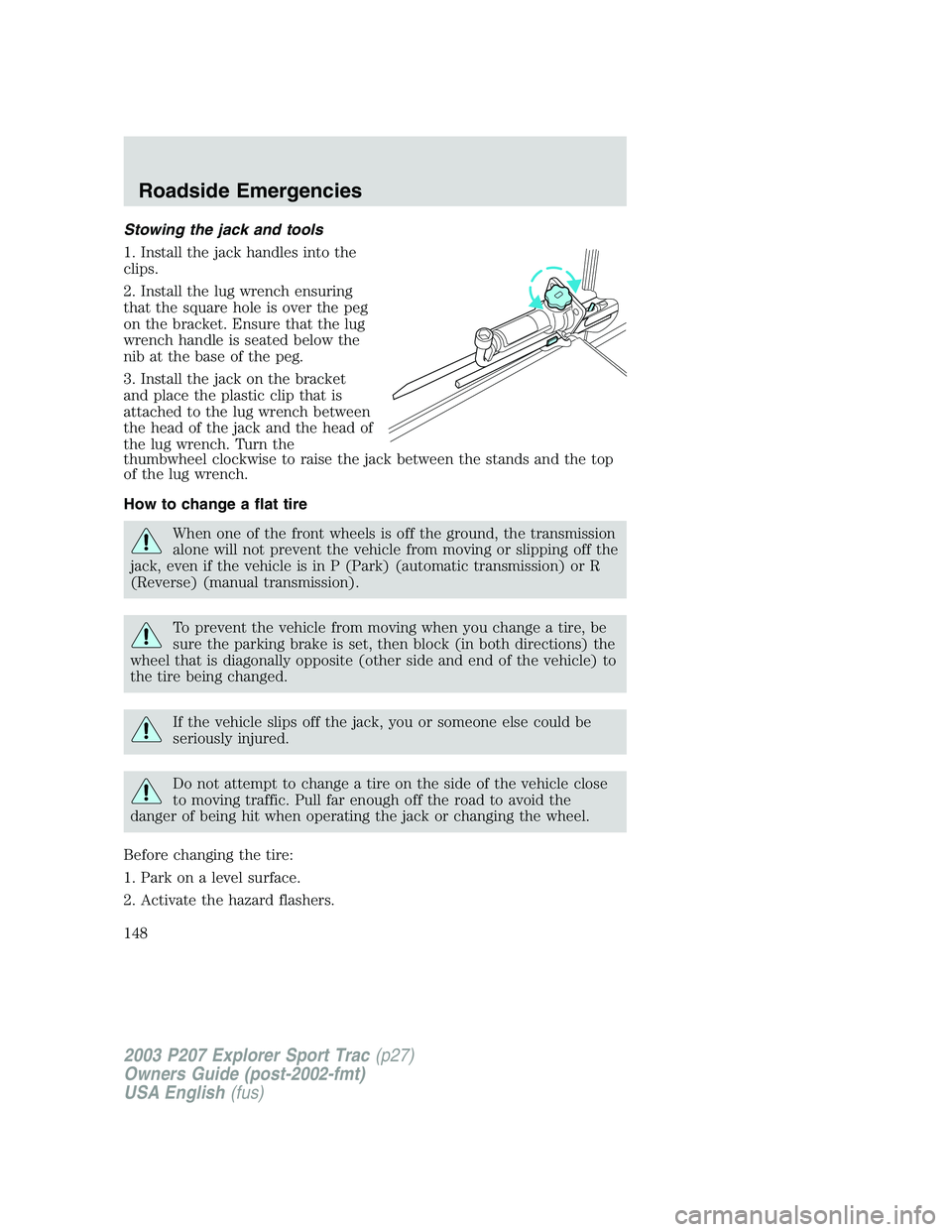
Stowing the jack and tools
1. Install the jack handles into the
clips.
2. Install the lug wrench ensuring
that the square hole is over the peg
on the bracket. Ensure that the lug
wrench handle is seated below the
nib at the base of the peg.
3. Install the jack on the bracket
and place the plastic clip that is
attached to the lug wrench between
the head of the jack and the head of
the lug wrench. Turn the
thumbwheel clockwise to raise the jack between the stands and the top
of the lug wrench.
How to change a flat tire
When one of the front wheels is off the ground, the transmission
alone will not prevent the vehicle from moving or slipping off the
jack, even if the vehicle is in P (Park) (automatic transmission) or R
(Reverse) (manual transmission).
To prevent the vehicle from moving when you change a tire, be
sure the parking brake is set, then block (in both directions) the
wheel that is diagonally opposite (other side and end of the vehicle) to
the tire being changed.
If the vehicle slips off the jack, you or someone else could be
seriously injured.
Do not attempt to change a tire on the side of the vehicle close
to moving traffic. Pull far enough off the road to avoid the
danger of being hit when operating the jack or changing the wheel.
Before changing the tire:
1. Park on a level surface.
2. Activate the hazard flashers.
2003 P207 Explorer Sport Trac(p27)
Owners Guide (post-2002-fmt)
USA English(fus)
Roadside Emergencies
148
Page 149 of 216
3. Place the gearshift lever in P (Park) (automatic transmission) or R
(Reverse) (manual transmission).
4. Set the parking brake.
5. Turn off the ignition.
To change the tire:
Note:Passengers should not remain in the vehicle when the vehicle is
being jacked.
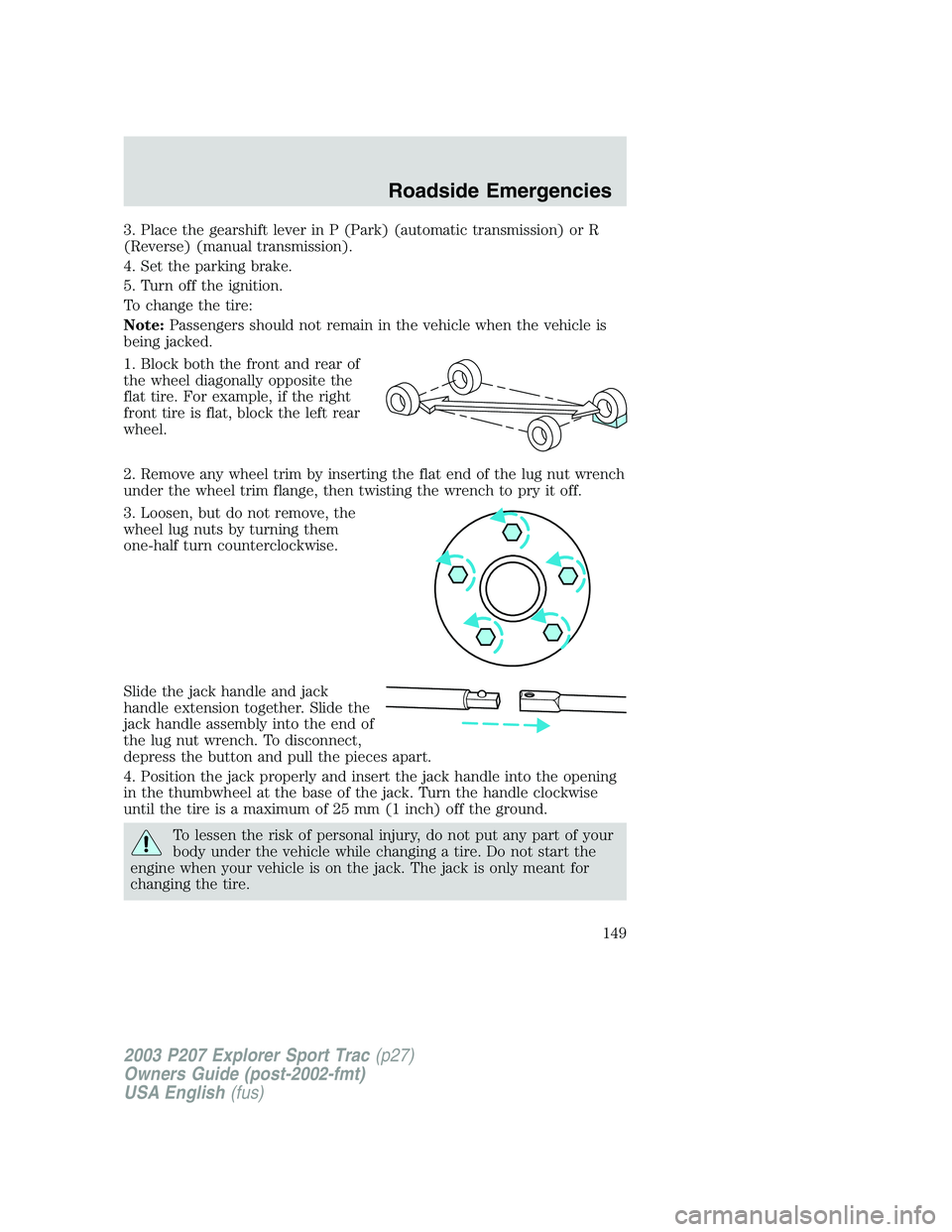
1. Block both the front and rear of
the wheel diagonally opposite the
flat tire. For example, if the right
front tire is flat, block the left rear
wheel.
2. Remove any wheel trim by inserting the flat end of the lug nut wrench
under the wheel trim flange, then twisting the wrench to pry it off.
3. Loosen, but do not remove, the
wheel lug nuts by turning them
one-half turn counterclockwise.
Slide the jack handle and jack
handle extension together. Slide the
jack handle assembly into the end of
the lug nut wrench. To disconnect,
depress the button and pull the pieces apart.
4. Position the jack properly and insert the jack handle into the opening
in the thumbwheel at the base of the jack. Turn the handle clockwise
until the tire is a maximum of 25 mm (1 inch) off the ground.
To lessen the risk of personal injury, do not put any part of your
body under the vehicle while changing a tire. Do not start the
engine when your vehicle is on the jack. The jack is only meant for
changing the tire.
2003 P207 Explorer Sport Trac(p27)
Owners Guide (post-2002-fmt)
USA English(fus)
Roadside Emergencies
149
Page 151 of 216
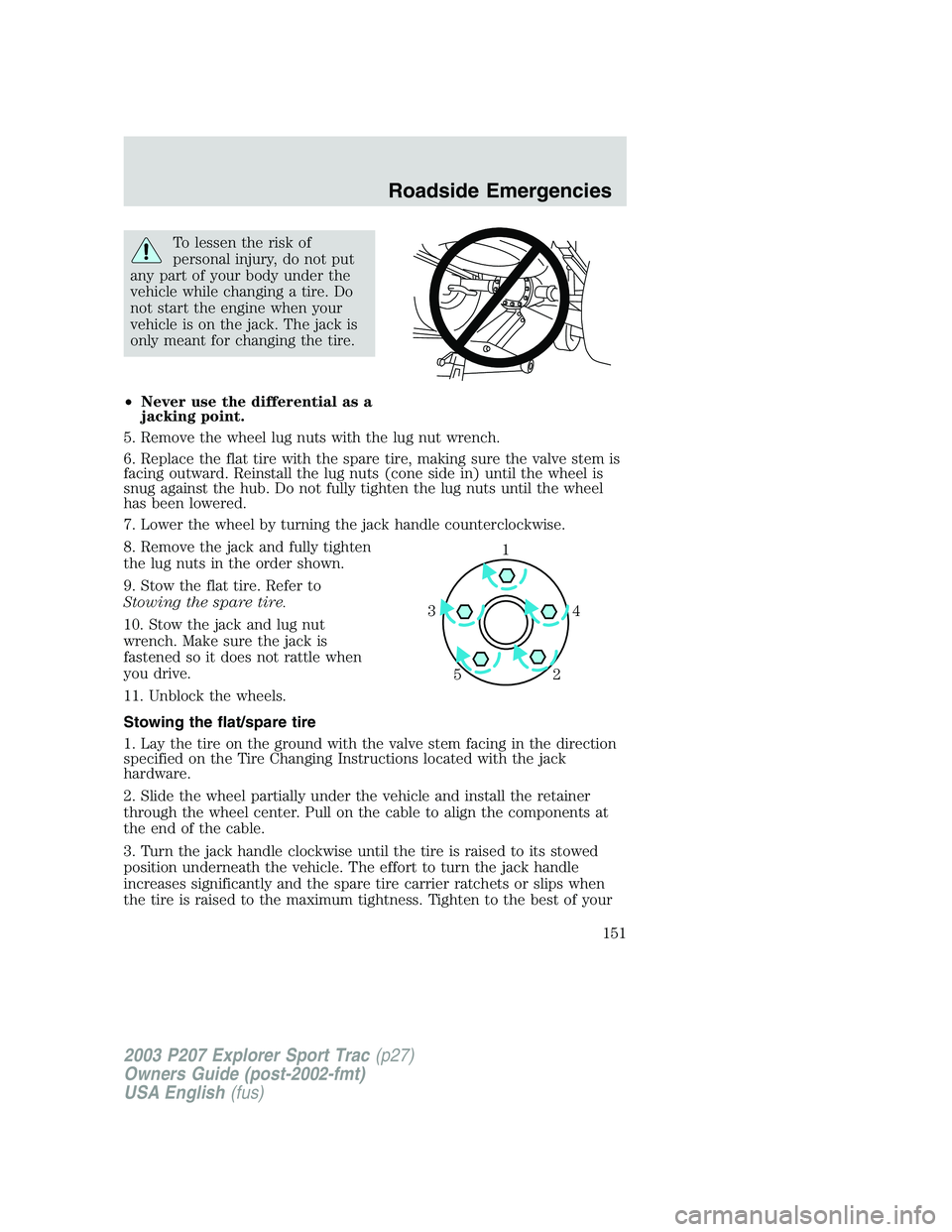
To lessen the risk of
personal injury, do not put
any part of your body under the
vehicle while changing a tire. Do
not start the engine when your
vehicle is on the jack. The jack is
only meant for changing the tire.
•Never use the differential as a
jacking point.
5. Remove the wheel lug nuts with the lug nut wrench.
6. Replace the flat tire with the spare tire, making sure the valve stem is
facing outward. Reinstall the lug nuts (cone side in) until the wheel is
snug against the hub. Do not fully tighten the lug nuts until the wheel
has been lowered.
7. Lower the wheel by turning the jack handle counterclockwise.
8. Remove the jack and fully tighten
the lug nuts in the order shown.
9. Stow the flat tire. Refer to
Stowing the spare tire.
10. Stow the jack and lug nut
wrench. Make sure the jack is
fastened so it does not rattle when
you drive.
11. Unblock the wheels.
Stowing the flat/spare tire
1. Lay the tire on the ground with the valve stem facing in the direction
specified on the Tire Changing Instructions located with the jack
hardware.
2. Slide the wheel partially under the vehicle and install the retainer
through the wheel center. Pull on the cable to align the components at
the end of the cable.
3. Turn the jack handle clockwise until the tire is raised to its stowed
position underneath the vehicle. The effort to turn the jack handle
increases significantly and the spare tire carrier ratchets or slips when
the tire is raised to the maximum tightness. Tighten to the best of your
1
4 3
2 5
2003 P207 Explorer Sport Trac(p27)
Owners Guide (post-2002-fmt)
USA English(fus)
Roadside Emergencies
151
Page 157 of 216
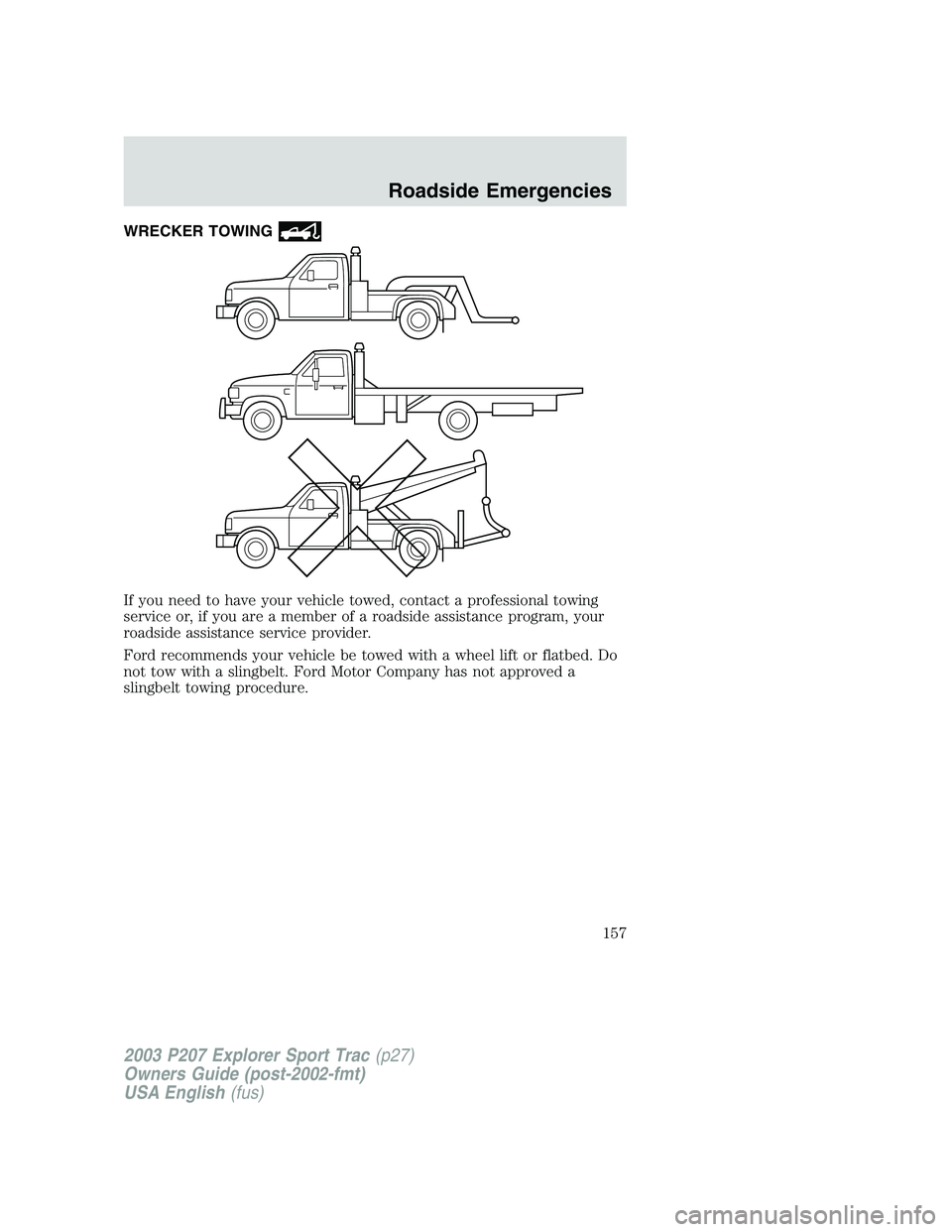
WRECKER TOWING
If you need to have your vehicle towed, contact a professional towing
service or, if you are a member of a roadside assistance program, your
roadside assistance service provider.
Ford recommends your vehicle be towed with a wheel lift or flatbed. Do
not tow with a slingbelt. Ford Motor Company has not approved a
slingbelt towing procedure.
2003 P207 Explorer Sport Trac(p27)
Owners Guide (post-2002-fmt)
USA English(fus)
Roadside Emergencies
157
Page 169 of 216
•Remove particles such as bird droppings, tree sap, insect deposits, tar
spots, road salt and industrial fallout before repairing paint chips.
•Always read the instructions before using the products.
ALUMINUM WHEELS AND WHEEL COVERS
Aluminum wheels and wheel covers are coated with a clearcoat paint
finish. In order to maintain their shine:
•Clean weekly with Motorcraft Wheel and Tire Cleaner (ZC-37–A),
which is available from your dealer. Heavy dirt and brake dust
accumulation may require agitation with a sponge. Rinse thoroughly
with a strong stream of water.
•Never apply any cleaning chemical to hot or warm wheel rims or
covers.
•Some automatic car washes may cause damage to the finish on your
wheel rims or covers. Chemical-strength cleaners, or cleaning
chemicals, in combination with brush agitation to remove brake dust
and dirt, could wear away the clearcoat finish over time.
•Do not use hydrofluoric acid-based or high caustic-based wheel
cleaners, steel wool, fuels or strong household detergent.
•To remove tar and grease, use Ford Extra Strength Tar and Road Oil
Removal (B7A-19520–AA), available from your dealer.
ENGINE
Engines are more efficient when they are clean because grease and dirt
buildup keep the engine warmer than normal. When washing:
•Take care when using a power washer to clean the engine. The
high-pressure fluid could penetrate the sealed parts and cause
damage.
•Do not spray a hot engine with cold water to avoid cracking the
engine block or other engine components.
•Spray Motorcraft Engine Shampoo and Degreaser (ZC-20) on all parts
that require cleaning and pressure rinse clean.
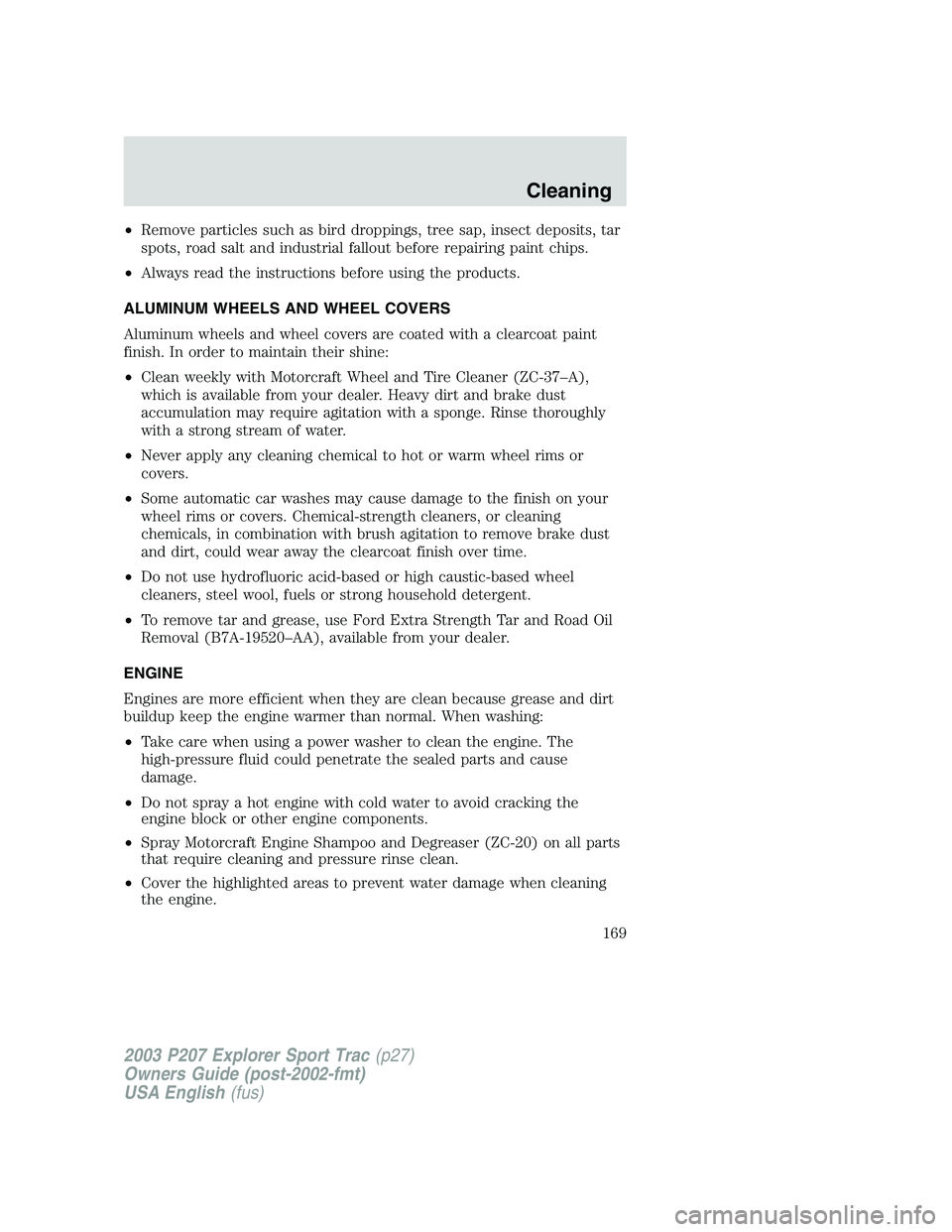
•Cover the highlighted areas to prevent water damage when cleaning
the engine.
2003 P207 Explorer Sport Trac(p27)
Owners Guide (post-2002-fmt)
USA English(fus)
Cleaning
169