overheating FORD F-350 2018 User Guide
[x] Cancel search | Manufacturer: FORD, Model Year: 2018, Model line: F-350, Model: FORD F-350 2018Pages: 660, PDF Size: 11.64 MB
Page 351 of 660
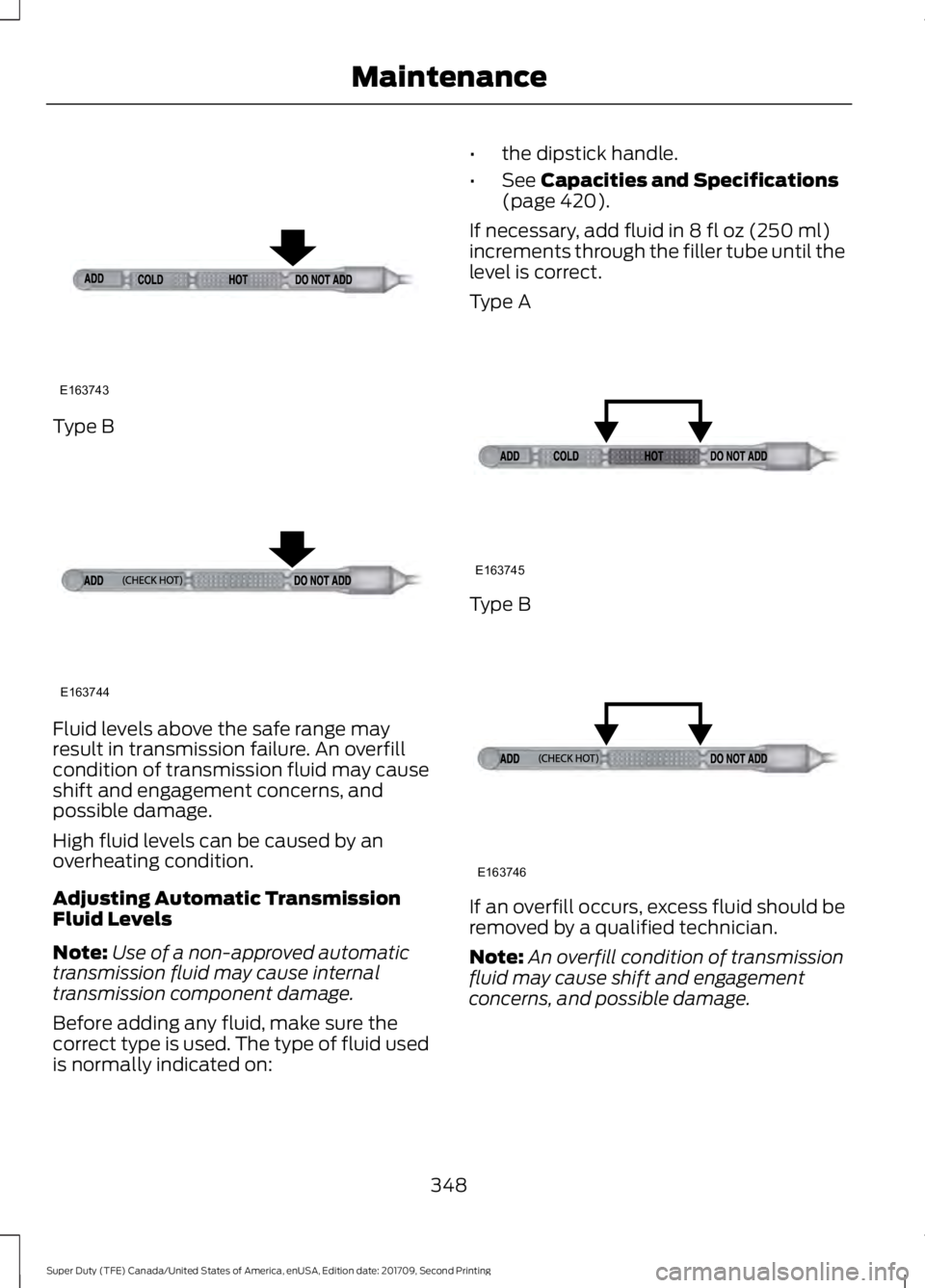
Type B
Fluid levels above the safe range may
result in transmission failure. An overfill
condition of transmission fluid may cause
shift and engagement concerns, and
possible damage.
High fluid levels can be caused by an
overheating condition.
Adjusting Automatic Transmission
Fluid Levels
Note:
Use of a non-approved automatic
transmission fluid may cause internal
transmission component damage.
Before adding any fluid, make sure the
correct type is used. The type of fluid used
is normally indicated on: •
the dipstick handle.
• See Capacities and Specifications
(page 420).
If necessary, add fluid in
8 fl oz (250 ml)
increments through the filler tube until the
level is correct.
Type A Type B
If an overfill occurs, excess fluid should be
removed by a qualified technician.
Note:
An overfill condition of transmission
fluid may cause shift and engagement
concerns, and possible damage.
348
Super Duty (TFE) Canada/United States of America, enUSA, Edition date: 201709, Second Printing MaintenanceE163743 E163744 E163745 E163746
Page 585 of 660
When the oil change message appears in
the information display, it is time for an oil
change. Make sure you perform the oil
change within two weeks or 500 mi
(800 km) of the message appearing. Make
sure you reset the Intelligent Oil-Life
Monitor after each oil change. See
Oil
Change Indicator Reset (page 337).
If your information display resets
prematurely or becomes inoperative, you
should perform the oil change interval at
six months or
5,000 mi (8,000 km) from
your last oil change. Never exceed one year
or
10,000 mi (16,000 km) between oil
change intervals.
Your vehicle is very sophisticated and built
with multiple, complex, performance
systems. Every manufacturer develops
these systems using different
specifications and performance features.
That is why it is important to rely upon your
dealership to properly diagnose and repair
your vehicle.
Ford Motor Company has recommended
maintenance intervals for various parts
and component systems based upon
engineering testing. Ford Motor Company
relies upon this testing to determine the
most appropriate mileage for replacement
of oils and fluids to protect your vehicle at
the lowest overall cost to you and
recommends against maintenance
schedules that deviate from the scheduled
maintenance information.
We strongly recommend the use of only
genuine Ford, Motorcraft or
Ford-authorized re-manufactured
replacement parts engineered for your
vehicle. Additives and Chemicals
This owner's manual and the Ford
Workshop Manual list the recommended
additives and chemicals for your vehicle.
We do not recommend using chemicals or
additives not approved by us as part of
your vehicle
’s normal maintenance. Please
consult your warranty information.
Oils, Fluids and Flushing
In many cases, fluid discoloration is a
normal operating characteristic and, by
itself, does not necessarily indicate a
concern or that the fluid needs to be
changed. However, a qualified expert, such
as the factory-trained technicians at your
dealership, should inspect discolored fluids
that also show signs of overheating or
foreign material contamination
immediately.
Make sure to change your vehicle ’s oils and
fluids at the specified intervals or in
conjunction with a repair. Flushing is a
viable way to change fluid for many vehicle
sub-systems during scheduled
maintenance. It is critical that systems are
flushed only with new fluid that is the same
as that required to fill and operate the
system or using a Ford-approved flushing
chemical.
Owner Checks and Services
Make sure you perform the following basic
maintenance checks and inspections every
month or at six-month intervals.
582
Super Duty (TFE) Canada/United States of America, enUSA, Edition date: 201709, Second Printing Scheduled Maintenance
Page 592 of 660
Other maintenance items
1
Change axle(s) fluid. See exceptions.
Change transfer case fluid, if equipped.
1 You can perform these maintenance items within 3,000 mi (4,800 km) of the last oil
change. Do not exceed the designated distance for the interval.
Note: When adding coolant additive, do not exceed the specified maximum of
50 fl oz
(1.4 L) for the engine and 20 fl oz (473 ml) for the secondary cooling system. Operating the
engine with excessive coolant additive may cause overheating which could lead to severe,
permanent engine damage.
2 Perform follow-up inspections every
15,000 mi (24,000 km) after the initial inspection.
Replace the belt or belts at 150,000 mi (240,000 km).
3 Initial replacement is at six years or 105,000 mi (168,000 km), then every three years or
45,000 mi (72,000 km)
.
SPECIAL OPERATING
CONDITIONS SCHEDULED
MAINTENANCE
Gasoline Engine
If you operate your vehicle primarily in any
of the following conditions, you need to
perform extra maintenance as indicated.
If you operate your vehicle occasionally
under any of these conditions, it is not
necessary to perform the extra
maintenance. For specific
recommendations, see your dealership
service advisor or technician. Towing a Trailer or Using a Car-top Carrier
Inspect and lubricate U-joints if equipped with grease
fittings.
Inspect frequently, service
as required
See axle maintenance items under
Exceptions.
Inspect the wheels and related components for abnormal
noise, wear, looseness or drag.
Every
5,000 mi (8,000 km)
589
Super Duty (TFE) Canada/United States of America, enUSA, Edition date: 201709, Second Printing Scheduled Maintenance
Page 596 of 660
Towing a Trailer or Using a Car-top Carrier
Inspect the engine and secondary cooling system coolant
concentration (freeze-point protection) and additive
(corrosion inhibitor) strength. Add coolant additive if
necessary.
Every 30,000 mi
(48,000 km) or 1200 engine
hours
Flush and refill the coolant. Do not add coolant additive.
Every
60,000 mi
(96,000 km) or 2400
engine hours
Note: When adding coolant additive, do not exceed the specified maximum of
50 fl oz
(1.4 L) for the engine and 20 fl oz (473 ml) for the secondary cooling system. Operating the
engine with excessive coolant additive may cause overheating which could lead to severe,
permanent engine damage.
Note: After the initial coolant flush and fill at
60,000 mi (96,000 km) or 2400 engine
hours, flush and fill every 45,000 mi (72,000 km) or 1800 engine hours thereafter. Frequent or Extended Idling (Over 10 Minutes Per Hour of Normal Driving) or Frequent
Low-speed Operation if your Vehicle is Used for Stationary Operation
Change the engine oil and filter as indicated by the
information display, and perform the services listed in the
scheduled maintenance chart.
As required
Replace the engine-mounted and frame-mounted fuel
filters.
Every
15,000 mi
(24,000 km), six months or
600 engine hours
Inspect the engine and secondary cooling system coolant
concentration (freeze-point protection) and additive
(corrosion inhibitor) strength. Add coolant additive if
necessary.
Every
30,000 mi
(48,000 km) or 1200 engine
hours
Flush and refill the coolant. Do not add coolant additive.
Every
60,000 mi
(96,000 km) or 2400
engine hours
Note: When adding coolant additive, do not exceed the specified maximum of
50 fl oz
(1.4 L) for the engine and 20 fl oz (473 ml) for the secondary cooling system. Operating the
engine with excessive coolant additive may cause overheating which could lead to severe,
permanent engine damage.
Note: After the initial coolant flush and fill at
60,000 mi (96,000 km) or 2400 engine
hours, flush and fill every 45,000 mi (72,000 km) or 1800 engine hours thereafter.
593
Super Duty (TFE) Canada/United States of America, enUSA, Edition date: 201709, Second Printing Scheduled Maintenance
Page 597 of 660
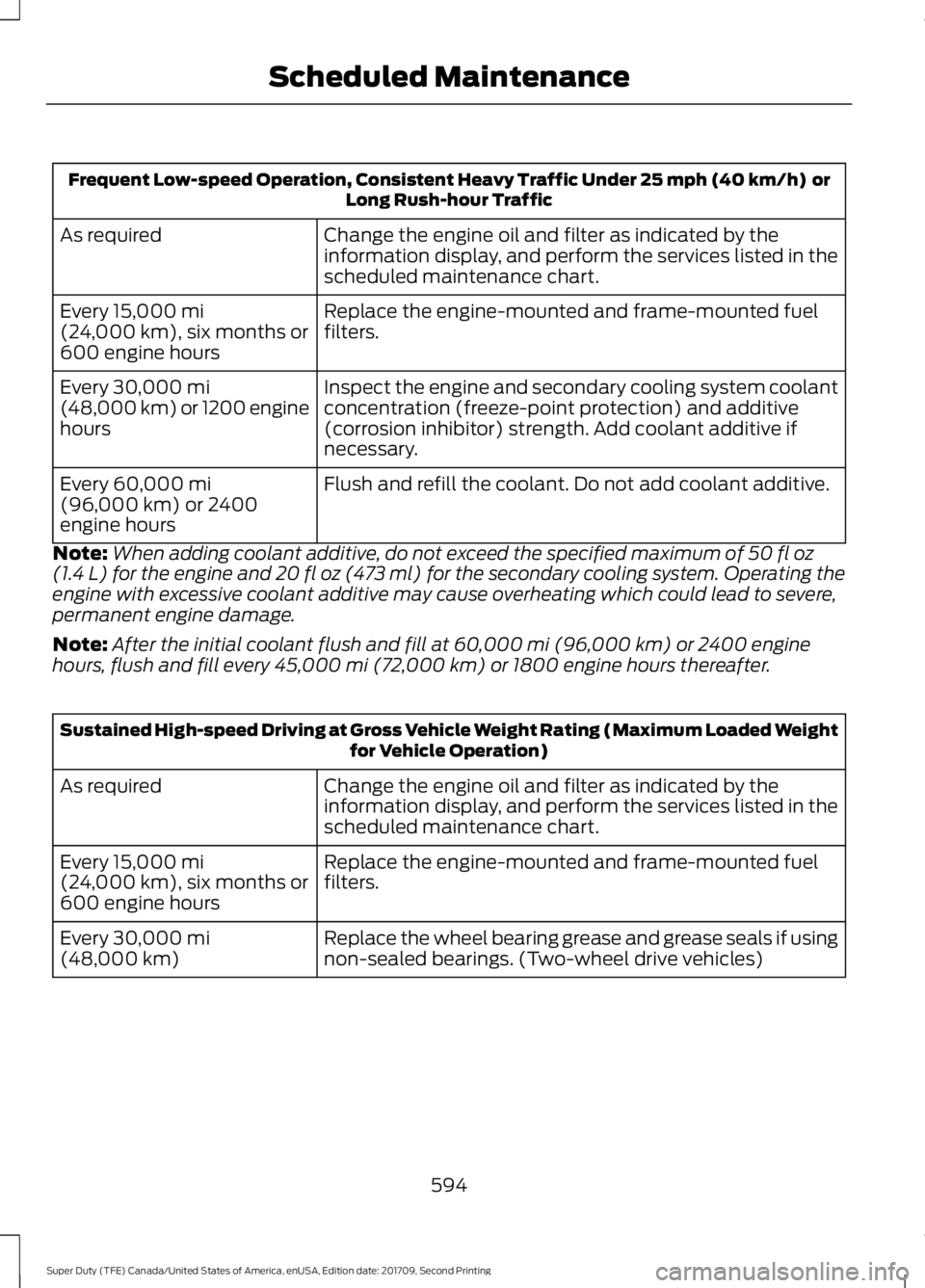
Frequent Low-speed Operation, Consistent Heavy Traffic Under 25 mph (40 km/h) or
Long Rush-hour Traffic
Change the engine oil and filter as indicated by the
information display, and perform the services listed in the
scheduled maintenance chart.
As required
Replace the engine-mounted and frame-mounted fuel
filters.
Every 15,000 mi
(24,000 km), six months or
600 engine hours
Inspect the engine and secondary cooling system coolant
concentration (freeze-point protection) and additive
(corrosion inhibitor) strength. Add coolant additive if
necessary.
Every
30,000 mi
(48,000 km) or 1200 engine
hours
Flush and refill the coolant. Do not add coolant additive.
Every
60,000 mi
(96,000 km) or 2400
engine hours
Note: When adding coolant additive, do not exceed the specified maximum of
50 fl oz
(1.4 L) for the engine and 20 fl oz (473 ml) for the secondary cooling system. Operating the
engine with excessive coolant additive may cause overheating which could lead to severe,
permanent engine damage.
Note: After the initial coolant flush and fill at
60,000 mi (96,000 km) or 2400 engine
hours, flush and fill every 45,000 mi (72,000 km) or 1800 engine hours thereafter. Sustained High-speed Driving at Gross Vehicle Weight Rating (Maximum Loaded Weight
for Vehicle Operation)
Change the engine oil and filter as indicated by the
information display, and perform the services listed in the
scheduled maintenance chart.
As required
Replace the engine-mounted and frame-mounted fuel
filters.
Every
15,000 mi
(24,000 km), six months or
600 engine hours
Replace the wheel bearing grease and grease seals if using
non-sealed bearings. (Two-wheel drive vehicles)
Every
30,000 mi
(48,000 km)
594
Super Duty (TFE) Canada/United States of America, enUSA, Edition date: 201709, Second Printing Scheduled Maintenance
Page 598 of 660
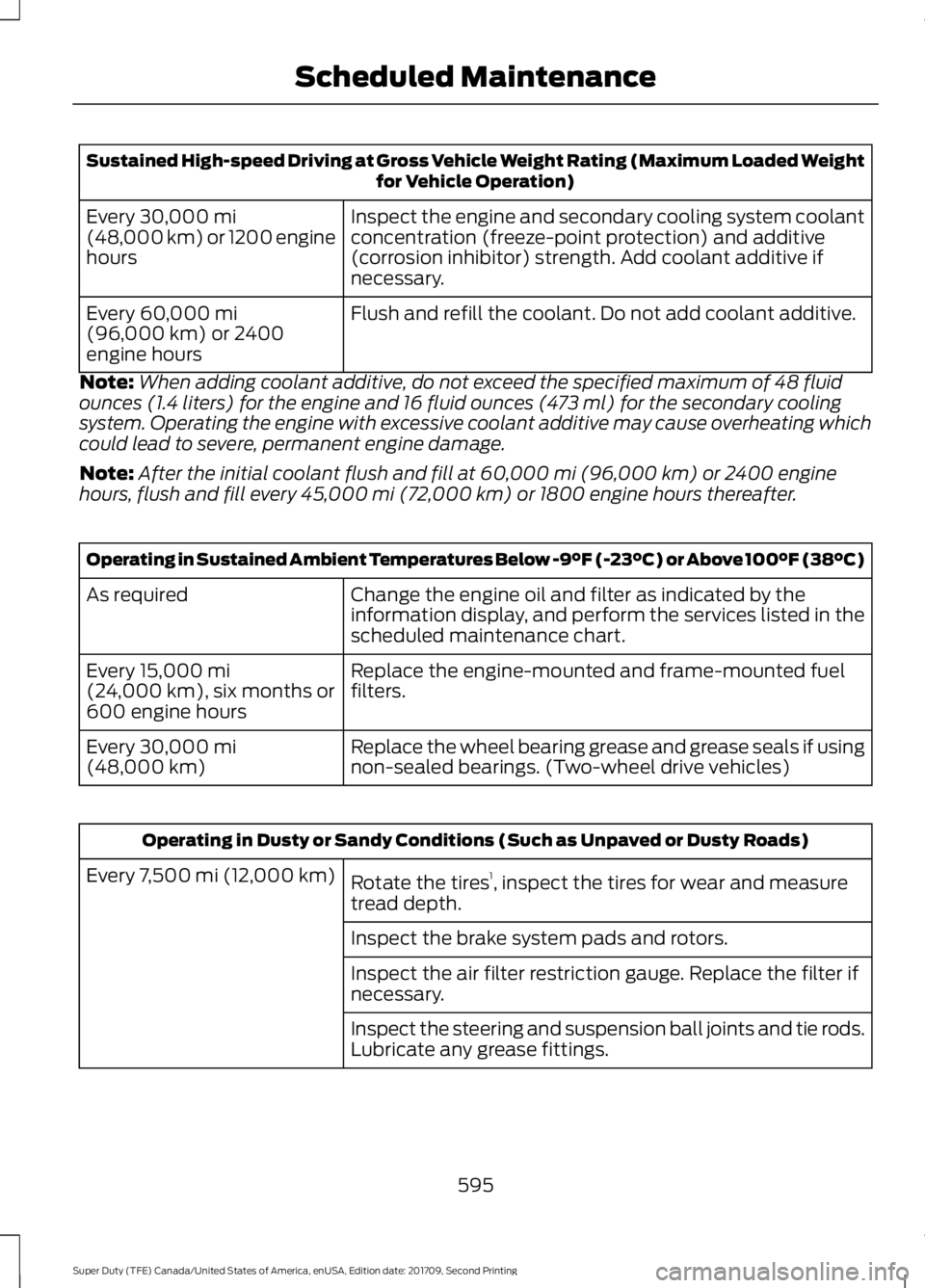
Sustained High-speed Driving at Gross Vehicle Weight Rating (Maximum Loaded Weight
for Vehicle Operation)
Inspect the engine and secondary cooling system coolant
concentration (freeze-point protection) and additive
(corrosion inhibitor) strength. Add coolant additive if
necessary.
Every 30,000 mi
(48,000 km) or 1200 engine
hours
Flush and refill the coolant. Do not add coolant additive.
Every
60,000 mi
(96,000 km) or 2400
engine hours
Note: When adding coolant additive, do not exceed the specified maximum of 48 fluid
ounces (1.4 liters) for the engine and 16 fluid ounces (473 ml) for the secondary cooling
system. Operating the engine with excessive coolant additive may cause overheating which
could lead to severe, permanent engine damage.
Note: After the initial coolant flush and fill at
60,000 mi (96,000 km) or 2400 engine
hours, flush and fill every 45,000 mi (72,000 km) or 1800 engine hours thereafter. Operating in Sustained Ambient Temperatures Below -9°F (-23°C) or Above 100°F (38°C)
Change the engine oil and filter as indicated by the
information display, and perform the services listed in the
scheduled maintenance chart.
As required
Replace the engine-mounted and frame-mounted fuel
filters.
Every
15,000 mi
(24,000 km), six months or
600 engine hours
Replace the wheel bearing grease and grease seals if using
non-sealed bearings. (Two-wheel drive vehicles)
Every
30,000 mi
(48,000 km) Operating in Dusty or Sandy Conditions (Such as Unpaved or Dusty Roads)
Rotate the tires1
, inspect the tires for wear and measure
tread depth.
Every
7,500 mi (12,000 km)
Inspect the brake system pads and rotors.
Inspect the air filter restriction gauge. Replace the filter if
necessary.
Inspect the steering and suspension ball joints and tie rods.
Lubricate any grease fittings.
595
Super Duty (TFE) Canada/United States of America, enUSA, Edition date: 201709, Second Printing Scheduled Maintenance