brake fluid FORD F-53 2019 User Guide
[x] Cancel search | Manufacturer: FORD, Model Year: 2019, Model line: F-53, Model: FORD F-53 2019Pages: 176, PDF Size: 9.98 MB
Page 96 of 176
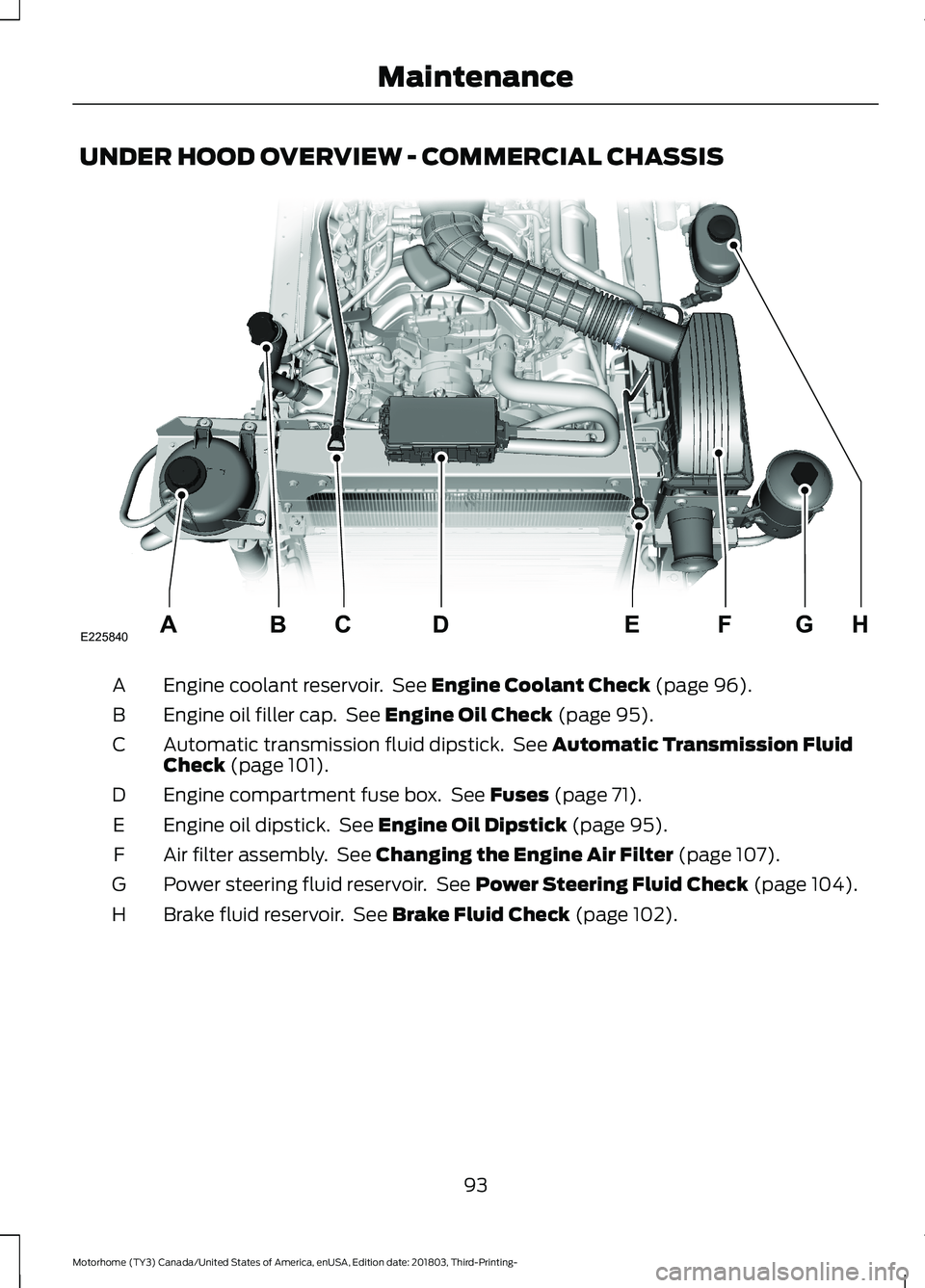
UNDER HOOD OVERVIEW - COMMERCIAL CHASSIS
Engine coolant reservoir. See Engine Coolant Check (page 96).A
Engine oil filler cap. See Engine Oil Check (page 95).B
Automatic transmission fluid dipstick. See Automatic Transmission FluidCheck (page 101).C
Engine compartment fuse box. See Fuses (page 71).D
Engine oil dipstick. See Engine Oil Dipstick (page 95).E
Air filter assembly. See Changing the Engine Air Filter (page 107).F
Power steering fluid reservoir. See Power Steering Fluid Check (page 104).G
Brake fluid reservoir. See Brake Fluid Check (page 102).H
93
Motorhome (TY3) Canada/United States of America, enUSA, Edition date: 201803, Third-Printing-MaintenanceE225840HGFEABCD
Page 97 of 176
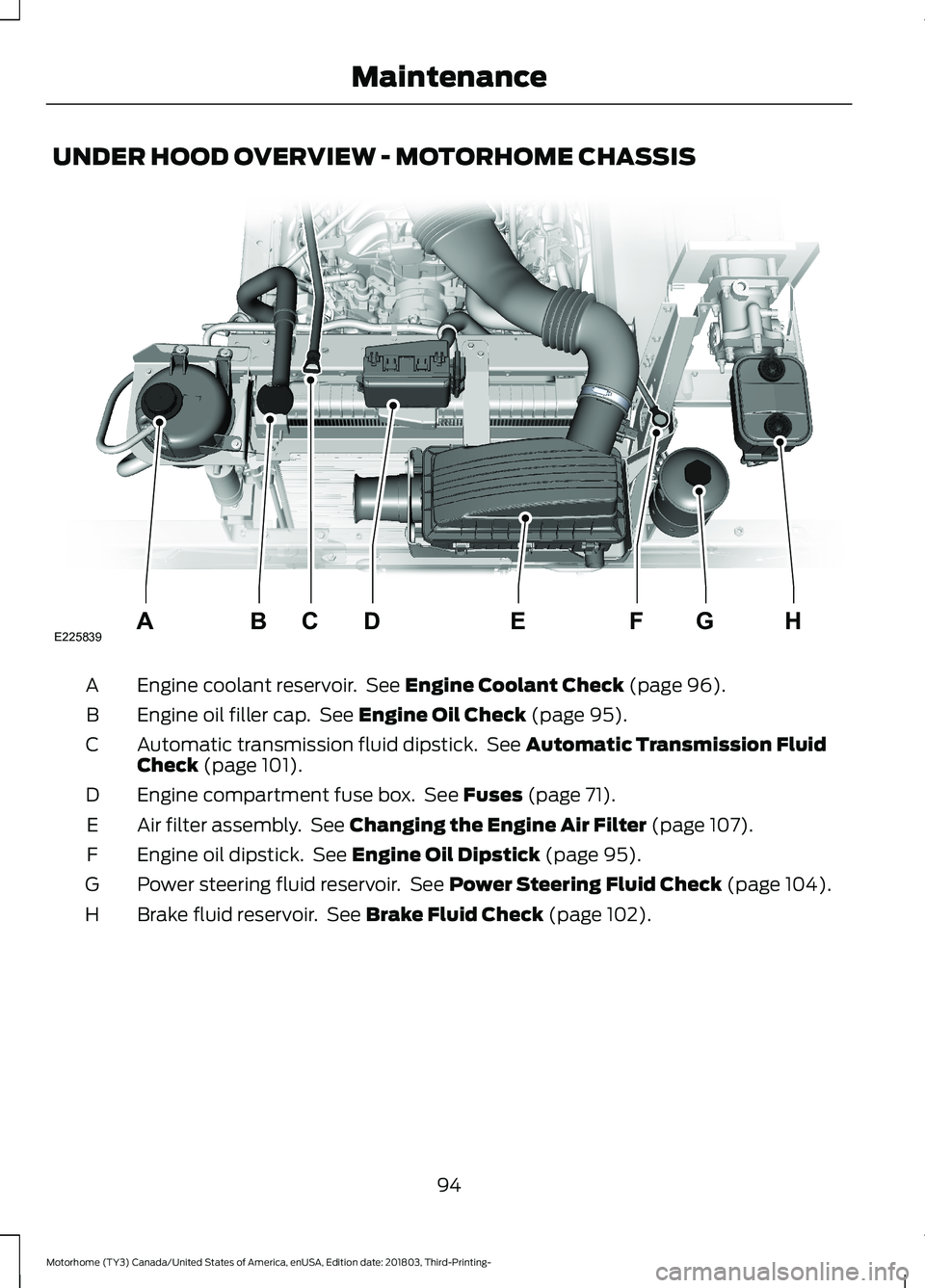
UNDER HOOD OVERVIEW - MOTORHOME CHASSIS
Engine coolant reservoir. See Engine Coolant Check (page 96).A
Engine oil filler cap. See Engine Oil Check (page 95).B
Automatic transmission fluid dipstick. See Automatic Transmission FluidCheck (page 101).C
Engine compartment fuse box. See Fuses (page 71).D
Air filter assembly. See Changing the Engine Air Filter (page 107).E
Engine oil dipstick. See Engine Oil Dipstick (page 95).F
Power steering fluid reservoir. See Power Steering Fluid Check (page 104).G
Brake fluid reservoir. See Brake Fluid Check (page 102).H
94
Motorhome (TY3) Canada/United States of America, enUSA, Edition date: 201803, Third-Printing-MaintenanceE225839HGFEABCD
Page 104 of 176
AUTOMATIC TRANSMISSION
FLUID CHECK
WARNING: The dipstick andsurrounding components are hot. Usegloves when moving components andchecking the transmission fluid level.Failure to follow this warning could resultin serious personal injury.
Note:Automatic transmission fluidexpands when warmed. To obtain anaccurate fluid check, drive the vehicle untilit is at normal operating temperature(approximately 20 mi (30 km)). If yourvehicle has been operated for an extendedperiod at high speeds, in city traffic duringhot weather or pulling a trailer, the vehicleshould be turned off for about 30 minutesto allow fluid to cool to normal operatingtemperature 196°F - 215°F (91°C - 102°C)before checking.
Refer to your scheduled maintenanceinformation for scheduled intervals for fluidchecks and changes.
Your transmission does not consume fluid.However, the fluid level should be checkedif the transmission is not working properly,(i.e., if the transmission slips or shiftsslowly) or if you notice some sign of fluidleakage. To check the fluid level:
1.Drive the vehicle 20 mi (30 km) or untilit reaches normal operatingtemperature
2.Park the vehicle on a level surface andengage the parking brake
3.With the engine running, parking brakeengaged and your foot on the brakepedal, move the gearshift lever throughall of the gear ranges. Allow sufficienttime for each gear to engage
4.Latch the gearshift lever in P (Park)and leave the engine running.
5.Remove the dipstick, wiping it cleanwith a clean, dry lint free rag. Ifnecessary, refer to Under HoodOverview in this chapter for thelocation of the dipstick.
6.Install the dipstick making sure it is fullyseated in the filler tube.
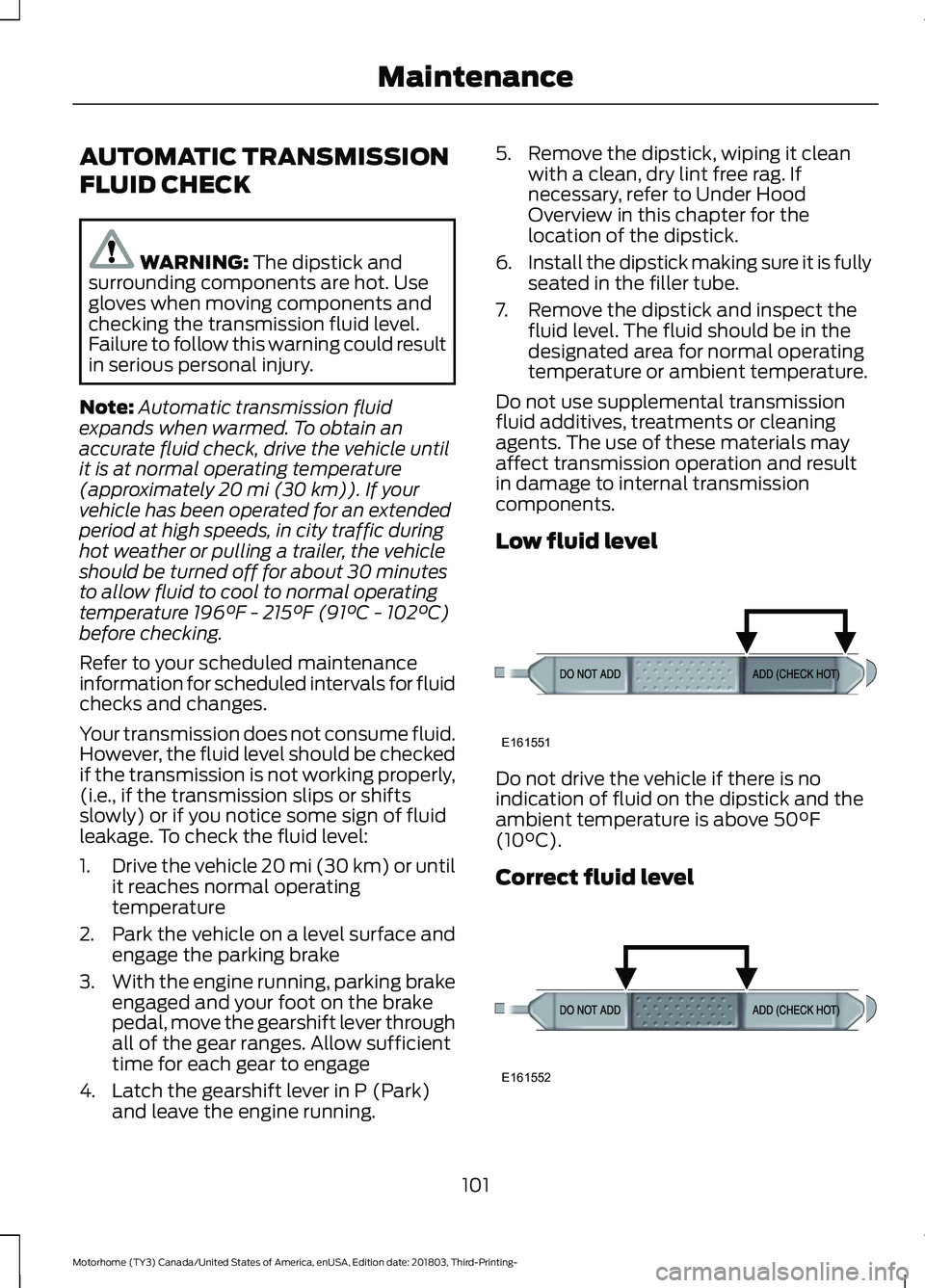
7.Remove the dipstick and inspect thefluid level. The fluid should be in thedesignated area for normal operatingtemperature or ambient temperature.
Do not use supplemental transmissionfluid additives, treatments or cleaningagents. The use of these materials mayaffect transmission operation and resultin damage to internal transmissioncomponents.
Low fluid level
Do not drive the vehicle if there is noindication of fluid on the dipstick and theambient temperature is above 50°F(10°C).
Correct fluid level
101
Motorhome (TY3) Canada/United States of America, enUSA, Edition date: 201803, Third-Printing-MaintenanceE161551 E161552
Page 105 of 176

The transmission fluid should be in thisrange if at normal operating temperature196°F - 215°F (91°C - 102°C).
The transmission fluid should be checkedat normal operating temperature 196°F -215°F (91°C - 102°C) on a level surface.The normal operating temperature can bereached after approximately 20 mi(30 km) of driving. You can check the fluidwithout driving if the ambient temperatureis above 50°F (10°C). However, if fluid isadded at this time, an overfill conditioncould result when the vehicle reachesnormal operating temperature
High fluid level
Fluid levels above the safe range mayresult in transmission failure. An overfillcondition of transmission fluid may causeshift and/or engagement concerns and/orpossible damage. High fluid levels can becaused by an overheating condition.
Adjusting automatic transmissionfluid levels
Note:Use of a non-approved automatictransmission fluid may cause internaltransmission damage. Before adding anyfluid, make sure the correct type is used. Thetype of fluid used is normally indicated onthe transmission dipstick and also in theSee Capacities and Specifications (page134).
Add fluid in ½ pint (250 ml) incrementsthrough the filler tube until the level iscorrect.
Note:If an overfill occurs, excess fluidshould be removed by an authorized dealer.An overfill condition of transmission fluidmay cause shift and/or engagementconcerns and/or possible damage.
Do not use supplemental transmissionfluid additives, treatments or cleaningagents. The use of these materials mayaffect transmission operation and resultin damage to internal transmissioncomponents.
Automatic transmission fluid filter
The TorqShift6™ automatic transmissionis equipped with a serviceable transmissionfluid filter located inside the transmissionbottom pan. Refer to the scheduledmaintenance information for serviceintervals for the automatic transmissionfluid and transmission filter. Fortransmission filter maintenance, see yourauthorized dealer.
BRAKE FLUID CHECK
Fluid levels between the MIN and MAXlines are within the normal operating range;there is no need to add fluid. If the fluidlevels are outside of the normal operatingrange, the performance of the systemcould be compromised; seek service fromyour authorized dealer immediately.
102
Motorhome (TY3) Canada/United States of America, enUSA, Edition date: 201803, Third-Printing-MaintenanceE161553 E161554
Page 106 of 176

Hydromax
WARNING: Carefully readcautionary information on product label.For MEDICAL EMERGENCYINFORMATION contact a physician orPoison Control Center immediately; onFord-Motorcraft™ products call:1-800-959-3673 (FORD). Failure tofollow these instructions may result inpersonal injury.
WARNING: Use of any brake fluidother than that indicated for your brakesystem will cause permanent damage.
WARNING: Do not let the reservoirfor the master cylinder run dry. This maycause the brakes to fail and result inpersonal injury.
Chassis with gross vehicle weight ratingsof 20500 pounds (9299 kilograms),22000 pounds (9979 kilograms), 24000pounds (10886 kilograms) and 26000pounds (11793 kilograms) are equippedwith Hydromax Brake Booster Systemsand must use Motorcraft DOT 5.1 MotorVehicle Brake Fluid or equivalent meetingFord Specification ESD-M6C57-A. SeeCapacities and Specifications (page138).
Add fluid up to the bottom of the ringslocated at the top of the reservoir. Do notfill above this line.
•Use only DOT 5.1 brake fluid that iscertified to meet Ford specifications.
•A clear gel-like substance in thehydraulic brake master cylinderreservoir may appear on some vehicles.This substance is a silicone baselubricant used during assembly of themaster cylinder. It will float on top ofthe brake hydraulic fluid in the mastercylinder. This condition is normal andin no way affects the operation of thebrake system. It does not require anyservice.
•Brake system fluid should be replacedon a regular basis to maintain optimumbraking performance, especially underheavy-duty driving conditions such asfrequent steep grades or heavy towingloads. See Scheduled Maintenance(page 145).
Hydroboost
Chassis with gross vehicle weight ratingsof 16000 pounds (7257 kilograms), 18000pounds (8165 kilograms) and 19500pounds (8845 kilograms) are equippedwith Hydroboost Brake Booster Systemsand must use Motorcraft HighPerformance DOT 3 Motor Vehicle BrakeFluid or equivalent meeting FordSpecification WSS-M6C62-A.
103
Motorhome (TY3) Canada/United States of America, enUSA, Edition date: 201803, Third-Printing-MaintenanceE161555
Page 107 of 176
Add brake fluid from a clean unopenedcontainer until the level reaches MAX. Donot fill above this line. Use only DOT 3brake fluid that is certified to meet Fordspecifications.
Brake system fluid should be replaced ona regular basis to maintain optimumbraking performance, especially underheavy-duty driving conditions such asfrequent steep grades or heavy towingloads. See Scheduled Maintenance(page 145).
POWER STEERING FLUID
CHECK
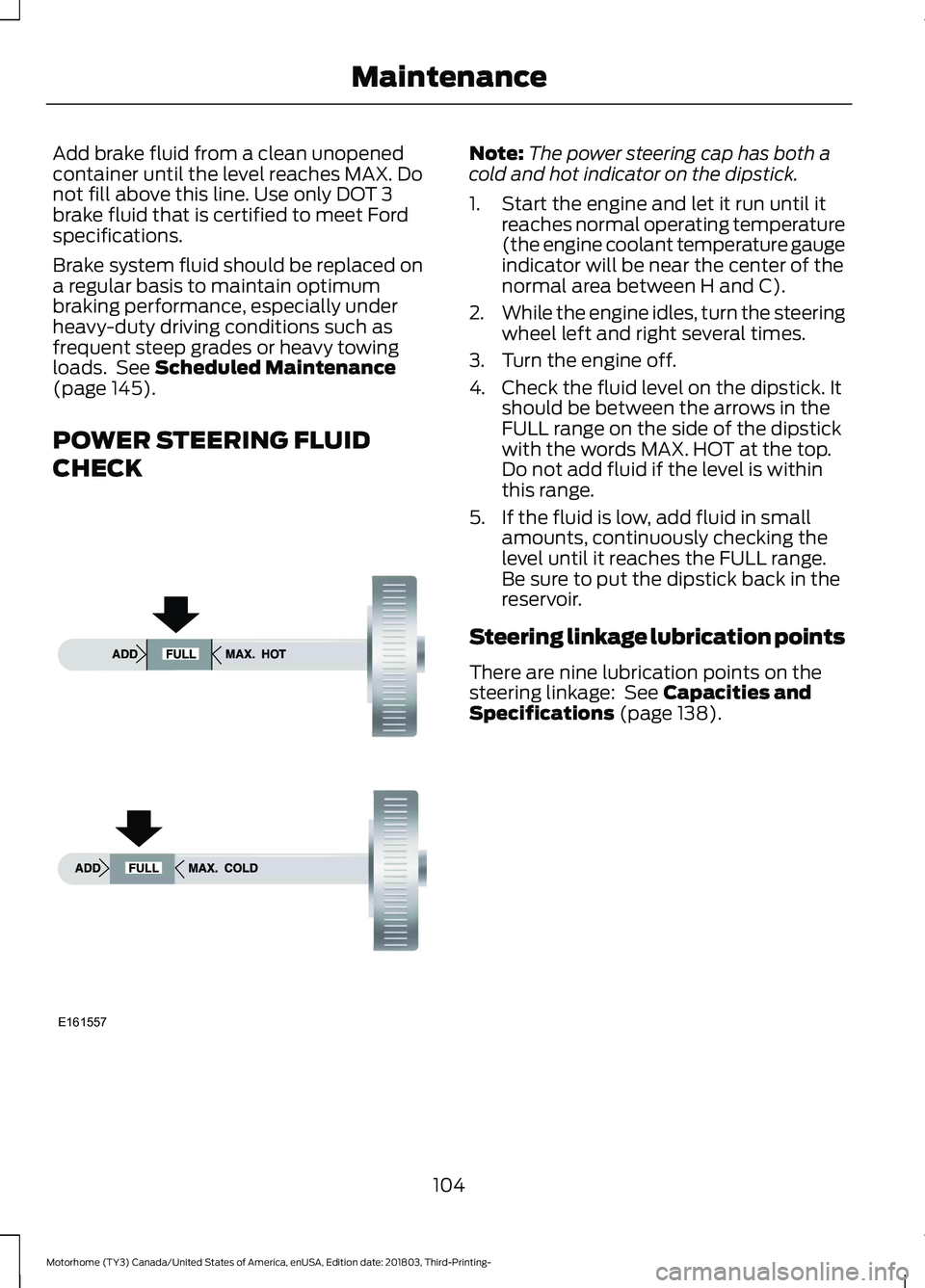
Note:The power steering cap has both acold and hot indicator on the dipstick.
1.Start the engine and let it run until itreaches normal operating temperature(the engine coolant temperature gaugeindicator will be near the center of thenormal area between H and C).
2.While the engine idles, turn the steeringwheel left and right several times.
3.Turn the engine off.
4.Check the fluid level on the dipstick. Itshould be between the arrows in theFULL range on the side of the dipstickwith the words MAX. HOT at the top.Do not add fluid if the level is withinthis range.
5.If the fluid is low, add fluid in smallamounts, continuously checking thelevel until it reaches the FULL range.Be sure to put the dipstick back in thereservoir.
Steering linkage lubrication points
There are nine lubrication points on thesteering linkage: See Capacities andSpecifications (page 138).
104
Motorhome (TY3) Canada/United States of America, enUSA, Edition date: 201803, Third-Printing-MaintenanceE161557
Page 113 of 176
Note:Holding the pressure washer nozzleat an angle to the vehicle's surface maydamage graphics and cause the edges topeel away from the vehicle's surface.
Underbody
Regularly clean the underside of yourvehicle using water. Keep body and doordrain holes free of debris or foreignmaterial.
Under Hood
For removing black rubber marks fromunder the hood we recommend MotorcraftWheel and Tire Cleaner or Motorcraft Bugand Tar Remover.
CLEANING THE ENGINE
Engines are more efficient when they areclean because grease and dirt buildup keepthe engine warmer than normal.
When washing:
•Take care when using a power washerto clean the engine. The high-pressurefluid could penetrate the sealed partsand cause damage.
•Do not spray a hot engine with coldwater to avoid cracking the engineblock or other engine components.
•Spray Motorcraft Engine Shampoo andDegreaser on all parts that requirecleaning and pressure rinse clean. InCanada, use Motorcraft EngineShampoo.
Note:If your vehicle has an engine coverremove the cover before application ofMotorcraft Engine Shampoo and Degreaser.Immediately rinse away any over spray.
•Never wash or rinse the engine while itis hot or running; water in the runningengine may cause internal damage.
•Never wash or rinse any ignition coil,spark plug wire or spark plug well, orthe area in and around these locations.
•Cover the battery, power distributionbox, and air filter assembly to preventwater damage when cleaning theengine.
CLEANING THE WHEELS (IF
EQUIPPED)
1.Regularly clean them with a wheelcleaner. We recommend that you useFord approved wheel cleaner ifavailable.
2.Remove dirt and brake dust with asponge.
3.Remove tar and grease with a bug andtar remover. We recommend that youuse Ford approved bug and tar removerif available.
4.Thoroughly rinse the wheels with waterafter cleaning.
If you intend on parking your vehicle for anextended period after cleaning the wheelswith a wheel cleaner, drive your vehicle fora few minutes before doing so. Thisreduces the risk of corrosion of the brakediscs, brake pads and linings.
Do not clean the wheels when they are hot.
Note: Some car washes could damagewheel rims and covers.
Note: Using non-recommended cleaners,harsh cleaning products, chrome wheelcleaners or abrasive materials coulddamage wheel rims and covers.
110
Motorhome (TY3) Canada/United States of America, enUSA, Edition date: 201803, Third-Printing-Vehicle Care
Page 114 of 176
VEHICLE STORAGE
If you plan on storing your vehicle for 30days or more, read the followingmaintenance recommendations to makesure your vehicle stays in good operatingcondition.
We engineer and test all motor vehiclesand their components for reliable, regulardriving. Under various conditions,long-term storage may lead to degradedengine performance or failure unless youuse specific precautions to preserve enginecomponents.
General
•Store all vehicles in a dry, ventilatedplace.
•Protect from sunlight, if possible.
•If vehicles are stored outside, theyrequire regular maintenance to protectagainst rust and damage.
Body
•Wash your vehicle thoroughly toremove dirt, grease, oil, tar or mud fromexterior surfaces, rear-wheel housingand the underside of front fenders.
•Periodically wash your vehicle if it isstored in exposed locations.
•Touch-up exposed or primed metal toprevent rust.
•Cover chrome and stainless steel partswith a thick coat of auto wax to preventdiscoloration. Re-wax as necessarywhen you wash your vehicle.
•Lubricate all hood, door and luggagecompartment hinges and latches witha light grade oil.
•Cover interior trim to prevent fading.
•Keep all rubber parts free from oil andsolvents.
Engine
•Change the engine oil and filter prior tostorage because used engine oilcontains contaminates which maycause engine damage.
•Start the engine every 15 days for aminimum of 15 minutes. Run at fastidle with the climate controls set todefrost until the engine reaches normaloperating temperature.
•With your foot on the brake, shiftthrough all the gears while the engineis running.
•We recommend that you change theengine oil before you use your vehicleagain.
Fuel system
•Fill the fuel tank with high-quality fueluntil the first automatic shutoff of thefuel pump nozzle.
Cooling system
•Protect against freezing temperatures.
•When removing your vehicle fromstorage, check coolant fluid level.Confirm that there are no coolingsystem leaks and that fluid is at therecommended level.
Disconnecting Your 12 Volt Battery
•Check and recharge as necessary. Keepconnections clean.
•If storing your vehicle for more than 30days without recharging the battery,we recommend that you disconnectthe battery cables to maintain batterycharge for quick starting.
Note:It is necessary to reset memoryfeatures if you disconnect the batterycables.
111
Motorhome (TY3) Canada/United States of America, enUSA, Edition date: 201803, Third-Printing-Vehicle Care
Page 115 of 176
Brakes
•Make sure the brakes and parking brakerelease fully.
Tires
•Maintain recommended air pressure.
Miscellaneous
•Make sure all linkages, cables, leversand pins under your vehicle are coveredwith grease to prevent rust.
•Move vehicles at least 25 ft (7.5 m)every 15 days to lubricate working partsand prevent corrosion.
Removing Vehicle From Storage
When your vehicle is ready to come out ofstorage, do the following:
•Wash your vehicle to remove any dirtor grease film build-up on windowsurfaces.
•Check windshield wipers for anydeterioration.
•Check under the hood for any foreignmaterial that may have collectedduring storage such as mice or squirrelnests.
•Check the exhaust for any foreignmaterial that may have collectedduring storage.
•Check tire pressures and set tireinflation per the Tire Label.
•Check brake pedal operation. Driveyour vehicle 15 ft (4.5 m) back andforth to remove rust build-up.
•Check fluid levels (including coolant,oil and gas) to make sure there are noleaks, and fluids are at recommendedlevels.
•If you remove the battery, clean thebattery cable ends and check fordamage.
Contact an authorized dealer if you haveany concerns or issues.
112
Motorhome (TY3) Canada/United States of America, enUSA, Edition date: 201803, Third-Printing-Vehicle Care
Page 141 of 176
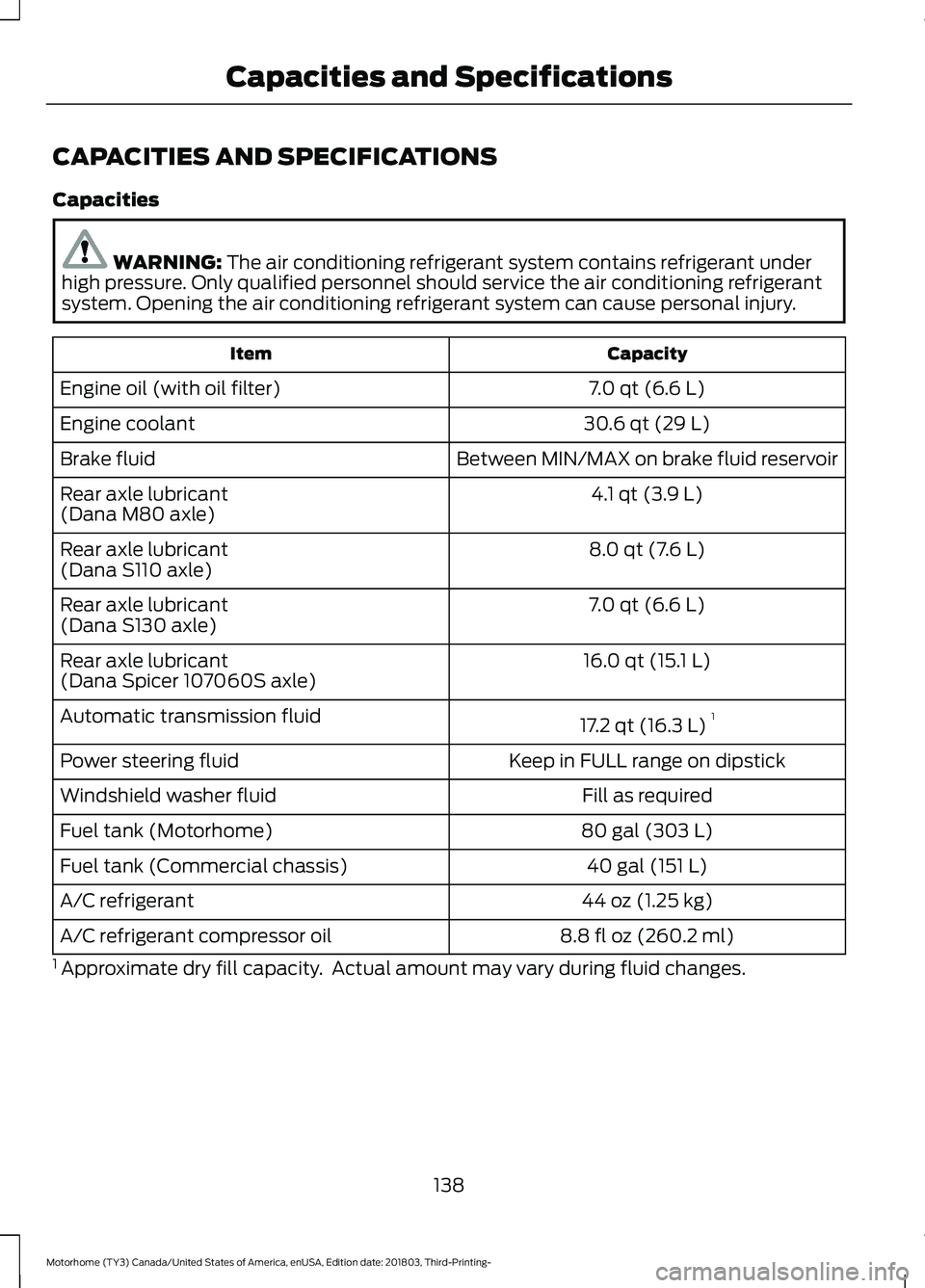
CAPACITIES AND SPECIFICATIONS
Capacities
WARNING: The air conditioning refrigerant system contains refrigerant underhigh pressure. Only qualified personnel should service the air conditioning refrigerantsystem. Opening the air conditioning refrigerant system can cause personal injury.
CapacityItem
7.0 qt (6.6 L)Engine oil (with oil filter)
30.6 qt (29 L)Engine coolant
Between MIN/MAX on brake fluid reservoirBrake fluid
4.1 qt (3.9 L)Rear axle lubricant(Dana M80 axle)
8.0 qt (7.6 L)Rear axle lubricant(Dana S110 axle)
7.0 qt (6.6 L)Rear axle lubricant(Dana S130 axle)
16.0 qt (15.1 L)Rear axle lubricant(Dana Spicer 107060S axle)
17.2 qt (16.3 L)1Automatic transmission fluid
Keep in FULL range on dipstickPower steering fluid
Fill as requiredWindshield washer fluid
80 gal (303 L)Fuel tank (Motorhome)
40 gal (151 L)Fuel tank (Commercial chassis)
44 oz (1.25 kg)A/C refrigerant
8.8 fl oz (260.2 ml)A/C refrigerant compressor oil
1 Approximate dry fill capacity. Actual amount may vary during fluid changes.
138
Motorhome (TY3) Canada/United States of America, enUSA, Edition date: 201803, Third-Printing-Capacities and Specifications