light FORD F-53 2019 Owner's Manual
[x] Cancel search | Manufacturer: FORD, Model Year: 2019, Model line: F-53, Model: FORD F-53 2019Pages: 176, PDF Size: 9.98 MB
Page 63 of 176
Vehicles Sold in Canada: GettingRoadside Assistance
To fully assist you should you have avehicle concern, Ford Motor Company ofCanada, Limited offers a complimentaryroadside assistance program. This programis eligible within Canada or the continentalUnited States.
The service is available 24 hours a day,seven days a week.
This program is separate from the NewVehicle Limited Warranty, but the coverageis concurrent with the powertrain coverageperiod of your vehicle. Canadian roadsidecoverage and benefits may differ from theU.S. coverage.
If you require more information, please callus in Canada at 1-800-665-2006, or visitour website at www.ford.ca.
HAZARD FLASHERS
Note:If used when the vehicle is notrunning, the battery loses charge. As a result,there may be insufficient power to restartyour vehicle.
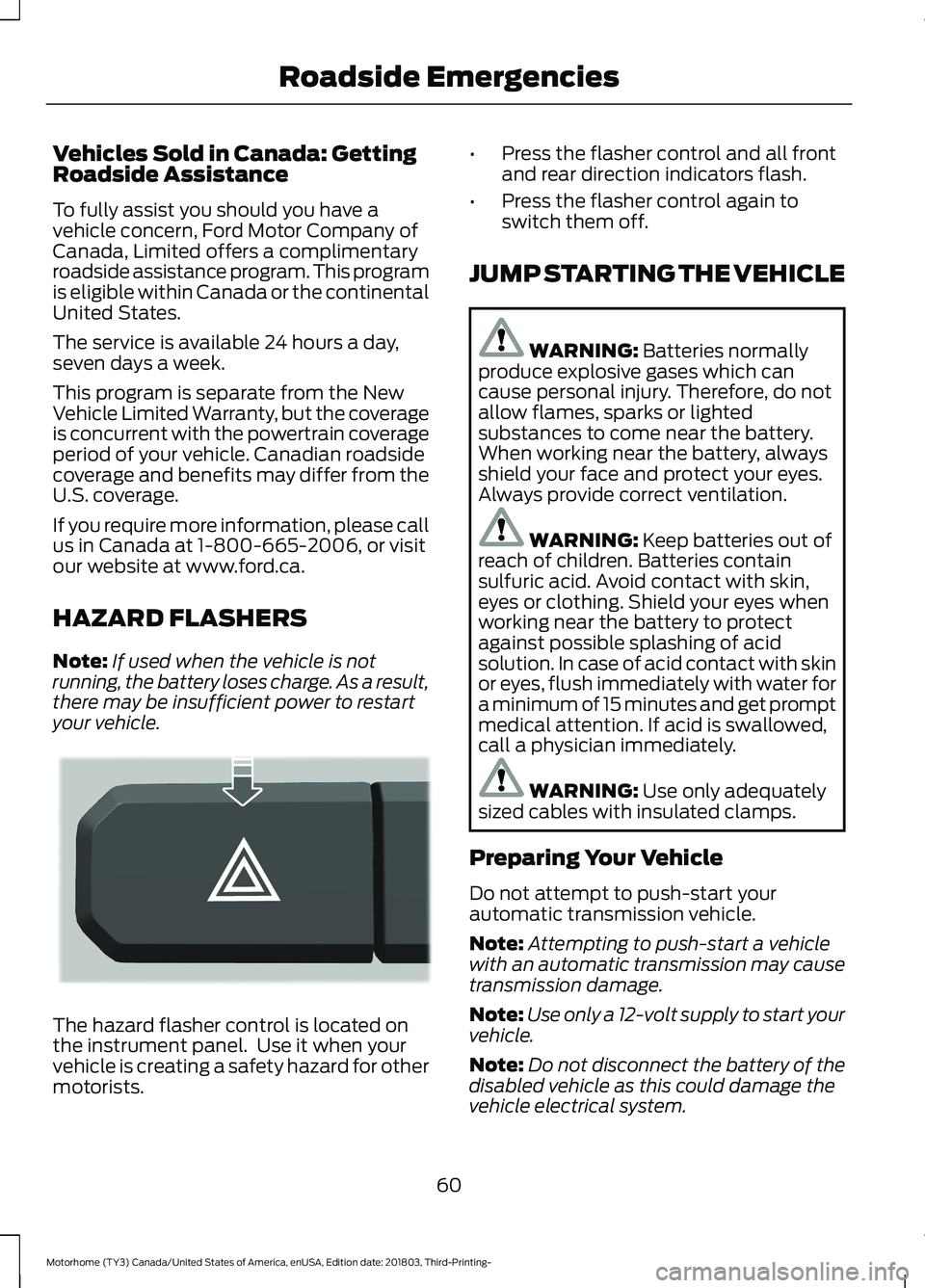
The hazard flasher control is located onthe instrument panel. Use it when yourvehicle is creating a safety hazard for othermotorists.
•Press the flasher control and all frontand rear direction indicators flash.
•Press the flasher control again toswitch them off.
JUMP STARTING THE VEHICLE
WARNING: Batteries normallyproduce explosive gases which cancause personal injury. Therefore, do notallow flames, sparks or lightedsubstances to come near the battery.When working near the battery, alwaysshield your face and protect your eyes.Always provide correct ventilation.
WARNING: Keep batteries out ofreach of children. Batteries containsulfuric acid. Avoid contact with skin,eyes or clothing. Shield your eyes whenworking near the battery to protectagainst possible splashing of acidsolution. In case of acid contact with skinor eyes, flush immediately with water fora minimum of 15 minutes and get promptmedical attention. If acid is swallowed,call a physician immediately.
WARNING: Use only adequatelysized cables with insulated clamps.
Preparing Your Vehicle
Do not attempt to push-start yourautomatic transmission vehicle.
Note:Attempting to push-start a vehiclewith an automatic transmission may causetransmission damage.
Note:Use only a 12-volt supply to start yourvehicle.
Note:Do not disconnect the battery of thedisabled vehicle as this could damage thevehicle electrical system.
60
Motorhome (TY3) Canada/United States of America, enUSA, Edition date: 201803, Third-Printing-Roadside EmergenciesE304635
Page 75 of 176
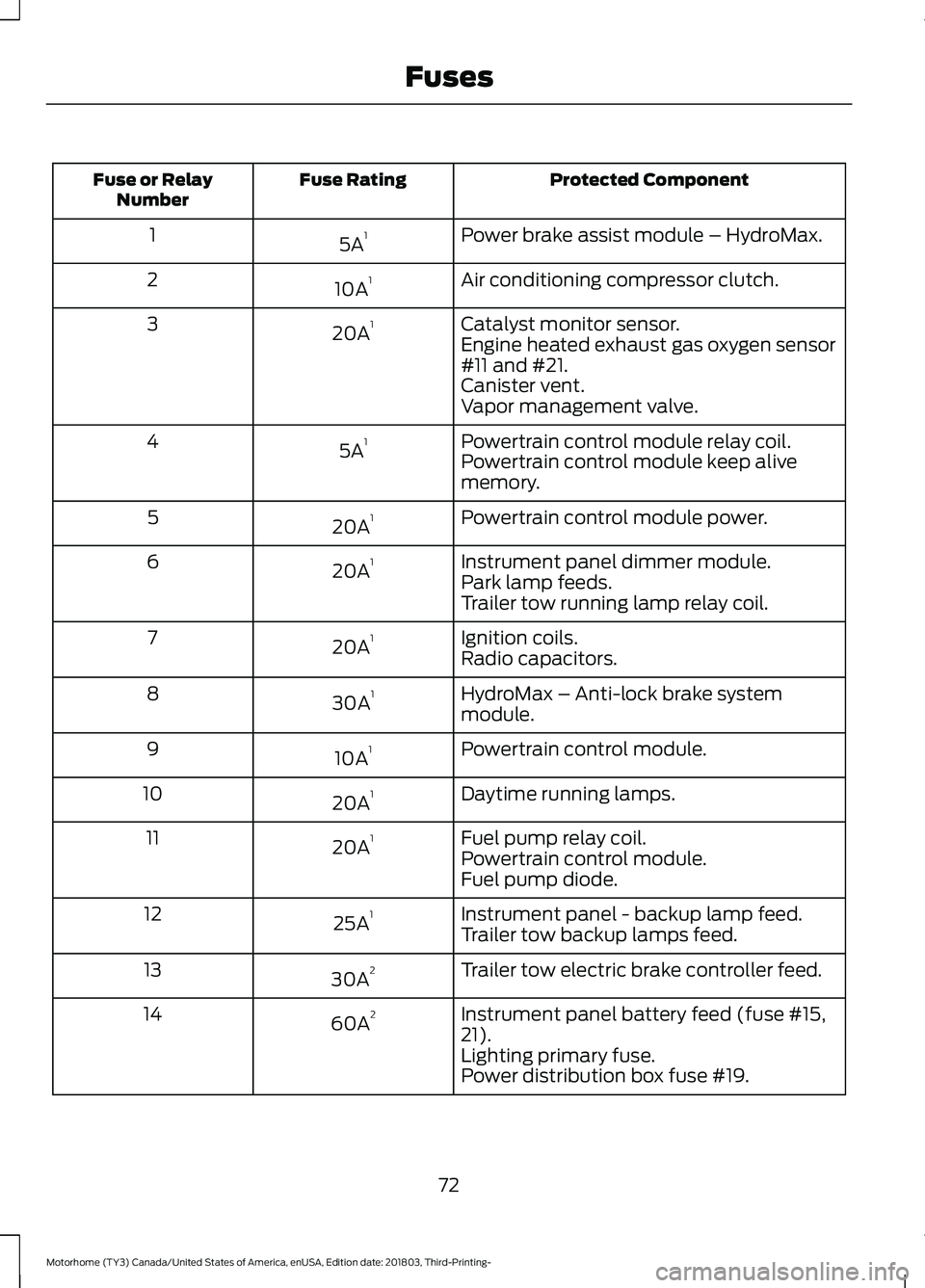
Protected ComponentFuse RatingFuse or RelayNumber
Power brake assist module – HydroMax.5A11
Air conditioning compressor clutch.10A12
Catalyst monitor sensor.20A13Engine heated exhaust gas oxygen sensor#11 and #21.Canister vent.Vapor management valve.
Powertrain control module relay coil.5A14Powertrain control module keep alivememory.
Powertrain control module power.20A15
Instrument panel dimmer module.20A16Park lamp feeds.Trailer tow running lamp relay coil.
Ignition coils.20A17Radio capacitors.
HydroMax – Anti-lock brake systemmodule.30A18
Powertrain control module.10A19
Daytime running lamps.20A110
Fuel pump relay coil.20A111Powertrain control module.Fuel pump diode.
Instrument panel - backup lamp feed.25A112Trailer tow backup lamps feed.
Trailer tow electric brake controller feed.30A213
Instrument panel battery feed (fuse #15,21).60A214
Lighting primary fuse.Power distribution box fuse #19.
72
Motorhome (TY3) Canada/United States of America, enUSA, Edition date: 201803, Third-Printing-Fuses
Page 76 of 176
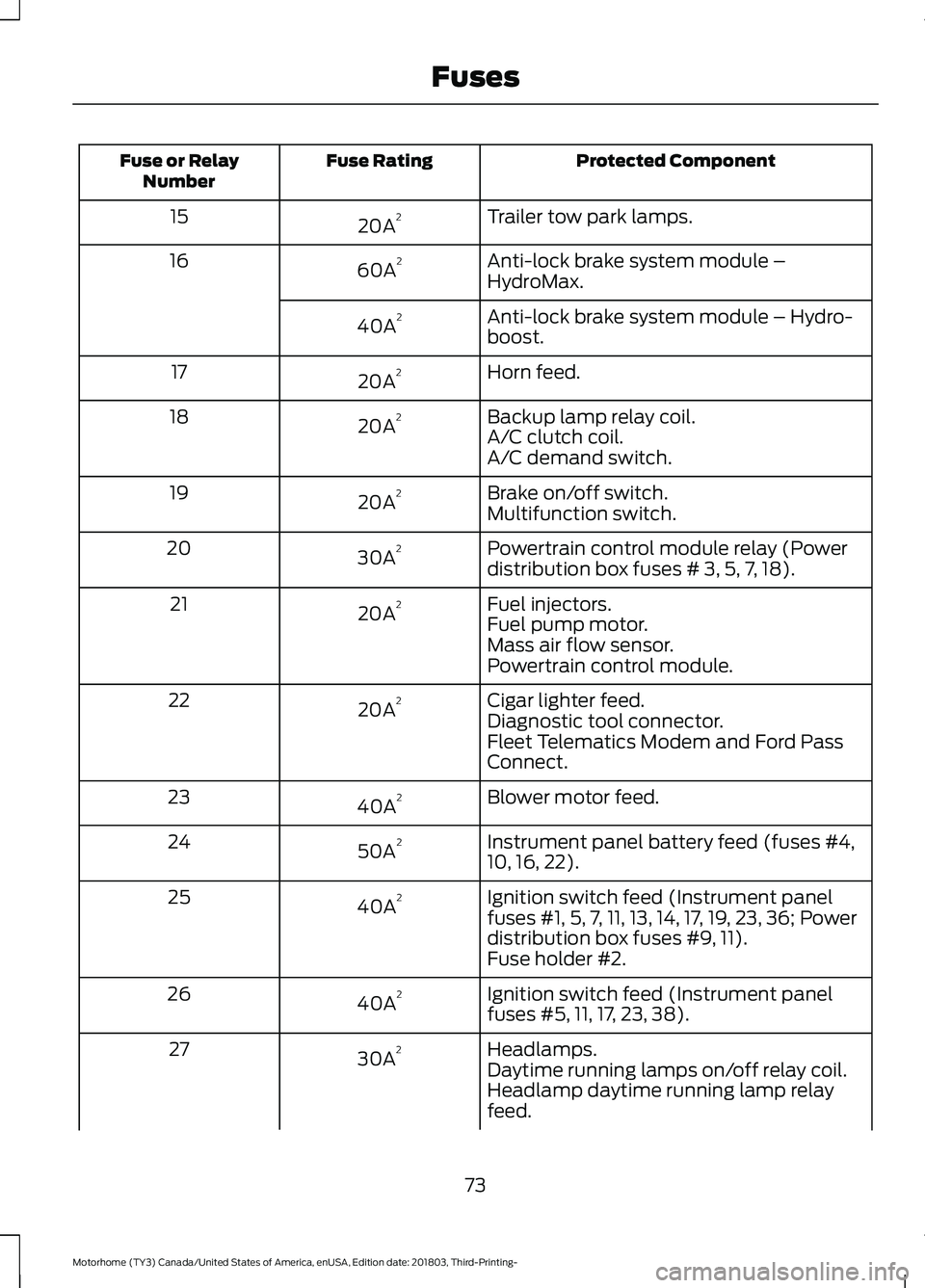
Protected ComponentFuse RatingFuse or RelayNumber
Trailer tow park lamps.20A215
Anti-lock brake system module –HydroMax.60A216
Anti-lock brake system module – Hydro-boost.40A2
Horn feed.20A217
Backup lamp relay coil.20A218A/C clutch coil.A/C demand switch.
Brake on/off switch.20A219Multifunction switch.
Powertrain control module relay (Powerdistribution box fuses # 3, 5, 7, 18).30A220
Fuel injectors.20A221Fuel pump motor.Mass air flow sensor.Powertrain control module.
Cigar lighter feed.20A222Diagnostic tool connector.Fleet Telematics Modem and Ford PassConnect.
Blower motor feed.40A223
Instrument panel battery feed (fuses #4,10, 16, 22).50A224
Ignition switch feed (Instrument panelfuses #1, 5, 7, 11, 13, 14, 17, 19, 23, 36; Powerdistribution box fuses #9, 11).
40A225
Fuse holder #2.
Ignition switch feed (Instrument panelfuses #5, 11, 17, 23, 38).40A226
Headlamps.30A227Daytime running lamps on/off relay coil.Headlamp daytime running lamp relayfeed.
73
Motorhome (TY3) Canada/United States of America, enUSA, Edition date: 201803, Third-Printing-Fuses
Page 80 of 176
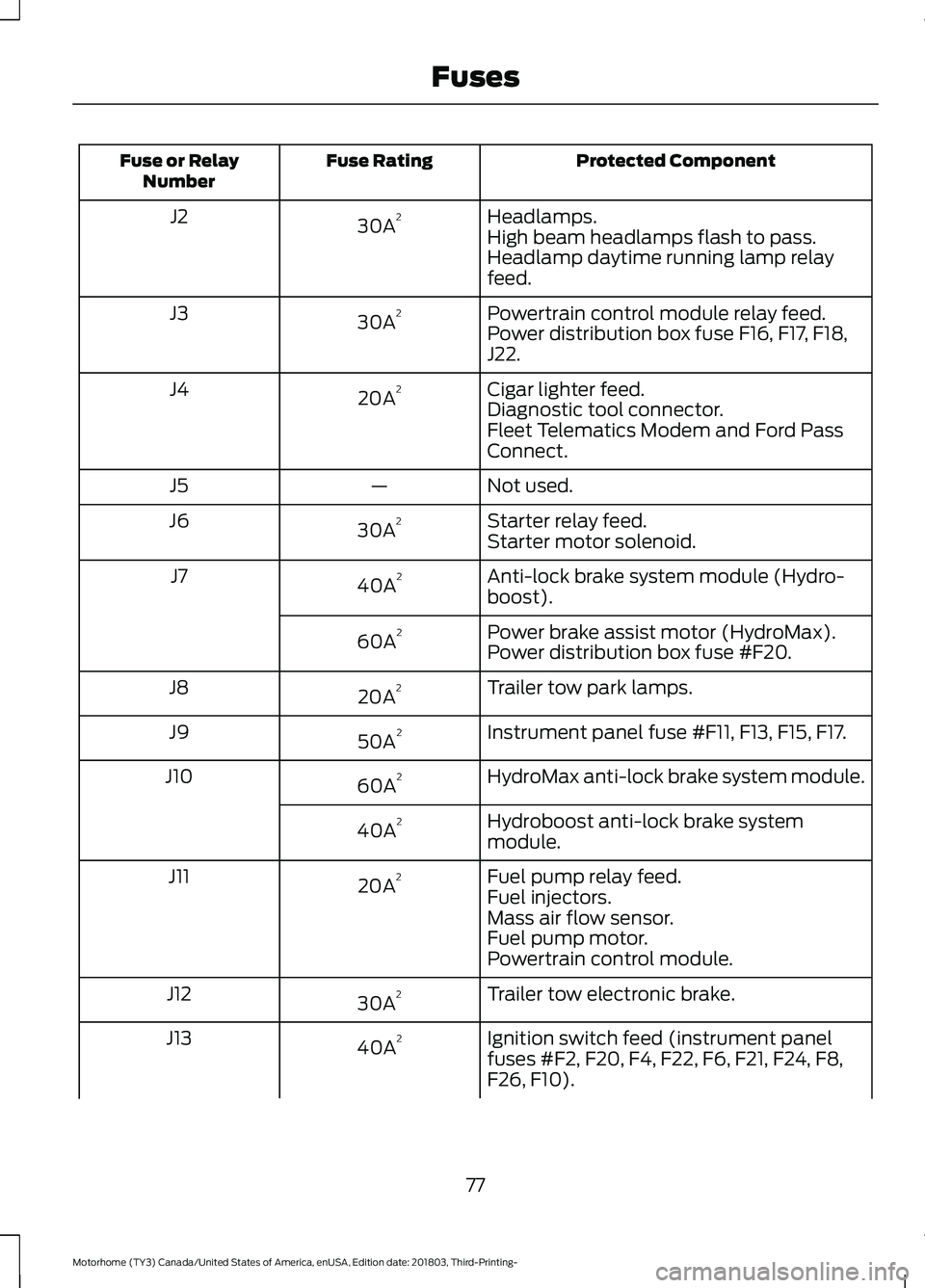
Protected ComponentFuse RatingFuse or RelayNumber
Headlamps.30A2J2High beam headlamps flash to pass.Headlamp daytime running lamp relayfeed.
Powertrain control module relay feed.30A2J3Power distribution box fuse F16, F17, F18,J22.
Cigar lighter feed.20A2J4Diagnostic tool connector.Fleet Telematics Modem and Ford PassConnect.
Not used.—J5
Starter relay feed.30A2J6Starter motor solenoid.
Anti-lock brake system module (Hydro-boost).40A2J7
Power brake assist motor (HydroMax).60A2
Power distribution box fuse #F20.
Trailer tow park lamps.20A2J8
Instrument panel fuse #F11, F13, F15, F17.50A2J9
HydroMax anti-lock brake system module.60A2J10
Hydroboost anti-lock brake systemmodule.40A2
Fuel pump relay feed.20A2J11Fuel injectors.Mass air flow sensor.Fuel pump motor.Powertrain control module.
Trailer tow electronic brake.30A2J12
Ignition switch feed (instrument panelfuses #F2, F20, F4, F22, F6, F21, F24, F8,F26, F10).
40A2J13
77
Motorhome (TY3) Canada/United States of America, enUSA, Edition date: 201803, Third-Printing-Fuses
Page 81 of 176
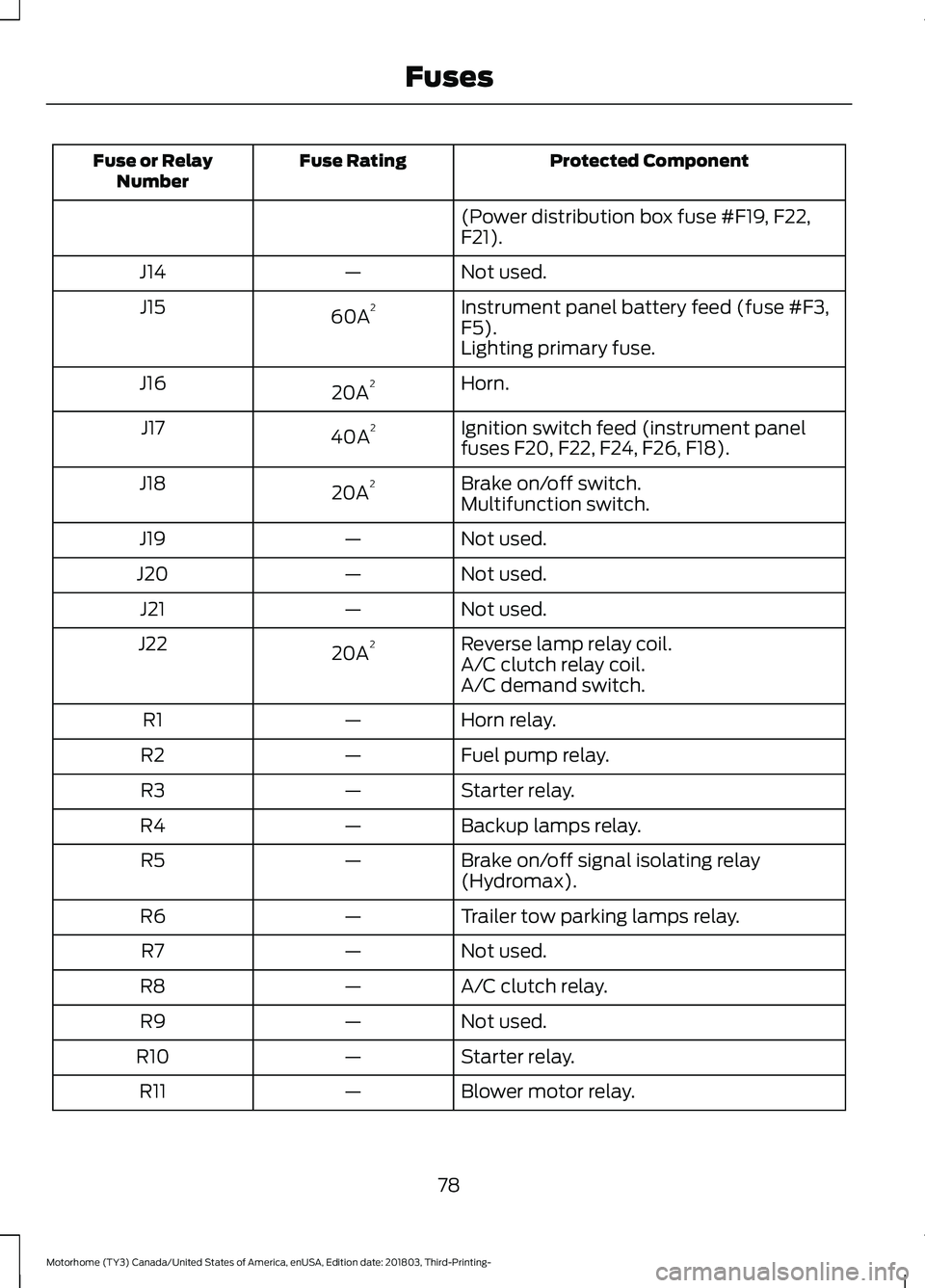
Protected ComponentFuse RatingFuse or RelayNumber
(Power distribution box fuse #F19, F22,F21).
Not used.—J14
Instrument panel battery feed (fuse #F3,F5).60A2J15
Lighting primary fuse.
Horn.20A2J16
Ignition switch feed (instrument panelfuses F20, F22, F24, F26, F18).40A2J17
Brake on/off switch.20A2J18Multifunction switch.
Not used.—J19
Not used.—J20
Not used.—J21
Reverse lamp relay coil.20A2J22A/C clutch relay coil.A/C demand switch.
Horn relay.—R1
Fuel pump relay.—R2
Starter relay.—R3
Backup lamps relay.—R4
Brake on/off signal isolating relay(Hydromax).—R5
Trailer tow parking lamps relay.—R6
Not used.—R7
A/C clutch relay.—R8
Not used.—R9
Starter relay.—R10
Blower motor relay.—R11
78
Motorhome (TY3) Canada/United States of America, enUSA, Edition date: 201803, Third-Printing-Fuses
Page 85 of 176
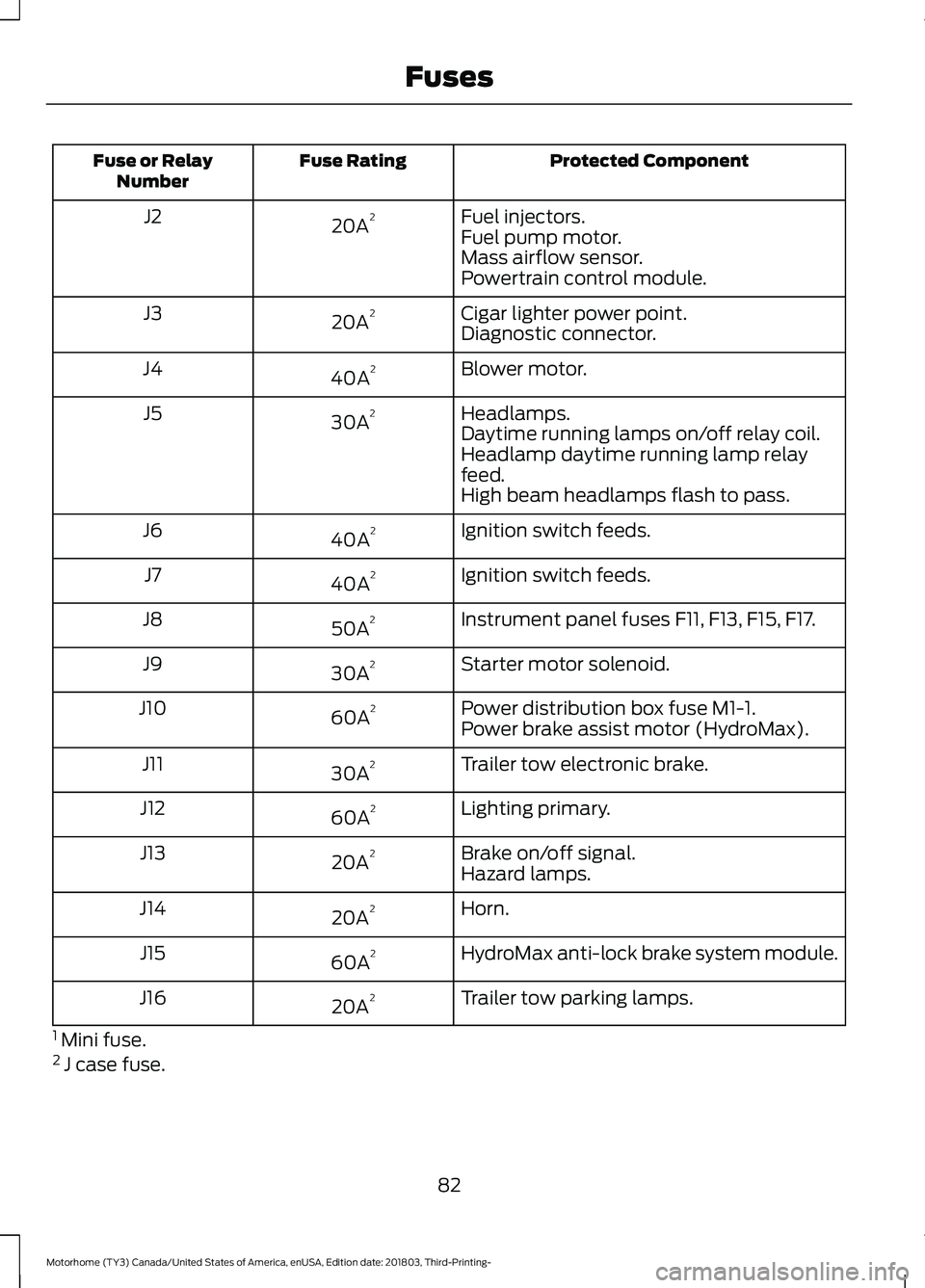
Protected ComponentFuse RatingFuse or RelayNumber
Fuel injectors.20A2J2Fuel pump motor.Mass airflow sensor.Powertrain control module.
Cigar lighter power point.20A2J3Diagnostic connector.
Blower motor.40A2J4
Headlamps.30A2J5Daytime running lamps on/off relay coil.Headlamp daytime running lamp relayfeed.High beam headlamps flash to pass.
Ignition switch feeds.40A2J6
Ignition switch feeds.40A2J7
Instrument panel fuses F11, F13, F15, F17.50A2J8
Starter motor solenoid.30A2J9
Power distribution box fuse M1-1.60A2J10Power brake assist motor (HydroMax).
Trailer tow electronic brake.30A2J11
Lighting primary.60A2J12
Brake on/off signal.20A2J13Hazard lamps.
Horn.20A2J14
HydroMax anti-lock brake system module.60A2J15
Trailer tow parking lamps.20A2J16
1 Mini fuse.2 J case fuse.
82
Motorhome (TY3) Canada/United States of America, enUSA, Edition date: 201803, Third-Printing-Fuses
Page 89 of 176
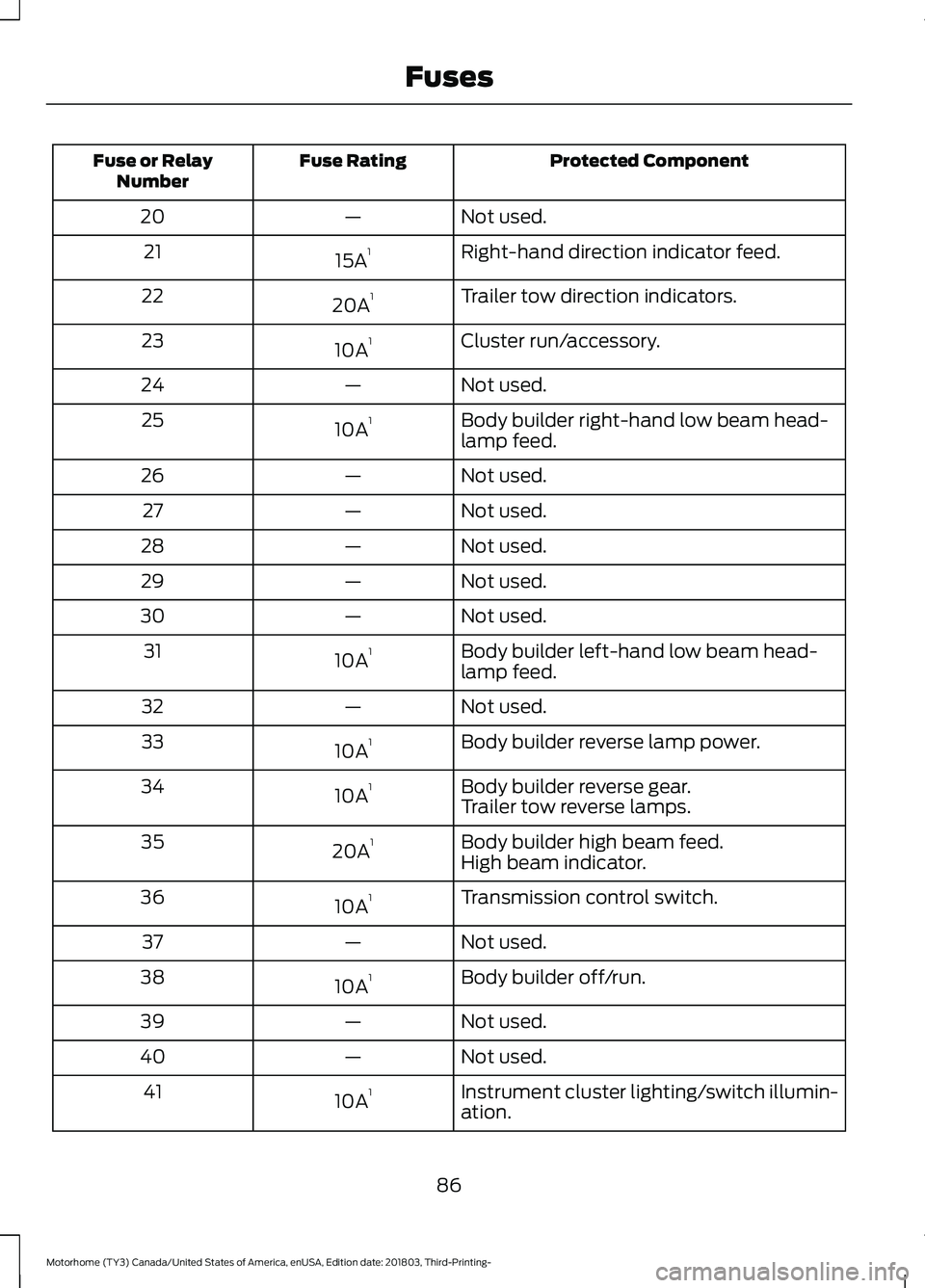
Protected ComponentFuse RatingFuse or RelayNumber
Not used.—20
Right-hand direction indicator feed.15A121
Trailer tow direction indicators.20A122
Cluster run/accessory.10A123
Not used.—24
Body builder right-hand low beam head-lamp feed.10A125
Not used.—26
Not used.—27
Not used.—28
Not used.—29
Not used.—30
Body builder left-hand low beam head-lamp feed.10A131
Not used.—32
Body builder reverse lamp power.10A133
Body builder reverse gear.10A134Trailer tow reverse lamps.
Body builder high beam feed.20A135High beam indicator.
Transmission control switch.10A136
Not used.—37
Body builder off/run.10A138
Not used.—39
Not used.—40
Instrument cluster lighting/switch illumin-ation.10A141
86
Motorhome (TY3) Canada/United States of America, enUSA, Edition date: 201803, Third-Printing-Fuses
Page 92 of 176
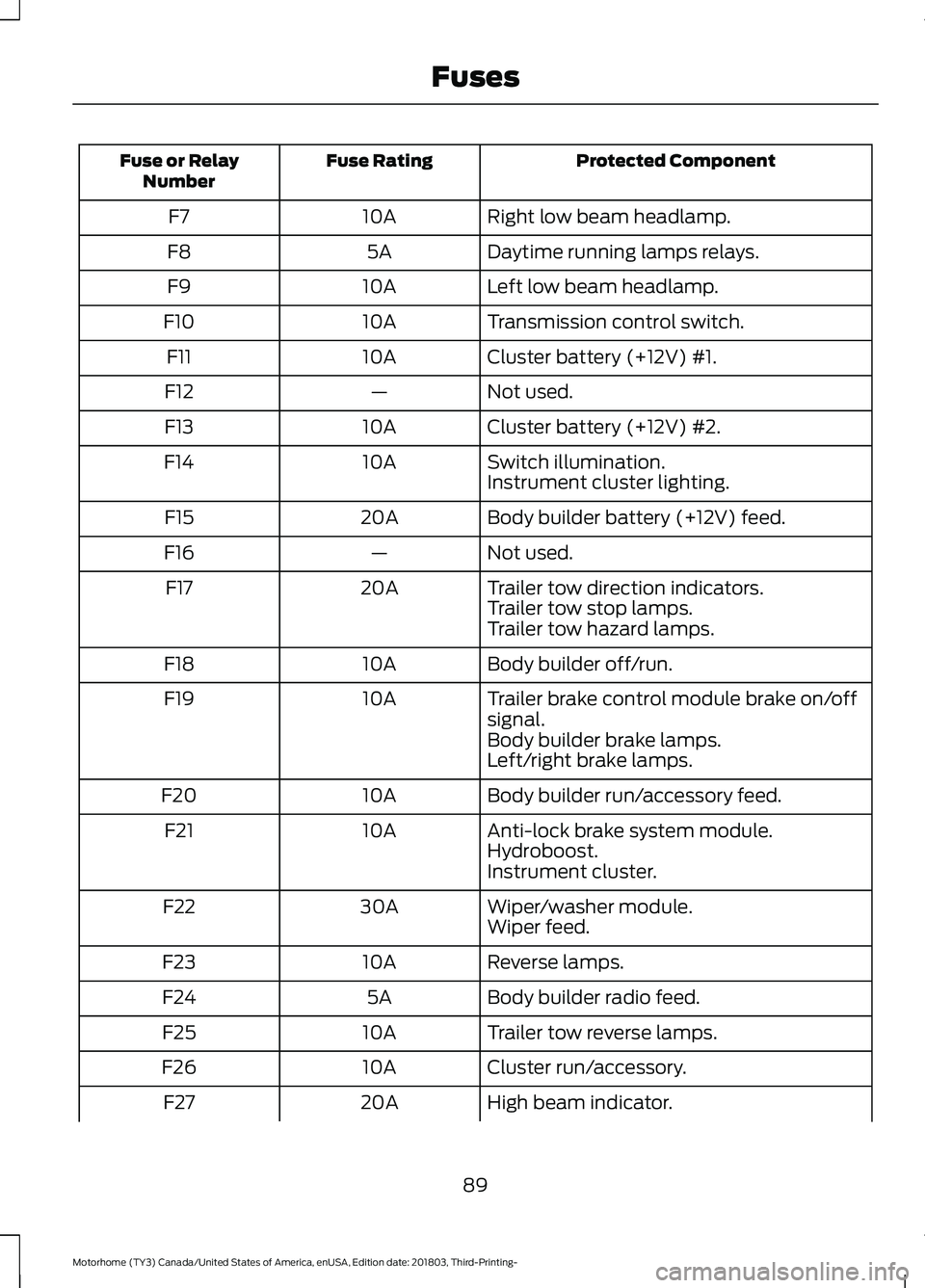
Protected ComponentFuse RatingFuse or RelayNumber
Right low beam headlamp.10AF7
Daytime running lamps relays.5AF8
Left low beam headlamp.10AF9
Transmission control switch.10AF10
Cluster battery (+12V) #1.10AF11
Not used.—F12
Cluster battery (+12V) #2.10AF13
Switch illumination.10AF14Instrument cluster lighting.
Body builder battery (+12V) feed.20AF15
Not used.—F16
Trailer tow direction indicators.20AF17Trailer tow stop lamps.Trailer tow hazard lamps.
Body builder off/run.10AF18
Trailer brake control module brake on/offsignal.10AF19
Body builder brake lamps.Left/right brake lamps.
Body builder run/accessory feed.10AF20
Anti-lock brake system module.10AF21Hydroboost.Instrument cluster.
Wiper/washer module.30AF22Wiper feed.
Reverse lamps.10AF23
Body builder radio feed.5AF24
Trailer tow reverse lamps.10AF25
Cluster run/accessory.10AF26
High beam indicator.20AF27
89
Motorhome (TY3) Canada/United States of America, enUSA, Edition date: 201803, Third-Printing-Fuses
Page 100 of 176
WARNING: To reduce the risk ofpersonal injury, make sure the engine iscool before unscrewing the coolantpressure relief cap. The cooling systemis under pressure. Steam and hot liquidcan come out forcefully when you loosenthe cap slightly.
WARNING: Do not add coolantfurther than the MAX mark.
When the engine is cold, check theconcentration and level of the coolant atthe intervals listed in the scheduledmaintenance information. See ScheduledMaintenance (page 145).
Note:Make sure that the coolant level isbetween the MIN and MAX marks on thecoolant reservoir.
Note: Coolant expands when it is hot. Thelevel may extend beyond the MAX mark.
Maintain coolant concentration within48% to 50%, which equates to a freezepoint between -29°F (-34°C) and -35°F(-37°C). Coolant concentration should bechecked using a refractometer. We do notrecommend the use of hydrometers orcoolant test strips for measuring coolantconcentration.
Adding Coolant
WARNING: Do not remove thecoolant reservoir cap when the engine ison or the cooling system is hot. Wait 10minutes for the cooling system to cooldown. Cover the coolant reservoir capwith a thick cloth to prevent thepossibility of scalding and slowly removethe cap. Failure to follow this instructioncould result in personal injury.
Note:Automotive fluids are notinterchangeable. Take care not to put enginecoolant in the windshield washer fluidreservoir or windshield washer fluid in theengine coolant reservoir.
Note: Do not use stop leak pellets, coolingsystem sealants, or non-specified additivesas they can cause damage to the enginecooling or heating systems. Resultingcomponent damage may not be covered bythe vehicle Warranty.
It is very important to use predilutedcoolant approved to the correctspecification in order to avoid plugging thesmall passageways in the engine coolingsystem. See Capacities andSpecifications (page 134). Do not mixdifferent colors or types of coolant in yourvehicle. Mixing of engine coolants or usingan incorrect coolant may harm the engineor cooling system components and maynot be covered by the vehicle Warranty.
Note:If prediluted coolant is not available,use the approved concentrated coolantdiluting it to 50/50 with distilled water. SeeCapacities and Specifications (page 134).Using water that has not been deionizedmay contribute to deposit formation,corrosion and plugging of the small coolingsystem passageways.
Note: Coolants marketed for all makes andmodels may not be approved to Fordspecifications and may cause damage tothe cooling system. Resulting componentdamage may not be covered by the vehicleWarranty.
If the coolant level is at or below theminimum mark, add prediluted coolantimmediately.
To top up the coolant level do thefollowing:
1.Unscrew the cap slowly. Any pressureescapes as you unscrew the cap.
97
Motorhome (TY3) Canada/United States of America, enUSA, Edition date: 201803, Third-Printing-Maintenance
Page 101 of 176
2.Add prediluted coolant approved tothe correct specification. SeeCapacities and Specifications (page134).
3.Add enough prediluted coolant toreach the correct level.
4.Replace the coolant reservoir cap, turnit clockwise until you feel a strongresistance.
5.Check the coolant level in the coolantreservoir the next few times you driveyour vehicle. If necessary, add enoughprediluted engine coolant to bring thecoolant level to the correct level.
If you have to add more than 1.1 qt (1 L) ofengine coolant per month, have yourvehicle checked as soon as possible.Operating an engine with a low level ofcoolant can result in engine overheatingand possible engine damage.
Note:During normal vehicle operation, thecoolant may change color from orange topink or light red. As long as the coolant isclear and uncontaminated, this color changedoes not indicate the coolant has degradednor does it require the coolant to be drained,the system to be flushed, or the coolant tobe replaced.
In case of emergency, you can add a largeamount of water without engine coolantin order to reach a vehicle service location.In this instance, qualified personnel must:
•Drain the cooling system.
•Chemically clean the cooling system.
•Refill with engine coolant.
Water alone, without engine coolant, cancause engine damage from corrosion,overheating or freezing.
Do not use the following as a coolantsubstitute:
•Alcohol.
•Methanol.
•Brine.
•Any coolant mixed with alcohol ormethanol antifreeze.
Alcohol and other liquids can cause enginedamage from overheating or freezing.
Do not add extra inhibitors or additives tothe coolant. These can be harmful andcompromise the corrosion protection ofthe coolant.
Recycled Coolant
We do not recommend the use of recycledcoolant as an approved recycling processis not yet available.
Dispose of used engine coolant in anappropriate manner.
Follow your community's regulations andstandards for recycling and disposing ofautomotive fluids.
Severe Climates
If you drive in extremely cold climates:
•It may be necessary to increase thecoolant concentration above 50%.
•A coolant concentration of 60%provides improved freeze pointprotection. Coolant concentrationsabove 60% decrease the overheatprotection characteristics of thecoolant and may cause enginedamage.
If you drive in extremely hot climates:
•You can decrease the coolantconcentration to 40%.
•Coolant concentrations below 40%decrease the freeze and corrosionprotection characteristics of thecoolant and may cause enginedamage.
98
Motorhome (TY3) Canada/United States of America, enUSA, Edition date: 201803, Third-Printing-Maintenance