transmission FORD F-53 2019 Owner's Guide
[x] Cancel search | Manufacturer: FORD, Model Year: 2019, Model line: F-53, Model: FORD F-53 2019Pages: 176, PDF Size: 9.98 MB
Page 104 of 176
AUTOMATIC TRANSMISSION
FLUID CHECK
WARNING: The dipstick andsurrounding components are hot. Usegloves when moving components andchecking the transmission fluid level.Failure to follow this warning could resultin serious personal injury.
Note:Automatic transmission fluidexpands when warmed. To obtain anaccurate fluid check, drive the vehicle untilit is at normal operating temperature(approximately 20 mi (30 km)). If yourvehicle has been operated for an extendedperiod at high speeds, in city traffic duringhot weather or pulling a trailer, the vehicleshould be turned off for about 30 minutesto allow fluid to cool to normal operatingtemperature 196°F - 215°F (91°C - 102°C)before checking.
Refer to your scheduled maintenanceinformation for scheduled intervals for fluidchecks and changes.
Your transmission does not consume fluid.However, the fluid level should be checkedif the transmission is not working properly,(i.e., if the transmission slips or shiftsslowly) or if you notice some sign of fluidleakage. To check the fluid level:
1.Drive the vehicle 20 mi (30 km) or untilit reaches normal operatingtemperature
2.Park the vehicle on a level surface andengage the parking brake
3.With the engine running, parking brakeengaged and your foot on the brakepedal, move the gearshift lever throughall of the gear ranges. Allow sufficienttime for each gear to engage
4.Latch the gearshift lever in P (Park)and leave the engine running.
5.Remove the dipstick, wiping it cleanwith a clean, dry lint free rag. Ifnecessary, refer to Under HoodOverview in this chapter for thelocation of the dipstick.
6.Install the dipstick making sure it is fullyseated in the filler tube.
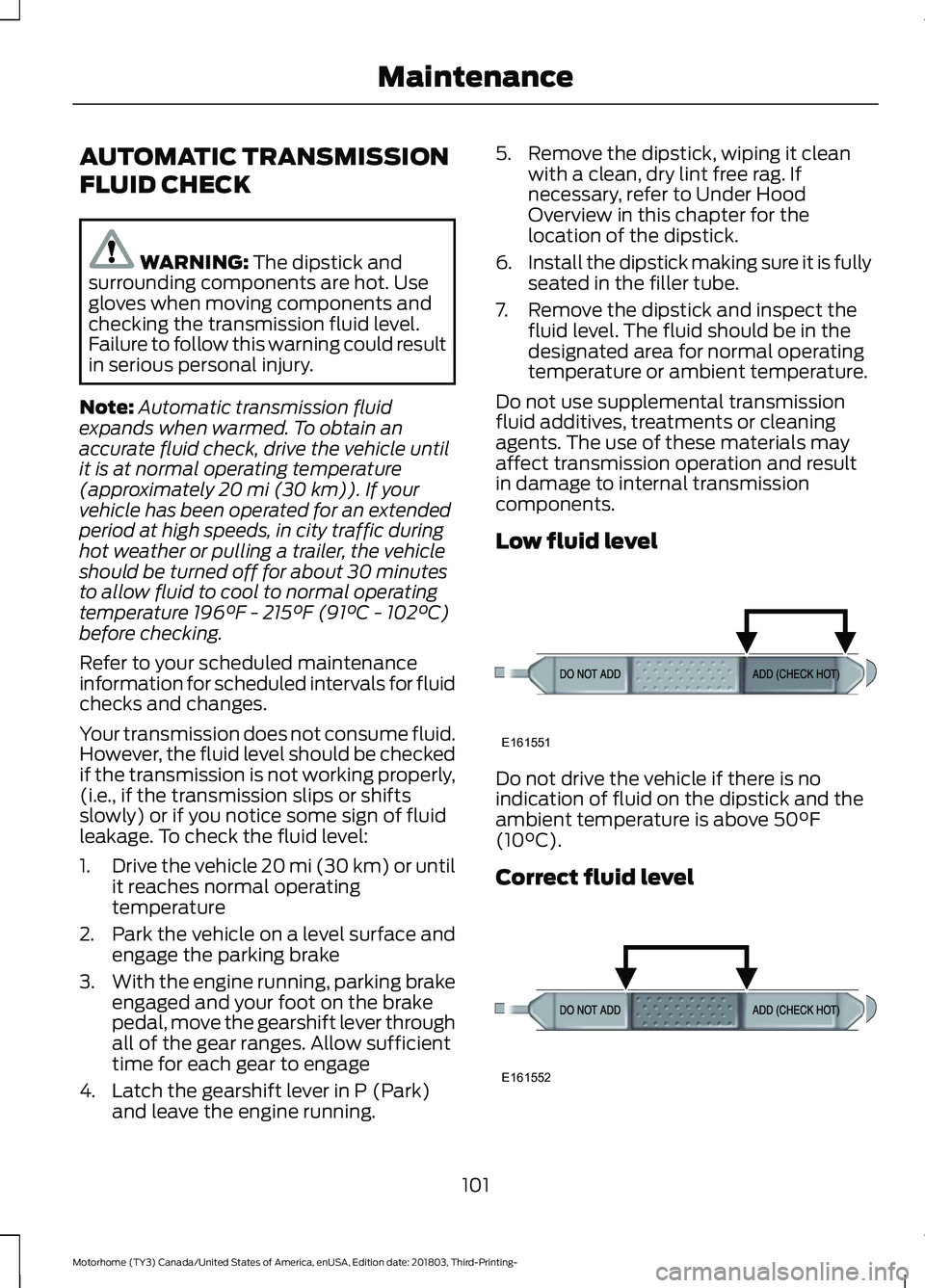
7.Remove the dipstick and inspect thefluid level. The fluid should be in thedesignated area for normal operatingtemperature or ambient temperature.
Do not use supplemental transmissionfluid additives, treatments or cleaningagents. The use of these materials mayaffect transmission operation and resultin damage to internal transmissioncomponents.
Low fluid level
Do not drive the vehicle if there is noindication of fluid on the dipstick and theambient temperature is above 50°F(10°C).
Correct fluid level
101
Motorhome (TY3) Canada/United States of America, enUSA, Edition date: 201803, Third-Printing-MaintenanceE161551 E161552
Page 105 of 176

The transmission fluid should be in thisrange if at normal operating temperature196°F - 215°F (91°C - 102°C).
The transmission fluid should be checkedat normal operating temperature 196°F -215°F (91°C - 102°C) on a level surface.The normal operating temperature can bereached after approximately 20 mi(30 km) of driving. You can check the fluidwithout driving if the ambient temperatureis above 50°F (10°C). However, if fluid isadded at this time, an overfill conditioncould result when the vehicle reachesnormal operating temperature
High fluid level
Fluid levels above the safe range mayresult in transmission failure. An overfillcondition of transmission fluid may causeshift and/or engagement concerns and/orpossible damage. High fluid levels can becaused by an overheating condition.
Adjusting automatic transmissionfluid levels
Note:Use of a non-approved automatictransmission fluid may cause internaltransmission damage. Before adding anyfluid, make sure the correct type is used. Thetype of fluid used is normally indicated onthe transmission dipstick and also in theSee Capacities and Specifications (page134).
Add fluid in ½ pint (250 ml) incrementsthrough the filler tube until the level iscorrect.
Note:If an overfill occurs, excess fluidshould be removed by an authorized dealer.An overfill condition of transmission fluidmay cause shift and/or engagementconcerns and/or possible damage.
Do not use supplemental transmissionfluid additives, treatments or cleaningagents. The use of these materials mayaffect transmission operation and resultin damage to internal transmissioncomponents.
Automatic transmission fluid filter
The TorqShift6™ automatic transmissionis equipped with a serviceable transmissionfluid filter located inside the transmissionbottom pan. Refer to the scheduledmaintenance information for serviceintervals for the automatic transmissionfluid and transmission filter. Fortransmission filter maintenance, see yourauthorized dealer.
BRAKE FLUID CHECK
Fluid levels between the MIN and MAXlines are within the normal operating range;there is no need to add fluid. If the fluidlevels are outside of the normal operatingrange, the performance of the systemcould be compromised; seek service fromyour authorized dealer immediately.
102
Motorhome (TY3) Canada/United States of America, enUSA, Edition date: 201803, Third-Printing-MaintenanceE161553 E161554
Page 110 of 176
•The transmission must relearn itsadaptive strategy. As a result of this,the transmission may shift firmly. Thisoperation is considered normal and willnot affect function or durability of thetransmission. Over time the adaptivelearning process will fully updatetransmission operation to its optimumshift feel.
•The clock and the preset radio stationsmust be reset once the battery isreconnected.
•Your vehicle’s engine is electronicallycontrolled by a computer, some controlconditions are maintained by powerfrom the battery, the engine mustrelearn its idle and fuel trim strategy.
When the battery is disconnected or a newbattery is installed, begin the batteryrelearn process:
1.With the vehicle at a complete stop,set the parking brake.
2.Put the gearshift lever in P (Park), turnoff all accessories and start the engine.
3.Run the engine until it reaches normaloperating temperature.
4.Allow the engine to idle for at least oneminute.
5.Turn the A/C on and allow the engineto idle for at least one minute.
6.Drive the vehicle to complete therelearning process.
•The vehicle may need to be drivento relearn the idle and fuel trimstrategy.
CHANGING THE ENGINE AIR
FILTER
WARNING: To reduce the risk ofvehicle damage and personal burninjuries, do not start your engine with theair cleaner removed and do not removeit while the engine is running.
Change the air filter element at the properinterval. See Scheduled Maintenance(page 145).
When changing the air filter element, useonly the air filter element listed. SeeCapacities and Specifications (page134).
Note:Failure to use the correct air filterelement may result in severe enginedamage. The customer warranty may bevoid for any damage to the engine if thecorrect air filter element is not used.
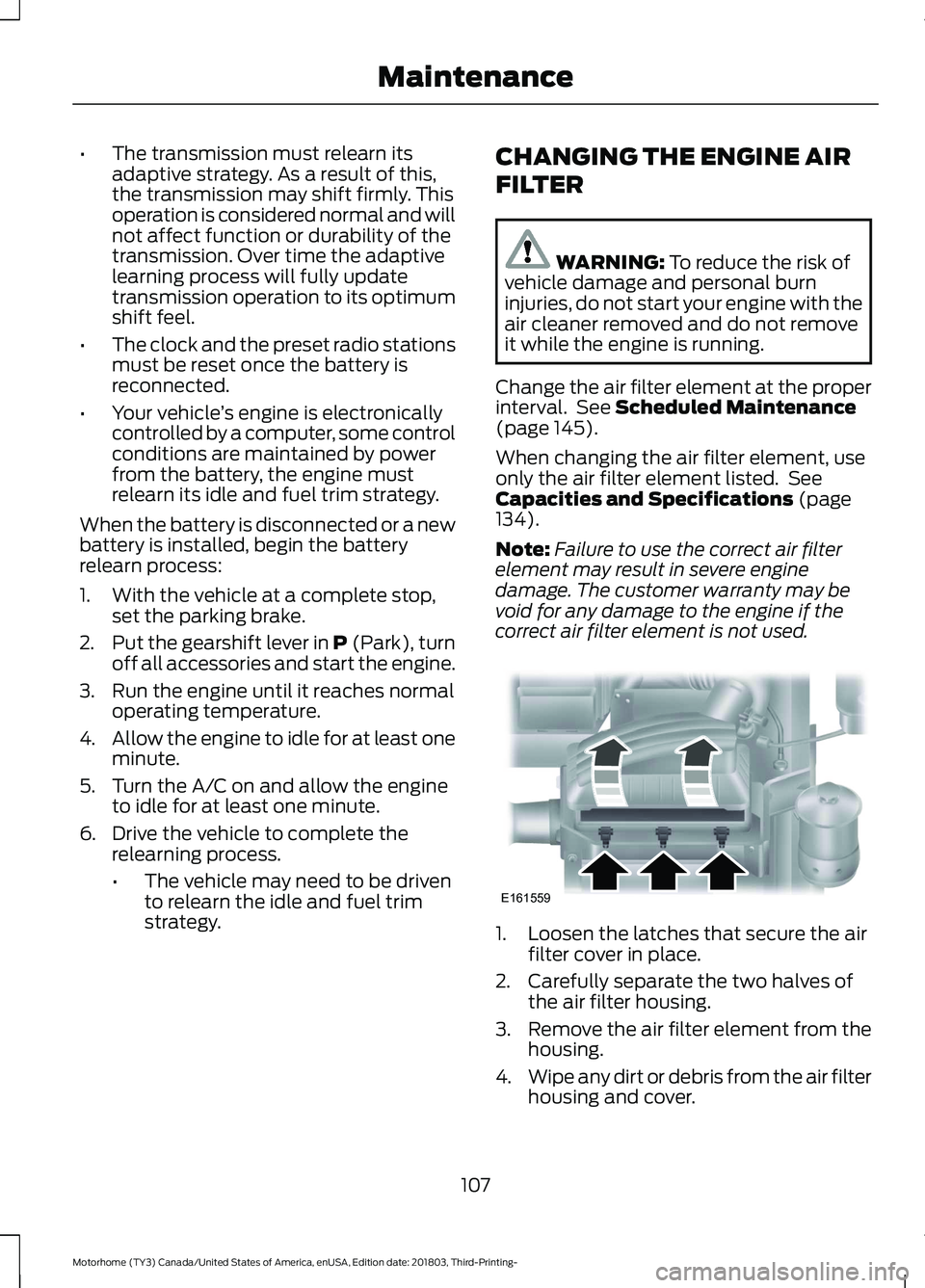
1.Loosen the latches that secure the airfilter cover in place.
2.Carefully separate the two halves ofthe air filter housing.
3.Remove the air filter element from thehousing.
4.Wipe any dirt or debris from the air filterhousing and cover.
107
Motorhome (TY3) Canada/United States of America, enUSA, Edition date: 201803, Third-Printing-MaintenanceE161559
Page 133 of 176
A dissimilar spare wheel and tire assemblyis defined as a spare wheel and tireassembly that is different in brand, size orappearance from the road tires and wheelsand can be one of three types:
1.T-type mini-spare: This spare tirebegins with the letter T for tire size andmay have Temporary Use Only molded inthe sidewall.
2.Full-size dissimilar spare with labelon wheel: This spare tire has a label onthe wheel that states: THIS WHEEL ANDTIRE ASSEMBLY FOR TEMPORARY USEONLY.
When driving with one of the dissimilarspare tires listed above, do not:
•Exceed 50 mph (80 km/h).
•Load the vehicle beyond maximumvehicle load rating listed on the SafetyCompliance Label.
•Tow a trailer.
•Use snow chains on the end of thevehicle with the dissimilar spare tire.
•Use more than one dissimilar spare tireat a time.
•Use commercial car washingequipment.
•Try to repair the dissimilar spare tire.
Use of one of the dissimilar spare tireslisted above at any one wheel location canlead to impairment of the following:
•Handling, stability and brakingperformance.
•Comfort and noise.
•Ground clearance and parking at curbs.
•Winter weather driving capability.
•Wet weather driving capability.
•All-wheel driving capability.
3.Full-size dissimilar spare withoutlabel on wheel
When driving with the full-size dissimilarspare wheel and tire assembly, do not:
•Exceed 70 mph (113 km/h).
•Use more than one dissimilar sparewheel and tire assembly at a time.
•Use commercial car washingequipment.
•Use snow chains on the end of thevehicle with the dissimilar spare wheeland tire assembly.
The usage of a full-size dissimilar sparewheel and tire assembly can lead toimpairment of the following:
•Handling, stability and brakingperformance.
•Comfort and noise.
•Ground clearance and parking at curbs.
•Winter weather driving capability.
•Wet weather driving capability.
•All-wheel driving capability.
When driving with the full-size dissimilarspare wheel and tire assembly additionalcaution should be given to:
•Towing a trailer.
•Driving vehicles equipped with acamper body.
•Driving vehicles with a load on thecargo rack.
Drive cautiously when using a full-sizedissimilar spare wheel and tire assemblyand seek service as soon as possible.
Tire Change Procedure
WARNING: When one of the frontwheels is off the ground, thetransmission alone will not prevent thevehicle from moving or slipping off thejack, even if the transmission is in park(P).
130
Motorhome (TY3) Canada/United States of America, enUSA, Edition date: 201803, Third-Printing-Wheels and Tires
Page 134 of 176
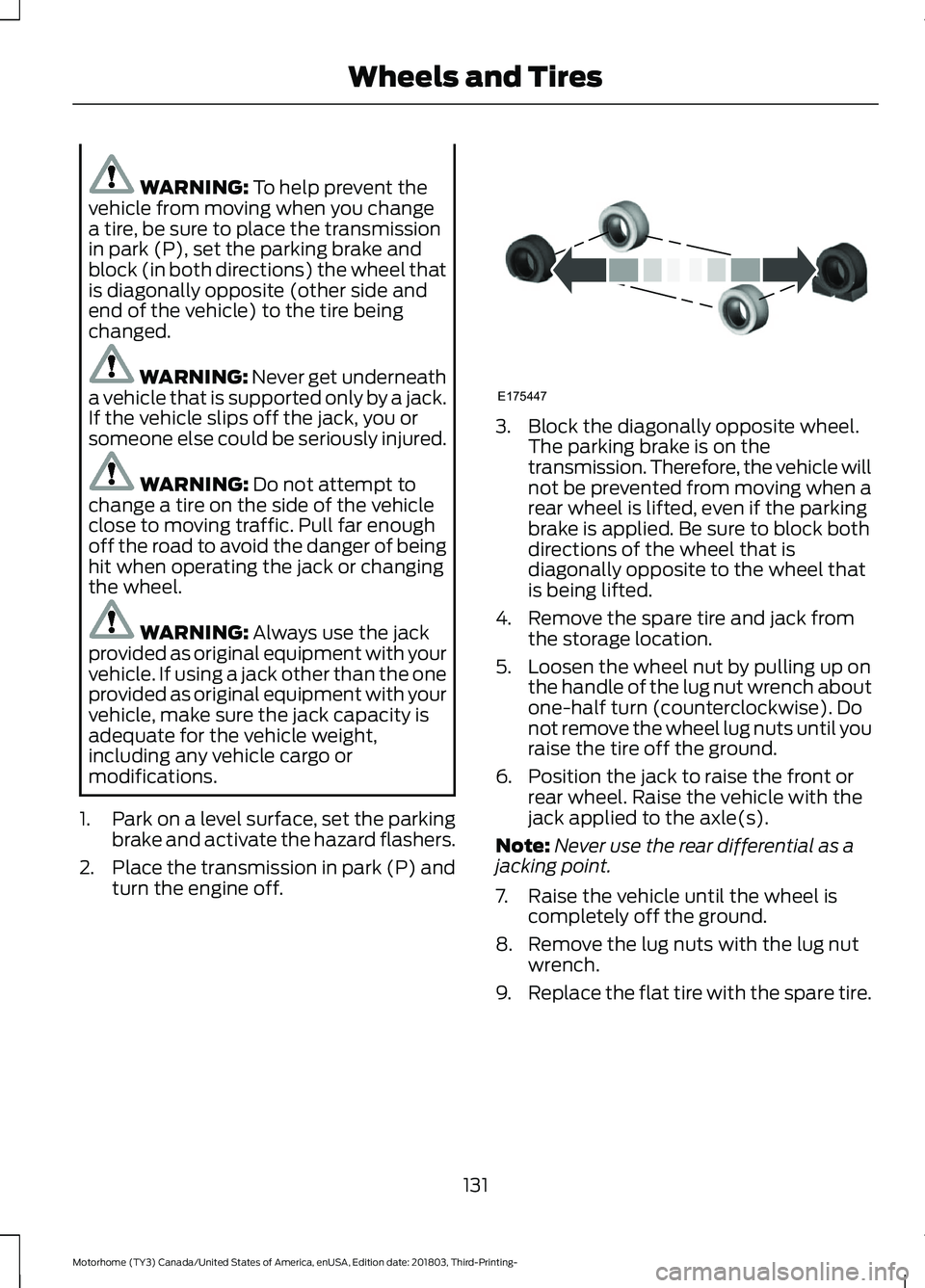
WARNING: To help prevent thevehicle from moving when you changea tire, be sure to place the transmissionin park (P), set the parking brake andblock (in both directions) the wheel thatis diagonally opposite (other side andend of the vehicle) to the tire beingchanged.
WARNING: Never get underneatha vehicle that is supported only by a jack.If the vehicle slips off the jack, you orsomeone else could be seriously injured.
WARNING: Do not attempt tochange a tire on the side of the vehicleclose to moving traffic. Pull far enoughoff the road to avoid the danger of beinghit when operating the jack or changingthe wheel.
WARNING: Always use the jackprovided as original equipment with yourvehicle. If using a jack other than the oneprovided as original equipment with yourvehicle, make sure the jack capacity isadequate for the vehicle weight,including any vehicle cargo ormodifications.
1.Park on a level surface, set the parkingbrake and activate the hazard flashers.
2.Place the transmission in park (P) andturn the engine off.
3.Block the diagonally opposite wheel.The parking brake is on thetransmission. Therefore, the vehicle willnot be prevented from moving when arear wheel is lifted, even if the parkingbrake is applied. Be sure to block bothdirections of the wheel that isdiagonally opposite to the wheel thatis being lifted.
4.Remove the spare tire and jack fromthe storage location.
5.Loosen the wheel nut by pulling up onthe handle of the lug nut wrench aboutone-half turn (counterclockwise). Donot remove the wheel lug nuts until youraise the tire off the ground.
6.Position the jack to raise the front orrear wheel. Raise the vehicle with thejack applied to the axle(s).
Note:Never use the rear differential as ajacking point.
7.Raise the vehicle until the wheel iscompletely off the ground.
8.Remove the lug nuts with the lug nutwrench.
9.Replace the flat tire with the spare tire.
131
Motorhome (TY3) Canada/United States of America, enUSA, Edition date: 201803, Third-Printing-Wheels and TiresE175447
Page 138 of 176
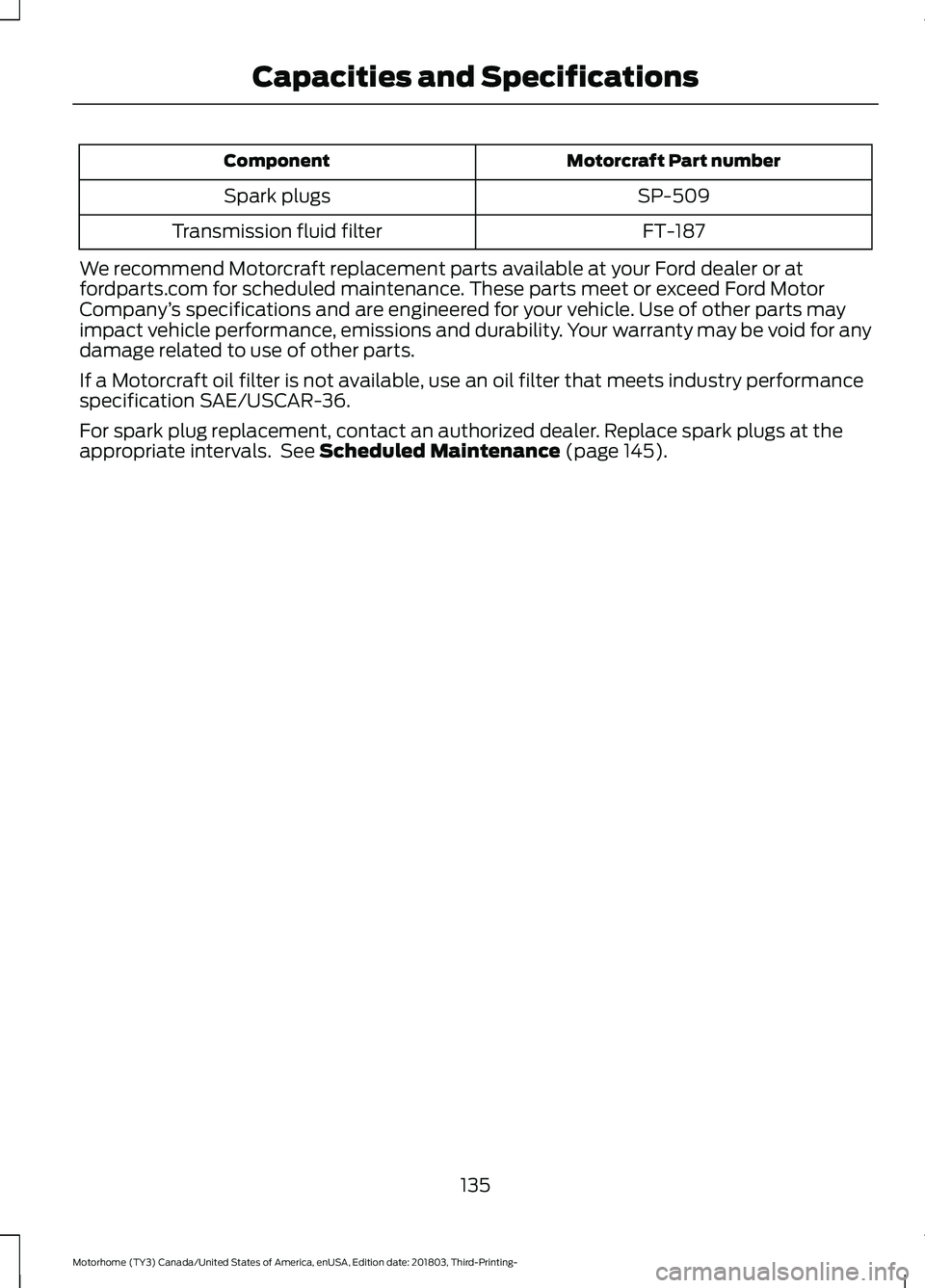
Motorcraft Part numberComponent
SP-509Spark plugs
FT-187Transmission fluid filter
We recommend Motorcraft replacement parts available at your Ford dealer or atfordparts.com for scheduled maintenance. These parts meet or exceed Ford MotorCompany’s specifications and are engineered for your vehicle. Use of other parts mayimpact vehicle performance, emissions and durability. Your warranty may be void for anydamage related to use of other parts.
If a Motorcraft oil filter is not available, use an oil filter that meets industry performancespecification SAE/USCAR-36.
For spark plug replacement, contact an authorized dealer. Replace spark plugs at theappropriate intervals. See Scheduled Maintenance (page 145).
135
Motorhome (TY3) Canada/United States of America, enUSA, Edition date: 201803, Third-Printing-Capacities and Specifications
Page 140 of 176
Make, vehicle line, series, bodytypeC
Engine typeD
Check digitE
Model yearF
Assembly plantG
Production sequence numberH
VEHICLE CERTIFICATION
LABEL
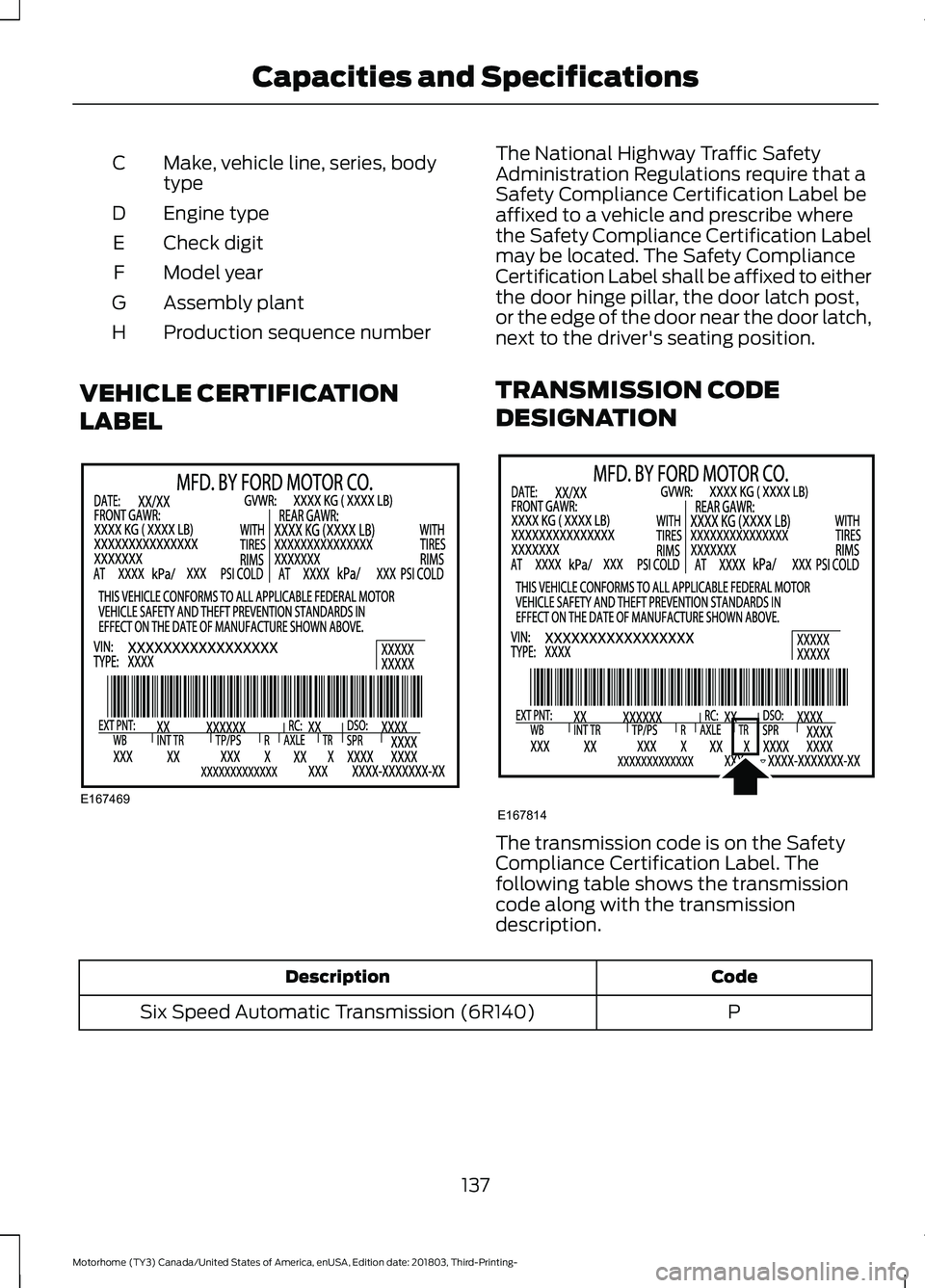
The National Highway Traffic SafetyAdministration Regulations require that aSafety Compliance Certification Label beaffixed to a vehicle and prescribe wherethe Safety Compliance Certification Labelmay be located. The Safety ComplianceCertification Label shall be affixed to eitherthe door hinge pillar, the door latch post,or the edge of the door near the door latch,next to the driver's seating position.
TRANSMISSION CODE
DESIGNATION
The transmission code is on the SafetyCompliance Certification Label. Thefollowing table shows the transmissioncode along with the transmissiondescription.
CodeDescription
PSix Speed Automatic Transmission (6R140)
137
Motorhome (TY3) Canada/United States of America, enUSA, Edition date: 201803, Third-Printing-Capacities and SpecificationsE167469 E167814
Page 141 of 176
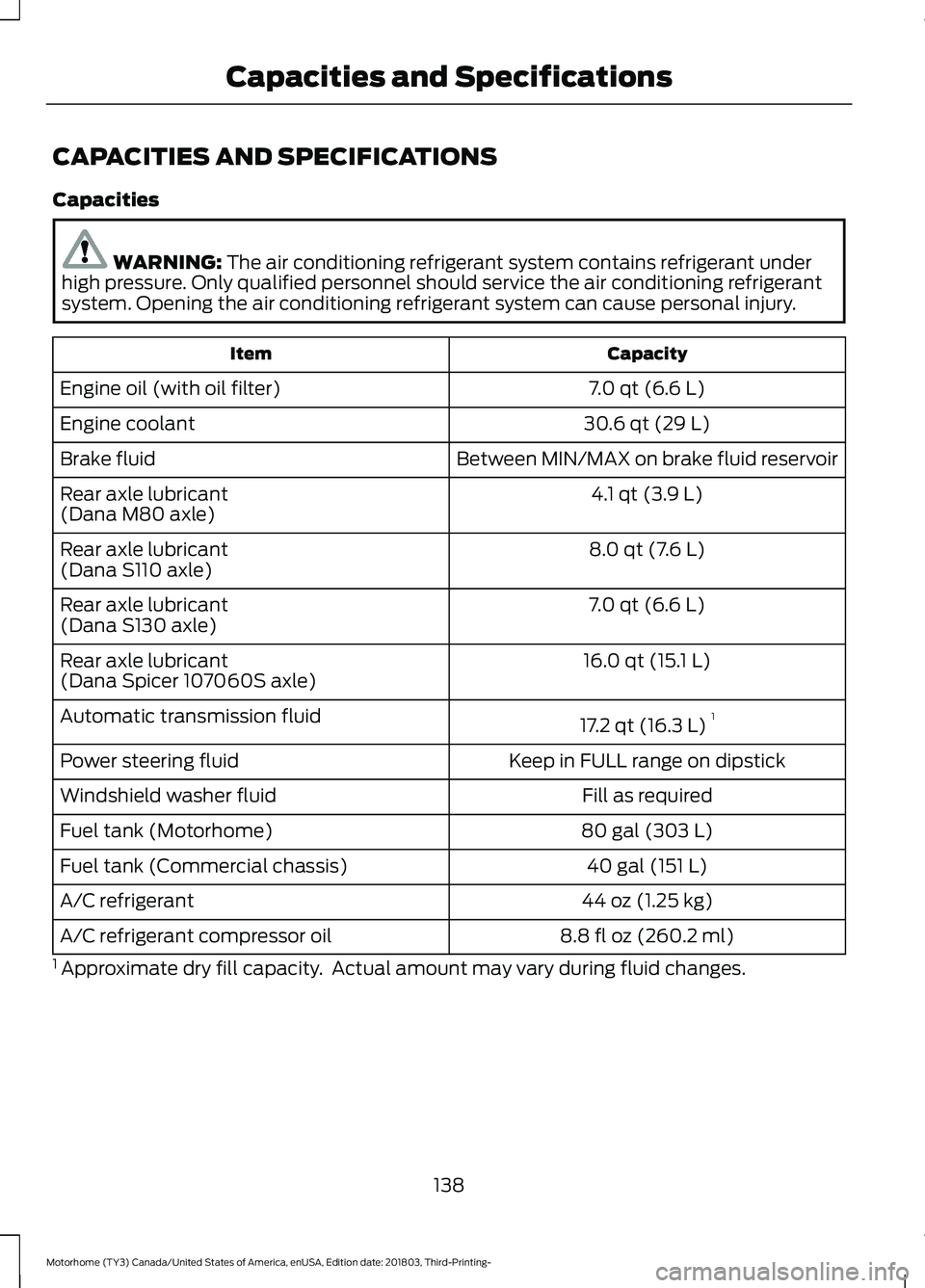
CAPACITIES AND SPECIFICATIONS
Capacities
WARNING: The air conditioning refrigerant system contains refrigerant underhigh pressure. Only qualified personnel should service the air conditioning refrigerantsystem. Opening the air conditioning refrigerant system can cause personal injury.
CapacityItem
7.0 qt (6.6 L)Engine oil (with oil filter)
30.6 qt (29 L)Engine coolant
Between MIN/MAX on brake fluid reservoirBrake fluid
4.1 qt (3.9 L)Rear axle lubricant(Dana M80 axle)
8.0 qt (7.6 L)Rear axle lubricant(Dana S110 axle)
7.0 qt (6.6 L)Rear axle lubricant(Dana S130 axle)
16.0 qt (15.1 L)Rear axle lubricant(Dana Spicer 107060S axle)
17.2 qt (16.3 L)1Automatic transmission fluid
Keep in FULL range on dipstickPower steering fluid
Fill as requiredWindshield washer fluid
80 gal (303 L)Fuel tank (Motorhome)
40 gal (151 L)Fuel tank (Commercial chassis)
44 oz (1.25 kg)A/C refrigerant
8.8 fl oz (260.2 ml)A/C refrigerant compressor oil
1 Approximate dry fill capacity. Actual amount may vary during fluid changes.
138
Motorhome (TY3) Canada/United States of America, enUSA, Edition date: 201803, Third-Printing-Capacities and Specifications
Page 143 of 176
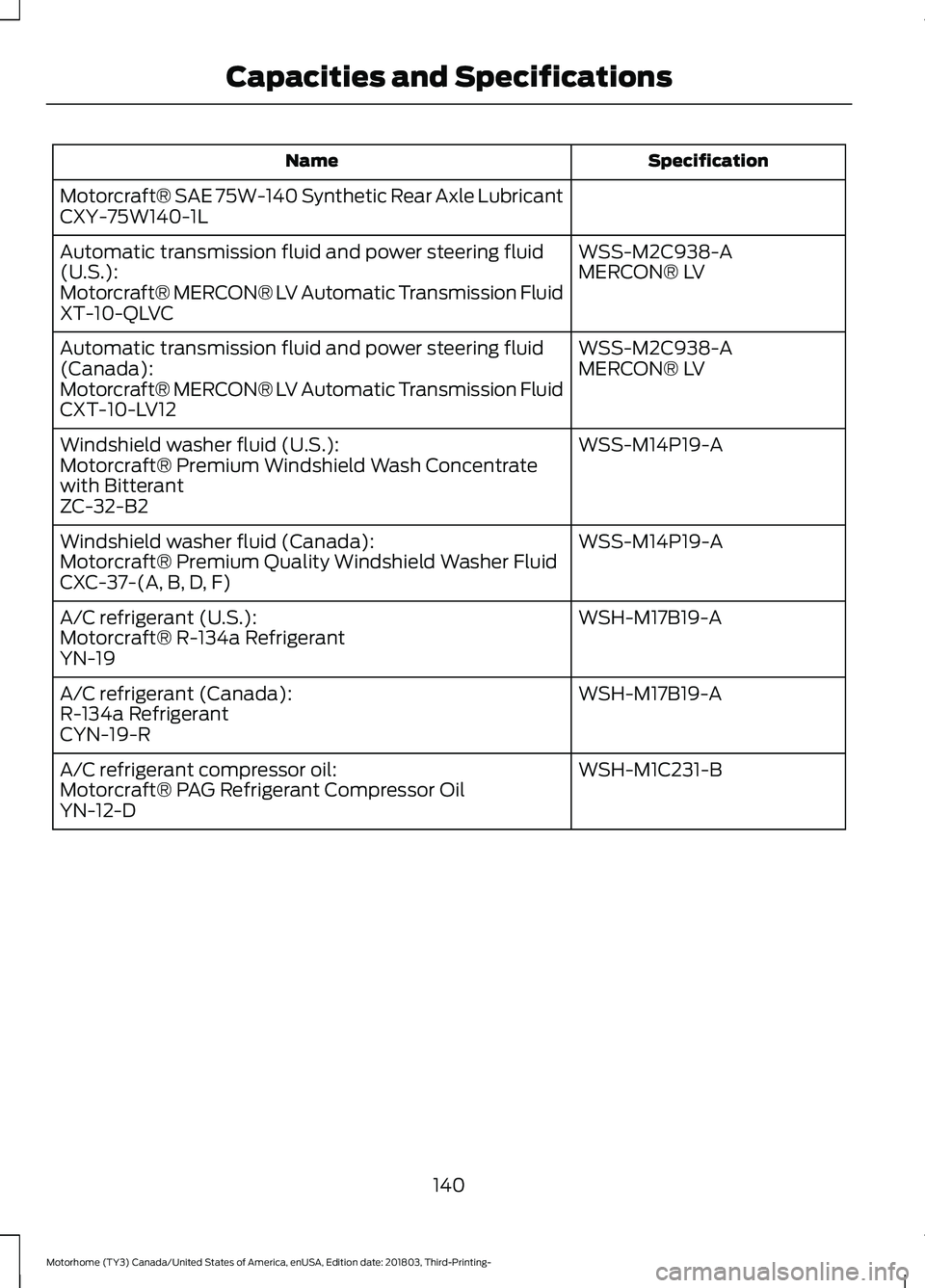
SpecificationName
Motorcraft® SAE 75W-140 Synthetic Rear Axle LubricantCXY-75W140-1L
WSS-M2C938-AAutomatic transmission fluid and power steering fluid(U.S.):MERCON® LVMotorcraft® MERCON® LV Automatic Transmission FluidXT-10-QLVC
WSS-M2C938-AAutomatic transmission fluid and power steering fluid(Canada):MERCON® LVMotorcraft® MERCON® LV Automatic Transmission FluidCXT-10-LV12
WSS-M14P19-AWindshield washer fluid (U.S.):Motorcraft® Premium Windshield Wash Concentratewith BitterantZC-32-B2
WSS-M14P19-AWindshield washer fluid (Canada):Motorcraft® Premium Quality Windshield Washer FluidCXC-37-(A, B, D, F)
WSH-M17B19-AA/C refrigerant (U.S.):Motorcraft® R-134a RefrigerantYN-19
WSH-M17B19-AA/C refrigerant (Canada):R-134a RefrigerantCYN-19-R
WSH-M1C231-BA/C refrigerant compressor oil:Motorcraft® PAG Refrigerant Compressor OilYN-12-D
140
Motorhome (TY3) Canada/United States of America, enUSA, Edition date: 201803, Third-Printing-Capacities and Specifications
Page 144 of 176
SpecificationName
ESA-M1C75-BTransmission, steering, parking linkages and pivots andbrake pedal shaft grease:Premium Long-Life GreaseXG-1-E1
ESB-M1C93-BMulti-purpose grease:Motorcraft® Multi-Purpose Grease SprayXL-5-A
1 Motorcraft® DOT 3 High Performance Motor Vehicle Brake Fluid is for vehicles withHydroboost brake booster systems. This include chassis with gross vehicle weight ratingsof 16,000 lb (7257 kg), 18,000 lb (8165 kg) and 19,500 lb (8845 kg).2 Motorcraft® DOT 5.1 Motor Vehicle Brake Fluid is for vehicles with Hydromax brakebooster systems. This includes chassis with gross vehicle weight ratings of 19,500 lb(8845 kg), 20,500 lb (9299 kg), 22,000 lb (9979 kg), 24,000 lb (10886 kg) and 26,000lb (11793 kg).
If you use oil and fluids that do not meetthe defined specification and viscositygrade, this may lead to:
•Component damage which is notcovered by the vehicle warranty.
•Longer engine cranking periods.
•Increased emission levels.
•Reduced engine performance.
•Reduced fuel economy.
•Degraded brake performance.
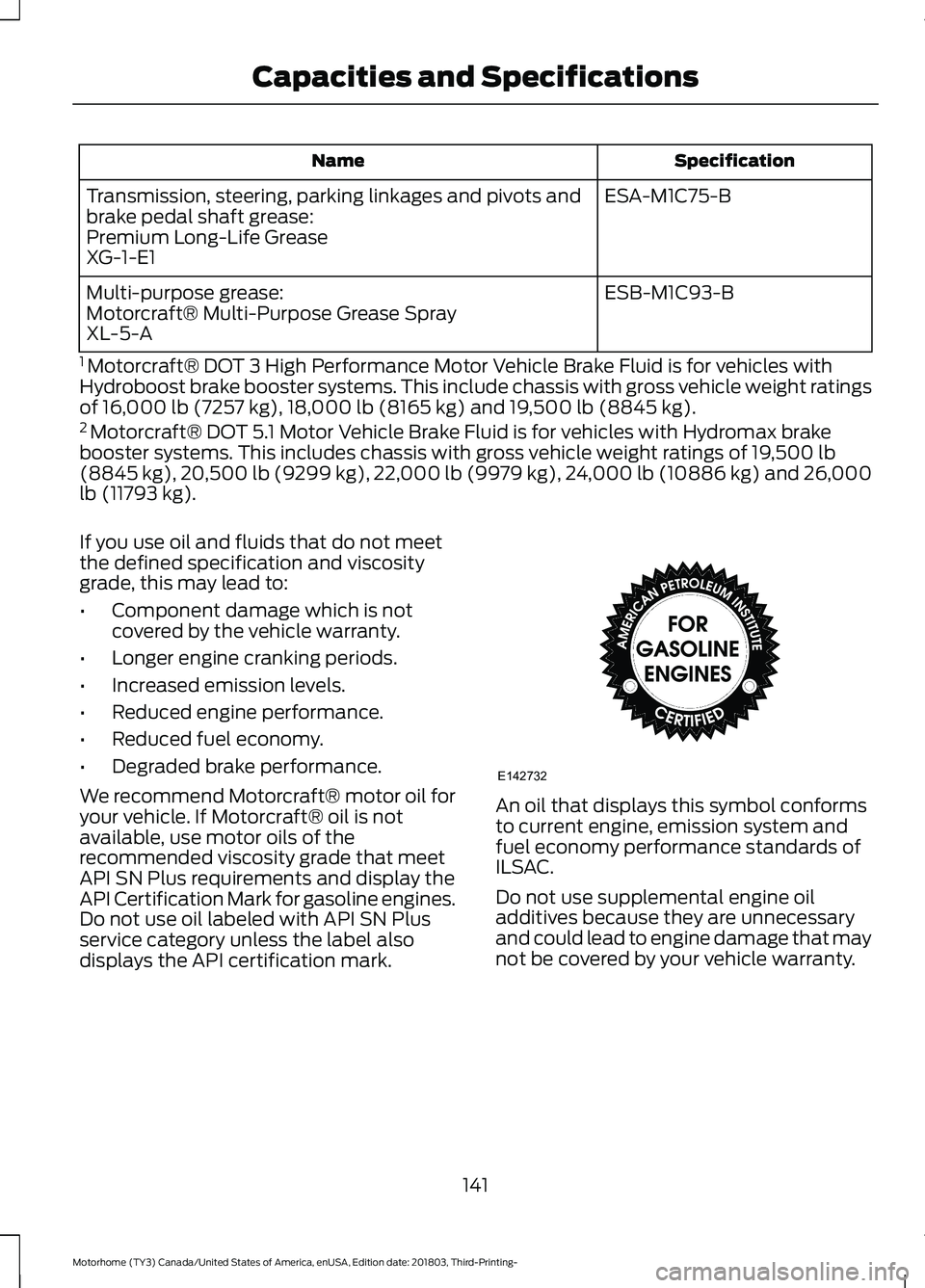
We recommend Motorcraft® motor oil foryour vehicle. If Motorcraft® oil is notavailable, use motor oils of therecommended viscosity grade that meetAPI SN Plus requirements and display theAPI Certification Mark for gasoline engines.Do not use oil labeled with API SN Plusservice category unless the label alsodisplays the API certification mark.
An oil that displays this symbol conformsto current engine, emission system andfuel economy performance standards ofILSAC.
Do not use supplemental engine oiladditives because they are unnecessaryand could lead to engine damage that maynot be covered by your vehicle warranty.
141
Motorhome (TY3) Canada/United States of America, enUSA, Edition date: 201803, Third-Printing-Capacities and SpecificationsE142732