check FORD F-550 2019 Owners Manual
[x] Cancel search | Manufacturer: FORD, Model Year: 2019, Model line: F-550, Model: FORD F-550 2019Pages: 666, PDF Size: 13.6 MB
Page 4 of 666
Introduction
About This Manual
..........................................7
Symbols Glossary ............................................
8
Data Recording ...............................................
10
Perchlorate .......................................................
14
Ford Credit ........................................................
14
Replacement Parts Recommendation ........................................................................\
...
14
Special Notices ...............................................
14
Mobile Communications Equipment ........................................................................\
...
16
Export Unique Options ................................
16
Environment
Protecting the Environment .......................
17
At a Glance
Instrument Panel ...........................................
18
Child Safety
General Information .....................................
20
Installing Child Restraints ..........................
22
Booster Seats .................................................
33
Child Restraint Positioning ........................
35
Child Safety Locks .........................................
37
Seatbelts
Principle of Operation .................................
38
Fastening the Seatbelts .............................
39
Seatbelt Height Adjustment .....................
43
Seatbelt Warning Lamp and Indicator Chime ............................................................
43
Seatbelt Reminder .......................................
44
Child Restraint and Seatbelt Maintenance ...............................................
45
Seatbelt Extensions .....................................
46
Supplementary Restraints System
Principle of Operation ..................................
47Driver and Passenger Airbags
..................
48
Side Airbags ....................................................
54
Safety Canopy ™...........................................
55
Crash Sensors and Airbag Indicator ......
56
Airbag Disposal ..............................................
57
Keys and Remote Controls
General Information on Radio Frequencies .................................................
58
Remote Control .............................................
58
Replacing a Lost Key or Remote Control ........................................................................\
..
64
MyKey ™
Principle of Operation .................................
65
Creating a MyKey ..........................................
66
Clearing All MyKeys ......................................
67
Checking MyKey System Status ..............
67
Using MyKey With Remote Start Systems ........................................................
67
MyKey – Troubleshooting ..........................
67
Doors and Locks
Locking and Unlocking ...............................
69
Keyless Entry ...................................................
72
Tailgate
Tailgate Lock ...................................................
74
Removing the Tailgate .................................
74
Tailgate Step ...................................................
75
Bed Extender ...................................................
76
Security
Passive Anti-Theft System ........................
78
Anti-Theft Alarm ..........................................
80
Power Running Boards
Using Power Running Boards ...................
82
1
Super Duty (TFE) Canada/United States of America, enUSA, Edition date: 201804, Fourth-Printing Table of Contents
Page 7 of 666
Lane Keeping System
...............................250
Blind Spot Information System .............
253
Cross Traffic Alert .......................................
258
Steering ..........................................................
260
Pre-Collision Assist ....................................
262
Load Carrying
Load Limit .....................................................
266
Bed Ramps ....................................................
270
Towing
Towing a Trailer ............................................
273
Trailer Reversing Aids .................................
275
Trailer Sway Control ..................................
282
Recommended Towing Weights ..........
283
Essential Towing Checks .........................
287
Towing the Vehicle on Four Wheels .....
296
Driving Hints
Breaking-In ...................................................
299
Economical Driving ....................................
299
Driving Through Water .............................
300
Floor Mats .....................................................
300
Snow Plowing ...............................................
301
Roadside Emergencies
Roadside Assistance ................................
304
Hazard Flashers ..........................................
305
Fire Extinguisher .........................................
305
Warning Triangle .........................................
305
Fuel Shutoff .................................................
305
Jump Starting the Vehicle .......................
306
Post-Crash Alert System .........................
308
Transporting the Vehicle .........................
308
Towing Points ..............................................
309
Customer Assistance
Getting the Services You Need ................
311
In California (U.S. Only) .............................
312The Better Business Bureau (BBB) Auto
Line Program (U.S. Only) ......................
313
Utilizing the Mediation/Arbitration Program (Canada Only) .......................
314
Getting Assistance Outside the U.S. and Canada ........................................................
314
Ordering Additional Owner's Literature ........................................................................\
.
316
Reporting Safety Defects (U.S. Only) ........................................................................\
.
316
Reporting Safety Defects (Canada Only) ........................................................................\
.
316
Fuses
Fuse Specification Chart ..........................
318
Changing a Fuse ..........................................
327
Maintenance
General Information ..................................
329
Opening and Closing the Hood .............
329
Under Hood Overview - 6.2L ..................
330
Under Hood Overview - 6.7L Diesel ......
331
Under Hood Overview - 6.8L ..................
333
Engine Oil Dipstick - 6.2L/6.8L ..............
334
Engine Oil Dipstick - 6.7L Diesel ............
334
Engine Oil Check - 6.2L/6.8L .................
334
Engine Oil Check - 6.7L Diesel ...............
335
Changing the Engine Oil and Oil Filter ........................................................................\
336
Changing the Crankcase Vent Filter Element ......................................................
337
Oil Change Indicator Reset .....................
338
Engine Coolant Check - 6.2L/6.8L .......
339
Engine Coolant Check - 6.7L Diesel ......
343
Automatic Transmission Fluid Check ........................................................................\
346
Transfer Case Fluid Check ......................
349
Brake Fluid Check .......................................
350
Power Steering Fluid Check ...................
350
Washer Fluid Check ....................................
351
Draining the Fuel Filter Water Trap - 6.7L Diesel ............................................................
351
4
Super Duty (TFE) Canada/United States of America, enUSA, Edition date: 201804, Fourth-Printing Table of Contents
Page 8 of 666
Fuel Filter - 6.2L/6.8L
................................353
Changing the 12V Battery ........................
354
Checking the Wiper Blades ....................
356
Changing the Wiper Blades ....................
356
Adjusting the Headlamps .......................
356
Changing a Bulb ..........................................
358
Changing the Engine Air Filter - 6.2L/6.8L ........................................................................\
.
361
Changing the Engine Air Filter - 6.7L Diesel ..........................................................
362
Changing the Engine-Mounted and Diesel Fuel Conditioner Module Fuel
Filters - 6.7L Diesel .................................
364
Vehicle Care
General Information ..................................
369
Cleaning Products ......................................
369
Cleaning the Exterior .................................
369
Waxing ..............................................................
371
Cleaning the Engine ....................................
371
Cleaning the Exhaust - 6.7L Diesel ........
371
Cleaning the Windows and Wiper Blades ........................................................................\
.
372
Cleaning the Interior ...................................
372
Cleaning the Instrument Panel and Instrument Cluster Lens .......................
374
Cleaning Leather Seats .............................
374
Repairing Minor Paint Damage ..............
376
Cleaning the Wheels .................................
376
Vehicle Storage ............................................
376
Wheels and Tires
General Information ..................................
379
Tire Care ..........................................................
381
Using Snow Chains ....................................
397
Tire Pressure Monitoring System .........
398
Changing a Road Wheel .........................
406
Technical Specifications ...........................
417Capacities and Specifications
Engine Specifications - 6.2L
...................
419
Engine Specifications - 6.7L Diesel ......
419
Engine Specifications - 6.8L ..................
420
Motorcraft Parts - 6.2L ..............................
421
Motorcraft Parts - 6.7L Diesel ................
422
Motorcraft Parts - 6.8L .............................
423
Vehicle Identification Number ...............
424
Vehicle Certification Label ......................
425
Transmission Code Designation ...........
425
Capacities and Specifications - 6.2L ........................................................................\
426
Capacities and Specifications - 6.7L Diesel ...........................................................
431
Capacities and Specifications - 6.8L ........................................................................\
437
Bulb Specification Chart .........................
442
Audio System
General Information ..................................
444
Audio Unit - Vehicles With: AM/FM .....
444
Audio Unit - Vehicles With: AM/FM/ Touchscreen Display .............................
446
Audio Unit - Vehicles With: AM/FM/ SYNC ...........................................................
447
Digital Radio ..................................................
451
Satellite Radio .............................................
453
USB Port ........................................................
456
Media Hub .....................................................
456
SYNC™
General Information ..................................
457
Using Voice Recognition ..........................
459
Using SYNC™ With Your Phone ............
461
SYNC™ Applications and Services ......
473
Using SYNC™ With Your Media Player ........................................................................\
478
SYNC™ Troubleshooting ........................
487
5
Super Duty (TFE) Canada/United States of America, enUSA, Edition date: 201804, Fourth-Printing Table of Contents
Page 11 of 666
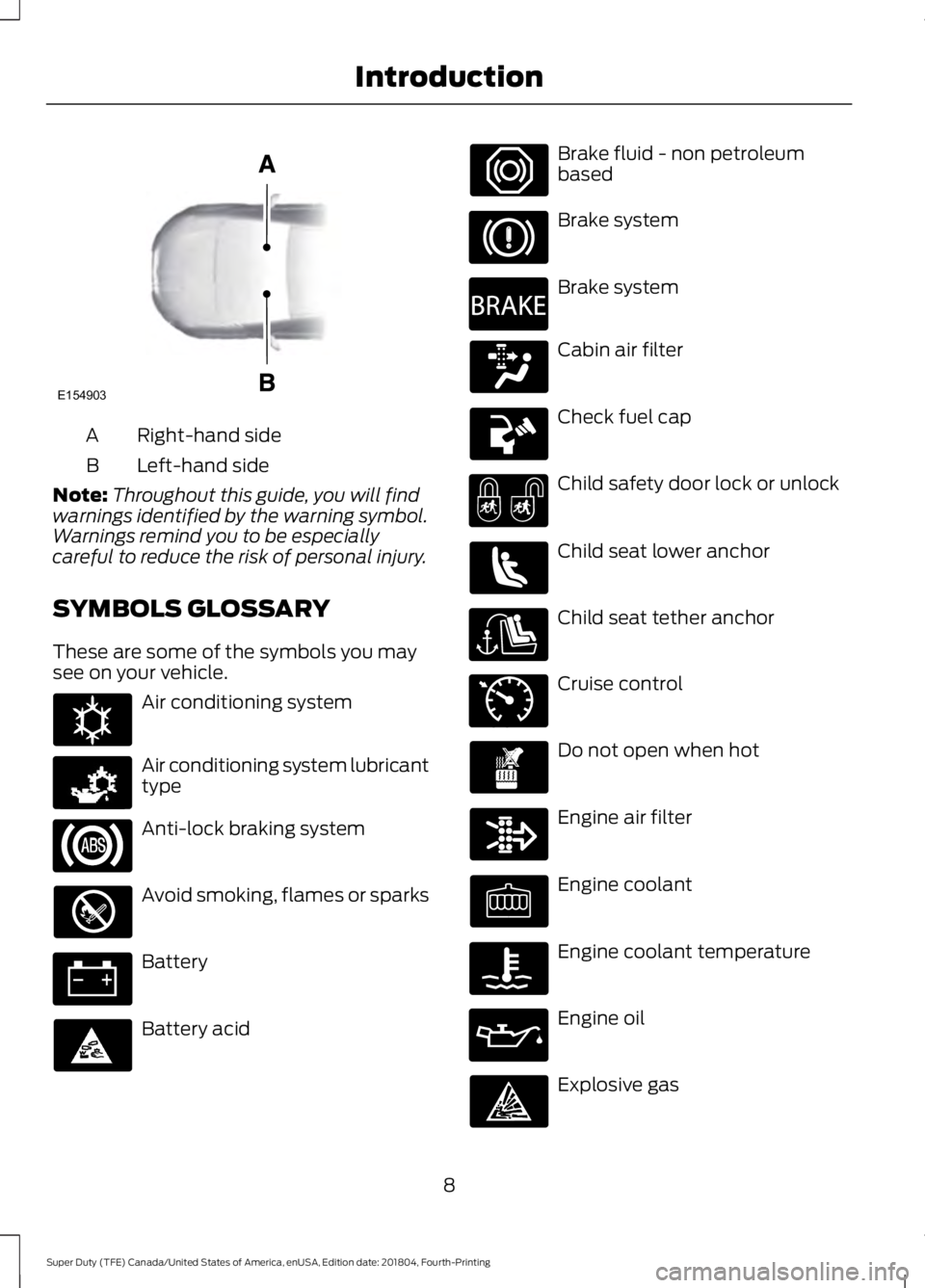
Right-hand side
A
Left-hand side
B
Note: Throughout this guide, you will find
warnings identified by the warning symbol.
Warnings remind you to be especially
careful to reduce the risk of personal injury.
SYMBOLS GLOSSARY
These are some of the symbols you may
see on your vehicle. Air conditioning system
Air conditioning system lubricant
type
Anti-lock braking system
Avoid smoking, flames or sparks
Battery
Battery acid Brake fluid - non petroleum
based
Brake system
Brake system
Cabin air filter
Check fuel cap
Child safety door lock or unlock
Child seat lower anchor
Child seat tether anchor
Cruise control
Do not open when hot
Engine air filter
Engine coolant
Engine coolant temperature
Engine oil
Explosive gas
8
Super Duty (TFE) Canada/United States of America, enUSA, Edition date: 201804, Fourth-Printing IntroductionE154903 E162384 E231157 E270480 E71340
Page 23 of 666
GENERAL INFORMATION
See the following sections for directions
on how to properly use safety restraints
for children.
WARNING: Always make sure your
child is secured properly in a device that
is appropriate for their height, age and
weight. Child safety restraints must be
bought separately from your vehicle.
Failure to follow these instructions and
guidelines may result in an increased risk
of serious injury or death to your child. WARNING: All children are shaped
differently. The National Highway Traffic
Safety Administration and other safety
organizations, base their
recommendations for child restraints on
probable child height, age and weight
thresholds, or on the minimum
requirements of the law. We recommend
that you check with a NHTSA Certified
Child Passenger Safety Technician (CPST) to make sure that you properly
install the child restraint in your vehicle
and that you consult your pediatrician to
make sure you have a child restraint
appropriate for your child. To locate a
child restraint fitting station and CPST,
contact NHTSA toll free at
1-888-327-4236 or go to
www.nhtsa.dot.gov. In Canada, contact
Transport Canada toll free at
1-800-333-0371 or go to www.tc.gc.ca
to find a Child Car Seat Clinic in your
area. Failure to properly restrain children
in child restraints made especially for
their height, age and weight, may result
in an increased risk of serious injury or
death to your child.
WARNING: On hot days, the
temperature inside the vehicle can rise
very quickly. Exposure of people or
animals to these high temperatures for
even a short time can cause death or
serious heat related injuries, including
brain damage. Small children are
particularly at risk.
20
Super Duty (TFE) Canada/United States of America, enUSA, Edition date: 201804, Fourth-Printing Child Safety
Page 24 of 666
Recommendations for Safety Restraints for Children
Recommended Restraint
Type
Child Size, Height, Weight, or Age
Child
Use a child restraint
(sometimes called an
infant carrier, convertible seat, or toddler seat).
Children weighing 40 lb (18 kg) or less
(generally age four or younger).
Infants or
toddlers
Use a belt-positioningbooster seat.
Children who have outgrown or no longer
properly fit in a child restraint (generally
children who are less than
57 in (1.45 m)
tall, are greater than age four and less
than age 12, and between
40 lb (18 kg)
and 80 lb (36 kg) and upward to 100 lb
(45 kg) if recommended by your child
restraint manufacturer).
Small children
Use a vehicle seatbelt
having the lap belt snug
and low across the hips, shoulder belt centered
across the shoulder and
chest, and seat backrest upright.
Children who have outgrown or no longer
properly fit in a belt-positioning booster
seat (generally children who are at least 57 in (1.45 m)
tall or greater than 80 lb
(36 kg) or 100 lb (45 kg) if recommended by child restraint manufacturer).
Larger children
• You are required by law to properly use
child restraints for infants and toddlers
in the United States and Canada.
• Many states and provinces require that
small children use approved booster
seats until they reach age eight, a
height of
57 in (1.45 m) tall, or 80 lb
(36 kg). Check your local and state or
provincial laws for specific
requirements about the safety of
children in your vehicle. •
When possible, always properly
restrain children 12 years of age and
under in a rear seating position of your
vehicle. Accident statistics suggest that
children are safer when properly
restrained in the rear seating positions
than in a front seating position.
• When installing a rear facing child
restraint, adjust the vehicle seats to
avoid interference between the child
restraint and the vehicle seat in front
of the child restraint.
21
Super Duty (TFE) Canada/United States of America, enUSA, Edition date: 201804, Fourth-Printing Child Safety
Page 27 of 666
Note:
The automatic locking mode is
available on the front passenger and rear
seats. This vehicle does not require the use
of a locking clip.
6. Allow the belt to retract to remove slack. The belt clicks as it retracts to
indicate it is in the automatic locking
mode.
7. Try to pull the belt out of the retractor to make sure the retractor is in the
automatic locking mode (you should
not be able to pull more belt out). If the
retractor is not locked, unbuckle the
belt and repeat Steps 5 and 6. 8.
Remove remaining slack from the belt.
Force the seat down with extra weight,
for example, by pressing down or
kneeling on the child restraint while
pulling up on the shoulder belt in order
to force slack from the belt. This is
necessary to remove the remaining
slack that exists once you add the extra
weight of the child to the child restraint.
It also helps to achieve the proper
snugness of the child restraint to your
vehicle. Sometimes, a slight lean
toward the buckle helps to remove
remaining slack from the belt.
9. Attach the tether strap (if the child restraint is equipped). 10. Before placing the child in the seat,
forcibly move the seat forward and
back to make sure the seat is securely
held in place.
To check this, grab the seat at the belt path
and attempt to move it side to side and
forward and back. There should be no
more than 1 in (2.5 cm) of movement for
proper installation.
We recommend checking with a NHTSA
Certified Child Passenger Safety
Technician to make certain the child
restraint is properly installed. In Canada,
check with Transport Canada for referral
to a Child Car Seat Clinic.
Using Lap and Shoulder Belts
(Front Center Position of Super
Cab and Crew Cab) WARNING:
Do not place a
rearward facing child restraint in front of
an active airbag. Failure to follow this
instruction could result in personal injury
or death. WARNING:
Always use both the
lap and shoulder portion of the seatbelt
in the center seating position.
24
Super Duty (TFE) Canada/United States of America, enUSA, Edition date: 201804, Fourth-Printing Child SafetyE142533 E142534
Page 29 of 666
5.
While pushing down with your knee on
the child restraint, pull up on the
shoulder belt portion to tighten the lap
belt portion of the combination lap and
shoulder belt.
6. Allow the seatbelt to retract and remove any slack in the belt to securely
tighten the child safety seat in the
vehicle.
7. Attach the tether strap (if the child restraint is equipped). 8. Before placing the child in the seat,
forcibly move the seat forward and
back to make sure the seat is securely
held in place. To check this, grab the
seat at the belt path and attempt to
move it side to side and forward and
back. There should be no more than
1 in (2.5 cm) of movement for proper
installation. 9.
Check from time to time to be sure that
there is no slack in the lap and shoulder
belt. The shoulder belt must be snug
to keep the lap belt tight during a crash.
We recommend checking with a NHTSA
Certified Child Passenger Safety
Technician to make certain the child
restraint is properly installed. In Canada,
check with Transport Canada for referral
to a Child Car Seat Clinic.
Using Inflatable Seatbelts (Rear
Seat Outboard Positions) (If Equipped) 1. Position the child safety seat in a seat
with a combination lap and shoulder
belt. 26
Super Duty (TFE) Canada/United States of America, enUSA, Edition date: 201804, Fourth-Printing Child SafetyE142533 E142534 E142528 E146522
Page 31 of 666
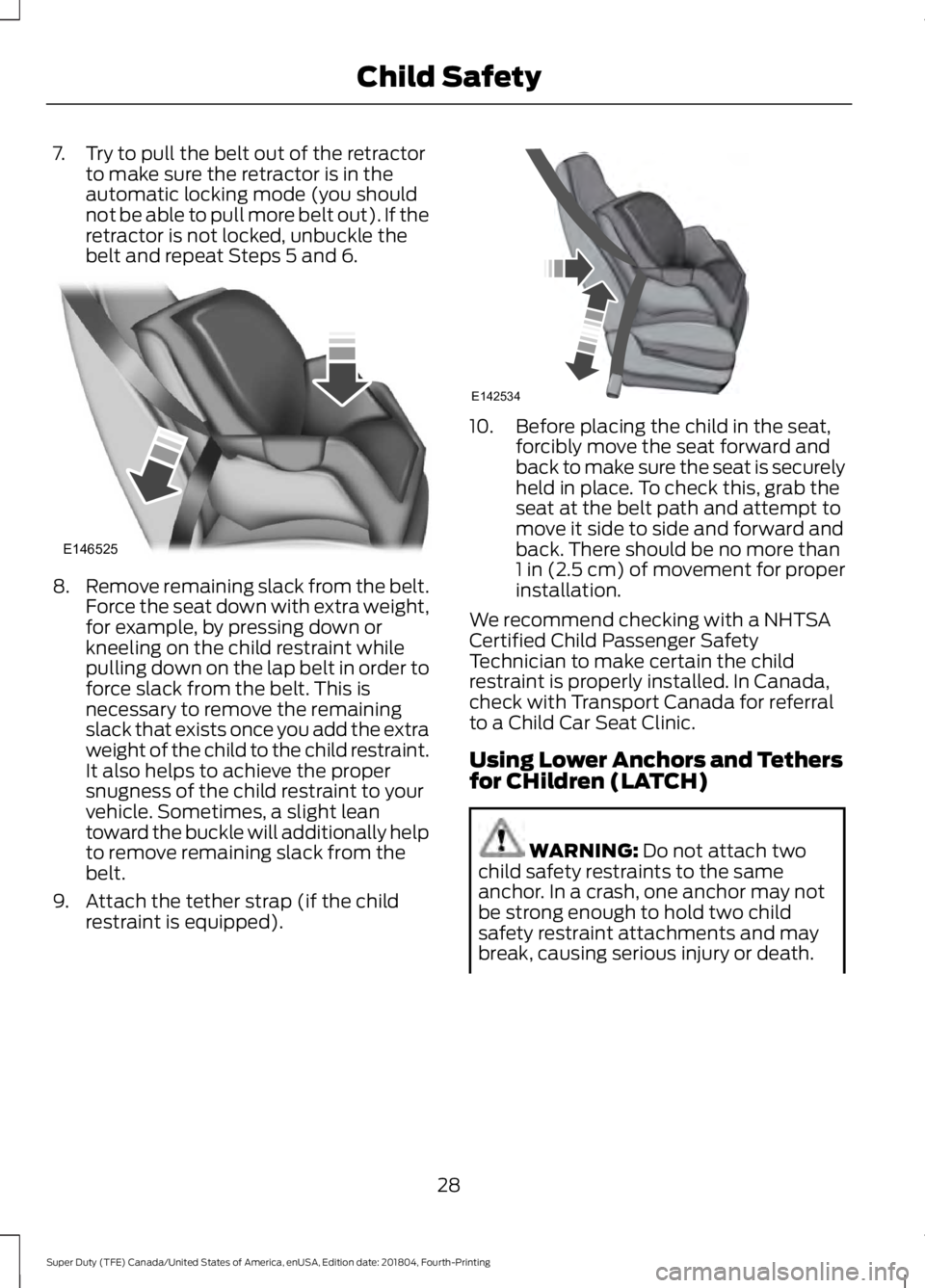
7. Try to pull the belt out of the retractor
to make sure the retractor is in the
automatic locking mode (you should
not be able to pull more belt out). If the
retractor is not locked, unbuckle the
belt and repeat Steps 5 and 6. 8.
Remove remaining slack from the belt.
Force the seat down with extra weight,
for example, by pressing down or
kneeling on the child restraint while
pulling down on the lap belt in order to
force slack from the belt. This is
necessary to remove the remaining
slack that exists once you add the extra
weight of the child to the child restraint.
It also helps to achieve the proper
snugness of the child restraint to your
vehicle. Sometimes, a slight lean
toward the buckle will additionally help
to remove remaining slack from the
belt.
9. Attach the tether strap (if the child restraint is equipped). 10. Before placing the child in the seat,
forcibly move the seat forward and
back to make sure the seat is securely
held in place. To check this, grab the
seat at the belt path and attempt to
move it side to side and forward and
back. There should be no more than
1 in (2.5 cm) of movement for proper
installation.
We recommend checking with a NHTSA
Certified Child Passenger Safety
Technician to make certain the child
restraint is properly installed. In Canada,
check with Transport Canada for referral
to a Child Car Seat Clinic.
Using Lower Anchors and Tethers
for CHildren (LATCH) WARNING: Do not attach two
child safety restraints to the same
anchor. In a crash, one anchor may not
be strong enough to hold two child
safety restraint attachments and may
break, causing serious injury or death.
28
Super Duty (TFE) Canada/United States of America, enUSA, Edition date: 201804, Fourth-Printing Child SafetyE146525 E142534
Page 33 of 666
Use of Inboard Lower Anchors
from the Outboard Seating
Positions (Center Seating Use)
WARNING: The standardized
spacing for LATCH lower anchors is 11 in
(280 mm) center to center. Do not use
LATCH lower anchors for the center
seating position unless the child restraint
manufacturer's instructions permit and
specify using anchors spaced at least as
far apart as those in this vehicle.
The lower anchors at the center of the
second row rear seat are spaced
26 in
(652 mm) apart. The standardized spacing
for LATCH lower anchors is 11 in (280 mm)
center to center. You cannot install a child
restraint with rigid LATCH attachments at
the center seating position. LATCH
compatible child restraints (with
attachments on belt webbing) can only be
used at this seating position provided that
the child restraint manufacturer's
instructions permit use with the anchor
spacing stated. Do not attach a child
restraint to any lower anchor if an adjacent
child restraint is attached to that anchor.
Each time you use the safety seat, check
that the seat is properly attached to the
lower anchors and tether anchor, if
applicable. Tug the child restraint from side
to side and forward and back where it is
secured to the vehicle. The seat should
move less than
1 in (2.5 cm) when you do
this for a proper installation.
If the safety seat is not anchored properly,
the risk of a child being injured in a crash
greatly increases. Combining Seatbelt and LATCH
Lower Anchors for Attaching Child
Safety Seats
When used in combination, either the
seatbelt or the LATCH lower anchors may
be attached first, provided a proper
installation is achieved. Attach the tether
strap afterward, if included with the child
restraint.
Using Tether Straps
Many forward-facing child safety seats
include a tether strap which extends from
the back of the child safety seat and hooks
to an anchoring point called the top tether
anchor. Tether straps are available as an
accessory for many older safety seats.
Contact the manufacturer of your child
restraint for information about ordering a
tether strap, or to obtain a longer tether
strap if the tether strap on your safety seat
does not reach the appropriate top tether
anchor in the vehicle.
The passenger seats of your vehicle may
have built-in tether strap anchors behind
the seats as described below.
The tether anchors in your vehicle may be
loops of webbing above the seat backrest
or an anchor bracket behind the seat on
the rear edge of the seat cushion.
The rear seat in the Crew Cab and Super
Cab has three straps along the top of the
seat backrest that function as both routing
loops for the tether straps and anchor
loops.
The tether strap anchors in your vehicle
are in the following positions (shown from
top view):
30
Super Duty (TFE) Canada/United States of America, enUSA, Edition date: 201804, Fourth-Printing Child Safety