air conditioning FORD F-59 2018 Owners Manual
[x] Cancel search | Manufacturer: FORD, Model Year: 2018, Model line: F-59, Model: FORD F-59 2018Pages: 168, PDF Size: 3.02 MB
Page 8 of 168
ABOUT THIS MANUAL
Thank you for choosing Ford. We
recommend that you take some time to
get to know your vehicle by reading this
manual. The more that you know about
your vehicle, the greater the safety and
pleasure you will get from driving it.
WARNING
Driving while distracted can result in
loss of vehicle control, crash and
injury. We strongly recommend that
you use extreme caution when using any
device that may take your focus off the
road. Your primary responsibility is the safe
operation of your vehicle. We recommend
against the use of any hand-held device
while driving and encourage the use of
voice-operated systems when possible.
Make sure you are aware of all applicable
local laws that may affect the use of
electronic devices while driving. Note:
This manual describes product
features and options available throughout
the range of available models, sometimes
even before they are generally available. It
may describe options not fitted to the
vehicle you have purchased.
Note: Some of the illustrations in this
manual may show features as used in
different models, so may appear different
to you on your vehicle.
Note: Always use and operate your vehicle
in line with all applicable laws and
regulations.
Note: Pass on this manual when selling
your vehicle. It is an integral part of your
vehicle. Note:
Either Ford Motor Company or an
authorized Ford dealer may have originally
sold this incomplete vehicle to a vehicle
modifier who upfitted it. As a result, it may
have different options and features than
described in this manual.
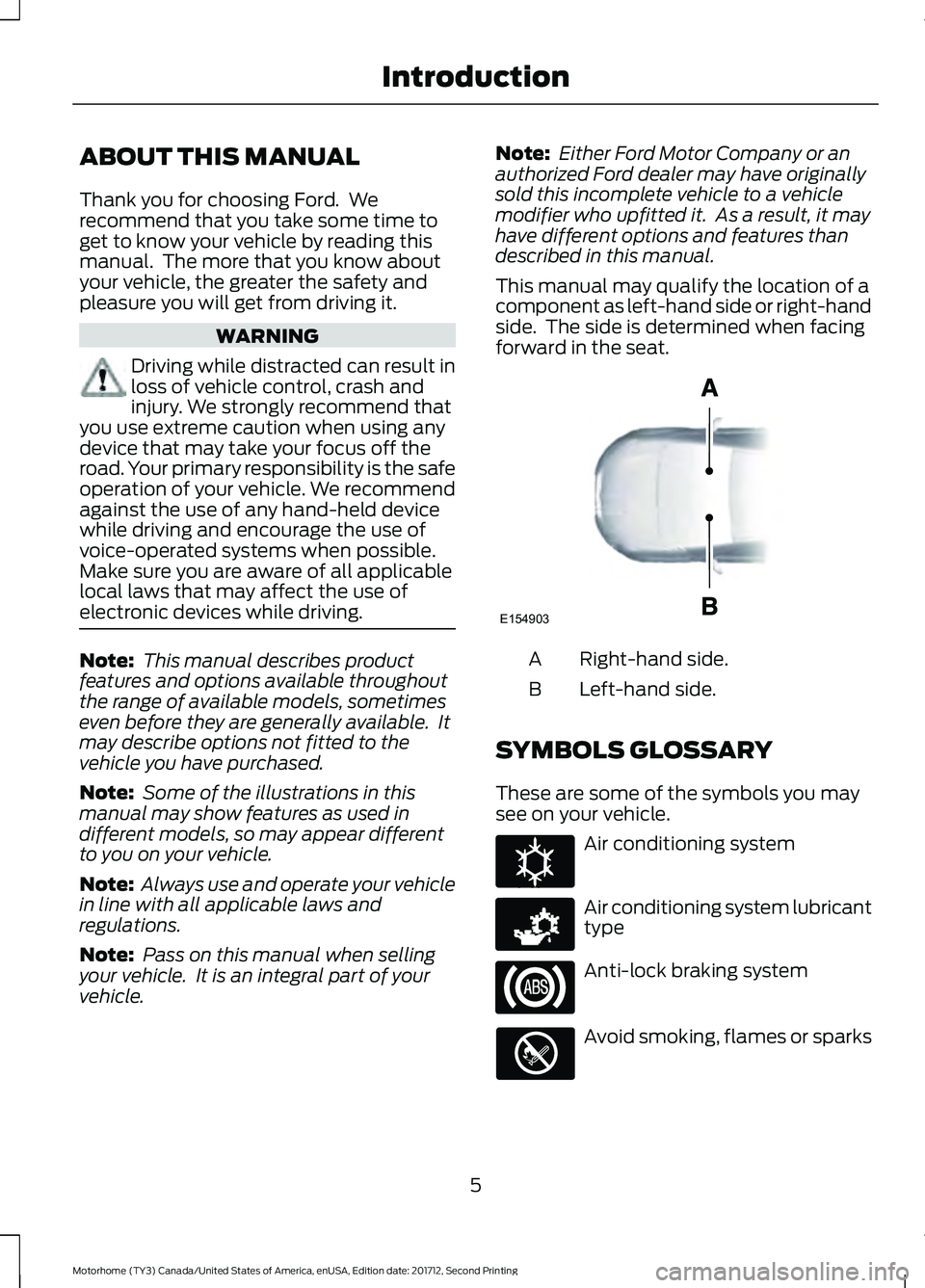
This manual may qualify the location of a
component as left-hand side or right-hand
side. The side is determined when facing
forward in the seat. Right-hand side.
A
Left-hand side.
B
SYMBOLS GLOSSARY
These are some of the symbols you may
see on your vehicle. Air conditioning system
Air conditioning system lubricant
type
Anti-lock braking system
Avoid smoking, flames or sparks
5
Motorhome (TY3) Canada/United States of America, enUSA, Edition date: 201712, Second Printing IntroductionE154903 E162384 E231157
Page 55 of 168
Trailer Brakes
WARNING
Do not connect a trailer's hydraulic
brake system directly to your
vehicle's brake system. Your vehicle
may not have enough braking power and
your chances of having a collision greatly
increase. Electric brakes and manual, automatic or
surge-type trailer brakes are safe if you
install them properly and adjust them to
the manufacturer's specifications. The
trailer brakes must meet local and federal
regulations.
The rating for the tow vehicle's braking
system operation is at the gross vehicle
weight rating, not the gross combined
weight rating.
Separate functioning brake systems
are required for safe control of towed
vehicles and trailers weighing more
than 1500 pounds (680 kilograms)
when loaded.
Trailer Lamps
WARNING
Never connect any trailer lamp wiring
to the vehicle's tail lamp wiring; this
may damage the electrical system
resulting in fire. Contact your authorized
dealer as soon as possible for assistance
in proper trailer tow wiring installation.
Additional electrical equipment may be
required. Trailer lamps are required on most towed
vehicles. Make sure all running lights, brake
lights, direction indicators and hazard lights
are working. Before Towing a Trailer
Practice turning, stopping and backing up
to get the feel of your vehicle-trailer
combination before starting on a trip.
When turning, make wider turns so the
trailer wheels clear curbs and other
obstacles.
When Towing a Trailer
•
Do not drive faster than 70 mph
(113 km/h) during the first 500 mi
(800 km).
• Do not make full-throttle starts.
• Check your hitch, electrical connections
and trailer wheel lug nuts thoroughly
after you have traveled 50 mi (80 km).
• When stopped in congested or heavy
traffic during hot weather, place the
gearshift in park (P) to aid engine and
transmission cooling and to help air
conditioning performance.
• Switch off the speed control with
heavy loads or in hilly terrain. The
speed control may turn off
automatically when you are towing on
long, steep grades.
• Shift to a lower gear when driving down
a long or steep hill. Do not apply the
brakes continuously, as they may
overheat and become less effective.
• If your transmission is equipped with a
Grade Assist or Tow/Haul feature, use
this feature when towing. This provides
engine braking and helps eliminate
excessive transmission shifting for
optimum fuel economy and
transmission cooling.
• Allow more distance for stopping with
a trailer attached. Anticipate stops and
brake gradually.
• Avoid parking on a grade. However, if
you must park on a grade:
1. Turn the steering wheel to point your vehicle tires away from traffic flow.
52
Motorhome (TY3) Canada/United States of America, enUSA, Edition date: 201712, Second Printing Towing
Page 57 of 168
BREAKING-IN
You need to break in new tires for
approximately 300 mi (480 km). During
this time, your vehicle may exhibit some
unusual driving characteristics.
Avoid driving too fast during the first
1,000 mi (1,600 km)
. Vary your speed
frequently and change up through the
gears early. Do not labor the engine.
Do not tow during the first
1,000 mi
(1,600 km).
REDUCED ENGINE
PERFORMANCE WARNING
If you continue to drive your vehicle
when the engine is overheating, the
engine could stop without warning.
Failure to follow this instruction could
result in the loss of control of your vehicle. If the engine coolant temperature gauge
needle moves to the upper limit position,
the engine is overheating. See
Gauges
(page 16).
You must only drive your vehicle for a short
distance if the engine overheats. The
distance you can travel depends on
ambient temperature, vehicle load and
terrain. The engine continues to operate
with limited power for a short period of
time.
If the engine temperature continues to rise,
the fuel supply to the engine reduces. The
air conditioning switches off and the engine
cooling fan operates continually.
1. Gradually reduce your speed and stop your vehicle as soon as it is safe to do
so.
2. Immediately switch the engine off to prevent severe engine damage. 3. Wait for the engine to cool down.
4. Check the coolant level. See
Engine
Coolant Check (page 93).
5. Have your vehicle checked as soon as possible.
ECONOMICAL DRIVING
Your fuel economy is affected by several
things, such as how you drive, the
conditions you drive under, and how you
maintain your vehicle.
You may improve your fuel economy by
keeping these things in mind:
• Accelerate and slow down in a smooth,
moderate fashion.
• Drive at steady speeds without
stopping.
• Anticipate stops; slowing down may
eliminate the need to stop.
• Combine errands and minimize
stop-and-go driving.
• Close the windows for high-speed
driving.
• Drive at reasonable speeds (traveling
at 55 mph [88 km/h] uses 15% less
fuel than traveling at 65 mph [105
km/h]).
• Keep the tires properly inflated and use
only the recommended size.
• Use the recommended engine oil.
• Perform all regularly scheduled
maintenance.
Avoid these actions; they reduce your fuel
economy:
• Sudden accelerations or hard
accelerations.
• Revving the engine before turning it off.
• Idle for periods longer than one minute.
• Warm up your vehicle on cold
mornings.
54
Motorhome (TY3) Canada/United States of America, enUSA, Edition date: 201712, Second Printing Driving Hints
Page 72 of 168
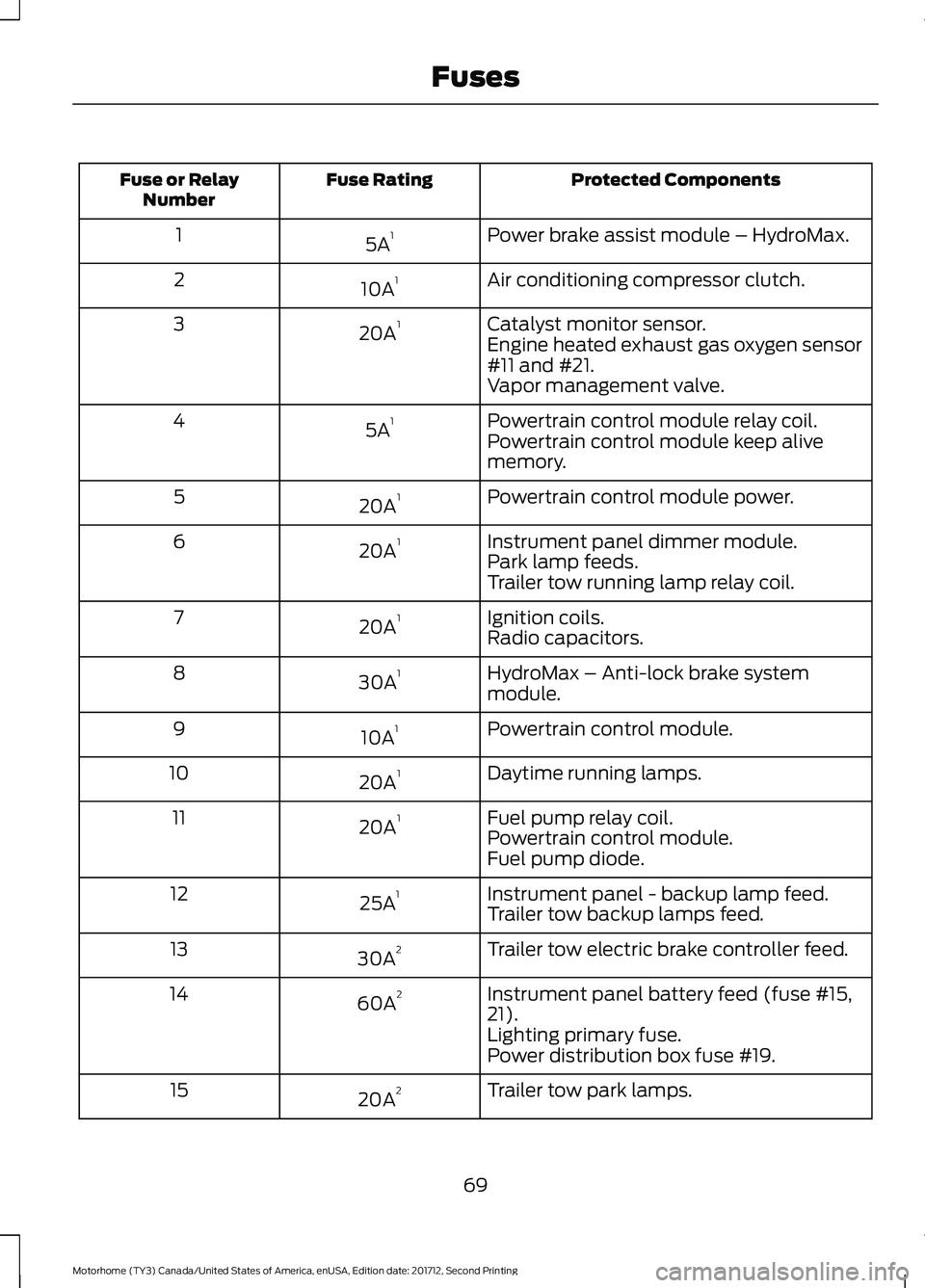
Protected Components
Fuse Rating
Fuse or Relay
Number
Power brake assist module – HydroMax.
5A 1
1
Air conditioning compressor clutch.
10A 1
2
Catalyst monitor sensor.
20A 1
3
Engine heated exhaust gas oxygen sensor
#11 and #21.
Vapor management valve.
Powertrain control module relay coil.
5A 1
4
Powertrain control module keep alive
memory.
Powertrain control module power.
20A 1
5
Instrument panel dimmer module.
20A 1
6
Park lamp feeds.
Trailer tow running lamp relay coil.
Ignition coils.
20A 1
7
Radio capacitors.
HydroMax – Anti-lock brake system
module.
30A 1
8
Powertrain control module.
10A 1
9
Daytime running lamps.
20A 1
10
Fuel pump relay coil.
20A 1
11
Powertrain control module.
Fuel pump diode.
Instrument panel - backup lamp feed.
25A 1
12
Trailer tow backup lamps feed.
Trailer tow electric brake controller feed.
30A 2
13
Instrument panel battery feed (fuse #15,
21).
60A 2
14
Lighting primary fuse.
Power distribution box fuse #19.
Trailer tow park lamps.
20A 2
15
69
Motorhome (TY3) Canada/United States of America, enUSA, Edition date: 201712, Second Printing Fuses
Page 74 of 168
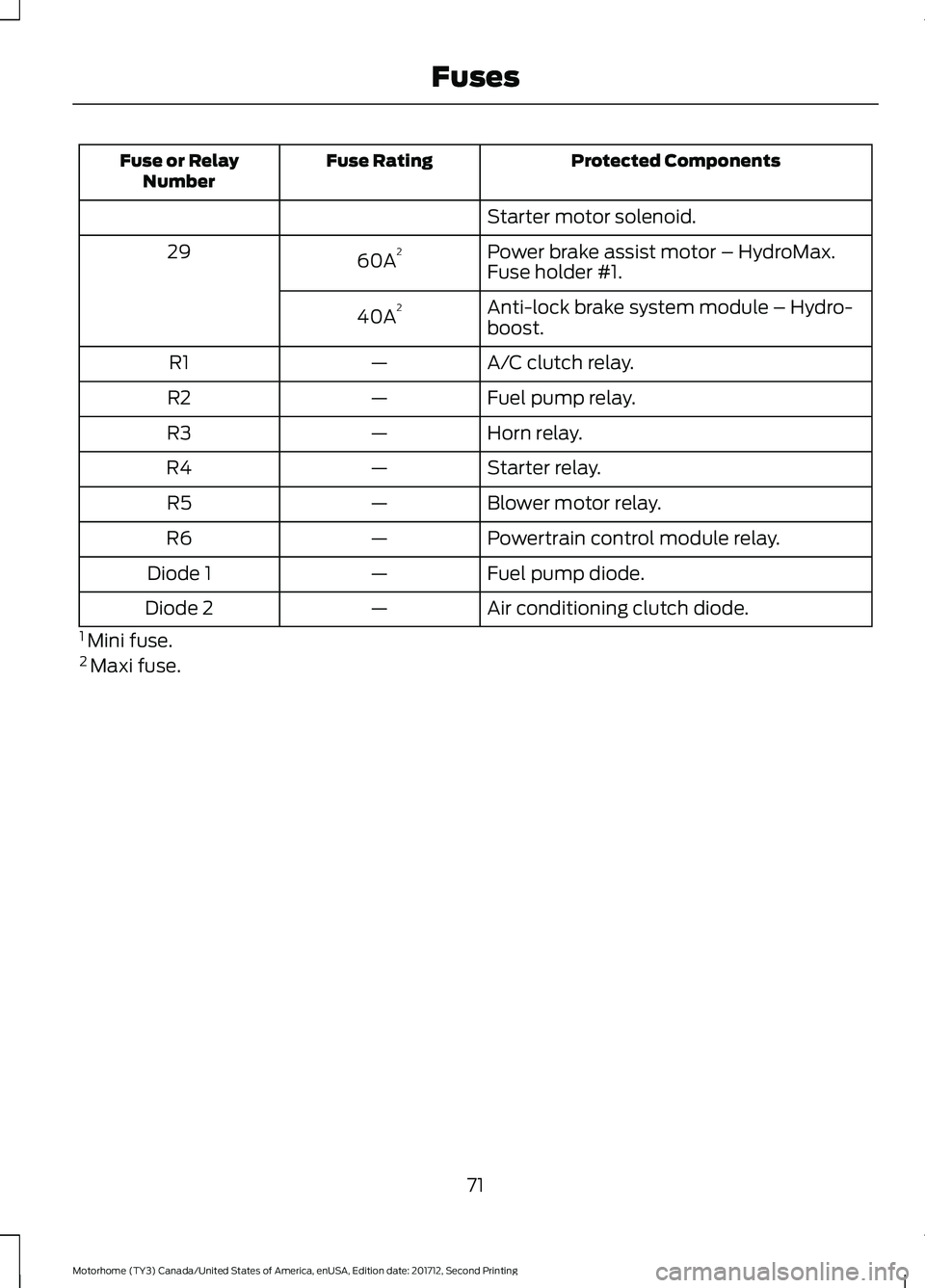
Protected Components
Fuse Rating
Fuse or Relay
Number
Starter motor solenoid.
Power brake assist motor – HydroMax.
60A 2
29
Fuse holder #1.
Anti-lock brake system module – Hydro-
boost.
40A 2
A/C clutch relay.
—
R1
Fuel pump relay.
—
R2
Horn relay.
—
R3
Starter relay.
—
R4
Blower motor relay.
—
R5
Powertrain control module relay.
—
R6
Fuel pump diode.
—
Diode 1
Air conditioning clutch diode.
—
Diode 2
1 Mini fuse.
2 Maxi fuse.
71
Motorhome (TY3) Canada/United States of America, enUSA, Edition date: 201712, Second Printing Fuses
Page 75 of 168
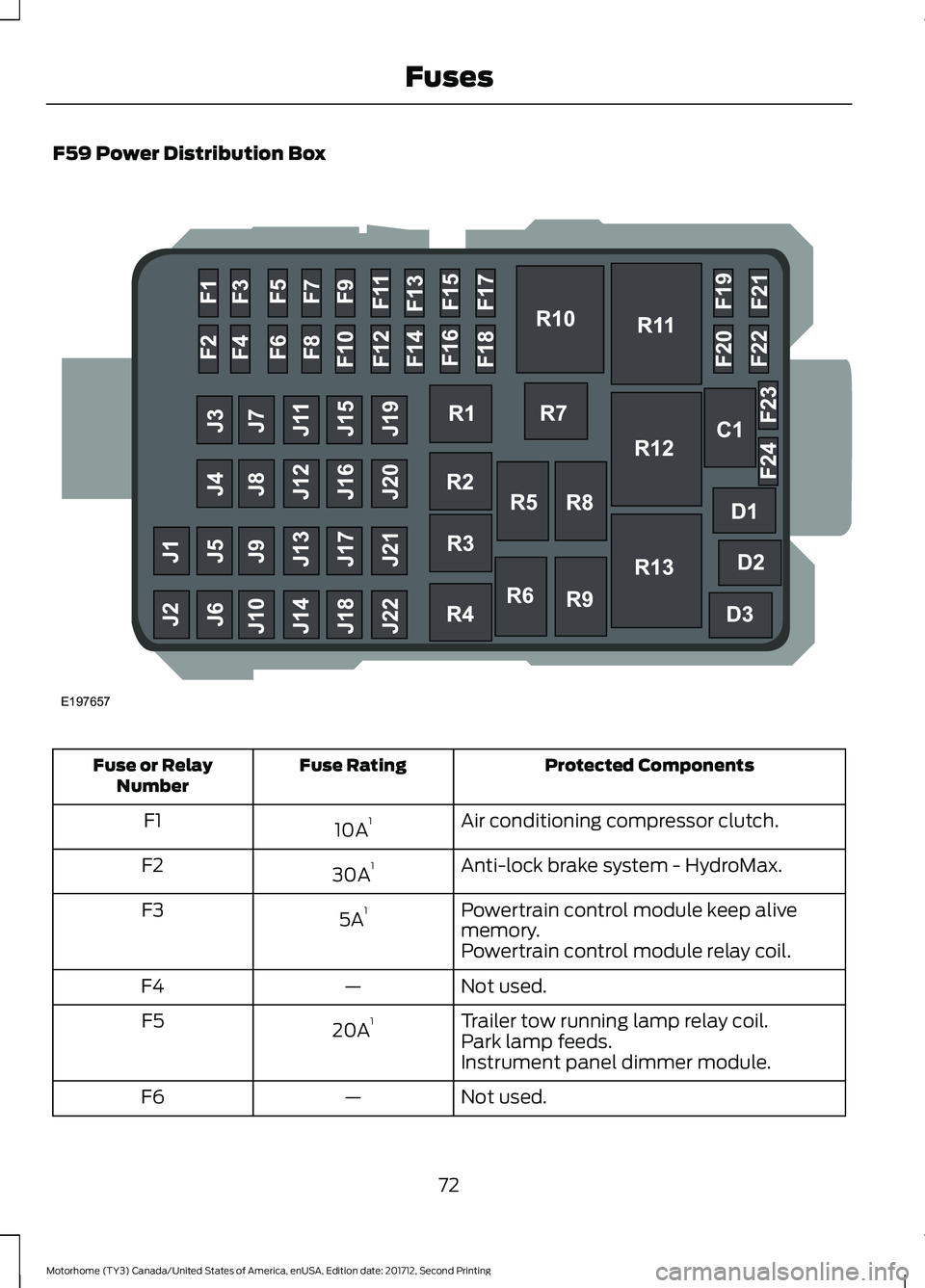
F59 Power Distribution Box
Protected Components
Fuse Rating
Fuse or Relay
Number
Air conditioning compressor clutch.
10A 1
F1
Anti-lock brake system - HydroMax.
30A 1
F2
Powertrain control module keep alive
memory.
5A 1
F3
Powertrain control module relay coil.
Not used.
—
F4
Trailer tow running lamp relay coil.
20A 1
F5
Park lamp feeds.
Instrument panel dimmer module.
Not used.
—
F6
72
Motorhome (TY3) Canada/United States of America, enUSA, Edition date: 201712, Second Printing FusesE197657
Page 79 of 168
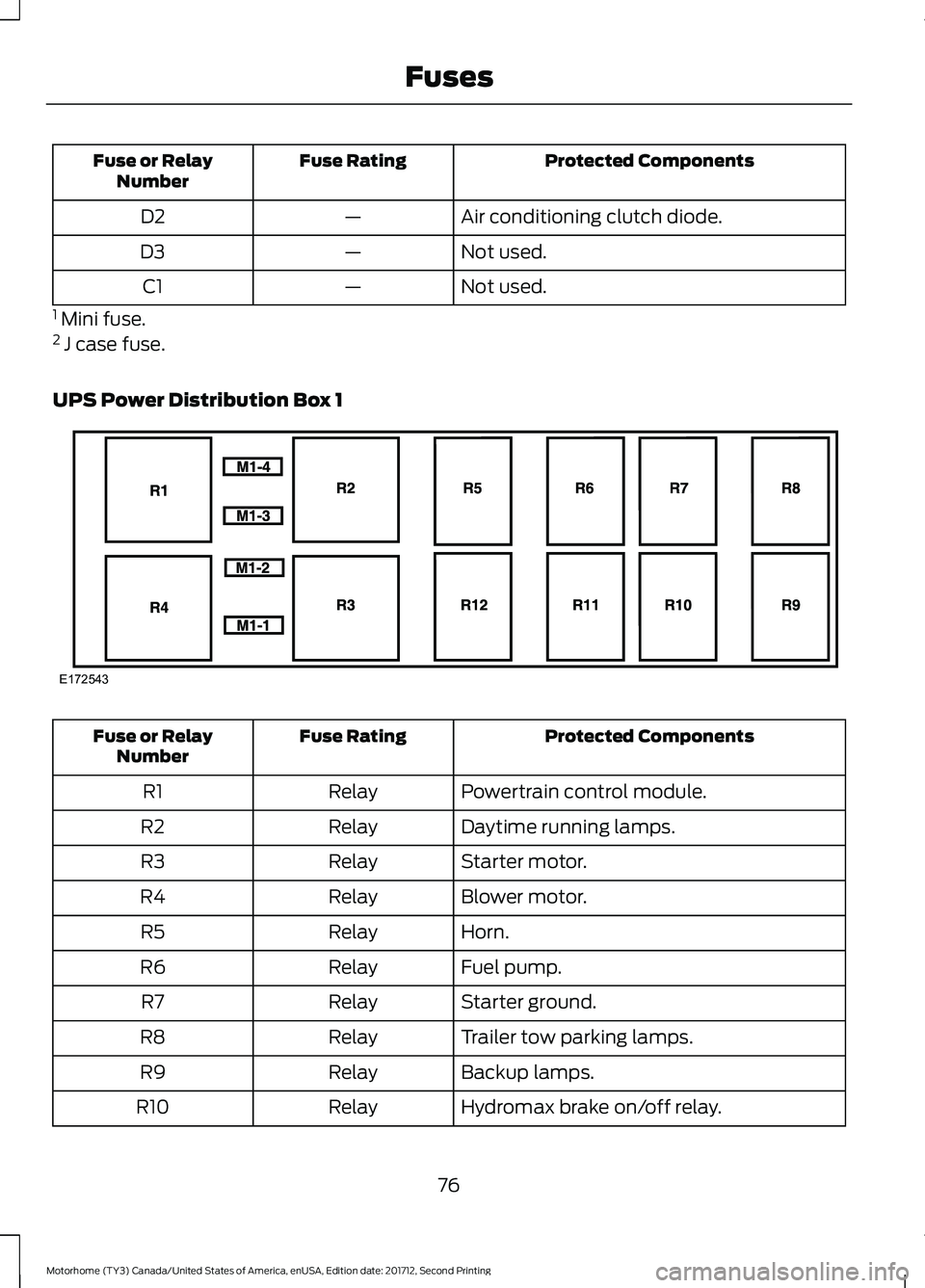
Protected Components
Fuse Rating
Fuse or Relay
Number
Air conditioning clutch diode.
—
D2
Not used.
—
D3
Not used.
—
C1
1 Mini fuse.
2 J case fuse.
UPS Power Distribution Box 1 Protected Components
Fuse Rating
Fuse or Relay
Number
Powertrain control module.
Relay
R1
Daytime running lamps.
Relay
R2
Starter motor.
Relay
R3
Blower motor.
Relay
R4
Horn.
Relay
R5
Fuel pump.
Relay
R6
Starter ground.
Relay
R7
Trailer tow parking lamps.
Relay
R8
Backup lamps.
Relay
R9
Hydromax brake on/off relay.
Relay
R10
76
Motorhome (TY3) Canada/United States of America, enUSA, Edition date: 201712, Second Printing FusesE172543
Page 81 of 168
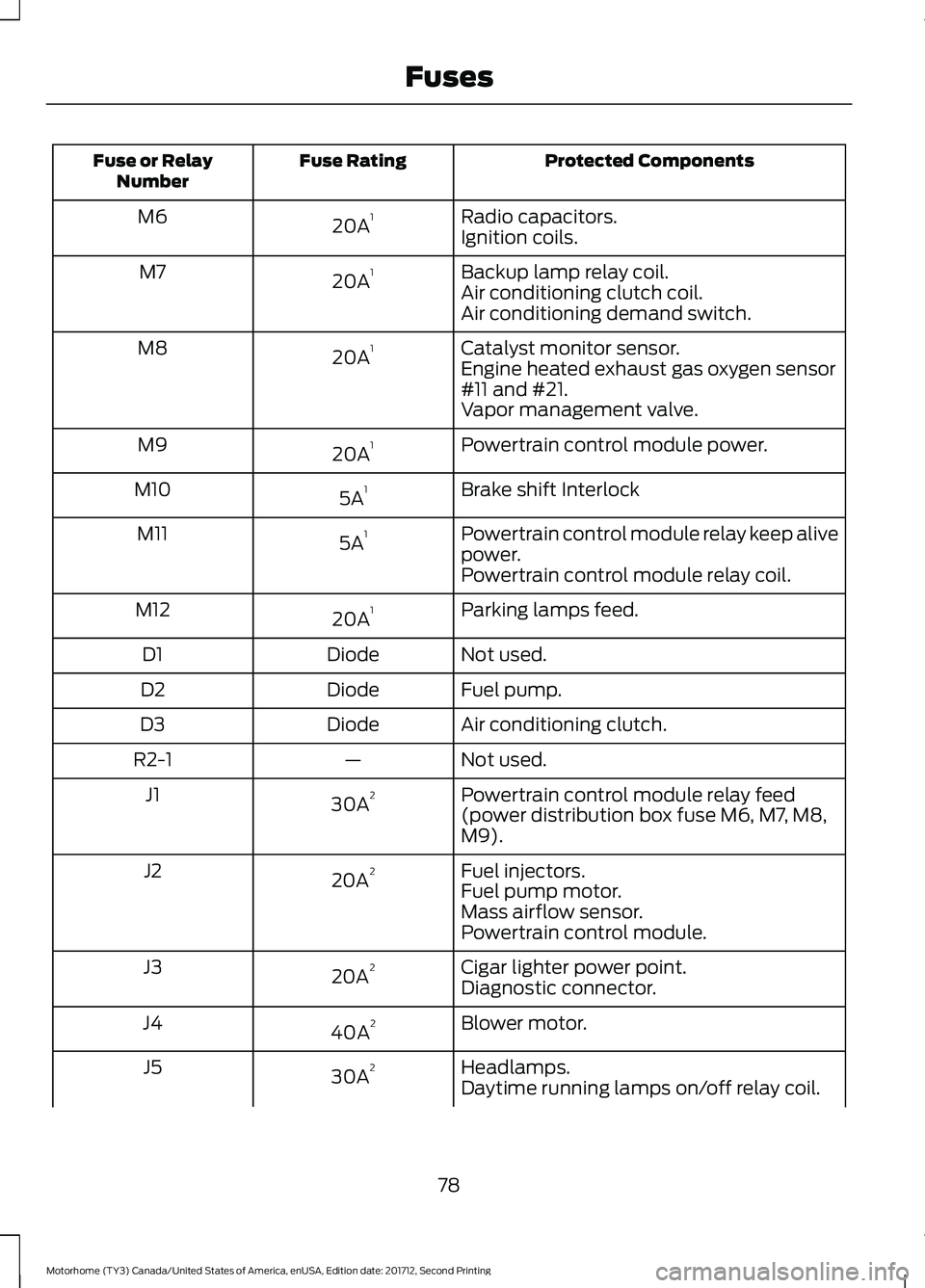
Protected Components
Fuse Rating
Fuse or Relay
Number
Radio capacitors.
20A 1
M6
Ignition coils.
Backup lamp relay coil.
20A 1
M7
Air conditioning clutch coil.
Air conditioning demand switch.
Catalyst monitor sensor.
20A 1
M8
Engine heated exhaust gas oxygen sensor
#11 and #21.
Vapor management valve.
Powertrain control module power.
20A 1
M9
Brake shift Interlock
5A 1
M10
Powertrain control module relay keep alive
power.
5A 1
M11
Powertrain control module relay coil.
Parking lamps feed.
20A 1
M12
Not used.
Diode
D1
Fuel pump.
Diode
D2
Air conditioning clutch.
Diode
D3
Not used.
—
R2-1
Powertrain control module relay feed
(power distribution box fuse M6, M7, M8,
M9).
30A
2
J1
Fuel injectors.
20A 2
J2
Fuel pump motor.
Mass airflow sensor.
Powertrain control module.
Cigar lighter power point.
20A 2
J3
Diagnostic connector.
Blower motor.
40A 2
J4
Headlamps.
30A 2
J5
Daytime running lamps on/off relay coil.
78
Motorhome (TY3) Canada/United States of America, enUSA, Edition date: 201712, Second Printing Fuses
Page 99 of 168
When this occurs, your vehicle still
operates, however:
•
Engine power is limited.
• The air conditioning system turns off.
Continued operation increases the engine
temperature, causing the engine to
completely shut down. Your steering and
braking effort increases in this situation.
When the engine temperature cools, you
can re-start the engine. Have your vehicle
checked as soon as possible to minimize
engine damage.
When Fail-Safe Mode Is Activated WARNINGS
Fail-safe mode is for use during
emergencies only. Operate your
vehicle in fail-safe mode only as long
as necessary to bring your vehicle to rest
in a safe location and seek immediate
repairs. When in fail-safe mode, your
vehicle will have limited power, will not be
able to maintain high-speed operation, and
may completely shut down without
warning, potentially losing engine power,
power steering assist, and power brake
assist, which may increase the possibility
of a crash resulting in serious injury. Never remove the coolant reservoir
cap when the engine is running or
hot.
Your vehicle has limited engine power
when in the fail-safe mode, drive your
vehicle with caution. Your vehicle does not
maintain high-speed operation and the
engine may operate poorly.
Remember that the engine is capable of
automatically shutting down to prevent
engine damage. In this situation:
1. Pull off the road as soon as safely
possible and switch the engine off. 2. If you are a member of a roadside
assistance program, we recommend
that you contact your roadside
assistance service provider.
3. If this is not possible, wait a short period for the engine to cool.
4. Check the coolant level. If the coolant level is at or below the minimum mark,
add prediluted coolant immediately.
5. When the engine temperature cools, you can re-start the engine. Have your
vehicle checked as soon as possible to
minimize engine damage.
Note: Driving your vehicle without repair
increases the chance of engine damage.
Engine Coolant Temperature
Management (If Equipped) WARNING
To reduce the risk of crash and injury,
be prepared that the vehicle speed
may reduce and the vehicle may not
be able to accelerate with full power until
the coolant temperature reduces. If you tow a trailer with your vehicle, the
engine may temporarily reach a higher
temperature during severe operating
conditions, for example ascending a long
or steep grade in high ambient
temperatures.
At this time, you may notice the coolant
temperature gauge moves toward the red
zone and a message may appear in the
information display.
96
Motorhome (TY3) Canada/United States of America, enUSA, Edition date: 201712, Second Printing Maintenance
Page 100 of 168
You may notice a reduction in vehicle
speed caused by reduced engine power in
order to manage the engine coolant
temperature. Your vehicle may enter this
mode if certain high-temperature and
high-load conditions take place. The
amount of speed reduction depends on
vehicle loading, grade and ambient
temperature. If this occurs, there is no
need to pull off the road. You can continue
to drive your vehicle.
The air conditioning may automatically
turn on and off during severe operating
conditions to protect the engine from
overheating. When the coolant
temperature decreases to the normal
operating temperature, the air conditioning
turns on.
If the coolant temperature gauge moves
fully into the red zone, or if the coolant
temperature warning or service engine
soon messages appear in your information
display, do the following:
1. Pull off the road as soon as safely
possible and shift the transmission into
park (P).
2. Leave the engine running until the coolant temperature gauge needle
returns to the normal position. After
several minutes, if the temperature
does not drop, follow the remaining
steps.
3. Switch the engine off and wait for it to
cool. Check the coolant level.
4. If the coolant level is at or below the minimum mark, add prediluted coolant
immediately.
5. If the coolant level is normal, restart the engine and continue. AUTOMATIC TRANSMISSION
FLUID CHECK WARNING
The dipstick cap and surrounding
components may be hot; gloves are
recommended.
Note:
Automatic transmission fluid
expands when warmed. To obtain an
accurate fluid check, drive the vehicle until
it is at normal operating temperature
(approximately 20 miles [30 km]). If your
vehicle has been operated for an extended
period at high speeds, in city traffic during
hot weather or pulling a trailer, the vehicle
should be turned off for about 30 minutes
to allow fluid to cool to normal operating
temperature 196°F - 215°F (91°C - 102°C)
before checking.
Refer to your scheduled maintenance
information for scheduled intervals for fluid
checks and changes.
Your transmission does not consume fluid.
However, the fluid level should be checked
if the transmission is not working properly,
(i.e., if the transmission slips or shifts
slowly) or if you notice some sign of fluid
leakage. To check the fluid level:
1. Drive the vehicle 20 miles (30 km) or until it reaches normal operating
temperature
2. Park the vehicle on a level surface and
engage the parking brake
3. With the engine running, parking brake
engaged and your foot on the brake
pedal, move the gearshift lever through
all of the gear ranges. Allow sufficient
time for each gear to engage
4. Latch the gearshift lever in P (Park) and leave the engine running.
97
Motorhome (TY3) Canada/United States of America, enUSA, Edition date: 201712, Second Printing Maintenance