reset FORD F-59 2018 Owners Manual
[x] Cancel search | Manufacturer: FORD, Model Year: 2018, Model line: F-59, Model: FORD F-59 2018Pages: 168, PDF Size: 3.02 MB
Page 5 of 168
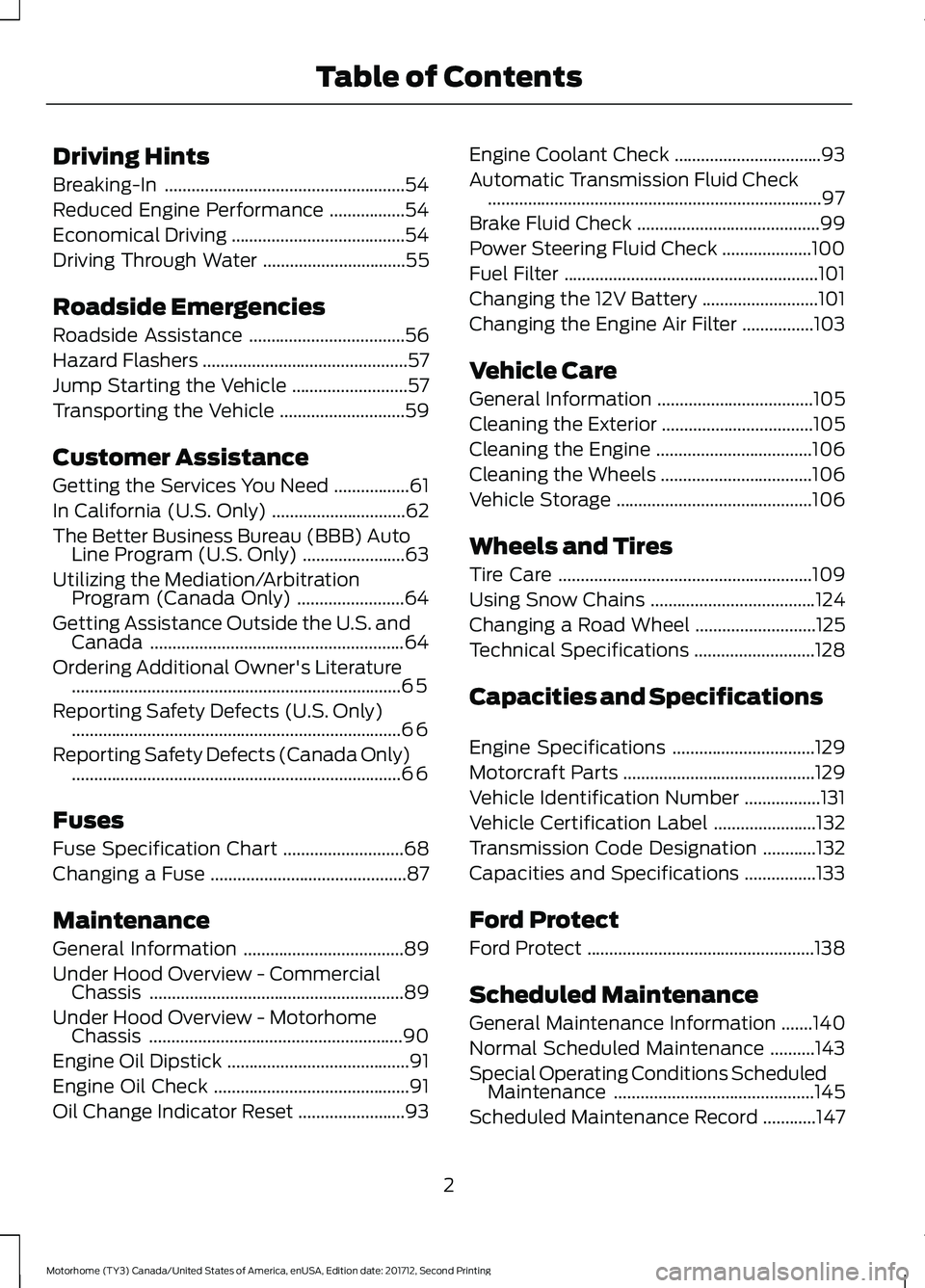
Driving Hints
Breaking-In
......................................................54
Reduced Engine Performance .................
54
Economical Driving .......................................
54
Driving Through Water ................................
55
Roadside Emergencies
Roadside Assistance ...................................
56
Hazard Flashers ..............................................
57
Jump Starting the Vehicle ..........................
57
Transporting the Vehicle ............................
59
Customer Assistance
Getting the Services You Need .................
61
In California (U.S. Only) ..............................
62
The Better Business Bureau (BBB) Auto Line Program (U.S. Only) .......................
63
Utilizing the Mediation/Arbitration Program (Canada Only) ........................
64
Getting Assistance Outside the U.S. and Canada .........................................................
64
Ordering Additional Owner's Literature ........................................................................\
..
65
Reporting Safety Defects (U.S. Only) ........................................................................\
..
66
Reporting Safety Defects (Canada Only) ........................................................................\
..
66
Fuses
Fuse Specification Chart ...........................
68
Changing a Fuse ............................................
87
Maintenance
General Information ....................................
89
Under Hood Overview - Commercial Chassis .........................................................
89
Under Hood Overview - Motorhome Chassis .........................................................
90
Engine Oil Dipstick .........................................
91
Engine Oil Check ............................................
91
Oil Change Indicator Reset ........................
93Engine Coolant Check
.................................
93
Automatic Transmission Fluid Check ........................................................................\
...
97
Brake Fluid Check .........................................
99
Power Steering Fluid Check ....................
100
Fuel Filter .........................................................
101
Changing the 12V Battery ..........................
101
Changing the Engine Air Filter ................
103
Vehicle Care
General Information ...................................
105
Cleaning the Exterior ..................................
105
Cleaning the Engine ...................................
106
Cleaning the Wheels ..................................
106
Vehicle Storage ............................................
106
Wheels and Tires
Tire Care .........................................................
109
Using Snow Chains .....................................
124
Changing a Road Wheel ...........................
125
Technical Specifications ...........................
128
Capacities and Specifications
Engine Specifications ................................
129
Motorcraft Parts ...........................................
129
Vehicle Identification Number .................
131
Vehicle Certification Label .......................
132
Transmission Code Designation ............
132
Capacities and Specifications ................
133
Ford Protect
Ford Protect ...................................................
138
Scheduled Maintenance
General Maintenance Information .......
140
Normal Scheduled Maintenance ..........
143
Special Operating Conditions Scheduled Maintenance .............................................
145
Scheduled Maintenance Record ............
147
2
Motorhome (TY3) Canada/United States of America, enUSA, Edition date: 201712, Second Printing Table of Contents
Page 9 of 168
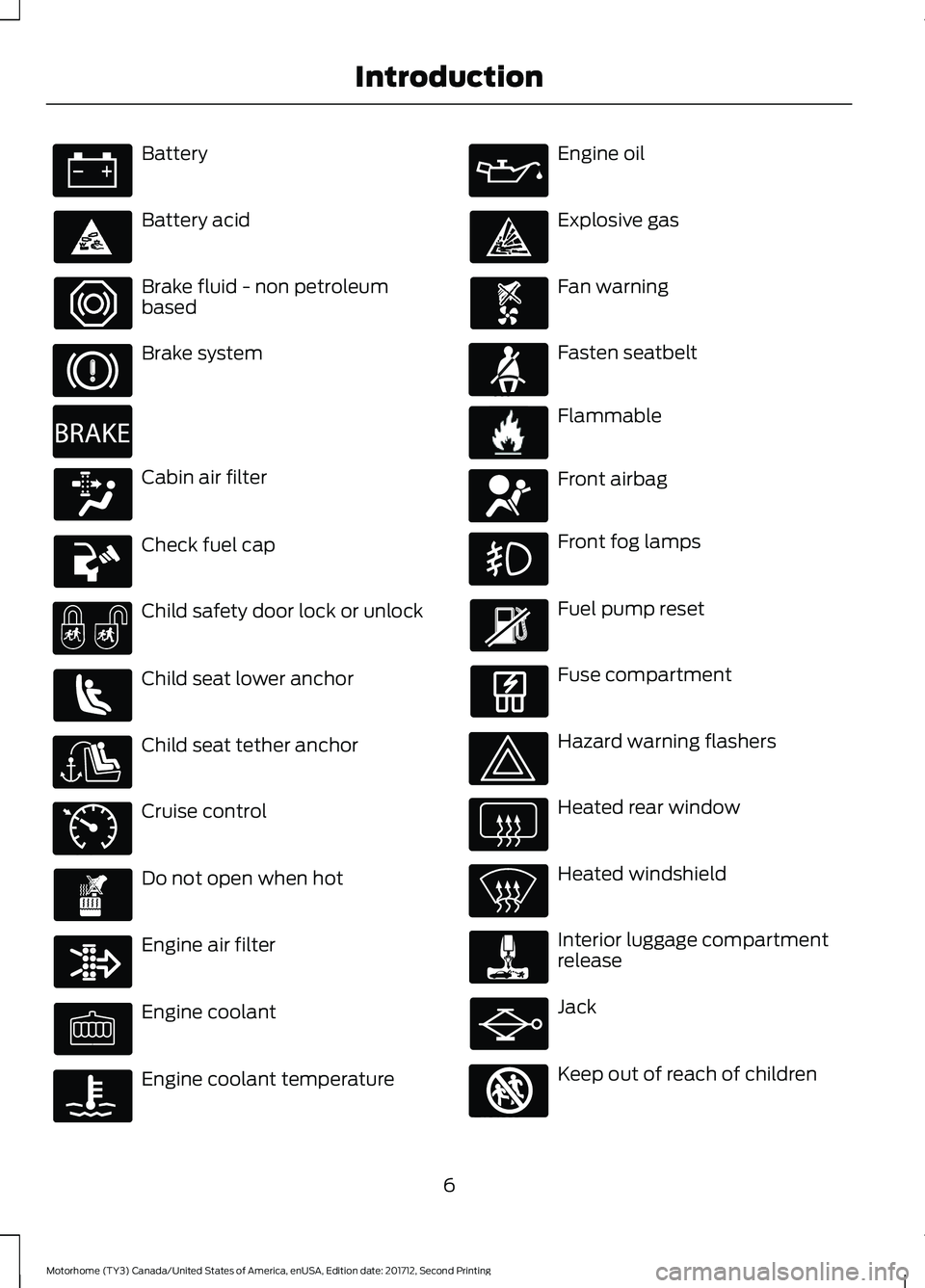
Battery
Battery acid
Brake fluid - non petroleum
based
Brake system
Cabin air filter
Check fuel cap
Child safety door lock or unlock
Child seat lower anchor
Child seat tether anchor
Cruise control
Do not open when hot
Engine air filter
Engine coolant
Engine coolant temperature Engine oil
Explosive gas
Fan warning
Fasten seatbelt
Flammable
Front airbag
Front fog lamps
Fuel pump reset
Fuse compartment
Hazard warning flashers
Heated rear window
Heated windshield
Interior luggage compartment
release
Jack
Keep out of reach of children
6
Motorhome (TY3) Canada/United States of America, enUSA, Edition date: 201712, Second Printing Introduction E270480 E71340 E71880 E231160 E67017 E161353
Page 17 of 168
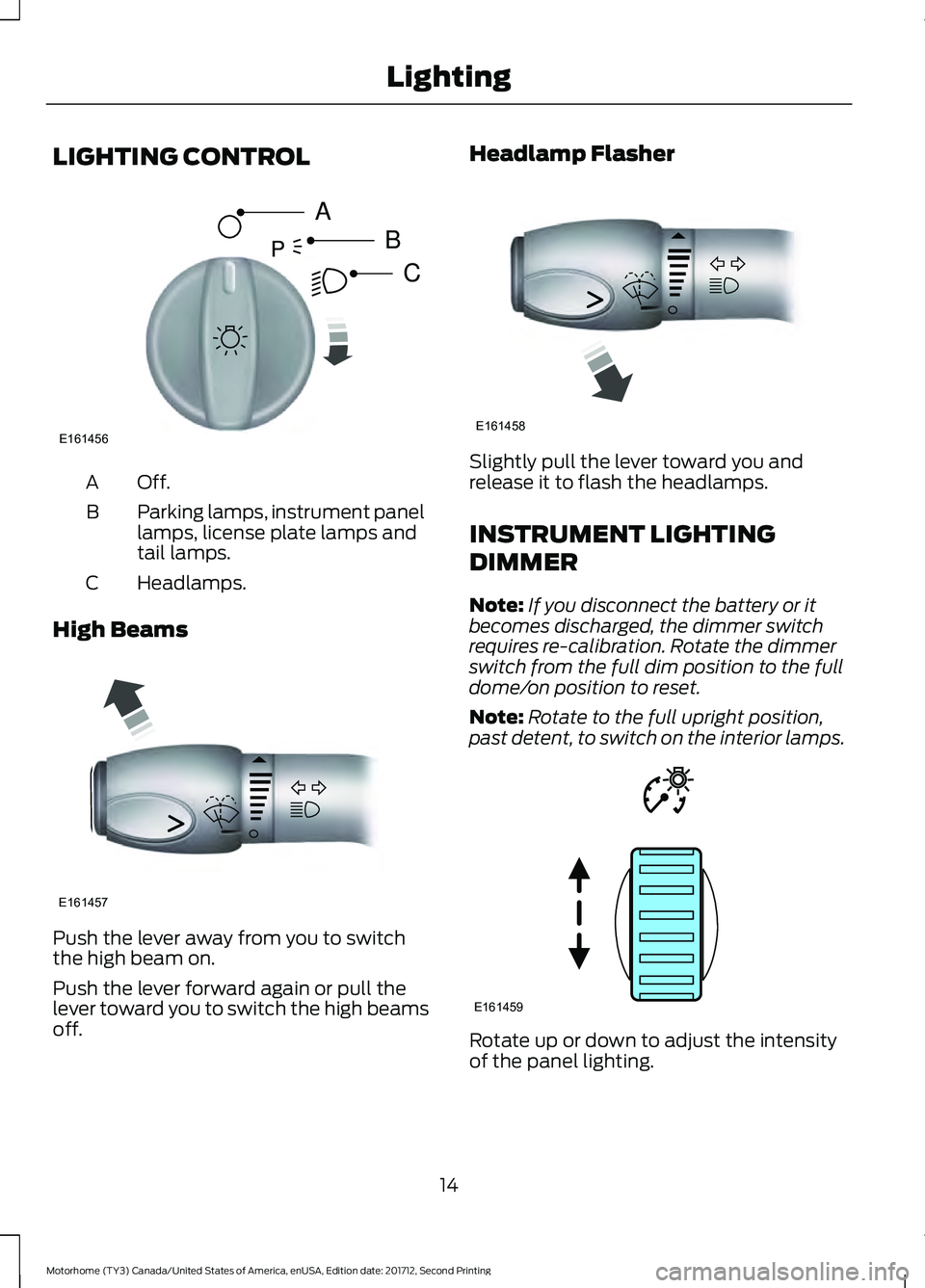
LIGHTING CONTROL
Off.A
Parking lamps, instrument panel
lamps, license plate lamps and
tail lamps.
B
Headlamps.
C
High Beams Push the lever away from you to switch
the high beam on.
Push the lever forward again or pull the
lever toward you to switch the high beams
off. Headlamp Flasher
Slightly pull the lever toward you and
release it to flash the headlamps.
INSTRUMENT LIGHTING
DIMMER
Note:
If you disconnect the battery or it
becomes discharged, the dimmer switch
requires re-calibration. Rotate the dimmer
switch from the full dim position to the full
dome/on position to reset.
Note: Rotate to the full upright position,
past detent, to switch on the interior lamps. Rotate up or down to adjust the intensity
of the panel lighting.
14
Motorhome (TY3) Canada/United States of America, enUSA, Edition date: 201712, Second Printing LightingE161456
A
B
CP E161457 E161458 E161459
Page 24 of 168
GENERAL INFORMATION
WARNING
Driving while distracted can result in
loss of vehicle control, crash and
injury. We strongly recommend that
you use extreme caution when using any
device that may take your focus off the
road. Your primary responsibility is the safe
operation of your vehicle. We recommend
against the use of any hand-held device
while driving and encourage the use of
voice-operated systems when possible.
Make sure you are aware of all applicable
local laws that may affect the use of
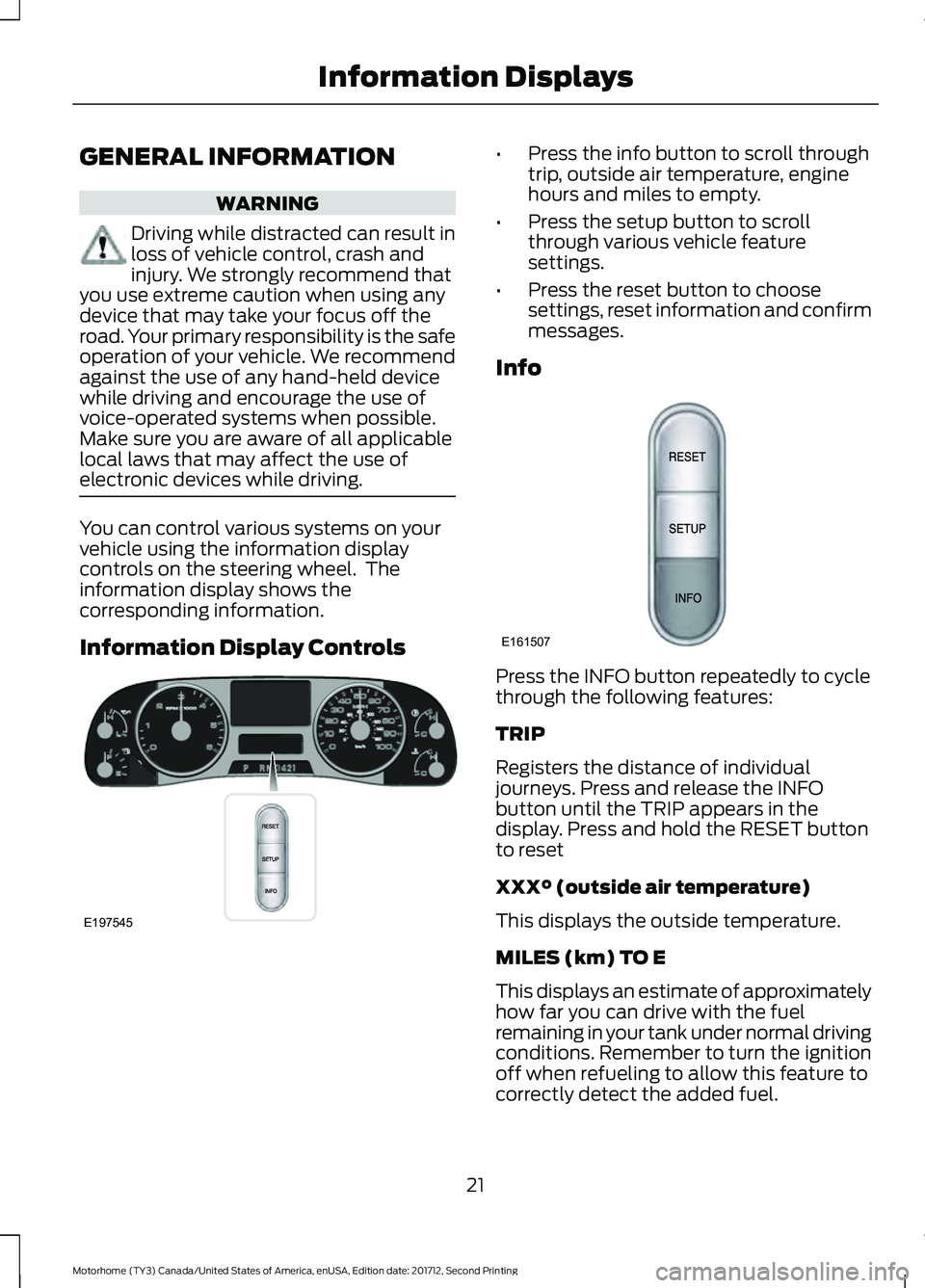
electronic devices while driving. You can control various systems on your
vehicle using the information display
controls on the steering wheel. The
information display shows the
corresponding information.
Information Display Controls •
Press the info button to scroll through
trip, outside air temperature, engine
hours and miles to empty.
• Press the setup button to scroll
through various vehicle feature
settings.
• Press the reset button to choose
settings, reset information and confirm
messages.
Info Press the INFO button repeatedly to cycle
through the following features:
TRIP
Registers the distance of individual
journeys. Press and release the INFO
button until the TRIP appears in the
display. Press and hold the RESET button
to reset
XXX° (outside air temperature)
This displays the outside temperature.
MILES (km) TO E
This displays an estimate of approximately
how far you can drive with the fuel
remaining in your tank under normal driving
conditions. Remember to turn the ignition
off when refueling to allow this feature to
correctly detect the added fuel.
21
Motorhome (TY3) Canada/United States of America, enUSA, Edition date: 201712, Second Printing Information DisplaysE197545 E161507
Page 25 of 168
The DTE function will display a message
in the information display when you have
approximately 50 mi (80 km) to empty.
Press RESET to clear this warning
message. It will return at approximately
25 mi (40 km)
, 10 mi (16 km) and 0 mi
(0 km) miles to empty.
DTE calculates using a running average
fuel economy based on your recent driving
history of
500 mi (800 km).
ENG HRS
Registers the accumulated time the engine
has been running.
System check and vehicle feature
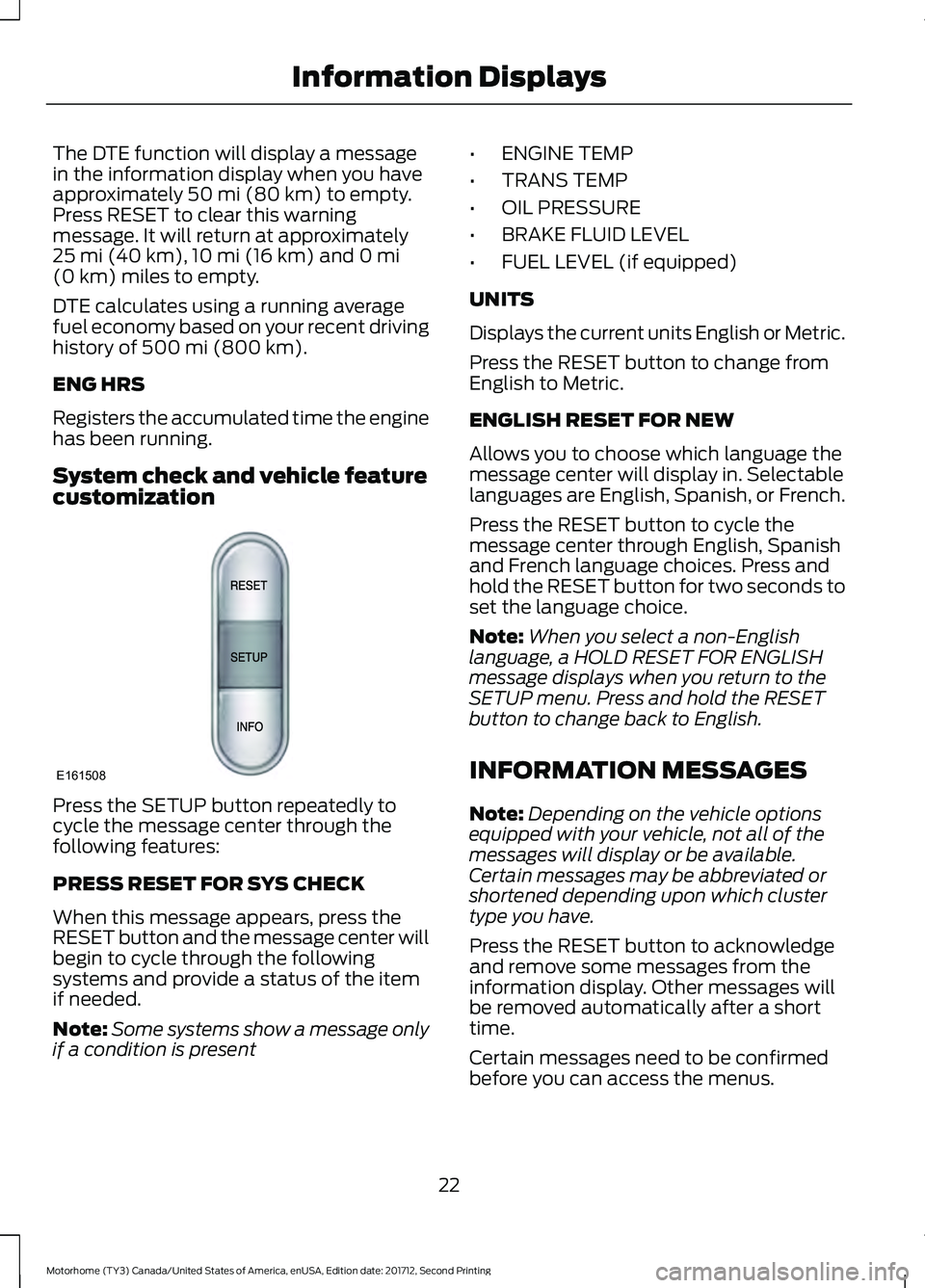
customization Press the SETUP button repeatedly to
cycle the message center through the
following features:
PRESS RESET FOR SYS CHECK
When this message appears, press the
RESET button and the message center will
begin to cycle through the following
systems and provide a status of the item
if needed.
Note:
Some systems show a message only
if a condition is present •
ENGINE TEMP
• TRANS TEMP
• OIL PRESSURE
• BRAKE FLUID LEVEL
• FUEL LEVEL (if equipped)
UNITS
Displays the current units English or Metric.
Press the RESET button to change from
English to Metric.
ENGLISH RESET FOR NEW
Allows you to choose which language the
message center will display in. Selectable
languages are English, Spanish, or French.
Press the RESET button to cycle the
message center through English, Spanish
and French language choices. Press and
hold the RESET button for two seconds to
set the language choice.
Note: When you select a non-English
language, a HOLD RESET FOR ENGLISH
message displays when you return to the
SETUP menu. Press and hold the RESET
button to change back to English.
INFORMATION MESSAGES
Note: Depending on the vehicle options
equipped with your vehicle, not all of the
messages will display or be available.
Certain messages may be abbreviated or
shortened depending upon which cluster
type you have.
Press the RESET button to acknowledge
and remove some messages from the
information display. Other messages will
be removed automatically after a short
time.
Certain messages need to be confirmed
before you can access the menus.
22
Motorhome (TY3) Canada/United States of America, enUSA, Edition date: 201712, Second Printing Information DisplaysE161508
Page 71 of 168
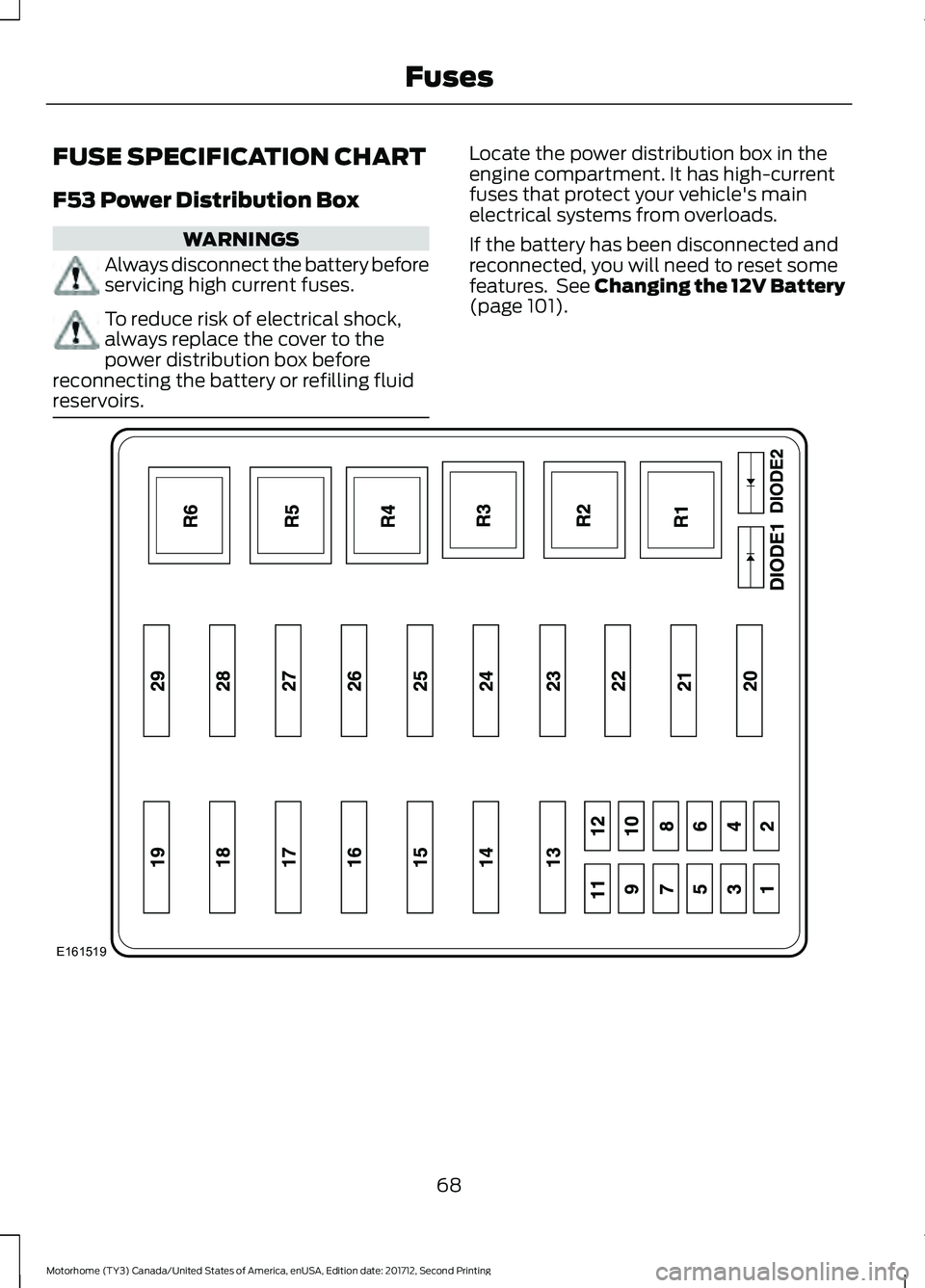
FUSE SPECIFICATION CHART
F53 Power Distribution Box
WARNINGS
Always disconnect the battery before
servicing high current fuses.
To reduce risk of electrical shock,
always replace the cover to the
power distribution box before
reconnecting the battery or refilling fluid
reservoirs. Locate the power distribution box in the
engine compartment. It has high-current
fuses that protect your vehicle's main
electrical systems from overloads.
If the battery has been disconnected and
reconnected, you will need to reset some
features. See Changing the 12V Battery
(page 101).
68
Motorhome (TY3) Canada/United States of America, enUSA, Edition date: 201712, Second Printing FusesE161519
Page 96 of 168
Note:
Do not add oil further than the
maximum mark. Oil levels above the
maximum mark may cause engine damage.
Note: Make sure you install the oil filler cap
correctly.
Note: Soak up any spillage with an
absorbent cloth immediately.
OIL CHANGE INDICATOR
RESET
Resetting the Oil Life Monitoring
System
Only reset the oil life monitoring system
after changing the engine oil and oil filter.
To reset the oil life monitoring system do
the following:
1. Switch the ignition on. Do not start the
engine.
2. Fully press the accelerator and brake pedals at the same time.
3. Keep the accelerator and brake pedals
fully pressed.
4. After three seconds, a message displays confirming the reset procedure
is in progress.
5. After 25 seconds, a message displays confirming the reset procedure is
complete.
6. Release the accelerator and brake pedals.
7. Switch the ignition off. ENGINE COOLANT CHECK WARNINGS
Do not remove the coolant reservoir
cap when the cooling system is hot.
Wait 10 minutes for the cooling
system to cool down. Cover the coolant
reservoir cap with a thick cloth to prevent
the possibility of scalding and slowly
remove the cap. Failure to follow this
instruction could result in personal injury. Do not put coolant in the windshield
washer fluid reservoir. If sprayed on
the windshield, coolant could make
it difficult to see through the windshield. To reduce the risk of personal injury,
make sure the engine is cool before
unscrewing the coolant pressure
relief cap. The cooling system is under
pressure. Steam and hot liquid can come
out forcefully when you loosen the cap
slightly. Do not add coolant further than the
MAX mark.
When the engine is cold, check the
concentration and level of the coolant at
the intervals listed in the scheduled
maintenance information. See Scheduled
Maintenance
(page 140).
Note: Make sure that the coolant level is
between the
MIN and MAX marks on the
coolant reservoir.
Note: Coolant expands when it is hot. The
level may extend beyond the
MAX mark.
Maintain coolant concentration within
48% to 50%, which equates to a freeze
point between -30°F (-34°C) and -34°F
(-37°C). Coolant concentration should be
checked using a refractometer. We do not
recommend the use of hydrometers or
coolant test strips for measuring coolant
concentration.
93
Motorhome (TY3) Canada/United States of America, enUSA, Edition date: 201712, Second Printing Maintenance
Page 98 of 168
3. Refill with engine coolant as soon as
possible.
Water alone, without engine coolant, can
cause engine damage from corrosion,
overheating or freezing.
Do not use the following as a coolant
substitute:
• Alcohol.
• Methanol.
• Brine.
• Any coolant mixed with alcohol or
methanol antifreeze.
Alcohol and other liquids can cause engine
damage from overheating or freezing.
Do not add extra inhibitors or additives to
the coolant. These can be harmful and
compromise the corrosion protection of
the coolant.
Recycled Coolant
We do not recommend the use of recycled
coolant as an approved recycling process
is not yet available.
Dispose of used engine coolant in an
appropriate manner. Follow your
community's regulations and standards
for recycling and disposing of automotive
fluids.
Severe Climates
If you drive in extremely cold climates:
• It may be necessary to increase the
coolant concentration above 50%.
• A coolant concentration of 60%
provides improved freeze point
protection. Coolant concentrations
above 60% decrease the overheat
protection characteristics of the
coolant and may cause engine
damage. If you drive in extremely hot climates:
•
You can decrease the coolant
concentration to 40%.
• Coolant concentrations below 40%
decrease the freeze and corrosion
protection characteristics of the
coolant and may cause engine
damage.
Vehicles driven year-round in non-extreme
climates should use prediluted coolant for
optimum cooling system and engine
protection.
Coolant Change
At specific mileage intervals, as listed in
the scheduled maintenance information,
the coolant should be changed. Add
prediluted coolant approved to the correct
specification. See Capacities and
Specifications (page 129).
Fail-Safe Cooling
Fail-safe cooling allows you to temporarily
drive your vehicle before any incremental
component damage occurs. The fail-safe
distance depends on ambient
temperature, vehicle load and terrain.
How Fail-Safe Cooling Works If the engine begins to overheat,
the coolant temperature gauge
moves toward the red zone:
A warning lamp illuminates and
a message may appear in the
information display.
If the engine reaches a preset
over-temperature condition, the engine
automatically switches to alternating
cylinder operation. Each disabled cylinder
acts as an air pump and cools the engine.
95
Motorhome (TY3) Canada/United States of America, enUSA, Edition date: 201712, Second Printing Maintenance
Page 106 of 168
•
The transmission must relearn its
adaptive strategy. As a result of this,
the transmission may shift firmly. This
operation is considered normal and will
not affect function or durability of the
transmission. Over time the adaptive
learning process will fully update
transmission operation to its optimum
shift feel.
• The clock and the preset radio stations
must be reset once the battery is
reconnected.
• Your vehicle ’s engine is electronically
controlled by a computer, some control
conditions are maintained by power
from the battery, the engine must
relearn its idle and fuel trim strategy.
When the battery is disconnected or a new
battery is installed, begin the battery
relearn process:
1. With the vehicle at a complete stop, set the parking brake.
2. Put the gearshift lever in P (Park), turn
off all accessories and start the engine.
3. Run the engine until it reaches normal operating temperature.
4. Allow the engine to idle for at least one
minute.
5. Turn the A/C on and allow the engine to idle for at least one minute.
6. Drive the vehicle to complete the relearning process.
•The vehicle may need to be driven
to relearn the idle and fuel trim
strategy. CHANGING THE ENGINE AIR
FILTER WARNING
To reduce the risk of vehicle damage
and personal burn injuries, do not
start your engine with the air cleaner
removed and do not remove it while the
engine is running. Change the air filter element at the proper
interval. See Scheduled Maintenance
(page 140).
When changing the air filter element, use
only the air filter element listed. See
Capacities and Specifications
(page
129).
Note: Failure to use the correct air filter
element may result in severe engine
damage. The customer warranty may be
void for any damage to the engine if the
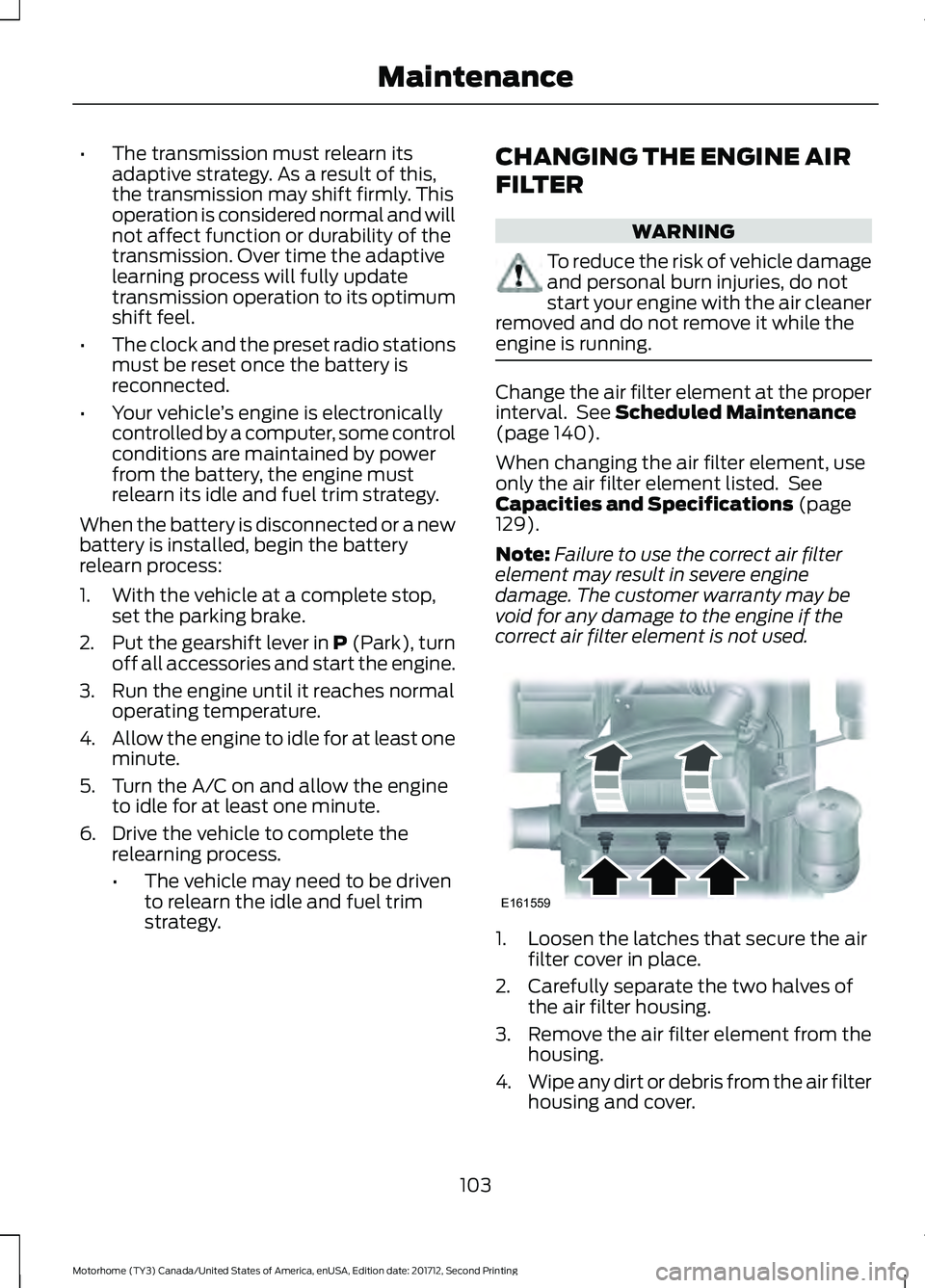
correct air filter element is not used. 1. Loosen the latches that secure the air
filter cover in place.
2. Carefully separate the two halves of the air filter housing.
3. Remove the air filter element from the
housing.
4. Wipe any dirt or debris from the air filter
housing and cover.
103
Motorhome (TY3) Canada/United States of America, enUSA, Edition date: 201712, Second Printing MaintenanceE161559
Page 110 of 168
General
•
Store all vehicles in a dry, ventilated
place.
• Protect from sunlight, if possible.
• If vehicles are stored outside, they
require regular maintenance to protect
against rust and damage.
Body
• Wash your vehicle thoroughly to
remove dirt, grease, oil, tar or mud from
exterior surfaces, rear-wheel housing
and the underside of front fenders.
• Periodically wash your vehicle if it is
stored in exposed locations.
• Touch-up exposed or primed metal to
prevent rust.
• Cover chrome and stainless steel parts
with a thick coat of auto wax to prevent
discoloration. Re-wax as necessary
when you wash your vehicle.
• Lubricate all hood, door and luggage
compartment hinges and latches with
a light grade oil.
• Cover interior trim to prevent fading.
• Keep all rubber parts free from oil and
solvents.
Engine
• Change the engine oil and filter prior to
storage because used engine oil
contains contaminates which may
cause engine damage.
• Start the engine every 15 days for a
minimum of 15 minutes. Run at fast idle
with the climate controls set to defrost
until the engine reaches normal
operating temperature. •
With your foot on the brake, shift
through all the gears while the engine
is running.
• We recommend that you change the
engine oil before you use your vehicle
again.
Fuel system
• Fill the fuel tank with high-quality fuel
until the first automatic shutoff of the
fuel pump nozzle.
Cooling system
• Protect against freezing temperatures.
• When removing your vehicle from
storage, check coolant fluid level.
Confirm that there are no cooling
system leaks and that fluid is at the
recommended level.
Battery
• Check and recharge as necessary. Keep
connections clean.
• If storing your vehicle for more than 30
days without recharging the battery,
we recommend that you disconnect
the battery cables to maintain battery
charge for quick starting.
Note: It is necessary to reset memory
features if battery cables are disconnected.
Brakes
• Make sure the brakes and parking brake
release fully.
Tires
• Maintain recommended air pressure.
107
Motorhome (TY3) Canada/United States of America, enUSA, Edition date: 201712, Second Printing Vehicle Care