lock FORD F-59 2019 User Guide
[x] Cancel search | Manufacturer: FORD, Model Year: 2019, Model line: F-59, Model: FORD F-59 2019Pages: 176, PDF Size: 9.98 MB
Page 35 of 176
2.Unlock the fuel filler cap and removeit.
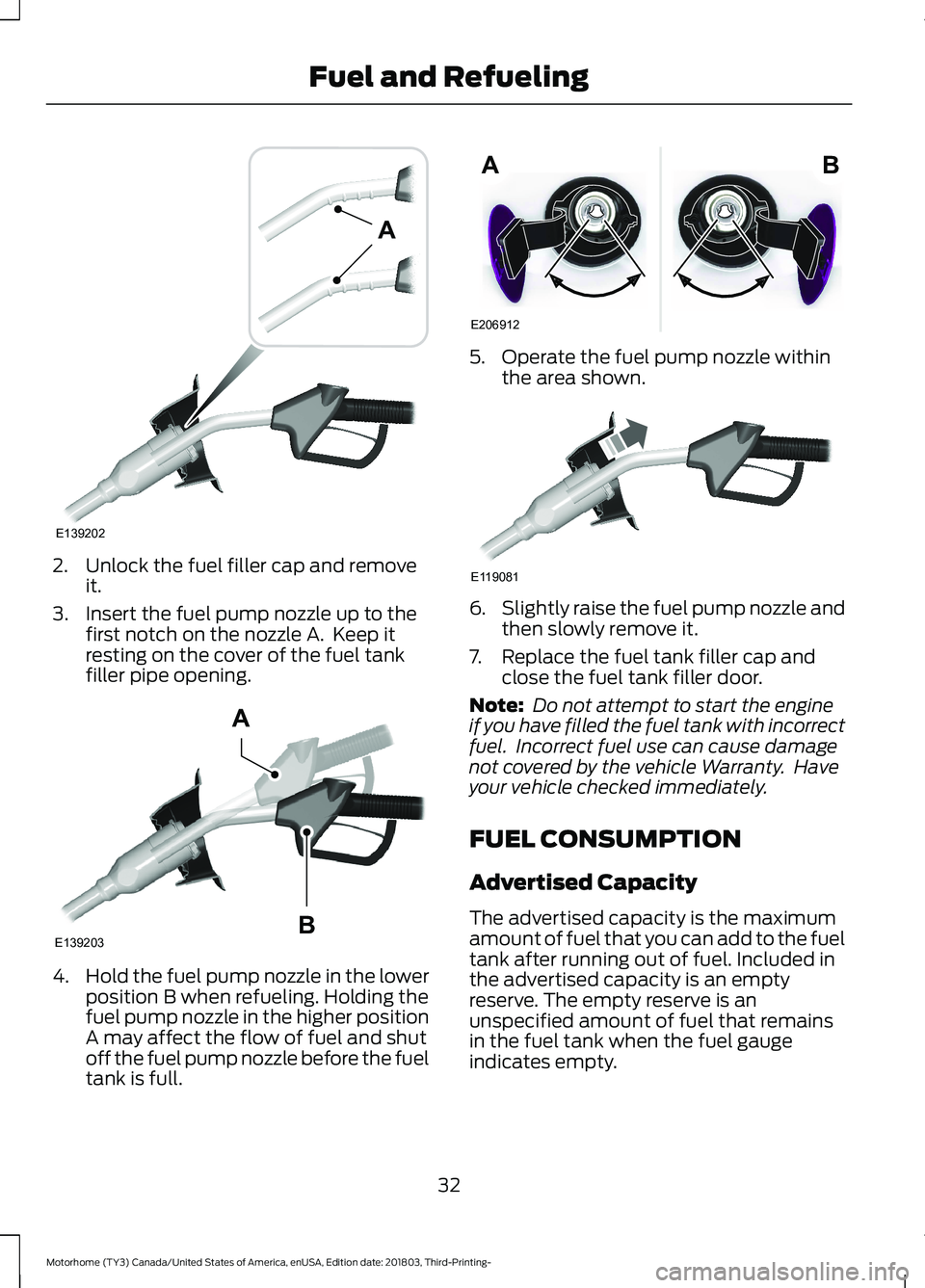
3.Insert the fuel pump nozzle up to thefirst notch on the nozzle A. Keep itresting on the cover of the fuel tankfiller pipe opening.
4.Hold the fuel pump nozzle in the lowerposition B when refueling. Holding thefuel pump nozzle in the higher positionA may affect the flow of fuel and shutoff the fuel pump nozzle before the fueltank is full.
5.Operate the fuel pump nozzle withinthe area shown.
6.Slightly raise the fuel pump nozzle andthen slowly remove it.
7.Replace the fuel tank filler cap andclose the fuel tank filler door.
Note: Do not attempt to start the engineif you have filled the fuel tank with incorrectfuel. Incorrect fuel use can cause damagenot covered by the vehicle Warranty. Haveyour vehicle checked immediately.
FUEL CONSUMPTION
Advertised Capacity
The advertised capacity is the maximumamount of fuel that you can add to the fueltank after running out of fuel. Included inthe advertised capacity is an emptyreserve. The empty reserve is anunspecified amount of fuel that remainsin the fuel tank when the fuel gaugeindicates empty.
32
Motorhome (TY3) Canada/United States of America, enUSA, Edition date: 201803, Third-Printing-Fuel and RefuelingE139202A E139203AB E206912AB E119081
Page 41 of 176
AUTOMATIC TRANSMISSION
WARNING: Always set the parkingbrake fully and make sure you shift thegearshift lever to first gear. Switch theignition off and remove the key wheneveryou leave your vehicle.
WARNING: Do not apply the brakepedal and accelerator pedalsimultaneously. Applying both pedalssimultaneously for more than a fewseconds will limit engine performance,which may result in difficulty maintainingspeed in traffic and could lead to seriousinjury.
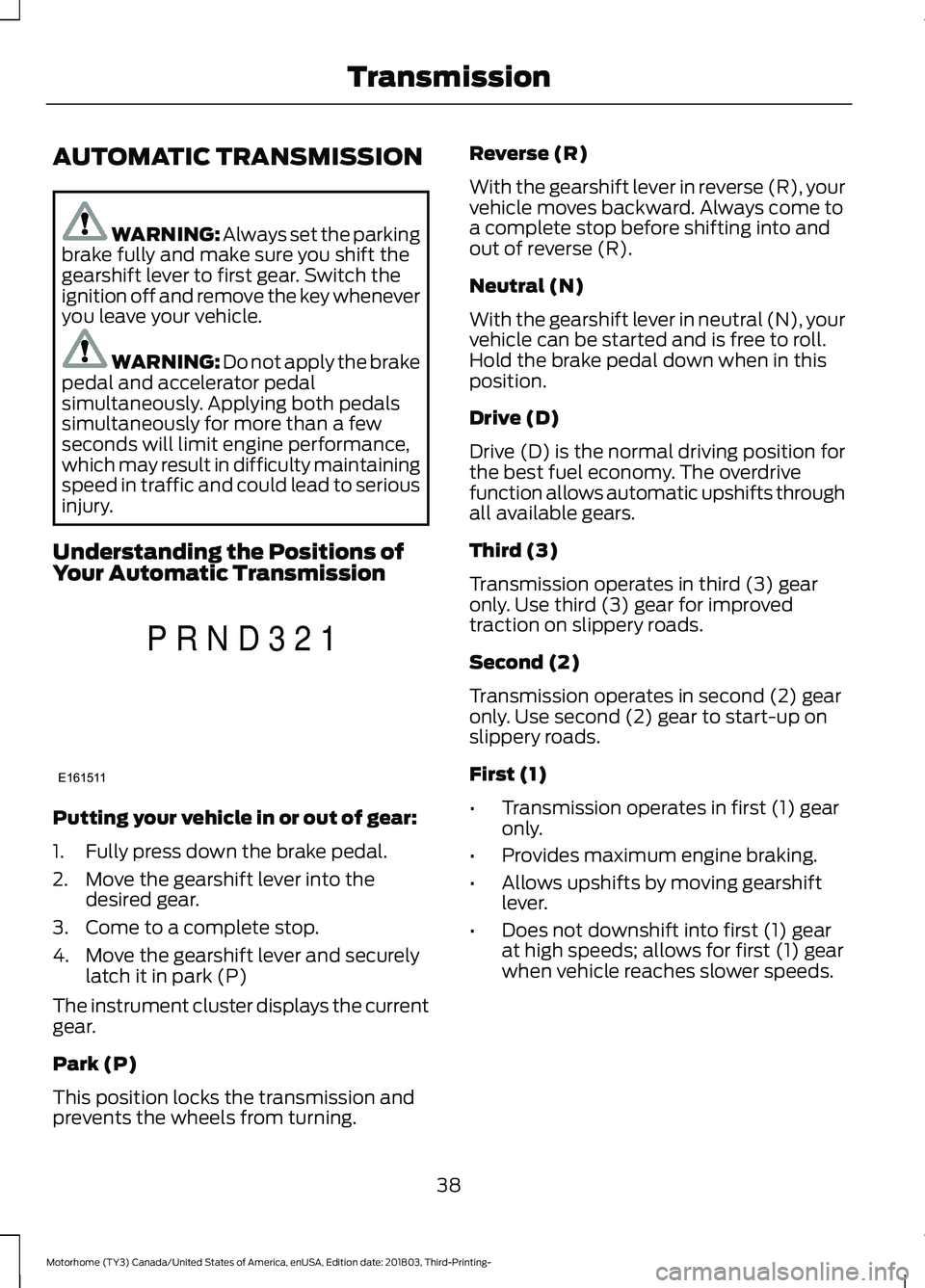
Understanding the Positions ofYour Automatic Transmission
Putting your vehicle in or out of gear:
1.Fully press down the brake pedal.
2.Move the gearshift lever into thedesired gear.
3.Come to a complete stop.
4.Move the gearshift lever and securelylatch it in park (P)
The instrument cluster displays the currentgear.
Park (P)
This position locks the transmission andprevents the wheels from turning.
Reverse (R)
With the gearshift lever in reverse (R), yourvehicle moves backward. Always come toa complete stop before shifting into andout of reverse (R).
Neutral (N)
With the gearshift lever in neutral (N), yourvehicle can be started and is free to roll.Hold the brake pedal down when in thisposition.
Drive (D)
Drive (D) is the normal driving position forthe best fuel economy. The overdrivefunction allows automatic upshifts throughall available gears.
Third (3)
Transmission operates in third (3) gearonly. Use third (3) gear for improvedtraction on slippery roads.
Second (2)
Transmission operates in second (2) gearonly. Use second (2) gear to start-up onslippery roads.
First (1)
•Transmission operates in first (1) gearonly.
•Provides maximum engine braking.
•Allows upshifts by moving gearshiftlever.
•Does not downshift into first (1) gearat high speeds; allows for first (1) gearwhen vehicle reaches slower speeds.
38
Motorhome (TY3) Canada/United States of America, enUSA, Edition date: 201803, Third-Printing-TransmissionE161511PRND321
Page 43 of 176
Brake-Shift Interlock
WARNING: Do not drive yourvehicle until you verify that thestoplamps are working.
WARNING: When doing thisprocedure, you need to take thetransmission out of park (P) whichmeans your vehicle can roll freely. Toavoid unwanted vehicle movement,always fully apply the parking brake priorto doing this procedure. Use wheelschocks if appropriate.
WARNING: If the parking brake isfully released, but the brake warninglamp remains illuminated, the brakesmay not be working properly. Have yourvehicle checked as soon as possible.
Your vehicle is equipped with a brake-shiftinterlock feature that prevents moving thegearshift lever from park (P) when theignition is in the on position and the brakepedal is not pressed.
If you cannot move the gearshift lever outof park (P) position with the ignition in theon position and the brake pedal pressed,a malfunction may have occurred. It ispossible that a fuse has blown or yourvehicle’s brake lamps are not operatingproperly. See Fuse Specification Chart(page 71).
If the fuse is not blown and the brakelamps are working properly, the followingprocedure can allow you to move thegearshift lever from park (P):
1.Apply the parking brake. Turn key tothe lock position, and then remove thekey.
2.Disconnect the negative black batterycable from the battery.
3.Insert the key and turn to the offposition. Shift the transmission toneutral (N).
4.Reconnect the negative black batterycable to the battery.
5.Start the vehicle.
Note:See your authorized dealer as soonas possible if this procedure is used.
If Your Vehicle Gets Stuck In Mudor Snow
Note:Do not rock your vehicle if the engineis not at normal operating temperature ordamage to the transmission may occur.
Note:Do not rock your vehicle for morethan a minute or damage to thetransmission and tires may occur, or theengine may overheat.
If your vehicle gets stuck in mud or snow,you may rock it out by shifting betweenforward and reverse gears, stoppingbetween shifts in a steady pattern. Presslightly on the accelerator in each gear.
40
Motorhome (TY3) Canada/United States of America, enUSA, Edition date: 201803, Third-Printing-Transmission
Page 44 of 176
GENERAL INFORMATION
Note: Occasional brake noise is normal. Ifa metal-to-metal, continuous grinding orcontinuous squeal sound is present, thebrake linings may be worn-out and shouldbe inspected by an authorized dealer. If thevehicle has continuous vibration or shudderin the steering wheel while braking, thevehicle should be inspected by anauthorized dealer.
Note:Brake dust may accumulate on thewheels, even under normal drivingconditions. Some dust is inevitable as thebrakes wear and does not contribute tobrake noise. See Cleaning the Wheels(page 110).
Note:Indicators vary depending on region.
See Warning Lamps andIndicators (page 18).
Wet brakes result in reduced brakingefficiency. Gently press the brake pedal afew times when driving from a car wash orstanding water to dry the brakes.
Brake Over Accelerator
In the event the accelerator pedalbecomes stuck or entrapped, apply steadyand firm pressure to the brake pedal toslow the vehicle and reduce engine power.If you experience this condition, apply thebrakes and bring your vehicle to a safestop. Switch the engine off, shift thetransmission into park (P), apply theparking brake, and then inspect theaccelerator pedal for any interferences. Ifnone are found and the condition persists,have your vehicle towed to the nearestauthorized dealer.
Hydraulic brake booster system(Hydroboost or Hydromax)
The Hydroboost and Hydromax systemsreceive fluid pressure from the powersteering pump to provide power assistduring braking.
The Hydromax booster receives backuppressure from the reserve system electricpump whenever the fluid in the powersteering system is not flowing. When theengine is off, the pump turns on if you applythe brake pedal, or if you switch the ignitionto the on position.
The sound of the pump operating may beheard by the driver. This is a normalcharacteristic of the system.
The reserve system provides reducedbraking power, so the vehicle should beoperated under these conditions withcaution, and only to seek service repair andremoval of the vehicle from the roadway.
Note:For vehicles with the Hydromaxsystem operating under normal conditions,the noise of the fluid flowing through thebooster may be heard whenever you applythe brake. This condition is normal. Vehicleservice is not required.
If braking performance or pedal responsebecomes very poor, even when youstrongly press the pedal, it may indicatethe presence of air in the hydraulic systemor leakage of fluid. Stop the vehicle safelyas soon as possible and seek serviceimmediately.
HINTS ON DRIVING WITH
ANTI-LOCK BRAKES
The anti-lock braking system does noteliminate the risks when:
•You drive too closely to the vehicle infront of you.
•Your vehicle is hydroplaning.
41
Motorhome (TY3) Canada/United States of America, enUSA, Edition date: 201803, Third-Printing-BrakesE144522
Page 56 of 176
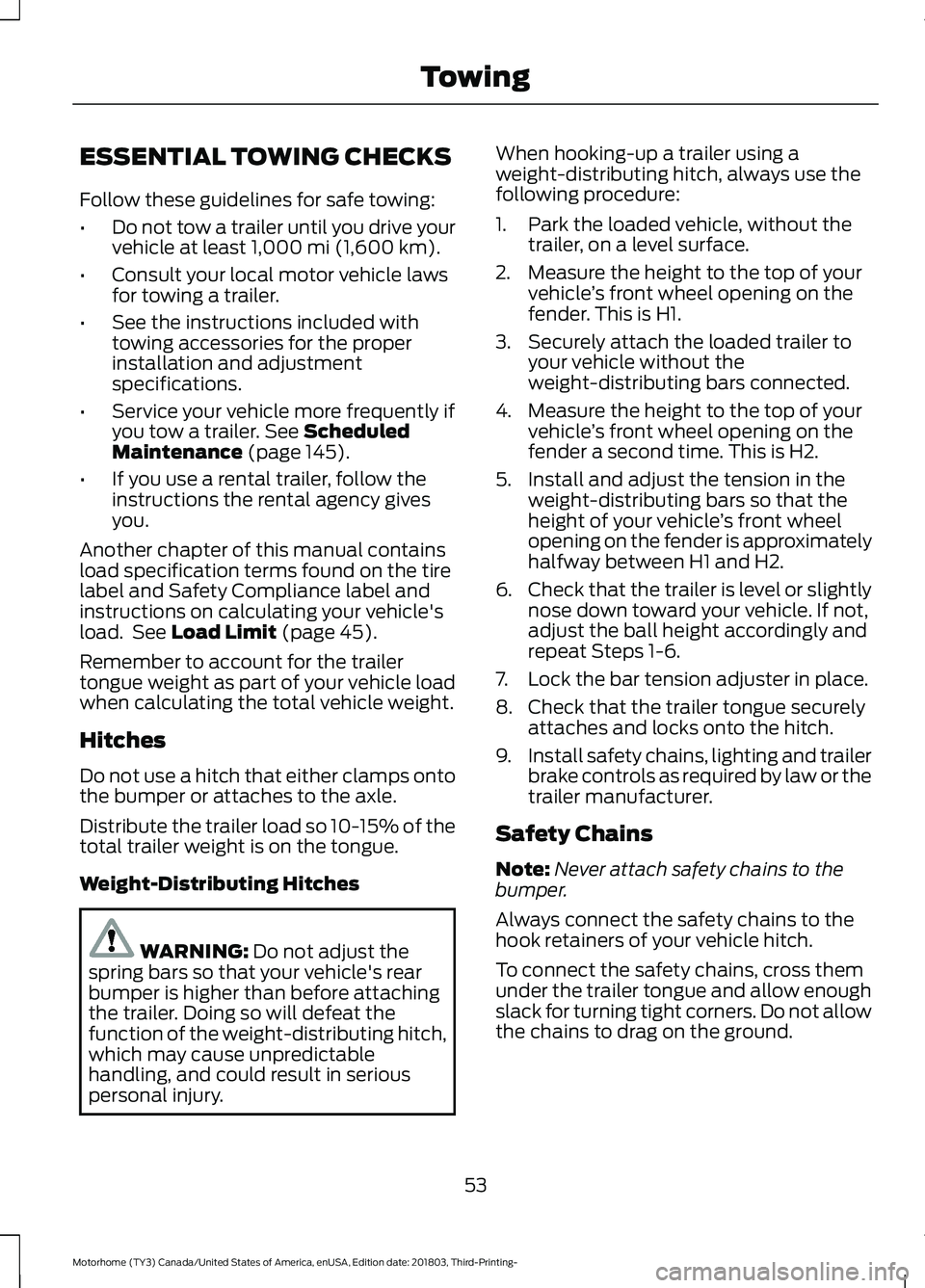
ESSENTIAL TOWING CHECKS
Follow these guidelines for safe towing:
•Do not tow a trailer until you drive yourvehicle at least 1,000 mi (1,600 km).
•Consult your local motor vehicle lawsfor towing a trailer.
•See the instructions included withtowing accessories for the properinstallation and adjustmentspecifications.
•Service your vehicle more frequently ifyou tow a trailer. See ScheduledMaintenance (page 145).
•If you use a rental trailer, follow theinstructions the rental agency givesyou.
Another chapter of this manual containsload specification terms found on the tirelabel and Safety Compliance label andinstructions on calculating your vehicle'sload. See Load Limit (page 45).
Remember to account for the trailertongue weight as part of your vehicle loadwhen calculating the total vehicle weight.
Hitches
Do not use a hitch that either clamps ontothe bumper or attaches to the axle.
Distribute the trailer load so 10-15% of thetotal trailer weight is on the tongue.
Weight-Distributing Hitches
WARNING: Do not adjust thespring bars so that your vehicle's rearbumper is higher than before attachingthe trailer. Doing so will defeat thefunction of the weight-distributing hitch,which may cause unpredictablehandling, and could result in seriouspersonal injury.
When hooking-up a trailer using aweight-distributing hitch, always use thefollowing procedure:
1.Park the loaded vehicle, without thetrailer, on a level surface.
2.Measure the height to the top of yourvehicle’s front wheel opening on thefender. This is H1.
3.Securely attach the loaded trailer toyour vehicle without theweight-distributing bars connected.
4.Measure the height to the top of yourvehicle’s front wheel opening on thefender a second time. This is H2.
5.Install and adjust the tension in theweight-distributing bars so that theheight of your vehicle’s front wheelopening on the fender is approximatelyhalfway between H1 and H2.
6.Check that the trailer is level or slightlynose down toward your vehicle. If not,adjust the ball height accordingly andrepeat Steps 1-6.
7.Lock the bar tension adjuster in place.
8.Check that the trailer tongue securelyattaches and locks onto the hitch.
9.Install safety chains, lighting and trailerbrake controls as required by law or thetrailer manufacturer.
Safety Chains
Note:Never attach safety chains to thebumper.
Always connect the safety chains to thehook retainers of your vehicle hitch.
To connect the safety chains, cross themunder the trailer tongue and allow enoughslack for turning tight corners. Do not allowthe chains to drag on the ground.
53
Motorhome (TY3) Canada/United States of America, enUSA, Edition date: 201803, Third-Printing-Towing
Page 58 of 176
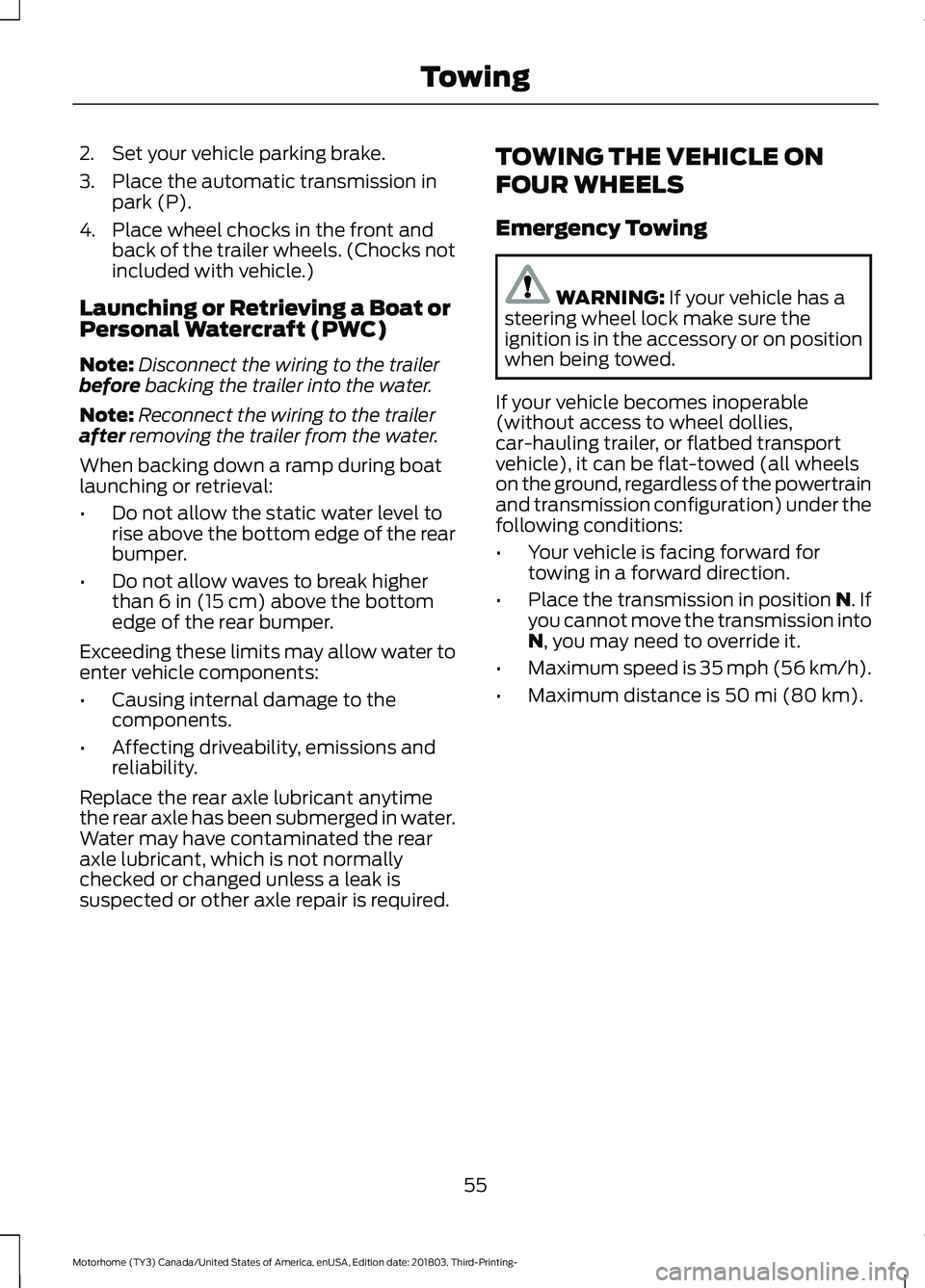
2.Set your vehicle parking brake.
3.Place the automatic transmission inpark (P).
4.Place wheel chocks in the front andback of the trailer wheels. (Chocks notincluded with vehicle.)
Launching or Retrieving a Boat orPersonal Watercraft (PWC)
Note:Disconnect the wiring to the trailerbefore backing the trailer into the water.
Note:Reconnect the wiring to the trailerafter removing the trailer from the water.
When backing down a ramp during boatlaunching or retrieval:
•Do not allow the static water level torise above the bottom edge of the rearbumper.
•Do not allow waves to break higherthan 6 in (15 cm) above the bottomedge of the rear bumper.
Exceeding these limits may allow water toenter vehicle components:
•Causing internal damage to thecomponents.
•Affecting driveability, emissions andreliability.
Replace the rear axle lubricant anytimethe rear axle has been submerged in water.Water may have contaminated the rearaxle lubricant, which is not normallychecked or changed unless a leak issuspected or other axle repair is required.
TOWING THE VEHICLE ON
FOUR WHEELS
Emergency Towing
WARNING: If your vehicle has asteering wheel lock make sure theignition is in the accessory or on positionwhen being towed.
If your vehicle becomes inoperable(without access to wheel dollies,car-hauling trailer, or flatbed transportvehicle), it can be flat-towed (all wheelson the ground, regardless of the powertrainand transmission configuration) under thefollowing conditions:
•Your vehicle is facing forward fortowing in a forward direction.
•Place the transmission in position N. Ifyou cannot move the transmission intoN, you may need to override it.
•Maximum speed is 35 mph (56 km/h).
•Maximum distance is 50 mi (80 km).
55
Motorhome (TY3) Canada/United States of America, enUSA, Edition date: 201803, Third-Printing-Towing
Page 62 of 176
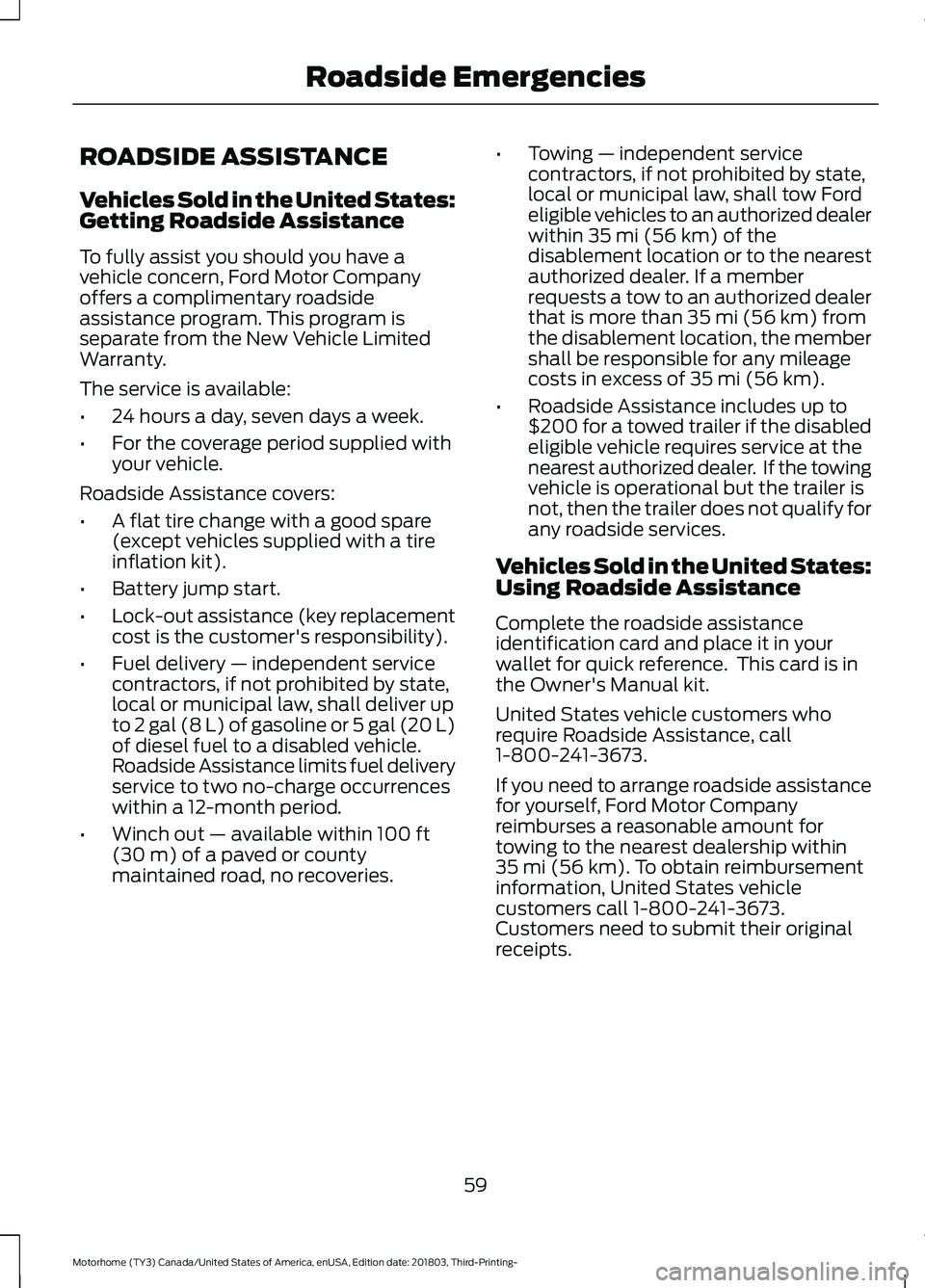
ROADSIDE ASSISTANCE
Vehicles Sold in the United States:Getting Roadside Assistance
To fully assist you should you have avehicle concern, Ford Motor Companyoffers a complimentary roadsideassistance program. This program isseparate from the New Vehicle LimitedWarranty.
The service is available:
•24 hours a day, seven days a week.
•For the coverage period supplied withyour vehicle.
Roadside Assistance covers:
•A flat tire change with a good spare(except vehicles supplied with a tireinflation kit).
•Battery jump start.
•Lock-out assistance (key replacementcost is the customer's responsibility).
•Fuel delivery — independent servicecontractors, if not prohibited by state,local or municipal law, shall deliver upto 2 gal (8 L) of gasoline or 5 gal (20 L)of diesel fuel to a disabled vehicle.Roadside Assistance limits fuel deliveryservice to two no-charge occurrenceswithin a 12-month period.
•Winch out — available within 100 ft(30 m) of a paved or countymaintained road, no recoveries.
•Towing — independent servicecontractors, if not prohibited by state,local or municipal law, shall tow Fordeligible vehicles to an authorized dealerwithin 35 mi (56 km) of thedisablement location or to the nearestauthorized dealer. If a memberrequests a tow to an authorized dealerthat is more than 35 mi (56 km) fromthe disablement location, the membershall be responsible for any mileagecosts in excess of 35 mi (56 km).
•Roadside Assistance includes up to$200 for a towed trailer if the disabledeligible vehicle requires service at thenearest authorized dealer. If the towingvehicle is operational but the trailer isnot, then the trailer does not qualify forany roadside services.
Vehicles Sold in the United States:Using Roadside Assistance
Complete the roadside assistanceidentification card and place it in yourwallet for quick reference. This card is inthe Owner's Manual kit.
United States vehicle customers whorequire Roadside Assistance, call1-800-241-3673.
If you need to arrange roadside assistancefor yourself, Ford Motor Companyreimburses a reasonable amount fortowing to the nearest dealership within35 mi (56 km). To obtain reimbursementinformation, United States vehiclecustomers call 1-800-241-3673.Customers need to submit their originalreceipts.
59
Motorhome (TY3) Canada/United States of America, enUSA, Edition date: 201803, Third-Printing-Roadside Emergencies
Page 75 of 176
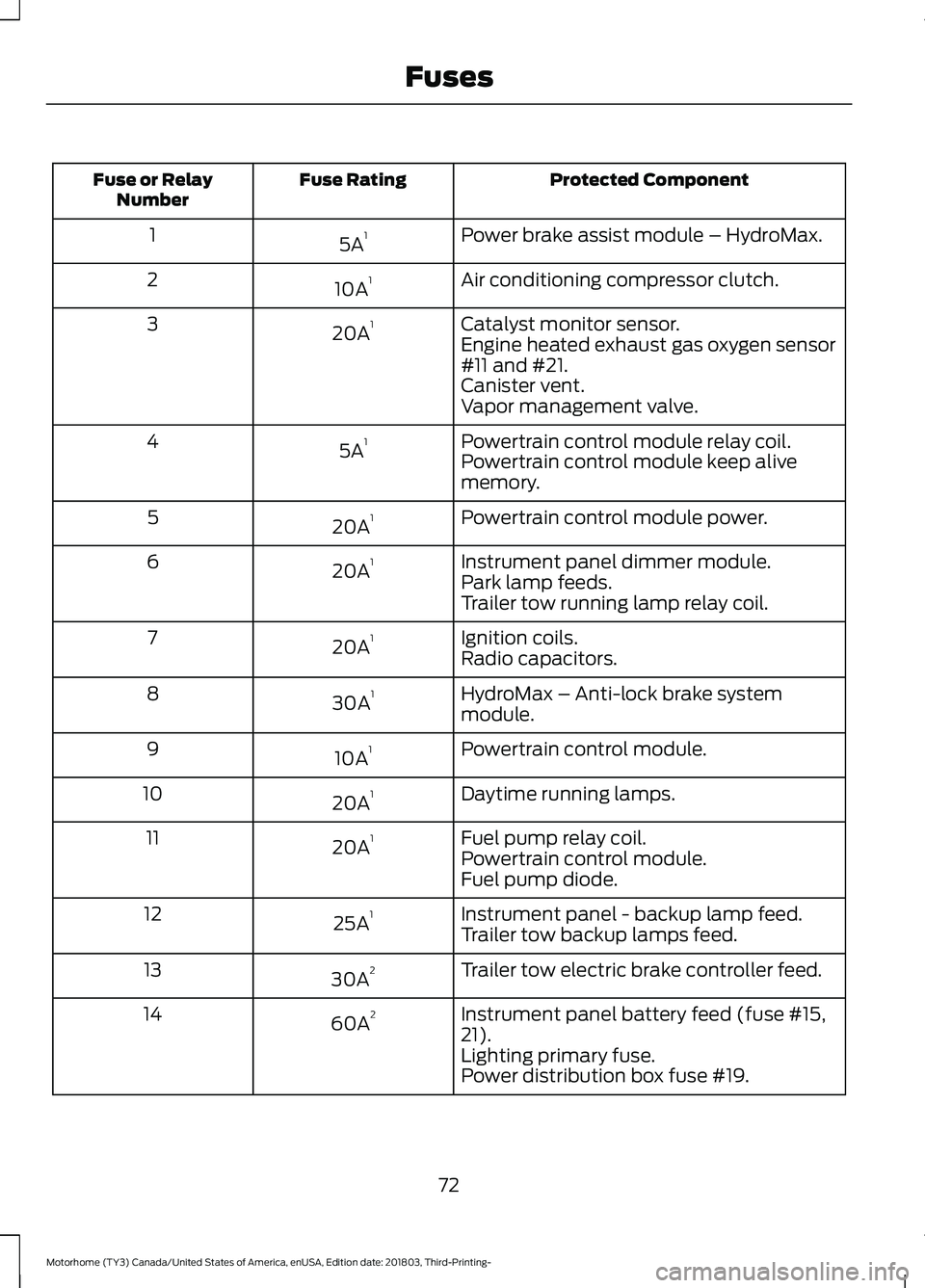
Protected ComponentFuse RatingFuse or RelayNumber
Power brake assist module – HydroMax.5A11
Air conditioning compressor clutch.10A12
Catalyst monitor sensor.20A13Engine heated exhaust gas oxygen sensor#11 and #21.Canister vent.Vapor management valve.
Powertrain control module relay coil.5A14Powertrain control module keep alivememory.
Powertrain control module power.20A15
Instrument panel dimmer module.20A16Park lamp feeds.Trailer tow running lamp relay coil.
Ignition coils.20A17Radio capacitors.
HydroMax – Anti-lock brake systemmodule.30A18
Powertrain control module.10A19
Daytime running lamps.20A110
Fuel pump relay coil.20A111Powertrain control module.Fuel pump diode.
Instrument panel - backup lamp feed.25A112Trailer tow backup lamps feed.
Trailer tow electric brake controller feed.30A213
Instrument panel battery feed (fuse #15,21).60A214
Lighting primary fuse.Power distribution box fuse #19.
72
Motorhome (TY3) Canada/United States of America, enUSA, Edition date: 201803, Third-Printing-Fuses
Page 76 of 176
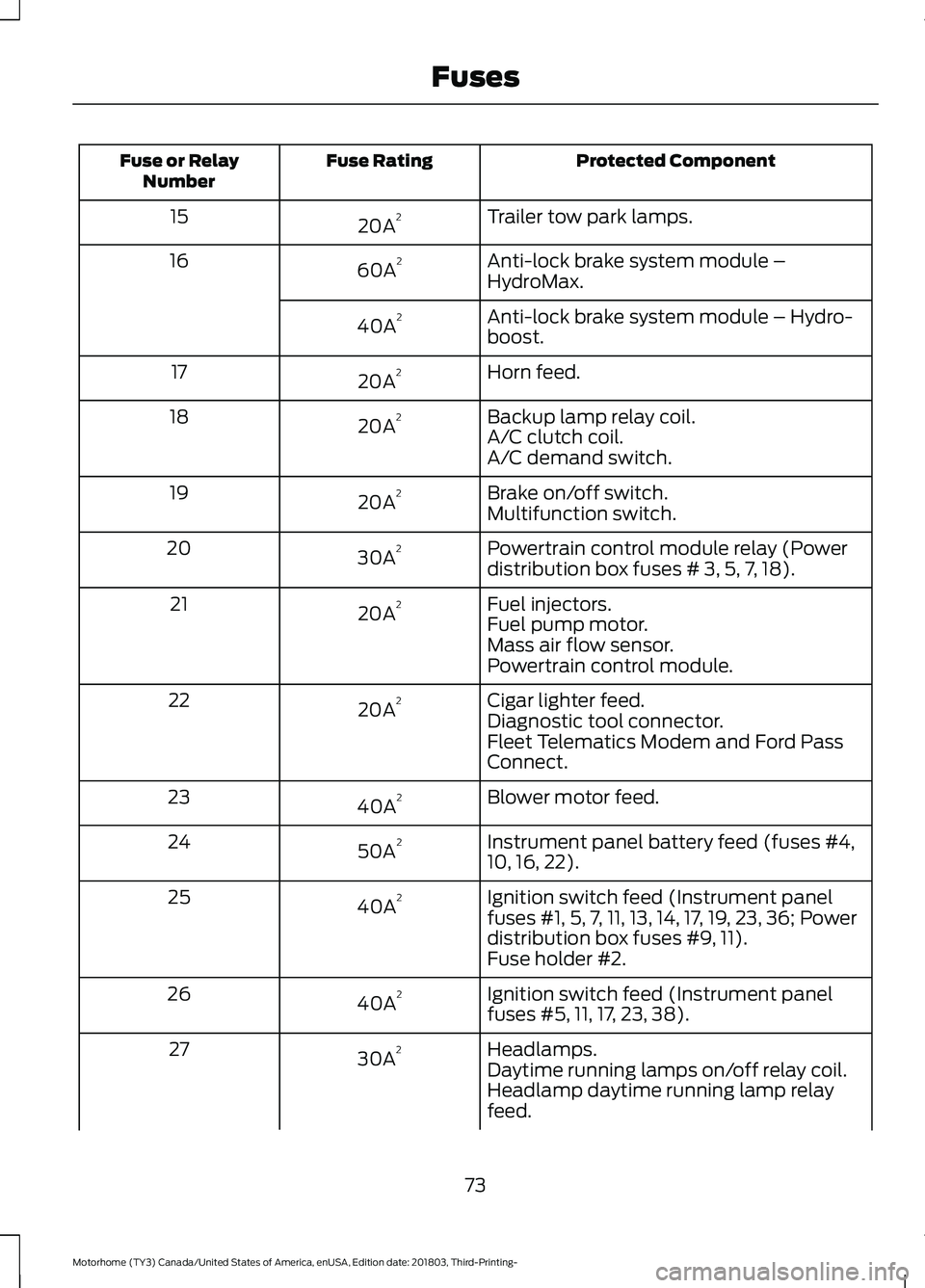
Protected ComponentFuse RatingFuse or RelayNumber
Trailer tow park lamps.20A215
Anti-lock brake system module –HydroMax.60A216
Anti-lock brake system module – Hydro-boost.40A2
Horn feed.20A217
Backup lamp relay coil.20A218A/C clutch coil.A/C demand switch.
Brake on/off switch.20A219Multifunction switch.
Powertrain control module relay (Powerdistribution box fuses # 3, 5, 7, 18).30A220
Fuel injectors.20A221Fuel pump motor.Mass air flow sensor.Powertrain control module.
Cigar lighter feed.20A222Diagnostic tool connector.Fleet Telematics Modem and Ford PassConnect.
Blower motor feed.40A223
Instrument panel battery feed (fuses #4,10, 16, 22).50A224
Ignition switch feed (Instrument panelfuses #1, 5, 7, 11, 13, 14, 17, 19, 23, 36; Powerdistribution box fuses #9, 11).
40A225
Fuse holder #2.
Ignition switch feed (Instrument panelfuses #5, 11, 17, 23, 38).40A226
Headlamps.30A227Daytime running lamps on/off relay coil.Headlamp daytime running lamp relayfeed.
73
Motorhome (TY3) Canada/United States of America, enUSA, Edition date: 201803, Third-Printing-Fuses
Page 77 of 176
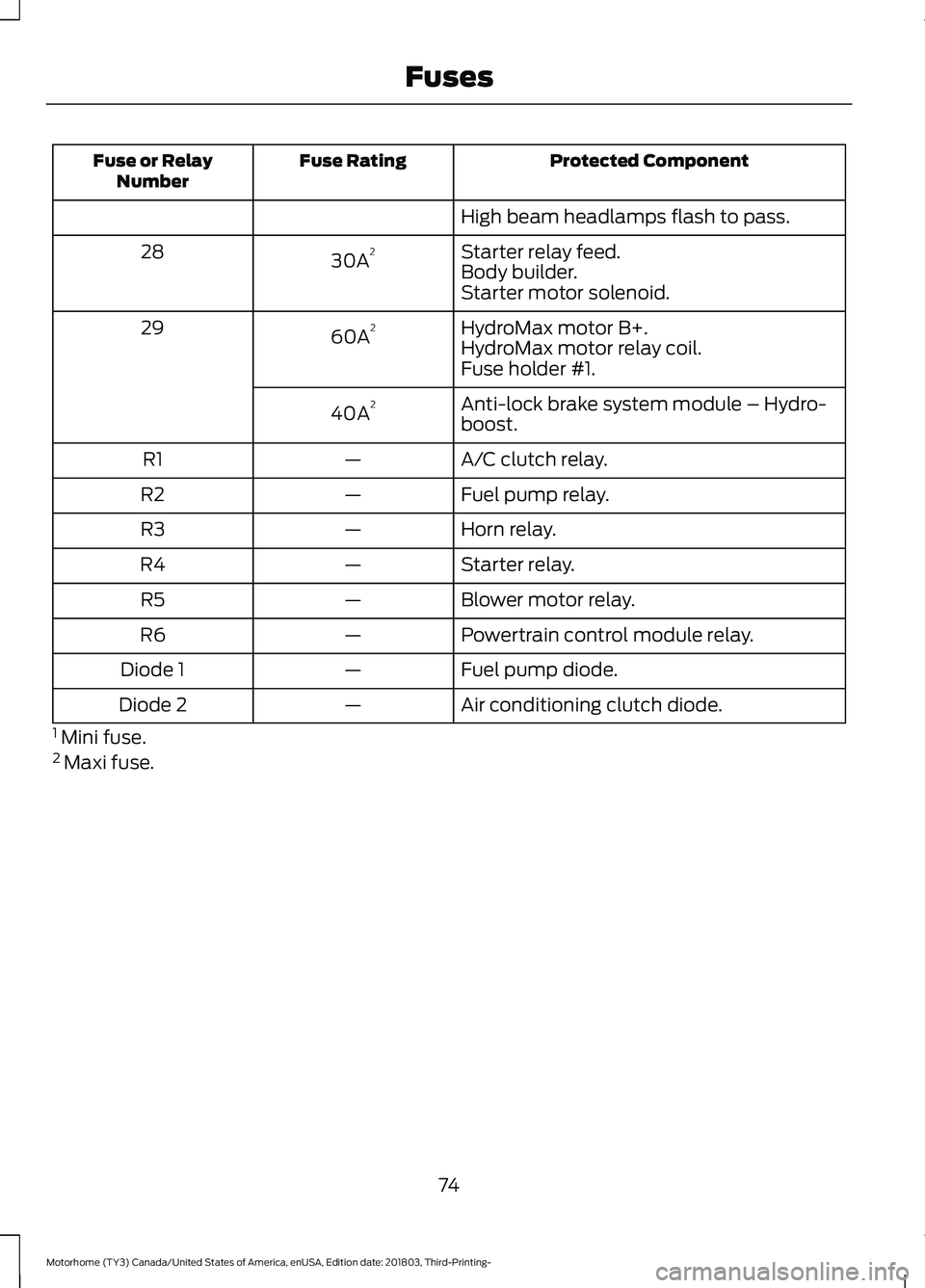
Protected ComponentFuse RatingFuse or RelayNumber
High beam headlamps flash to pass.
Starter relay feed.30A228Body builder.Starter motor solenoid.
HydroMax motor B+.60A229HydroMax motor relay coil.Fuse holder #1.
Anti-lock brake system module – Hydro-boost.40A2
A/C clutch relay.—R1
Fuel pump relay.—R2
Horn relay.—R3
Starter relay.—R4
Blower motor relay.—R5
Powertrain control module relay.—R6
Fuel pump diode.—Diode 1
Air conditioning clutch diode.—Diode 2
1 Mini fuse.2 Maxi fuse.
74
Motorhome (TY3) Canada/United States of America, enUSA, Edition date: 201803, Third-Printing-Fuses