transmission FORD F-59 2019 Owners Manual
[x] Cancel search | Manufacturer: FORD, Model Year: 2019, Model line: F-59, Model: FORD F-59 2019Pages: 176, PDF Size: 9.98 MB
Page 4 of 176
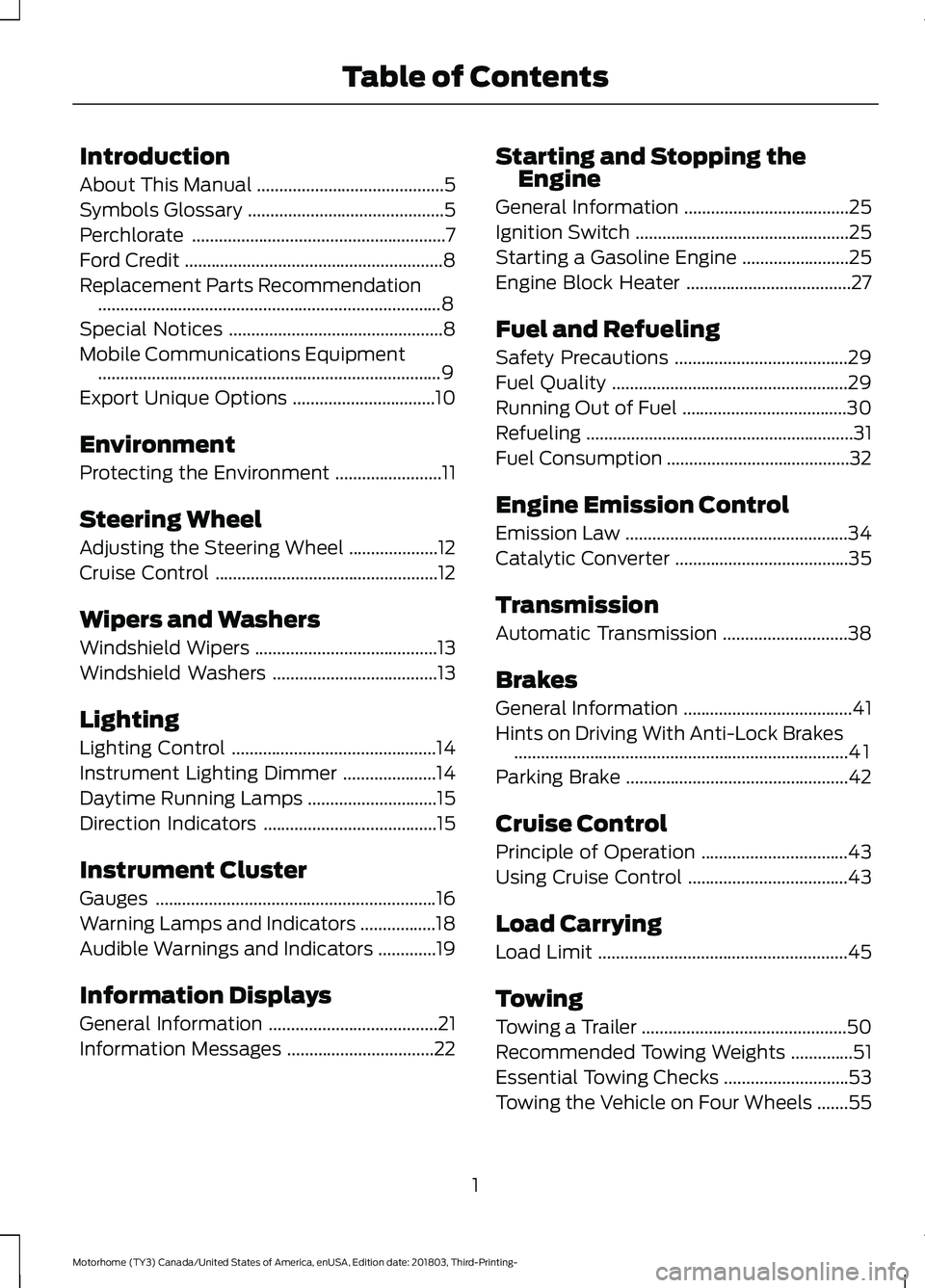
Introduction
About This Manual..........................................5
Symbols Glossary............................................5
Perchlorate.........................................................7
Ford Credit..........................................................8
Replacement Parts Recommendation.............................................................................8
Special Notices................................................8
Mobile Communications Equipment.............................................................................9
Export Unique Options................................10
Environment
Protecting the Environment........................11
Steering Wheel
Adjusting the Steering Wheel....................12
Cruise Control..................................................12
Wipers and Washers
Windshield Wipers.........................................13
Windshield Washers.....................................13
Lighting
Lighting Control..............................................14
Instrument Lighting Dimmer.....................14
Daytime Running Lamps.............................15
Direction Indicators.......................................15
Instrument Cluster
Gauges...............................................................16
Warning Lamps and Indicators.................18
Audible Warnings and Indicators.............19
Information Displays
General Information......................................21
Information Messages.................................22
Starting and Stopping theEngine
General Information.....................................25
Ignition Switch................................................25
Starting a Gasoline Engine........................25
Engine Block Heater.....................................27
Fuel and Refueling
Safety Precautions.......................................29
Fuel Quality.....................................................29
Running Out of Fuel.....................................30
Refueling............................................................31
Fuel Consumption.........................................32
Engine Emission Control
Emission Law..................................................34
Catalytic Converter.......................................35
Transmission
Automatic Transmission............................38
Brakes
General Information......................................41
Hints on Driving With Anti-Lock Brakes...........................................................................41
Parking Brake..................................................42
Cruise Control
Principle of Operation.................................43
Using Cruise Control....................................43
Load Carrying
Load Limit........................................................45
Towing
Towing a Trailer..............................................50
Recommended Towing Weights..............51
Essential Towing Checks............................53
Towing the Vehicle on Four Wheels.......55
1
Motorhome (TY3) Canada/United States of America, enUSA, Edition date: 201803, Third-Printing-Table of Contents
Page 5 of 176
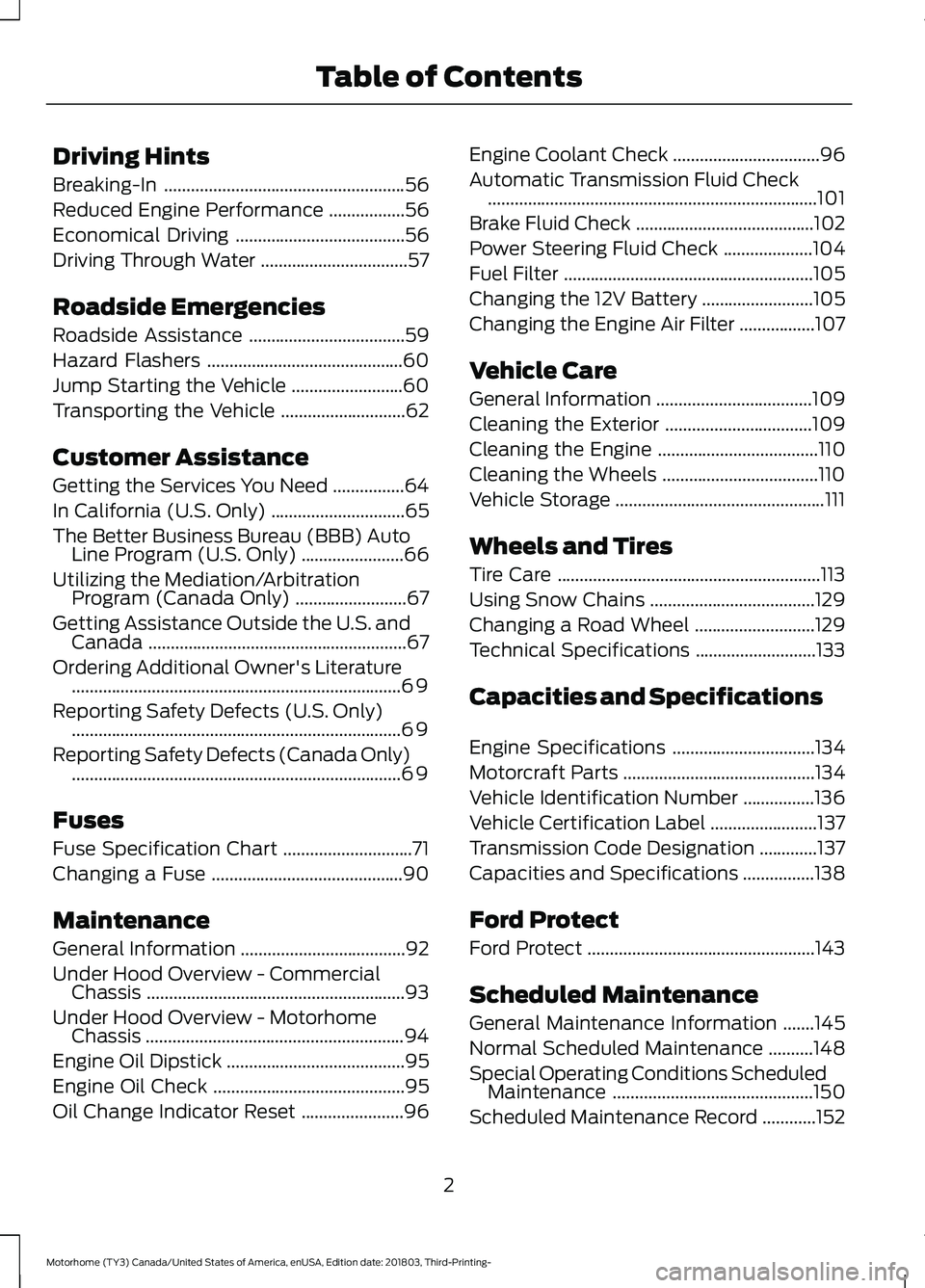
Driving Hints
Breaking-In......................................................56
Reduced Engine Performance.................56
Economical Driving......................................56
Driving Through Water.................................57
Roadside Emergencies
Roadside Assistance...................................59
Hazard Flashers............................................60
Jump Starting the Vehicle.........................60
Transporting the Vehicle............................62
Customer Assistance
Getting the Services You Need................64
In California (U.S. Only)..............................65
The Better Business Bureau (BBB) AutoLine Program (U.S. Only).......................66
Utilizing the Mediation/ArbitrationProgram (Canada Only).........................67
Getting Assistance Outside the U.S. andCanada..........................................................67
Ordering Additional Owner's Literature..........................................................................69
Reporting Safety Defects (U.S. Only)..........................................................................69
Reporting Safety Defects (Canada Only)..........................................................................69
Fuses
Fuse Specification Chart.............................71
Changing a Fuse...........................................90
Maintenance
General Information.....................................92
Under Hood Overview - CommercialChassis..........................................................93
Under Hood Overview - MotorhomeChassis..........................................................94
Engine Oil Dipstick........................................95
Engine Oil Check...........................................95
Oil Change Indicator Reset.......................96
Engine Coolant Check.................................96
Automatic Transmission Fluid Check..........................................................................101
Brake Fluid Check........................................102
Power Steering Fluid Check....................104
Fuel Filter........................................................105
Changing the 12V Battery.........................105
Changing the Engine Air Filter.................107
Vehicle Care
General Information...................................109
Cleaning the Exterior.................................109
Cleaning the Engine....................................110
Cleaning the Wheels...................................110
Vehicle Storage...............................................111
Wheels and Tires
Tire Care...........................................................113
Using Snow Chains.....................................129
Changing a Road Wheel...........................129
Technical Specifications...........................133
Capacities and Specifications
Engine Specifications................................134
Motorcraft Parts...........................................134
Vehicle Identification Number................136
Vehicle Certification Label........................137
Transmission Code Designation.............137
Capacities and Specifications................138
Ford Protect
Ford Protect...................................................143
Scheduled Maintenance
General Maintenance Information.......145
Normal Scheduled Maintenance..........148
Special Operating Conditions ScheduledMaintenance.............................................150
Scheduled Maintenance Record............152
2
Motorhome (TY3) Canada/United States of America, enUSA, Edition date: 201803, Third-Printing-Table of Contents
Page 12 of 176
WARNING: NEVER use a rearwardfacing child restraint on a seat protectedby an ACTIVE AIRBAG in front of it,DEATH or SERIOUS INJURY to the CHILDcan occur.
Fleet Telematics Modem (If Equipped)
The onboard modem provides access todata to support telematics services suchas location, speed, idle time, fuel, vehiclediagnostics and maintenance alerts. Toexplore data, telematics services, thirdparty service provider support and tomanage existing telematics accounts, referto www.commericalsolutions.ford.com orcall 833-FCS-FORD.
Note:This is not available with FordPassConnect.
FordPass Connect (If Equipped)
With a FordPass-equipped vehicle, you canuse FordPass to track your vehicle’slocation and remotely access vehiclefeatures such as start, lock and unlock andvehicle status including fuel level andapproximate mileage. Message and datarates may apply. Services may be limitedby mobile phone network coverage area.For additional information, refer towww.fordpass.com.
On Board Diagnostics Data LinkConnector
WARNING: Do not connectwireless plug-in devices to the data linkconnector. Unauthorized third partiescould gain access to vehicle data andimpair the performance of safety relatedsystems. Only allow repair facilities thatfollow our service and repair instructionsto connect their equipment to the datalink connector.
Your vehicle has an OBD Data LinkConnector (DLC) that is used inconjunction with a diagnostic scan tool forvehicle diagnostics, repairs andreprogramming services. Installing anaftermarket device that uses the DLCduring normal driving for purposes such asremote insurance company monitoring,transmission of vehicle data to otherdevices or entities, or altering theperformance of the vehicle, may causeinterference with or even damage tovehicle systems. We do not recommendor endorse the use of aftermarket plug-indevices unless approved by Ford. Thevehicle Warranty will not cover damagecaused by an aftermarket plug-in device.
MOBILE COMMUNICATIONS
EQUIPMENT
WARNING: Driving whiledistracted can result in loss of vehiclecontrol, crash and injury. We stronglyrecommend that you use extremecaution when using any device that maytake your focus off the road. Yourprimary responsibility is the safeoperation of your vehicle. Werecommend against the use of any
9
Motorhome (TY3) Canada/United States of America, enUSA, Edition date: 201803, Third-Printing-Introduction
Page 19 of 176
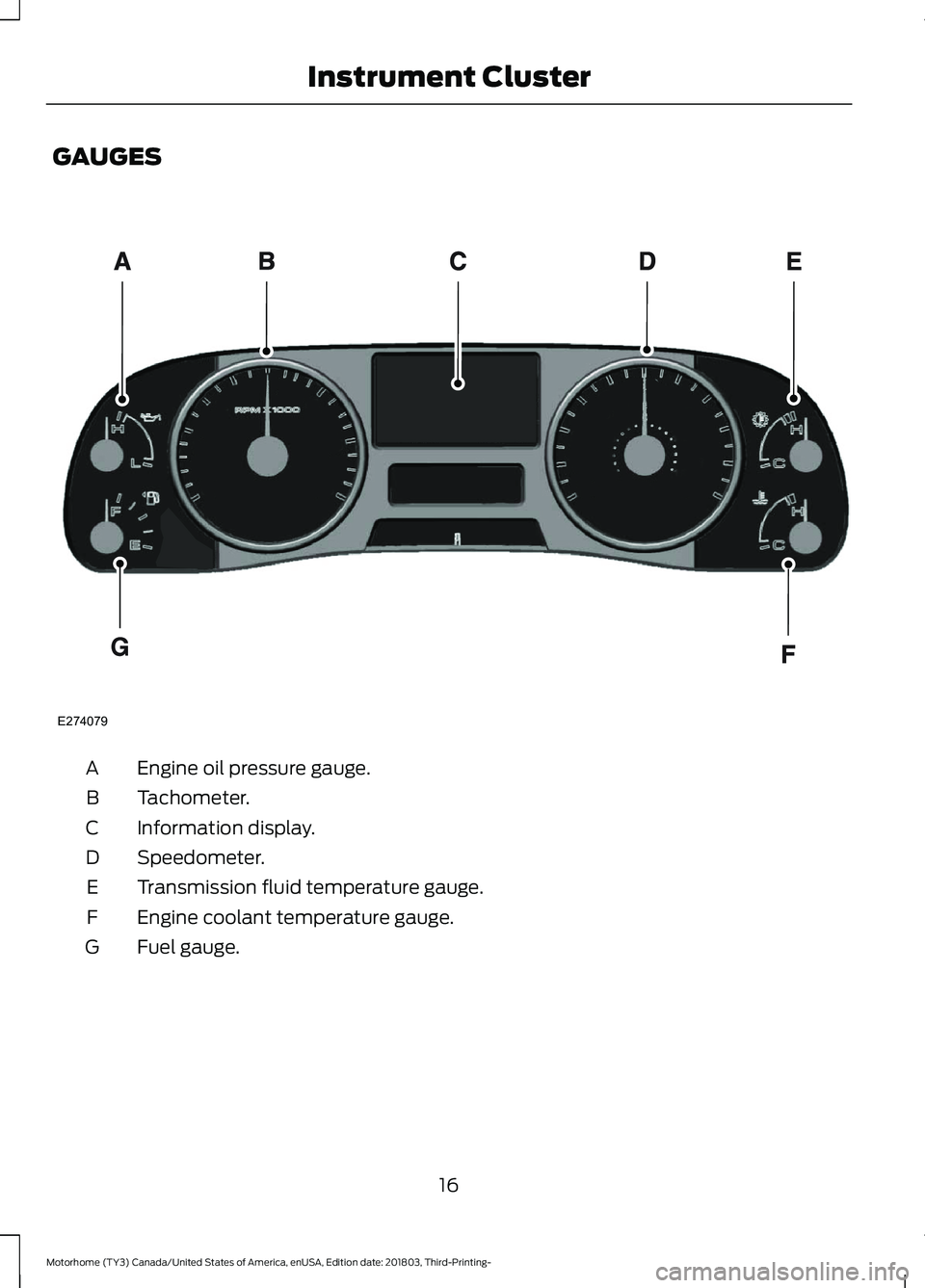
GAUGES
Engine oil pressure gauge.A
Tachometer.B
Information display.C
Speedometer.D
Transmission fluid temperature gauge.E
Engine coolant temperature gauge.F
Fuel gauge.G
16
Motorhome (TY3) Canada/United States of America, enUSA, Edition date: 201803, Third-Printing-Instrument ClusterE274079
Page 20 of 176
Engine Oil Pressure Gauge
Indicates engine oil pressure. At normaloperating temperature, the level indicatoris in the normal range. If the pressure gaugefalls below the normal range, stop yourvehicle, switch off the engine and checkthe engine oil level. Add oil if needed. If theoil level is correct, have your vehiclechecked by an authorized dealer.
Speedometer
Indicates vehicle speed. Vehicle speed islimited to either 65 mph (105 km/h) or75 mph (120 km/h).
Transmission Fluid TemperatureGauge
Normal area
The transmission fluid is within the normaloperating temperature (between H andC).
Yellow area
The transmission fluid is higher thannormal operating temperature. This canbe caused by special operation conditions(snowplowing, towing or off-road use).
To lower the transmission temperatureinto the normal range, alter the severity ofyour driving conditions. Operating thetransmission for extended periods with thegauge in the higher than normal area maycause internal transmission damage. If thegauge continues to show hightemperatures, see an authorized dealer.
Red area
The transmission fluid is overheating. Stopthe vehicle to allow the temperature toreturn to normal range.
If the gauge is operating in the yellow orred area, stop the vehicle and verify theairflow is not restricted such as snow ordebris blocking airflow through the grille.If the gauge continues to show hightemperatures, see your authorized dealer.
Engine Coolant TemperatureGauge
WARNING: Do not remove thecoolant reservoir cap when the coolingsystem is hot. Wait 10 minutes for thecooling system to cool down. Cover thecoolant reservoir cap with a thick clothto prevent the possibility of scalding andslowly remove the cap. Failure to followthis instruction could result in personalinjury.
Indicates engine coolant temperature. Atnormal operating temperature, the levelindicator is in the normal range. If theengine coolant temperature exceeds thenormal range, stop your vehicle as soon aspossible, switch off the engine and let theengine cool.
Fuel Gauge
The fuel gauge indicates about how muchfuel is in the fuel tank.
The arrow adjacent to the fuel pumpsymbol indicates on which side of yourvehicle the fuel filler door is located.
Note:The fuel gauge may vary slightlywhen your vehicle is moving or on a slope.
Low Fuel Reminder
A low fuel level reminder displays andsounds when the distance to emptyreaches 50 mi (80 km),25 mi (40 km),10 mi (20 km) and 0 mi (0 km).
17
Motorhome (TY3) Canada/United States of America, enUSA, Edition date: 201803, Third-Printing-Instrument Cluster
Page 22 of 176
If the light remains on while the engine isrunning, this indicates inadequate hydraulicbooster pressure or reserve pump systemfailure. Stop the vehicle as soon aspossible and seek service immediately byyour authorized dealer.
Cruise Control Indicator
Illuminates when you switch thisfeature on. See Using CruiseControl (page 43).
Direction Indicator
Illuminates when the left or rightdirection indicator or the hazardwarning flasher is turned on. Ifthe indicators stay on or flash faster, checkfor a burned out bulb.
Electronic Throttle Control
Illuminates when the engine hasdefaulted to a limp-homeoperation. See your authorizeddealer as soon as possible.
Fasten Seatbelt Warning Lamp
It illuminates and a chimesounds until you fasten theseatbelts.
Headlamp High Beam Indicator
Illuminates when you switch thehigh beam headlamps on. It willflash when you use theheadlamp flasher.
Service Engine Soon
If it illuminates when the engineis running this indicates amalfunction. The On BoardDiagnostics system has detected amalfunction of the vehicle emission controlsystem.
If it flashes, engine misfire may beoccurring. Increased exhaust gastemperatures could damage the catalyticconverter or other vehicle components.Drive in a moderate fashion (avoid heavyacceleration and deceleration) and haveyour vehicle immediately serviced.
It illuminates when you switch the ignitionon prior to engine start to check the bulband to indicate whether your vehicle isready for Inspection and Maintenance(I/M) testing.
Normally, it illuminates until the engine iscranked and automatically turns off if nomalfunctions are present. However, if after15 seconds it flashes eight times, thisindicates that your vehicle is not ready forInspection and Maintenance (I/M) testing.See Emission Law (page 34).
Tow Haul Indicator
Illuminates when the tow/haulfeature has been activated. If thelight flashes steadily, have thesystem serviced immediately, damage tothe transmission could occur.
AUDIBLE WARNINGS AND
INDICATORS
Fail-Safe Cooling Warning Chime
Sounds when the coolant gauge pointerhas moved to hot. There are three stagesof chimes:
19
Motorhome (TY3) Canada/United States of America, enUSA, Edition date: 201803, Third-Printing-Instrument ClusterE71340 E71880 E161509
Page 27 of 176
Transmission
ActionMessage
The transmission fluid is overheating. This warningmay appear when towing heavy loads or when drivingin a low gear at a high speed for an extended periodof time. Stop your vehicle as soon as safely possible,turn off the engine and let the transmission cool.
CHECK TRANS TEMPERATURE
A reminder to apply the brakes, then shift to park.SHIFT TO PARK
24
Motorhome (TY3) Canada/United States of America, enUSA, Edition date: 201803, Third-Printing-Information Displays
Page 29 of 176
Before starting the engine check thefollowing:
•Make sure all occupants have fastenedtheir safety belts.
•Make sure the headlamps andelectrical accessories are off.
•Make sure the parking brake is on.
•Make sure the transmission is in park(P) or neutral (N).
•Turn the ignition key to the on position.
Note:Do not touch the accelerator pedal.
1.Fully press the brake pedal.
2.Turn the key to the start position tostart the engine. Release the key whenthe engine starts.
Note:The engine may continue crankingfor up to 15 seconds or until it starts.
Note:If you cannot start the engine on thefirst try, wait for a short period and try again.
Failure to Start
If you cannot start the engine after threeattempts, wait 10 seconds and follow thisprocedure:
1.Fully press the brake pedal.
2.Fully press the accelerator pedal andhold it there.
3.Start the engine.
Stopping the Engine When YourVehicle is Stationary
1.Shift into park (P) or neutral (N).
2.Turn the key to the off position.
3.Apply the parking brake.
Stopping the Engine When YourVehicle is Moving
WARNING: Switching off theengine when the vehicle is still movingwill result in a loss of brake and steeringassistance. The steering will not lock, buthigher effort will be required. When theignition is switched off, some electricalcircuits, including air bags, warning lampsand indicators may also be off. If theignition was turned off accidentally, youcan shift into neutral (N) and re-start theengine.
1.Put the transmission into neutral (N)and use the brakes to bring your vehicleto a safe stop.
2.When your vehicle has stopped, shiftinto park (P) or neutral (N) and switchthe ignition off.
3.Apply the parking brake.
Guarding Against Exhaust Fumes
WARNING: If you smell exhaustfumes inside your vehicle, have yourvehicle checked by your authorizeddealer immediately. Do not drive yourvehicle if you smell exhaust fumes.Carbon monoxide is present in exhaustfumes. Take precautions to avoid itsdangerous effects.
Important Ventilating Information
If you stop your vehicle and then leave theengine idling for long periods of time, werecommend that you do one of thefollowing:
•Open the windows at least 1 in (3 cm).
•Set your climate control to outside air.
26
Motorhome (TY3) Canada/United States of America, enUSA, Edition date: 201803, Third-Printing-Starting and Stopping the Engine
Page 39 of 176
Illumination of the service engine soonindicator, charging system warning light orthe temperature warning light, fluid leaks,strange odors, smoke or loss of enginepower could indicate that the emissioncontrol system is not working properly.
An improperly operating or damagedexhaust system may allow exhaust toenter the vehicle. Have a damaged orimproperly operating exhaust systeminspected and repaired immediately.
Do not make any unauthorized changes toyour vehicle or engine. By law, vehicleowners and anyone who manufactures,repairs, services, sells, leases, tradesvehicles, or supervises a fleet of vehiclesare not permitted to intentionally removean emission control device or prevent itfrom working. Information about yourvehicle’s emission system is on the VehicleEmission Control Information Decallocated on or near the engine. This decalalso lists engine displacement.
Please consult your warranty informationfor complete details.
On-Board Diagnostics (OBD-II)
Your vehicle has a computer known as theon-board diagnostics system (OBD-II) thatmonitors the engine’s emission controlsystem. The system protects theenvironment by making sure that yourvehicle continues to meet governmentemission standards. The OBD-II systemalso assists a service technician in properlyservicing your vehicle.
When the service engine soonindicator illuminates, the OBD-IIsystem has detected amalfunction. Temporary malfunctions maycause the service engine soon indicator toilluminate. Examples are:
1.Your vehicle has run out of fuel—theengine may misfire or run poorly.
2.Poor fuel quality or water in thefuel—the engine may misfire or runpoorly.
3.The fuel fill inlet may not have closedproperly. See Refueling (page 31).
4.Driving through deep water—theelectrical system may be wet.
You can correct these temporarymalfunctions by filling the fuel tank withgood quality fuel, properly closing the fuelfill inlet or letting the electrical system dryout. After three driving cycles without theseor any other temporary malfunctionspresent, the service engine soon indicatorshould stay off the next time you start theengine. A driving cycle consists of a coldengine startup followed by mixed city andhighway driving. No additional vehicleservice is required.
If the service engine soon indicator remainson, have your vehicle serviced at the firstavailable opportunity. Although somemalfunctions detected by the OBD-II maynot have symptoms that are apparent,continued driving with the service enginesoon indicator on can result in increasedemissions, lower fuel economy, reducedengine and transmission smoothness andlead to more costly repairs.
Readiness for Inspection andMaintenance (I/M) Testing
Some state and provincial and localgovernments may haveInspection/Maintenance (I/M) programsto inspect the emission control equipmenton your vehicle. Failure to pass thisinspection could prevent you from gettinga vehicle registration.
If the service engine soonindicator is on or the bulb doesnot work, your vehicle may needservice. See On-Board Diagnostics.
36
Motorhome (TY3) Canada/United States of America, enUSA, Edition date: 201803, Third-Printing-Engine Emission Control
Page 40 of 176
Your vehicle may not pass the I/M test ifthe service engine soon indicator is on ornot working properly (bulb is burned out),or if the OBD-II system has determinedthat some of the emission control systemshave not been properly checked. In thiscase, the vehicle is not ready for I/Mtesting.
If the vehicle’s engine or transmission hasjust been serviced, or the battery hasrecently run down or been replaced, theOBD-II system may indicate that thevehicle is not ready for I/M testing. Todetermine if the vehicle is ready for I/Mtesting, turn the ignition key to the onposition for 15 seconds without crankingthe engine. If the service engine soonindicator blinks eight times, it means thatthe vehicle is not ready for I/M testing; ifthe service engine soon indicator stays onsolid, it means that your vehicle is readyfor I/M testing.
The OBD-II system checks the emissioncontrol system during normal driving. Acomplete check may take several days.
If the vehicle is not ready for I/M testing,you can perform the following driving cycleconsisting of mixed city and highwaydriving:
1.15 minutes of steady driving on anexpressway or highway followed by 20minutes of stop-and-go driving with atleast four 30-second idle periods.
2.Allow your vehicle to sit for at leasteight hours with the ignition off. Then,start the vehicle and complete theabove driving cycle. The vehicle mustwarm up to its normal operatingtemperature. Once started, do not turnoff the vehicle until the above drivingcycle is complete.
If the vehicle is still not ready for I/Mtesting, you need to repeat the abovedriving cycle.
37
Motorhome (TY3) Canada/United States of America, enUSA, Edition date: 201803, Third-Printing-Engine Emission Control