lock FORD F-650/750 2022 Owners Manual
[x] Cancel search | Manufacturer: FORD, Model Year: 2022, Model line: F-650/750, Model: FORD F-650/750 2022Pages: 379, PDF Size: 5.29 MB
Page 4 of 379
Introduction
About This Manual
..........................................7
Symbols Glossary ..........................................
10
Data Recording ................................................
13
Perchlorate ........................................................
17
Ford Credit .........................................................
17
Replacement Parts Recommendation ........................................................................\
....
17
Special Notices ...............................................
18
Mobile Communications Equipment ........................................................................\
...
19
Export Unique Options ...............................
20
Federal Highway Administration Regulation ...................................................
20
Entering, Exiting or Climbing on This Vehicle ...........................................................
20
Environment
Protecting the Environment .......................
21
Noise Pollution Control ................................
21
At a Glance
Instrument Panel ...........................................
23
Child Safety
General Information .....................................
24
Installing Child Restraints ..........................
26
Booster Seats .................................................
32
Child Restraint Positioning ........................
34
Child Safety Locks ........................................
35
Seatbelts
Principle of Operation ..................................
37
Fastening the Seatbelts .............................
38
Seatbelt Height Adjustment ......................
41
Seatbelt Warning Lamp and Indicator Chime ............................................................
42
Seatbelt Reminder ........................................
42
Child Restraint and Seatbelt Maintenance ...............................................
44
Seatbelt Extensions .....................................
44Keys and Remote Controls
General Information on Radio
Frequencies .................................................
45
Remote Control .............................................
46
Replacing a Lost Key or Remote Control ........................................................................\
...
47
Doors and Locks
Locking and Unlocking ...............................
48
Security
Passive Anti-Theft System .......................
50
Steering Wheel
Adjusting the Steering Wheel ....................
51
Cruise Control - Vehicles With: Adaptive Cruise Control ..............................................
51
Cruise Control - Vehicles With: Cruise Control ...........................................................
51
Information Display Control ......................
52
Horn ....................................................................
52
Wipers and Washers
Windshield Wipers ........................................
53
Windshield Washers ....................................
53
Lighting
General Information .....................................
54
Lighting Control .............................................
54
Autolamps .......................................................
55
Instrument Lighting Dimmer ....................
55
Headlamp Exit Delay ...................................
55
Daytime Running Lamps - Vehicles With: Daytime Running Lamps (DRL) ..........
56
Daytime Running Lamps - Vehicles With: Configurable Daytime Running Lamps
........................................................................\
..
56
Automatic High Beam Control ................
56
Direction Indicators .......................................
57
Interior Lamps ................................................
58
1
2022 F650750 (TBC) , enUSA, Edition date: 202010, Second-Printing Table of Contents
Page 5 of 379
Windows and Mirrors
Power Windows
............................................59
Exterior Mirrors ..............................................
60
Interior Mirror ..................................................
62
Sun Visors ........................................................
62
Instrument Cluster
Gauges ..............................................................
63
Warning Lamps and Indicators ...............
66
Audible Warnings and Indicators ............
69
Information Displays
General Information .....................................
70
Information Messages .................................
74
Climate Control
Manual Climate Control .............................
85
Hints on Controlling the Interior Climate ........................................................................\
..
86
Heated Exterior Mirrors ...............................
87
Seats
Sitting in the Correct Position ..................
88
Head Restraints .............................................
88
Manual Seats .................................................
90
Power Seats .....................................................
91
Rear Seats ........................................................
93
Front Seat Armrest .......................................
94
Rear Seat Armrest ........................................
94
Auxiliary Power Points
Auxiliary Power Points ................................
95
USB Ports
Locating the USB Ports ...............................
97
Playing Media Using the USB Port .........
97
Charging a Device .........................................
98Storage Compartments
Overhead Console
........................................
99
Starting and Stopping the Engine
General Information ..................................
100
Ignition Switch .............................................
100
Starting a Gasoline Engine .......................
101
Starting a Diesel Engine ............................
102
Switching Off the Engine .........................
103
Engine Idle Shutdown ...............................
103
Engine Block Heater ...................................
104
Fuel and Refueling
Safety Precautions .....................................
105
Fuel Quality - Diesel ...................................
106
Fuel Quality - Gasoline .............................
109
Running Out of Fuel - Diesel ....................
110
Running Out of Fuel - Gasoline ...............
110
Refueling - Diesel .........................................
110
Refueling - Gasoline .....................................
111
Fuel Consumption ........................................
112
Fuel Tank Selector Switch .........................
114
Engine Emission Control
Emission Law .................................................
115
Catalytic Converter ......................................
116
Selective Catalytic Reductant System - Diesel ............................................................
118
Diesel Particulate Filter ..............................
122
Transmission
Automatic Transmission ...........................
128
Power Take-Off ............................................
133
Rear Axle
General Information ...................................
134
Electronic Locking Differential ...............
134
2-Speed Rear Axle ......................................
135
2
2022 F650750 (TBC) , enUSA, Edition date: 202010, Second-Printing Table of Contents
Page 6 of 379

Brakes
General Information
...................................136
Hints on Driving With Anti-Lock Brakes ........................................................................\
.
137
Parking Brake .................................................
137
Hill Start Assist ............................................
140
Air Brakes .........................................................
141
Exhaust Brake ...............................................
142
Trailer Brakes .................................................
144
Traction Control
Principle of Operation ...............................
148
Using Traction Control - Vehicles With: Air Brakes ...................................................
148
Using Traction Control - Vehicles With: Hydraulic Brakes ......................................
148
Stability Control
Principle of Operation - Vehicles With: Hydraulic Brakes ......................................
150
Principle of Operation - Vehicles With: Air Brakes .....................................................
151
Using Stability Control ...............................
152
Cruise Control - Vehicles With: Adaptive Cruise Control
Using Adaptive Cruise Control ...............
154
Cruise Control - Vehicles With: Cruise Control
What Is Cruise Control ..............................
160
Switching Cruise Control On and Off ........................................................................\
160
Setting the Cruise Control Speed .........
160
Canceling the Set Speed ...........................
161
Resuming the Set Speed ...........................
161
Cruise Control Indicators ...........................
161
Driving Aids
Driver Alert ......................................................
162
Lane Keeping System ................................
163Steering
...........................................................
166
Pre-Collision Assist - Vehicles With: Air Brakes ..........................................................
167
Pre-Collision Assist - Vehicles With: Hydraulic Brakes ......................................
169
Load Carrying
Load Limit .......................................................
174
Air Suspension ..............................................
175
Towing
Towing a Trailer .............................................
177
Recommended Towing Weights ............
178
Essential Towing Checks ..........................
179
Fifth Wheel Operation ..............................
180
Driving Hints
General Driving Points ...............................
182
Economical Driving .....................................
183
Cold Weather Precautions .......................
183
Breaking-In .....................................................
185
Driving Through Water ..............................
186
Roadside Emergencies
Roadside Assistance ..................................
187
Hazard Flashers ...........................................
188
Fuel Shutoff ..................................................
188
Jump Starting the Vehicle ........................
189
Transporting the Vehicle ............................
191
Towing Points ................................................
192
Customer Assistance
Getting the Services You Need ...............
193
In California (U.S. Only) ............................
194
The Better Business Bureau (BBB) Auto Line Program (U.S. Only) .....................
195
Getting Assistance Outside the U.S. and Canada .......................................................
196
Ordering Additional Owner's Literature ........................................................................\
.
197
3
2022 F650750 (TBC) , enUSA, Edition date: 202010, Second-Printing Table of Contents
Page 13 of 379
•
The gearshift lever must be in P (Park)
or N (Neutral) in order for the starter
to operate.
• Try operating the starter switch several
times. This operation may clean
potentially corroded contacts or make
the switch temporarily operable until
you can reach the dealer.
• If all electrical connections are tight
and you need assistance to start, See
Jump Starting the Vehicle (page
189).
If engine cranks but won ’t start
Prolonged starter cranking (in excess of 10
seconds) could cause damage to the
starter motor or the high-pressure fuel
pump.
• Check the fuel gauge. You may be out
of fuel. If the gauge shows that there
is fuel in the tank, the trouble may be
in the electrical system or the fuel
system. If equipped with an auxiliary
tank, be sure that the tank control
switch is set for the tank with fuel and
not on an empty tank.
• Leaving your ignition key turned to on
for over two minutes without starting
may make starting difficult because
the glow plugs will cease activation.
Reset the system by turning the ignition
key to off and then back to on again.
Note: If the system is out of fuel and the
engine will not start, do not continue
cranking the engine. Continued cranking can
damage the high-pressure fuel pump.
If the engine runs hot
The following could cause the engine to
overheat:
• Lack of coolant
• Dirty cooling system.
• Plugged radiator fins, A/C condenser
and/or oil cooler
• Malfunctioning fan drive •
Driving with frozen coolant
• Sticking thermostat
• Overloading or pulling heavy trailers
during hot weather
• Grill or radiator air blockage
• Slipping or missing drive belt
• Plugged or very dirty air filter
If fuses burn out WARNING: Replacement fuses and
circuit breakers must always be the
same rating as the original equipment
shown. Never replace a fuse or circuit
breaker with one of a higher rating.
Higher rated fuses or circuit breakers
could allow circuit overloading in the
event of a circuit malfunction, resulting
in severe vehicle damage or personal
injury due to fire.
Burned-out or blown fuses usually indicate
an electrical short-circuit, although a fuse
may occasionally burn out from vibration.
Insert a second fuse. If this fuse
immediately burns out and you cannot
locate the cause, return your vehicle to
your dealer for a circuit check. See
Changing a Fuse
(page 207).
Selective catalytic reduction system
speed limit and Idle-only modes
If the vehicle ’s speed is limited or in an
idle-only mode, the selective catalytic
reduction system may be limiting the
vehicle ’s functions due to low or
contaminated DEF. Check the DEF. See
Selective Catalytic Reductant System
(page
118).
SYMBOLS GLOSSARY
These are some of the symbols you may
see on your vehicle.
10
2022 F650750 (TBC) , enUSA, Edition date: 202010, Second-Printing Introduction
Page 14 of 379
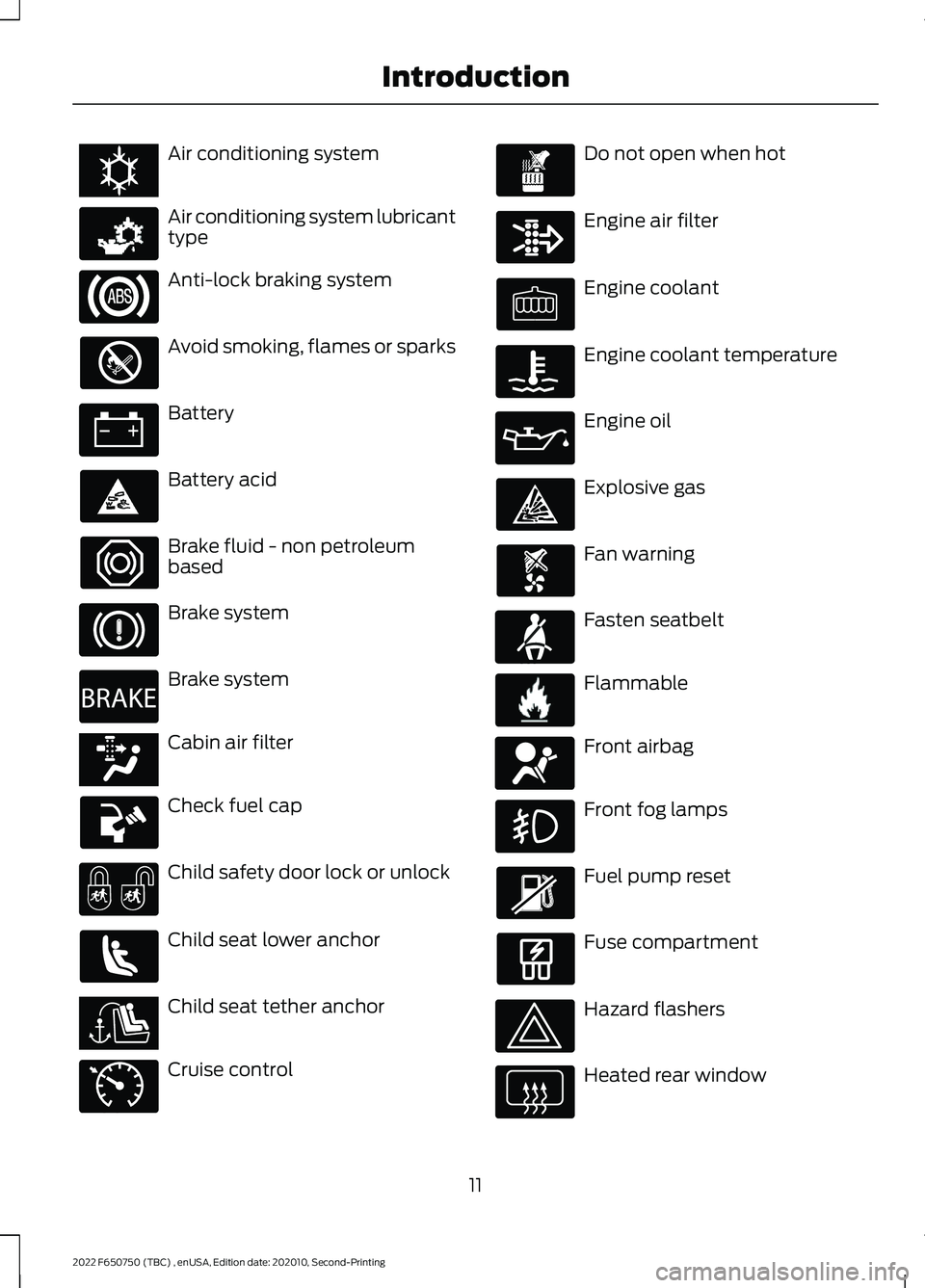
Air conditioning system
Air conditioning system lubricant
type
Anti-lock braking system
Avoid smoking, flames or sparks
Battery
Battery acid
Brake fluid - non petroleum
based
Brake system
Brake system
Cabin air filter
Check fuel cap
Child safety door lock or unlock
Child seat lower anchor
Child seat tether anchor
Cruise control Do not open when hot
Engine air filter
Engine coolant
Engine coolant temperature
Engine oil
Explosive gas
Fan warning
Fasten seatbelt
Flammable
Front airbag
Front fog lamps
Fuel pump reset
Fuse compartment
Hazard flashers
Heated rear window
11
2022 F650750 (TBC) , enUSA, Edition date: 202010, Second-Printing IntroductionE162384 E231157 E270480 E139223 E141128 E71340 E71880 E231160 E67017
Page 15 of 379
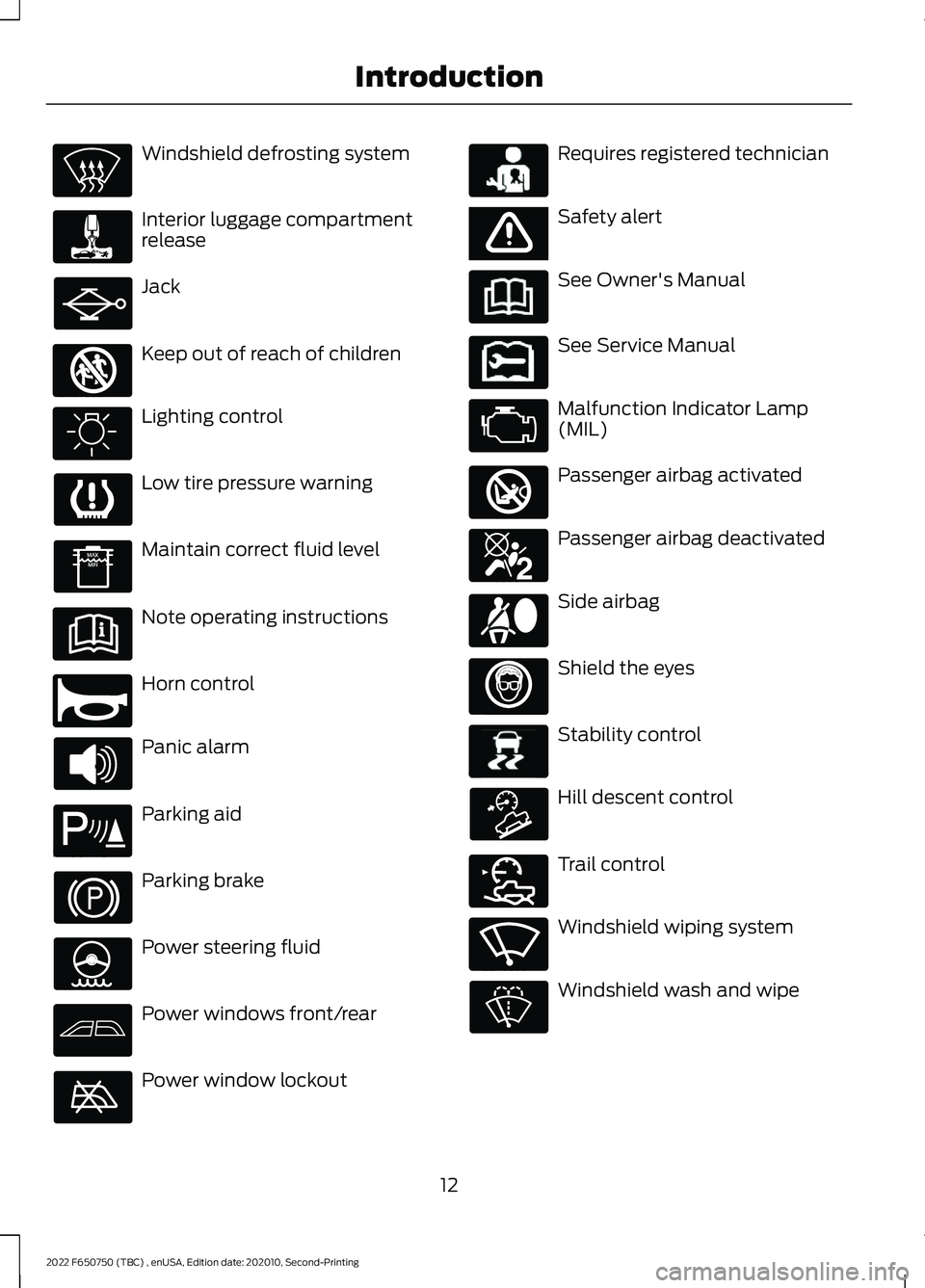
Windshield defrosting system
Interior luggage compartment
release
Jack
Keep out of reach of children
Lighting control
Low tire pressure warning
Maintain correct fluid level
Note operating instructions
Horn control
Panic alarm
Parking aid
Parking brake
Power steering fluid
Power windows front/rear
Power window lockout Requires registered technician
Safety alert
See Owner's Manual
See Service Manual
Malfunction Indicator Lamp
(MIL)
Passenger airbag activated
Passenger airbag deactivated
Side airbag
Shield the eyes
Stability control
Hill descent control
Trail control
Windshield wiping system
Windshield wash and wipe
12
2022 F650750 (TBC) , enUSA, Edition date: 202010, Second-Printing Introduction E161353 E270945 E139213 E231159 E65963 E231158 E270849 E270850 E167012 E138639 E163957 E272858 E270969
Page 24 of 379
PROTECTING THE
ENVIRONMENT
Sustainability is a priority at Ford. We are
constantly looking for ways to reduce our
impact on the planet while providing
customers with great products and
delivering a strong business. You should
play your part in protecting the
environment. Correct vehicle usage and
the authorized disposal of waste, cleaning
and lubrication materials are significant
steps toward this aim.
For additional information about our
sustainability progress and initiatives, visit
www
.sus t ainabilit y .f or d . c om .
NOISE POLLUTION CONTROL
In order to keep to the federal exterior
noise regulations, your vehicle may be
equipped with noise emission items.
Depending on your vehicle configuration,
it may have all or some of the following
items:
Air Intake System
Inspect the air cleaner. Do not alter its
location. Do not alter inlet and outlet
piping.
Body
Inspect wheel well splash shields, cab
shields and under hood insulation for
deterioration, dislocation and orientation. Cooling System
•
Inspect the fan for blade damage. If
you find any damage, replace with the
recommended parts. Inspect for
fan-to-shroud interference and any
damage to shroud, such as cracks and
holes.
• Do not change fan ratio or alter fan
spacer dimensions and positions.
• Inspect fan clutch for proper operation.
Make sure the fan is disengaged when
cooling of the engine is not required.
• Inspect radiator shutters (if equipped)
for proper operation. The shutters
should be open during normal
operating temperatures.
Engine
Valve covers and block covers damp-out
engine mechanical noise. If they need
replacing, make sure to replace them with
the recommended parts. Check for
mechanical isolations.
Transmission Enclosure
Inspect for cracks, holes and tears. Clean
any deposits, such as oil, dirt and stones.
Exhaust System
• Inspect for leaks at various joint
connections and loose clamps.
• Perform a visual inspection for cracks
or holes in the muffler and tail pipe.
• Always use the recommended
replacement parts.
21
2022 F650750 (TBC) , enUSA, Edition date: 202010, Second-Printing Environment
Page 29 of 379
INSTALLING CHILD
RESTRAINTS
Child Restraints
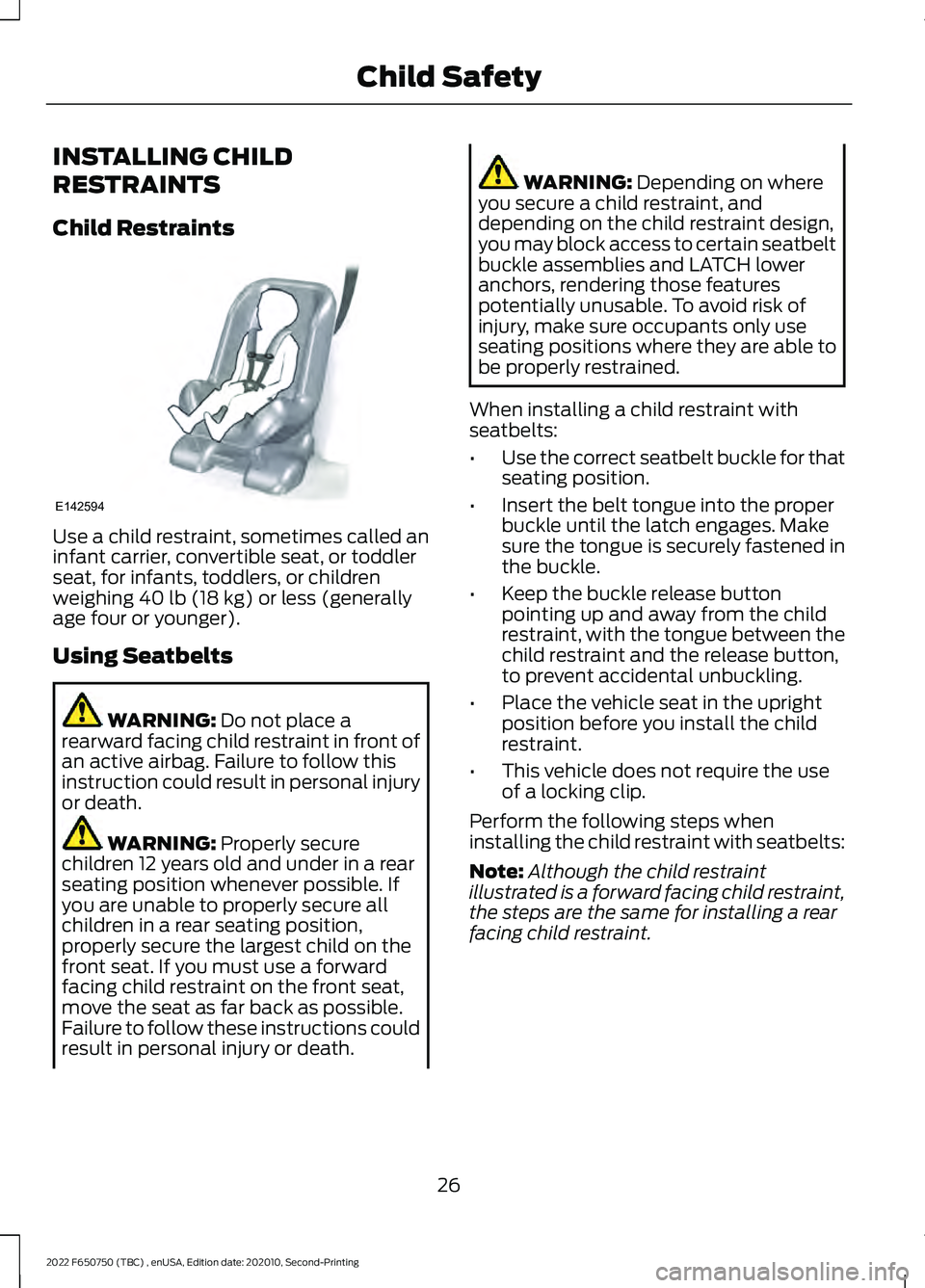
Use a child restraint, sometimes called an
infant carrier, convertible seat, or toddler
seat, for infants, toddlers, or children
weighing 40 lb (18 kg) or less (generally
age four or younger).
Using Seatbelts WARNING:
Do not place a
rearward facing child restraint in front of
an active airbag. Failure to follow this
instruction could result in personal injury
or death. WARNING:
Properly secure
children 12 years old and under in a rear
seating position whenever possible. If
you are unable to properly secure all
children in a rear seating position,
properly secure the largest child on the
front seat. If you must use a forward
facing child restraint on the front seat,
move the seat as far back as possible.
Failure to follow these instructions could
result in personal injury or death. WARNING:
Depending on where
you secure a child restraint, and
depending on the child restraint design,
you may block access to certain seatbelt
buckle assemblies and LATCH lower
anchors, rendering those features
potentially unusable. To avoid risk of
injury, make sure occupants only use
seating positions where they are able to
be properly restrained.
When installing a child restraint with
seatbelts:
• Use the correct seatbelt buckle for that
seating position.
• Insert the belt tongue into the proper
buckle until the latch engages. Make
sure the tongue is securely fastened in
the buckle.
• Keep the buckle release button
pointing up and away from the child
restraint, with the tongue between the
child restraint and the release button,
to prevent accidental unbuckling.
• Place the vehicle seat in the upright
position before you install the child
restraint.
• This vehicle does not require the use
of a locking clip.
Perform the following steps when
installing the child restraint with seatbelts:
Note: Although the child restraint
illustrated is a forward facing child restraint,
the steps are the same for installing a rear
facing child restraint.
26
2022 F650750 (TBC) , enUSA, Edition date: 202010, Second-Printing Child SafetyE142594
Page 30 of 379
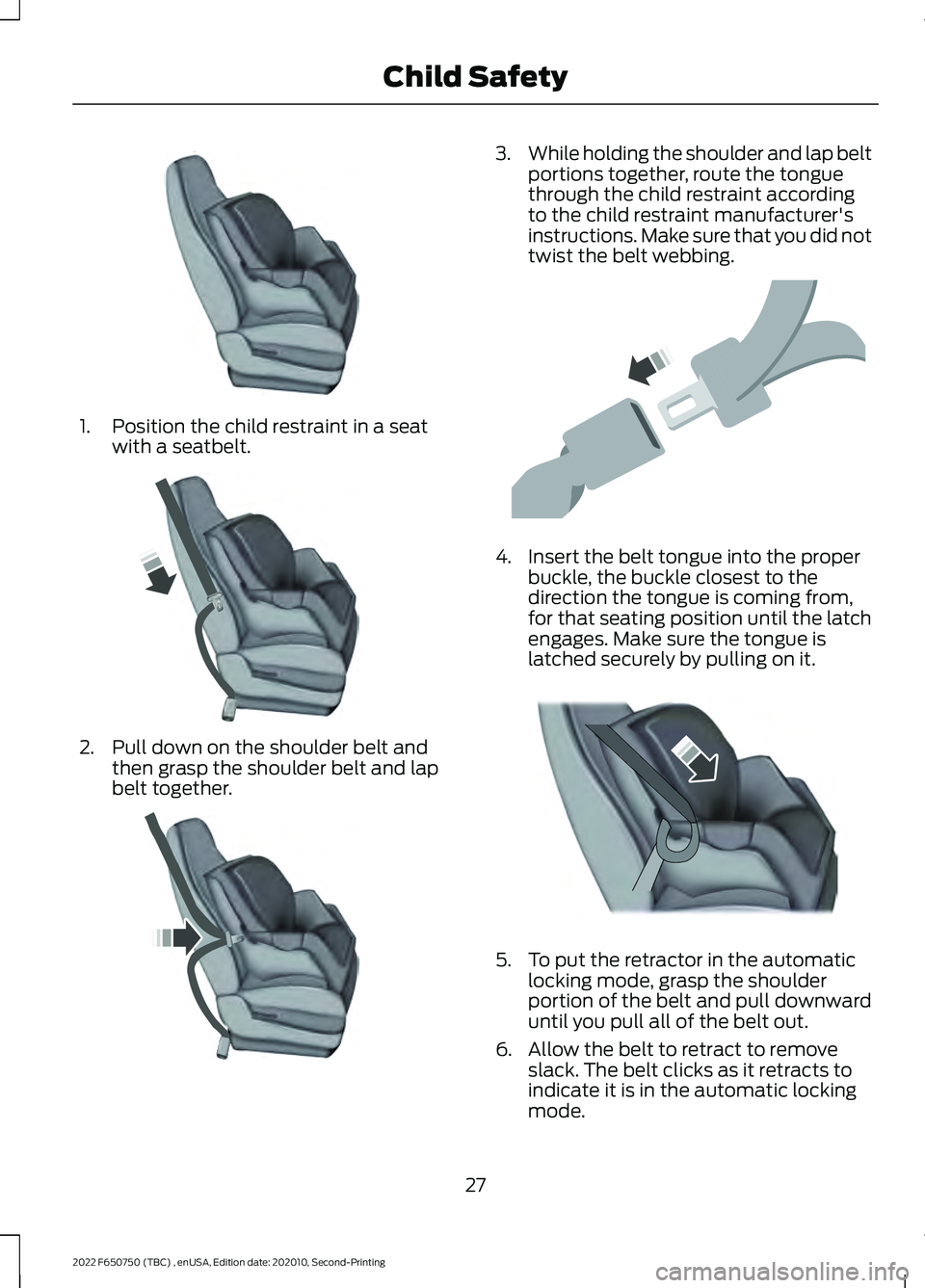
1. Position the child restraint in a seat
with a seatbelt. 2. Pull down on the shoulder belt and
then grasp the shoulder belt and lap
belt together. 3.
While holding the shoulder and lap belt
portions together, route the tongue
through the child restraint according
to the child restraint manufacturer's
instructions. Make sure that you did not
twist the belt webbing. 4. Insert the belt tongue into the proper
buckle, the buckle closest to the
direction the tongue is coming from,
for that seating position until the latch
engages. Make sure the tongue is
latched securely by pulling on it. 5. To put the retractor in the automatic
locking mode, grasp the shoulder
portion of the belt and pull downward
until you pull all of the belt out.
6. Allow the belt to retract to remove slack. The belt clicks as it retracts to
indicate it is in the automatic locking
mode.
27
2022 F650750 (TBC) , enUSA, Edition date: 202010, Second-Printing Child SafetyE142528 E142529 E142530 E142531 E142875
Page 31 of 379
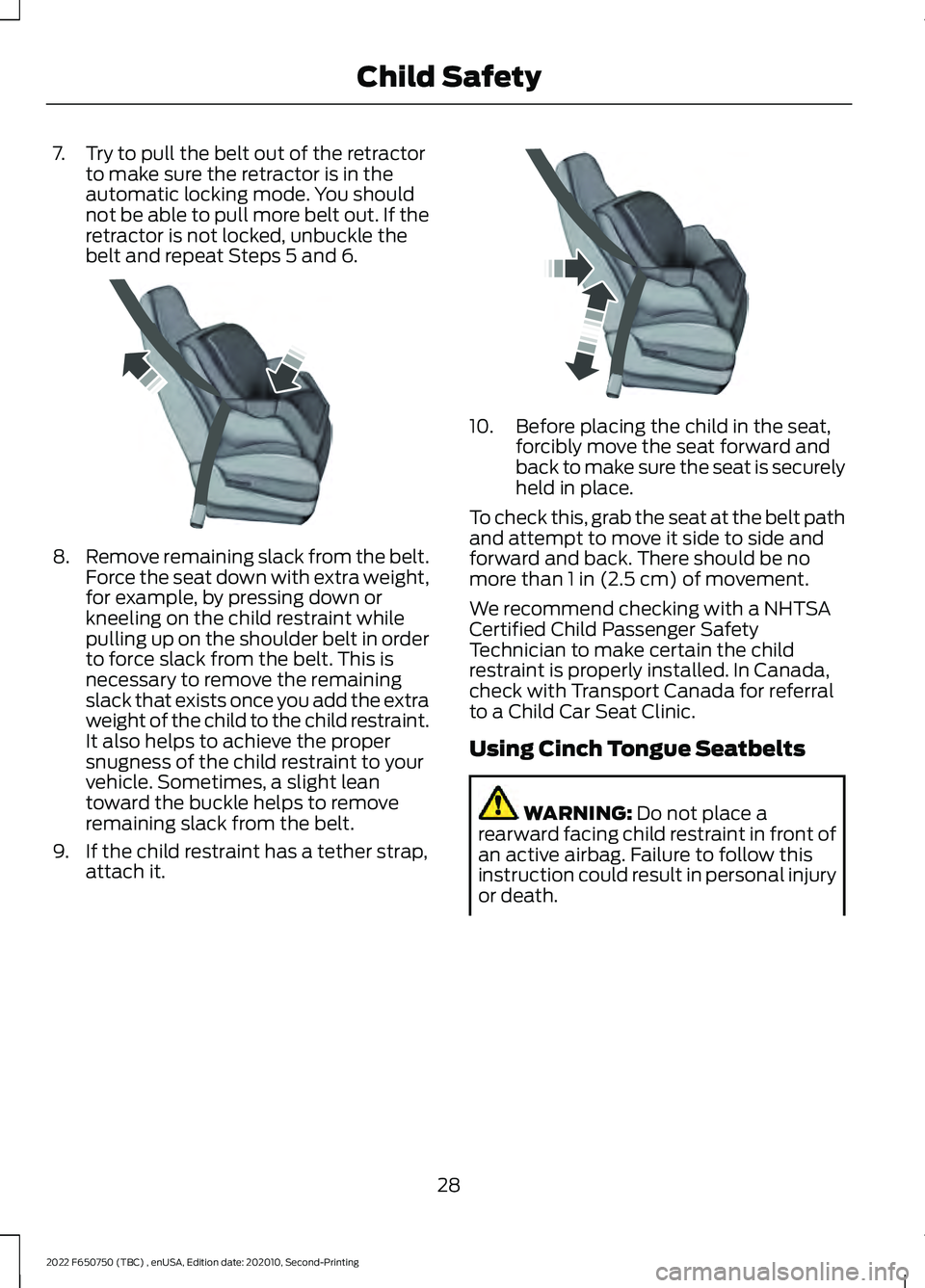
7. Try to pull the belt out of the retractor
to make sure the retractor is in the
automatic locking mode. You should
not be able to pull more belt out. If the
retractor is not locked, unbuckle the
belt and repeat Steps 5 and 6. 8.
Remove remaining slack from the belt.
Force the seat down with extra weight,
for example, by pressing down or
kneeling on the child restraint while
pulling up on the shoulder belt in order
to force slack from the belt. This is
necessary to remove the remaining
slack that exists once you add the extra
weight of the child to the child restraint.
It also helps to achieve the proper
snugness of the child restraint to your
vehicle. Sometimes, a slight lean
toward the buckle helps to remove
remaining slack from the belt.
9. If the child restraint has a tether strap, attach it. 10. Before placing the child in the seat,
forcibly move the seat forward and
back to make sure the seat is securely
held in place.
To check this, grab the seat at the belt path
and attempt to move it side to side and
forward and back. There should be no
more than 1 in (2.5 cm) of movement.
We recommend checking with a NHTSA
Certified Child Passenger Safety
Technician to make certain the child
restraint is properly installed. In Canada,
check with Transport Canada for referral
to a Child Car Seat Clinic.
Using Cinch Tongue Seatbelts WARNING:
Do not place a
rearward facing child restraint in front of
an active airbag. Failure to follow this
instruction could result in personal injury
or death.
28
2022 F650750 (TBC) , enUSA, Edition date: 202010, Second-Printing Child SafetyE142533 E142534