warning lights FORD F SERIES MOTORHOME AND COMMERCIAL CHASSIS 2003 10.G Owners Manual
[x] Cancel search | Manufacturer: FORD, Model Year: 2003, Model line: F SERIES MOTORHOME AND COMMERCIAL CHASSIS, Model: FORD F SERIES MOTORHOME AND COMMERCIAL CHASSIS 2003 10.GPages: 96, PDF Size: 1.39 MB
Page 1 of 96
Introduction
3
Instrumentation
8
Warning and control lights 8
Gauges 11
Lights
14
Headlamps 14
Bulb replacement 15
Driver controls
16
Windshield wiper/washer control 16
Speed control (Cruise control) 17
Driving
20
Starting 20
Brakes 23
Transmission operation 27
Vehicle loading 31
Trailer towing 33
Roadside emergencies
36
Hazard flasher switch 36
Fuel pump shut-off switch 36
Fuses and relays 38
Changing tires 45
Jump starting 48
Wrecker towing 52
Table of contents
1
Page 8 of 96
WARNING LIGHTS AND CHIMES
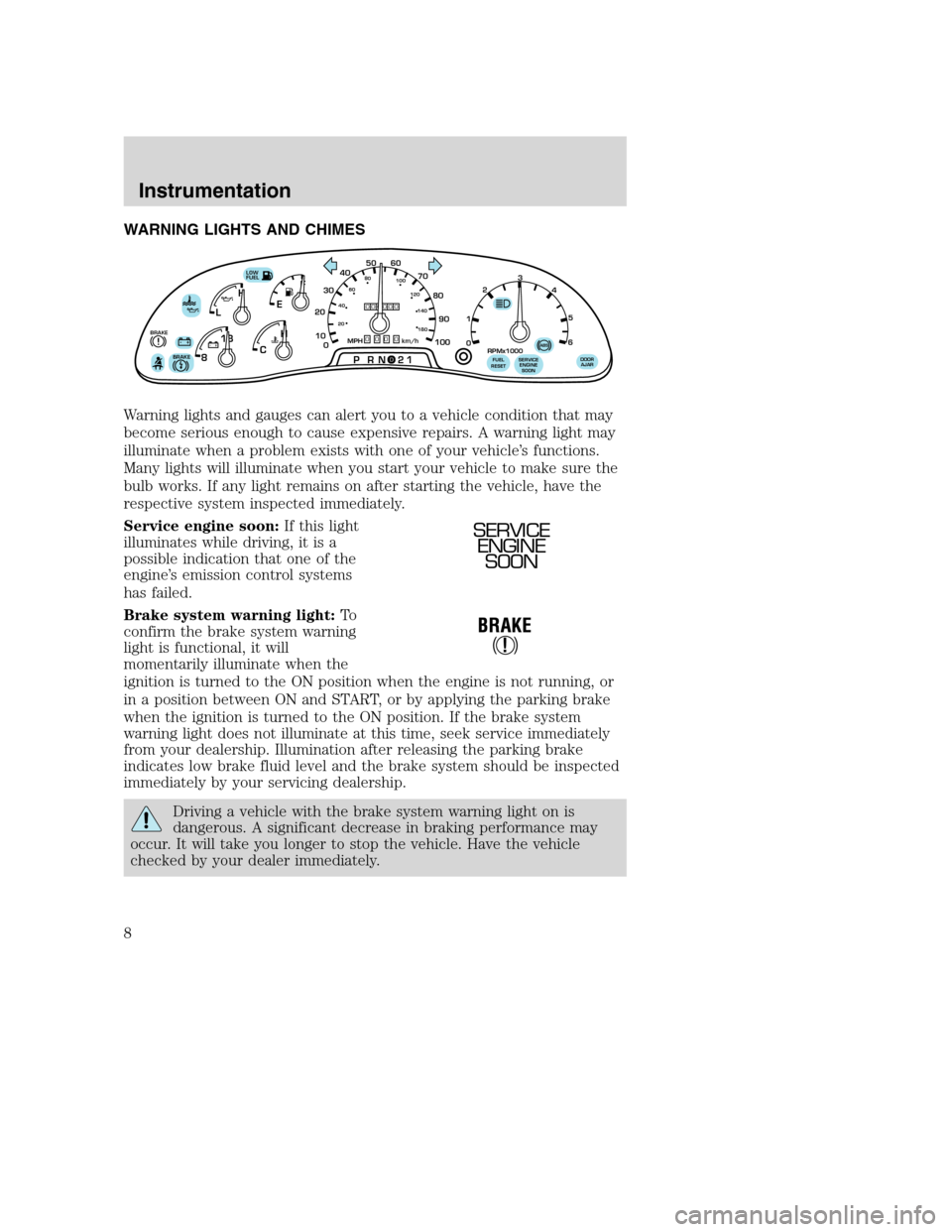
Warning lights and gauges can alert you to a vehicle condition that may
become serious enough to cause expensive repairs. A warning light may
illuminate when a problem exists with one of your vehicle’s functions.
Many lights will illuminate when you start your vehicle to make sure the
bulb works. If any light remains on after starting the vehicle, have the
respective system inspected immediately.
Service engine soon:If this light
illuminates while driving, it is a
possible indication that one of the
engine’s emission control systems
has failed.
Brake system warning light:To
confirm the brake system warning
light is functional, it will
momentarily illuminate when the
ignition is turned to the ON position when the engine is not running, or
in a position between ON and START, or by applying the parking brake
when the ignition is turned to the ON position. If the brake system
warning light does not illuminate at this time, seek service immediately
from your dealership. Illumination after releasing the parking brake
indicates low brake fluid level and the brake system should be inspected
immediately by your servicing dealership.
Driving a vehicle with the brake system warning light on is
dangerous. A significant decrease in braking performance may
occur. It will take you longer to stop the vehicle. Have the vehicle
checked by your dealer immediately.
F
E
CH H
L
18
8
PRN 21LOW
FUEL
BRAKE!+ -+ -000000000
0
50
60
70
20
10
0 3040
80
90
100
20406080
100
120
140
180
MPH km/h
1
02
RPMx1000
3
4
5
6
SERVICE
ENGINE
SOONABSFUEL
RESETDOOR
AJARBRAKE
SERVICE
ENGINE
SOON
Instrumentation
8
Page 10 of 96
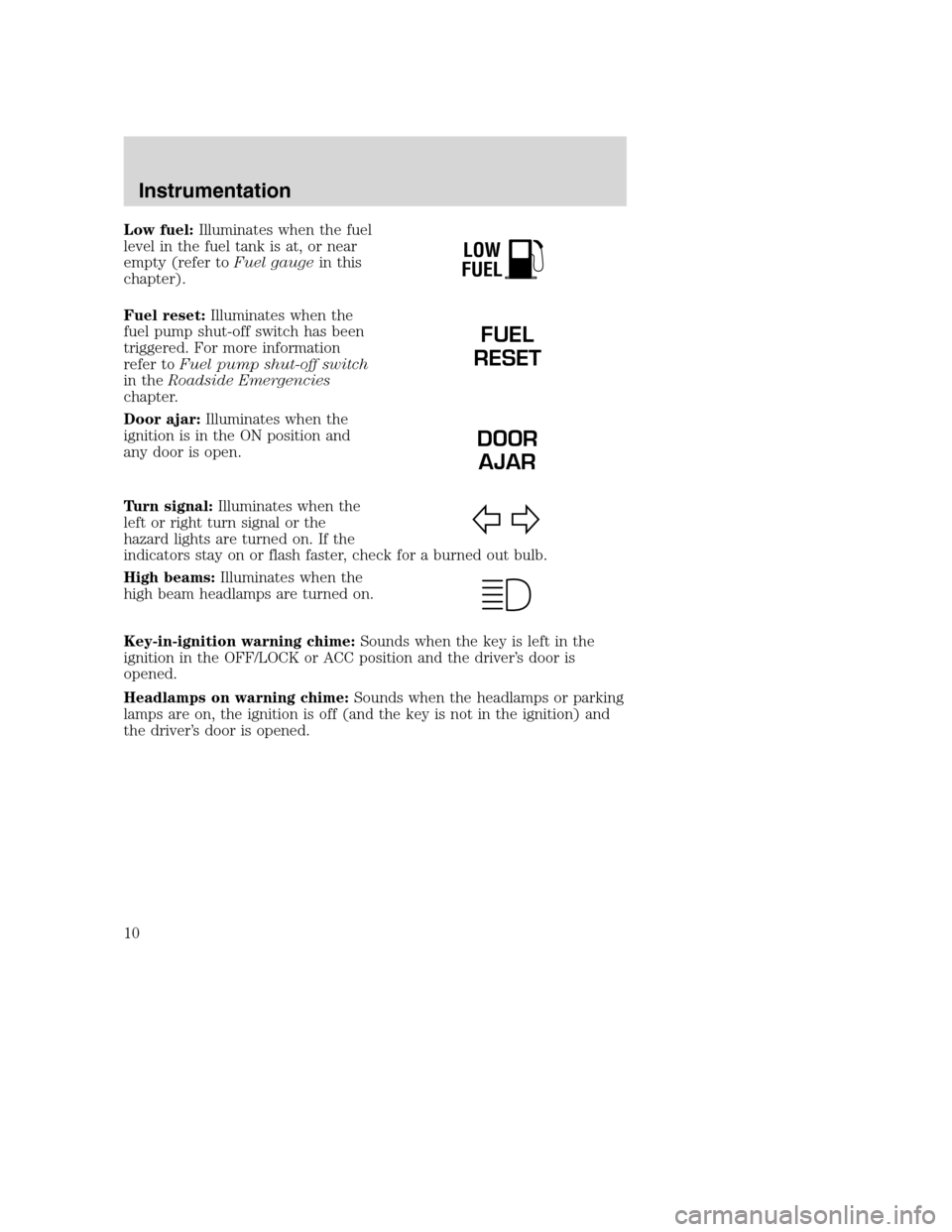
Low fuel:Illuminates when the fuel
level in the fuel tank is at, or near
empty (refer toFuel gaugein this
chapter).
Fuel reset:Illuminates when the
fuel pump shut-off switch has been
triggered. For more information
refer toFuel pump shut-off switch
in theRoadside Emergencies
chapter.
Door ajar:Illuminates when the
ignition is in the ON position and
any door is open.
Turn signal:Illuminates when the
left or right turn signal or the
hazard lights are turned on. If the
indicators stay on or flash faster, check for a burned out bulb.
High beams:Illuminates when the
high beam headlamps are turned on.
Key-in-ignition warning chime:Sounds when the key is left in the
ignition in the OFF/LOCK or ACC position and the driver’s door is
opened.
Headlamps on warning chime:Sounds when the headlamps or parking
lamps are on, the ignition is off (and the key is not in the ignition) and
the driver’s door is opened.
LOW
FUEL
FUEL
RESET
DOOR
AJAR
Instrumentation
10
Page 20 of 96
STARTING
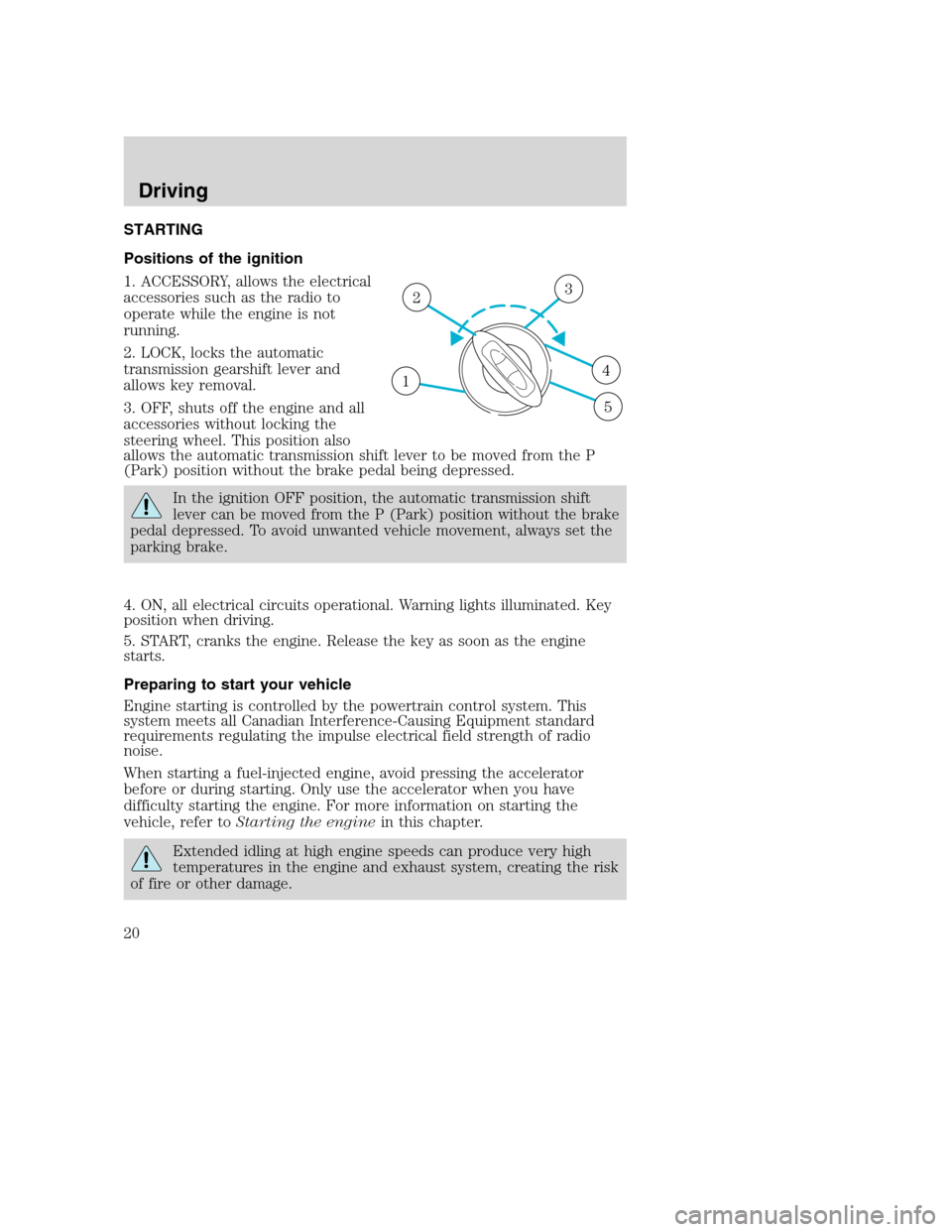
Positions of the ignition
1. ACCESSORY, allows the electrical
accessories such as the radio to
operate while the engine is not
running.
2. LOCK, locks the automatic
transmission gearshift lever and
allows key removal.
3. OFF, shuts off the engine and all
accessories without locking the
steering wheel. This position also
allows the automatic transmission shift lever to be moved from the P
(Park) position without the brake pedal being depressed.
In the ignition OFF position, the automatic transmission shift
lever can be moved from the P (Park) position without the brake
pedal depressed. To avoid unwanted vehicle movement, always set the
parking brake.
4. ON, all electrical circuits operational. Warning lights illuminated. Key
position when driving.
5. START, cranks the engine. Release the key as soon as the engine
starts.
Preparing to start your vehicle
Engine starting is controlled by the powertrain control system. This
system meets all Canadian Interference-Causing Equipment standard
requirements regulating the impulse electrical field strength of radio
noise.
When starting a fuel-injected engine, avoid pressing the accelerator
before or during starting. Only use the accelerator when you have
difficulty starting the engine. For more information on starting the
vehicle, refer toStarting the enginein this chapter.
Extended idling at high engine speeds can produce very high
temperatures in the engine and exhaust system, creating the risk
of fire or other damage.
1
23
4
5
Driving
20
Page 77 of 96
•Do not turn off the ignition while your vehicle is moving, especially at
high speeds.
•Have the items listed in your scheduled maintenance guide performed
according to the specified schedule.
The scheduled maintenance items listed in the scheduled maintenance
guide are essential to the life and performance of your vehicle and to its
emissions system.
If other than Ford, Motorcraft or Ford-authorized parts are used for
maintenance replacements or for service of components affecting
emission control, such non-Ford parts should be equivalent to genuine
Ford Motor Company parts in performance and durability.
Do not park, idle, or drive your vehicle in dry grass or other dry
ground cover. The emission system heats up the engine
compartment and exhaust system, which can start a fire.
Illumination of the “Service Engine Soon” light, charging system warning
light or the temperature warning light, fluid leaks, strange odors, smoke
or loss of engine power, could indicate that the emission control system
is not working properly.
Exhaust leaks may result in entry of harmful and potentially
lethal fumes into the passenger compartment.
Do not make any unauthorized changes to your vehicle or engine. By
law, vehicle owners and anyone who manufactures, repairs, services,
sells, leases, trades vehicles, or supervises a fleet of vehicles are not
permitted to intentionally remove an emission control device or prevent
it from working. Information about your vehicle’s emission system is on
the Vehicle Emission Control Information Decal located on or near the
engine. This decal identifies engine displacement and gives some tune up
specifications.
Please consult yourWarranty Guidefor complete emission warranty
information.
Readiness for Inspection/Maintenance (I/M) testing
In some localities, it may be a legal requirement to pass an I/M test of
the on-board diagnostics system. If your “Check Engine/Service Engine
Soon” light is on, refer to the description in theWarning lights and
chimessection of theInstrument clusterchapter. Your vehicle may not
pass the I/M test with the “Check Engine/Service Engine Soon” light on.
Maintenance and specifications
77
Page 96 of 96
daytime running light ...............14
headlamps .................................14
headlamps, flash to pass ..........15
instrument panel, dimming .....15
replacing bulbs .........................15
Lights, warning and indicator ......8
anti-lock brakes (ABS) ............25
Load limits ...................................31
GAWR ........................................31
GVWR ........................................31
trailer towing ............................31
Lubricant specifications .......91–92
M
Motorcraft parts ....................71, 88
O
Octane rating ..............................69
Oil (see Engine oil) ....................57
P
Parking brake ..............................26
Parts (see Motorcraft parts) ......88
Power distribution box
(see Fuses) .................................41
Power steering
fluid, checking and adding ......78
fluid, refill capacity ..................89
fluid, specifications .............91–92
R
Relays ....................................38, 44
S
Safety defects, reporting ............93
Servicing your vehicle ................55
Spark plugs, specifications ...88, 92
Special notice ..........................5, 53Specification chart,
lubricants ...............................91–92
Speed control ..............................17
Starting your vehicle ............20–22
jump starting ............................48
Steering wheel
tilting .........................................16
T
Tires .................................45, 84–86
changing ....................................45
replacing ..............................46, 87
rotating ......................................86
snow tires and chains ..............87
tire grades .................................85
treadwear ..................................84
Towing .........................................33
trailer towing ............................33
wrecker ......................................52
Transmission ...............................27
fluid, checking and adding
(automatic) ...............................81
fluid, refill capacities ................89
lubricant specifications ......91–92
V
Vehicle Identification Number
(VIN) ............................................92
Vehicle loading ............................31
Ventilating your vehicle .............23
W
Warning lights (see Lights) .........8
Water, Driving through ...............30
Windshield washer fluid and
wipers ..........................................16
Wrecker towing ...........................52
Index
96