check engine FORD F150 1997 10.G Owner's Manual
[x] Cancel search | Manufacturer: FORD, Model Year: 1997, Model line: F150, Model: FORD F150 1997 10.GPages: 219, PDF Size: 2.21 MB
Page 172 of 219
2. When the engine coolant
temperature gauge reaches the
normal zone, turn the engine off.
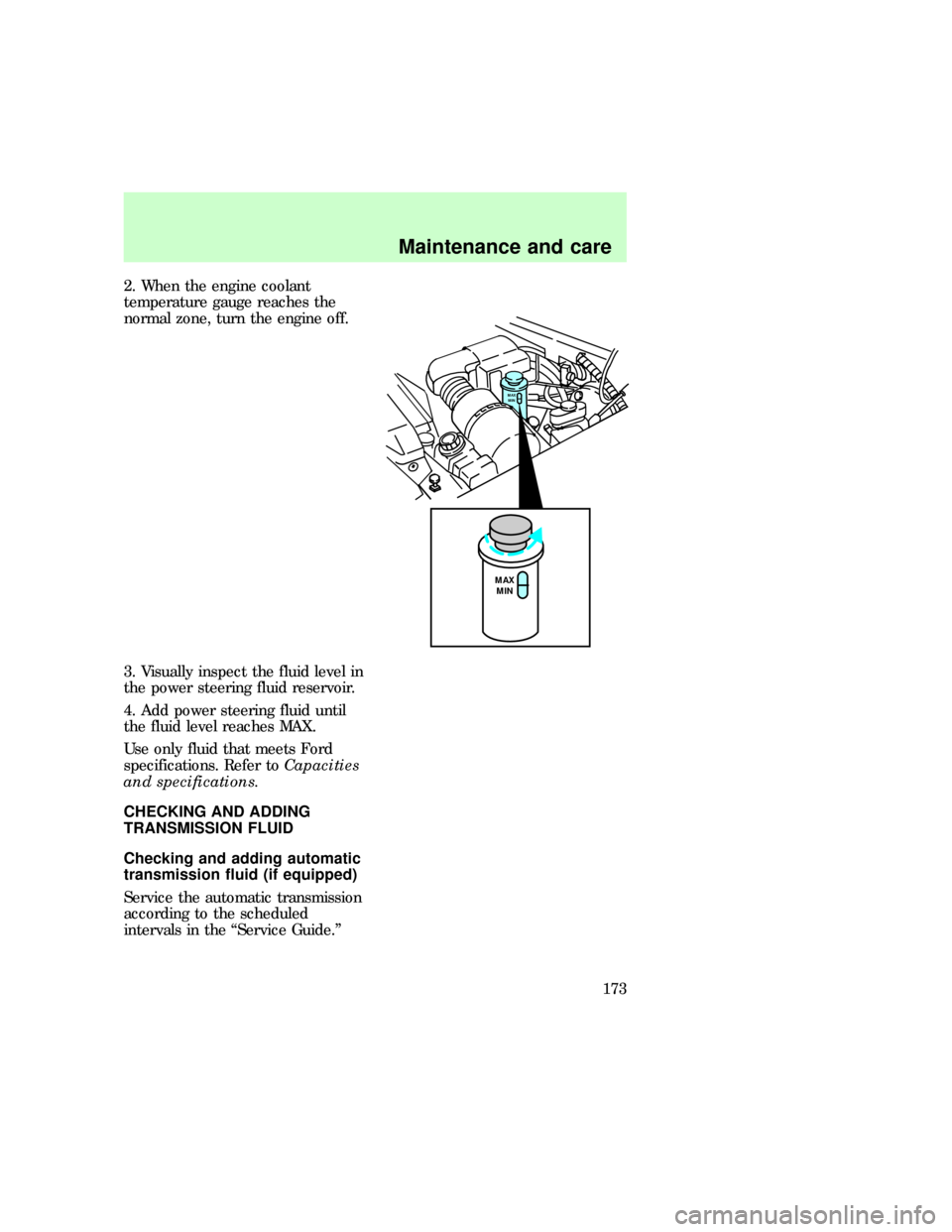
3. Visually inspect the fluid level in
the power steering fluid reservoir.
4. Add power steering fluid until
the fluid level reaches MAX.
Use only fluid that meets Ford
specifications. Refer toCapacities
and specifications.
CHECKING AND ADDING
TRANSMISSION FLUID
Checking and adding automatic
transmission fluid (if equipped)
Service the automatic transmission
according to the scheduled
intervals in the ªService Guide.º
MAX
MIN
MAX
MIN
f12_trans_fluid
f12_checking_adding_autotrans
Maintenance and care
173
Page 174 of 219
1. Park the vehicle on a level
surface.
2. Start the engine and move the
gearshift lever through all of the
gear ranges. Allow sufficient time
for each gear to engage.
3. Latch the gearshift lever in P
(Park), set the parking brake and
leave the engine running.
4. Remove the dipstick, wiping it
clean with a clean, dry rag.
5. Install the dipstick.
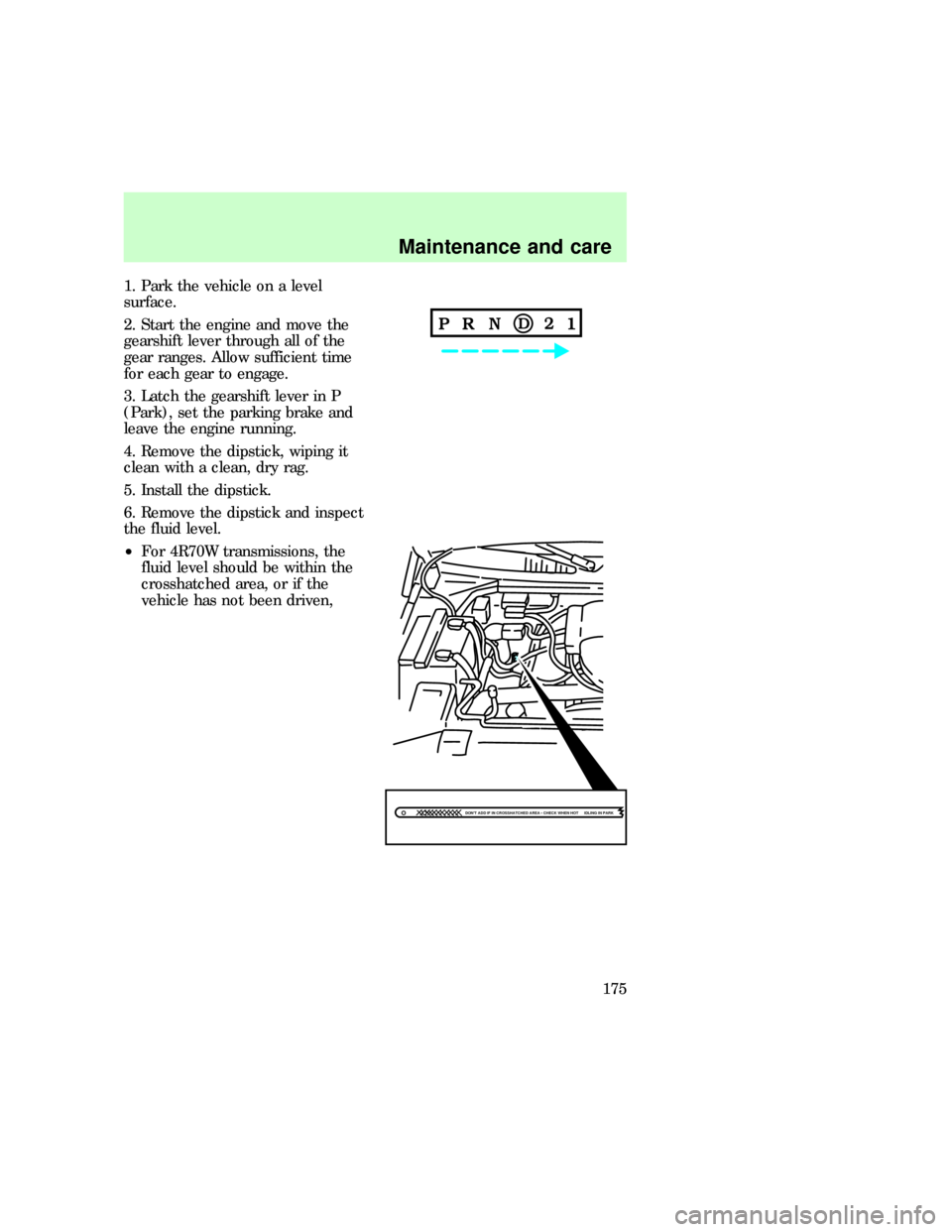
6. Remove the dipstick and inspect
the fluid level.
²For 4R70W transmissions, the
fluid level should be within the
crosshatched area, or if the
vehicle has not been driven,
DON'T ADD IF IN CROSSHATCHED AREA • CHECK WHEN HOT IDLING IN PARK
Maintenance and care
175
Page 179 of 219

have the charging system checked
for a possible malfunction.
Your vehicle is equipped with a
battery saver feature designed to
prevent your battery from
accidental wear down due to doors
left ajar. For information on this
system, refer to theControls and
featureschapter.
Relearning idle conditions
Because your vehicle's engine is
electronically controlled by a
computer, some control conditions
are maintained by power from the
battery. When the battery is
disconnected or a new battery is
installed, the computer must
ªrelearnº its idle conditions before
your vehicle will drive properly. To
complete this process:
1. Put the gearshift in P
(Park)(automatic transmission) or
N (Neutral)(manual transmission).
2. Turn off all accessories, and
start the engine.
3. Let the engine idle for at least
one minute.
4.The relearning process will
automatically complete as you
drive the vehicle.
²If you do not allow the engine to
relearn its idle, the idle quality
of your vehicle may be adversely
affected until the idle is
eventually relearned.
²If the battery has been
disconnected or a new battery
has been installed, the clock and
Maintenance and care
180
Page 193 of 219

WHAT YOU SHOULD KNOW
ABOUT THE EMISSION
CONTROL SYSTEM
Your vehicle is equipped with a
catalytic convertor which enables
your vehicle to comply with
applicable exhaust emission
requirements. For more
information on your vehicle's
emission control system, see the
Vehicle Emission Control
Information decal located on the
left side of the engine
compartment.
Follow these guidelines to ensure
proper emission system operation:
²Use only unleaded fuel.
²Avoid running out of fuel.
²Do not turn off the ignition
while the vehicle is in motion.
²Have regular maintenance
checks performed according to
the intervals in the ªService
Guide.º
When servicing your vehicle, never
use a metal exhaust collector. A
metal collector may melt or deform
plastic parts.
Maintenance and care
194
Page 194 of 219
Do not park, idle, or drive
your vehicle in dry grass
or other dry ground cover. The
emission system heats up the
engine compartment and exhaust
system, which can start a fire.
If you smell exhaust fumes
inside your vehicle, have
your dealer inspect your vehicle
immediately. Do not drive if you
smell exhaust fumes.
On vehicles without
original equipment floor
covering or insulation, do not let
passengers ride in your truck in
a manner that allows contact
between skin and the metal floor.
If you notice one or more of the
following, the emissions system
may not be working properly. Have
your vehicle serviced as soon as
possible.
²Fluid leaks
²The
orCHECK
ENGINElights
illuminate in the instrument
cluster and remain lit
²Strange odors
²Engine runs more than five
seconds after shut-off or engine
misfires, surges, stalls or
backfires
²Loss of oil pressure.
f12_important_emissions_info
Maintenance and care
195
Page 195 of 219

Important emission control
information
By law, anyone who manufacturers,
repairs, services, sells, leases,
trades vehicles or supervises a
fleet of vehicles is not permitted to
intentionally remove an emission
control device or prevent it from
working.
Do not make any unauthorized
changes to the vehicle or engine.
Changes that cause more
unburned fuel to reach the exhaust
system can increase the
temperature of the engine or
exhaust system.
Preparing your vehicle for
inspection/maintenance testing
In some localities it may become a
legal requirement to pass an
Inspection/Maintenance test of the
on-board diagnostic (OBDII)
system. If the vehicle's powertrain
system or battery has just been
serviced, the OBD II system is
reset to a ªnot ready for I/M
testing condition.º To ready the
OBD II system for I/M testing, the
law specifies that additional mixed
city and highway driving is
necessary to complete the check of
the OBD II system.
The driving modes required to
reach the ready condition consist
of a minimum of 30 minutes of city
and highway driving as described
below:
f12_readiness_im_testing
Maintenance and care
196