ECU FORD F150 1997 10.G Owners Manual
[x] Cancel search | Manufacturer: FORD, Model Year: 1997, Model line: F150, Model: FORD F150 1997 10.GPages: 219, PDF Size: 2.21 MB
Page 76 of 219
Child and infant or child safety
seats
Carefully follow all of the
manufacturer's instructions
included with the safety seat you
put in your vehicle. If you do not
install and use the safety seat
properly, the child may be
injured in a sudden stop or
collision.
Ford recommends the use of a
child safety seat having a top
tether strap. Install the child safety
seat in a seating position which is
capable of providing a tether
anchorage. For more information
on top tether straps seeAttaching
safety seats with tether strapsin
this chapter.
When installing a child safety seat:
²Use the correct safety belt
buckle for that seating position.
²Make sure the tongue is
securely fastened in the buckle.
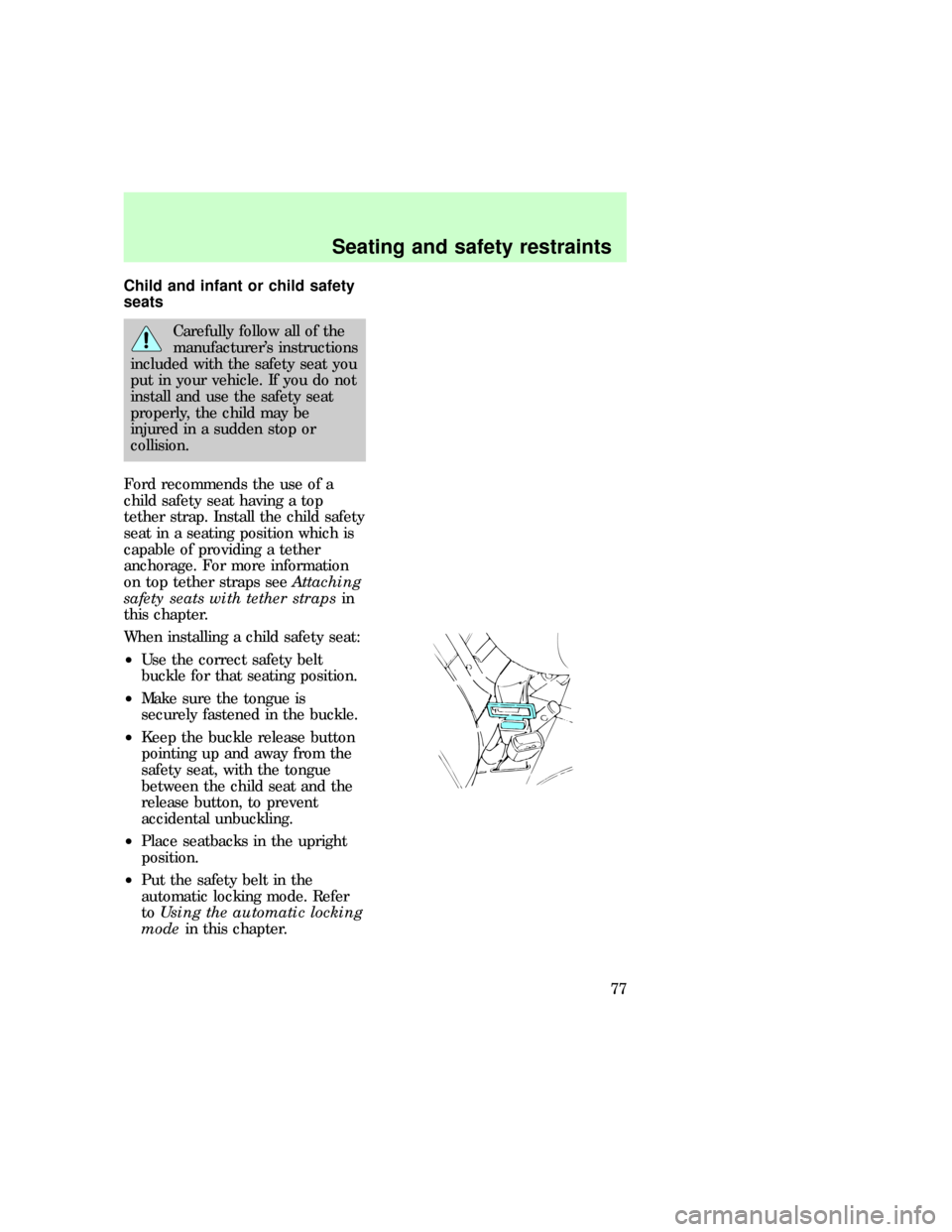
²Keep the buckle release button
pointing up and away from the
safety seat, with the tongue
between the child seat and the
release button, to prevent
accidental unbuckling.
²Place seatbacks in the upright
position.
²Put the safety belt in the
automatic locking mode. Refer
toUsing the automatic locking
modein this chapter.
f12_installing_seats
Seating and safety restraints
77
Page 79 of 219
sure the belt webbing is not
twisted.
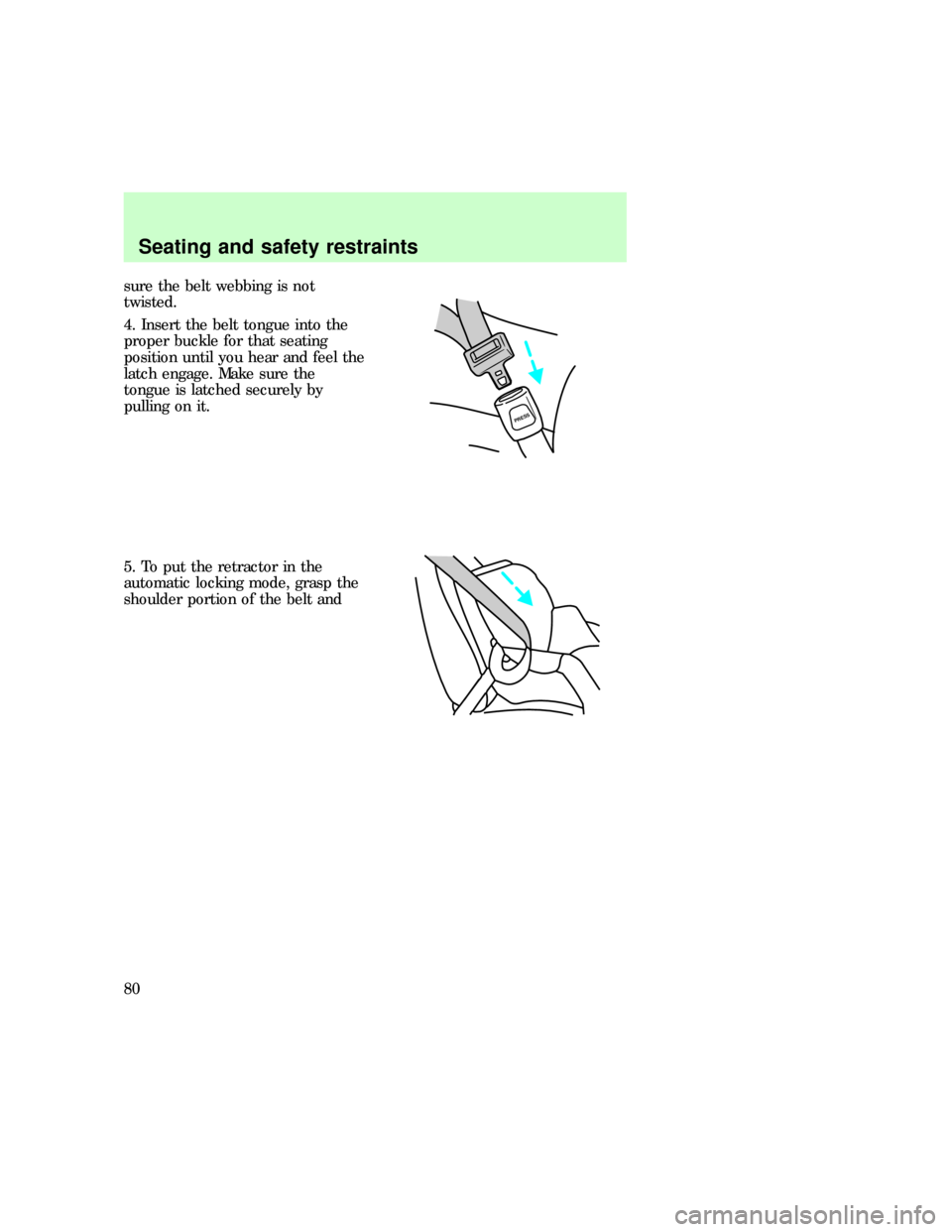
4. Insert the belt tongue into the
proper buckle for that seating
position until you hear and feel the
latch engage. Make sure the
tongue is latched securely by
pulling on it.
5. To put the retractor in the
automatic locking mode, grasp the
shoulder portion of the belt and
PRESS
Seating and safety restraints
80
Page 80 of 219
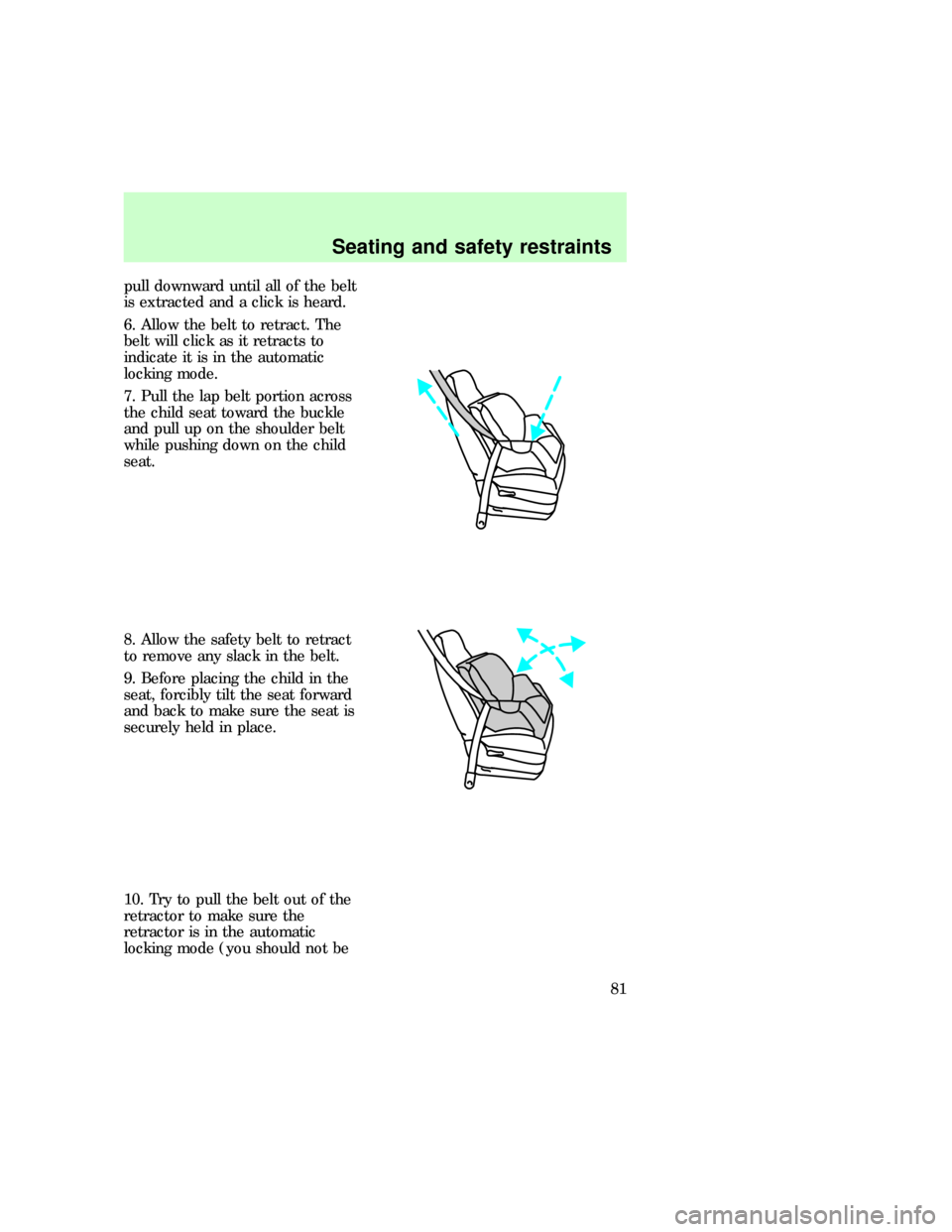
pull downward until all of the belt
is extracted and a click is heard.
6. Allow the belt to retract. The
belt will click as it retracts to
indicate it is in the automatic
locking mode.
7. Pull the lap belt portion across
the child seat toward the buckle
and pull up on the shoulder belt
while pushing down on the child
seat.
8. Allow the safety belt to retract
to remove any slack in the belt.
9. Before placing the child in the
seat, forcibly tilt the seat forward
and back to make sure the seat is
securely held in place.
10. Try to pull the belt out of the
retractor to make sure the
retractor is in the automatic
locking mode (you should not be
Seating and safety restraints
81
Page 81 of 219

able to pull more belt out). If the
retractor is not locked, unbuckle
the belt and repeat steps two
through nine.
Check to make sure the child seat is
properly secured before each use.
Using a tether strap
Ford recommends using child
safety seats with a top tether
strap. Contact the manufacturer of
your safety seat for information
about ordering a tether strap if one
is not provided to you. Contact
your Ford dealer for a free tether
strap if one is not provided to you.
Contact your Ford dealer for a free
tether anchor kit (613D74) so you
can attach a tether anchor bracket
to the back of the seat cushion. If
you have a SuperCab, attach the
bracket to the inside of the back
panel of your vehicle. Carefully
follow the instructions provided
with the kit.
If you have a SuperCab, Ford
recommends you attach tether
safety seats in a rear seating
position (if possible) with the
tether strap attached to the tether
anchor bracket as shown in the
instructions provided with the
tether anchor kit.
If the tethered seat is installed in
the front seat, put the tether strap
over the seatback and attach it to
the anchor bracket installed on the
rear edge of the seat cushion as
explained in the tether strap
instructions.
f12_tether_straps
Seating and safety restraints
82
Page 146 of 219
4. Raise the vehicle high enough
for the spare tire to clear the
ground when installed.
5. Remove the wheel lug nuts.
6. Remove the flat tire and install
the spare.
7. Install the lug nuts and tighten
until the wheel is seated.
Installing wheels without a
good metal-to-metal
contact at the wheel mounting
surface can cause the wheel lug
nuts to loosen and could allow
the wheel to come off while the
vehicle is in motion.
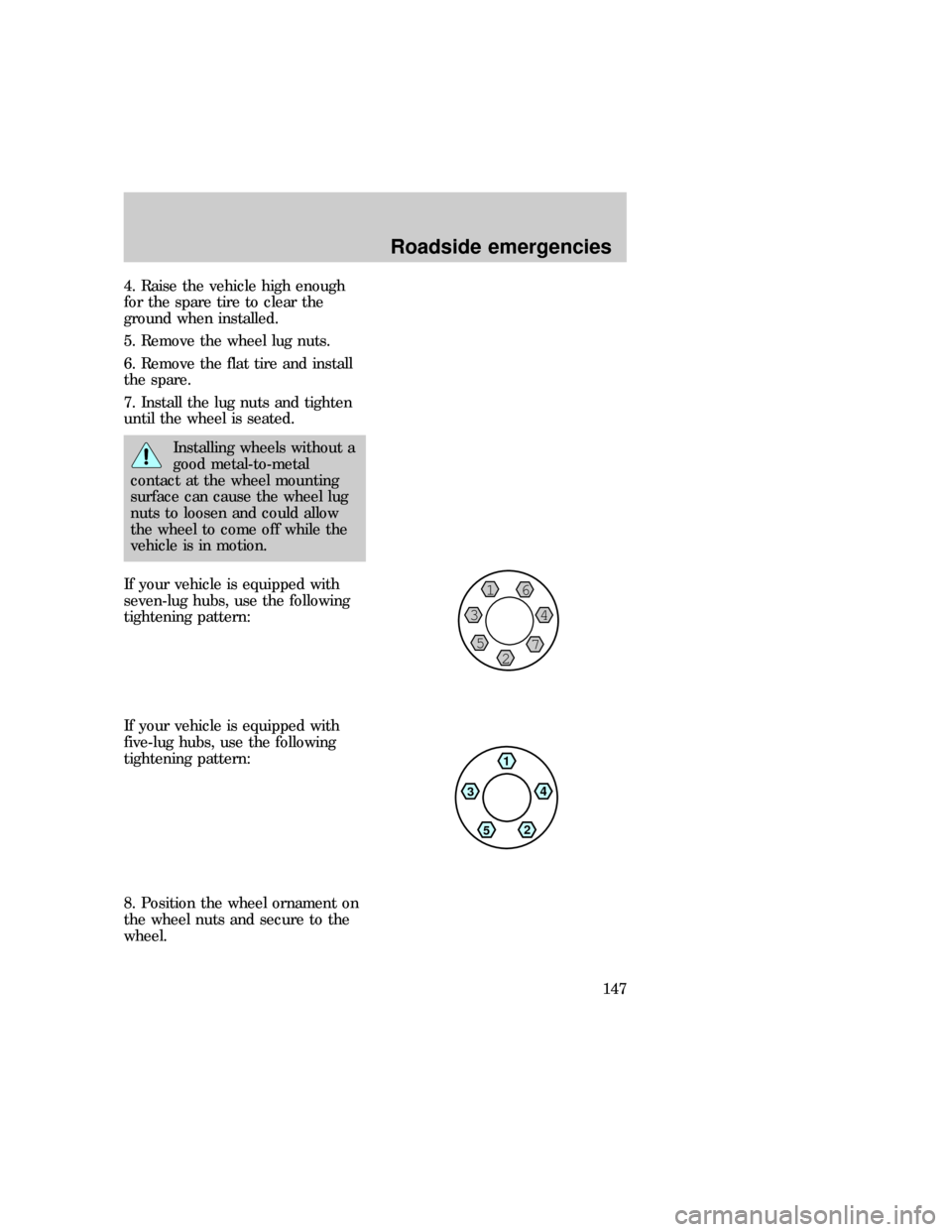
If your vehicle is equipped with
seven-lug hubs, use the following
tightening pattern:
If your vehicle is equipped with
five-lug hubs, use the following
tightening pattern:
8. Position the wheel ornament on
the wheel nuts and secure to the
wheel.
16
34
7 5
2
1
4
2
5 3
Roadside emergencies
147
Page 154 of 219

could get caught in moving
parts. Take precautions with
long hair.
²Do not work on a vehicle with
the engine running in an
enclosed space, unless you are
sure you have enough
ventilation.
²Keep all lit cigarettes, open
flames and other lit material
away from the battery and all
fuel related parts.
If you disconnect the battery, the
engine must ªrelearnº its idle
conditions before your vehicle will
drive properly, as explained in
Batteryin this chapter.
Working with the engine off
²Automatic transmission
1. Set the parking brake fully and
ensure the gearshift is securely
latched in P (Park).
2. Turn off the engine and remove
the key.
3. Block the wheels to prevent the
vehicle from moving unexpectedly.
²Manual transmission
1. Set the parking brake, depress
the clutch and place the gearshift
in 1 (First).
2. Turn off the engine and remove
the key.
3. Block the wheels to prevent the
vehicle from moving unexpectedly.
Working with the engine on
²Automatic transmission
com_working_off.02
com_working_on.02
Maintenance and care
155
Page 155 of 219

1. Set the parking brake fully and
ensure the gearshift is securely
latched in P (Park).
2. Block the wheels to prevent the
vehicle from moving unexpectedly.
Do not start your engine
with the air cleaner
removed and do not remove it
while the engine is running.
²Manual transmission
1. Set the parking brake, depress
the clutch and place the gearshift
in 1 (First).
2. Block the wheels to prevent the
vehicle from moving unexpectedly.
f12_opening_hood
Maintenance and care
156
Page 156 of 219
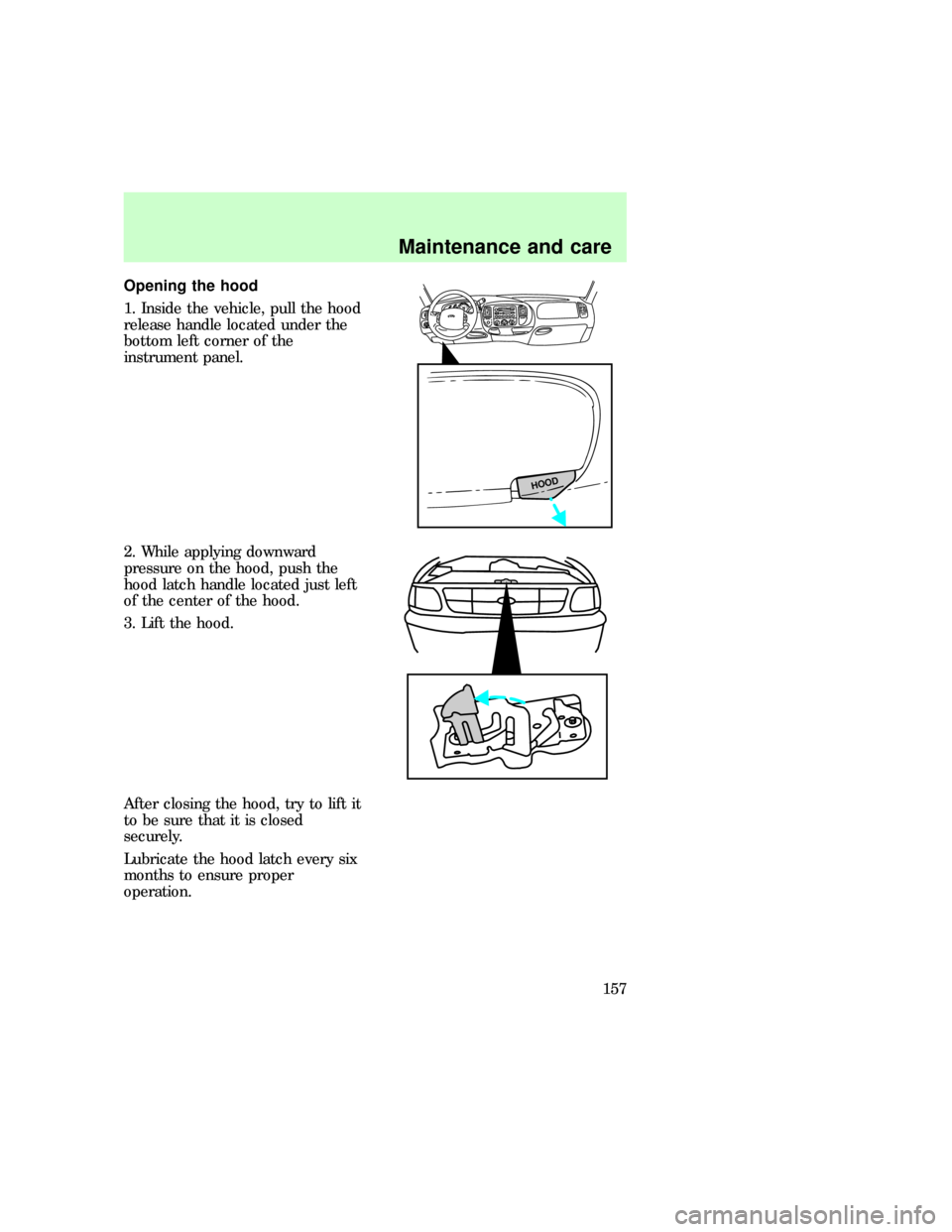
Opening the hood
1. Inside the vehicle, pull the hood
release handle located under the
bottom left corner of the
instrument panel.
2. While applying downward
pressure on the hood, push the
hood latch handle located just left
of the center of the hood.
3. Lift the hood.
After closing the hood, try to lift it
to be sure that it is closed
securely.
Lubricate the hood latch every six
months to ensure proper
operation.
HOOD
f12_4.2L_engine_components
Maintenance and care
157
Page 180 of 219
preset radio stations must be
reset once the battery is
reconnected.
²Always dispose of used
automotive batteries in a
responsible manner. Follow your
community's standards for
disposal. Call your local
recycling center to find out
more about recycling automotive
batteries.
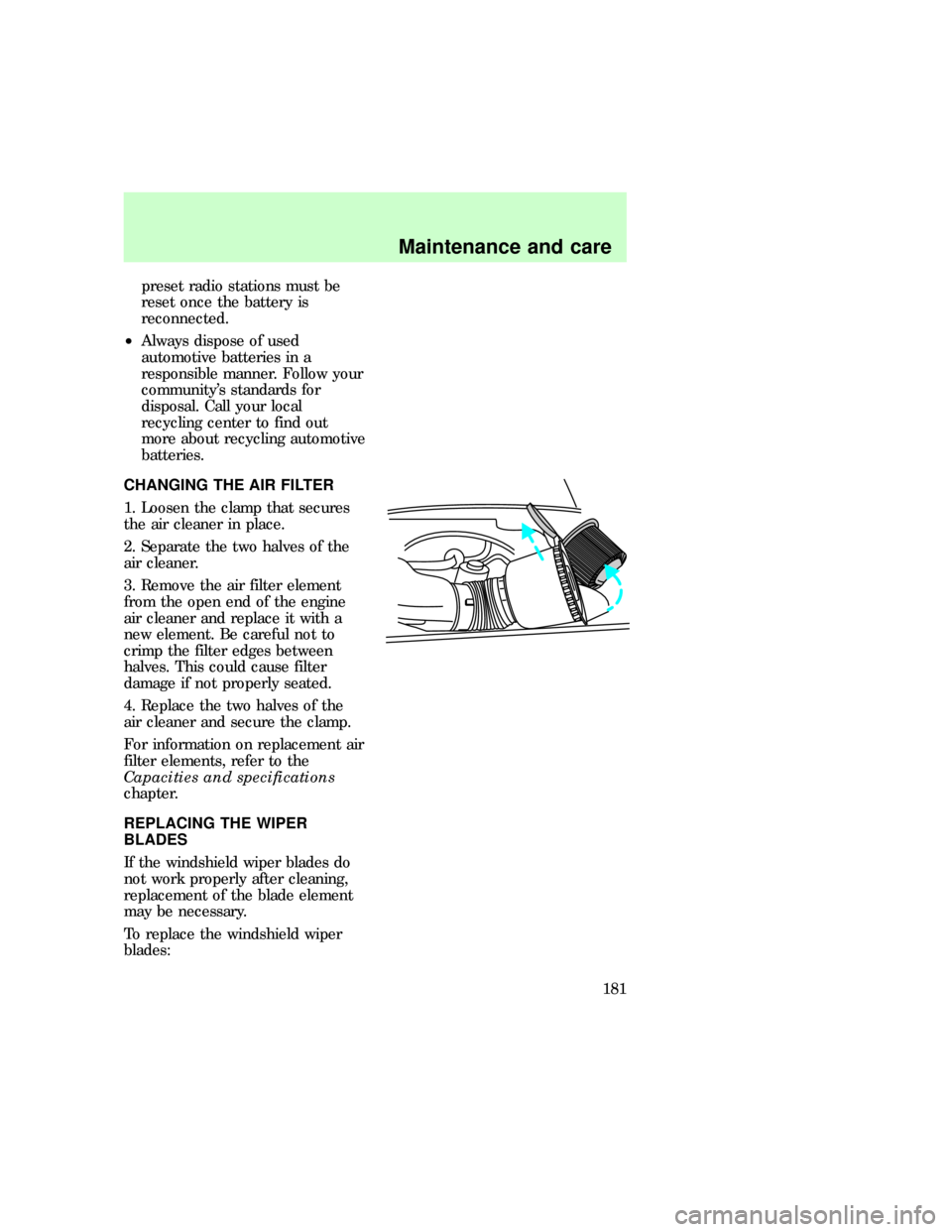
CHANGING THE AIR FILTER
1. Loosen the clamp that secures
the air cleaner in place.
2. Separate the two halves of the
air cleaner.
3. Remove the air filter element
from the open end of the engine
air cleaner and replace it with a
new element. Be careful not to
crimp the filter edges between
halves. This could cause filter
damage if not properly seated.
4. Replace the two halves of the
air cleaner and secure the clamp.
For information on replacement air
filter elements, refer to the
Capacities and specifications
chapter.
REPLACING THE WIPER
BLADES
If the windshield wiper blades do
not work properly after cleaning,
replacement of the blade element
may be necessary.
To replace the windshield wiper
blades:
f12_changing_air_filter
f12_changing_wiper_blades
Maintenance and care
181
Page 187 of 219

Snow tires and chains
Snow tires must be the
same size and grade as the
tires you currently have on your
vehicle.
The tires on your vehicle have all
weather treads to provide traction
in rain and snow.
However, in some climates, you
may need to use snow tires and
chains.
Follow these guidelines when using
snow tires and chains.
²Use only SAE Class ªSº chains.
²Install chains securely, verifying
that the chains do not touch any
wiring, brake lines or fuel lines.
²4x2: Install tire chains on rear
tires (of all sizes) only.
²4x4: Install tire chains on rear
tires (of all sizes), and on front
tires of size P235/70R16 only.
²Drive cautiously. If you hear the
chains rub or bang against your
vehicle, stop and retighten the
chains. If this does not work,
remove the chains to prevent
damage to your vehicle.
²If possible, avoid fully loading
your vehicle.
²Remove the tire chains when
they are no longer needed. Do
not use tire chains on dry roads.
²The suspension insulation and
bumpers will help prevent
vehicle damage. Do not remove
Maintenance and care
188