warning FORD F150 2003 10.G Owner's Manual
[x] Cancel search | Manufacturer: FORD, Model Year: 2003, Model line: F150, Model: FORD F150 2003 10.GPages: 280, PDF Size: 4.2 MB
Page 140 of 280
Guarding against exhaust fumes
Carbon monoxide is present in exhaust fumes. Take precautions to avoid
its dangerous effects.
If you smell exhaust fumes inside your vehicle, have your dealer
inspect your vehicle immediately. Do not drive if you smell
exhaust fumes.
Important ventilating information
If the engine is idling while the vehicle is stopped for a long period of
time, open the windows at least 2.5 cm (one inch) or adjust the heating
or air conditioning to bring in fresh air.
BRAKES
Occasional brake noise is normal. If a metal-to-metal, continuous grinding
or continuous squeal sound is present, the brake linings may be worn-out
and should be inspected by a qualified service technician. If the vehicle
has continuous vibration or shudder in the steering wheel while braking,
the vehicle should be inspected by a qualified service technician.
Four-wheel anti-lock brake system (ABS)
Your vehicle is equipped with an Anti-lock Braking System (ABS). This
system helps you maintain steering control during emergency stops by
keeping the brakes from locking. Noise from the ABS pump motor and
brake pedal pulsation may be observed during ABS braking; any
pulsations or mechanical noise you may feel or hear is normal.
Using ABS
When hard braking is required, apply continuous force on the brake
pedal; do not pump the brake pedal since this will reduce the
effectiveness of the ABS and will increase your vehicle’s stopping
distance. The ABS will be activated immediately, allowing you to retain
full steering control during hard braking and on slippery surfaces.
However, the ABS does not decrease stopping distance.
ABS warning lamp
ABS
TheABSlamp in the instrument cluster momentarily illuminates when
the ignition is turned to ON. If the light does not illuminate during start
up, remains on or flashes, the ABS may be disabled and the ABS may
need to be serviced.
Driving
140
Page 141 of 280
Even when the ABS is disabled,
normal braking is still effective. (If
your BRAKE warning lamp
illuminates with the parking brake
released, have your brake system serviced immediately.)
Parking brake
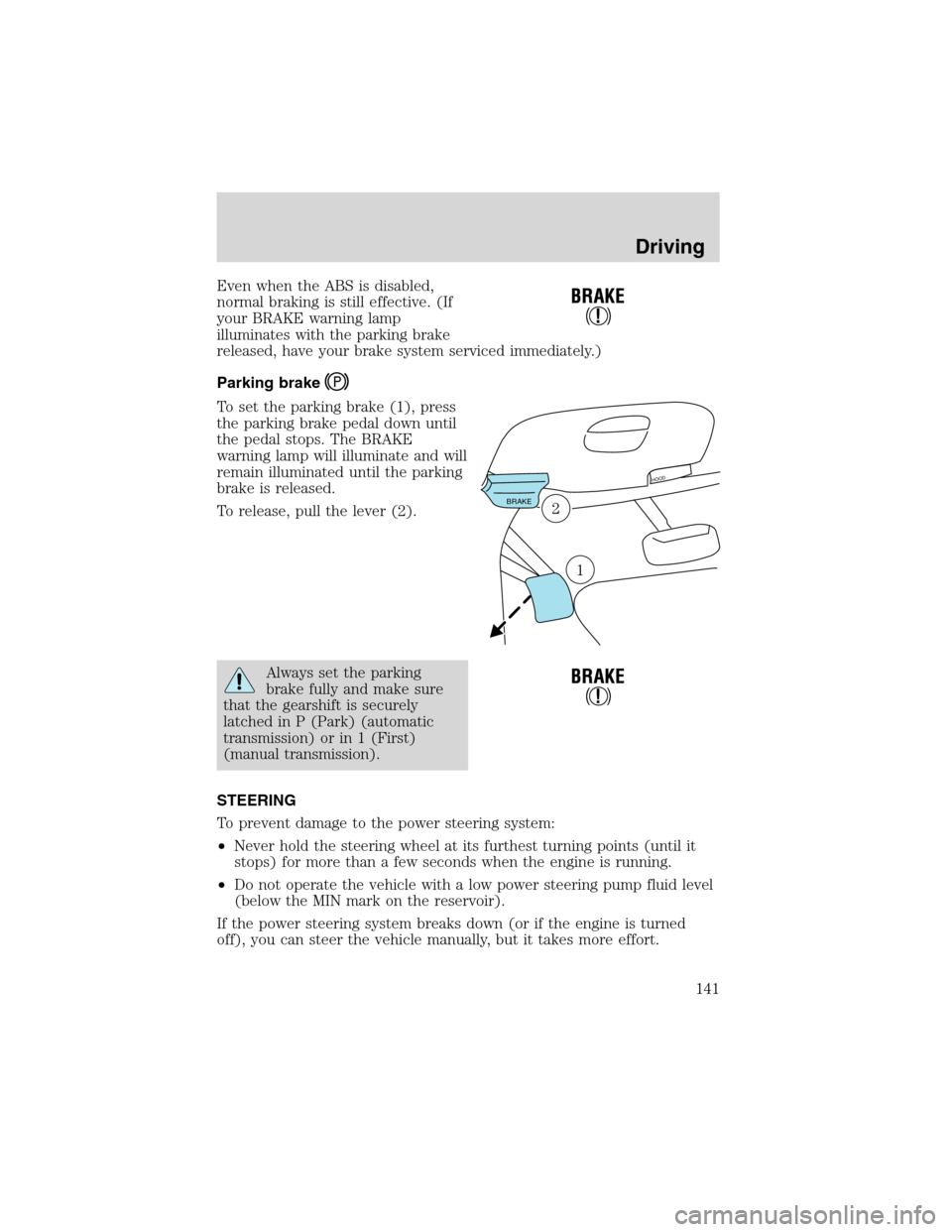
To set the parking brake (1), press
the parking brake pedal down until
the pedal stops. The BRAKE
warning lamp will illuminate and will
remain illuminated until the parking
brake is released.
To release, pull the lever (2).
Always set the parking
brake fully and make sure
that the gearshift is securely
latched in P (Park) (automatic
transmission) or in 1 (First)
(manual transmission).
STEERING
To prevent damage to the power steering system:
•Never hold the steering wheel at its furthest turning points (until it
stops) for more than a few seconds when the engine is running.
•Do not operate the vehicle with a low power steering pump fluid level
(below the MIN mark on the reservoir).
If the power steering system breaks down (or if the engine is turned
off), you can steer the vehicle manually, but it takes more effort.
BRAKE
H
OOD
2
1
Driving
141
Page 143 of 280
Loaded vehicles, with a higher center of gravity, may handle
differently than unloaded vehicles. Extra precautions, such as
slower speeds and increased stopping distance, should be taken when
driving a heavily loaded vehicle.
AUTOMATIC TRANSMISSION OPERATION (IF EQUIPPED)
Brake-shift interlock
This vehicle is equipped with a brake-shift interlock feature that prevents
the gearshift lever from being moved from P (Park) when the ignition is
in the ON position unless brake pedal is depressed.
If you cannot move the gearshift lever out of P (Park) with ignition in
the ON position and the brake pedal depressed:
1.
Apply the parking brake, turn ignition key to LOCK, then remove the key.
2. Insert the key and turn it to OFF.Apply the brake pedal and shift
to N (Neutral).
In the ignition OFF position, the automatic transmission shift
lever can be moved from the P (Park) position without the brake
pedal depressed. To avoid unwanted vehicle movement, always set the
parking brake.
3. Start the vehicle.
If it is necessary to use the above procedure to move the gearshift lever,
it is possible that a fuse has blown or the vehicle’s brakelamps are not
operating properly. Refer toFuses and relaysin theRoadside
emergencieschapter.
Do not drive your vehicle until you verify that the brakelamps
are working.
Always set the parking brake fully and make sure the gearshift is
latched in P (Park). Turn the ignition to the LOCK position and
remove the key whenever you leave your vehicle.
If the parking brake is fully released, but the brake warning lamp
remains illuminated, the brakes may not be working properly.
See your dealer or a qualified service technician.
Driving
143
Page 154 of 280
•It often may be less risky to strike small objects, such as highway
reflectors, with minor damage to your vehicle rather than attempt a
sudden return to the pavement which could cause the vehicle to slide
sideways out of control or roll over. Remember, your safety and the
safety of others should be your primary concern.
Vehicles with a higher center of gravity such as utility and
four-wheel drive vehicles handle differently than vehicles with a
lower center of gravity. Utility and four-wheel drive vehicles arenot
designed for cornering at speeds as high as passenger cars any more
than low-slung sports cars are designed to perform satisfactorily under
off-road conditions. Avoid sharp turns, excessive speed and abrupt
maneuvers in these vehicles. Failure to drive cautiously could result in
an increased risk of loss of vehicle control, vehicle rollover, personal
injury and death.
If your vehicle gets stuck
If your vehicle gets stuck in mud or snow it may be rocked out by
shifting between forward and reverse gears, stopping between shifts, in a
steady pattern. Press lightly on the accelerator in each gear.
Do not rock the vehicle if the engine is not at normal operating
temperature or damage to the transmission may occur.
Do not rock the vehicle for more than a few minutes or damage
to the transmission and tires may occur or the engine may
overheat.
Always set the parking brake fully and make sure the gearshift is
latched in P (Park). Turn the ignition to the LOCK position and
remove the key whenever you leave your vehicle.
If the parking brake is fully released, but the brake warning lamp
remains illuminated, the brakes may not be working properly.
See your dealer or a qualified service technician.
Do not spin the wheels at over 56 km/h (35 mph). The tires may
fail and injure a passenger or bystander.
Emergency maneuvers
•In an unavoidable emergency situation where a sudden sharp turn
must be made, remember to avoid“over-driving”your vehicle, i.e.,
Driving
154
Page 242 of 280
emission control, such non-Ford parts should be equivalent to genuine
Ford Motor Company parts in performance and durability.
Do not park, idle, or drive your vehicle in dry grass or other dry
ground cover. The emission system heats up the engine
compartment and exhaust system, which can start a fire.
Illumination of the“Service Engine Soon”light, charging system warning
light or the temperature warning light, fluid leaks, strange odors, smoke
or loss of engine power, could indicate that the emission control system
is not working properly.
Exhaust leaks may result in entry of harmful and potentially
lethal fumes into the passenger compartment.
Do not make any unauthorized changes to your vehicle or engine. By
law, vehicle owners and anyone who manufactures, repairs, services,
sells, leases, trades vehicles, or supervises a fleet of vehicles are not
permitted to intentionally remove an emission control device or prevent
it from working. Information about your vehicle’s emission system is on
the Vehicle Emission Control Information Decal located on or near the
engine. This decal identifies engine displacement and gives some tune up
specifications.
Please consult yourWarranty Guidefor complete emission warranty
information.
Readiness for Inspection/Maintenance (I/M) testing
In some localities, it may be a legal requirement to pass an I/M test of
the on-board diagnostics system. If your“Service Engine Soon”light is
on, refer to the description in theWarning lights and chimessection of
theInstrument Clusterchapter. Your vehicle may not pass the I/M test
with the“Service Engine Soon”light on.
If the vehicle’s powertrain system or its battery has just been serviced,
the on-board diagnostics system is reset to a“not ready for I/M test”
condition. To ready the on-board diagnostics system for I/M testing, a
minimum of 30 minutes of city and highway driving is necessary as
described below:
•First, at least 10 minutes of driving on an expressway or highway.
•Next, at least 20 minutes driving in stop-and-go, city-type traffic with
at least four idle periods.
Allow the vehicle to sit for at least eight hours without starting the
engine. Then, start the engine and complete the above driving cycle. The
Maintenance and Specifications
242
Page 244 of 280
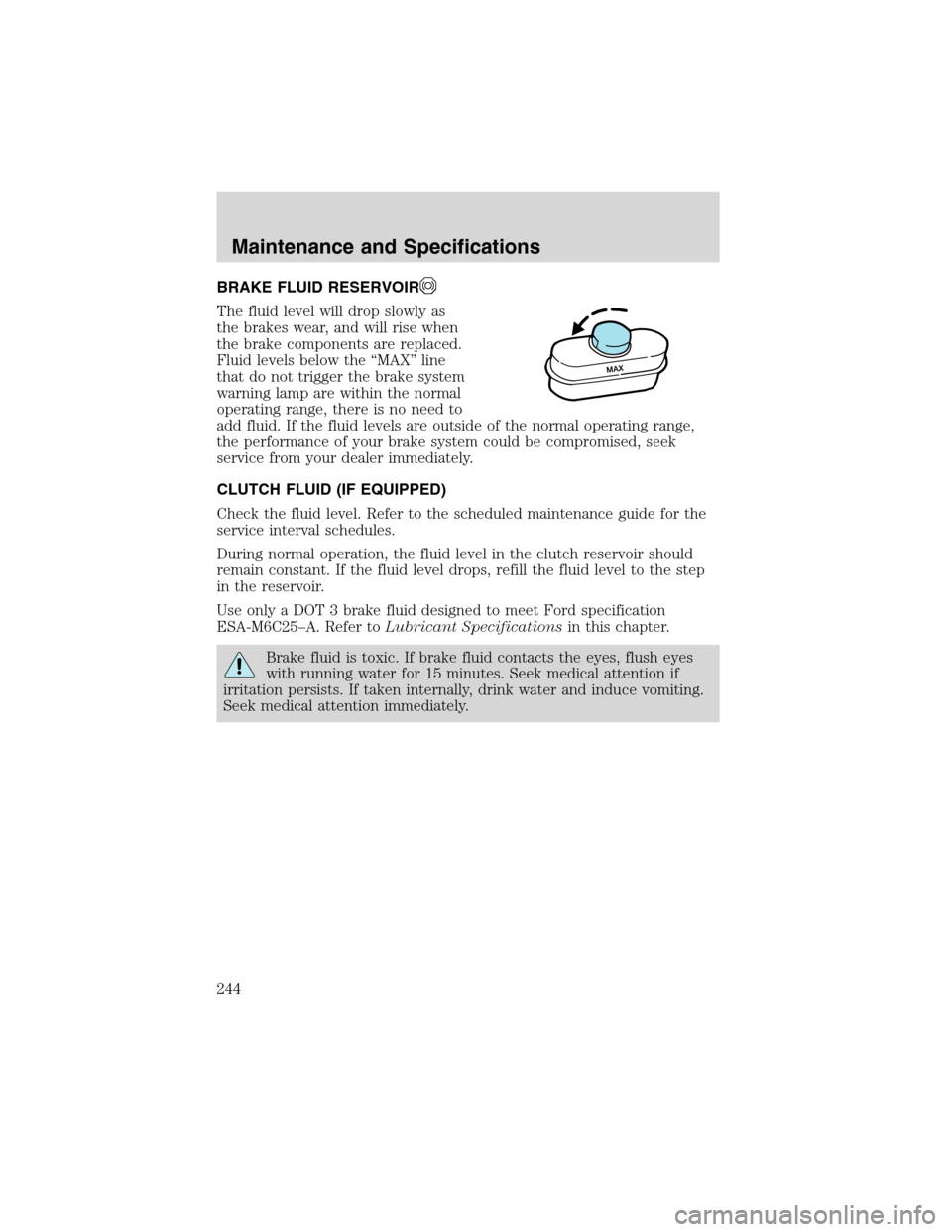
BRAKE FLUID RESERVOIR
The fluid level will drop slowly as
the brakes wear, and will rise when
the brake components are replaced.
Fluid levels below the“MAX”line
that do not trigger the brake system
warning lamp are within the normal
operating range, there is no need to
add fluid. If the fluid levels are outside of the normal operating range,
the performance of your brake system could be compromised, seek
service from your dealer immediately.
CLUTCH FLUID (IF EQUIPPED)
Check the fluid level. Refer to the scheduled maintenance guide for the
service interval schedules.
During normal operation, the fluid level in the clutch reservoir should
remain constant. If the fluid level drops, refill the fluid level to the step
in the reservoir.
Use only a DOT 3 brake fluid designed to meet Ford specification
ESA-M6C25–A. Refer toLubricant Specificationsin this chapter.
Brake fluid is toxic. If brake fluid contacts the eyes, flush eyes
with running water for 15 minutes. Seek medical attention if
irritation persists. If taken internally, drink water and induce vomiting.
Seek medical attention immediately.
Maintenance and Specifications
244
Page 273 of 280
A
Accessory delay ..........................61
Air bag supplemental
restraint system ........................111
and child safety seats ............113
description ..............................111
disposal ....................................115
driver air bag ..........................113
indicator light .........................115
operation .................................113
passenger air bag ...................113
passenger deactivation
switch ......................................116
Air cleaner filter ...............250, 255
Air conditioning ..........................41
Ambulance packages ....................8
Antifreeze (see
Engine coolant) ........................227
Anti-lock brake system
(see Brakes) ..............................140
Armrests ......................................98
Audio system (see
Radio) ........................19, 25, 28, 31
Automatic transmission ............143
driving an automatic
overdrive .................................144
fluid, adding ............................245
fluid, checking ........................245
fluid, refill capacities ..............256
fluid, specification ..................262
Auxiliary power point .................59
Axle
lubricant
specifications ..................259, 262
refill capacities ........................256
traction lok ..............................142B
Battery .......................................225
acid, treating emergencies .....225
jumping a disabled battery ....191
maintenance-free ....................225
replacement, specifications ...255
servicing ..................................225
Bed extender ..............................73
BeltMinder .................................106
Brakes ........................................140
anti-lock ...................................140
anti-lock brake system
(ABS) warning light ...............140
fluid, checking and adding ....244
fluid, refill capacities ..............256
fluid, specifications .........259, 262
lubricant
specifications ..................259, 262
parking ....................................141
shift interlock ..........................143
Bulbs ............................................48
C
Calculating load ........................163
Capacities for refilling fluids ....256
Cassette tape player ...................28
CD-single premium .........19, 25, 31
Cell phone use ............................60
Certification Label ....................267
Changing a tire .........................184
Child safety restraints ..............120
child safety belts ....................120
Child safety seats ......................123
attaching with tether
straps .......................................128
in front seat ............................124
in rear seat ......................124, 127
Index
273
Page 276 of 280
I
Ignition ...............................135, 262
Infant seats (see
Safety seats) .............................123
Inspection/maintenance
(I/M) testing ..............................242
Instrument panel
cleaning ...................................212
cluster ........................................12
lighting up panel and
interior .......................................46
J
Jack ............................................184
positioning ...............................184
storage .....................................184
Jump-starting your vehicle ......191
K
Keyless entry system .................85
Keys
positions of the ignition .........135
L
Lamps
autolamp system .......................44
bulb replacement
specifications chart ..................48
cargo lamps ...............................46
daytime running light ...............45
fog lamps ...................................44
headlamps .................................44
headlamps, flash to pass ..........45
instrument panel, dimming .....46
interior lamps .....................47–48
replacing bulbs ...................48–53Lane change indicator (see
Turn signal) .................................46
Lights, warning and indicator ....12
anti-lock brakes (ABS) ..........140
speed control ............................66
Load limits .................................161
GAWR ......................................161
GVWR ......................................161
trailer towing ..........................161
Loading instructions .................163
Locks
childproof ..................................79
Lubricant specifications ...259, 262
Lumbar support, seats ...............93
M
Manual transmission .................146
fluid capacities ........................256
lubricant specifications ..........262
reverse .....................................149
Mirrors .........................................55
automatic dimming
rearview mirror .........................61
fold away ...................................63
side view mirrors (power) .......62
Moon roof ....................................66
Motorcraft parts ................238, 255
O
Octane rating ............................236
Oil (see Engine oil) ..................221
P
Parking brake ............................141
Parts (see Motorcraft parts) ....255
Index
276
Page 277 of 280
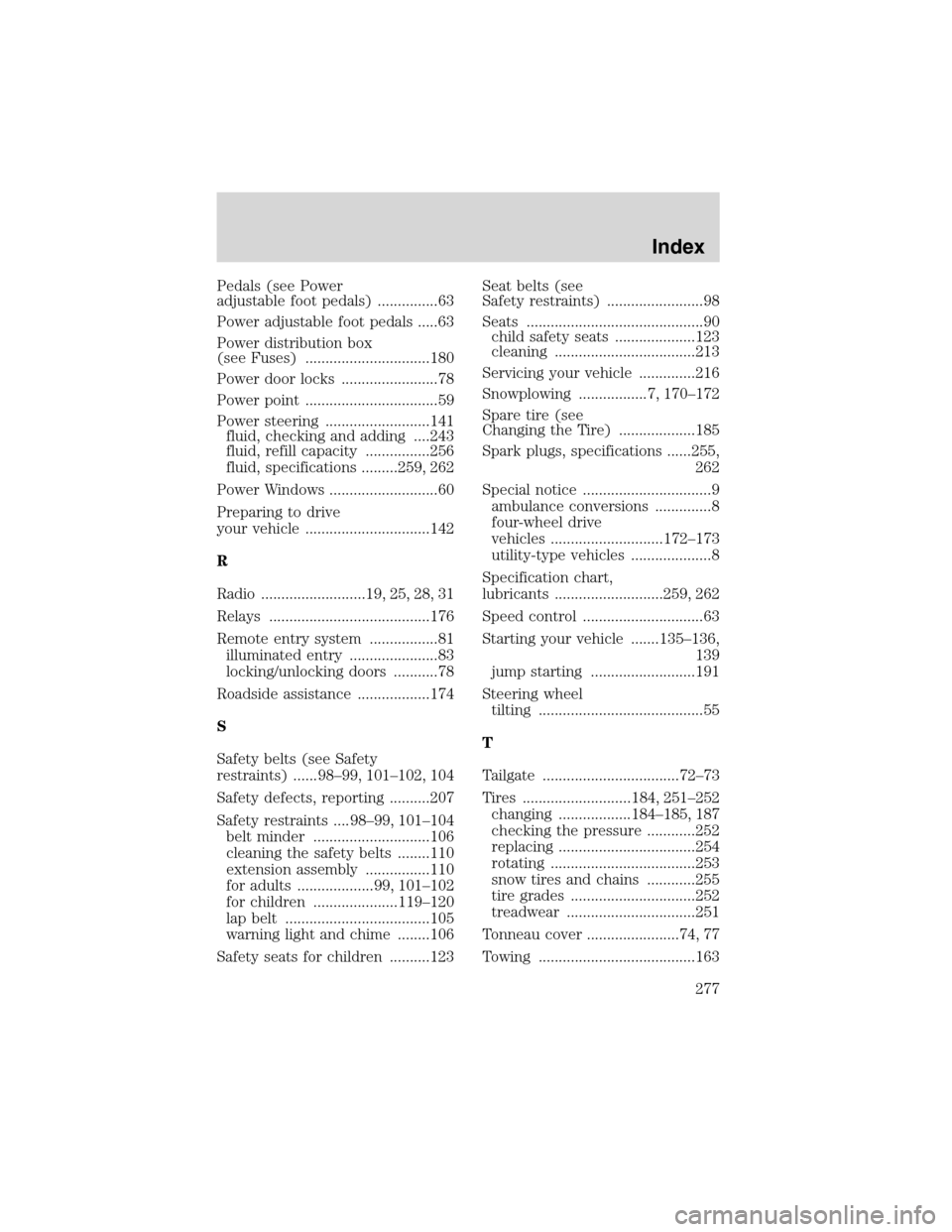
Pedals (see Power
adjustable foot pedals) ...............63
Power adjustable foot pedals .....63
Power distribution box
(see Fuses) ...............................180
Power door locks ........................78
Power point .................................59
Power steering ..........................141
fluid, checking and adding ....243
fluid, refill capacity ................256
fluid, specifications .........259, 262
Power Windows ...........................60
Preparing to drive
your vehicle ...............................142
R
Radio ..........................19, 25, 28, 31
Relays ........................................176
Remote entry system .................81
illuminated entry ......................83
locking/unlocking doors ...........78
Roadside assistance ..................174
S
Safety belts (see Safety
restraints) ......98–99, 101–102, 104
Safety defects, reporting ..........207
Safety restraints .... 98–99, 101–104
belt minder .............................106
cleaning the safety belts ........110
extension assembly ................110
for adults ...................99, 101–102
for children .....................119–120
lap belt ....................................105
warning light and chime ........106
Safety seats for children ..........123Seat belts (see
Safety restraints) ........................98
Seats ............................................90
child safety seats ....................123
cleaning ...................................213
Servicing your vehicle ..............216
Snowplowing .................7, 170–172
Spare tire (see
Changing the Tire) ...................185
Spark plugs, specifications ......255,
262
Special notice ................................9
ambulance conversions ..............8
four-wheel drive
vehicles ............................172–173
utility-type vehicles ....................8
Specification chart,
lubricants ...........................259, 262
Speed control ..............................63
Starting your vehicle .......135–136,
139
jump starting ..........................191
Steering wheel
tilting .........................................55
T
Tailgate ..................................72–73
Tires ...........................184, 251–252
changing ..................184–185, 187
checking the pressure ............252
replacing ..................................254
rotating ....................................253
snow tires and chains ............255
tire grades ...............................252
treadwear ................................251
Tonneau cover .......................74, 77
Towing .......................................163
Index
277
Page 278 of 280
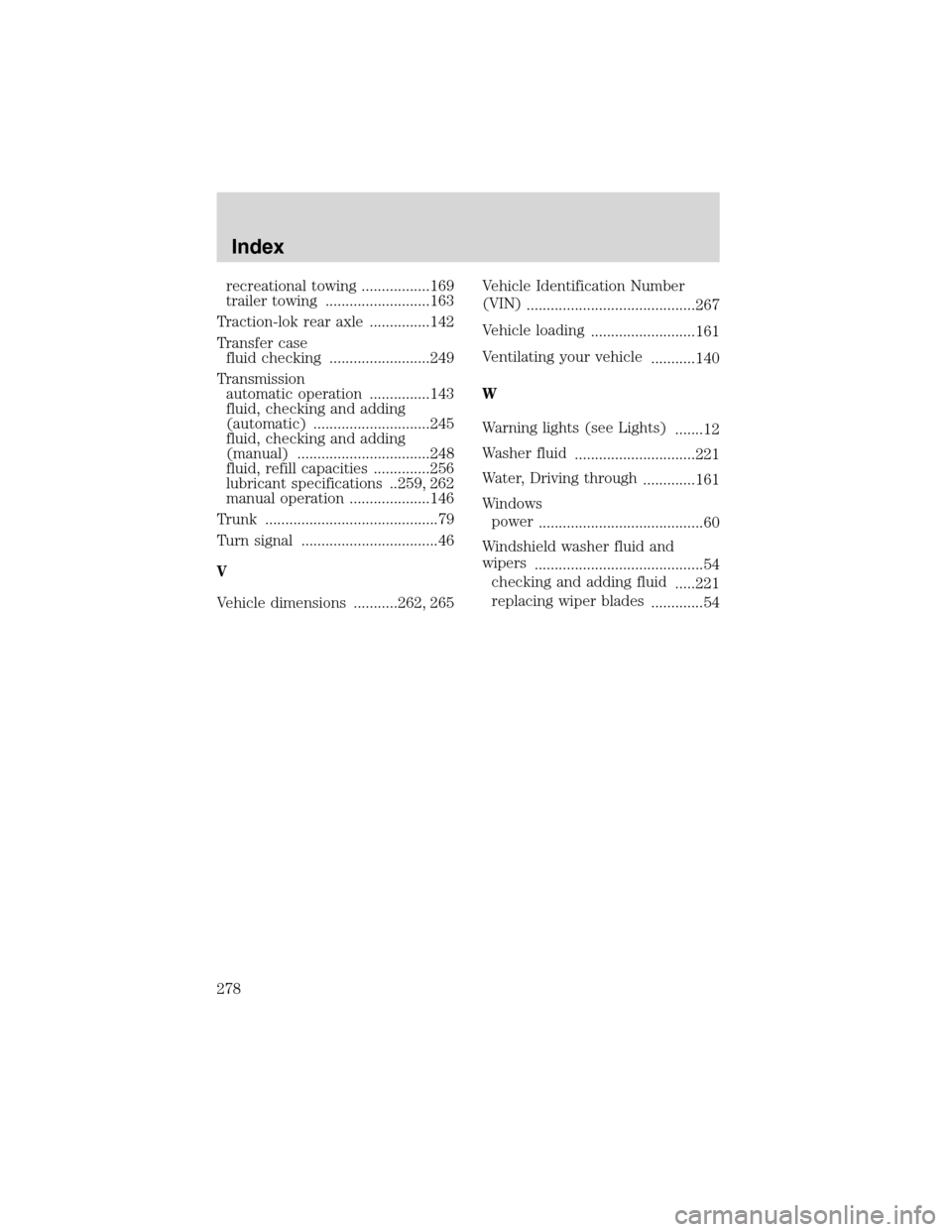
recreational towing .................169
trailer towing ..........................163
Traction-lok rear axle ...............142
Transfer case
fluid checking .........................249
Transmission
automatic operation ...............143
fluid, checking and adding
(automatic) .............................245
fluid, checking and adding
(manual) .................................248
fluid, refill capacities ..............256
lubricant specifications ..259, 262
manual operation ....................146
Trunk ...........................................79
Turn signal ..................................46
V
Vehicle dimensions ...........262, 265Vehicle Identification Number
(VIN)
..........................................267
Vehicle loading
..........................161
Ventilating your vehicle
...........140
W
Warning lights (see Lights)
.......12
Washer fluid
..............................221
Water, Driving through
.............161
Windows
power
.........................................60
Windshield washer fluid and
wipers
..........................................54
checking and adding fluid
.....221
replacing wiper blades
.............54
Index
278