reset FORD F150 2009 12.G Service Manual
[x] Cancel search | Manufacturer: FORD, Model Year: 2009, Model line: F150, Model: FORD F150 2009 12.GPages: 405, PDF Size: 2.82 MB
Page 256 of 405
3.GAIN setting display:Shows the current GAIN setting. This will
illuminate when a trailer is connected, flash if the trailer becomes
disconnected, or remain off if no trailer is connected.
4.+/– (GAIN adjustment buttons):Pressing these buttons will adjust
the TBC’s power output to the trailer brakes (in 0.5 increments). The
GAIN setting can be increased to a maximum of 10.0 or decreased to a
minimum of 0 (no trailer braking). Pressing and holding a button will
raise or lower the setting continuously. Continued pressing of a gain
button for five seconds after reaching a limit will reset the gain to the
previous setting.
5.Manual control lever:Slide the control lever to the left to activate
power to the trailer’s electric brakes independent of the tow vehicle’s
brakes (seeProcedure for adjusting GAINsection following for
instructions on proper use of this feature). If the manual control is
activated while the brake is also applied, the greater of the two inputs
determines the power sent to the trailer brakes.
•Stop Lamps:Activating the TBC manual control lever will illuminate
both the trailer brake lamps and the tow vehicle brake lamps except
the Center High-Mount Stop Lamp (presuming proper trailer electrical
connection). Pressing the vehicle brake pedal will also illuminate both
trailer and vehicle brake lamps.
GAIN:
The GAIN setting is used to set the TBC for the specific towing
condition and should be changed as towing conditions change. Changes
to towing conditions include trailer load, vehicle load, road conditions
and weather.
The GAIN should be set to provide the maximum trailer braking
assistance while ensuring the trailer wheels do not lock when braking.
Locked trailer wheels may lead to trailer instability.
Procedure for adjusting GAIN:
Note:This should only be performed in a traffic free environment at
speeds of approximately 20–25 mph (30–40 km/h).
1. Make sure the trailer brakes are in good working condition,
functioning normally, and properly adjusted. See your trailer dealer if
necessary.
2. Hook up the trailer and make the electrical connections according to
the trailer manufacturer’s instructions.
3. When a trailer with electric brakes is plugged in, the trailer connection
indicator will illuminate blue on the TBC and the GAIN setting display
will illuminate.
2009 F-150(f12)
Owners Guide, 1st Printing
USA(fus)
Tires, Wheels and Loading
256
Page 297 of 405
3. Move the 4WD control to the desired position.
The message center will display4X4 SHIFT IN PROGRESSduring the
shift. The message center will then display the system mode selected.
If any of the above shift conditions are not met, the shift will not occur
and the message center will display information guiding the driver
through the proper shifting procedures.
If 4X4 SHIFT IN PROGRESS is displayed for more than five
seconds, transfer case gear tooth blockage is present. To alleviate
this condition, move the vehicle forward approximately five feet
(2 meters). If a blocked shift remains present, reset the 4X4
mode select switch to the desired mode. The system will
reattempt a shift.
Note:Some noise may be heard as the system shifts or engages; this is
normal.
Electronic locking differential (ELD) (if equipped)
The electronic locking differential (ELD) is a device housed in the rear
axle which allows both rear wheels to turn at the same speed. The ELD
can provide additional traction should the vehicle become stuck. The
ELD is electronically activated by the driver and can be shifted on the
fly. It is intended for use in mud, rocks, sand, or any off-road condition
where maximum traction is needed. It is not intended for use on dry
pavement.
The ELD is affected by the following conditions:
•The 4WD control must be in either 4H or 4L mode.
•The ELD will not engage if the vehicle speed is above 20 mph
(30 km/h) in 4X4 High or 56 mph (90 km/h) in 4X4 Low.
•In 4X4 High, the ELD will disengage at speeds above 25 mph
(40 km/h) and will automatically reengage at speeds below 20 mph
(30 km/h).
•In 4X4 Low, the ELD will disengage at speeds above 62 mph
(100 km/h) and will automatically reengage at speeds below 56 mph
(90 km/h).
•The ELD will not engage if one wheel is spinning 9 mph (15 km/h)
faster than the other.
The ELD is designed for off-road use only.
2009 F-150(f12)
Owners Guide, 1st Printing
USA(fus)
Driving
297
Page 362 of 405
If the battery has been disconnected or a new battery has been installed,
the clock and radio settings must be reset once the battery is
reconnected.
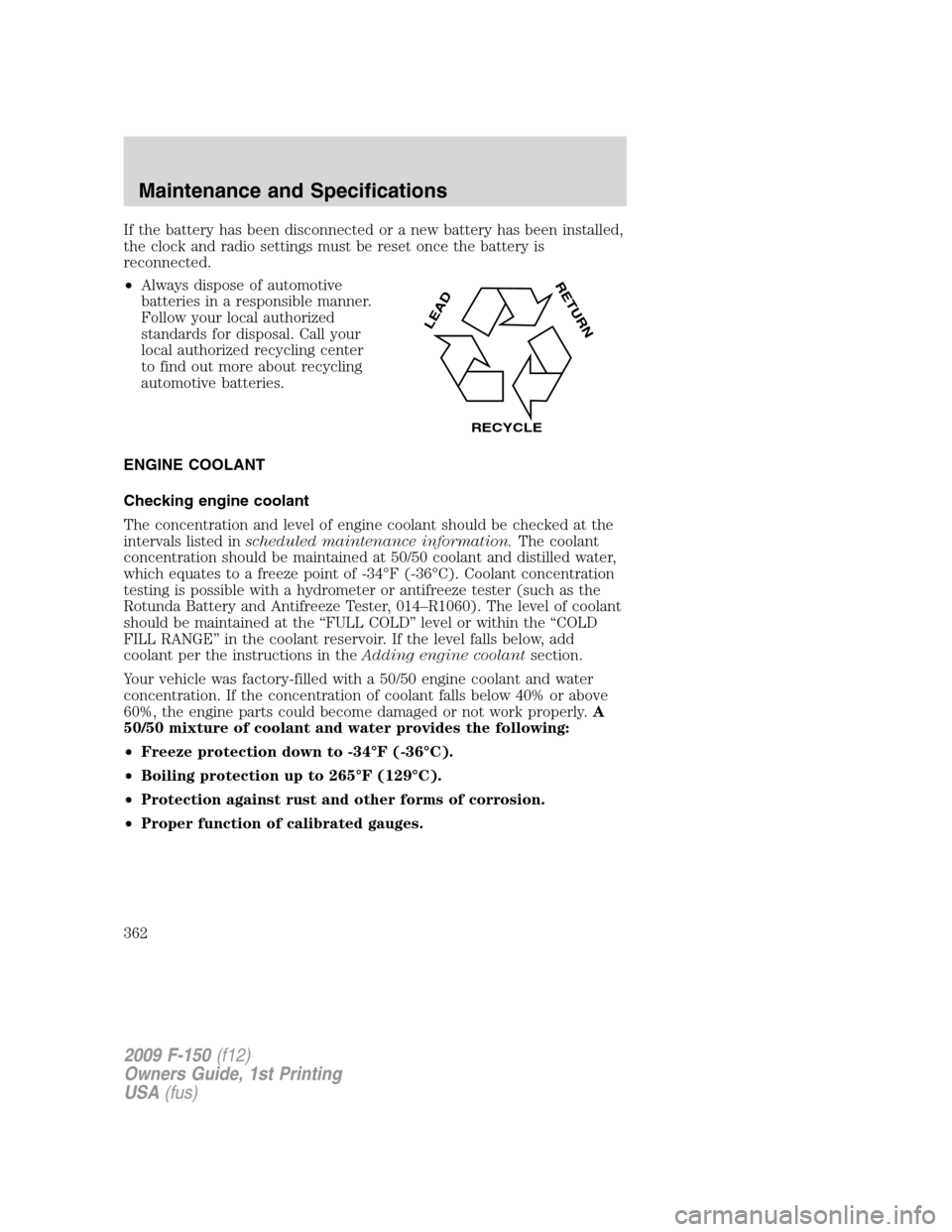
•Always dispose of automotive
batteries in a responsible manner.
Follow your local authorized
standards for disposal. Call your
local authorized recycling center
to find out more about recycling
automotive batteries.
ENGINE COOLANT
Checking engine coolant
The concentration and level of engine coolant should be checked at the
intervals listed inscheduled maintenance information.The coolant
concentration should be maintained at 50/50 coolant and distilled water,
which equates to a freeze point of -34°F (-36°C). Coolant concentration
testing is possible with a hydrometer or antifreeze tester (such as the
Rotunda Battery and Antifreeze Tester, 014–R1060). The level of coolant
should be maintained at the “FULL COLD” level or within the “COLD
FILL RANGE” in the coolant reservoir. If the level falls below, add
coolant per the instructions in theAdding engine coolantsection.
Your vehicle was factory-filled with a 50/50 engine coolant and water
concentration. If the concentration of coolant falls below 40% or above
60%, the engine parts could become damaged or not work properly.A
50/50 mixture of coolant and water provides the following:
•Freeze protection down to -34°F (-36°C).
•Boiling protection up to 265°F (129°C).
•Protection against rust and other forms of corrosion.
•Proper function of calibrated gauges.
L
E
A
D
RETURN
RECYCLE
2009 F-150(f12)
Owners Guide, 1st Printing
USA(fus)
Maintenance and Specifications
362
Page 367 of 405
How fail-safe cooling works
If the engine begins to overheat:
•
The engine coolant temperature gauge will move to the red (hot) area.
•The mini message center (if equipped) will indicate “Check Gauges”,
refer toWarning lights and chimesin theInstrument Clusterchapter.
•Thelight will illuminate.
If the engine reaches a preset over-temperature condition, the engine
will automatically switch to alternating cylinder operation. Each disabled
cylinder acts as an air pump and cools the engine.
When this occurs the vehicle will still operate. However:
•The engine power will be limited.
•The air conditioning system will be disabled.
Continued operation will increase the engine temperature:
•The engine will completely shut down.
•Steering and braking effort will increase.
Once the engine temperature cools, the engine can be re-started. Take
your vehicle to an authorized dealer as soon as possible to minimize
engine damage.
When fail-safe mode is activated
You have limited engine power when in the fail-safe mode, so drive the
vehicle with caution. The vehicle will not be able to maintain high speed
operation and the engine will run rough. Remember that the engine is
capable of completely shutting down automatically to prevent engine
damage, therefore:
1. Pull off the road as soon as safely possible and turn off the engine.
2. Arrange for the vehicle to be taken to an authorized dealer.
3. If this is not possible, wait a short period for the engine to cool.
4. Check the coolant level and replenish if low.
WARNING:Never remove the coolant reservoir cap while the
engine is running or hot.
5. Restart the engine and take your vehicle to an authorized dealer.
Driving the vehicle without repairing the engine problem
increases the chance of engine damage. Take your vehicle to an
authorized dealer as soon as possible.
2009 F-150(f12)
Owners Guide, 1st Printing
USA(fus)
Maintenance and Specifications
367
Page 371 of 405
Easy Fuel™ “no cap” fuel system
Your fuel tank is equipped with an Easy Fuel™ “no cap” fuel filler
system. This allows you to simply open the fuel filler door and insert the
fuel filler nozzle into the fuel system. The Easy Fuel™ system is
self-sealing and protected against dust, dirt, water and snow/ice.
When fueling your vehicle:
1. Turn the engine off.
2. Open the fuel filler door.
3. Slowly insert the fuel filler nozzle fully into the fuel system. Pump fuel
as normal.
4. After you are done pumping fuel, slowly remove the fuel filler
nozzle—allow about five seconds after pumping fuel before removing the
fuel filler nozzle. This allows residual fuel to drain back into the fuel tank
and not spill onto the vehicle.
If the Check Fuel Fill Inlet lamp or Check Fuel Fill Inlet message comes
on, the fuel fill inlet may not have properly closed. The inlet may have
stuck open or debris may be preventing the inlet from fully closing. At
the next opportunity, safely pull off the road, turn off the engine, open
the fuel filler door and remove any visible debris from the fuel fill
opening. Insert either the fuel fill nozzle or the fuel fill funnel (see
Refilling with a portable fuel containerfor funnel location) provided
with the vehicle several times to dislodge any debris and/or allow the
inlet to close properly. If this action corrects the problem, the Check
Fuel Fill Inlet lamp or Check Fuel Fill Inlet message may not reset
immediately. It may take several driving cycles for the Check Fuel Fill
Inlet lamp or Check Fuel Fill Inlet message to turn off. A driving cycle
consists of an engine start-up (after four or more hours with the engine
off) followed by city/highway driving. Continuing to drive with the Check
Fuel Fill Inlet lamp or Check Fuel Fill Inlet message on may cause the
Service Engine Soon lamp to turn on as well.
WARNING:The fuel system may be under pressure. If you hear
a hissing sound near the fuel filler door (Easy Fuel™ “no cap”
fuel system), do not refuel until the sound stops. Otherwise, fuel may
spray out, which could cause serious personal injury.
2009 F-150(f12)
Owners Guide, 1st Printing
USA(fus)
Maintenance and Specifications
371