wheel FORD F150 2009 12.G Workshop Manual
[x] Cancel search | Manufacturer: FORD, Model Year: 2009, Model line: F150, Model: FORD F150 2009 12.GPages: 405, PDF Size: 2.82 MB
Page 248 of 405
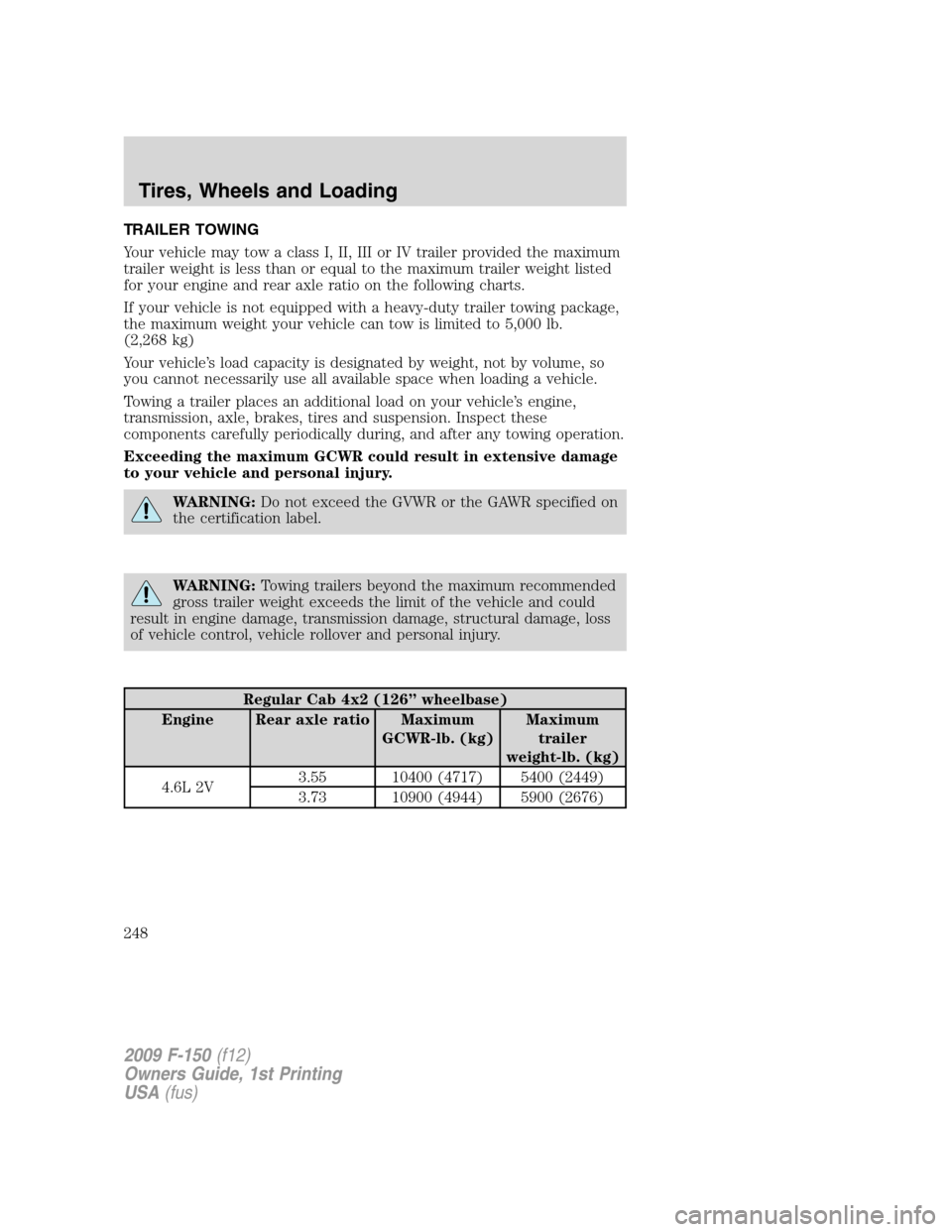
TRAILER TOWING
Your vehicle may tow a class I, II, III or IV trailer provided the maximum
trailer weight is less than or equal to the maximum trailer weight listed
for your engine and rear axle ratio on the following charts.
If your vehicle is not equipped with a heavy-duty trailer towing package,
the maximum weight your vehicle can tow is limited to 5,000 lb.
(2,268 kg)
Your vehicle’s load capacity is designated by weight, not by volume, so
you cannot necessarily use all available space when loading a vehicle.
Towing a trailer places an additional load on your vehicle’s engine,
transmission, axle, brakes, tires and suspension. Inspect these
components carefully periodically during, and after any towing operation.
Exceeding the maximum GCWR could result in extensive damage
to your vehicle and personal injury.
WARNING:Do not exceed the GVWR or the GAWR specified on
the certification label.
WARNING:Towing trailers beyond the maximum recommended
gross trailer weight exceeds the limit of the vehicle and could
result in engine damage, transmission damage, structural damage, loss
of vehicle control, vehicle rollover and personal injury.
Regular Cab 4x2 (126” wheelbase)
Engine Rear axle ratio Maximum
GCWR-lb. (kg)Maximum
trailer
weight-lb. (kg)
4.6L 2V3.55 10400 (4717) 5400 (2449)
3.73 10900 (4944) 5900 (2676)
2009 F-150(f12)
Owners Guide, 1st Printing
USA(fus)
Tires, Wheels and Loading
248
Page 249 of 405
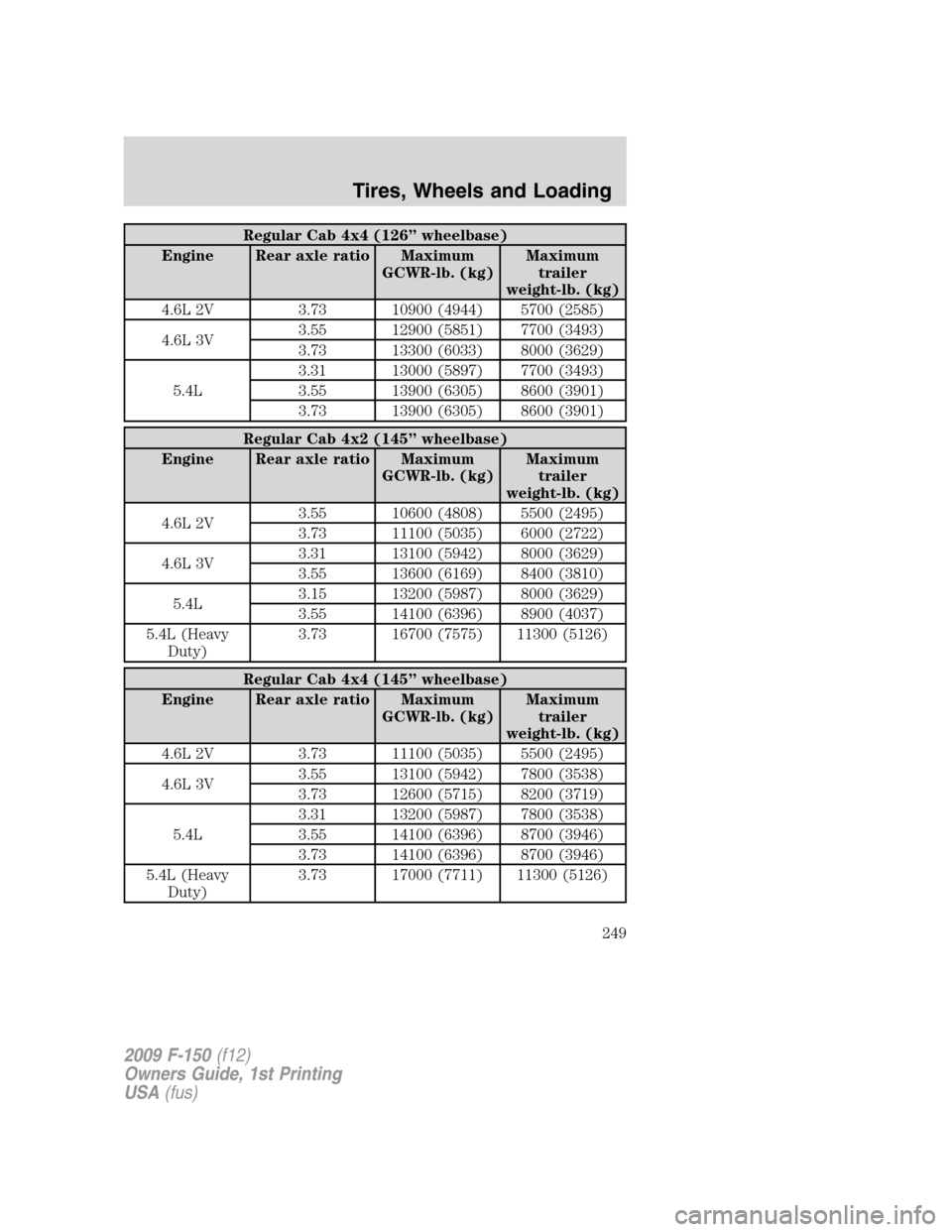
Regular Cab 4x4 (126” wheelbase)
Engine Rear axle ratio Maximum
GCWR-lb. (kg)Maximum
trailer
weight-lb. (kg)
4.6L 2V 3.73 10900 (4944) 5700 (2585)
4.6L 3V3.55 12900 (5851) 7700 (3493)
3.73 13300 (6033) 8000 (3629)
5.4L3.31 13000 (5897) 7700 (3493)
3.55 13900 (6305) 8600 (3901)
3.73 13900 (6305) 8600 (3901)
Regular Cab 4x2 (145” wheelbase)
Engine Rear axle ratio Maximum
GCWR-lb. (kg)Maximum
trailer
weight-lb. (kg)
4.6L 2V3.55 10600 (4808) 5500 (2495)
3.73 11100 (5035) 6000 (2722)
4.6L 3V3.31 13100 (5942) 8000 (3629)
3.55 13600 (6169) 8400 (3810)
5.4L3.15 13200 (5987) 8000 (3629)
3.55 14100 (6396) 8900 (4037)
5.4L (Heavy
Duty)3.73 16700 (7575) 11300 (5126)
Regular Cab 4x4 (145” wheelbase)
Engine Rear axle ratio Maximum
GCWR-lb. (kg)Maximum
trailer
weight-lb. (kg)
4.6L 2V 3.73 11100 (5035) 5500 (2495)
4.6L 3V3.55 13100 (5942) 7800 (3538)
3.73 12600 (5715) 8200 (3719)
5.4L3.31 13200 (5987) 7800 (3538)
3.55 14100 (6396) 8700 (3946)
3.73 14100 (6396) 8700 (3946)
5.4L (Heavy
Duty)3.73 17000 (7711) 11300 (5126)
2009 F-150(f12)
Owners Guide, 1st Printing
USA(fus)
Tires, Wheels and Loading
249
Page 250 of 405
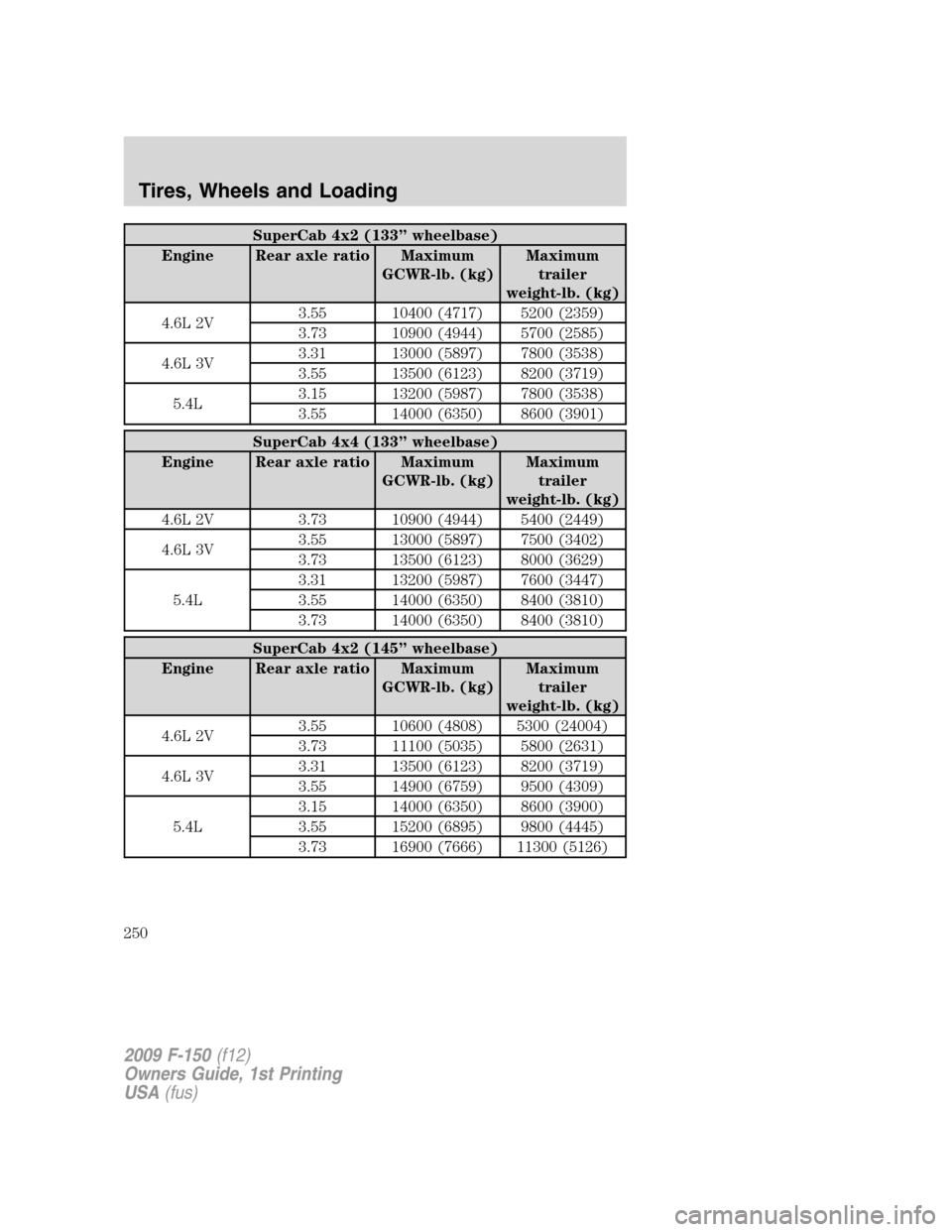
SuperCab 4x2 (133” wheelbase)
Engine Rear axle ratio Maximum
GCWR-lb. (kg)Maximum
trailer
weight-lb. (kg)
4.6L 2V3.55 10400 (4717) 5200 (2359)
3.73 10900 (4944) 5700 (2585)
4.6L 3V3.31 13000 (5897) 7800 (3538)
3.55 13500 (6123) 8200 (3719)
5.4L3.15 13200 (5987) 7800 (3538)
3.55 14000 (6350) 8600 (3901)
SuperCab 4x4 (133” wheelbase)
Engine Rear axle ratio Maximum
GCWR-lb. (kg)Maximum
trailer
weight-lb. (kg)
4.6L 2V 3.73 10900 (4944) 5400 (2449)
4.6L 3V3.55 13000 (5897) 7500 (3402)
3.73 13500 (6123) 8000 (3629)
5.4L3.31 13200 (5987) 7600 (3447)
3.55 14000 (6350) 8400 (3810)
3.73 14000 (6350) 8400 (3810)
SuperCab 4x2 (145” wheelbase)
Engine Rear axle ratio Maximum
GCWR-lb. (kg)Maximum
trailer
weight-lb. (kg)
4.6L 2V3.55 10600 (4808) 5300 (24004)
3.73 11100 (5035) 5800 (2631)
4.6L 3V3.31 13500 (6123) 8200 (3719)
3.55 14900 (6759) 9500 (4309)
5.4L3.15 14000 (6350) 8600 (3900)
3.55 15200 (6895) 9800 (4445)
3.73 16900 (7666) 11300 (5126)
2009 F-150(f12)
Owners Guide, 1st Printing
USA(fus)
Tires, Wheels and Loading
250
Page 251 of 405
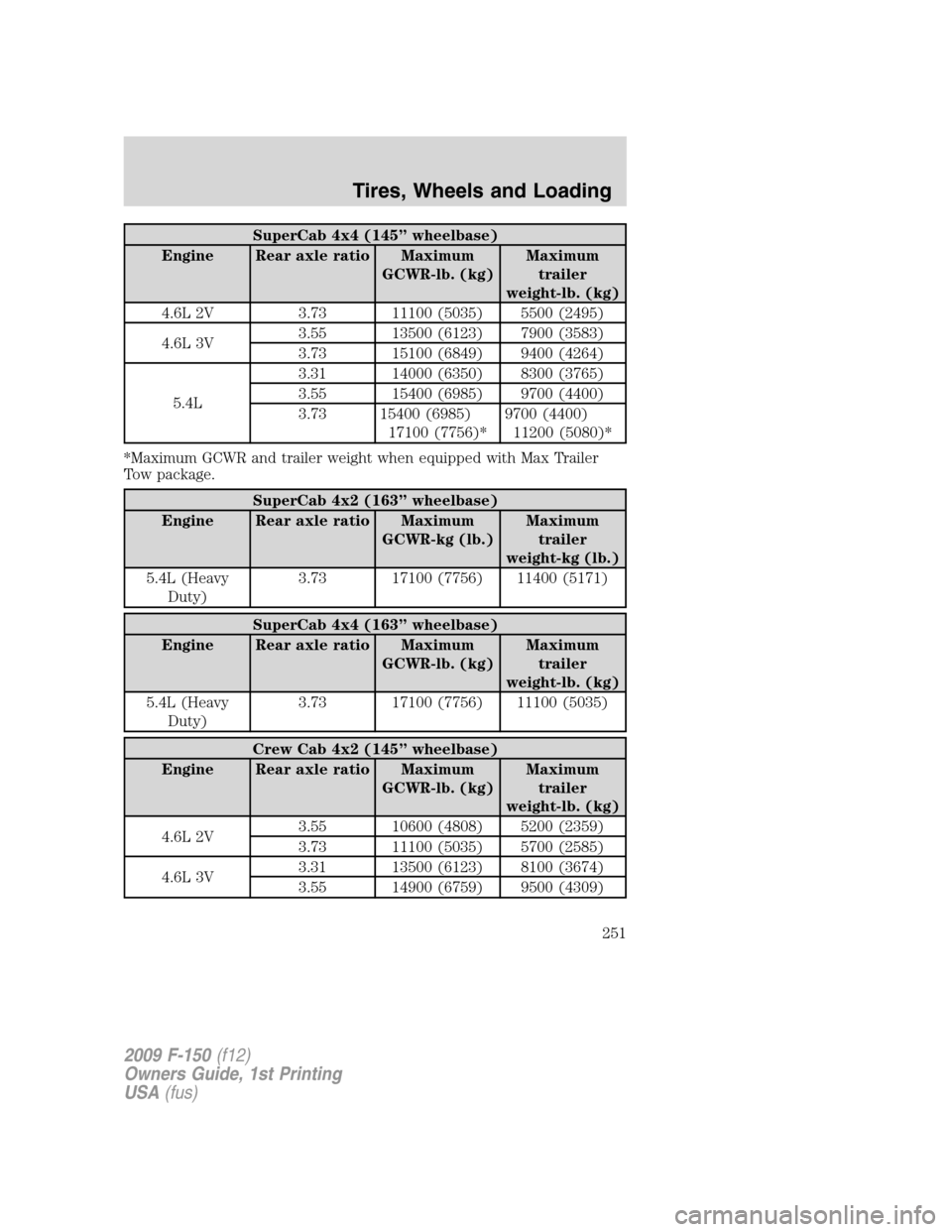
SuperCab 4x4 (145” wheelbase)
Engine Rear axle ratio Maximum
GCWR-lb. (kg)Maximum
trailer
weight-lb. (kg)
4.6L 2V 3.73 11100 (5035) 5500 (2495)
4.6L 3V3.55 13500 (6123) 7900 (3583)
3.73 15100 (6849) 9400 (4264)
5.4L3.31 14000 (6350) 8300 (3765)
3.55 15400 (6985) 9700 (4400)
3.73 15400 (6985)
17100 (7756)*9700 (4400)
11200 (5080)*
*Maximum GCWR and trailer weight when equipped with Max Trailer
Tow package.
SuperCab 4x2 (163” wheelbase)
Engine Rear axle ratio Maximum
GCWR-kg (lb.)Maximum
trailer
weight-kg (lb.)
5.4L (Heavy
Duty)3.73 17100 (7756) 11400 (5171)
SuperCab 4x4 (163” wheelbase)
Engine Rear axle ratio Maximum
GCWR-lb. (kg)Maximum
trailer
weight-lb. (kg)
5.4L (Heavy
Duty)3.73 17100 (7756) 11100 (5035)
Crew Cab 4x2 (145” wheelbase)
Engine Rear axle ratio Maximum
GCWR-lb. (kg)Maximum
trailer
weight-lb. (kg)
4.6L 2V3.55 10600 (4808) 5200 (2359)
3.73 11100 (5035) 5700 (2585)
4.6L 3V3.31 13500 (6123) 8100 (3674)
3.55 14900 (6759) 9500 (4309)
2009 F-150(f12)
Owners Guide, 1st Printing
USA(fus)
Tires, Wheels and Loading
251
Page 252 of 405
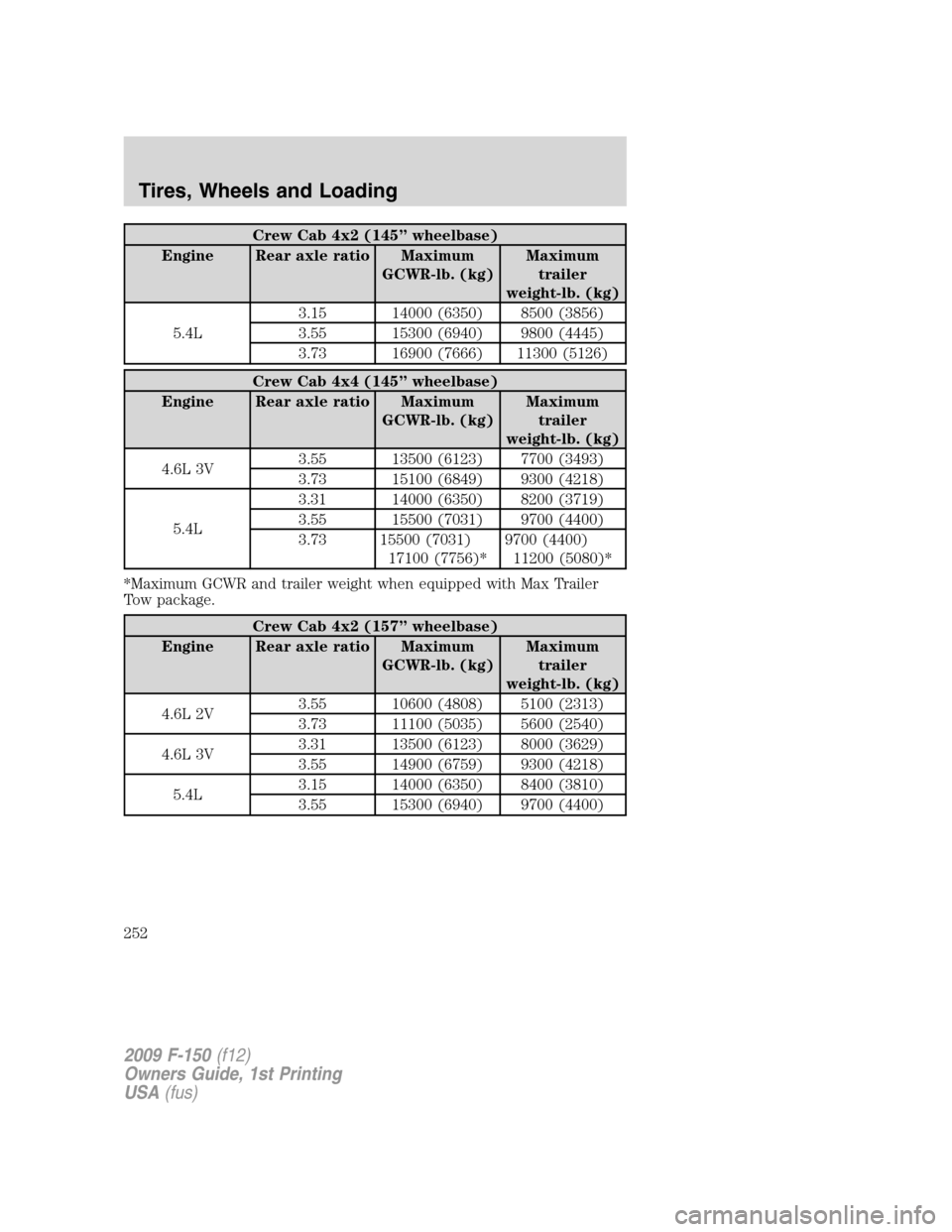
Crew Cab 4x2 (145” wheelbase)
Engine Rear axle ratio Maximum
GCWR-lb. (kg)Maximum
trailer
weight-lb. (kg)
5.4L3.15 14000 (6350) 8500 (3856)
3.55 15300 (6940) 9800 (4445)
3.73 16900 (7666) 11300 (5126)
Crew Cab 4x4 (145” wheelbase)
Engine Rear axle ratio Maximum
GCWR-lb. (kg)Maximum
trailer
weight-lb. (kg)
4.6L 3V3.55 13500 (6123) 7700 (3493)
3.73 15100 (6849) 9300 (4218)
5.4L3.31 14000 (6350) 8200 (3719)
3.55 15500 (7031) 9700 (4400)
3.73 15500 (7031)
17100 (7756)*9700 (4400)
11200 (5080)*
*Maximum GCWR and trailer weight when equipped with Max Trailer
Tow package.
Crew Cab 4x2 (157” wheelbase)
Engine Rear axle ratio Maximum
GCWR-lb. (kg)Maximum
trailer
weight-lb. (kg)
4.6L 2V3.55 10600 (4808) 5100 (2313)
3.73 11100 (5035) 5600 (2540)
4.6L 3V3.31 13500 (6123) 8000 (3629)
3.55 14900 (6759) 9300 (4218)
5.4L3.15 14000 (6350) 8400 (3810)
3.55 15300 (6940) 9700 (4400)
2009 F-150(f12)
Owners Guide, 1st Printing
USA(fus)
Tires, Wheels and Loading
252
Page 253 of 405
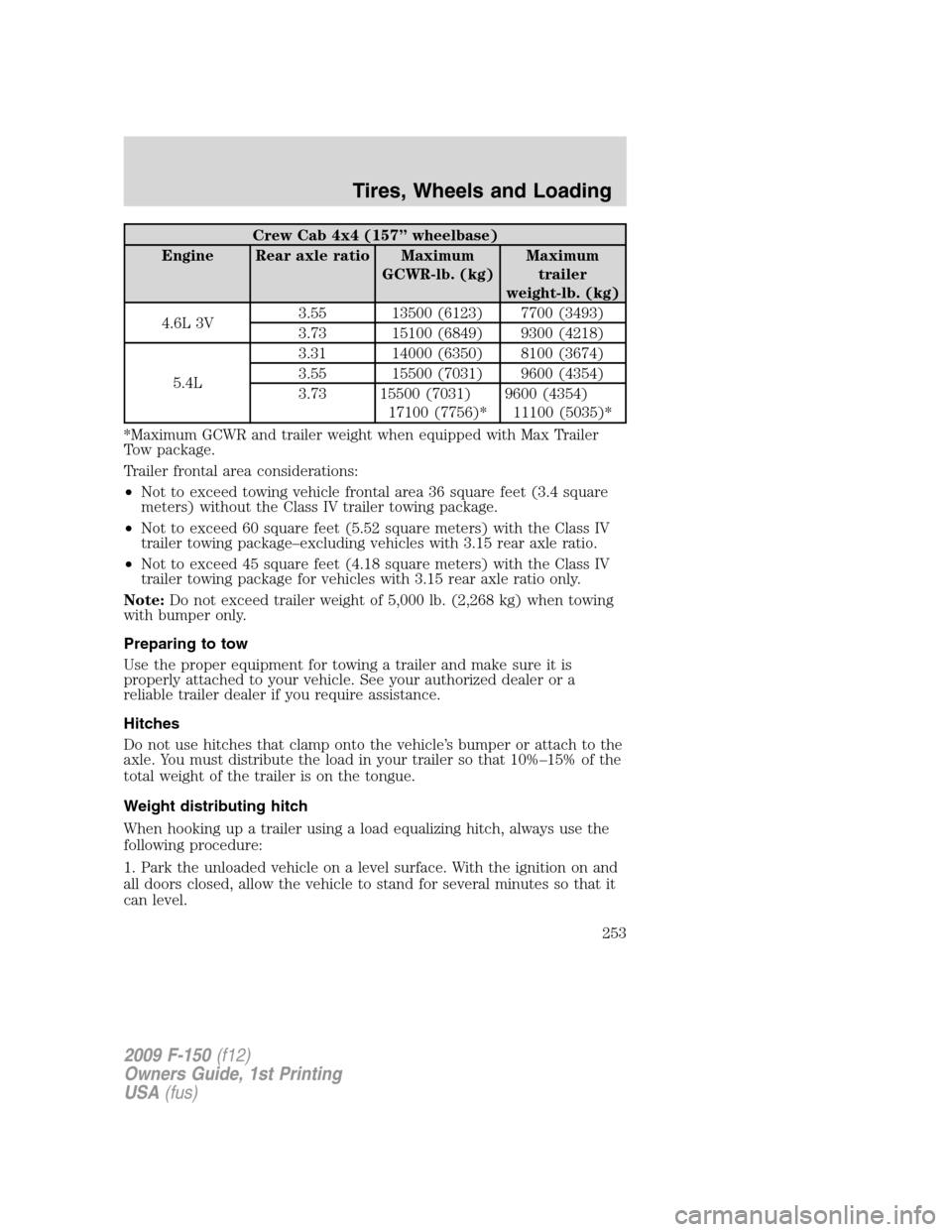
Crew Cab 4x4 (157” wheelbase)
Engine Rear axle ratio Maximum
GCWR-lb. (kg)Maximum
trailer
weight-lb. (kg)
4.6L 3V3.55 13500 (6123) 7700 (3493)
3.73 15100 (6849) 9300 (4218)
5.4L3.31 14000 (6350) 8100 (3674)
3.55 15500 (7031) 9600 (4354)
3.73 15500 (7031)
17100 (7756)*9600 (4354)
11100 (5035)*
*Maximum GCWR and trailer weight when equipped with Max Trailer
Tow package.
Trailer frontal area considerations:
•Not to exceed towing vehicle frontal area 36 square feet (3.4 square
meters) without the Class IV trailer towing package.
•Not to exceed 60 square feet (5.52 square meters) with the Class IV
trailer towing package–excluding vehicles with 3.15 rear axle ratio.
•Not to exceed 45 square feet (4.18 square meters) with the Class IV
trailer towing package for vehicles with 3.15 rear axle ratio only.
Note:Do not exceed trailer weight of 5,000 lb. (2,268 kg) when towing
with bumper only.
Preparing to tow
Use the proper equipment for towing a trailer and make sure it is
properly attached to your vehicle. See your authorized dealer or a
reliable trailer dealer if you require assistance.
Hitches
Do not use hitches that clamp onto the vehicle’s bumper or attach to the
axle. You must distribute the load in your trailer so that 10%–15% of the
total weight of the trailer is on the tongue.
Weight distributing hitch
When hooking up a trailer using a load equalizing hitch, always use the
following procedure:
1. Park the unloaded vehicle on a level surface. With the ignition on and
all doors closed, allow the vehicle to stand for several minutes so that it
can level.
2009 F-150(f12)
Owners Guide, 1st Printing
USA(fus)
Tires, Wheels and Loading
253
Page 254 of 405

2. Measure the height of a reference point on the front and rear bumpers
at the center of the vehicle.
3. Attach the trailer to the vehicle and adjust the hitch equalizers so that
the front bumper height is within
12inch (13 mm) of the reference
point. After proper adjustment, the rear bumper should be no higher
than in Step 2.
WARNING:Do not adjust a weight distributing hitch to any
position where the rear bumper of the vehicle is higher than it
was before attaching the trailer. Doing so will defeat the function of
the weight distributing hitch, which may cause unpredictable handling,
and could result in serious personal injury.
Safety chains
Always connect the trailer’s safety chains to the frame or hook retainers
of the vehicle hitch. To connect the trailer’s safety chains, cross the
chains under the trailer tongue and allow slack for turning corners.
If you use a rental trailer, follow the instructions that the rental agency
gives to you.
Do not attach safety chains to the bumper.
Trailer brakes
Electric brakes and manual, automatic or surge-type trailer brakes are
safe if installed properly and adjusted to the manufacturer’s
specifications. The trailer brakes must meet local and Federal
regulations.
WARNING:Do not connect a trailer’s hydraulic brake system
directly to your vehicle’s brake system. Your vehicle may not
have enough braking power and your chances of having a collision
greatly increase.
The braking system of the tow vehicle is rated for operation at the
GVWR not GCWR.
Integrated trailer brake controller (if equipped)
Your vehicle may be equipped with a fully integrated electronic trailer
brake controller (TBC). When used properly, the TBC helps ensure
smooth and effective trailer braking by powering the trailer’s electric
brakes with a proportional output based on the towing vehicle’s brake
pressure.
2009 F-150(f12)
Owners Guide, 1st Printing
USA(fus)
Tires, Wheels and Loading
254
Page 255 of 405
WARNING:The Ford TBC has only been verified to be
compatible with trailers having electric-actuated drum brakes
(one to four axles) and not hydraulic surge or electric-over-hydraulic
types. It is the responsibility of the customer to ensure that the trailer
brakes are adjusted appropriately, functioning normally and all electric
connections are properly made.
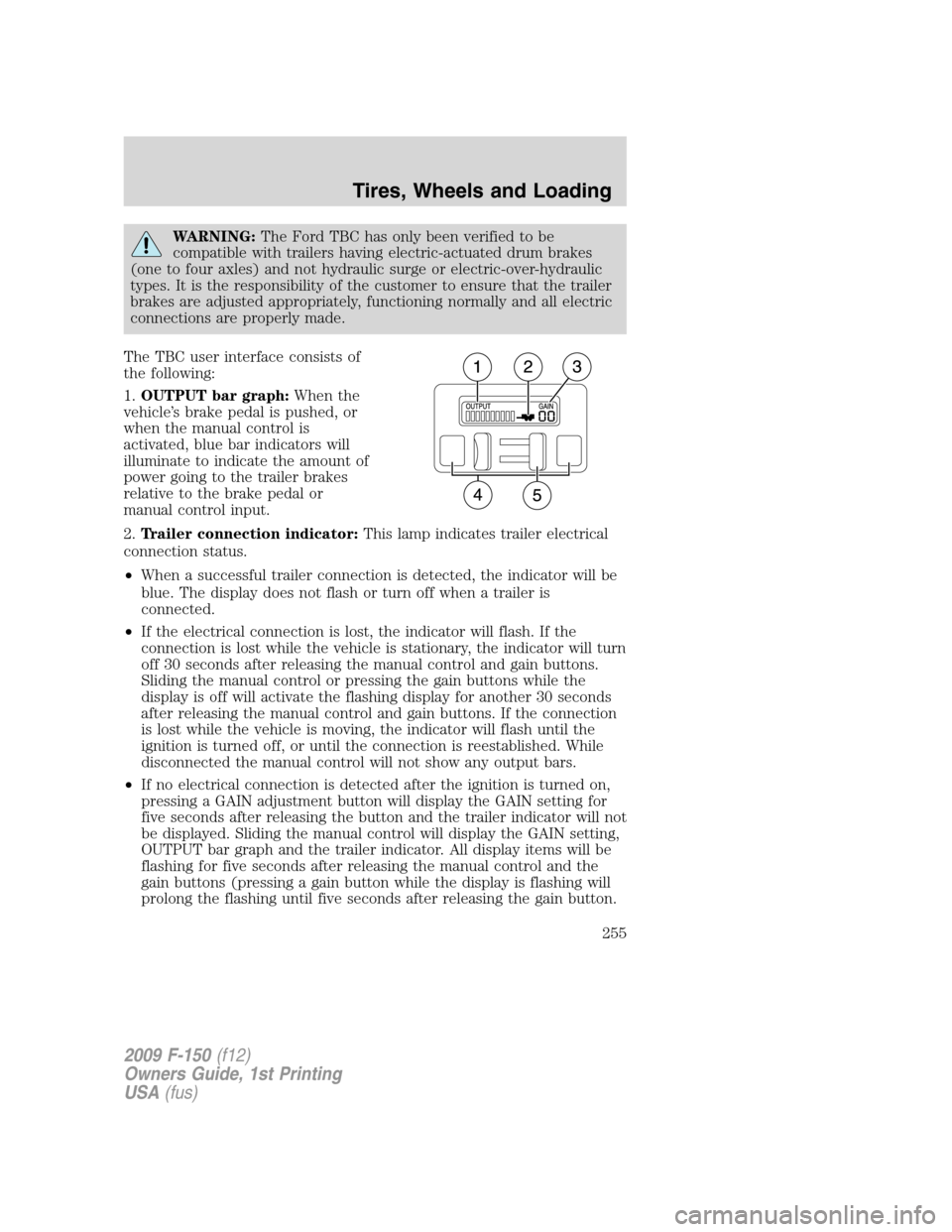
The TBC user interface consists of
the following:
1.OUTPUT bar graph:When the
vehicle’s brake pedal is pushed, or
when the manual control is
activated, blue bar indicators will
illuminate to indicate the amount of
power going to the trailer brakes
relative to the brake pedal or
manual control input.
2.Trailer connection indicator:This lamp indicates trailer electrical
connection status.
•When a successful trailer connection is detected, the indicator will be
blue. The display does not flash or turn off when a trailer is
connected.
•If the electrical connection is lost, the indicator will flash. If the
connection is lost while the vehicle is stationary, the indicator will turn
off 30 seconds after releasing the manual control and gain buttons.
Sliding the manual control or pressing the gain buttons while the
display is off will activate the flashing display for another 30 seconds
after releasing the manual control and gain buttons. If the connection
is lost while the vehicle is moving, the indicator will flash until the
ignition is turned off, or until the connection is reestablished. While
disconnected the manual control will not show any output bars.
•If no electrical connection is detected after the ignition is turned on,
pressing a GAIN adjustment button will display the GAIN setting for
five seconds after releasing the button and the trailer indicator will not
be displayed. Sliding the manual control will display the GAIN setting,
OUTPUT bar graph and the trailer indicator. All display items will be
flashing for five seconds after releasing the manual control and the
gain buttons (pressing a gain button while the display is flashing will
prolong the flashing until five seconds after releasing the gain button.
2009 F-150(f12)
Owners Guide, 1st Printing
USA(fus)
Tires, Wheels and Loading
255
Page 256 of 405
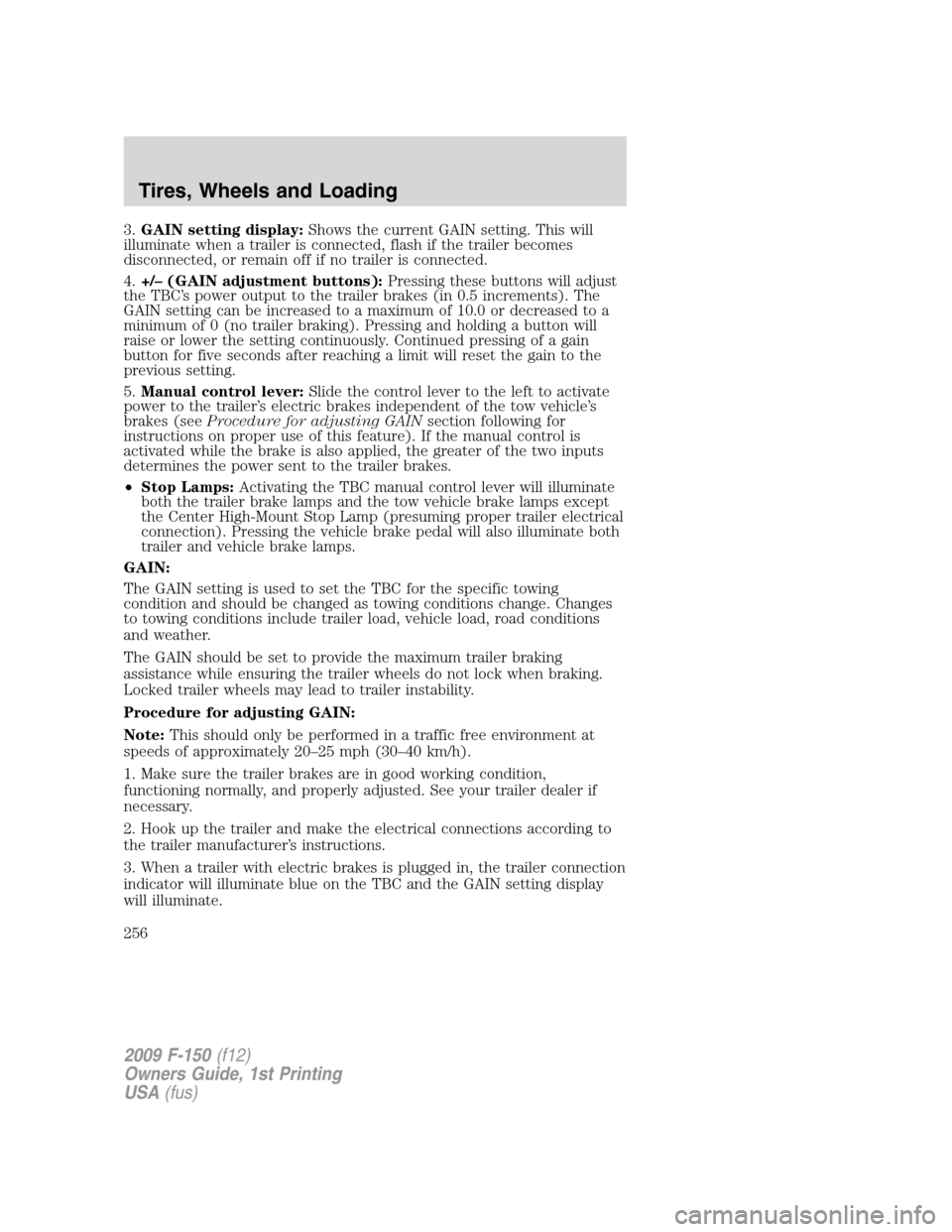
3.GAIN setting display:Shows the current GAIN setting. This will
illuminate when a trailer is connected, flash if the trailer becomes
disconnected, or remain off if no trailer is connected.
4.+/– (GAIN adjustment buttons):Pressing these buttons will adjust
the TBC’s power output to the trailer brakes (in 0.5 increments). The
GAIN setting can be increased to a maximum of 10.0 or decreased to a
minimum of 0 (no trailer braking). Pressing and holding a button will
raise or lower the setting continuously. Continued pressing of a gain
button for five seconds after reaching a limit will reset the gain to the
previous setting.
5.Manual control lever:Slide the control lever to the left to activate
power to the trailer’s electric brakes independent of the tow vehicle’s
brakes (seeProcedure for adjusting GAINsection following for
instructions on proper use of this feature). If the manual control is
activated while the brake is also applied, the greater of the two inputs
determines the power sent to the trailer brakes.
•Stop Lamps:Activating the TBC manual control lever will illuminate
both the trailer brake lamps and the tow vehicle brake lamps except
the Center High-Mount Stop Lamp (presuming proper trailer electrical
connection). Pressing the vehicle brake pedal will also illuminate both
trailer and vehicle brake lamps.
GAIN:
The GAIN setting is used to set the TBC for the specific towing
condition and should be changed as towing conditions change. Changes
to towing conditions include trailer load, vehicle load, road conditions
and weather.
The GAIN should be set to provide the maximum trailer braking
assistance while ensuring the trailer wheels do not lock when braking.
Locked trailer wheels may lead to trailer instability.
Procedure for adjusting GAIN:
Note:This should only be performed in a traffic free environment at
speeds of approximately 20–25 mph (30–40 km/h).
1. Make sure the trailer brakes are in good working condition,
functioning normally, and properly adjusted. See your trailer dealer if
necessary.
2. Hook up the trailer and make the electrical connections according to
the trailer manufacturer’s instructions.
3. When a trailer with electric brakes is plugged in, the trailer connection
indicator will illuminate blue on the TBC and the GAIN setting display
will illuminate.
2009 F-150(f12)
Owners Guide, 1st Printing
USA(fus)
Tires, Wheels and Loading
256
Page 257 of 405
4. Use the GAIN adjustment (+/–) buttons to increase or decrease the
GAIN setting to the desired starting point. A GAIN setting of 6.0 is a
good starting point for heavier loads.
5. In a traffic-free environment, tow the trailer on a dry, level surface at
a speed of 20–25 mph (30–40 km/h) and squeeze the manual control
lever completely.
6. If the trailer wheels lockup (indicated by squealing tires), reduce the
GAIN setting; if the trailer wheels turn freely, increase the GAIN setting.
Repeat Steps 5 and 6 until the GAIN setting is at a point just below
trailer-wheel lockup. If towing a heavier trailer, trailer wheel lockup
may not be attainable even with the maximum GAIN setting of 10.
Explanation of instrument cluster messages:
The TBC interacts with the instrument cluster message center. These
messages, accompanied by a single chime, will be displayed when the
TBC determines a malfunction in the trailer connection, TBC system, or
in the trailer. These messages are listed below:
TRAILER DISCONNECTED (if equipped with message center):
This message is displayed when a trailer connection was determined and
then a disconnection, either intentionally or unintentionally, has been
sensed during a given ignition cycle. It is also displayed if a trailer fault
occurs causing the trailer to appear disconnected. This message is also
displayed during manual activation without a trailer connected.
TRAILER BRAKE MODULE FAULT: This message is displayed in
response to faults sensed by the TBC. In the event this message is seen,
please take your vehicle to an authorized dealer for diagnosis and repair.
The TBC may still function, but performance may be degraded.
WIRING FAULT ON TRAILER: The TBC is capable of determining
certain faults in the vehicle wiring and trailer wiring/brake system. These
faults do not mean there is anything wrong with the TBC. This message
is displayed when one of the following faults has occurred:
•Short circuit on the electric brake output wire:If theWIRING
FAULT ON TRAILERmessage is displayed with no trailer connected,
the problem is with the vehicle wiring from the TBC to the 7–pin
connector in the bumper. If the message is only displayed with a
trailer connected, the problem is related to the trailer wiring; consult
your trailer dealer for assistance. This can be a short to ground (i.e.,
chaffed wire) or a short to voltage (i.e., a pulled pin on trailer
emergency break-away battery) or trailer brakes drawing too much
current.
2009 F-150(f12)
Owners Guide, 1st Printing
USA(fus)
Tires, Wheels and Loading
257