light FORD F150 2012 12.G Owners Manual
[x] Cancel search | Manufacturer: FORD, Model Year: 2012, Model line: F150, Model: FORD F150 2012 12.GPages: 462, PDF Size: 3.26 MB
Page 294 of 462
All engines
If the steering wanders or pulls equipped with either an EPS or a
hydraulic steering system, check for:
•an improperly inflated tire
•uneven tire wear
•loose or worn suspension components
•loose or worn steering components
•improper steering alignment
A high crown in the road or high crosswinds may also make the steering
seem to wander/pull.
LIMITED-SLIP AXLE (IF EQUIPPED)
This axle provides added traction on slippery surfaces, particularly when
one wheel is on a poor traction surface. Under normal conditions, the
limited-slip axle functions like a standard rear axle. The axle may exhibit
a slight noise or vibration in tight turns with low vehicle speed. This is
normal behavior and indicates the axle is working.
Electronic locking differential (ELD) (if equipped)
The electronic locking differential provides added traction on slippery
and/or off-road surfaces, particularly when one wheel is on a poor
traction surface. In normal driving conditions, the rear axle functions as
a standard axle. The ELD may be locked or unlocked by the vehicle
operator. Refer toFour-wheel drive (4WD) operationsection in this
chapter for further details on ELD function and usage. When the axle is
unlocked, it will function like a standard rear axle. When the axle is
locked, it will not allow the rear wheels to rotate at different speeds
when turning. The ELD axle is not recommended for use on good
traction surfaces such as dry pavement. Doing so may result in abnormal
driving behavior while cornering and excessive tire wear.
PREPARING TO DRIVE
WARNING:Utility vehicles have a significantly higher rollover
rate than other types of vehicles.
WARNING:In a rollover crash, an unbelted person is
significantly more likely to die than a person wearing a seat belt.
Utility vehicles and trucks have larger tires and increased ground clearance,
giving the vehicle a higher center of gravity than a passenger car.
Driving
294
2012 F-150(f12)
Owners Guide, 1st Printing
USA(fus)
Page 300 of 462
D (Drive) with Tow/Haul Off
The normal driving position for the best fuel economy. Transmission
operates in gears one through six.
D (Drive) with Tow/Haul On
The Tow/Haul feature improves transmission operation when towing a
trailer or a heavy load. All transmission gear ranges are available when
using Tow/Haul.
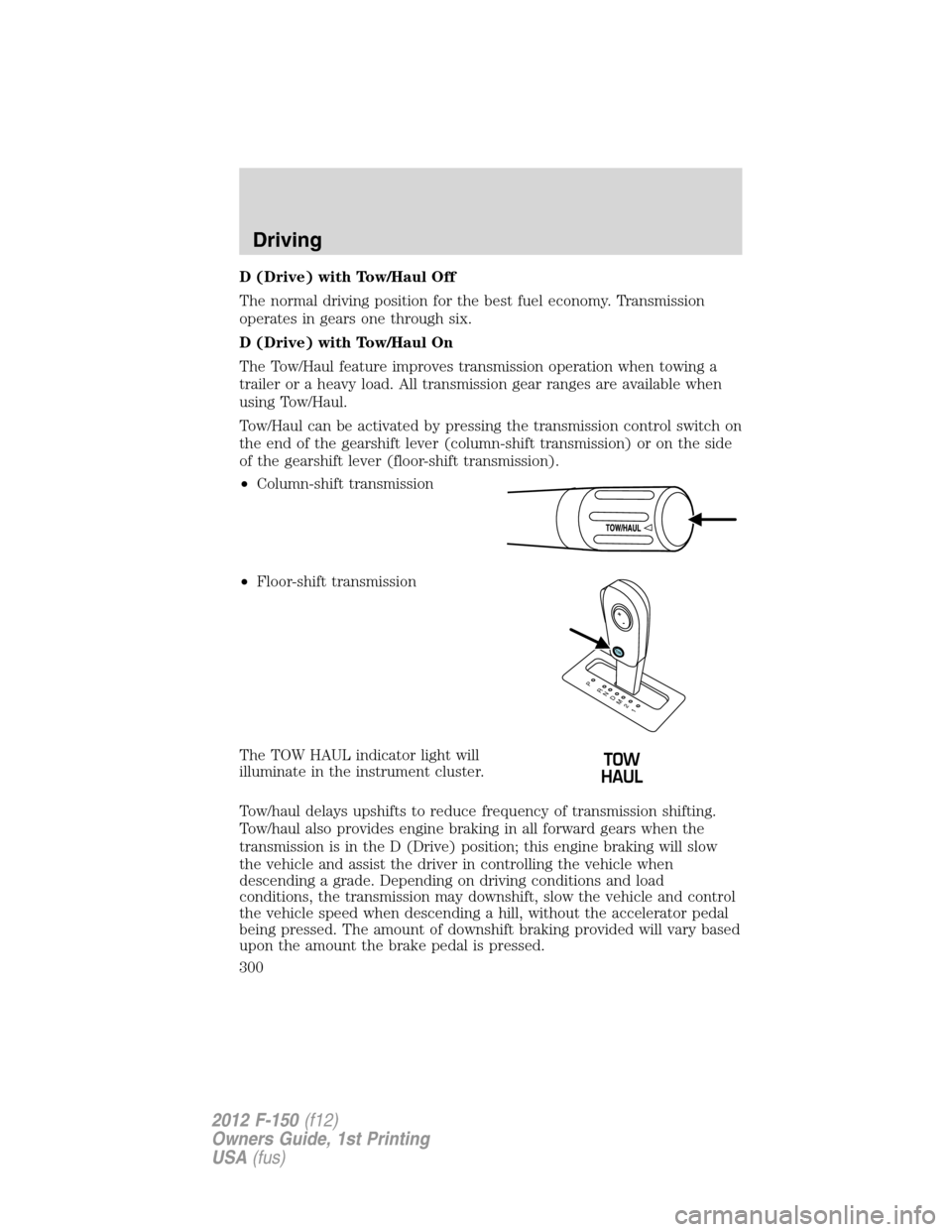
Tow/Haul can be activated by pressing the transmission control switch on
the end of the gearshift lever (column-shift transmission) or on the side
of the gearshift lever (floor-shift transmission).
•Column-shift transmission
•Floor-shift transmission
The TOW HAUL indicator light will
illuminate in the instrument cluster.
Tow/haul delays upshifts to reduce frequency of transmission shifting.
Tow/haul also provides engine braking in all forward gears when the
transmission is in the D (Drive) position; this engine braking will slow
the vehicle and assist the driver in controlling the vehicle when
descending a grade. Depending on driving conditions and load
conditions, the transmission may downshift, slow the vehicle and control
the vehicle speed when descending a hill, without the accelerator pedal
being pressed. The amount of downshift braking provided will vary based
upon the amount the brake pedal is pressed.
T/H
PR
N
D
M
2
1
+
-
Driving
300
2012 F-150(f12)
Owners Guide, 1st Printing
USA(fus)
Page 301 of 462
To deactivate the tow/haul feature and return to normal driving mode,
press the button on the end of the gearshift lever. The TOW HAUL light
will no longer be illuminated. Tow/haul will also deactivate when the
vehicle is powered down.
WARNING:Do not use the tow/haul feature when driving in icy
or slippery conditions as the increased engine braking can cause
the rear wheels to slide and the vehicle to swing around with the
possible loss of vehicle control.
3 (Third) (column-shift only) (For vehicles without SST)
Transmission operates in third gear only.
Used for improved traction on slippery roads.
2 (Second)
Transmission operates in 2nd gear only.
Use 2 (Second) to start-up on slippery roads.
1 (First)
•Transmission operates in 1st gear only.
•Provides maximum engine braking.
•Allows upshifts by moving gearshift lever.
•Will not downshift into 1 (First) at high speeds; allows for 1 (First)
when vehicle reaches slower speeds.
Forced downshifts
•Allowed in D (Drive) only.
•Press the accelerator to the floor.
•Allows transmission to select an appropriate gear.
Understanding your SelectShift Automatic™ transmission (SST)
gearshift lever (if equipped)
This vehicle may be equipped with a SelectShift Automatic™
transmission (SST) gearshift lever. The SST is an automatic transmission
with the ability for the driver to change gears up or down (without a
clutch) as desired. The SST feature has two modes: PRS and M mode.
Driving
301
2012 F-150(f12)
Owners Guide, 1st Printing
USA(fus)
Page 304 of 462
4. Drive off in the normal manner. The brakes will be released automatically.
If your vehicle gets stuck in mud or snow
Note:Do not rock the vehicle if the engine is not at normal operating
temperature or damage to the transmission may occur.
Note:Do not rock the vehicle for more than a minute or damage to the
transmission and tires may occur, or the engine may overheat.
If your vehicle gets stuck in mud or snow, it may be rocked out by
shifting between forward and reverse gears, stopping between shifts in a
steady pattern. Press lightly on the accelerator in each gear.
REVERSE SENSING SYSTEM (IF EQUIPPED)
The Reverse Sensing System (RSS) sounds a tone to warn the driver of
obstacles near the rear bumper when R (Reverse) is selected and the
vehicle is moving at speeds less than 3 mph (5 km/h). The system is not
effective at speeds above 3 mph (5 km/h) and may not detect certain
angular or moving objects.
WARNING:To help avoid personal injury, please read and
understand the limitations of the reverse sensing system as
contained in this section. Reverse sensing is only an aid for some
(generally large and fixed) objects when moving in reverse on a flat
surface at “parking speeds”. Inclement weather may also affect the
function of the RSS; this may include reduced performance or a false
activation.
WARNING:To help avoid personal injury, always use caution
when in reverse and when using the RSS.
WARNING:This system is not designed to prevent contact with
small or moving objects. The system is designed to provide a
warning to assist the driver in detecting large stationary objects to
avoid damaging the vehicle. The system may not detect smaller
objects, particularly those close to the ground.
WARNING:Certain add-on devices such as large trailer hitches,
bike or surfboard racks and any device that may block the
normal detection zone of the RSS system may create false beeps.
Driving
304
2012 F-150(f12)
Owners Guide, 1st Printing
USA(fus)
Page 307 of 462
Visual park aid alert (if equipped)
Visual park aid alert allows the driver to see the area that is causing the
reverse sensing system to beep. The visual alerts are red, yellow or green
highlights which appear on top of the video image when an object is
detected by the reverse sensing system. The visual alert will highlight
the closest object detected by the reverse sensing system. The reverse
sensing alert can be disabled and if visual park aid alert is enabled,
highlighted areas will still be displayed.
If equipped with touch screen display: To turn this feature on or off
when the vehicle is in R (Reverse), select Settings on the touch screen
display. The visual park aid alert options are ON and OFF.
If equipped with rearview mirror display and optional instrument cluster:
To turn this feature on or off, select the following from the message
center in the instrument cluster:
1. Settings
2. Driver Assist
3. Rear View Camera
4. Visual Park Aid
The visual park aid alert options are ON and OFF. The visual park aid
alert feature is not available on vehicles with a rearview mirror and a
standard instrument cluster.
Note:The reverse sensing system is not effective at speeds above 3 mph
(5 km/h) and may not detect certain angular or moving objects.
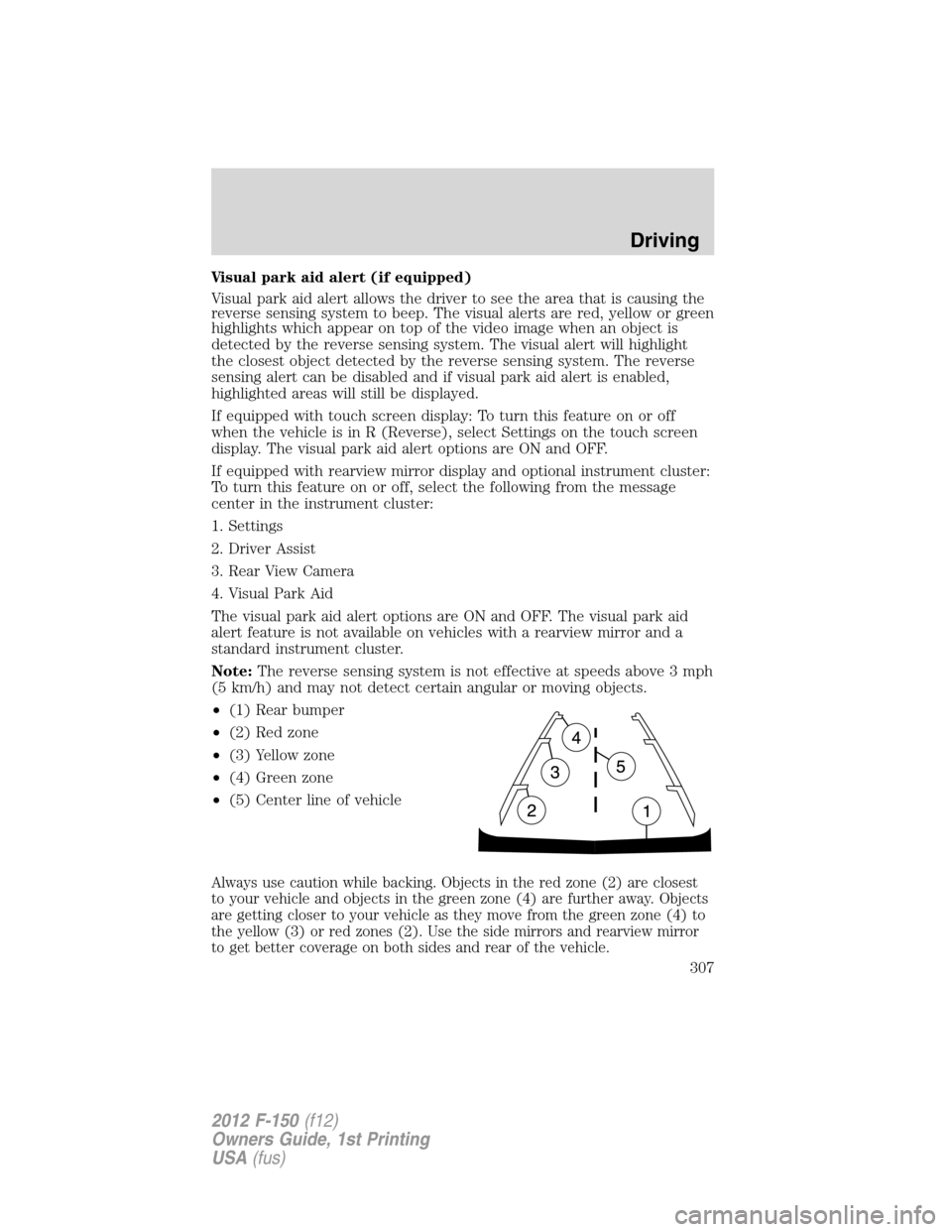
•(1) Rear bumper
•(2) Red zone
•(3) Yellow zone
•(4) Green zone
•(5) Center line of vehicle
Always use caution while backing. Objects in the red zone (2) are closest
to your vehicle and objects in the green zone (4) are further away. Objects
are getting closer to your vehicle as they move from the green zone (4) to
the yellow (3) or red zones (2). Use the side mirrors and rearview mirror
to get better coverage on both sides and rear of the vehicle.
Driving
307
2012 F-150(f12)
Owners Guide, 1st Printing
USA(fus)
Page 310 of 462
The camera lens for the reverse camera system is located on the tailgate.
Keep the lens clean so the video image remains clear and undistorted.
Clean the lens with a soft, lint-free cloth and non-abrasive cleaner.
Note:If the camera system image is not clear or seems distorted, it may
be covered with water droplets, snow, mud or any other substance. If
this occurs, clean the camera lens before using the camera system.
WARNING:The rearview camera system is a reverse aid
supplement device that still requires the driver to use it in
conjunction with the rearview mirror and the side mirrors for
maximum coverage.
WARNING:Objects that are close to either corner of the
bumper or under the bumper, might not be seen on the screen
due to the limited coverage of the camera system.
WARNING:Backup as slow as possible since higher speeds
might limit your reaction time to stop the vehicle.
WARNING:Do not use the rearview camera system when the
tailgate is open. If the back end of the vehicle is hit or damaged,
check with your authorized dealer to have your rear camera system
checked for proper coverage and operation.
WARNING:When manual zoom is enabled (Level 1, Level 2 or
Level 3), the full area behind the vehicle will not be shown. Be
aware of your surroundings when using the manual zoom feature.
Night time and dark area use
At night time or in dark areas, the camera system relies on the reverse
lamp lighting to produce an image. Therefore it is necessary that both
reverse lamps are operating in order to get a clear image in the dark. If
either of the lamps are not operating, stop using the camera system, at
least in the dark, until the lamp(s) are replaced and functioning.
Servicing
•If the image comes on while the vehicle is not in R (Reverse), have
the system inspected by your authorized dealer.
Driving
310
2012 F-150(f12)
Owners Guide, 1st Printing
USA(fus)
Page 312 of 462
FOUR-WHEEL DRIVE (4WD) OPERATION (IF EQUIPPED)
WARNING:For important information regarding safe operation
of this type of vehicle, seePreparing to drive your vehiclein
this chapter.
Note:If 4X4 low is selected while the vehicle is moving above 3 mph
(5 km/h), the 4WD system will not perform a shift. This is normal and
should be no reason for concern. Refer toShifting to/from 4L (4X4
Low)for proper operation.
4WD indicator lights
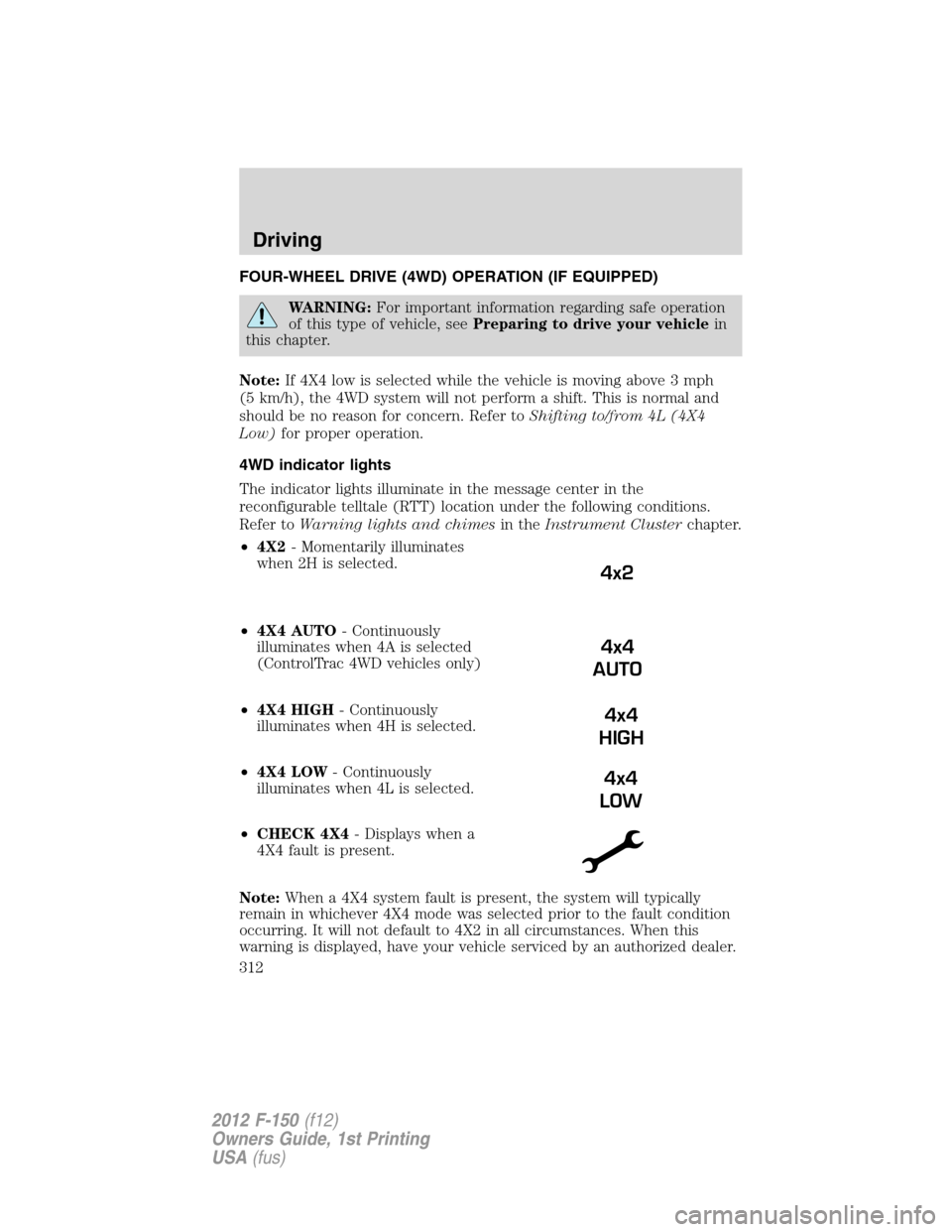
The indicator lights illuminate in the message center in the
reconfigurable telltale (RTT) location under the following conditions.
Refer toWarning lights and chimesin theInstrument Clusterchapter.
•4X2- Momentarily illuminates
when 2H is selected.
•4X4 AUTO- Continuously
illuminates when 4A is selected
(ControlTrac 4WD vehicles only)
•4X4 HIGH- Continuously
illuminates when 4H is selected.
•4X4 LOW- Continuously
illuminates when 4L is selected.
•CHECK 4X4- Displays when a
4X4 fault is present.
Note:When a 4X4 system fault is present, the system will typically
remain in whichever 4X4 mode was selected prior to the fault condition
occurring. It will not default to 4X2 in all circumstances. When this
warning is displayed, have your vehicle serviced by an authorized dealer.
4x2
4x4
AUTO
4x4
HIGH
4x4
LOW
Driving
312
2012 F-150(f12)
Owners Guide, 1st Printing
USA(fus)
Page 317 of 462
•The ELD will not engage if the accelerator pedal is pressed beyond
50% during an engagement attempt
•In 4x2, 4x4 Auto, and 4x4 High modes, the ELD will automatically
disengage at speeds above 25 mph (40 km/h) and will automatically
reengage at speeds below 18 mph (30 km/h).
•In 4L (4X4 low), the ELD will automatically disengage at speeds above
62 mph (100 km/h) and will automatically reengage at speeds below
56 mph (90 km/h).
•The AdvanceTrac system has the ability to take over control of the
ELD and disable it during driving maneuvers when necessary.
If the required conditions for ELD activation are not met when the
switch is actuated, the instrument cluster will display the appropriate
information guiding the driver through the proper ELD activation
process.
Note:The ELD is designed for off-road use only and is not intended for
use on dry pavement. Using the ELD on dry pavement will result in
increased tire wear, noise and vibration.
Electronic locking differential (ELD) indicator lights
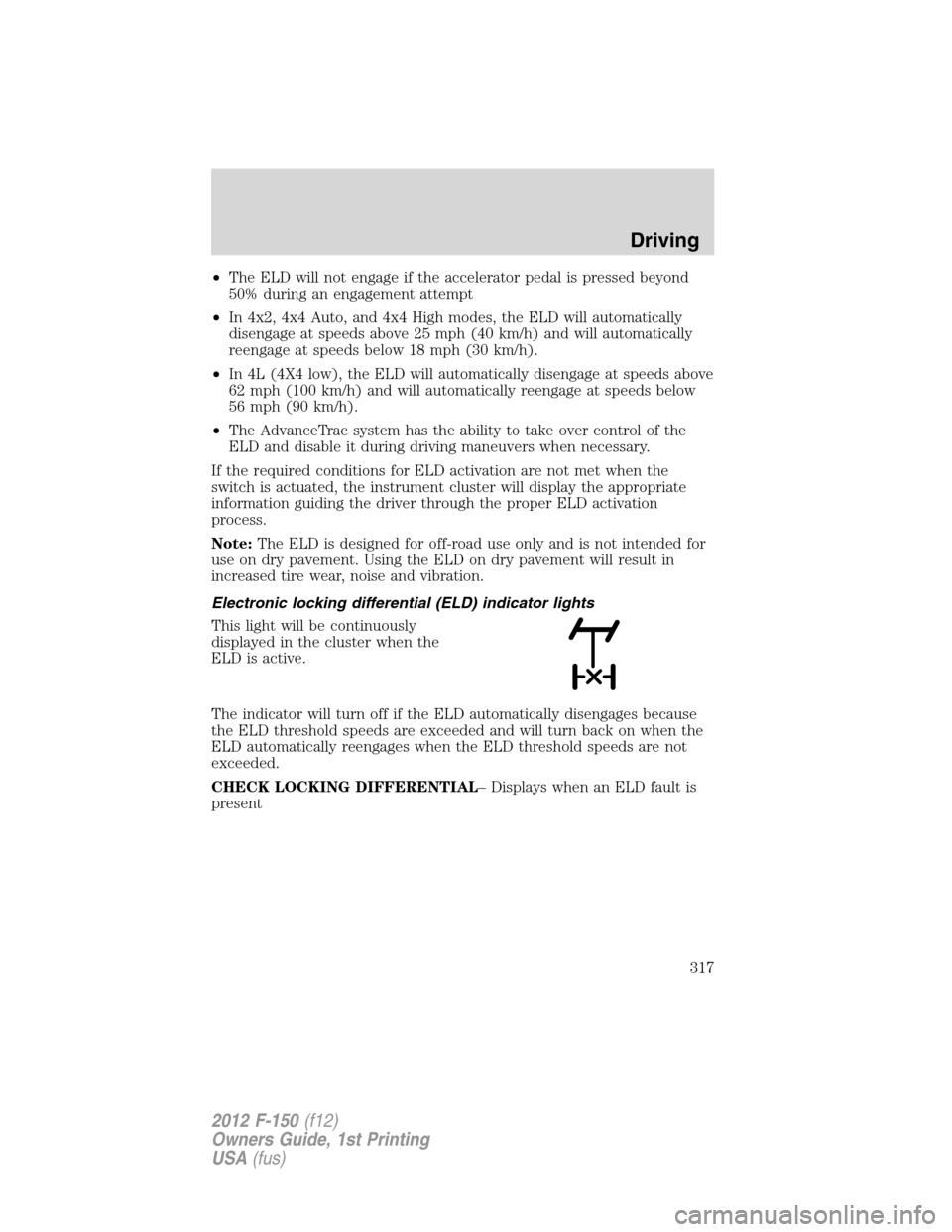
This light will be continuously
displayed in the cluster when the
ELD is active.
The indicator will turn off if the ELD automatically disengages because
the ELD threshold speeds are exceeded and will turn back on when the
ELD automatically reengages when the ELD threshold speeds are not
exceeded.
CHECK LOCKING DIFFERENTIAL– Displays when an ELD fault is
present
Driving
317
2012 F-150(f12)
Owners Guide, 1st Printing
USA(fus)
Page 318 of 462
Activating the electronic locking differential (ELD)
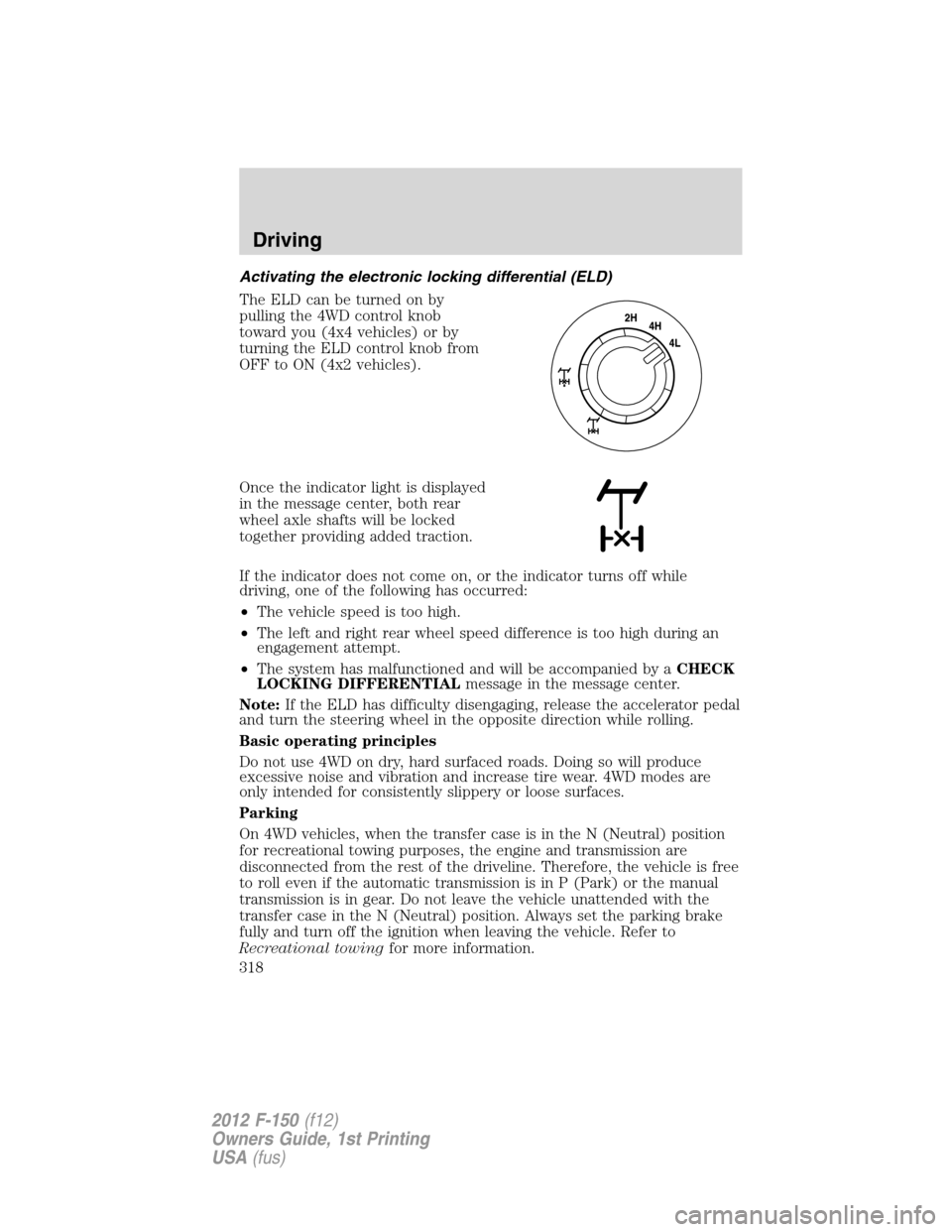
The ELD can be turned on by
pulling the 4WD control knob
toward you (4x4 vehicles) or by
turning the ELD control knob from
OFF to ON (4x2 vehicles).
Once the indicator light is displayed
in the message center, both rear
wheel axle shafts will be locked
together providing added traction.
If the indicator does not come on, or the indicator turns off while
driving, one of the following has occurred:
•The vehicle speed is too high.
•The left and right rear wheel speed difference is too high during an
engagement attempt.
•The system has malfunctioned and will be accompanied by aCHECK
LOCKING DIFFERENTIALmessage in the message center.
Note:If the ELD has difficulty disengaging, release the accelerator pedal
and turn the steering wheel in the opposite direction while rolling.
Basic operating principles
Do not use 4WD on dry, hard surfaced roads. Doing so will produce
excessive noise and vibration and increase tire wear. 4WD modes are
only intended for consistently slippery or loose surfaces.
Parking
On 4WD vehicles, when the transfer case is in the N (Neutral) position
for recreational towing purposes, the engine and transmission are
disconnected from the rest of the driveline. Therefore, the vehicle is free
to roll even if the automatic transmission is in P (Park) or the manual
transmission is in gear. Do not leave the vehicle unattended with the
transfer case in the N (Neutral) position. Always set the parking brake
fully and turn off the ignition when leaving the vehicle. Refer to
Recreational towingfor more information.
Driving
318
2012 F-150(f12)
Owners Guide, 1st Printing
USA(fus)
Page 320 of 462
If your vehicle goes off the edge of the pavement
•If your vehicle goes off the edge of the pavement, slow down, but
avoid severe brake application, ease the vehicle back onto the
pavement only after reducing your speed. Do not turn the steering
wheel too sharply while returning to the road surface.
•It may be safer to stay on the apron or shoulder of the road and slow
down gradually before returning to the pavement. You may lose
control if you do not slow down or if you turn the steering wheel too
sharply or abruptly.
•It often may be less risky to strike small objects, such as highway
reflectors, with minor damage to your vehicle rather than attempt a
sudden return to the pavement which could cause the vehicle to slide
sideways out of control or roll over. Remember, your safety and the
safety of others should be your primary concern.
WARNING:Vehicles with a higher center of gravity such as
utility and four-wheel drive vehicles handle differently than
vehicles with a lower center of gravity. Utility and four-wheel drive
vehicles arenotdesigned for cornering at speeds as high as passenger
cars any more than low-slung sports cars are designed to perform
satisfactorily under off-road conditions. Avoid sharp turns, excessive
speed and abrupt maneuvers in these vehicles. Failure to drive
cautiously could result in an increased risk of loss of vehicle control,
vehicle rollover, personal injury and death.
If your vehicle gets stuck
If your vehicle gets stuck in mud or snow it may be rocked out by
shifting between forward and reverse gears, stopping between shifts, in a
steady pattern. Press lightly on the accelerator in each gear.
Do not rock the vehicle if the engine is not at normal operating
temperature or damage to the transmission may occur.
Do not rock the vehicle for more than a few minutes or damage
to the transmission and tires may occur or the engine may
overheat.
WARNING:Do not spin the wheels at over 35 mph (56 km/h).
The tires may fail and injure a passenger or bystander.
Driving
320
2012 F-150(f12)
Owners Guide, 1st Printing
USA(fus)