lock FORD F150 2017 13.G Owners Manual
[x] Cancel search | Manufacturer: FORD, Model Year: 2017, Model line: F150, Model: FORD F150 2017 13.GPages: 599, PDF Size: 7.34 MB
Page 293 of 599
WARNINGS
Check attachment of floor mats on
a regular basis. Always properly
reinstall and secure floor mats that
have been removed for cleaning or
replacement. Always make sure that objects
cannot fall into the driver foot well
while the vehicle is moving. Objects
that are loose can become trapped under
the pedals causing a loss of vehicle control. Failure to properly follow floor mat
installation or attachment
instructions can potentially cause
interference with pedal operation causing
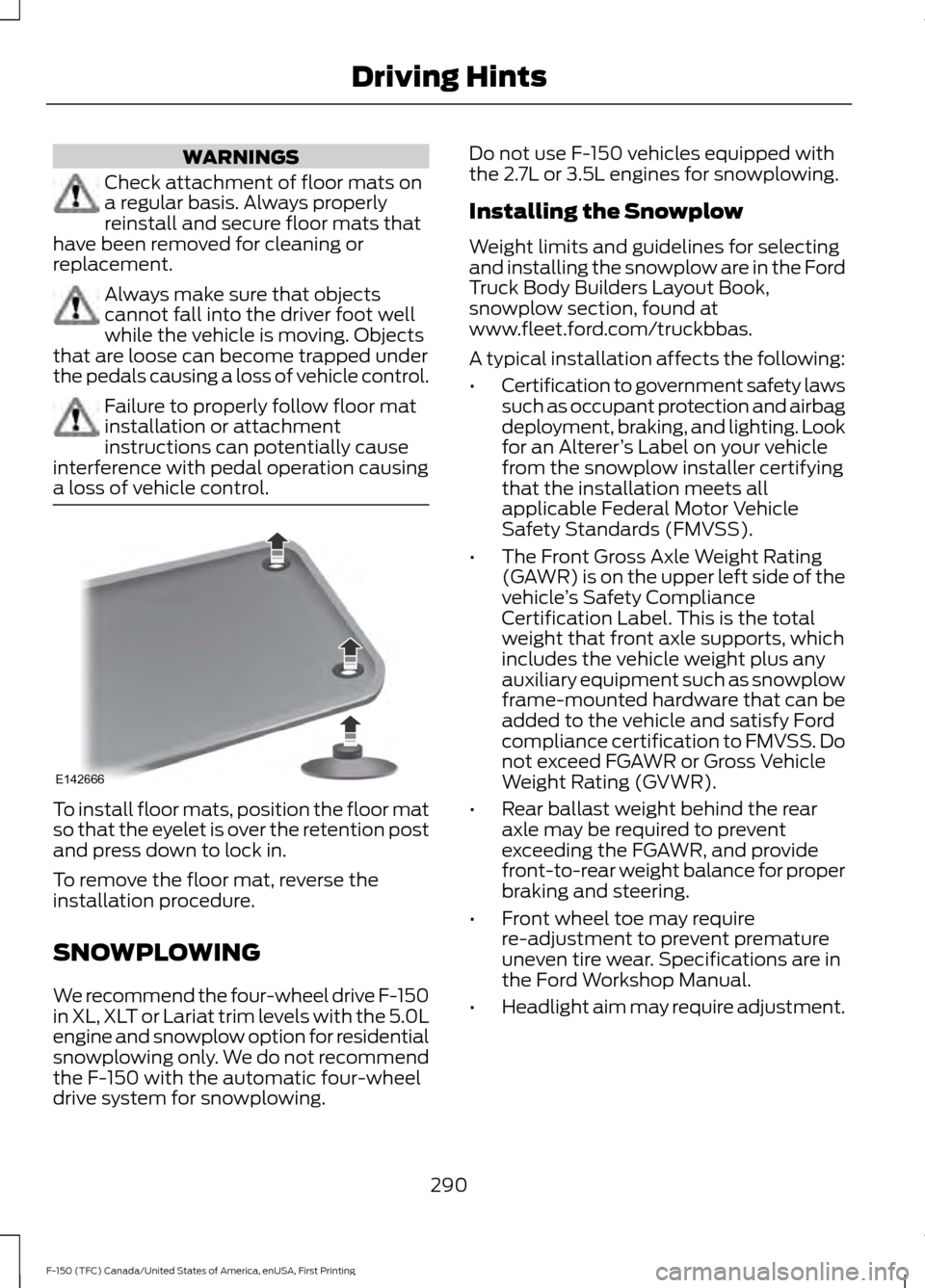
a loss of vehicle control. To install floor mats, position the floor mat
so that the eyelet is over the retention post
and press down to lock in.
To remove the floor mat, reverse the
installation procedure.
SNOWPLOWING
We recommend the four-wheel drive F-150
in XL, XLT or Lariat trim levels with the 5.0L
engine and snowplow option for residential
snowplowing only. We do not recommend
the F-150 with the automatic four-wheel
drive system for snowplowing. Do not use F-150 vehicles equipped with
the 2.7L or 3.5L engines for snowplowing.
Installing the Snowplow
Weight limits and guidelines for selecting
and installing the snowplow are in the Ford
Truck Body Builders Layout Book,
snowplow section, found at
www.fleet.ford.com/truckbbas.
A typical installation affects the following:
•
Certification to government safety laws
such as occupant protection and airbag
deployment, braking, and lighting. Look
for an Alterer ’s Label on your vehicle
from the snowplow installer certifying
that the installation meets all
applicable Federal Motor Vehicle
Safety Standards (FMVSS).
• The Front Gross Axle Weight Rating
(GAWR) is on the upper left side of the
vehicle ’s Safety Compliance
Certification Label. This is the total
weight that front axle supports, which
includes the vehicle weight plus any
auxiliary equipment such as snowplow
frame-mounted hardware that can be
added to the vehicle and satisfy Ford
compliance certification to FMVSS. Do
not exceed FGAWR or Gross Vehicle
Weight Rating (GVWR).
• Rear ballast weight behind the rear
axle may be required to prevent
exceeding the FGAWR, and provide
front-to-rear weight balance for proper
braking and steering.
• Front wheel toe may require
re-adjustment to prevent premature
uneven tire wear. Specifications are in
the Ford Workshop Manual.
• Headlight aim may require adjustment.
290
F-150 (TFC) Canada/United States of America, enUSA, First Printing Driving HintsE142666
Page 295 of 599
WARNINGS
Additional equipment such as
snowplow equipment may affect the
performance of the airbag sensors
increasing the risk of injury. Please refer to
the Body Builders Layout Book for
instructions about the appropriate
installation of additional equipment. All occupants of the vehicle,
including the driver, should always
properly wear their safety belts, even
when provided with an airbag
supplemental restraint system (SRS). Your vehicle is equipped with a driver and
passenger airbag supplemental restraint
system. The supplemental restraint system
activates in certain frontal and offset
frontal collisions when the vehicle sustains
sufficient longitudinal deceleration.
Careless or high speed driving while
snowplowing, which results in significant
vehicle decelerations, can deploy the
airbag. Such driving also increases the risk
of accidents.
Never remove or defeat the tripping
mechanisms designed into the snow
removal equipment by its manufacturer.
Doing so may cause damage to the vehicle
and the snow removal equipment as well
as possible airbag deployment.
Engine Temperature while Plowing
Your engine may run at a higher
temperature than normal because the
attached snowplow blade restricts airflow
to the radiator: •
If you are driving more than 15 mi
(24 km) at temperatures above
freezing, angle the plow blade either
full left or full right to provide
maximum airflow to the radiator.
• If you are driving less than
15 mi
(24 km) at speeds up to 45 mph
(72 km/h) in cold weather, you do not
need to worry about blade position to
provide maximum airflow.
Transmission Operation while
Plowing WARNING
Do not spin the wheels at over 35
mph (55 km/h). The tires may fail
and injure a passenger or bystander.
•
Shift transfer case to
4L (4WD Low)
when plowing in small areas at speeds
below
5.0 mph (8 km/h).
• Shift transfer case to
4H (4WD High)
when plowing larger areas or light snow
at higher speeds. Do not exceed 15 mph
(24 km/h)
.
• Do not shift the transmission from a
forward gear to
R (Reverse) until the
engine is at idle and the wheels have
stopped.
Outside Air Temperature While
Plowing
While plowing with your vehicle, the plow
blade can block the sensor airflow and
cause the outside air temperature reading
to be inaccurate.
A Ford wiring kit is available to relocate the
Outside Air Temperature sensor to the
plow blade frame to provide more
accurate outside air temperature readings.
Contact an authorized dealer for more
information.
292
F-150 (TFC) Canada/United States of America, enUSA, First Printing Driving Hints
Page 296 of 599
ROADSIDE ASSISTANCE
Vehicles Sold in the United States:
Getting Roadside Assistance
To fully assist you should you have a
vehicle concern, Ford Motor Company
offers a complimentary roadside
assistance program. This program is
separate from the New Vehicle Limited
Warranty. The service is available:
•
24 hours a day, seven days a week.
• For the coverage period listed on the
Roadside Assistance Card included in
your Owner's Manual portfolio.
Roadside Assistance covers:
• A flat tire change with a good spare, if
provided with the vehicle (except
vehicles supplied with a tire inflation
kit).
• Battery jump start.
• Lock-out assistance (key replacement
cost is the customer's responsibility).
• Fuel delivery — independent service
contractors, if not prohibited by state,
local or municipal law, shall deliver up
to 2 gal (7.6 L) of gasoline or 5 gal
(18.9 L) of diesel fuel to a disabled
vehicle. Roadside Assistance limits fuel
delivery service to two no-charge
occurrences within a 12-month period.
• Winch out — available within
100 ft
(30.5 m) of a paved or county
maintained road, no recoveries.
• Towing — independent service
contractors, if not prohibited by state,
local or municipal law, shall tow Ford
eligible vehicles to an authorized dealer
within
35 mi (56 km) of the
disablement location or to the nearest authorized dealer. If a member
requests a tow to an authorized dealer
that is more than
35 mi (56 km) from
the disablement location, the member
shall be responsible for any mileage
costs in excess of
35 mi (56 km).
Roadside Assistance includes up to $200
for a towed trailer if the disabled eligible
vehicle requires service at the nearest
authorized dealer. If the towing vehicle is
operational but the trailer is not, then the
trailer does not qualify for any roadside
services.
Vehicles Sold in the United States:
Using Roadside Assistance
Complete the roadside assistance
identification card and place it in your
wallet for quick reference. This card is in
the owner's information portfolio in the
glove compartment.
United States Ford vehicle customers who
require Roadside Assistance, call
1-800-241-3673.
If you need to arrange roadside assistance
for yourself, Ford Motor Company
reimburses a reasonable amount for
towing to the nearest dealership within
35 mi (56 km)
. To obtain reimbursement
information, United States Ford vehicle
customers call 1-800-241-3673.
Customers need to submit their original
receipts.
Vehicles Sold in Canada: Getting
Roadside Assistance
To fully assist you should you have a
vehicle concern, Ford Motor Company of
Canada, Limited offers a complimentary
roadside assistance program. This program
is eligible within Canada or the continental
United States.
293
F-150 (TFC) Canada/United States of America, enUSA, First Printing Roadside Emergencies
Page 300 of 599
2. Remove the jumper cable on the
negative (-) terminal of the booster
vehicle battery.
3. Remove the jumper cable from the positive (+) terminal of the booster
vehicle battery.
4. Remove the jumper cable from the positive (+) terminal of the disabled
vehicle battery.
5. Allow the engine to idle for at least one
minute.
POST-CRASH ALERT SYSTEM
The system flashes the direction indicators
and sounds the horn (intermittently) in the
event of a serious impact that deploys an
airbag (front, side, side curtain or Safety
Canopy) or the safety belt pretensioners.
The horn and indicators will turn off when:
• You press the hazard control button.
• You press the panic button on the
remote entry transmitter (if equipped).
• Your vehicle runs out of power.
TRANSPORTING THE VEHICLE WARNINGS
Block the wheels to help prevent the
vehicle from moving.
Unexpected and possibly sudden
vehicle movement may occur if you
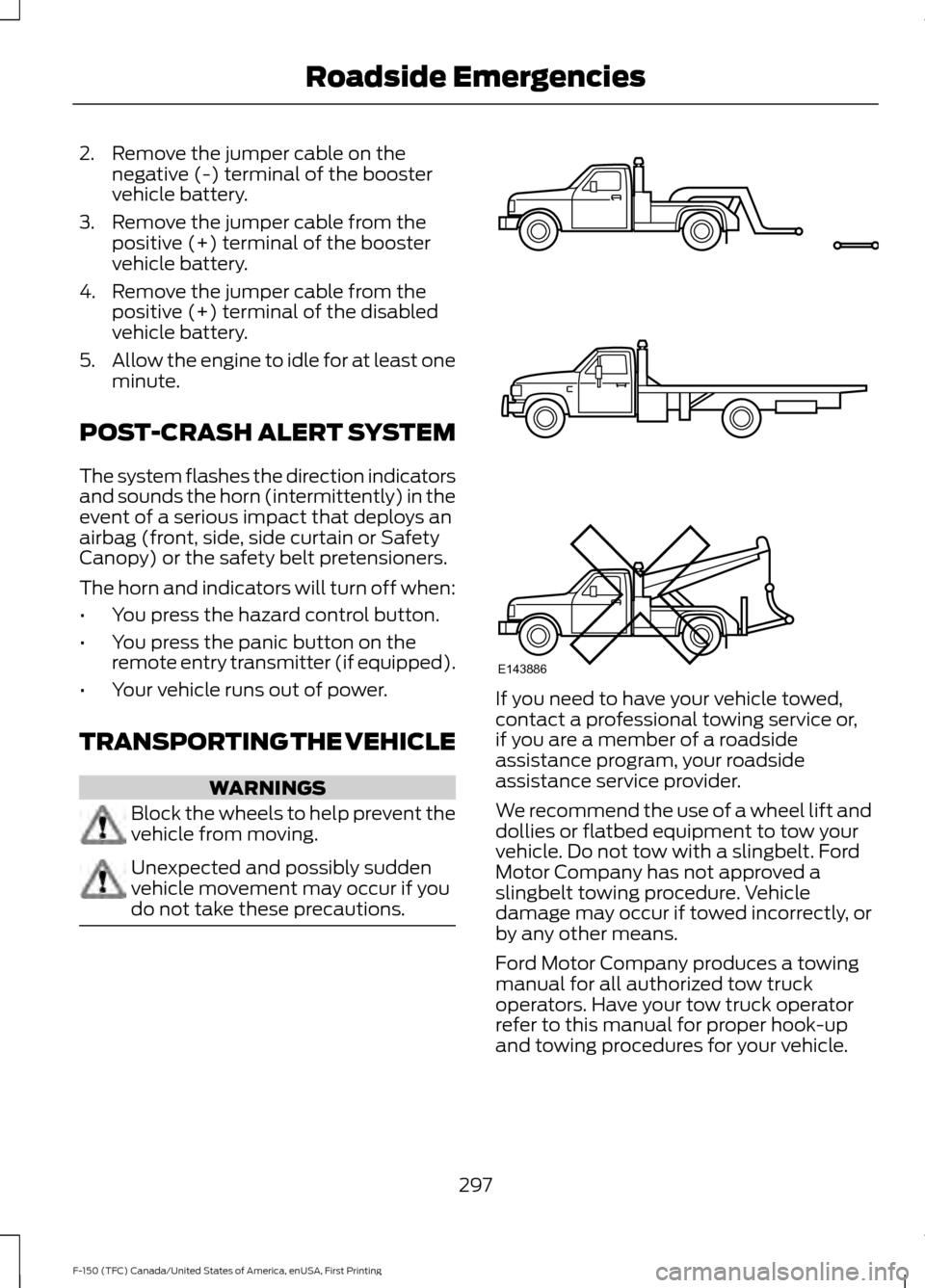
do not take these precautions. If you need to have your vehicle towed,
contact a professional towing service or,
if you are a member of a roadside
assistance program, your roadside
assistance service provider.
We recommend the use of a wheel lift and
dollies or flatbed equipment to tow your
vehicle. Do not tow with a slingbelt. Ford
Motor Company has not approved a
slingbelt towing procedure. Vehicle
damage may occur if towed incorrectly, or
by any other means.
Ford Motor Company produces a towing
manual for all authorized tow truck
operators. Have your tow truck operator
refer to this manual for proper hook-up
and towing procedures for your vehicle.
297
F-150 (TFC) Canada/United States of America, enUSA, First Printing Roadside EmergenciesE143886
Page 301 of 599
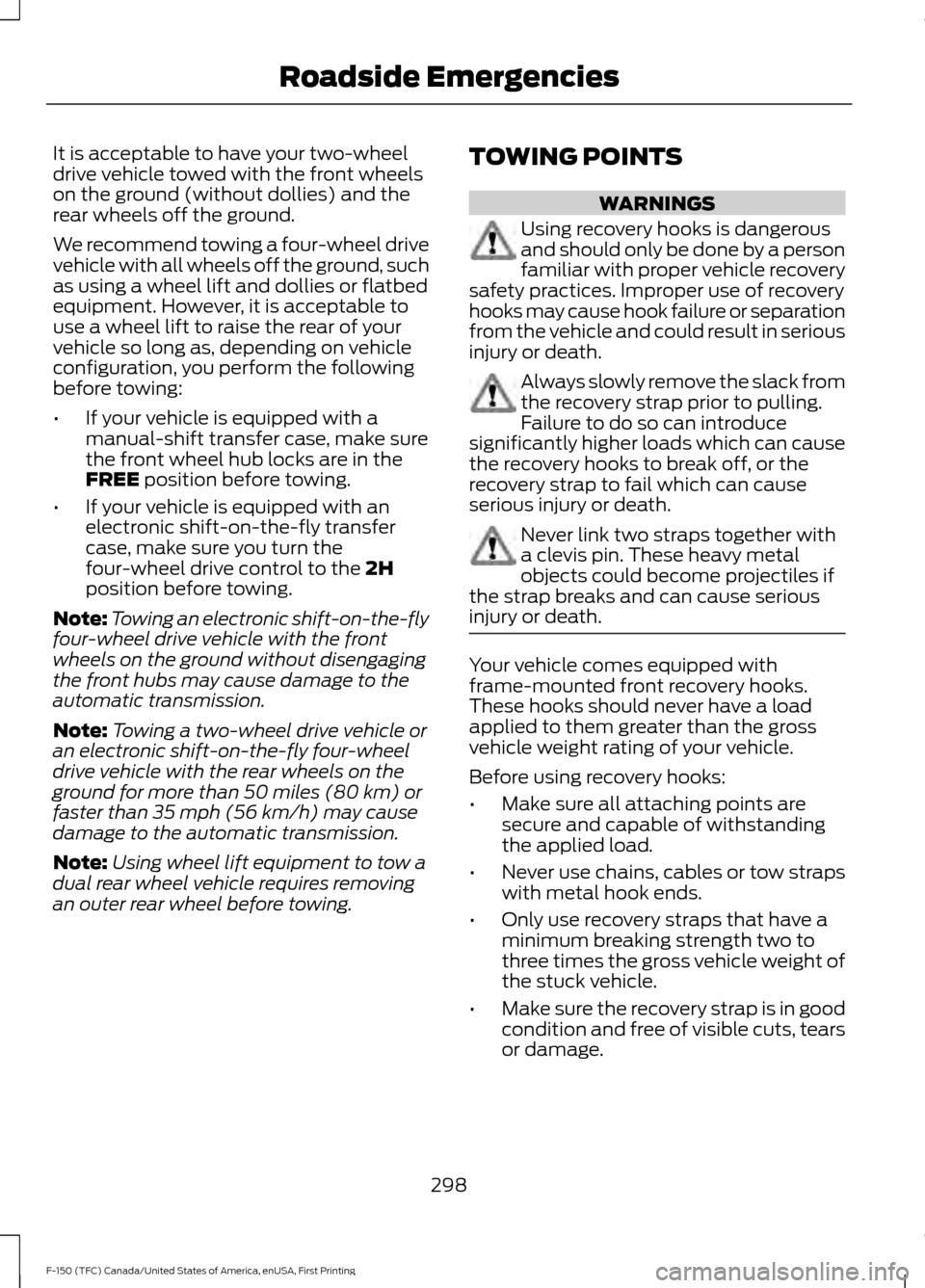
It is acceptable to have your two-wheel
drive vehicle towed with the front wheels
on the ground (without dollies) and the
rear wheels off the ground.
We recommend towing a four-wheel drive
vehicle with all wheels off the ground, such
as using a wheel lift and dollies or flatbed
equipment. However, it is acceptable to
use a wheel lift to raise the rear of your
vehicle so long as, depending on vehicle
configuration, you perform the following
before towing:
•
If your vehicle is equipped with a
manual-shift transfer case, make sure
the front wheel hub locks are in the
FREE position before towing.
• If your vehicle is equipped with an
electronic shift-on-the-fly transfer
case, make sure you turn the
four-wheel drive control to the
2H
position before towing.
Note: Towing an electronic shift-on-the-fly
four-wheel drive vehicle with the front
wheels on the ground without disengaging
the front hubs may cause damage to the
automatic transmission.
Note: Towing a two-wheel drive vehicle or
an electronic shift-on-the-fly four-wheel
drive vehicle with the rear wheels on the
ground for more than 50 miles (80 km) or
faster than 35 mph (56 km/h) may cause
damage to the automatic transmission.
Note: Using wheel lift equipment to tow a
dual rear wheel vehicle requires removing
an outer rear wheel before towing. TOWING POINTS WARNINGS
Using recovery hooks is dangerous
and should only be done by a person
familiar with proper vehicle recovery
safety practices. Improper use of recovery
hooks may cause hook failure or separation
from the vehicle and could result in serious
injury or death. Always slowly remove the slack from
the recovery strap prior to pulling.
Failure to do so can introduce
significantly higher loads which can cause
the recovery hooks to break off, or the
recovery strap to fail which can cause
serious injury or death. Never link two straps together with
a clevis pin. These heavy metal
objects could become projectiles if
the strap breaks and can cause serious
injury or death. Your vehicle comes equipped with
frame-mounted front recovery hooks.
These hooks should never have a load
applied to them greater than the gross
vehicle weight rating of your vehicle.
Before using recovery hooks:
•
Make sure all attaching points are
secure and capable of withstanding
the applied load.
• Never use chains, cables or tow straps
with metal hook ends.
• Only use recovery straps that have a
minimum breaking strength two to
three times the gross vehicle weight of
the stuck vehicle.
• Make sure the recovery strap is in good
condition and free of visible cuts, tears
or damage.
298
F-150 (TFC) Canada/United States of America, enUSA, First Printing Roadside Emergencies
Page 311 of 599
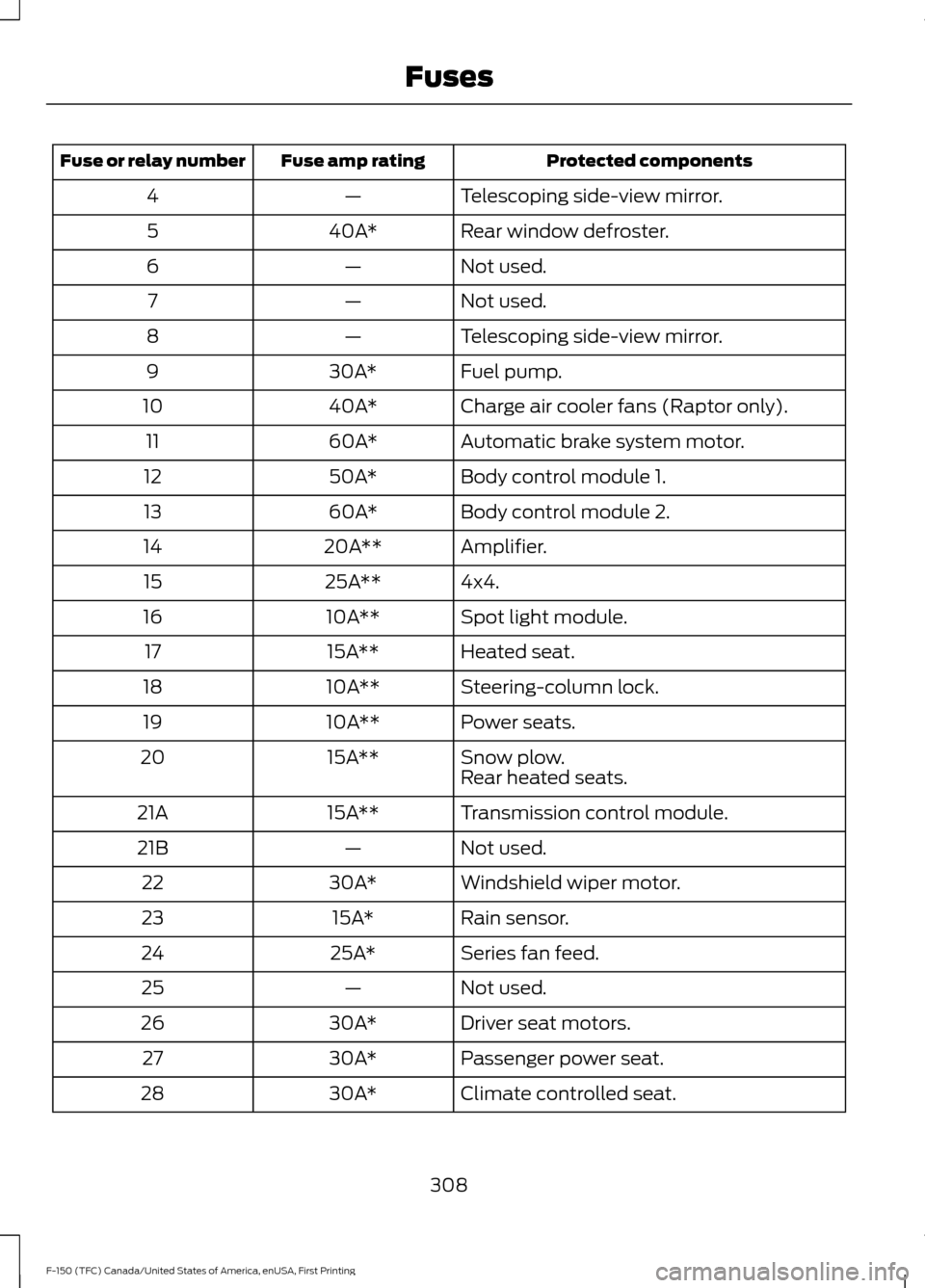
Protected components
Fuse amp rating
Fuse or relay number
Telescoping side-view mirror.
—
4
Rear window defroster.
40A*
5
Not used.
—
6
Not used.
—
7
Telescoping side-view mirror.
—
8
Fuel pump.
30A*
9
Charge air cooler fans (Raptor only).
40A*
10
Automatic brake system motor.
60A*
11
Body control module 1.
50A*
12
Body control module 2.
60A*
13
Amplifier.
20A**
14
4x4.
25A**
15
Spot light module.
10A**
16
Heated seat.
15A**
17
Steering-column lock.
10A**
18
Power seats.
10A**
19
Snow plow.
15A**
20
Rear heated seats.
Transmission control module.
15A**
21A
Not used.
—
21B
Windshield wiper motor.
30A*
22
Rain sensor.
15A*
23
Series fan feed.
25A*
24
Not used.
—
25
Driver seat motors.
30A*
26
Passenger power seat.
30A*
27
Climate controlled seat.
30A*
28
308
F-150 (TFC) Canada/United States of America, enUSA, First Printing Fuses
Page 312 of 599
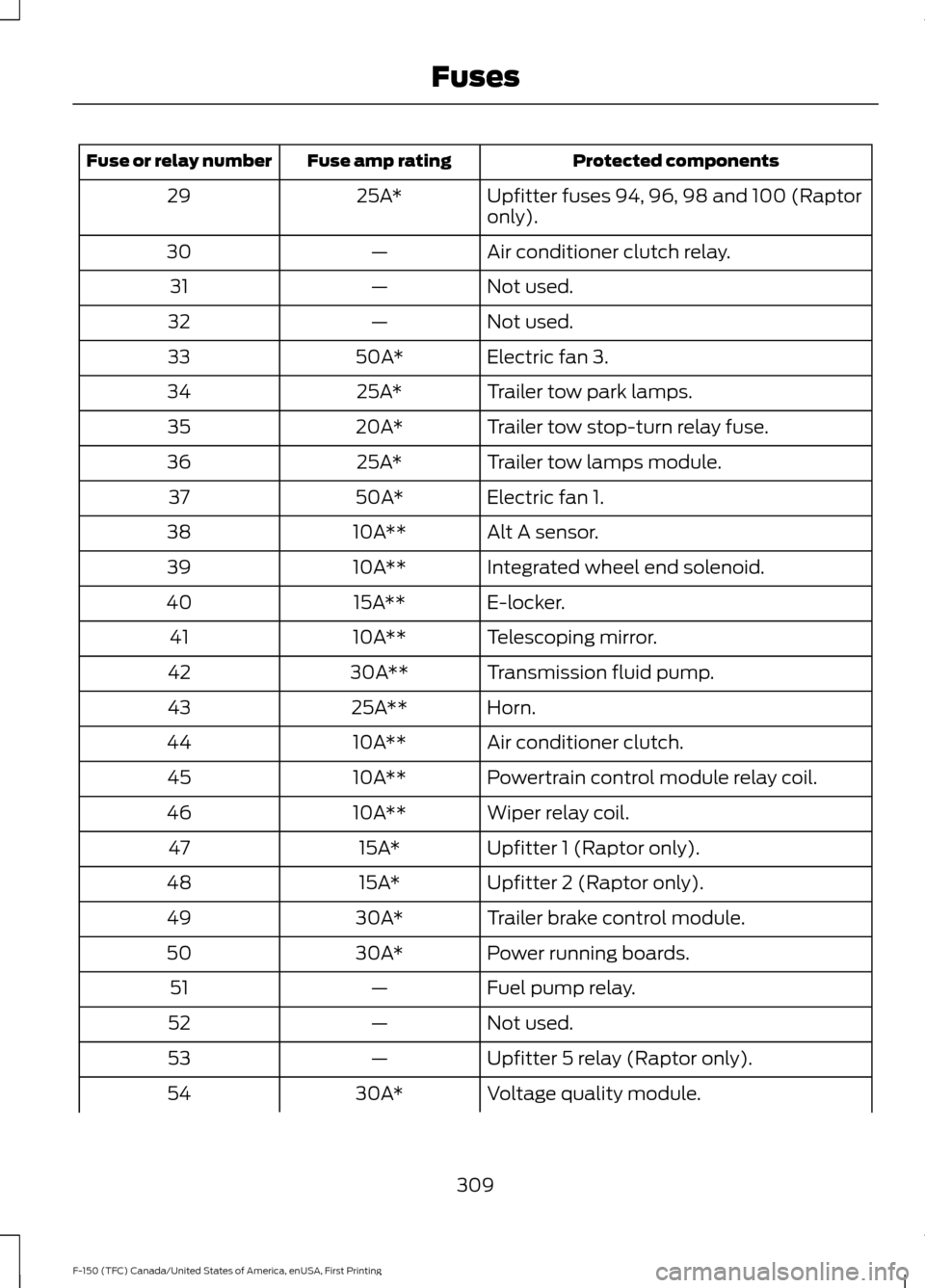
Protected components
Fuse amp rating
Fuse or relay number
Upfitter fuses 94, 96, 98 and 100 (Raptor
only).
25A*
29
Air conditioner clutch relay.
—
30
Not used.
—
31
Not used.
—
32
Electric fan 3.
50A*
33
Trailer tow park lamps.
25A*
34
Trailer tow stop-turn relay fuse.
20A*
35
Trailer tow lamps module.
25A*
36
Electric fan 1.
50A*
37
Alt A sensor.
10A**
38
Integrated wheel end solenoid.
10A**
39
E-locker.
15A**
40
Telescoping mirror.
10A**
41
Transmission fluid pump.
30A**
42
Horn.
25A**
43
Air conditioner clutch.
10A**
44
Powertrain control module relay coil.
10A**
45
Wiper relay coil.
10A**
46
Upfitter 1 (Raptor only).
15A*
47
Upfitter 2 (Raptor only).
15A*
48
Trailer brake control module.
30A*
49
Power running boards.
30A*
50
Fuel pump relay.
—
51
Not used.
—
52
Upfitter 5 relay (Raptor only).
—
53
Voltage quality module.
30A*
54
309
F-150 (TFC) Canada/United States of America, enUSA, First Printing Fuses
Page 313 of 599
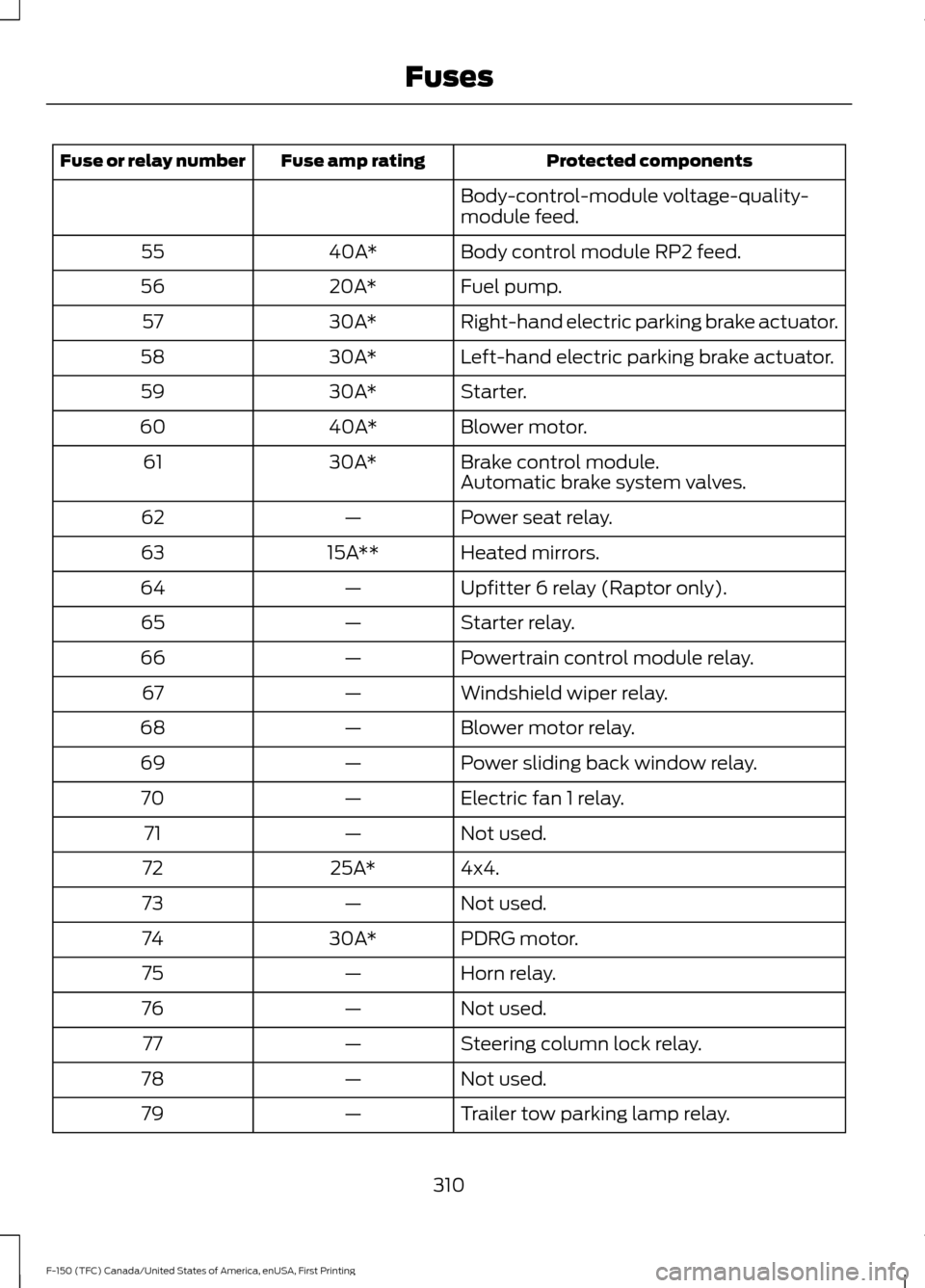
Protected components
Fuse amp rating
Fuse or relay number
Body-control-module voltage-quality-
module feed.
Body control module RP2 feed.
40A*
55
Fuel pump.
20A*
56
Right-hand electric parking brake actuator.
30A*
57
Left-hand electric parking brake actuator.
30A*
58
Starter.
30A*
59
Blower motor.
40A*
60
Brake control module.
30A*
61
Automatic brake system valves.
Power seat relay.
—
62
Heated mirrors.
15A**
63
Upfitter 6 relay (Raptor only).
—
64
Starter relay.
—
65
Powertrain control module relay.
—
66
Windshield wiper relay.
—
67
Blower motor relay.
—
68
Power sliding back window relay.
—
69
Electric fan 1 relay.
—
70
Not used.
—
71
4x4.
25A*
72
Not used.
—
73
PDRG motor.
30A*
74
Horn relay.
—
75
Not used.
—
76
Steering column lock relay.
—
77
Not used.
—
78
Trailer tow parking lamp relay.
—
79
310
F-150 (TFC) Canada/United States of America, enUSA, First Printing Fuses
Page 315 of 599
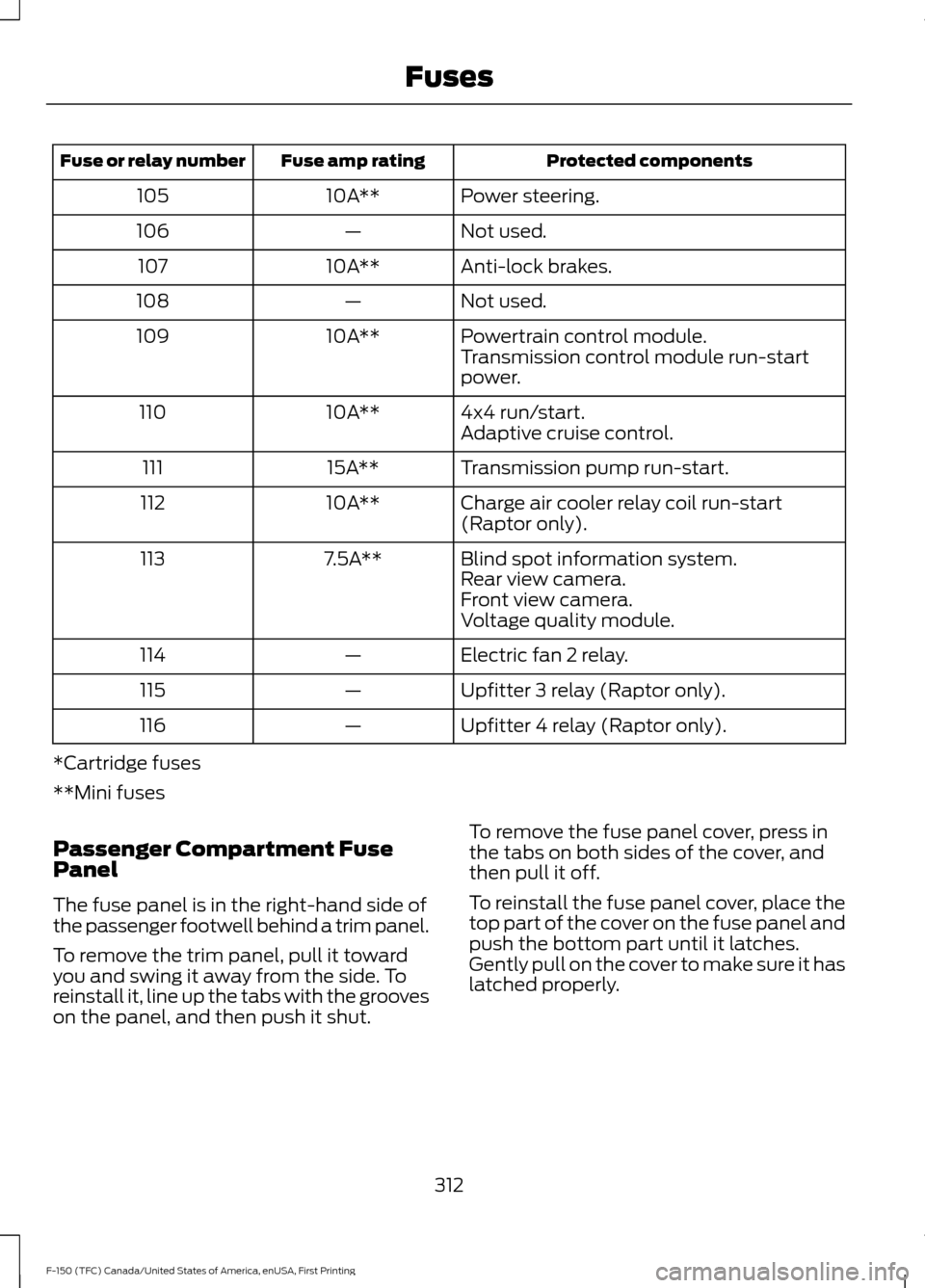
Protected components
Fuse amp rating
Fuse or relay number
Power steering.
10A**
105
Not used.
—
106
Anti-lock brakes.
10A**
107
Not used.
—
108
Powertrain control module.
10A**
109
Transmission control module run-start
power.
4x4 run/start.
10A**
110
Adaptive cruise control.
Transmission pump run-start.
15A**
111
Charge air cooler relay coil run-start
(Raptor only).
10A**
112
Blind spot information system.
7.5A**
113
Rear view camera.
Front view camera.
Voltage quality module.
Electric fan 2 relay.
—
114
Upfitter 3 relay (Raptor only).
—
115
Upfitter 4 relay (Raptor only).
—
116
*Cartridge fuses
**Mini fuses
Passenger Compartment Fuse
Panel
The fuse panel is in the right-hand side of
the passenger footwell behind a trim panel.
To remove the trim panel, pull it toward
you and swing it away from the side. To
reinstall it, line up the tabs with the grooves
on the panel, and then push it shut. To remove the fuse panel cover, press in
the tabs on both sides of the cover, and
then pull it off.
To reinstall the fuse panel cover, place the
top part of the cover on the fuse panel and
push the bottom part until it latches.
Gently pull on the cover to make sure it has
latched properly.
312
F-150 (TFC) Canada/United States of America, enUSA, First Printing Fuses
Page 316 of 599
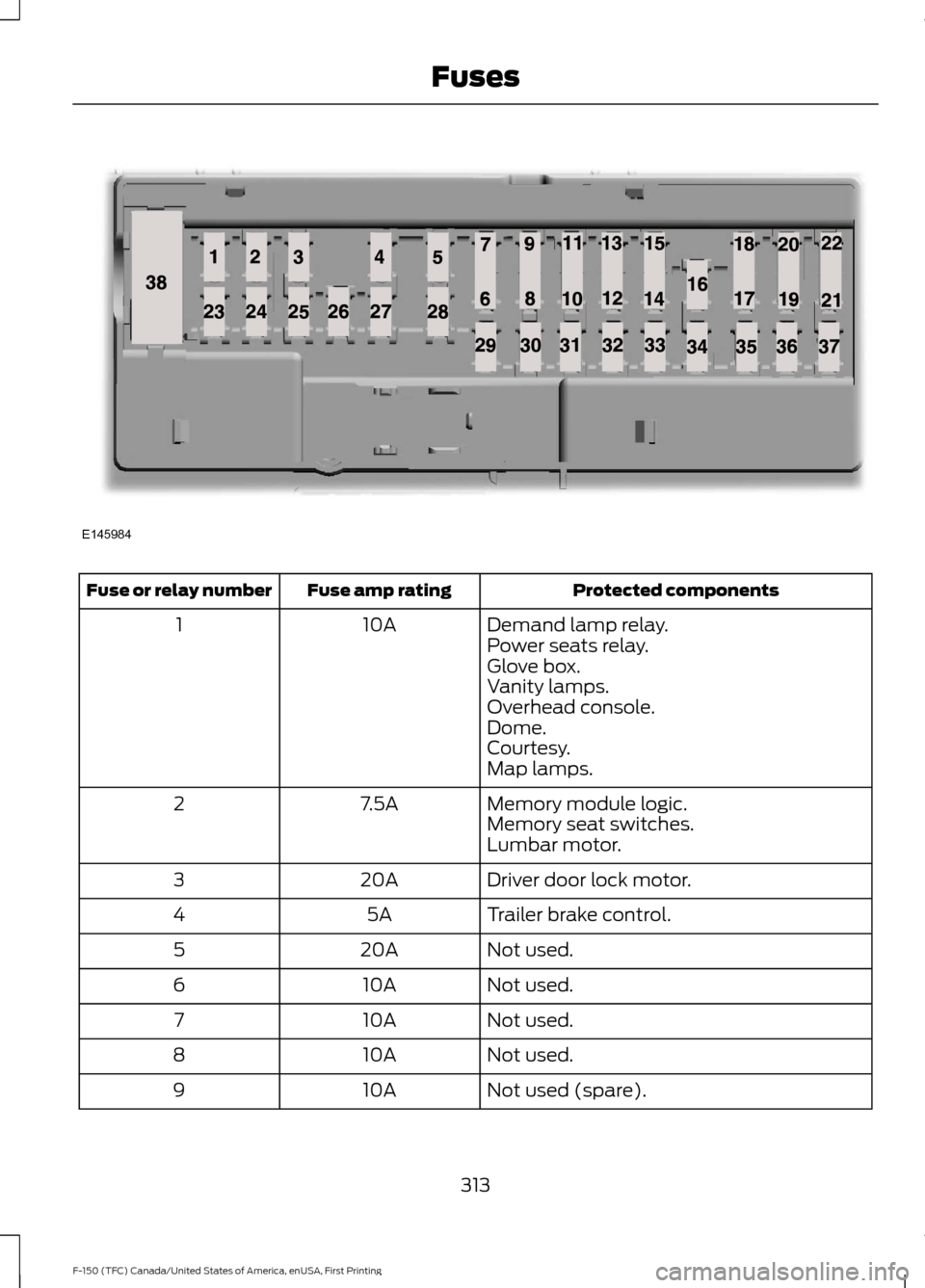
Protected components
Fuse amp rating
Fuse or relay number
Demand lamp relay.
10A
1
Power seats relay.
Glove box.
Vanity lamps.
Overhead console.
Dome.
Courtesy.
Map lamps.
Memory module logic.
7.5A
2
Memory seat switches.
Lumbar motor.
Driver door lock motor.
20A
3
Trailer brake control.
5A
4
Not used.
20A
5
Not used.
10A
6
Not used.
10A
7
Not used.
10A
8
Not used (spare).
10A
9
313
F-150 (TFC) Canada/United States of America, enUSA, First Printing FusesE145984