belt FORD F250 2006 Owner's Guide
[x] Cancel search | Manufacturer: FORD, Model Year: 2006, Model line: F250, Model: FORD F250 2006Pages: 312, PDF Size: 3.19 MB
Page 129 of 312
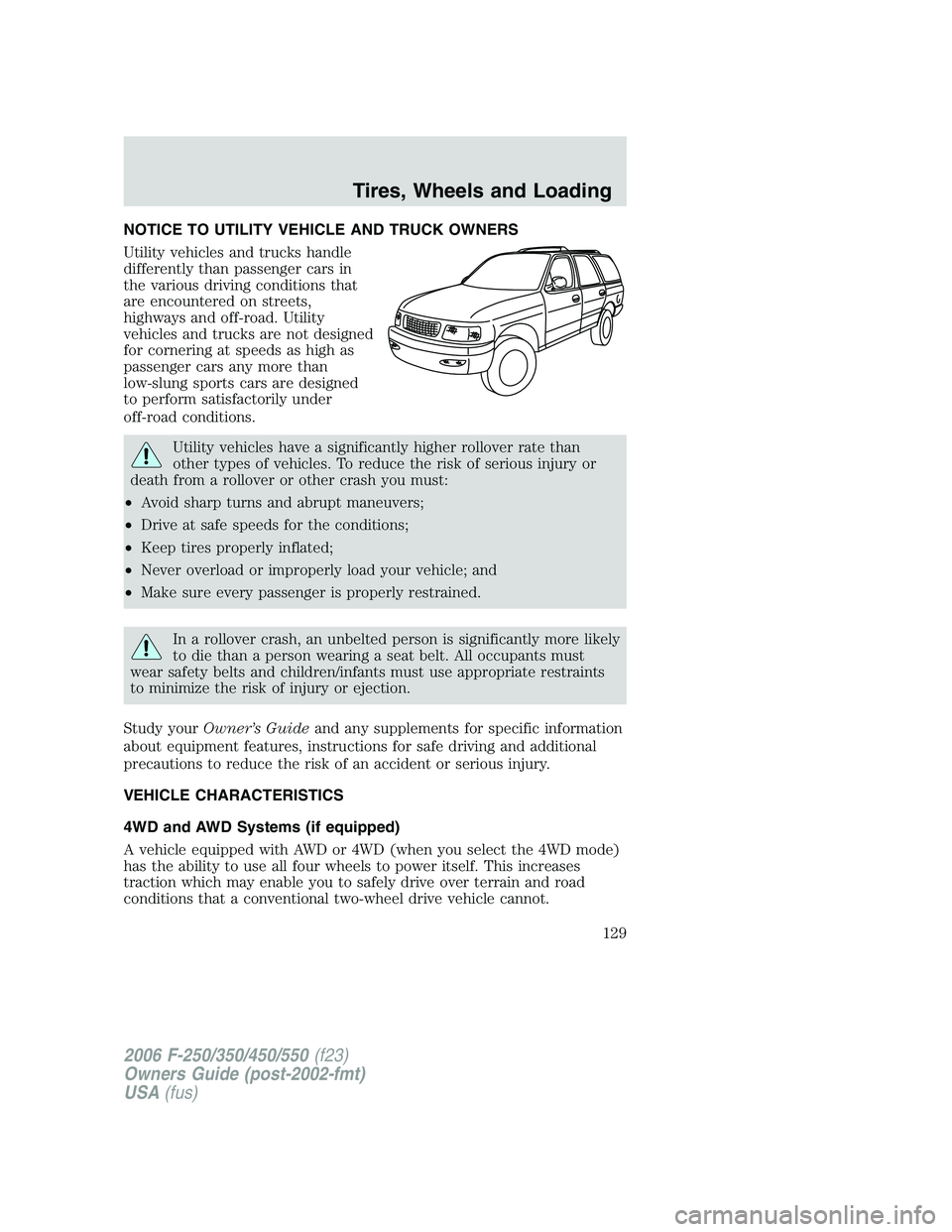
NOTICE TO UTILITY VEHICLE AND TRUCK OWNERS
Utility vehicles and trucks handle
differently than passenger cars in
the various driving conditions that
are encountered on streets,
highways and off-road. Utility
vehicles and trucks are not designed
for cornering at speeds as high as
passenger cars any more than
low-slung sports cars are designed
to perform satisfactorily under
off-road conditions.
Utility vehicles have a significantly higher rollover rate than
other types of vehicles. To reduce the risk of serious injury or
death from a rollover or other crash you must:
•Avoid sharp turns and abrupt maneuvers;
•Drive at safe speeds for the conditions;
•Keep tires properly inflated;
•Never overload or improperly load your vehicle; and
•Make sure every passenger is properly restrained.
In a rollover crash, an unbelted person is significantly more likely
to die than a person wearing a seat belt. All occupants must
wear safety belts and children/infants must use appropriate restraints
to minimize the risk of injury or ejection.
Study yourOwner’s Guideand any supplements for specific information
about equipment features, instructions for safe driving and additional
precautions to reduce the risk of an accident or serious injury.
VEHICLE CHARACTERISTICS
4WD and AWD Systems (if equipped)
A vehicle equipped with AWD or 4WD (when you select the 4WD mode)
has the ability to use all four wheels to power itself. This increases
traction which may enable you to safely drive over terrain and road
conditions that a conventional two-wheel drive vehicle cannot.
2006 F-250/350/450/550(f23)
Owners Guide (post-2002-fmt)
USA(fus)
Tires, Wheels and Loading
129
Page 168 of 312
Extended idling at high engine speeds can produce very high
temperatures in the engine and exhaust system, creating the risk
of fire or other damage.
Do not park, idle, or drive your vehicle in dry grass or other dry
ground cover. The emission system heats up the engine
compartment and exhaust system, which can start a fire.
Do not start your vehicle in a closed garage or in other enclosed
areas. Exhaust fumes can be toxic. Always open the garage door
before you start the engine. SeeGuarding against exhaust fumesin
this chapter for more instructions.
If you smell exhaust fumes inside your vehicle, have your dealer
inspect your vehicle immediately. Do not drive if you smell
exhaust fumes.
Important safety precautions
When the engine starts, the idle RPM runs faster to warm the engine. If
the engine idle speed does not slow down automatically, have the vehicle
checked. If your vehicle is operated in a heavy snow storm or blowing
snow conditions, the engine air induction may become partially clogged
with snow and/or ice. If this occurs, the engine may experience a
significant reduction in power output. At the earliest opportunity, clear
all the snow and/or ice away from the air induction inlet. The following
starting instructions are for vehicles equipped with a gasoline engine; if
your vehicle is equipped with a Diesel engine, refer toStarting the
enginein your6.0 Liter Power Stroke Direct Injection Turbo Diesel
Owner’s Guide Supplement.
Before starting the vehicle:
1. Make sure all occupants buckle their safety belts. For more
information on safety belts and their proper usage, refer to theSeating
and Safety Restraintschapter.
2. Make sure the headlamps and electrical accessories are off.
2006 F-250/350/450/550(f23)
Owners Guide (post-2002-fmt)
USA(fus)
Driving
168
Page 170 of 312
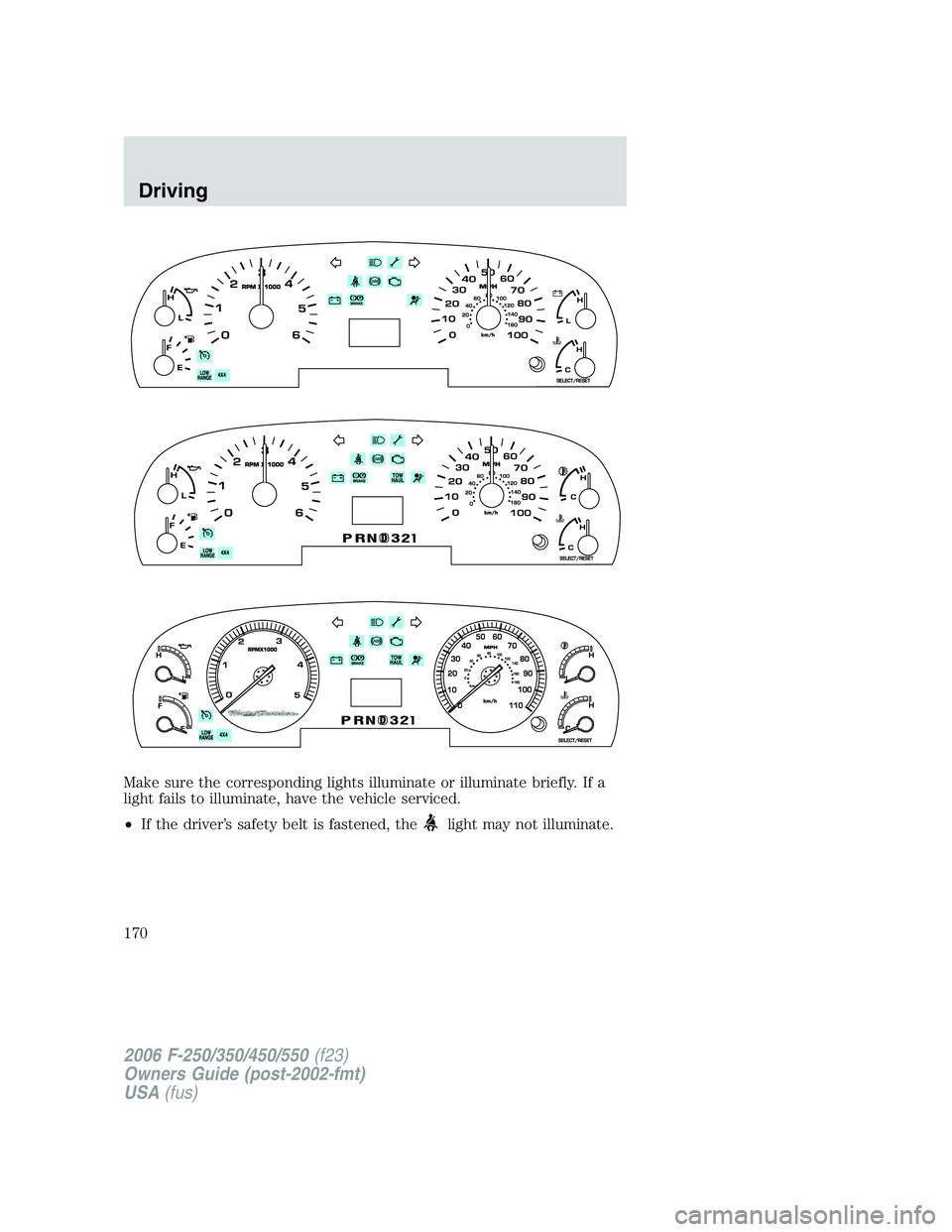
Make sure the corresponding lights illuminate or illuminate briefly. If a
light fails to illuminate, have the vehicle serviced.
•If the driver’s safety belt is fastened, the
light may not illuminate.
2006 F-250/350/450/550(f23)
Owners Guide (post-2002-fmt)
USA(fus)
Driving
170
Page 175 of 312
•Do not operate the vehicle with a low power steering pump fluid level
(below the FULL COLD mark on the dipstick).
If the power steering system breaks down (or if the engine is turned
off), you can steer the vehicle manually, but it takes more effort.
If the steering wanders or pulls, check for:
•an improperly inflated tire
•uneven tire wear
•loose or worn suspension components
•loose or worn steering components
•improper steering alignment
If any steering components are serviced or replaced, install new
fasteners (many are coated with thread adhesive or have prevailing
torque features which may not be re-used). Never re-use a bolt or nut.
Torque fasteners to specifications inWorkshop Manual.
A high crown in the road or high crosswinds may also make the steering
seem to wander/pull.
TRACTION-LOK AXLE (IF EQUIPPED)
This axle provides added traction on slippery surfaces, particularly when
one wheel is on a poor traction surface. Under normal conditions, the
Traction-Lok axle functions like a standard rear axle. The axle may
exhibit a slight noise or vibration in tight turns with low vehicle speed.
This is normal behavior and indicates the axle is working.
PREPARING TO DRIVE YOUR VEHICLE
Utility vehicles have a significantly higher rollover rate than
other types of vehicles.
In a rollover crash, an unbelted person is significantly more likely
to die than a person wearing a safety belt.
Your vehicle has larger tires and increased ground clearance, giving the
vehicle a higher center of gravity than a passenger car.
2006 F-250/350/450/550(f23)
Owners Guide (post-2002-fmt)
USA(fus)
Driving
175
Page 200 of 312
Operating the vehicle with the snowplow attached
Do not use your vehicle for snow removal until it has been driven at
least 500 miles (800 km).
The attached snowplow blade restricts airflow to the radiator, and may
cause the engine to run at a higher temperature:
•If you are driving more than 15 miles (24 km) where outside air
temperatures are above freezing, then angle the plow blade to full left
or right to maximize airflow to the radiator.
•If you are driving less than 15 miles (24 km) at speeds up to 40 mph
(64 km/h) in cold weather you will not need to adjust blade position
Follow the severe duty schedule in yourscheduled maintenance
informationfor engine oil and transmission fluid change intervals.
Snowplowing with your airbag-equipped vehicle
Your vehicle is equipped with a driver and passenger airbag
Supplemental Restraint System (SRS) The SRS is designed to activate in
certain frontal and offset frontal collisions when the vehicle sustains
sufficient longitudinal deceleration.
Careless or high speed driving while plowing snow which results in
sufficient vehicle decelerations can deploy the airbag. Such driving also
increases the risk of accidents.
All occupants of the vehicle, including the driver, should always
properly wear their safety belts, even when an air bag
supplemental restraint system (SRS) is provided.
Never remove or defeat the “tripping mechanisms” designed into the
snow removal equipment by its manufacturer. Doing so may cause
damage to the vehicle and the snow removal equipment as well as
possible airbag deployment.
Do not attempt to service, repair, or modify the air bag
supplemental restraint system (SRS) or its fuses. See your Ford
or Lincoln Mercury dealer.
Additional equipment such as snowplow equipment may effect
the performance of the airbag sensors increasing the risk of
injury. Please refer to theBody Builders Layout Bookfor instructions
about the appropriate installation of additional equipment.
2006 F-250/350/450/550(f23)
Owners Guide (post-2002-fmt)
USA(fus)
Driving
200
Page 229 of 312
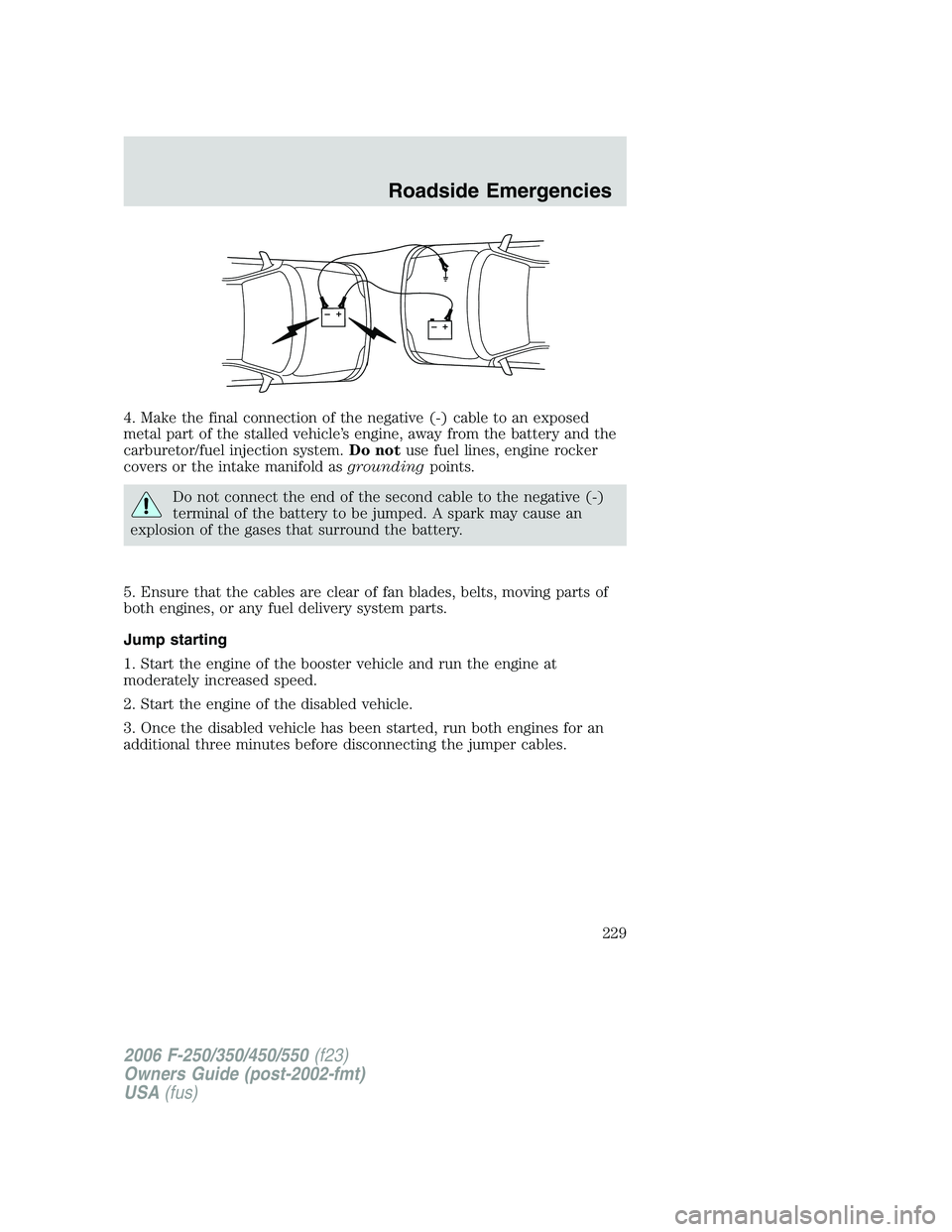
4. Make the final connection of the negative (-) cable to an exposed
metal part of the stalled vehicle’s engine, away from the battery and the
carburetor/fuel injection system.Do notuse fuel lines, engine rocker
covers or the intake manifold asgroundingpoints.
Do not connect the end of the second cable to the negative (-)
terminal of the battery to be jumped. A spark may cause an
explosion of the gases that surround the battery.
5. Ensure that the cables are clear of fan blades, belts, moving parts of
both engines, or any fuel delivery system parts.
Jump starting
1. Start the engine of the booster vehicle and run the engine at
moderately increased speed.
2. Start the engine of the disabled vehicle.
3. Once the disabled vehicle has been started, run both engines for an
additional three minutes before disconnecting the jumper cables.
+–+–
2006 F-250/350/450/550(f23)
Owners Guide (post-2002-fmt)
USA(fus)
Roadside Emergencies
229
Page 245 of 312
Do not use chemical solvents or strong detergents when cleaning
the steering wheel or instrument panel to avoid contamination of
the airbag system.
•Be certain to wash or wipe your hands clean if you have been in
contact with certain products such as insect repellent and suntan
lotion in order to avoid possible damage to the interior painted
surfaces.
INTERIOR TRIM
•Clean the interior trim areas with a damp cloth, then dry by wiping
with a dry, soft, clean cloth.
•Do not use household or glass cleaners as these may damage the
finish.
INTERIOR
For fabric, carpets, cloth seats and safety belts:
•Remove dust and loose dirt with a vacuum cleaner.
•Remove light stains and soil with Motorcraft Professional Strength
Carpet & Upholstery Cleaner (ZC-54).
•If grease or tar is present on the material, spot-clean the area first
with Motorcraft Spot and Stain Remover (ZC-14).
•If a ring forms on the fabric after spot cleaning, clean the entire area
immediately (but do not oversaturate) or the ring will set.
•Do not use household cleaning products or glass cleaners, which can
stain and discolor the fabric and affect the flame retardant abilities of
the seat materials.
Do not use cleaning solvents, bleach or dye on the vehicle’s
seatbelts, as these actions may weaken the belt webbing.
LEATHER SEATS (IF EQUIPPED, EXCEPT FOR THE KING RANCH
F–250 AND F–350 CREWCAB)
Your leather seating surfaces have a clear, protective coating over the
leather.
For King Ranch F-250 and F-350 CrewCab leather seats, refer to
separate section in this chapter.
•To clean, use a soft cloth with Motorcraft Deluxe Leather and Vinyl
Cleaner (ZC-11–A). Dry the area with a soft cloth.
2006 F-250/350/450/550(f23)
Owners Guide (post-2002-fmt)
USA(fus)
Cleaning
245
Page 305 of 312
A
Accessory delay ..........................58
Air cleaner filter .......283–284, 286
Air conditioning ..........................36
Airbag supplemental restraint
system ................................108–109
and child safety seats ............110
description ..............................109
disposal ....................................112
driver airbag ............................111
indicator light .........................112
operation .................................111
passenger airbag .....................111
passenger deactivation
switch ......................................113
Ambulance packages ....................8
Antifreeze
(see Engine coolant) ................260
Anti-lock brake system
(see Brakes) ......................172–173
Audio system
(see Radio) ................20, 22, 25, 28
Automatic transmission ............176
driving an automatic
overdrive .................................177
fluid, adding ............................279
fluid, checking ........................279
fluid, refill capacities ..............287
Auxiliary power point .................56
Axle
lubricant specifications ..........290
refill capacities ........................287
traction lok ..............................175
B
Battery .......................................258
acid, treating emergencies .....258jumping a disabled battery ....226
maintenance-free ....................258
replacement, specifications ...286
servicing ..................................258
BeltMinder .................................104
Brakes ........................................172
anti-lock ...........................172–173
anti-lock brake system (ABS)
warning light ...........................173
fluid, checking and adding ....278
fluid, refill capacities ..............287
fluid, specifications .................290
lubricant specifications ..........290
parking ....................................173
shift interlock ..........................176
trailer .......................................159
Break-in period .............................5
Bulbs ............................................45
C
Capacities for refilling fluids ....287
Cassette tape player .......20, 22, 25
Cell phone use ..............................7
Child safety restraints ..............118
child safety belts ....................118
Child safety seats ......................121
attaching with tether straps ..124
in front seat ............................122
in rear seat ..............................122
Cleaning your vehicle
engine compartment ..............242
instrument panel ....................244
interior .....................................245
interior trim ............................245
plastic parts ............................244
safety belts ..............................245
washing ....................................241
waxing .....................................241
2006 F-250/350/450/550(f23)
Owners Guide (post-2002-fmt)
USA(fus)
Index
305
Page 309 of 312
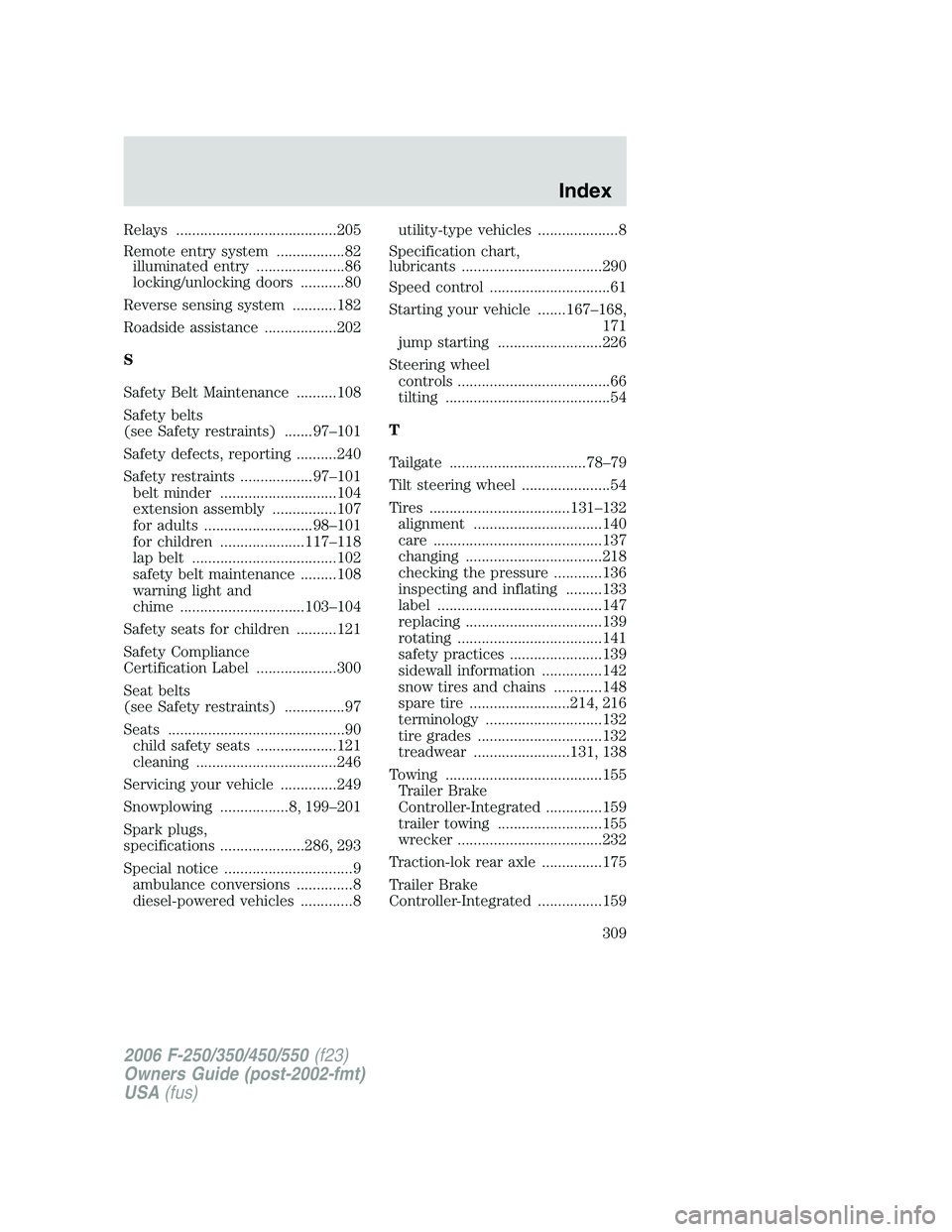
Relays ........................................205
Remote entry system .................82
illuminated entry ......................86
locking/unlocking doors ...........80
Reverse sensing system ...........182
Roadside assistance ..................202
S
Safety Belt Maintenance ..........108
Safety belts
(see Safety restraints) .......97–101
Safety defects, reporting ..........240
Safety restraints ..................97–101
belt minder .............................104
extension assembly ................107
for adults ...........................98–101
for children .....................117–118
lap belt ....................................102
safety belt maintenance .........108
warning light and
chime ...............................103–104
Safety seats for children ..........121
Safety Compliance
Certification Label ....................300
Seat belts
(see Safety restraints) ...............97
Seats ............................................90
child safety seats ....................121
cleaning ...................................246
Servicing your vehicle ..............249
Snowplowing .................8, 199–201
Spark plugs,
specifications .....................286, 293
Special notice ................................9
ambulance conversions ..............8
diesel-powered vehicles .............8utility-type vehicles ....................8
Specification chart,
lubricants ...................................290
Speed control ..............................61
Starting your vehicle .......167–168,
171
jump starting ..........................226
Steering wheel
controls ......................................66
tilting .........................................54
T
Tailgate ..................................78–79
Tilt steering wheel ......................54
Tires ...................................131–132
alignment ................................140
care ..........................................137
changing ..................................218
checking the pressure ............136
inspecting and inflating .........133
label .........................................147
replacing ..................................139
rotating ....................................141
safety practices .......................139
sidewall information ...............142
snow tires and chains ............148
spare tire .........................214, 216
terminology .............................132
tire grades ...............................132
treadwear ........................131, 138
Towing .......................................155
Trailer Brake
Controller-Integrated ..............159
trailer towing ..........................155
wrecker ....................................232
Traction-lok rear axle ...............175
Trailer Brake
Controller-Integrated ................159
2006 F-250/350/450/550(f23)
Owners Guide (post-2002-fmt)
USA(fus)
Index
309