warning FORD F250 2009 Manual PDF
[x] Cancel search | Manufacturer: FORD, Model Year: 2009, Model line: F250, Model: FORD F250 2009Pages: 419, PDF Size: 3.58 MB
Page 194 of 419
WARNING:Never place your arm over the airbag module as a
deploying airbag can result in serious arm fractures or other
injuries.
To properly position yourself away from the airbag:
•Move your seat to the rear as far as you can while still reaching the
pedals comfortably.
•Recline the seat slightly one or two degrees from the upright position.
WARNING:Do not put anything on or over the airbag module.
Placing objects on or over the airbag inflation area may cause
those objects to be propelled by the airbag into your face and torso
causing serious injury.
WARNING:Do not attempt to service, repair, or modify the
airbag supplemental restraint systems or its fuses. Contact your
authorized dealer as soon as possible.
WARNING:The front passenger airbag is not designed to offer
protection to an occupant in the center front seating position.
WARNING:Modifying or adding equipment to the front end of
the vehicle (including frame, bumper, front end body structure
and tow hooks) may affect the performance of the airbag system,
increasing the risk of injury. Do not modify the front end of the
vehicle.
WARNING:Additional equipment such as snowplow equipment
may effect the performance of the airbag sensors increasing the
risk of injury. Please refer to theBody Builders Layout Bookfor
instructions about the appropriate installation of additional equipment.
WARNING:Removing the blocker beam without installing snow
plow attachment hardware may effect airbag deployment in a
crash. Do not operate the truck unless either the blocker beam or
snow plow attachment hardware is installed on the vehicle.
2009 F-250/350/450/550(f23)
Owners Guide, 3rd Printing
USA(fus)
Seating and Safety Restraints
194
Page 195 of 419
Children and airbags
For additional important safety information, read all information on
safety restraints in this guide.
Children must always be properly restrained. Failure to follow these
instructions may increase the risk of injury in a collision.
WARNING:An infant in a rear-facing seat faces a high risk of
serious or fatal injuries from a deploying passenger airbag. Rear
facing infant seats should NEVER be placed in the front seats, unless
the passenger airbag is turned off. SeePassenger airbag ON/OFF
switch.
WARNING:Front seating positions only: If seating two adults
and a child, Ford recommends properly restraining the child in
the center front seating position, but only if doing so will not interfere
with driving the vehicle. This arrangement provides lap and shoulder
belt and airbag protection for adult occupants and an attachment
method for a child restraint. If the child seat interferes with driving the
vehicle and the child restraint is forward-facing, the child may be
restrained in the passenger seat. Move the seat as far rearward as
possible to minimize the likelihood of interaction with the front
passenger airbag. Never place a rear-facing child seat in front of an
active airbag. Always properly restrain all occupants, including the
child in an appropriate child seat or booster.
How does the airbag supplemental restraint system work?
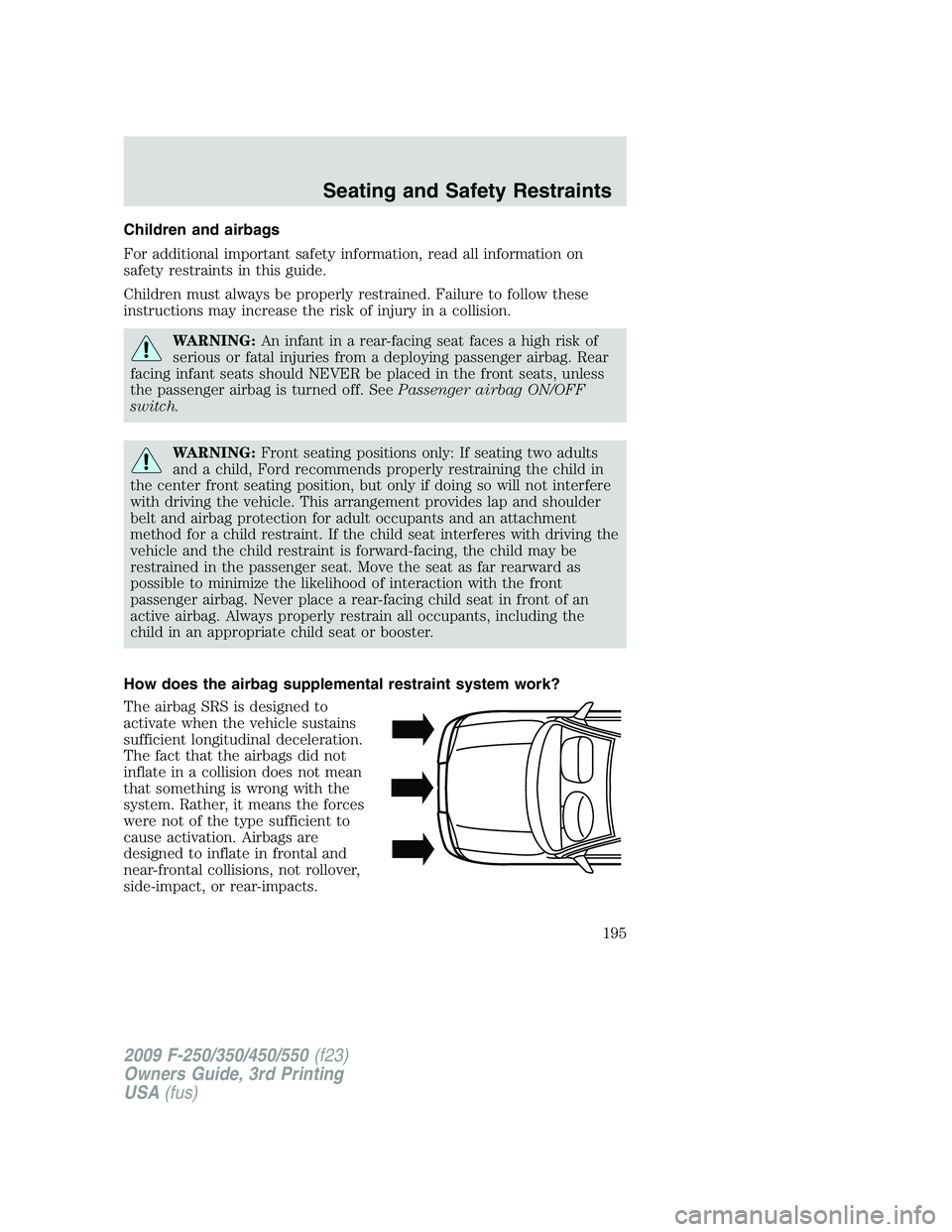
The airbag SRS is designed to
activate when the vehicle sustains
sufficient longitudinal deceleration.
The fact that the airbags did not
inflate in a collision does not mean
that something is wrong with the
system. Rather, it means the forces
were not of the type sufficient to
cause activation. Airbags are
designed to inflate in frontal and
near-frontal collisions, not rollover,
side-impact, or rear-impacts.
2009 F-250/350/450/550(f23)
Owners Guide, 3rd Printing
USA(fus)
Seating and Safety Restraints
195
Page 196 of 419
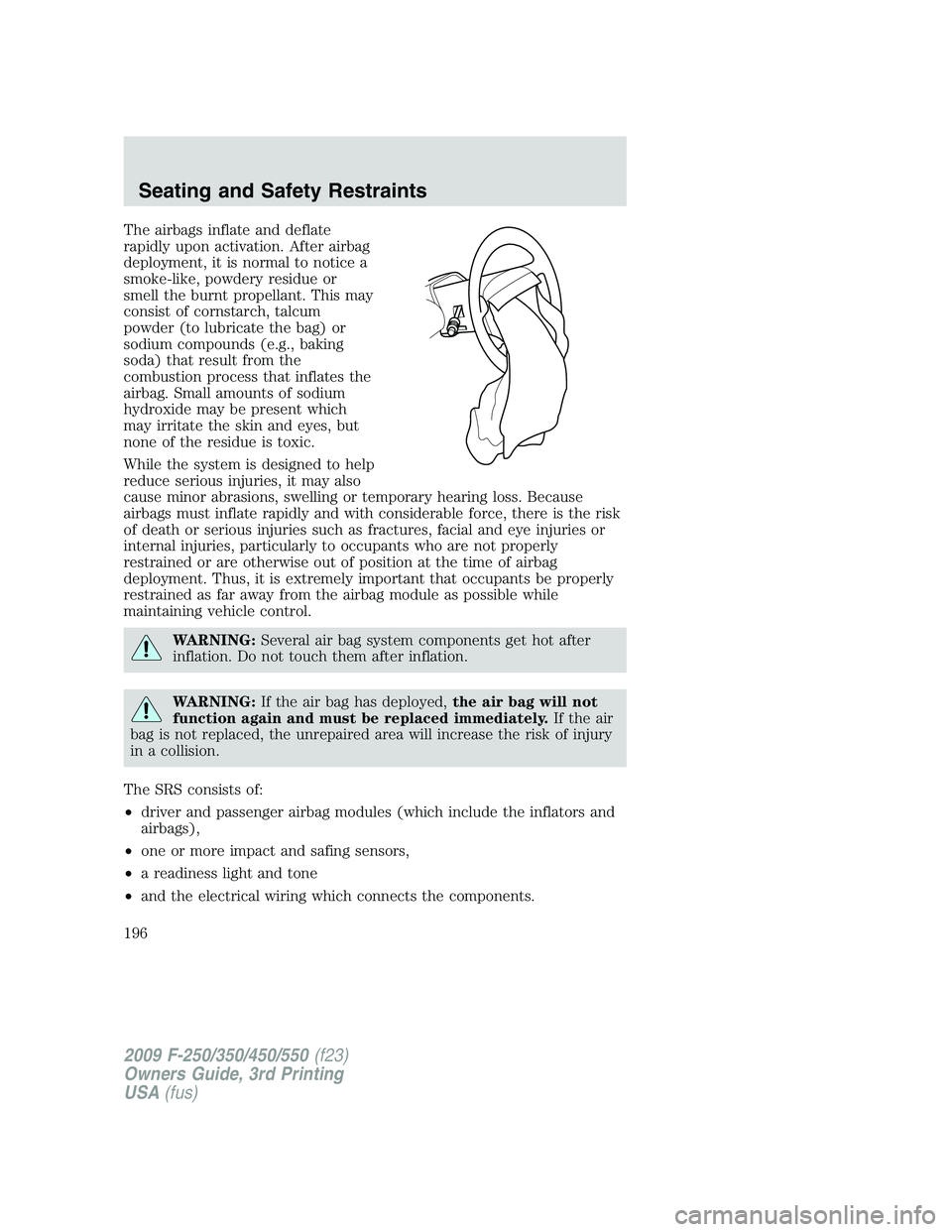
The airbags inflate and deflate
rapidly upon activation. After airbag
deployment, it is normal to notice a
smoke-like, powdery residue or
smell the burnt propellant. This may
consist of cornstarch, talcum
powder (to lubricate the bag) or
sodium compounds (e.g., baking
soda) that result from the
combustion process that inflates the
airbag. Small amounts of sodium
hydroxide may be present which
may irritate the skin and eyes, but
none of the residue is toxic.
While the system is designed to help
reduce serious injuries, it may also
cause minor abrasions, swelling or temporary hearing loss. Because
airbags must inflate rapidly and with considerable force, there is the risk
of death or serious injuries such as fractures, facial and eye injuries or
internal injuries, particularly to occupants who are not properly
restrained or are otherwise out of position at the time of airbag
deployment. Thus, it is extremely important that occupants be properly
restrained as far away from the airbag module as possible while
maintaining vehicle control.
WARNING:Several air bag system components get hot after
inflation. Do not touch them after inflation.
WARNING:If the air bag has deployed,the air bag will not
function again and must be replaced immediately.If the air
bag is not replaced, the unrepaired area will increase the risk of injury
in a collision.
The SRS consists of:
•driver and passenger airbag modules (which include the inflators and
airbags),
•one or more impact and safing sensors,
•a readiness light and tone
•and the electrical wiring which connects the components.
2009 F-250/350/450/550(f23)
Owners Guide, 3rd Printing
USA(fus)
Seating and Safety Restraints
196
Page 198 of 419
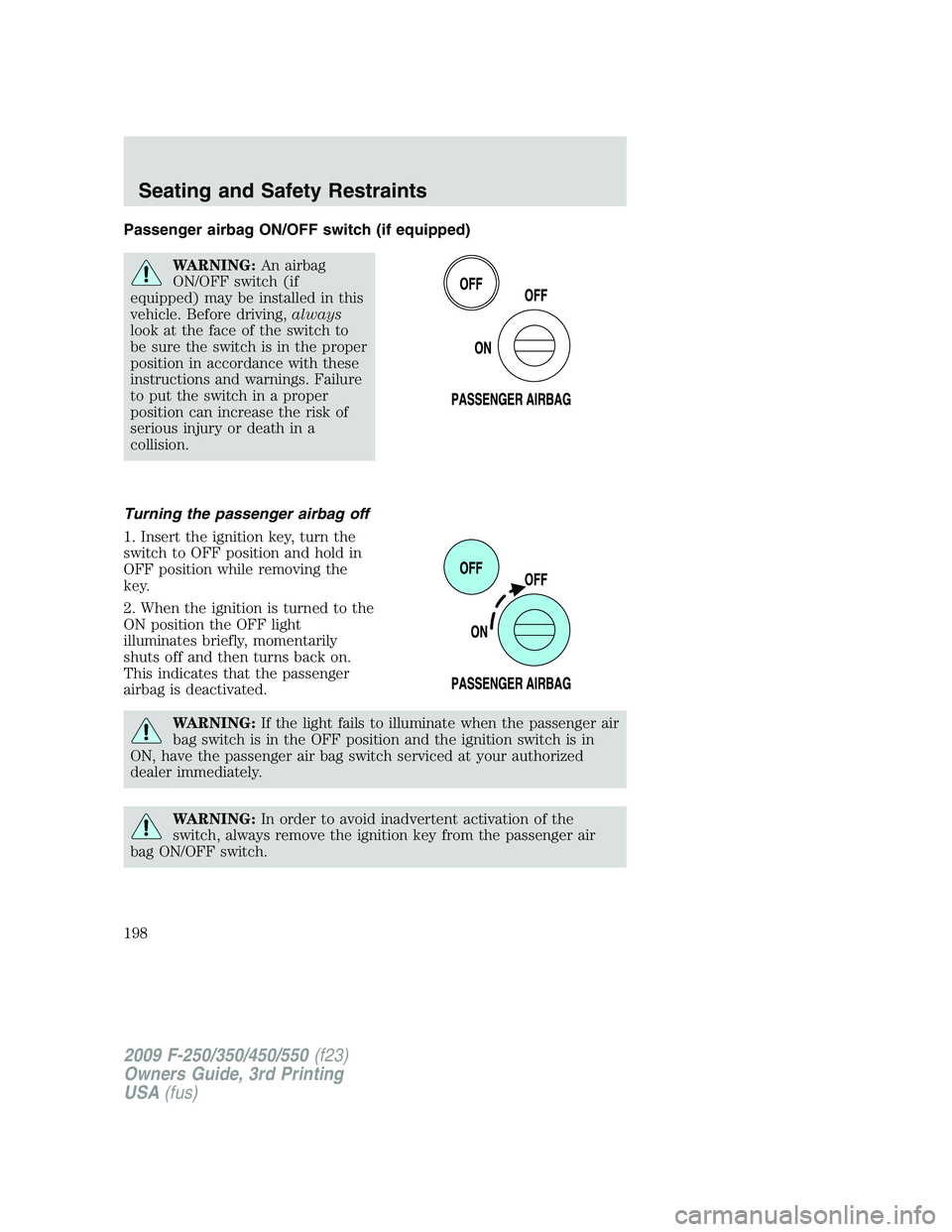
Passenger airbag ON/OFF switch (if equipped)
WARNING:An airbag
ON/OFF switch (if
equipped) may be installed in this
vehicle. Before driving,always
look at the face of the switch to
be sure the switch is in the proper
position in accordance with these
instructions and warnings. Failure
to put the switch in a proper
position can increase the risk of
serious injury or death in a
collision.
Turning the passenger airbag off
1. Insert the ignition key, turn the
switch to OFF position and hold in
OFF position while removing the
key.
2. When the ignition is turned to the
ON position the OFF light
illuminates briefly, momentarily
shuts off and then turns back on.
This indicates that the passenger
airbag is deactivated.
WARNING:If the light fails to illuminate when the passenger air
bag switch is in the OFF position and the ignition switch is in
ON, have the passenger air bag switch serviced at your authorized
dealer immediately.
WARNING:In order to avoid inadvertent activation of the
switch, always remove the ignition key from the passenger air
bag ON/OFF switch.
2009 F-250/350/450/550(f23)
Owners Guide, 3rd Printing
USA(fus)
Seating and Safety Restraints
198
Page 199 of 419
WARNING:An infant in a rear-facing seat faces a high risk of
serious or fatal injuries from a deploying passenger airbag. Rear
facing infant seats should NEVER be placed in the front seats, unless
the passenger airbag is turned off.
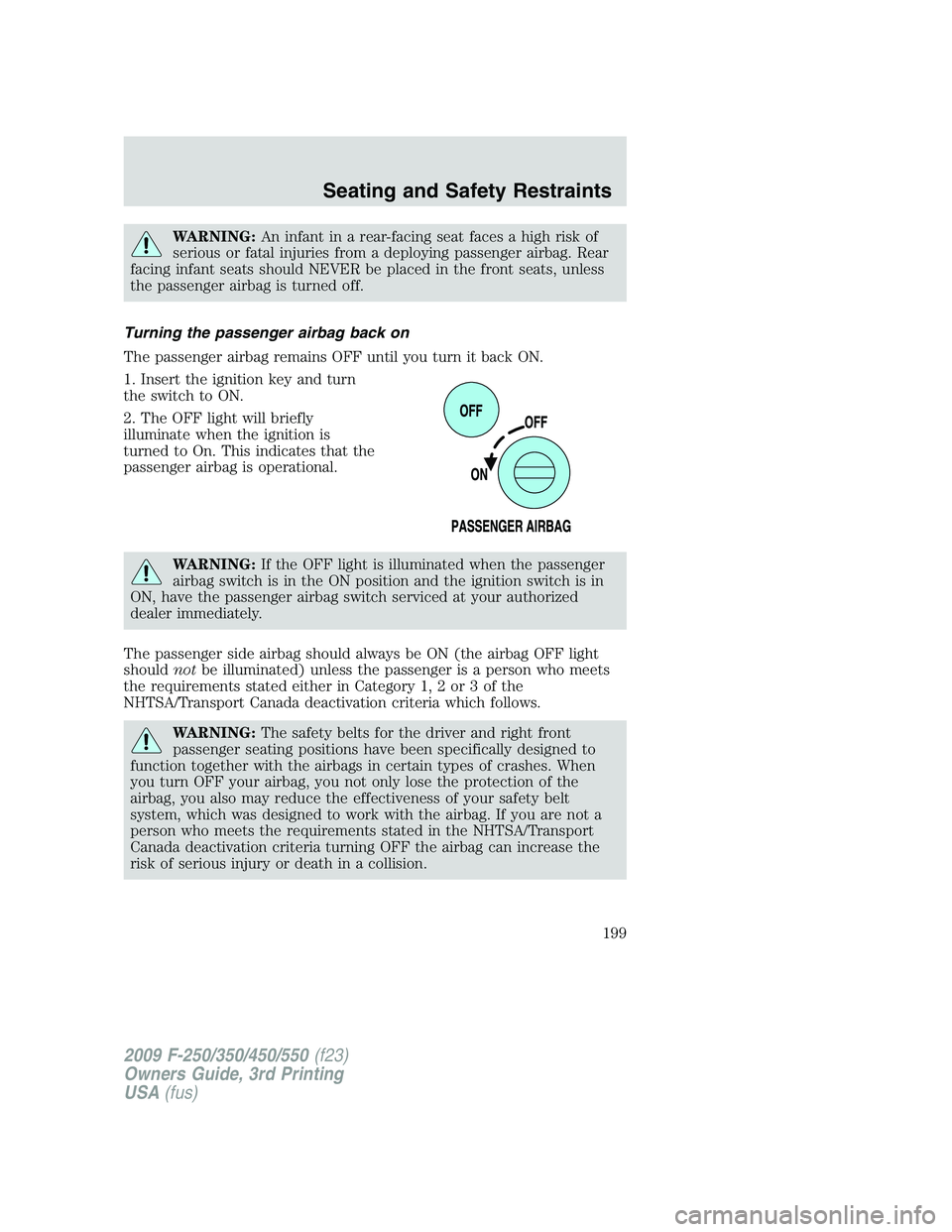
Turning the passenger airbag back on
The passenger airbag remains OFF until you turn it back ON.
1. Insert the ignition key and turn
the switch to ON.
2. The OFF light will briefly
illuminate when the ignition is
turned to On. This indicates that the
passenger airbag is operational.
WARNING:If the OFF light is illuminated when the passenger
airbag switch is in the ON position and the ignition switch is in
ON, have the passenger airbag switch serviced at your authorized
dealer immediately.
The passenger side airbag should always be ON (the airbag OFF light
shouldnotbe illuminated) unless the passenger is a person who meets
the requirements stated either in Category 1, 2 or 3 of the
NHTSA/Transport Canada deactivation criteria which follows.
WARNING:The safety belts for the driver and right front
passenger seating positions have been specifically designed to
function together with the airbags in certain types of crashes. When
you turn OFF your airbag, you not only lose the protection of the
airbag, you also may reduce the effectiveness of your safety belt
system, which was designed to work with the airbag. If you are not a
person who meets the requirements stated in the NHTSA/Transport
Canada deactivation criteria turning OFF the airbag can increase the
risk of serious injury or death in a collision.
2009 F-250/350/450/550(f23)
Owners Guide, 3rd Printing
USA(fus)
Seating and Safety Restraints
199
Page 200 of 419
WARNING:If your vehicle has rear seats, always transport
children who are 12 and younger in the rear seat. Always use
safety belts and child restraints properly. DO NOT place a child in a
rear facing infant seat in the front seat unless your vehicle is equipped
with an airbag ON/OFF switch and the passenger airbag is turned OFF.
This is because the back of the infant seat is too close to the inflating
airbag and the risk of a fatal injury to the infant when the airbag
inflates is substantial.
The vast majority of drivers and passengers are much safer with an
airbag than without. To do their job and reduce the risk of life
threatening injuries, airbags must open with great force, and this force
can pose a potentially deadly risk in some situations, particularly when a
front seat occupant is not properly buckled up. The most effective way
to reduce the risk of unnecessary airbag injuries without reducing the
overall safety of the vehicle is to make sure all occupants are properly
restrained in the vehicle, especially in the front seat. This provides the
protection of safety belts and permits the airbags to provide the
additional protection they were designed to provide. If you choose to
deactivate your airbag, you are losing the very significant risk reducing
benefits of the airbag and you are also reducing the effectiveness of the
safety belts, because safety belts in modern vehicles are designed to
work as a safety system with the airbags.
Read all airbag warning labels in the vehicle as well as the other
important airbag instructions and warnings in this Owner’s Guide.
NHTSA deactivation criteria (excluding Canada)
1.Infant.An infant (less than 1 year old) must ride in the front seat
because:
•the vehicle has no rear seat;
•the vehicle has a rear seat too small to accommodate a rear-facing
infant seat; or
•the infant has a medical condition which, according to the infant’s
physician, makes it necessary for the infant to ride in the front so that
the driver can constantly monitor the child’s condition.
2.Child age 1 to 12.A child age 1 to 12 must ride in the front seat
because:
•the vehicle has no rear seat;
•although children ages 1 to 12 ride in the rear seat(s) whenever
possible, children ages 1 to 12 sometimes must ride in the front
because no space is available in the rear seat(s) of the vehicle; or
2009 F-250/350/450/550(f23)
Owners Guide, 3rd Printing
USA(fus)
Seating and Safety Restraints
200
Page 201 of 419
•the child has a medical condition which, according to the child’s
physician, makes it necessary for the child to ride in the front seat so
that the driver can constantly monitor the child’s condition.
3.Medical condition.A passenger has a medical condition which,
according to his or her physician:
•causes the passenger airbag to pose a special risk for the passenger;
and
•makes the potential harm from the passenger airbag in a crash greater
than the potential harm from turning OFF the airbag and allowing the
passenger, even if belted, to hit the dashboard or windshield in a
crash.
WARNING:This vehicle has special energy management safety
belts for the driver and right front passenger. These particular
belts are specifically designed to work with airbags to help reduce the
risk of injury in a collision. The energy management safety belt is
designed to give or release additional belt webbing in some accidents
to reduce concentration of force on an occupant’s chest and reduce the
risk of certain bone fractures and injuries to underlying organs. In a
crash, if the airbag is turned OFF, this energy management safety belt
might permit the person wearing the belt to move forward enough to
incur a serious or fatal injury. The more severe the crash, and the
heavier the occupant, the greater the risk is. Be sure the airbag is
turned ON for any person who does not qualify under the NHTSA
deactivation criteria.
Transport Canada deactivation criteria (Canada Only)
1.Infant:An infant (less than 1 year old) must ride in the front seat
because:
•my vehicle has no rear seat;
•the rear seat in my vehicle cannot accommodate a rear-facing infant
seat; or
•the infant has a medical condition which, according to the infant’s
physician, makes it necessary for the infant to ride in the front seat so
that the driver can monitor the infant’s condition.
2.Child age 12 or under:A child age 12 or under must ride in the
front seat because:
•my vehicle has no rear seat;
•although children age 12 and under ride in the rear seat whenever
possible, children age 12 and under have no option but to sometimes
ride in the front seat because rear seat space is insufficient; or
2009 F-250/350/450/550(f23)
Owners Guide, 3rd Printing
USA(fus)
Seating and Safety Restraints
201
Page 202 of 419
•the child has a medical condition that, according to the child’s
physician, makes it necessary for the child to ride in the front seat so
that the driver can monitor the child’s condition.
3.Medical condition:A passenger has a medical condition that,
according to his or her physician:
•poses a special risk for the passenger if the airbag deploys; and
•makes the potential harm from the passenger airbag deployment
greater than the potential harm from turning OFF the airbag and
experiencing a crash without the protection offered by the airbag
WARNING:This vehicle has special energy management safety
belts for the driver and right front passenger. These particular
belts are specifically designed to work with airbags to help reduce the
risk of injury in a collision. The energy management safety belt is
designed to give or release additional belt webbing in some accidents
to reduce concentration of force on an occupant’s chest and reduce the
risk of certain bone fractures and injuries to underlying organs. In a
crash, if the airbag is turned OFF, this energy management safety belt
might permit the person wearing the belt to move forward enough to
incur a serious or fatal injury. The more severe the crash, and the
heavier the occupant, the greater the risk is. Be sure the airbag is
turned ON for any person who does not qualify under the NHTSA
deactivation criteria.
SAFETY RESTRAINTS FOR CHILDREN
See the following sections for directions on how to properly use safety
restraints for children. Also seeAirbag supplemental restraint system
(SRS)in this chapter for special instructions about using airbags.
Important child restraint precautions
WARNING:Always make sure your child is secured properly in
a device that is appropriate for their height, age and weight.
Child safety restraints must be purchased separately from the vehicle.
Failure to follow these instructions and guidelines may result in an
increased risk of serious injury or death to your child.
2009 F-250/350/450/550(f23)
Owners Guide, 3rd Printing
USA(fus)
Seating and Safety Restraints
202
Page 203 of 419
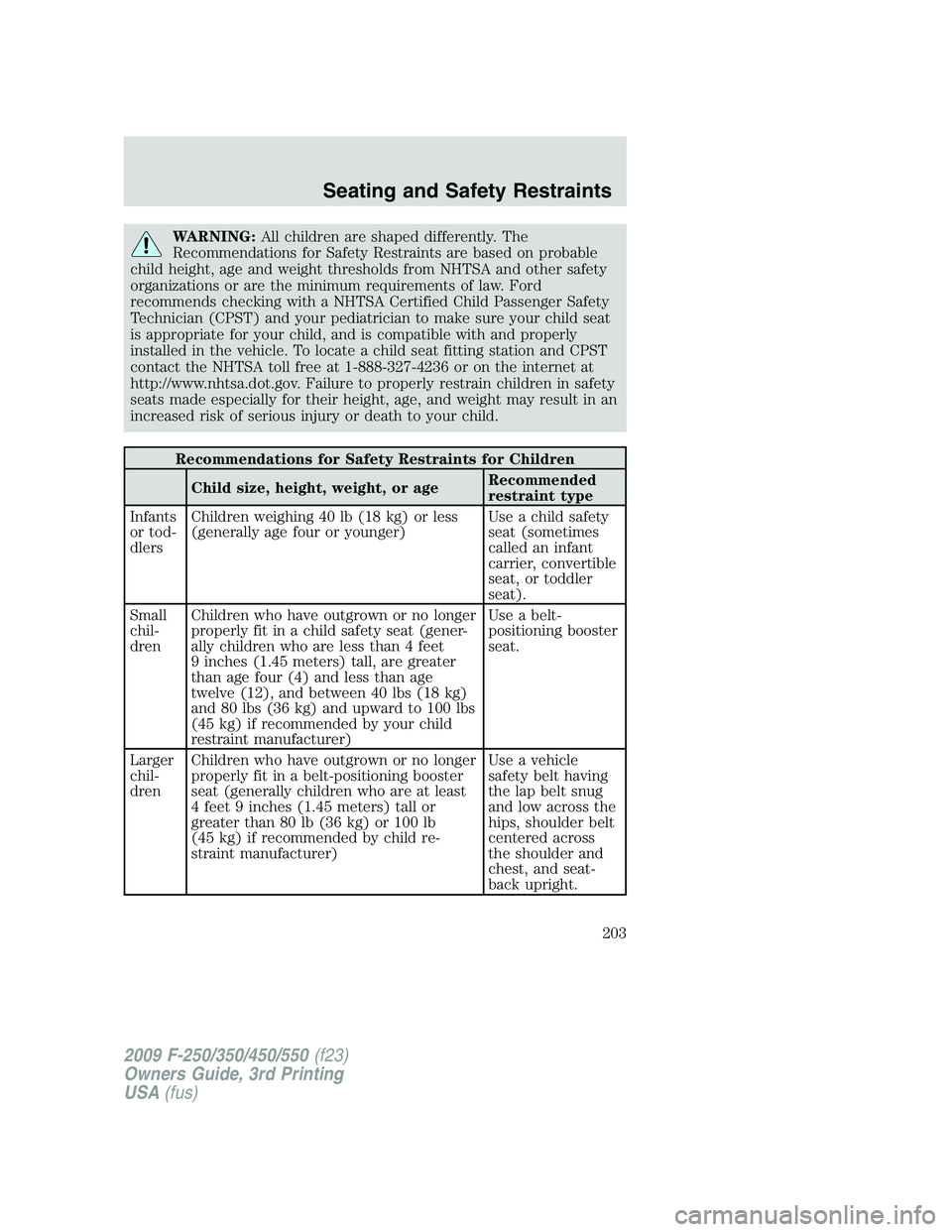
WARNING:All children are shaped differently. The
Recommendations for Safety Restraints are based on probable
child height, age and weight thresholds from NHTSA and other safety
organizations or are the minimum requirements of law. Ford
recommends checking with a NHTSA Certified Child Passenger Safety
Technician (CPST) and your pediatrician to make sure your child seat
is appropriate for your child, and is compatible with and properly
installed in the vehicle. To locate a child seat fitting station and CPST
contact the NHTSA toll free at 1-888-327-4236 or on the internet at
http://www.nhtsa.dot.gov. Failure to properly restrain children in safety
seats made especially for their height, age, and weight may result in an
increased risk of serious injury or death to your child.
Recommendations for Safety Restraints for Children
Child size, height, weight, or ageRecommended
restraint type
Infants
or tod-
dlersChildren weighing 40 lb (18 kg) or less
(generally age four or younger)Use a child safety
seat (sometimes
called an infant
carrier, convertible
seat, or toddler
seat).
Small
chil-
drenChildren who have outgrown or no longer
properly fit in a child safety seat (gener-
ally children who are less than 4 feet
9 inches (1.45 meters) tall, are greater
than age four (4) and less than age
twelve (12), and between 40 lbs (18 kg)
and 80 lbs (36 kg) and upward to 100 lbs
(45 kg) if recommended by your child
restraint manufacturer)Use a belt-
positioning booster
seat.
Larger
chil-
drenChildren who have outgrown or no longer
properly fit in a belt-positioning booster
seat (generally children who are at least
4 feet 9 inches (1.45 meters) tall or
greater than 80 lb (36 kg) or 100 lb
(45 kg) if recommended by child re-
straint manufacturer)Use a vehicle
safety belt having
the lap belt snug
and low across the
hips, shoulder belt
centered across
the shoulder and
chest, and seat-
back upright.
2009 F-250/350/450/550(f23)
Owners Guide, 3rd Printing
USA(fus)
Seating and Safety Restraints
203
Page 205 of 419
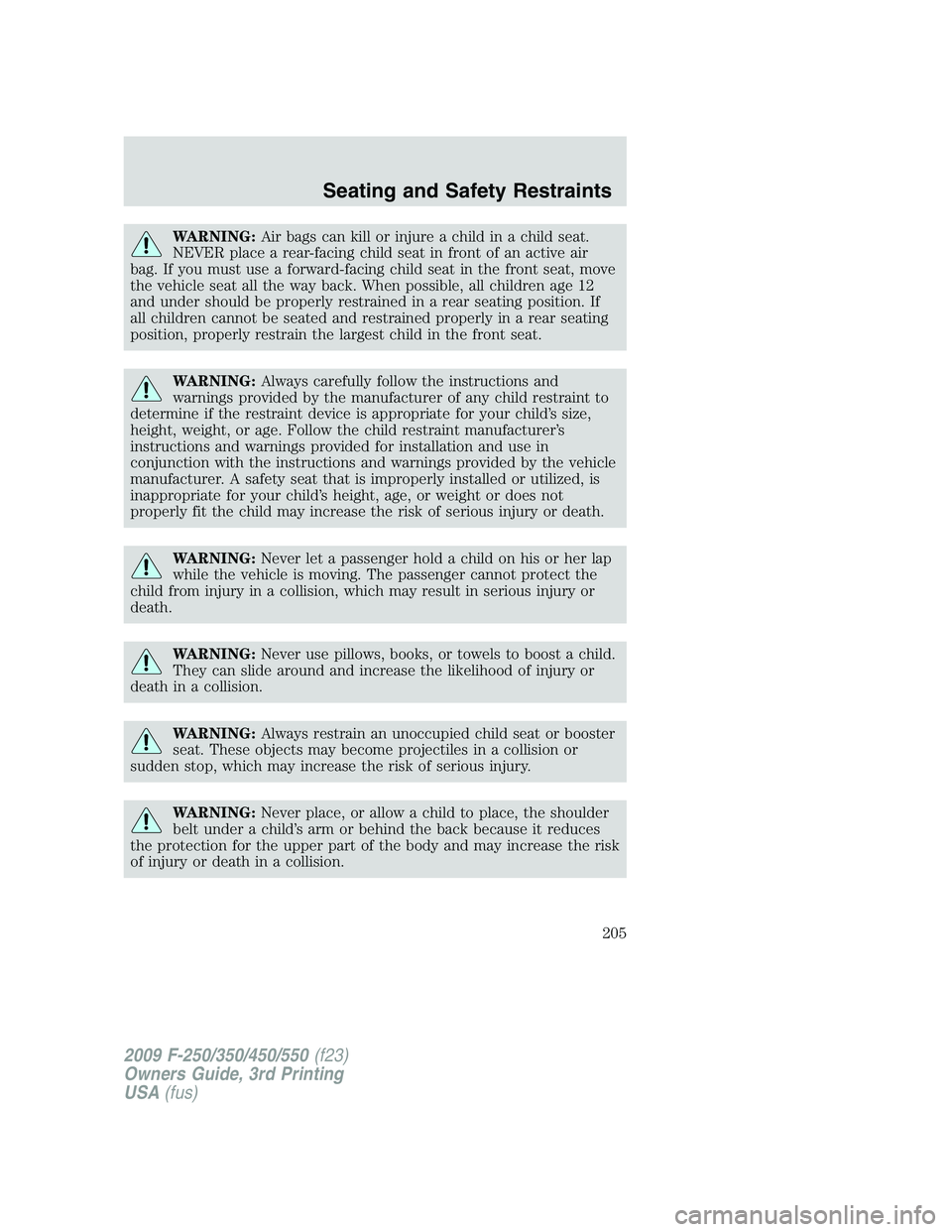
WARNING:Air bags can kill or injure a child in a child seat.
NEVER place a rear-facing child seat in front of an active air
bag. If you must use a forward-facing child seat in the front seat, move
the vehicle seat all the way back. When possible, all children age 12
and under should be properly restrained in a rear seating position. If
all children cannot be seated and restrained properly in a rear seating
position, properly restrain the largest child in the front seat.
WARNING:Always carefully follow the instructions and
warnings provided by the manufacturer of any child restraint to
determine if the restraint device is appropriate for your child’s size,
height, weight, or age. Follow the child restraint manufacturer’s
instructions and warnings provided for installation and use in
conjunction with the instructions and warnings provided by the vehicle
manufacturer. A safety seat that is improperly installed or utilized, is
inappropriate for your child’s height, age, or weight or does not
properly fit the child may increase the risk of serious injury or death.
WARNING:Never let a passenger hold a child on his or her lap
while the vehicle is moving. The passenger cannot protect the
child from injury in a collision, which may result in serious injury or
death.
WARNING:Never use pillows, books, or towels to boost a child.
They can slide around and increase the likelihood of injury or
death in a collision.
WARNING:Always restrain an unoccupied child seat or booster
seat. These objects may become projectiles in a collision or
sudden stop, which may increase the risk of serious injury.
WARNING:Never place, or allow a child to place, the shoulder
belt under a child’s arm or behind the back because it reduces
the protection for the upper part of the body and may increase the risk
of injury or death in a collision.
2009 F-250/350/450/550(f23)
Owners Guide, 3rd Printing
USA(fus)
Seating and Safety Restraints
205