seats FORD F250 2010 Owner's Manual
[x] Cancel search | Manufacturer: FORD, Model Year: 2010, Model line: F250, Model: FORD F250 2010Pages: 408, PDF Size: 3.36 MB
Page 175 of 408
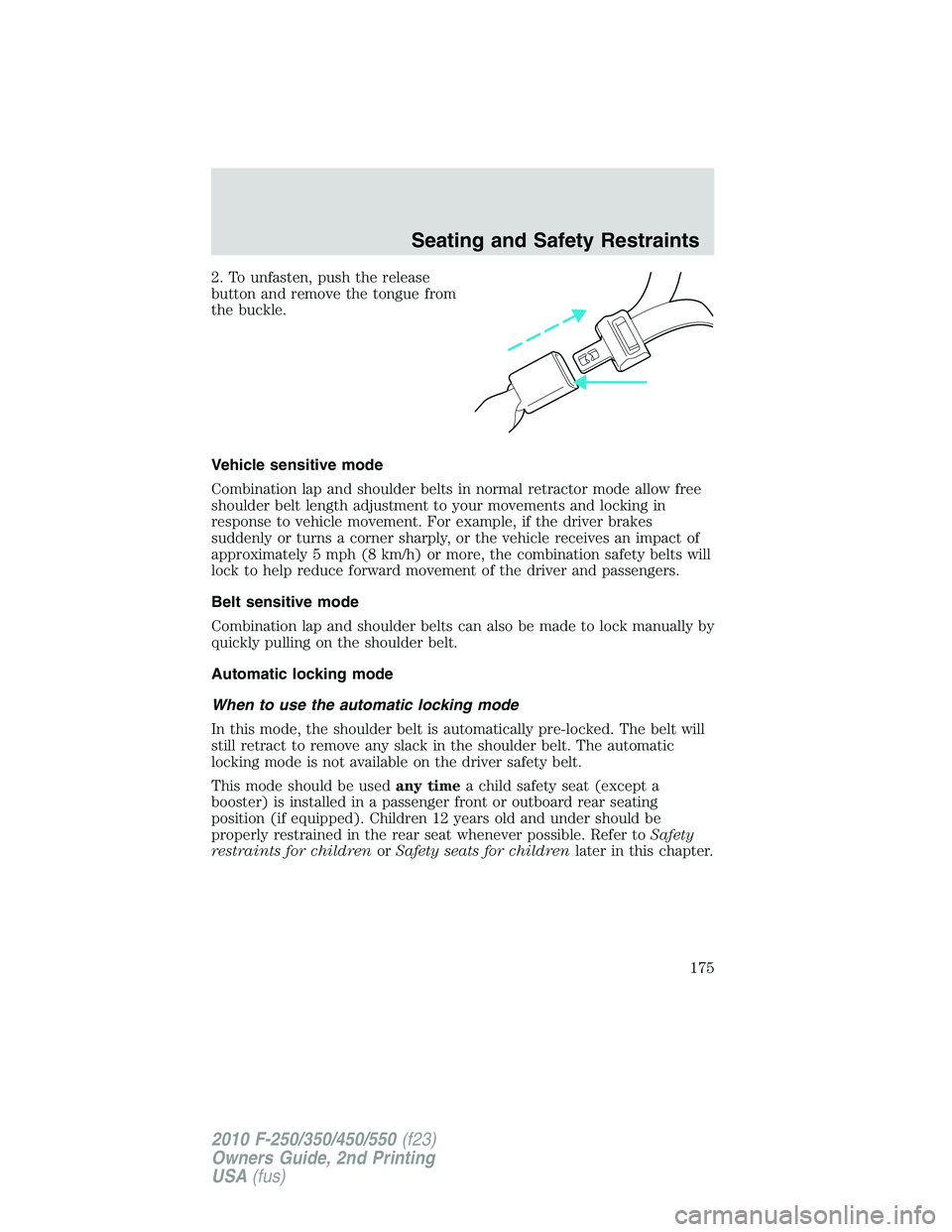
2. To unfasten, push the release
button and remove the tongue from
the buckle.
Vehicle sensitive mode
Combination lap and shoulder belts in normal retractor mode allow free
shoulder belt length adjustment to your movements and locking in
response to vehicle movement. For example, if the driver brakes
suddenly or turns a corner sharply, or the vehicle receives an impact of
approximately 5 mph (8 km/h) or more, the combination safety belts will
lock to help reduce forward movement of the driver and passengers.
Belt sensitive mode
Combination lap and shoulder belts can also be made to lock manually by
quickly pulling on the shoulder belt.
Automatic locking mode
When to use the automatic locking mode
In this mode, the shoulder belt is automatically pre-locked. The belt will
still retract to remove any slack in the shoulder belt. The automatic
locking mode is not available on the driver safety belt.
This mode should be usedany timea child safety seat (except a
booster) is installed in a passenger front or outboard rear seating
position (if equipped). Children 12 years old and under should be
properly restrained in the rear seat whenever possible. Refer toSafety
restraints for childrenorSafety seats for childrenlater in this chapter.
Seating and Safety Restraints
175
2010 F-250/350/450/550(f23)
Owners Guide, 2nd Printing
USA(fus)
Page 176 of 408
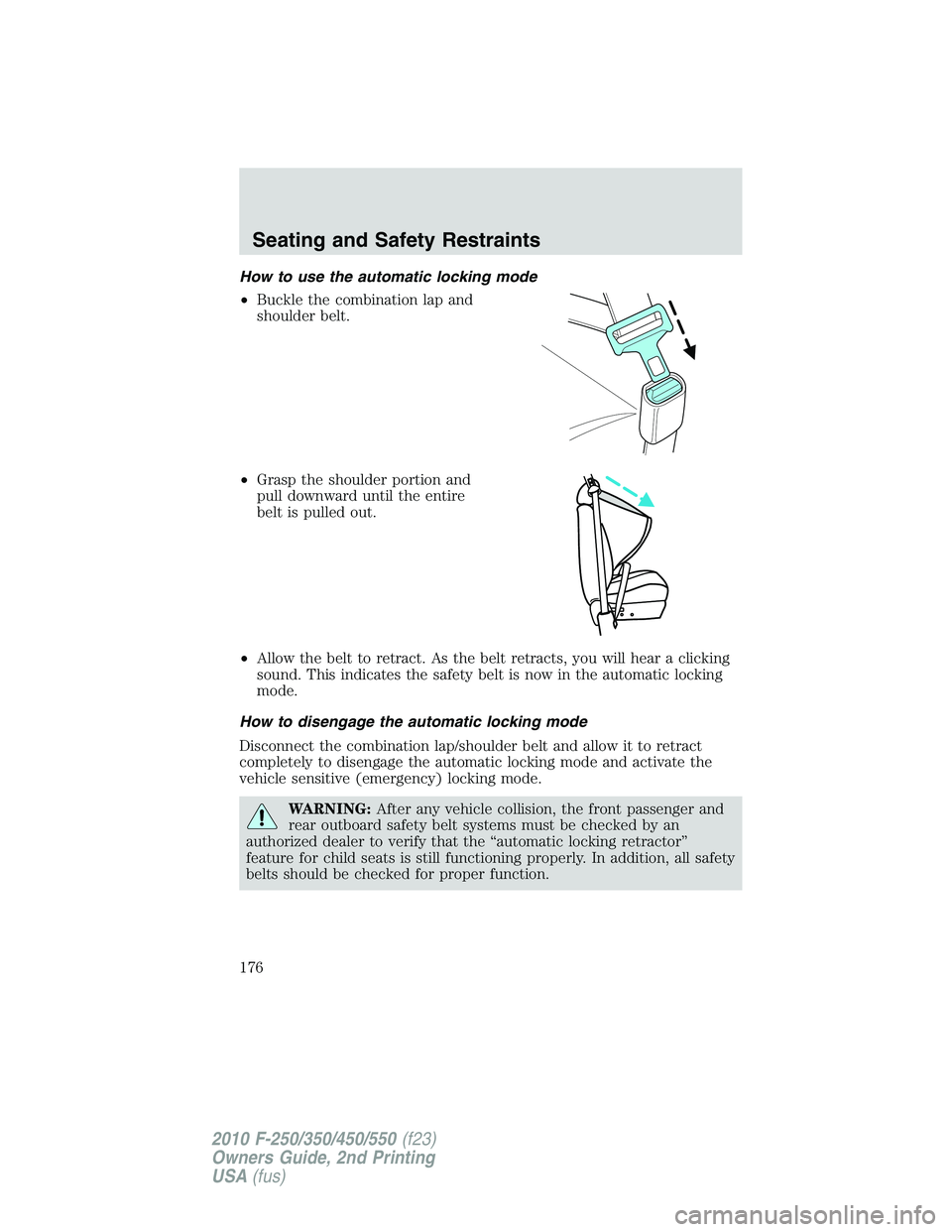
How to use the automatic locking mode
•Buckle the combination lap and
shoulder belt.
•Grasp the shoulder portion and
pull downward until the entire
belt is pulled out.
•Allow the belt to retract. As the belt retracts, you will hear a clicking
sound. This indicates the safety belt is now in the automatic locking
mode.
How to disengage the automatic locking mode
Disconnect the combination lap/shoulder belt and allow it to retract
completely to disengage the automatic locking mode and activate the
vehicle sensitive (emergency) locking mode.
WARNING:After any vehicle collision, the front passenger and
rear outboard safety belt systems must be checked by an
authorized dealer to verify that the “automatic locking retractor”
feature for child seats is still functioning properly. In addition, all safety
belts should be checked for proper function.
Seating and Safety Restraints
176
2010 F-250/350/450/550(f23)
Owners Guide, 2nd Printing
USA(fus)
Page 187 of 408
WARNING:An infant in a rear-facing seat faces a high risk of
serious or fatal injuries from a deploying passenger airbag. Rear
facing infant seats should NEVER be placed in the front seats, unless
the passenger airbag is turned off. SeePassenger airbag ON/OFF
switch.
WARNING:Front seating positions only: If seating two adults
and a child, Ford recommends properly restraining the child in
the center front seating position, but only if doing so will not interfere
with driving the vehicle. This arrangement provides lap and shoulder
belt and airbag protection for adult occupants and an attachment
method for a child restraint. If the child seat interferes with driving the
vehicle and the child restraint is forward-facing, the child may be
restrained in the passenger seat. Move the seat as far rearward as
possible to minimize the likelihood of interaction with the front
passenger airbag. Never place a rear-facing child seat in front of an
active airbag. Always properly restrain all occupants, including the
child in an appropriate child seat or booster.
How does the airbag supplemental restraint system work?
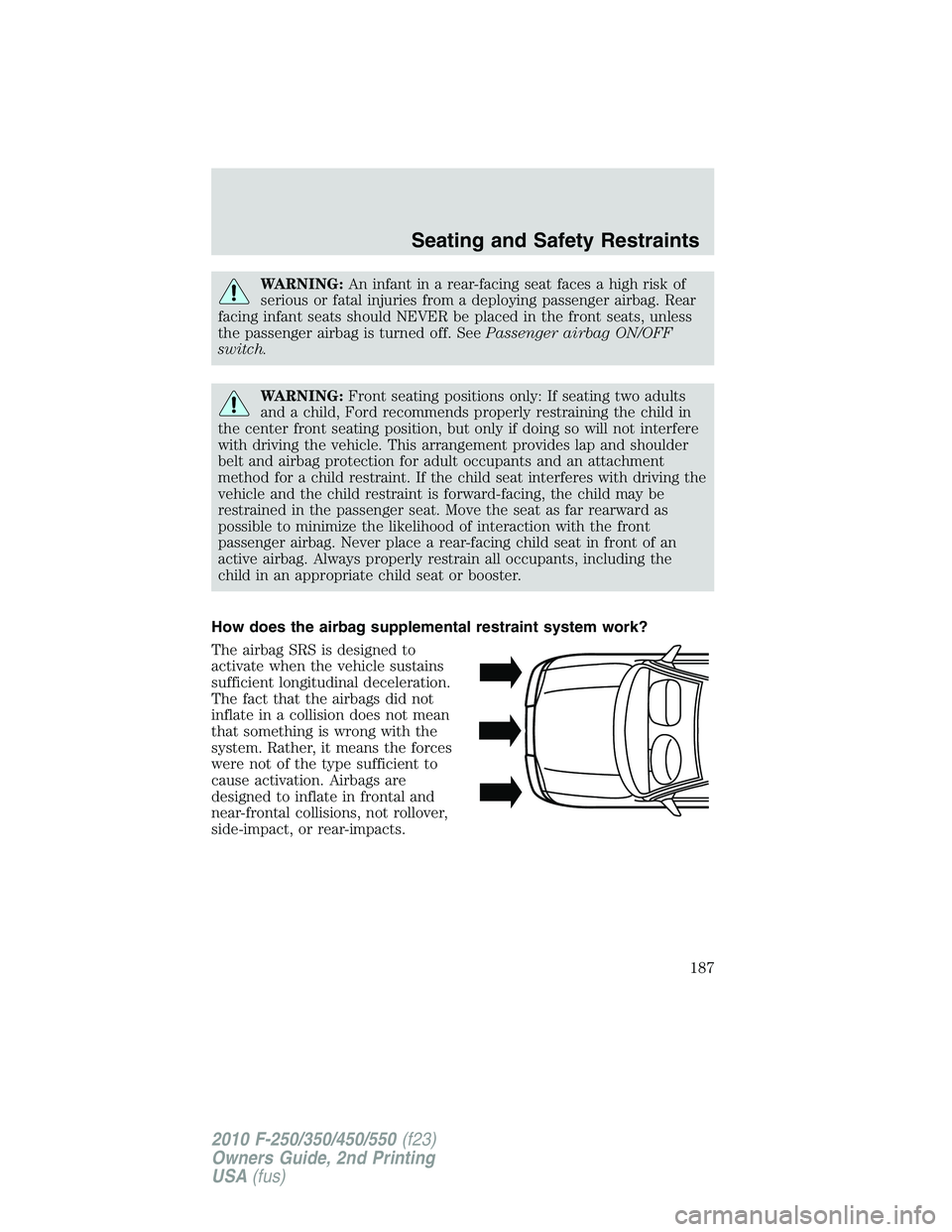
The airbag SRS is designed to
activate when the vehicle sustains
sufficient longitudinal deceleration.
The fact that the airbags did not
inflate in a collision does not mean
that something is wrong with the
system. Rather, it means the forces
were not of the type sufficient to
cause activation. Airbags are
designed to inflate in frontal and
near-frontal collisions, not rollover,
side-impact, or rear-impacts.
Seating and Safety Restraints
187
2010 F-250/350/450/550(f23)
Owners Guide, 2nd Printing
USA(fus)
Page 191 of 408
WARNING:An infant in a rear-facing seat faces a high risk of
serious or fatal injuries from a deploying passenger airbag. Rear
facing infant seats should NEVER be placed in the front seats, unless
the passenger airbag is turned off.
Turning the passenger airbag back on
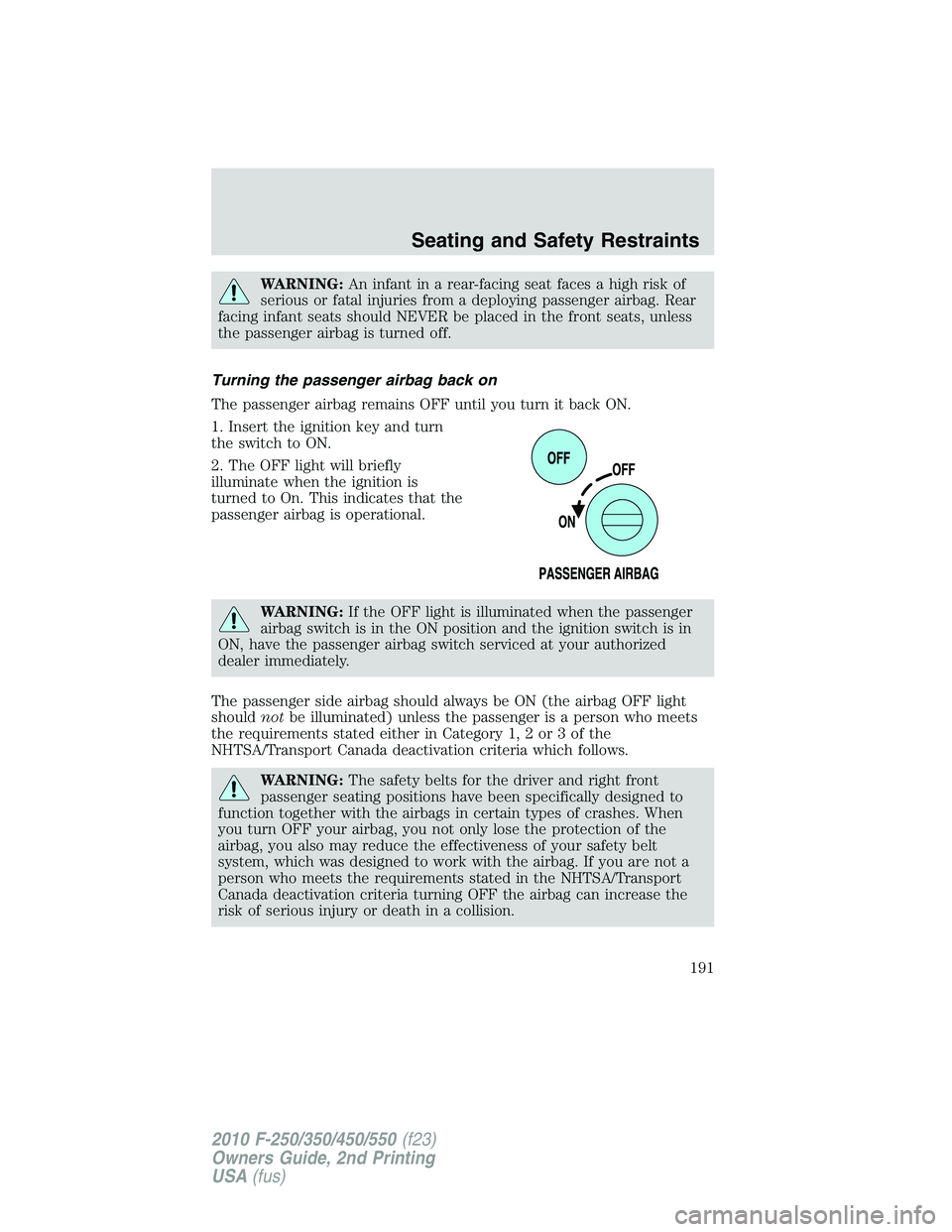
The passenger airbag remains OFF until you turn it back ON.
1. Insert the ignition key and turn
the switch to ON.
2. The OFF light will briefly
illuminate when the ignition is
turned to On. This indicates that the
passenger airbag is operational.
WARNING:If the OFF light is illuminated when the passenger
airbag switch is in the ON position and the ignition switch is in
ON, have the passenger airbag switch serviced at your authorized
dealer immediately.
The passenger side airbag should always be ON (the airbag OFF light
shouldnotbe illuminated) unless the passenger is a person who meets
the requirements stated either in Category 1, 2 or 3 of the
NHTSA/Transport Canada deactivation criteria which follows.
WARNING:The safety belts for the driver and right front
passenger seating positions have been specifically designed to
function together with the airbags in certain types of crashes. When
you turn OFF your airbag, you not only lose the protection of the
airbag, you also may reduce the effectiveness of your safety belt
system, which was designed to work with the airbag. If you are not a
person who meets the requirements stated in the NHTSA/Transport
Canada deactivation criteria turning OFF the airbag can increase the
risk of serious injury or death in a collision.
Seating and Safety Restraints
191
2010 F-250/350/450/550(f23)
Owners Guide, 2nd Printing
USA(fus)
Page 192 of 408

WARNING:If your vehicle has rear seats, always transport
children who are 12 and younger in the rear seat. Always use
safety belts and child restraints properly. DO NOT place a child in a
rear facing infant seat in the front seat unless your vehicle is equipped
with an airbag ON/OFF switch and the passenger airbag is turned OFF.
This is because the back of the infant seat is too close to the inflating
airbag and the risk of a fatal injury to the infant when the airbag
inflates is substantial.
The vast majority of drivers and passengers are much safer with an
airbag than without. To do their job and reduce the risk of life
threatening injuries, airbags must open with great force, and this force
can pose a potentially deadly risk in some situations, particularly when a
front seat occupant is not properly buckled up. The most effective way
to reduce the risk of unnecessary airbag injuries without reducing the
overall safety of the vehicle is to make sure all occupants are properly
restrained in the vehicle, especially in the front seat. This provides the
protection of safety belts and permits the airbags to provide the
additional protection they were designed to provide. If you choose to
deactivate your airbag, you are losing the very significant risk reducing
benefits of the airbag and you are also reducing the effectiveness of the
safety belts, because safety belts in modern vehicles are designed to
work as a safety system with the airbags.
Read all airbag warning labels in the vehicle as well as the other
important airbag instructions and warnings in this Owner’s Guide.
NHTSA deactivation criteria (excluding Canada)
1.Infant.An infant (less than 1 year old) must ride in the front seat
because:
•the vehicle has no rear seat;
•the vehicle has a rear seat too small to accommodate a rear-facing
infant seat; or
•the infant has a medical condition which, according to the infant’s
physician, makes it necessary for the infant to ride in the front so that
the driver can constantly monitor the child’s condition.
2.Child age 1 to 12.A child age 1 to 12 must ride in the front seat
because:
•the vehicle has no rear seat;
•although children ages 1 to 12 ride in the rear seat(s) whenever
possible, children ages 1 to 12 sometimes must ride in the front
because no space is available in the rear seat(s) of the vehicle; or
Seating and Safety Restraints
192
2010 F-250/350/450/550(f23)
Owners Guide, 2nd Printing
USA(fus)
Page 195 of 408
SAFETY RESTRAINTS FOR CHILDREN
See the following sections for directions on how to properly use safety
restraints for children. Also seeAirbag supplemental restraint system
(SRS)in this chapter for special instructions about using airbags.
Important child restraint precautions
WARNING:Always make sure your child is secured properly in
a device that is appropriate for their height, age and weight.
Child safety restraints must be purchased separately from the vehicle.
Failure to follow these instructions and guidelines may result in an
increased risk of serious injury or death to your child.
WARNING:All children are shaped differently. The
Recommendations for Safety Restraints are based on probable
child height, age and weight thresholds from NHTSA and other safety
organizations or are the minimum requirements of law. Ford
recommends checking with a NHTSA Certified Child Passenger Safety
Technician (CPST) and your pediatrician to make sure your child seat
is appropriate for your child, and is compatible with and properly
installed in the vehicle. To locate a child seat fitting station and CPST
contact the NHTSA toll free at 1-888-327-4236 or on the internet at
http://www.nhtsa.dot.gov. Failure to properly restrain children in safety
seats made especially for their height, age, and weight may result in an
increased risk of serious injury or death to your child.
Seating and Safety Restraints
195
2010 F-250/350/450/550(f23)
Owners Guide, 2nd Printing
USA(fus)
Page 196 of 408
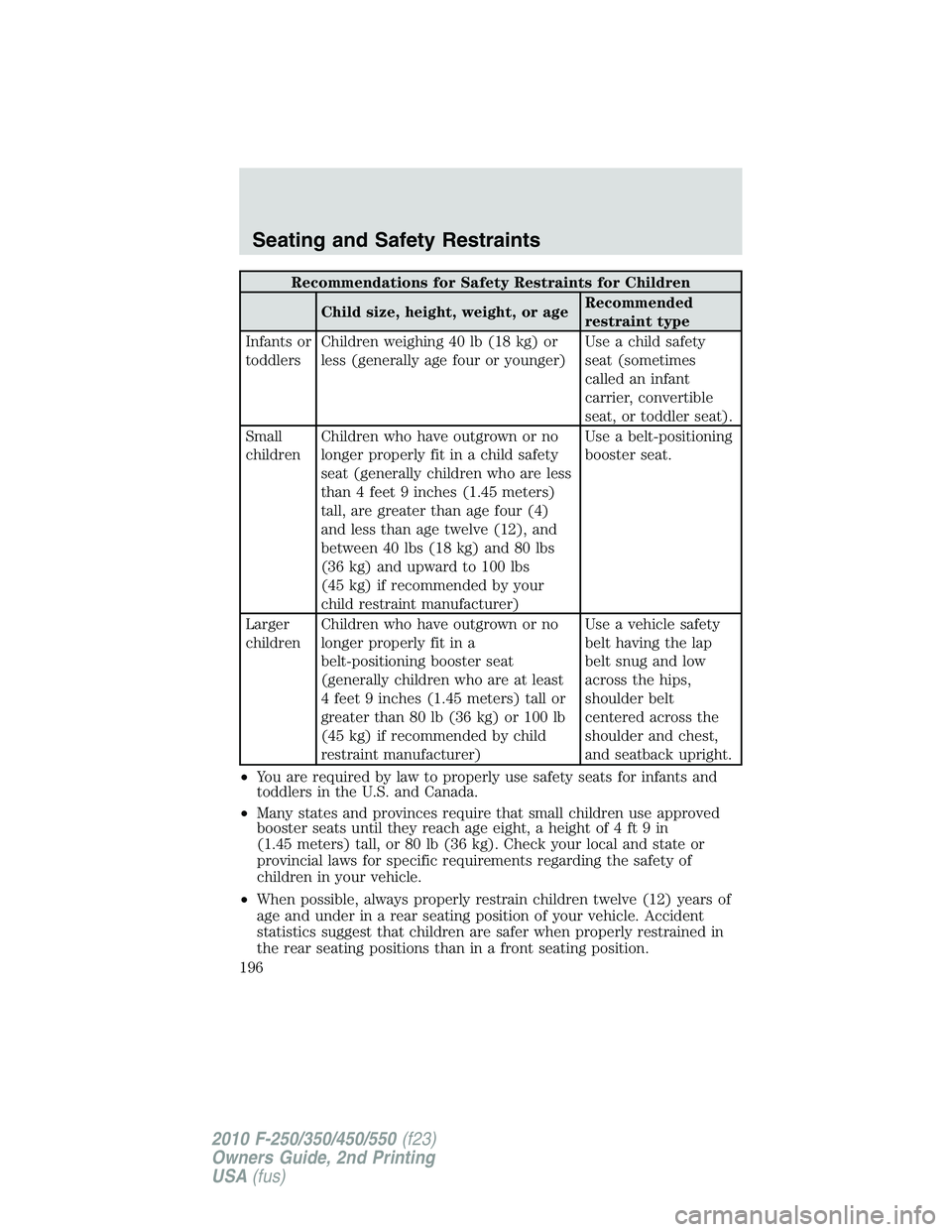
Recommendations for Safety Restraints for Children
Child size, height, weight, or ageRecommended
restraint type
Infants or
toddlersChildren weighing 40 lb (18 kg) or
less (generally age four or younger)Use a child safety
seat (sometimes
called an infant
carrier, convertible
seat, or toddler seat).
Small
childrenChildren who have outgrown or no
longer properly fit in a child safety
seat (generally children who are less
than 4 feet 9 inches (1.45 meters)
tall, are greater than age four (4)
and less than age twelve (12), and
between 40 lbs (18 kg) and 80 lbs
(36 kg) and upward to 100 lbs
(45 kg) if recommended by your
child restraint manufacturer)Use a belt-positioning
booster seat.
Larger
childrenChildren who have outgrown or no
longer properly fit in a
belt-positioning booster seat
(generally children who are at least
4 feet 9 inches (1.45 meters) tall or
greater than 80 lb (36 kg) or 100 lb
(45 kg) if recommended by child
restraint manufacturer)Use a vehicle safety
belt having the lap
belt snug and low
across the hips,
shoulder belt
centered across the
shoulder and chest,
and seatback upright.
•You are required by law to properly use safety seats for infants and
toddlers in the U.S. and Canada.
•Many states and provinces require that small children use approved
booster seats until they reach age eight, a height of 4 ft 9 in
(1.45 meters) tall, or 80 lb (36 kg). Check your local and state or
provincial laws for specific requirements regarding the safety of
children in your vehicle.
•When possible, always properly restrain children twelve (12) years of
age and under in a rear seating position of your vehicle. Accident
statistics suggest that children are safer when properly restrained in
the rear seating positions than in a front seating position.
Seating and Safety Restraints
196
2010 F-250/350/450/550(f23)
Owners Guide, 2nd Printing
USA(fus)
Page 199 of 408

training to ensure that all children ages 0 to 16 are properly restrained in
the correct restraint system. Ford recommends checking with a NHTSA
Certified Child Passenger Safety Technician (CPST) and your
pediatrician to make sure your seat is appropriate for your child and
properly installed in the vehicle. To locate a child seat fitting station and
CPST contact the NHTSA toll free at1-888-327-4236or on the internet
at http://www.nhtsa.dot.gov.
Follow all the safety restraint and airbag precautions that apply to adult
passengers in your vehicle.
If the child is the proper height, age, and weight (as specified by your
child safety seat or booster manufacturer), fits the restraint and can be
restrained properly, then restrain the child in the child safety seat or
with the belt-positioning booster. Remember that child seats and
belt-positioning boosters vary and may be designed to fit children of
different heights, ages and weights. Children who are too large for child
safety seats or belt-positioning boosters (as specified by your child safety
seat manufacturer) should always properly wear safety belts.
SAFETY SEATS FOR CHILDREN
Infant and/or toddler seats
Use a safety seat that is recommended for the size and weight of the
child.
When installing a child safety seat:
•Review and follow the information
presented in theAirbag
supplemental restraint system
(SRS)section in this chapter.
•Carefully follow all of the
manufacturer’s instructions
included with the safety seat you
put in your vehicle. If you do not
install and use the safety seat
properly, the child may be injured
in a sudden stop or collision.
Airbags can kill or injure a child in a child seat. NEVER place a
rear-facing child seat in front of an active airbag. If you must use a
forward-facing child seat in the front seat, move the vehicle seat all the
way back.
Seating and Safety Restraints
199
2010 F-250/350/450/550(f23)
Owners Guide, 2nd Printing
USA(fus)
Page 200 of 408

Children 12 and under should be properly restrained in a rear seating
position whenever possible. If all children cannot be seated and
restrained properly in a rear seating position, properly restrain the
largest child in the front seat.
Installing child safety seats with automatic locking mode
combination lap and shoulder belts
(front passenger and rear outboard seating positions)
Check to make sure the child seat is properly secured before each use.
Children 12 and under should be properly restrained in a rear seating
position whenever possible. If all children cannot be seated and
restrained properly in a rear seating position, properly restrain the
largest child in the front seat.
When installing a child safety seat with combination lap/shoulder belts:
•Use the correct safety belt buckle for that seating position.
•Insert the belt tongue into the proper buckle until you hear a snap
and feel it latch. Make sure the tongue is securely fastened in the
buckle.
•Keep the buckle release button pointing up and away from the safety
seat, with the tongue between the child seat and the release button,
to prevent accidental unbuckling.
•Place vehicle seat back in upright position.
•This vehicle does not require the use of a locking clip.
WARNING:Depending on where you secure a child restraint,
and depending on the child restraint design, you may block
access to certain safety belt buckle assemblies and/or LATCH lower
anchors, rendering those features potentially unusable. To avoid risk of
injury, occupants should only use seating positions where they are able
to be properly restrained.
Seating and Safety Restraints
200
2010 F-250/350/450/550(f23)
Owners Guide, 2nd Printing
USA(fus)
Page 201 of 408
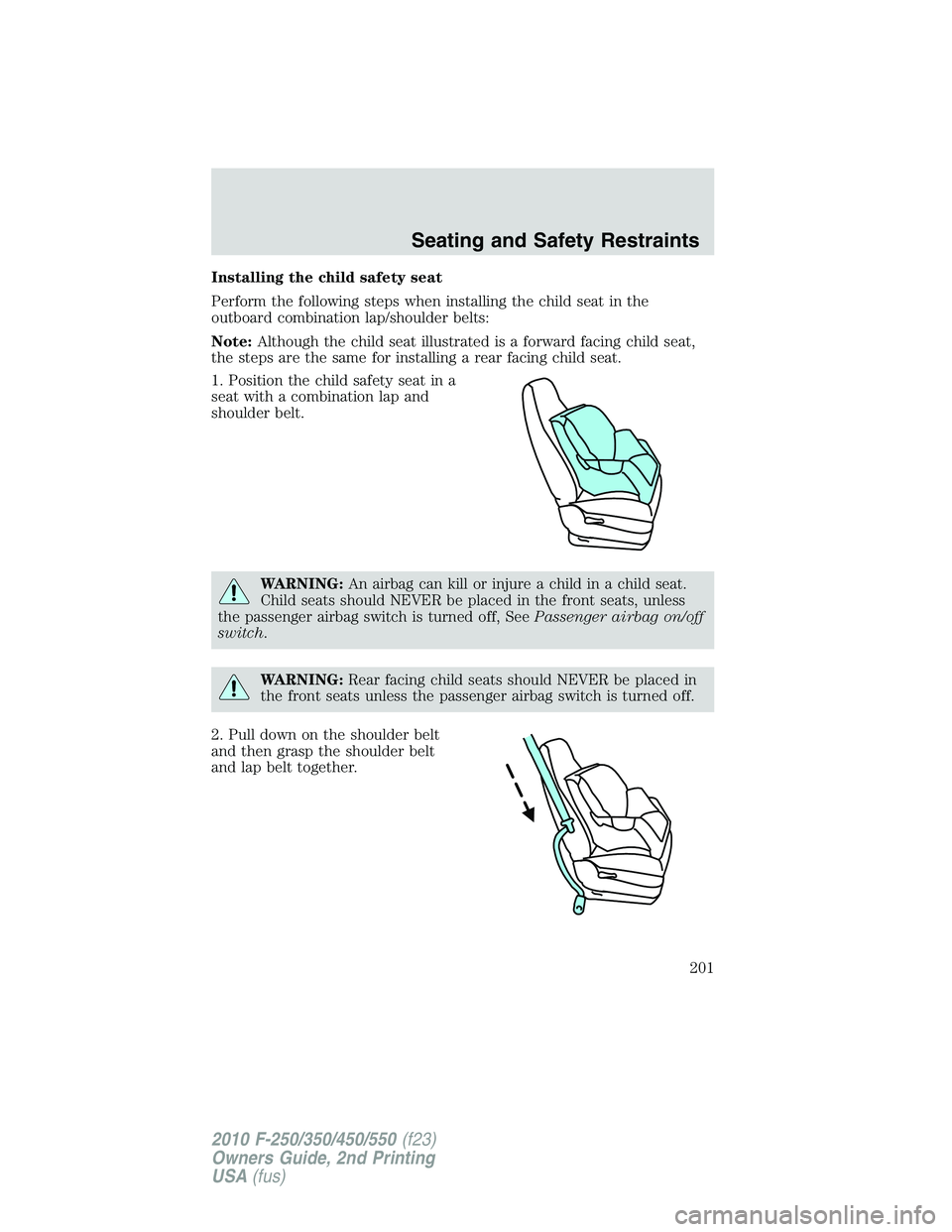
Installing the child safety seat
Perform the following steps when installing the child seat in the
outboard combination lap/shoulder belts:
Note:Although the child seat illustrated is a forward facing child seat,
the steps are the same for installing a rear facing child seat.
1. Position the child safety seat in a
seat with a combination lap and
shoulder belt.
WARNING:An airbag can kill or injure a child in a child seat.
Child seats should NEVER be placed in the front seats, unless
the passenger airbag switch is turned off, SeePassenger airbag on/off
switch.
WARNING:Rear facing child seats should NEVER be placed in
the front seats unless the passenger airbag switch is turned off.
2. Pull down on the shoulder belt
and then grasp the shoulder belt
and lap belt together.
Seating and Safety Restraints
201
2010 F-250/350/450/550(f23)
Owners Guide, 2nd Printing
USA(fus)