transmission FORD F250 2013 Repair Manual
[x] Cancel search | Manufacturer: FORD, Model Year: 2013, Model line: F250, Model: FORD F250 2013Pages: 577, PDF Size: 7.74 MB
Page 317 of 577
Do not use supplemental transmission fluid additives, treatments or
cleaning agents. The use of these materials may affect transmission
operation and result in damage to internal transmission components.
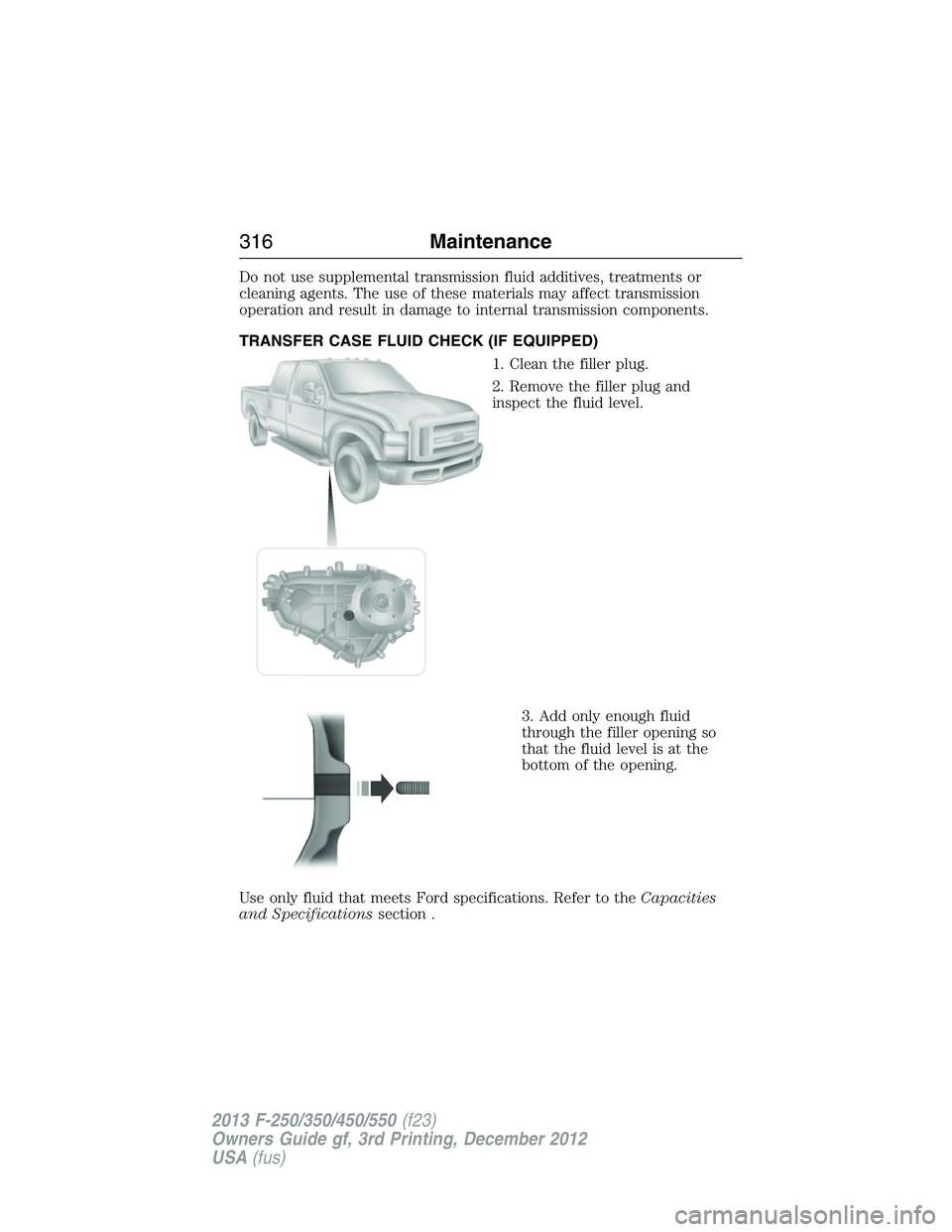
TRANSFER CASE FLUID CHECK (IF EQUIPPED)
1. Clean the filler plug.
2. Remove the filler plug and
inspect the fluid level.
3. Add only enough fluid
through the filler opening so
that the fluid level is at the
bottom of the opening.
Use only fluid that meets Ford specifications. Refer to theCapacities
and Specificationssection .
316Maintenance
2013 F-250/350/450/550(f23)
Owners Guide gf, 3rd Printing, December 2012
USA(fus)
Page 345 of 577
Power is supplied to all four wheels through a transfer case or power
transfer unit. Four-wheel drive vehicles allow you to select different drive
modes as necessary. You can find information on transfer case operation
and shifting procedures in theTransmissionchapter. You can find
information on transfer case maintenance in theMaintenancechapter.
You should become thoroughly familiar with this information before you
operate your vehicle.
On some four-wheel drive models, the initial shift from two-wheel drive
to four-wheel drive while the vehicle is moving can cause a momentary
clunk and ratcheting sound. These sounds are normal as the front
drivetrain comes up to speed and are not cause for concern.
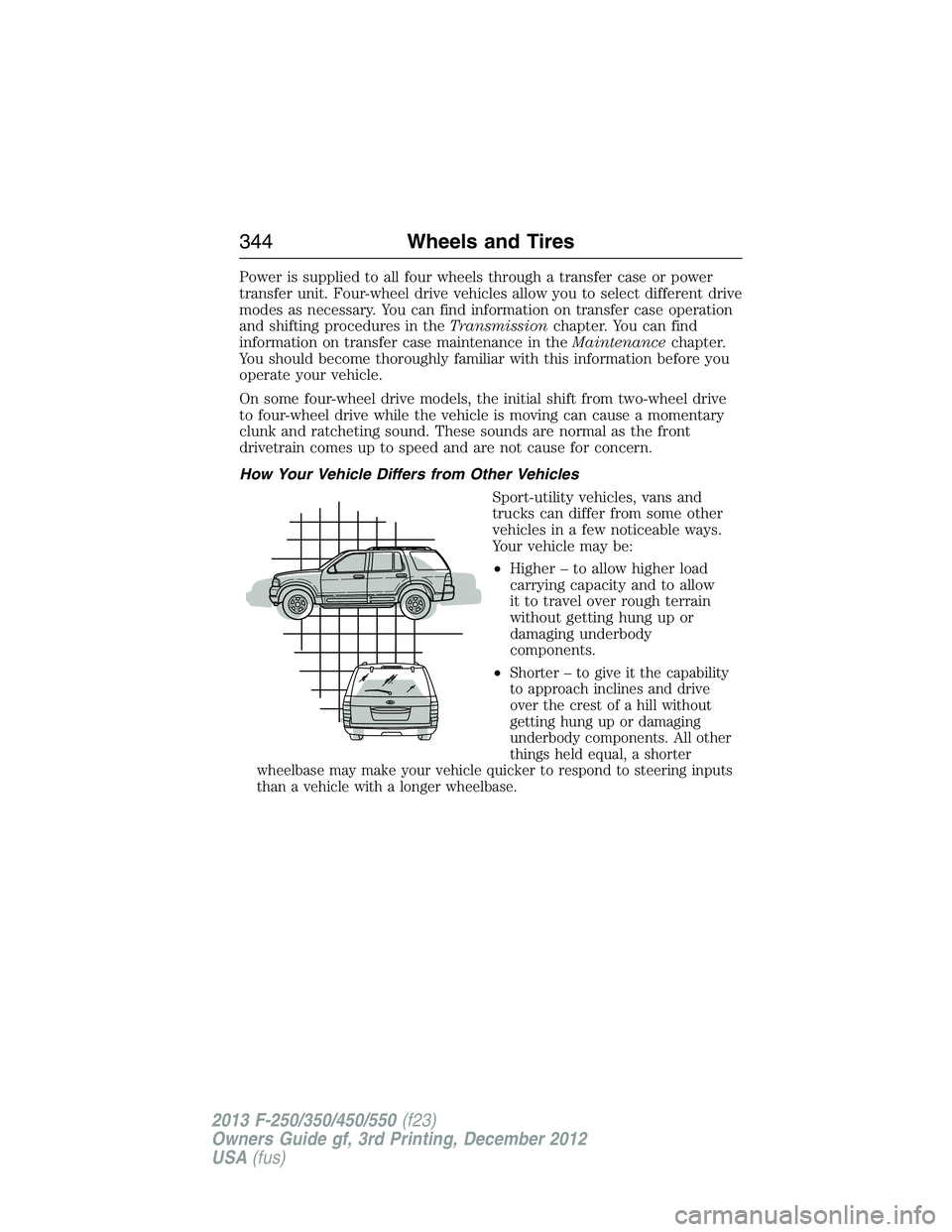
How Your Vehicle Differs from Other Vehicles
Sport-utility vehicles, vans and
trucks can differ from some other
vehicles in a few noticeable ways.
Your vehicle may be:
•Higher – to allow higher load
carrying capacity and to allow
it to travel over rough terrain
without getting hung up or
damaging underbody
components.
•
Shorter – to give it the capability
to approach inclines and drive
over the crest of a hill without
getting hung up or damaging
underbody components. All other
things held equal, a shorter
wheelbase may make your vehicle quicker to respond to steering inputs
than a vehicle with a longer wheelbase.
344Wheels and Tires
2013 F-250/350/450/550(f23)
Owners Guide gf, 3rd Printing, December 2012
USA(fus)
Page 377 of 577
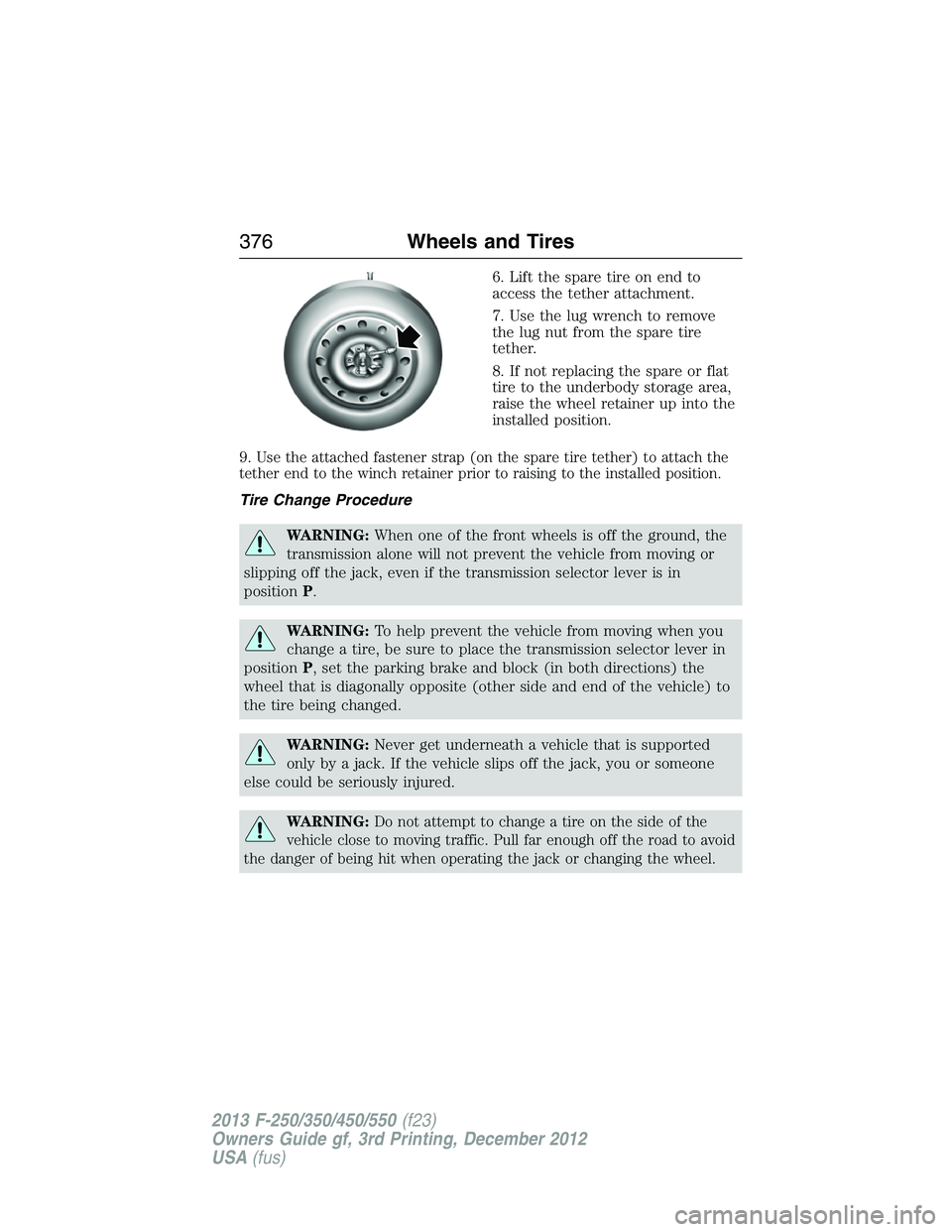
6. Lift the spare tire on end to
access the tether attachment.
7. Use the lug wrench to remove
the lug nut from the spare tire
tether.
8. If not replacing the spare or flat
tire to the underbody storage area,
raise the wheel retainer up into the
installed position.
9.
Use the attached fastener strap (on the spare tire tether) to attach the
tether end to the winch retainer prior to raising to the installed position.
Tire Change Procedure
WARNING:When one of the front wheels is off the ground, the
transmission alone will not prevent the vehicle from moving or
slipping off the jack, even if the transmission selector lever is in
positionP.
WARNING:To help prevent the vehicle from moving when you
change a tire, be sure to place the transmission selector lever in
positionP, set the parking brake and block (in both directions) the
wheel that is diagonally opposite (other side and end of the vehicle) to
the tire being changed.
WARNING:Never get underneath a vehicle that is supported
only by a jack. If the vehicle slips off the jack, you or someone
else could be seriously injured.
WARNING:Do not attempt to change a tire on the side of the
vehicle close to moving traffic. Pull far enough off the road to avoid
the danger of being hit when operating the jack or changing the wheel.
376Wheels and Tires
2013 F-250/350/450/550(f23)
Owners Guide gf, 3rd Printing, December 2012
USA(fus)
Page 393 of 577
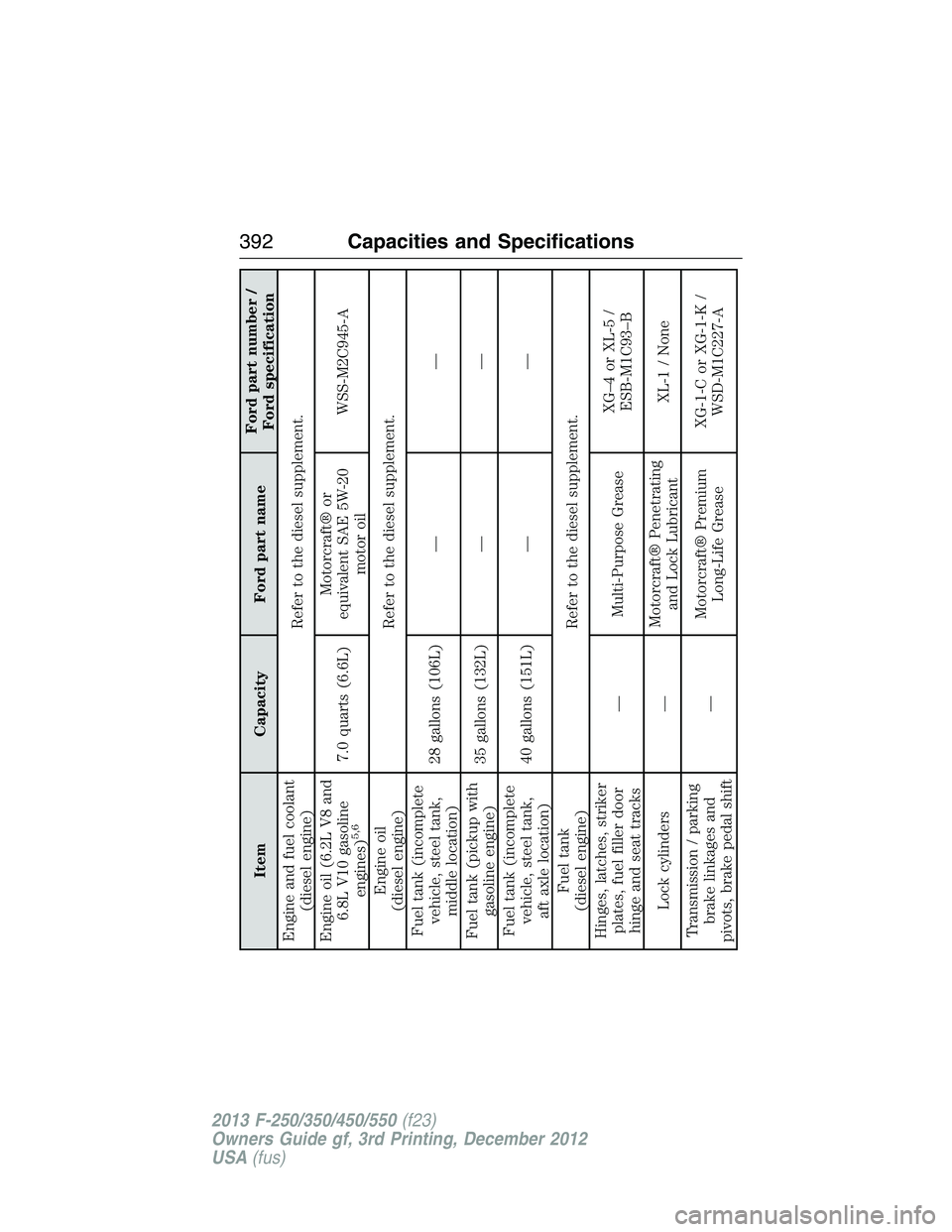
Item Capacity Ford part nameFord part number /
Ford specification
Engine and fuel coolant
(diesel engine)Refer to the diesel supplement.
Engine oil (6.2L V8 and
6.8L V10 gasoline
engines)
5,6
7.0 quarts (6.6L)Motorcraft® or
equivalent SAE 5W-20
motor oilWSS-M2C945-A
Engine oil
(diesel engine)Refer to the diesel supplement.
Fuel tank (incomplete
vehicle, steel tank,
middle location)28 gallons (106L) — —
Fuel tank (pickup with
gasoline engine)35 gallons (132L) — —
Fuel tank (incomplete
vehicle, steel tank,
aft axle location)40 gallons (151L) — —
Fuel tank
(diesel engine)Refer to the diesel supplement.
Hinges, latches, striker
plates, fuel filler door
hinge and seat tracks— Multi-Purpose GreaseXG–4 or XL-5 /
ESB-M1C93–B
Lock cylinders —Motorcraft® Penetrating
and Lock LubricantXL-1 / None
Transmission / parking
brake linkages and
pivots, brake pedal shift—Motorcraft® Premium
Long-Life GreaseXG-1-C or XG-1-K /
WSD-M1C227-A
392Capacities and Specifications
2013 F-250/350/450/550(f23)
Owners Guide gf, 3rd Printing, December 2012
USA(fus)
Page 394 of 577
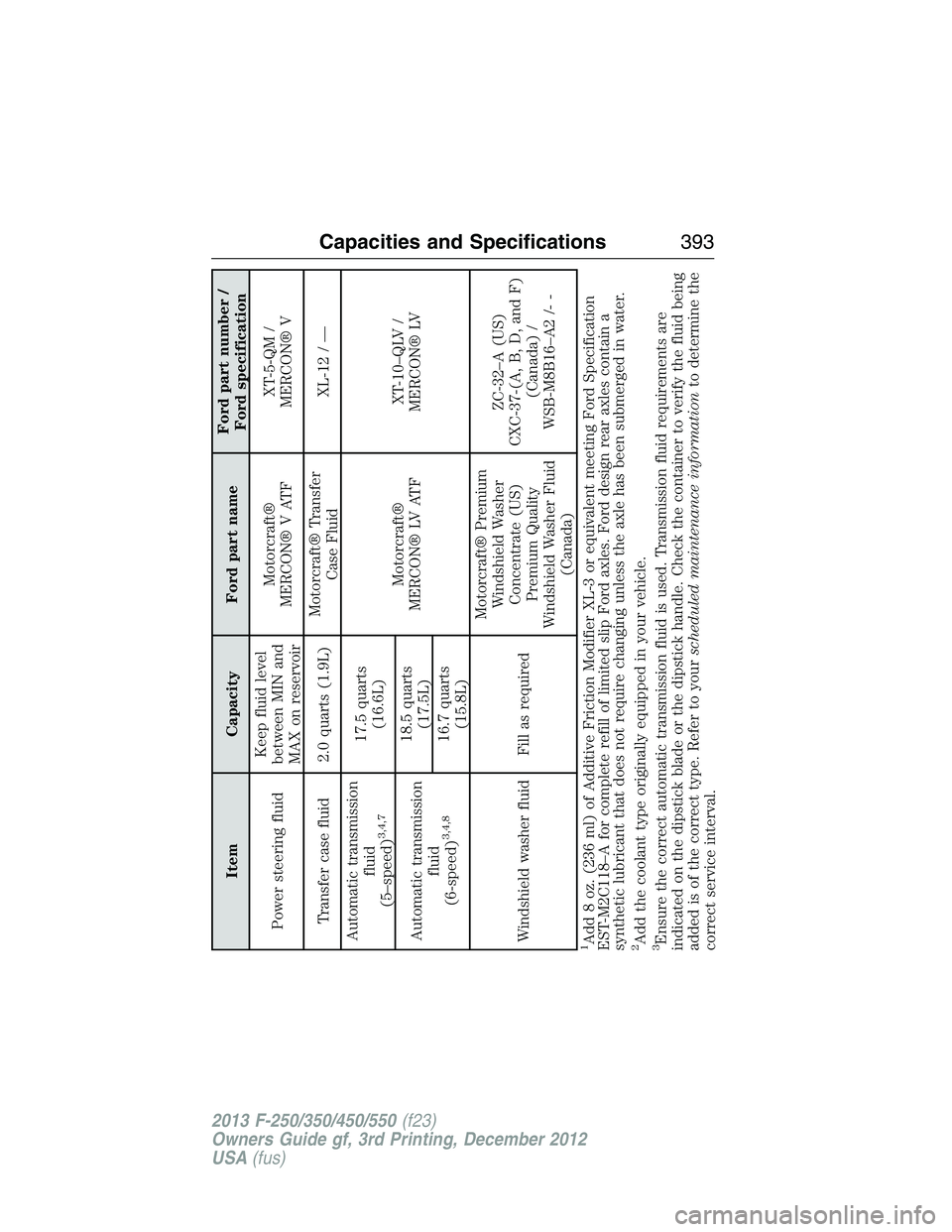
Item Capacity Ford part nameFord part number /
Ford specification
Power steering fluidKeep fluid level
between MIN and
MAX on reservoirMotorcraft®
MERCON® V ATFXT-5-QM /
MERCON® V
Transfer case fluid 2.0 quarts (1.9L)Motorcraft® Transfer
Case FluidXL-12 / —
Automatic transmission
fluid
(5–speed)
3,4,7
17.5 quarts
(16.6L)
Motorcraft®
MERCON® LV ATFXT-10–QLV /
MERCON® LV
Automatic transmission
fluid
(6-speed)
3,4,8
18.5 quarts
(17.5L)
16.7 quarts
(15.8L)
Windshield washer fluid Fill as requiredMotorcraft® Premium
Windshield Washer
Concentrate (US)
Premium Quality
Windshield Washer Fluid
(Canada)ZC-32–A (US)
CXC-37-(A, B, D, and F)
(Canada) /
WSB-M8B16–A2 /- -
1Add 8 oz. (236 ml) of Additive Friction Modifier XL-3 or equivalent meeting Ford Specification
EST-M2C118–A for complete refill of limited slip Ford axles. Ford design rear axles contain a
synthetic lubricant that does not require changing unless the axle has been submerged in water.2Add the coolant type originally equipped in your vehicle.3Ensure the correct automatic transmission fluid is used. Transmission fluid requirements are
indicated on the dipstick blade or the dipstick handle. Check the container to verify the fluid being
added is of the correct type. Refer to yourscheduled maintenance informationto determine the
correct service interval.
Capacities and Specifications393
2013 F-250/350/450/550(f23)
Owners Guide gf, 3rd Printing, December 2012
USA(fus)
Page 395 of 577
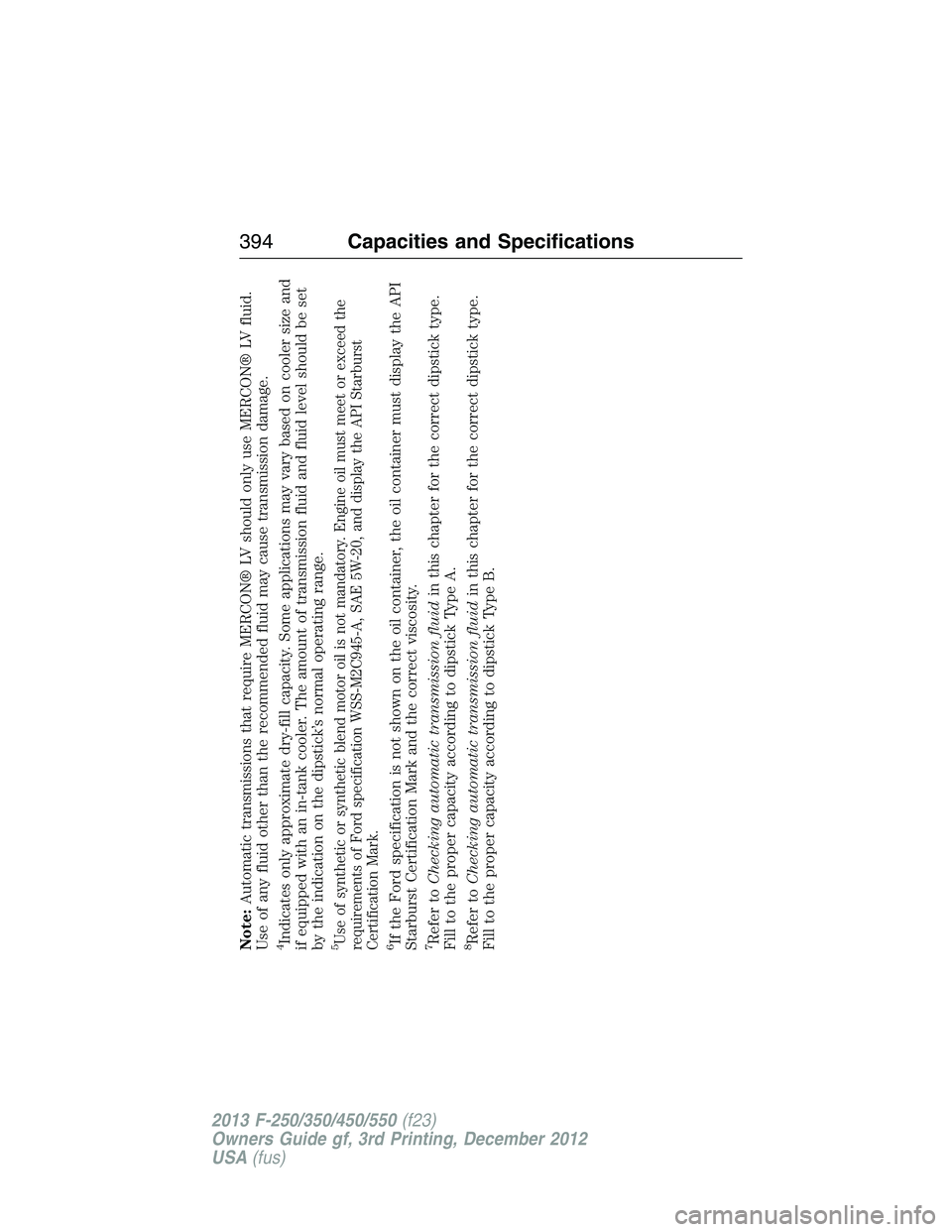
Note:Automatic transmissions that require MERCON® LV should only use MERCON® LV fluid.
Use of any fluid other than the recommended fluid may cause transmission damage.4Indicates only approximate dry-fill capacity. Some applications may vary based on cooler size and
if equipped with an in-tank cooler. The amount of transmission fluid and fluid level should be set
by the indication on the dipstick’s normal operating range.5Use of synthetic or synthetic blend motor oil is not mandatory. Engine oil must meet or exceed the
requirements of Ford specification WSS-M2C945-A, SAE 5W-20, and display the API Starburst
Certification Mark.6If the Ford specification is not shown on the oil container, the oil container must display the API
Starburst Certification Mark and the correct viscosity.7Refer toChecking automatic transmission fluidin this chapter for the correct dipstick type.
Fill to the proper capacity according to dipstick Type A.8Refer toChecking automatic transmission fluidin this chapter for the correct dipstick type.
Fill to the proper capacity according to dipstick Type B.
394Capacities and Specifications
2013 F-250/350/450/550(f23)
Owners Guide gf, 3rd Printing, December 2012
USA(fus)
Page 398 of 577
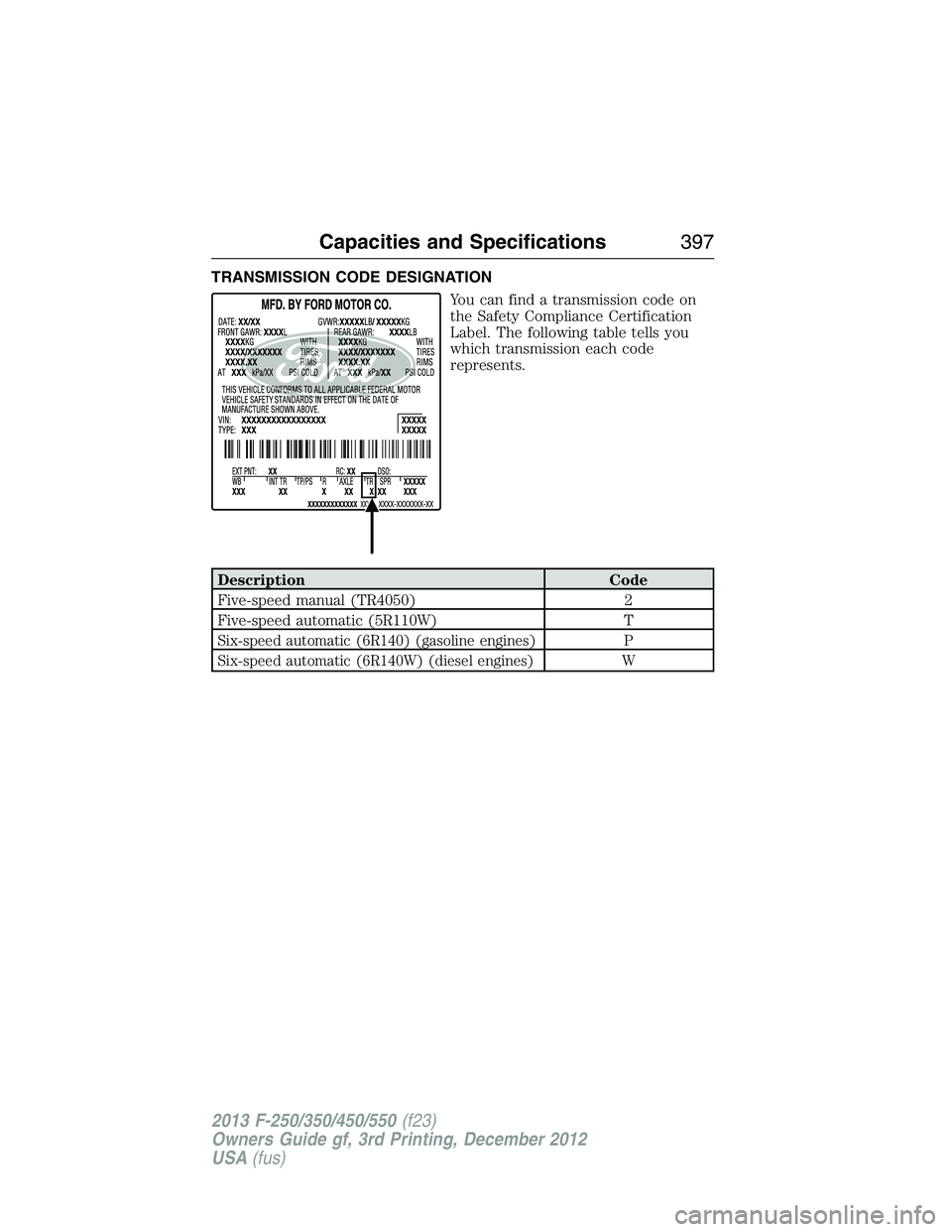
TRANSMISSION CODE DESIGNATION
You can find a transmission code on
the Safety Compliance Certification
Label. The following table tells you
which transmission each code
represents.
Description Code
Five-speed manual (TR4050) 2
Five-speed automatic (5R110W) T
Six-speed automatic (6R140) (gasoline engines)P
Six-speed automatic (6R140W) (diesel engines)W
Capacities and Specifications397
2013 F-250/350/450/550(f23)
Owners Guide gf, 3rd Printing, December 2012
USA(fus)
Page 407 of 577
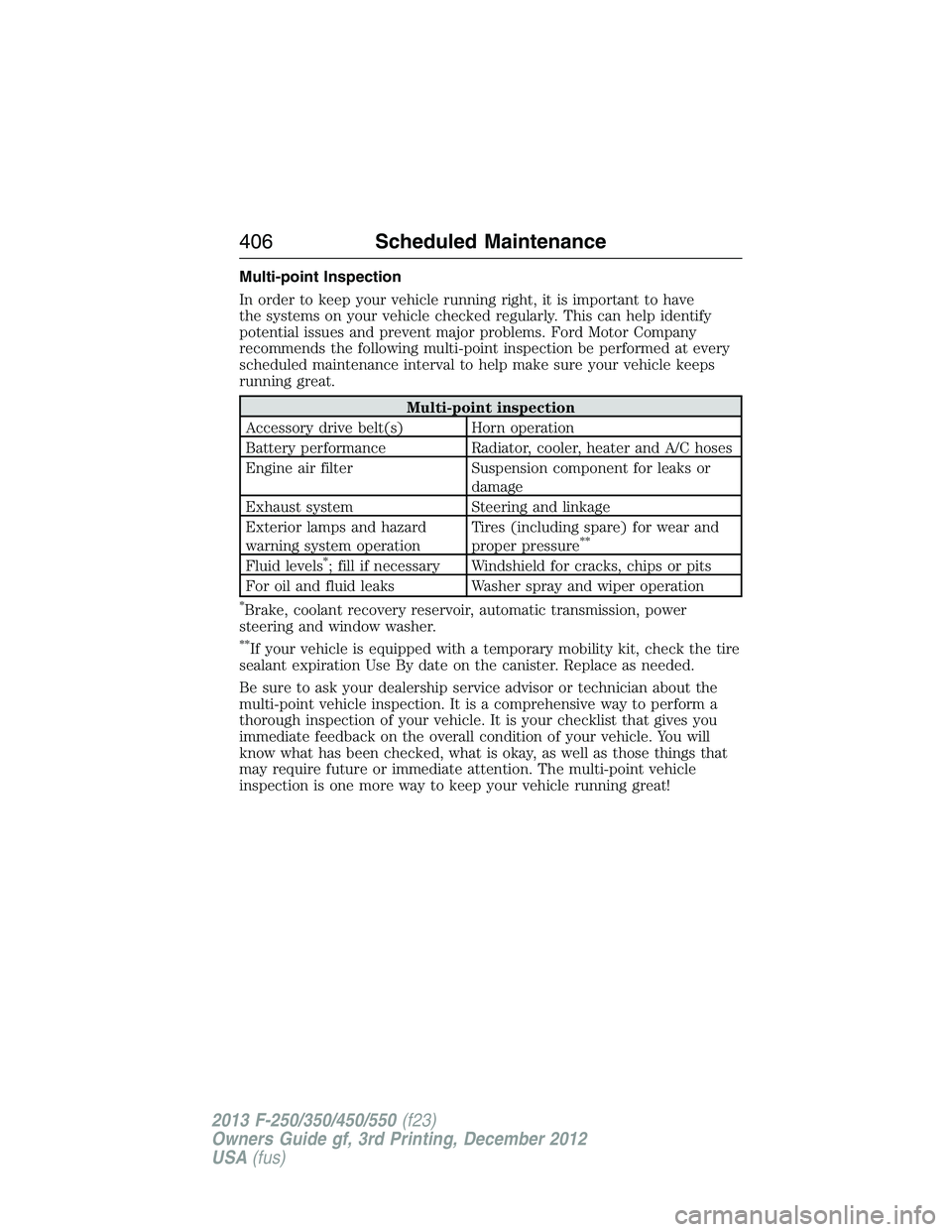
Multi-point Inspection
In order to keep your vehicle running right, it is important to have
the systems on your vehicle checked regularly. This can help identify
potential issues and prevent major problems. Ford Motor Company
recommends the following multi-point inspection be performed at every
scheduled maintenance interval to help make sure your vehicle keeps
running great.
Multi-point inspection
Accessory drive belt(s) Horn operation
Battery performance Radiator, cooler, heater and A/C hoses
Engine air filter Suspension component for leaks or
damage
Exhaust system Steering and linkage
Exterior lamps and hazard
warning system operationTires (including spare) for wear and
proper pressure
**
Fluid levels*; fill if necessary Windshield for cracks, chips or pits
For oil and fluid leaks Washer spray and wiper operation
*Brake, coolant recovery reservoir, automatic transmission, power
steering and window washer.
**If your vehicle is equipped with a temporary mobility kit, check the tire
sealant expiration Use By date on the canister. Replace as needed.
Be sure to ask your dealership service advisor or technician about the
multi-point vehicle inspection. It is a comprehensive way to perform a
thorough inspection of your vehicle. It is your checklist that gives you
immediate feedback on the overall condition of your vehicle. You will
know what has been checked, what is okay, as well as those things that
may require future or immediate attention. The multi-point vehicle
inspection is one more way to keep your vehicle running great!
406Scheduled Maintenance
2013 F-250/350/450/550(f23)
Owners Guide gf, 3rd Printing, December 2012
USA(fus)
Page 409 of 577
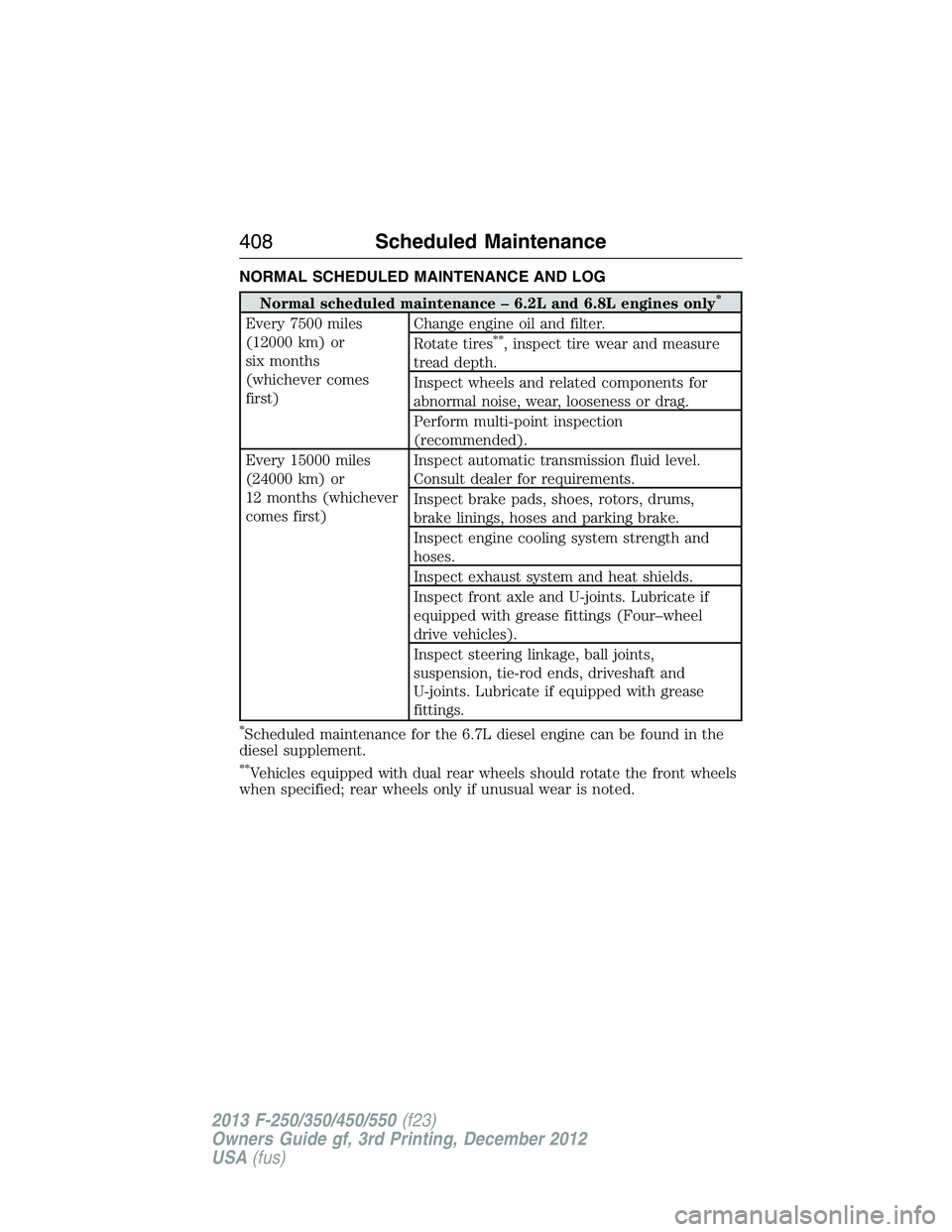
NORMAL SCHEDULED MAINTENANCE AND LOG
Normal scheduled maintenance – 6.2L and 6.8L engines only*
Every 7500 miles
(12000 km) or
six months
(whichever comes
first)Change engine oil and filter.
Rotate tires**, inspect tire wear and measure
tread depth.
Inspect wheels and related components for
abnormal noise, wear, looseness or drag.
Perform multi-point inspection
(recommended).
Every 15000 miles
(24000 km) or
12 months (whichever
comes first)Inspect automatic transmission fluid level.
Consult dealer for requirements.
Inspect brake pads, shoes, rotors, drums,
brake linings, hoses and parking brake.
Inspect engine cooling system strength and
hoses.
Inspect exhaust system and heat shields.
Inspect front axle and U-joints. Lubricate if
equipped with grease fittings (Four–wheel
drive vehicles).
Inspect steering linkage, ball joints,
suspension, tie-rod ends, driveshaft and
U-joints. Lubricate if equipped with grease
fittings.
*Scheduled maintenance for the 6.7L diesel engine can be found in the
diesel supplement.
**Vehicles equipped with dual rear wheels should rotate the front wheels
when specified; rear wheels only if unusual wear is noted.
408Scheduled Maintenance
2013 F-250/350/450/550(f23)
Owners Guide gf, 3rd Printing, December 2012
USA(fus)
Page 410 of 577
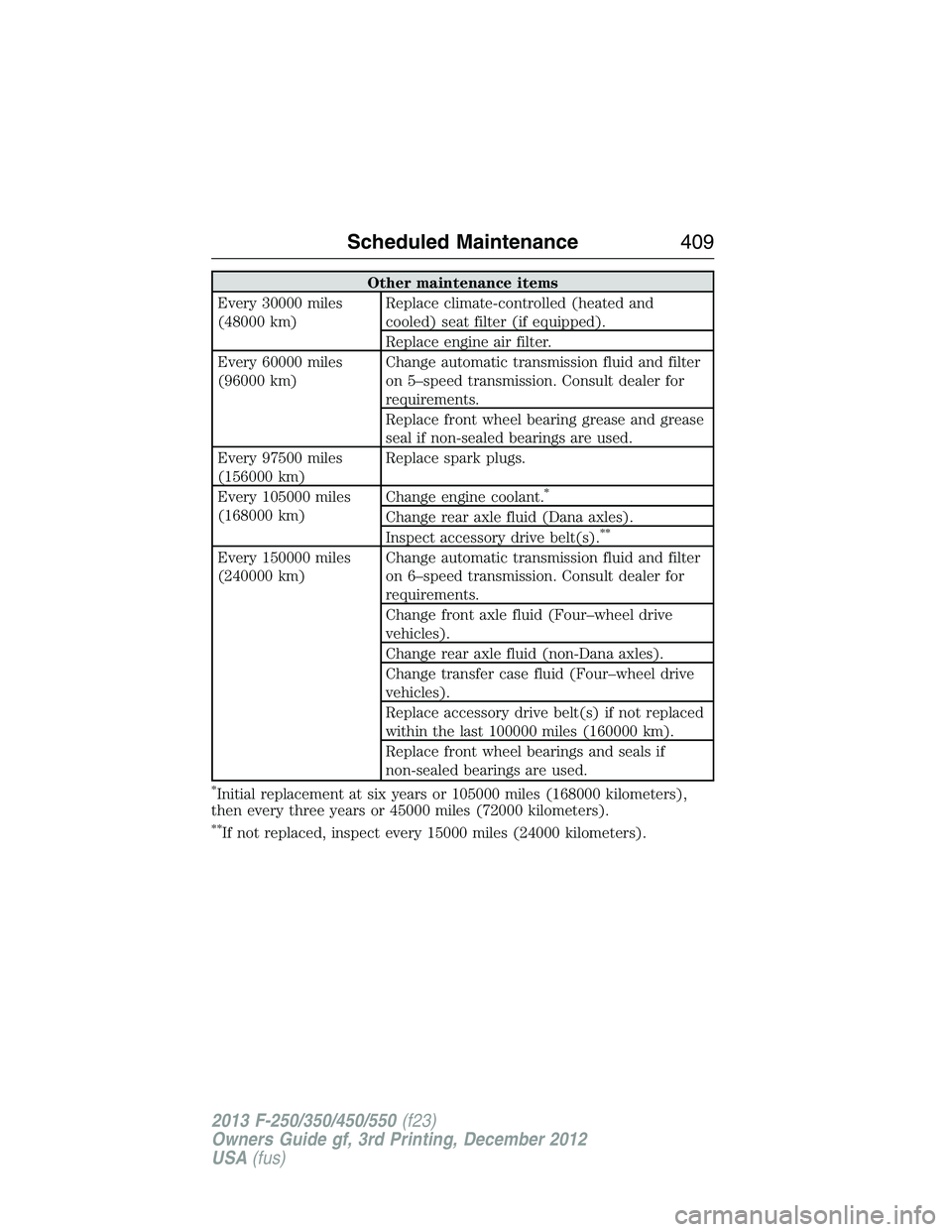
Other maintenance items
Every 30000 miles
(48000 km)Replace climate-controlled (heated and
cooled) seat filter (if equipped).
Replace engine air filter.
Every 60000 miles
(96000 km)Change automatic transmission fluid and filter
on 5–speed transmission. Consult dealer for
requirements.
Replace front wheel bearing grease and grease
seal if non-sealed bearings are used.
Every 97500 miles
(156000 km)Replace spark plugs.
Every 105000 miles
(168000 km)Change engine coolant.
*
Change rear axle fluid (Dana axles).
Inspect accessory drive belt(s).**
Every 150000 miles
(240000 km)Change automatic transmission fluid and filter
on 6–speed transmission. Consult dealer for
requirements.
Change front axle fluid (Four–wheel drive
vehicles).
Change rear axle fluid (non-Dana axles).
Change transfer case fluid (Four–wheel drive
vehicles).
Replace accessory drive belt(s) if not replaced
within the last 100000 miles (160000 km).
Replace front wheel bearings and seals if
non-sealed bearings are used.
*Initial replacement at six years or 105000 miles (168000 kilometers),
then every three years or 45000 miles (72000 kilometers).
**If not replaced, inspect every 15000 miles (24000 kilometers).
Scheduled Maintenance409
2013 F-250/350/450/550(f23)
Owners Guide gf, 3rd Printing, December 2012
USA(fus)