warning FORD F250 2014 Owner's Manual
[x] Cancel search | Manufacturer: FORD, Model Year: 2014, Model line: F250, Model: FORD F250 2014Pages: 460, PDF Size: 5.33 MB
Page 37 of 460
Then...
If...
The Belt-Minder feature will not activate.
The driver's safety belt is buckled before
the ignition switch is turned to the on posi- tion or less than 1-2 minutes have elapsed since the ignition switch has been turned to on...
The Belt-Minder feature is activated - thesafety belt warning light illuminates and
the warning chime sounds for six seconds every 25 seconds, repeating for about five minutes or until the safety belts are buckled.
The driver's safety belt is not buckled when
the vehicle has reached at least 6 mph (9.7
km/h) and 1-2 minutes have elapsed since
the ignition switch has been turned to on...
The Belt-Minder feature is activated - thesafety belt warning light illuminates and
the warning chime sounds for six seconds every 25 seconds, repeating for about five minutes or until the safety belts are buckled.
The driver's safety belt becomes unbuckled
for about one minute while the vehicle istraveling at least 6 mph (9.7 km/h) and
more than 1-2 minutes have elapsed since
the ignition switch has been turned to on...
Deactivating and Activating the
Belt-Minder Feature (Driver Only) WARNING
While the system allows you to
deactivate it, this system is designed
to improve your chances of being
safely belted and surviving an accident.
We recommend you leave the system
activated for yourself and others who may
use the vehicle. To reduce the risk of injury,
do not deactivate or activate the system
while driving the vehicle. Note:
If you are using MyKey, you cannot
disable the Belt-Minder. Also, if the
Belt-Minder has been previously disabled,
it will be re-enabled during the use of
MyKey. See MyKey ™ (page 50).
Read Steps 1 - 4 thoroughly before
proceeding with the programming
procedure. Deactivate or activate the system by
performing the following procedure:
Before following the procedure, make sure
that:
•
The parking brake is set.
• The transmission is in park (P).
• The ignition is off.
• All vehicle doors are closed.
• The driver's safety belt is unbuckled.
1. Turn the ignition on. Do not start the engine.
2. Wait until the safety belt warning light turns off (about one minute). Step 3
must be completed within 30 seconds
after the safety belt warning light turns
off.
3. Buckle then unbuckle the safety belt three times at a moderate speed,
ending with the safety belt in the
unbuckled state. After Step 3, the
safety belt warning light will turn on.
34
Super Duty (TFA) Safety Belts
Page 38 of 460
4. While the safety belt warning light is
on, buckle then unbuckle the safety
belt. After Step 4, the safety belt
warning light will flash for confirmation.
• This will disable the feature if it is
currently enabled.
• This will enable the feature if it is
currently disabled.
CHILD RESTRAINT AND
SAFETY BELT MAINTENANCE
Inspect the vehicle safety belts and child
safety seat systems periodically to make
sure they work properly and are not
damaged. Inspect the vehicle and child
seat safety belts to make sure there are no
nicks, tears or cuts. Replace if necessary.
All vehicle safety belt assemblies, including
retractors, buckles, front safety belt buckle
assemblies, buckle support assemblies
(slide bar-if equipped), shoulder belt
height adjusters (if equipped), shoulder
belt guide on seat back (if equipped), child
safety seat LATCH and tether anchors, and
attaching hardware, should be inspected
after a crash. Read the child restraint
manufacturer's instructions for additional
inspection and maintenance information
specific to the child restraint.
Ford Motor Company recommends that
all safety belt assemblies in use in vehicles
involved in a crash be replaced. However,
if the crash was minor and an authorized
dealer finds that the belts do not show
damage and continue to operate properly,
they do not need to be replaced. Safety
belt assemblies not in use during a crash
should also be inspected and replaced if
either damage or improper operation is
noted.
Properly care for safety belts. See Vehicle
Care (page 247).
35
Super Duty (TFA) Safety Belts
Page 39 of 460
PRINCIPLE OF OPERATION
WARNINGS
Airbags do not inflate slowly or
gently, and the risk of injury from a
deploying airbag is the greatest close
to the trim covering the airbag module. All occupants of your vehicle,
including the driver, should always
properly wear their safety belts, even
when an airbag supplemental restraint
system is provided. Failure to properly wear
your safety belt could seriously increase
the risk of injury or death. Always transport children 12 years
old and under in the back seat and
always properly use appropriate
child restraints. Failure to follow this could
seriously increase the risk of injury or death. Never place your arm over the airbag
module as a deploying airbag can
result in serious arm fractures or
other injuries. Airbags can kill or injure a child in a
child seat. Never place a rear-facing
child seat in front of an active airbag.
If you must use a forward-facing child seat
in the front seat, move the seat upon which
the child seat is installed all the way back. Do not attempt to service, repair, or
modify the airbag supplemental
restraint systems or its fuses as you
could be seriously injured or killed. Contact
your authorized dealer as soon as possible. Several airbag system components
get hot after inflation. To avoid risk
of injury, do not touch them after
inflation. If the airbag has deployed, the airbag
will not function again and must be
replaced immediately. If the airbag
is not replaced, the unrepaired area will
increase the risk of injury in a crash. The airbags are a supplemental restraint
system and are designed to work with the
safety belts to help protect the driver and
right front passenger from certain upper
body injuries. Airbags do not inflate slowly;
there is a risk of injury from a deploying
airbag.
Note:
You will hear a loud bang and see a
cloud of harmless powdery residue if an
airbag deploys. This is normal.
The airbags inflate and deflate rapidly
upon activation. After airbag deployment,
it is normal to notice a smoke-like, powdery
residue or smell the burnt propellant. This
may consist of cornstarch, talcum powder
(to lubricate the bag) or sodium
compounds (for example, baking soda)
that result from the combustion process
that inflates the airbag. Small amounts of
sodium hydroxide may be present which
may irritate the skin and eyes, but none of
the residue is toxic.
While the system is designed to help
reduce serious injuries, contact with a
deploying airbag may also cause abrasions
or swelling. Temporary hearing loss is also
a possibility as a result of the noise
associated with a deploying airbag.
Because airbags must inflate rapidly and
with considerable force, there is the risk of
death or serious injuries such as fractures,
facial and eye injuries or internal injuries,
particularly to occupants who are not
properly restrained or are otherwise out of
position at the time of airbag deployment.
Thus, it is extremely important that
occupants be properly restrained as far
away from the airbag module as possible
while maintaining vehicle control.
Routine maintenance of the airbags is not
required.
36
Super Duty (TFA) Supplementary Restraints System
Page 40 of 460
DRIVER AND PASSENGER
AIRBAGS
WARNINGS
Never place your arm or any objects
over an airbag module. Placing your
arm over a deploying airbag can
result in serious arm fractures or other
injuries. Objects placed on or over the
airbag inflation area may cause those
objects to be propelled by the airbag into
your face and torso causing serious injury. Airbags can kill or injure a child in a
child seat. Never place a rear-facing
child seat in front of an active airbag.
If you must use a forward-facing child seat
in the front seat, move the seat upon which
the child seat is installed all the way back. The driver and front passenger airbags will
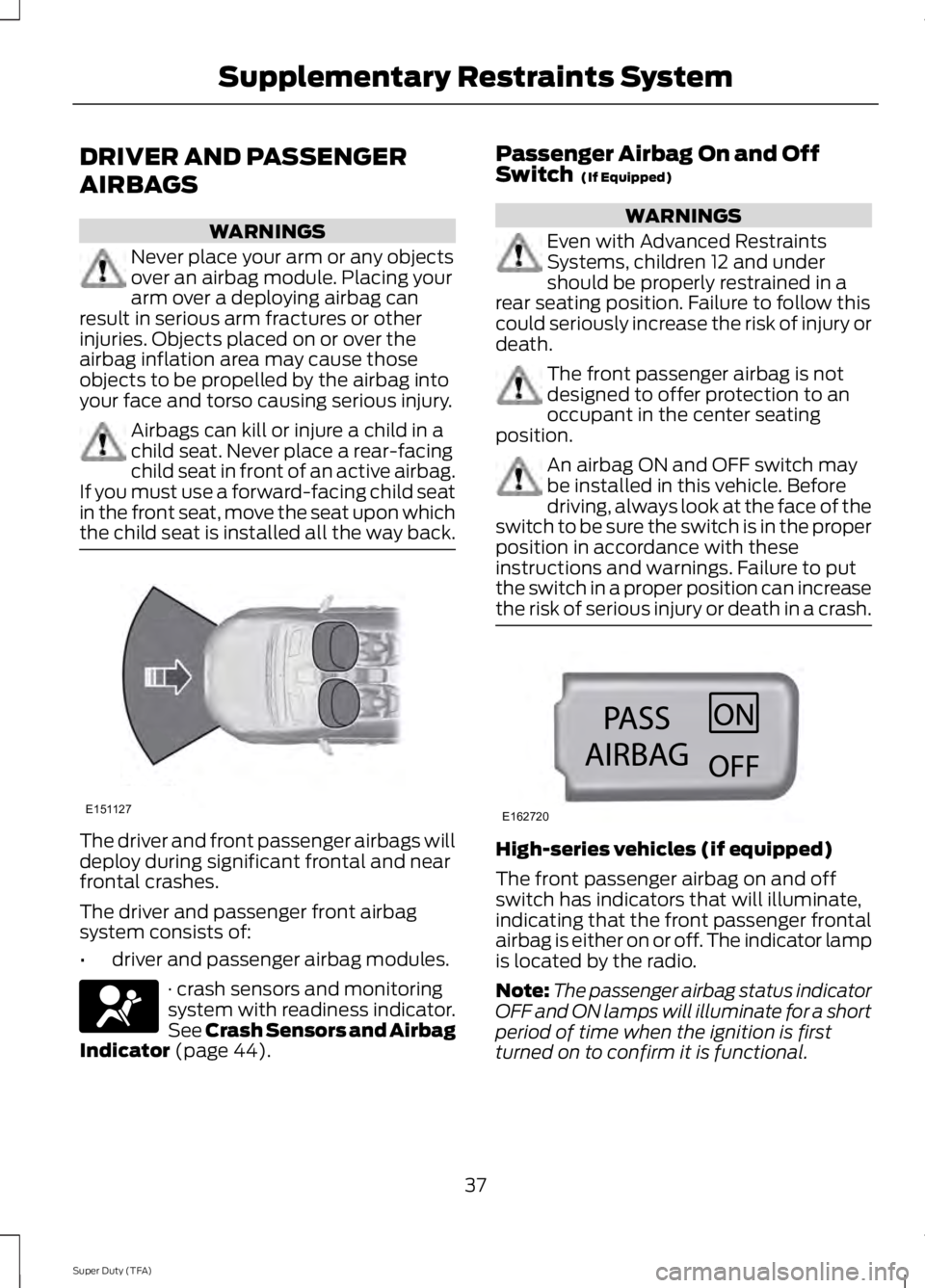
deploy during significant frontal and near
frontal crashes.
The driver and passenger front airbag
system consists of:
•
driver and passenger airbag modules. · crash sensors and monitoring
system with readiness indicator.
See Crash Sensors and Airbag
Indicator (page 44). Passenger Airbag On and Off
Switch
(If Equipped) WARNINGS
Even with Advanced Restraints
Systems, children 12 and under
should be properly restrained in a
rear seating position. Failure to follow this
could seriously increase the risk of injury or
death. The front passenger airbag is not
designed to offer protection to an
occupant in the center seating
position. An airbag ON and OFF switch may
be installed in this vehicle. Before
driving, always look at the face of the
switch to be sure the switch is in the proper
position in accordance with these
instructions and warnings. Failure to put
the switch in a proper position can increase
the risk of serious injury or death in a crash. High-series vehicles (if equipped)
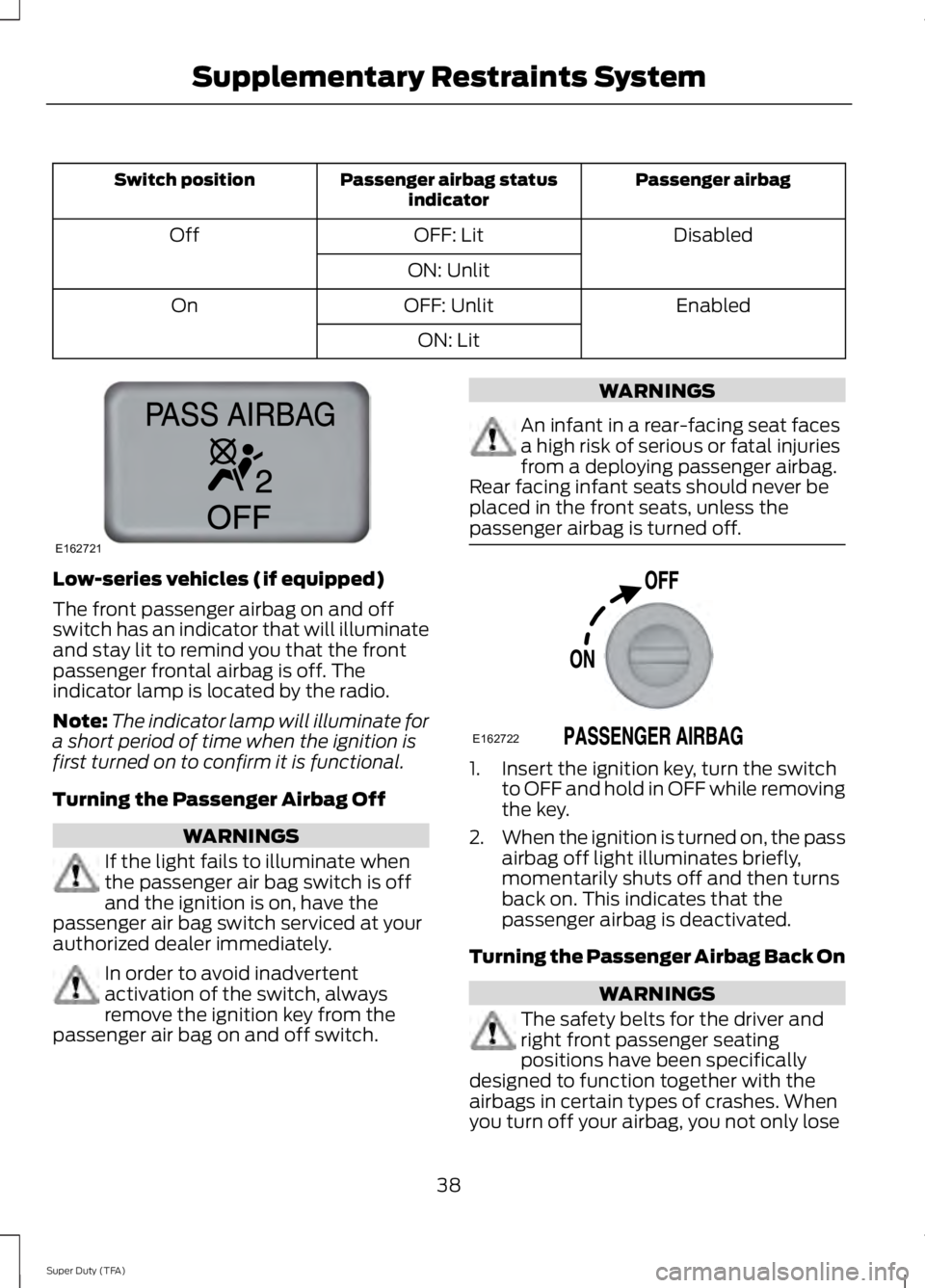
The front passenger airbag on and off
switch has indicators that will illuminate,
indicating that the front passenger frontal
airbag is either on or off. The indicator lamp
is located by the radio.
Note:
The passenger airbag status indicator
OFF and ON lamps will illuminate for a short
period of time when the ignition is first
turned on to confirm it is functional.
37
Super Duty (TFA) Supplementary Restraints SystemE151127 E162720
Page 41 of 460
Passenger airbag
Passenger airbag status
indicator
Switch position
Disabled
OFF: Lit
Off
ON: Unlit Enabled
OFF: Unlit
On
ON: LitLow-series vehicles (if equipped)
The front passenger airbag on and off
switch has an indicator that will illuminate
and stay lit to remind you that the front
passenger frontal airbag is off. The
indicator lamp is located by the radio.
Note:
The indicator lamp will illuminate for
a short period of time when the ignition is
first turned on to confirm it is functional.
Turning the Passenger Airbag Off WARNINGS
If the light fails to illuminate when
the passenger air bag switch is off
and the ignition is on, have the
passenger air bag switch serviced at your
authorized dealer immediately. In order to avoid inadvertent
activation of the switch, always
remove the ignition key from the
passenger air bag on and off switch. WARNINGS
An infant in a rear-facing seat faces
a high risk of serious or fatal injuries
from a deploying passenger airbag.
Rear facing infant seats should never be
placed in the front seats, unless the
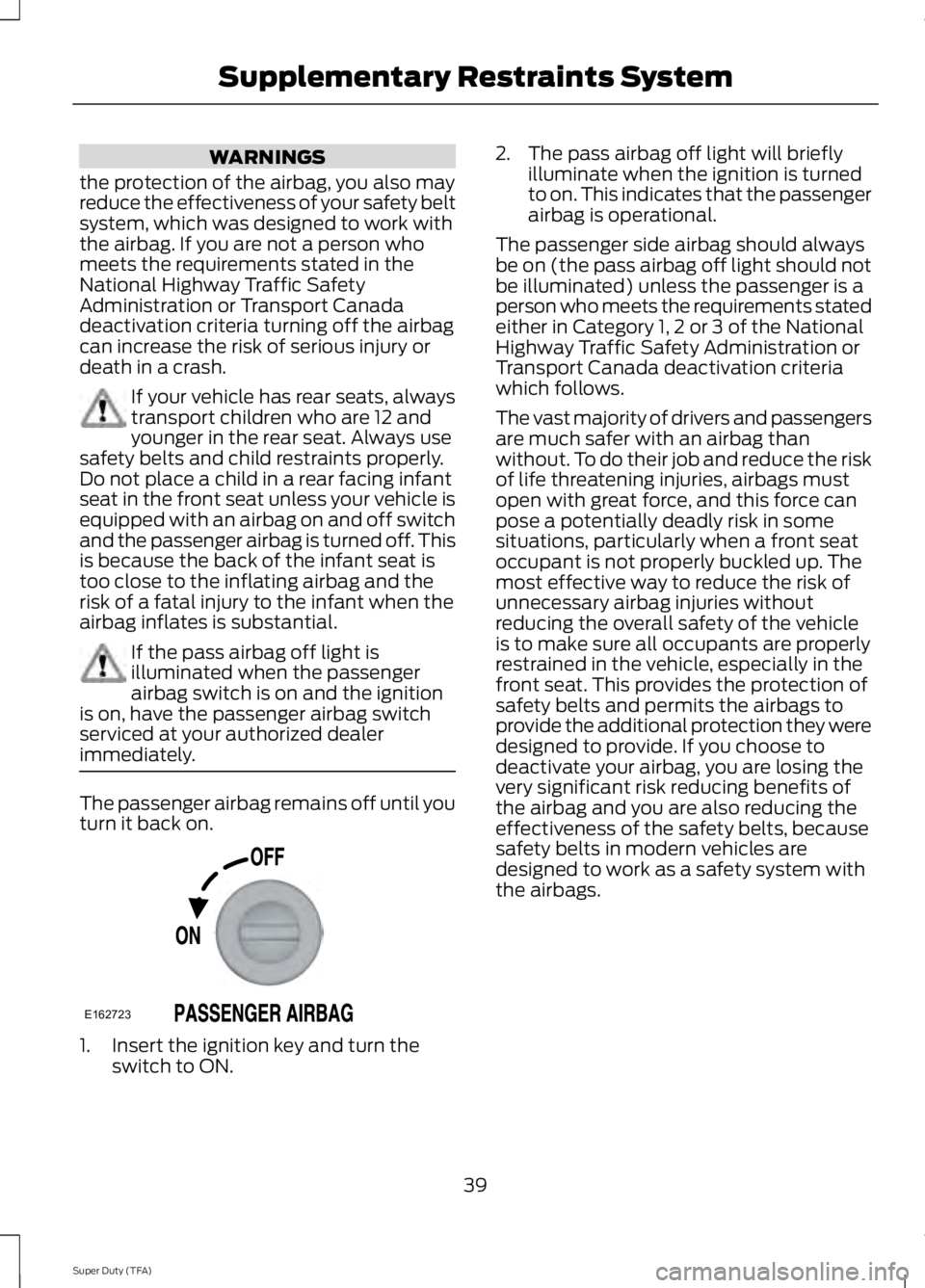
passenger airbag is turned off. 1. Insert the ignition key, turn the switch
to OFF and hold in OFF while removing
the key.
2. When the ignition is turned on, the pass
airbag off light illuminates briefly,
momentarily shuts off and then turns
back on. This indicates that the
passenger airbag is deactivated.
Turning the Passenger Airbag Back On WARNINGS
The safety belts for the driver and
right front passenger seating
positions have been specifically
designed to function together with the
airbags in certain types of crashes. When
you turn off your airbag, you not only lose
38
Super Duty (TFA) Supplementary Restraints SystemE162721 E162722
Page 42 of 460
WARNINGS
the protection of the airbag, you also may
reduce the effectiveness of your safety belt
system, which was designed to work with
the airbag. If you are not a person who
meets the requirements stated in the
National Highway Traffic Safety
Administration or Transport Canada
deactivation criteria turning off the airbag
can increase the risk of serious injury or
death in a crash. If your vehicle has rear seats, always
transport children who are 12 and
younger in the rear seat. Always use
safety belts and child restraints properly.
Do not place a child in a rear facing infant
seat in the front seat unless your vehicle is
equipped with an airbag on and off switch
and the passenger airbag is turned off. This
is because the back of the infant seat is
too close to the inflating airbag and the
risk of a fatal injury to the infant when the
airbag inflates is substantial. If the pass airbag off light is
illuminated when the passenger
airbag switch is on and the ignition
is on, have the passenger airbag switch
serviced at your authorized dealer
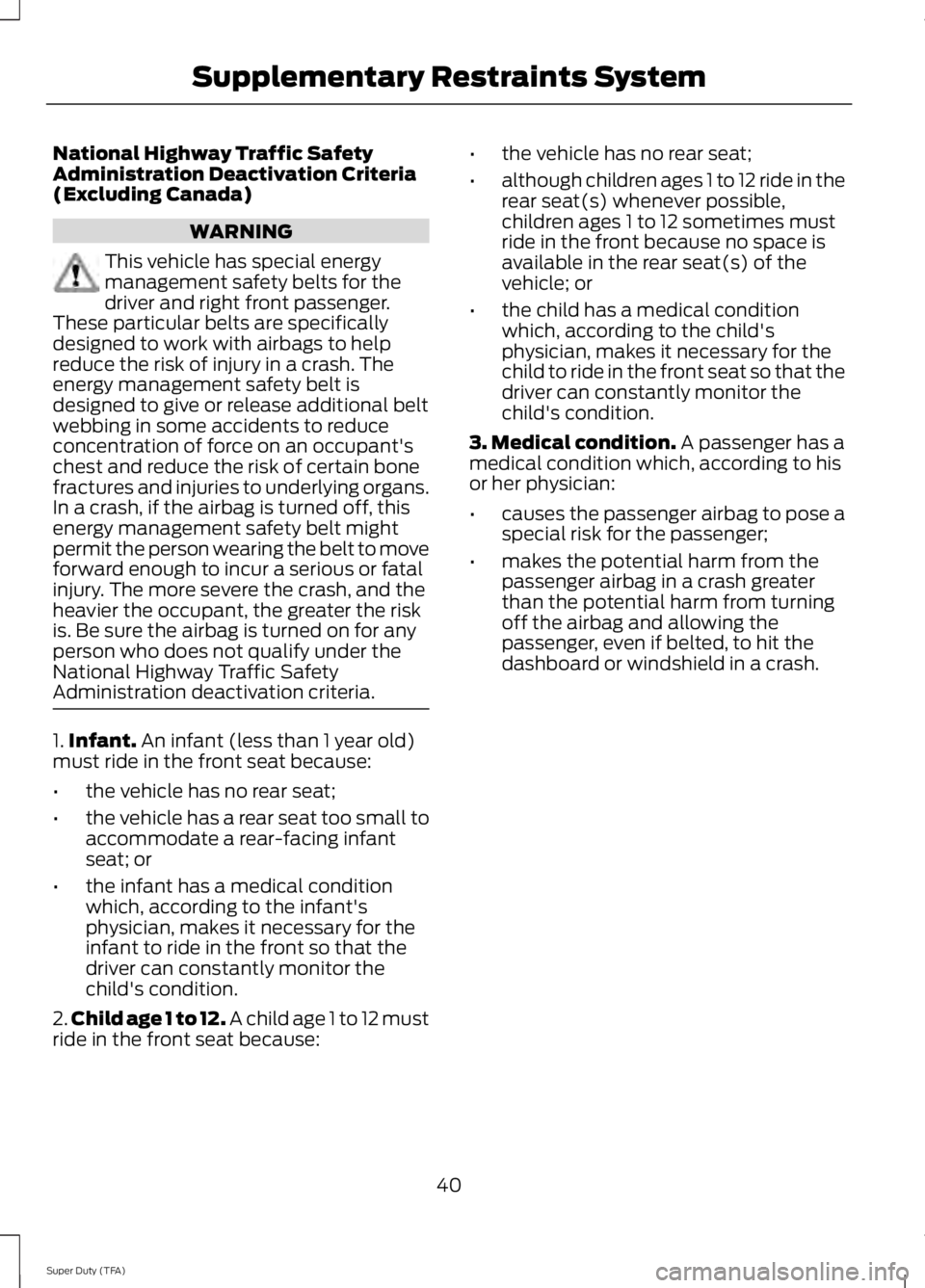
immediately. The passenger airbag remains off until you
turn it back on.
1. Insert the ignition key and turn the
switch to ON. 2. The pass airbag off light will briefly
illuminate when the ignition is turned
to on. This indicates that the passenger
airbag is operational.
The passenger side airbag should always
be on (the pass airbag off light should not
be illuminated) unless the passenger is a
person who meets the requirements stated
either in Category 1, 2 or 3 of the National
Highway Traffic Safety Administration or
Transport Canada deactivation criteria
which follows.
The vast majority of drivers and passengers
are much safer with an airbag than
without. To do their job and reduce the risk
of life threatening injuries, airbags must
open with great force, and this force can
pose a potentially deadly risk in some
situations, particularly when a front seat
occupant is not properly buckled up. The
most effective way to reduce the risk of
unnecessary airbag injuries without
reducing the overall safety of the vehicle
is to make sure all occupants are properly
restrained in the vehicle, especially in the
front seat. This provides the protection of
safety belts and permits the airbags to
provide the additional protection they were
designed to provide. If you choose to
deactivate your airbag, you are losing the
very significant risk reducing benefits of
the airbag and you are also reducing the
effectiveness of the safety belts, because
safety belts in modern vehicles are
designed to work as a safety system with
the airbags.
39
Super Duty (TFA) Supplementary Restraints SystemE162723
Page 43 of 460
National Highway Traffic Safety
Administration Deactivation Criteria
(Excluding Canada)
WARNING
This vehicle has special energy
management safety belts for the
driver and right front passenger.
These particular belts are specifically
designed to work with airbags to help
reduce the risk of injury in a crash. The
energy management safety belt is
designed to give or release additional belt
webbing in some accidents to reduce
concentration of force on an occupant's
chest and reduce the risk of certain bone
fractures and injuries to underlying organs.
In a crash, if the airbag is turned off, this
energy management safety belt might
permit the person wearing the belt to move
forward enough to incur a serious or fatal
injury. The more severe the crash, and the
heavier the occupant, the greater the risk
is. Be sure the airbag is turned on for any
person who does not qualify under the
National Highway Traffic Safety
Administration deactivation criteria. 1.
Infant. An infant (less than 1 year old)
must ride in the front seat because:
• the vehicle has no rear seat;
• the vehicle has a rear seat too small to
accommodate a rear-facing infant
seat; or
• the infant has a medical condition
which, according to the infant's
physician, makes it necessary for the
infant to ride in the front so that the
driver can constantly monitor the
child's condition.
2. Child age 1 to 12. A child age 1 to 12 must
ride in the front seat because: •
the vehicle has no rear seat;
• although children ages 1 to 12 ride in the
rear seat(s) whenever possible,
children ages 1 to 12 sometimes must
ride in the front because no space is
available in the rear seat(s) of the
vehicle; or
• the child has a medical condition
which, according to the child's
physician, makes it necessary for the
child to ride in the front seat so that the
driver can constantly monitor the
child's condition.
3. Medical condition.
A passenger has a
medical condition which, according to his
or her physician:
• causes the passenger airbag to pose a
special risk for the passenger;
• makes the potential harm from the
passenger airbag in a crash greater
than the potential harm from turning
off the airbag and allowing the
passenger, even if belted, to hit the
dashboard or windshield in a crash.
40
Super Duty (TFA) Supplementary Restraints System
Page 44 of 460
Transport Canada Deactivation Criteria
(Canada Only)
WARNING
This vehicle has special energy
management safety belts for the
driver and right front passenger.
These particular belts are specifically
designed to work with airbags to help
reduce the risk of injury in a crash. The
energy management safety belt is
designed to give or release additional belt
webbing in some accidents to reduce
concentration of force on an occupant's
chest and reduce the risk of certain bone
fractures and injuries to underlying organs.
In a crash, if the airbag is turned off, this
energy management safety belt might
permit the person wearing the belt to move
forward enough to incur a serious or fatal
injury. The more severe the crash, and the
heavier the occupant, the greater the risk
is. Be sure the airbag is turned on for any
person who does not qualify under the
National Highway Traffic Safety
Administration deactivation criteria. 1.
Infant: An infant (less than 1 year old)
must ride in the front seat because:
• my vehicle has no rear seat;
• the rear seat in my vehicle cannot
accommodate a rear-facing infant
seat;
• the infant has a medical condition
which, according to the infant's
physician, makes it necessary for the
infant to ride in the front seat so that
the driver can monitor the infant's
condition.
2. Child age 12 or under: A child age 12 or
under must ride in the front seat because: •
my vehicle has no rear seat;
• although children age 12 and under ride
in the rear seat whenever possible,
children age 12 and under have no
option but to sometimes ride in the
front seat because rear seat space is
insufficient;
• the child has a medical condition that,
according to the child's physician,
makes it necessary for the child to ride
in the front seat so that the driver can
monitor the child's condition.
3. Medical condition:
A passenger has a
medical condition that, according to his or
her physician:
• poses a special risk for the passenger
if the airbag deploys; and
• makes the potential harm from the
passenger airbag deployment greater
than the potential harm from turning
off the airbag and experiencing a crash
without the protection offered by the
airbag
Proper Driver and Front Passenger
Seating Adjustment WARNING
The National Highway Traffic Safety
Administration recommends a
minimum distance of at least 10
inches (25 centimeters) between an
occupant’ s chest and the driver airbag
module. To properly position yourself away from
the airbag:
•
Move your seat to the rear as far as you
can while still reaching the pedals
comfortably.
• Recline the seat slightly (one or two
degrees) from the upright position.
41
Super Duty (TFA) Supplementary Restraints System
Page 45 of 460
After all occupants have adjusted their
seats and put on safety belts, it is very
important that they continue to sit
properly. Properly seated occupants sit
upright, lean against the seat back, and
center themselves on the seat cushion,
with their feet comfortably extended on
the floor. Sitting improperly can increase
the chance of injury in a crash event. For
example, if an occupant slouches, lies
down, turns sideways, sits forward, leans
forward or sideways, or puts one or both
feet up, the chance of injury during a crash
is greatly increased.
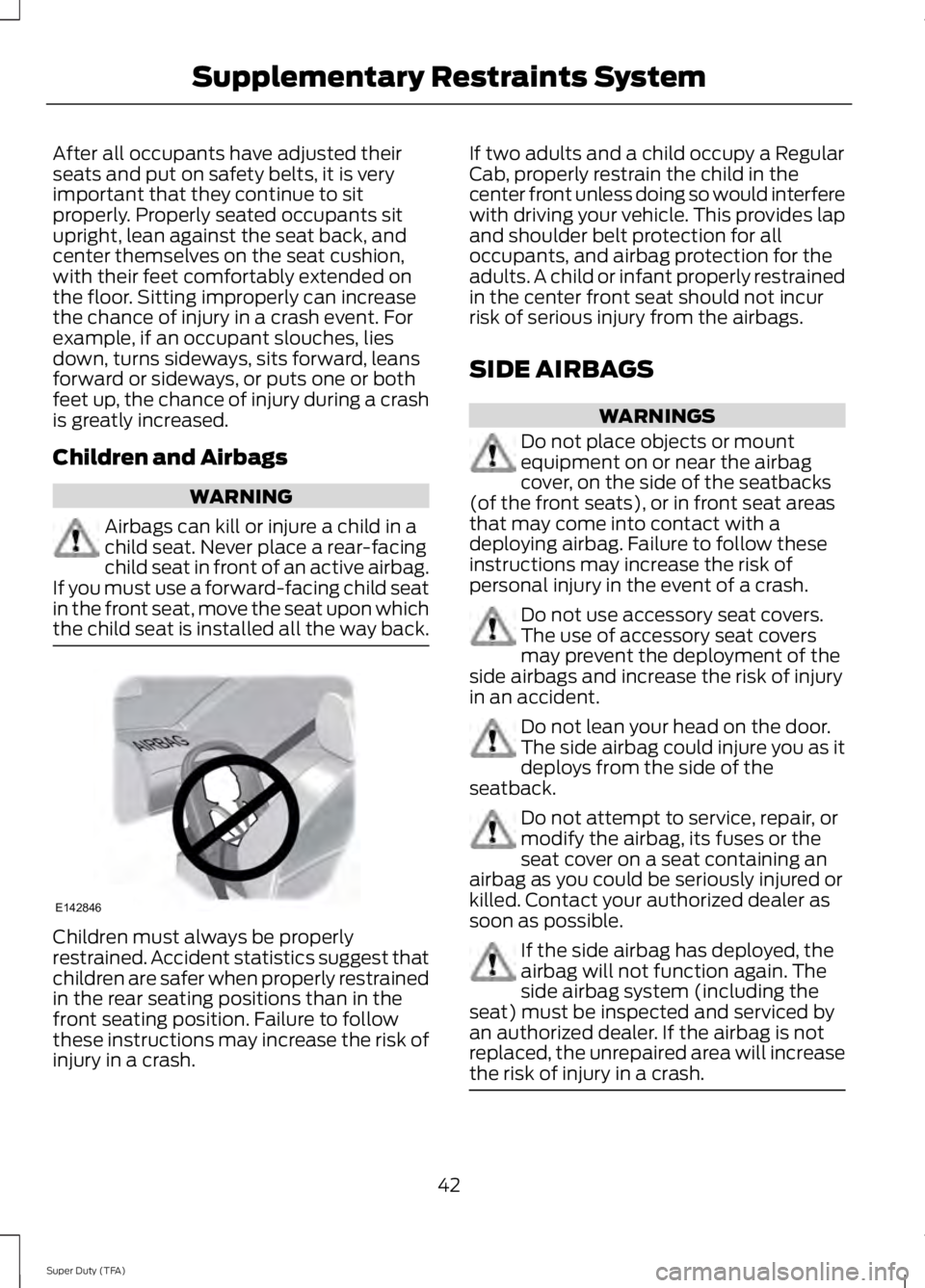
Children and Airbags
WARNING
Airbags can kill or injure a child in a
child seat. Never place a rear-facing
child seat in front of an active airbag.
If you must use a forward-facing child seat
in the front seat, move the seat upon which
the child seat is installed all the way back. Children must always be properly
restrained. Accident statistics suggest that
children are safer when properly restrained
in the rear seating positions than in the
front seating position. Failure to follow
these instructions may increase the risk of
injury in a crash. If two adults and a child occupy a Regular
Cab, properly restrain the child in the
center front unless doing so would interfere
with driving your vehicle. This provides lap
and shoulder belt protection for all
occupants, and airbag protection for the
adults. A child or infant properly restrained
in the center front seat should not incur
risk of serious injury from the airbags.
SIDE AIRBAGS
WARNINGS
Do not place objects or mount
equipment on or near the airbag
cover, on the side of the seatbacks
(of the front seats), or in front seat areas
that may come into contact with a
deploying airbag. Failure to follow these
instructions may increase the risk of
personal injury in the event of a crash. Do not use accessory seat covers.
The use of accessory seat covers
may prevent the deployment of the
side airbags and increase the risk of injury
in an accident. Do not lean your head on the door.
The side airbag could injure you as it
deploys from the side of the
seatback. Do not attempt to service, repair, or
modify the airbag, its fuses or the
seat cover on a seat containing an
airbag as you could be seriously injured or
killed. Contact your authorized dealer as
soon as possible. If the side airbag has deployed, the
airbag will not function again. The
side airbag system (including the
seat) must be inspected and serviced by
an authorized dealer. If the airbag is not
replaced, the unrepaired area will increase
the risk of injury in a crash. 42
Super Duty (TFA) Supplementary Restraints SystemE142846
Page 46 of 460
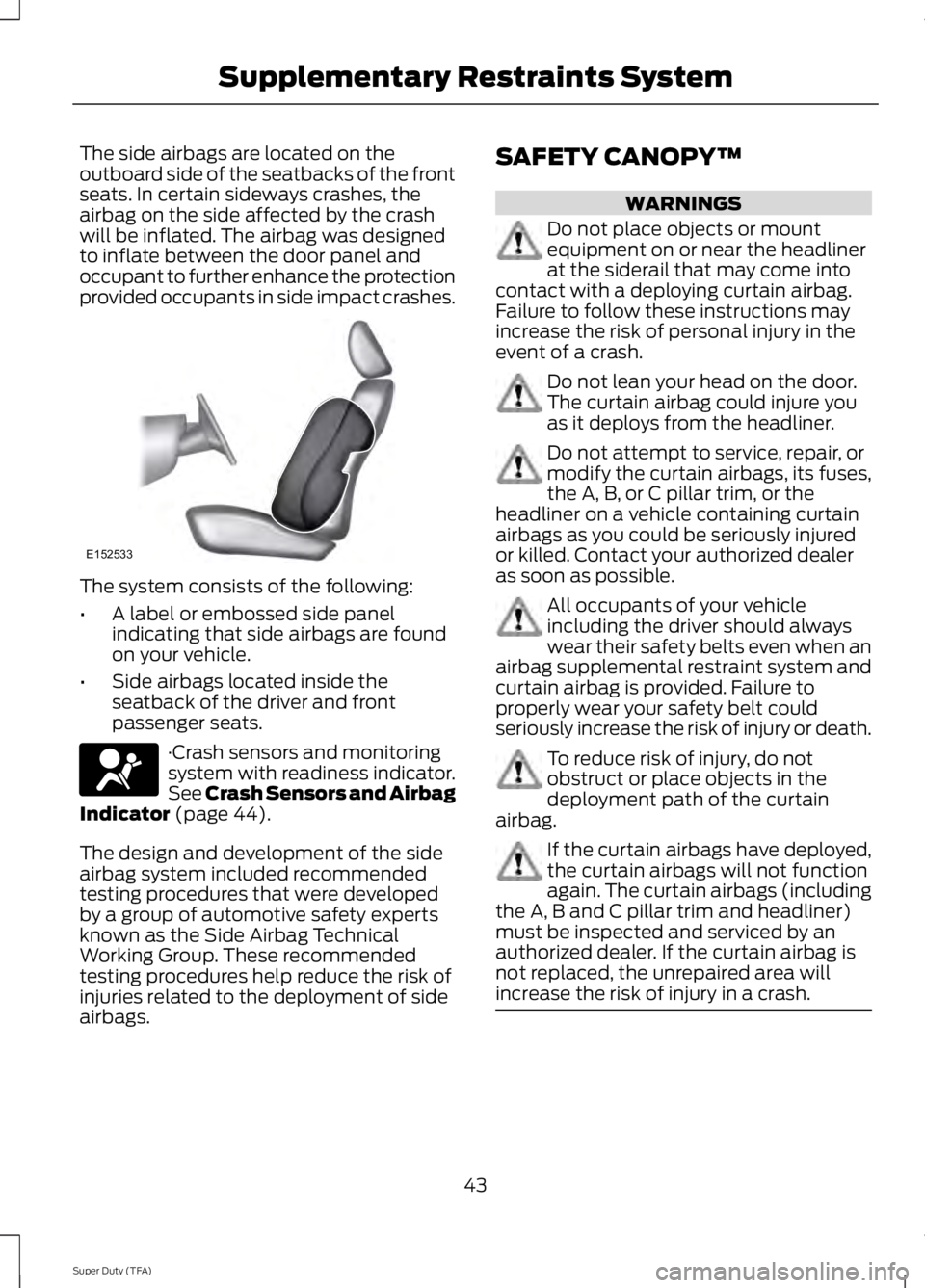
The side airbags are located on the
outboard side of the seatbacks of the front
seats. In certain sideways crashes, the
airbag on the side affected by the crash
will be inflated. The airbag was designed
to inflate between the door panel and
occupant to further enhance the protection
provided occupants in side impact crashes.
The system consists of the following:
•
A label or embossed side panel
indicating that side airbags are found
on your vehicle.
• Side airbags located inside the
seatback of the driver and front
passenger seats. ·Crash sensors and monitoring
system with readiness indicator.
See Crash Sensors and Airbag
Indicator (page 44).
The design and development of the side
airbag system included recommended
testing procedures that were developed
by a group of automotive safety experts
known as the Side Airbag Technical
Working Group. These recommended
testing procedures help reduce the risk of
injuries related to the deployment of side
airbags. SAFETY CANOPY™ WARNINGS
Do not place objects or mount
equipment on or near the headliner
at the siderail that may come into
contact with a deploying curtain airbag.
Failure to follow these instructions may
increase the risk of personal injury in the
event of a crash. Do not lean your head on the door.
The curtain airbag could injure you
as it deploys from the headliner.
Do not attempt to service, repair, or
modify the curtain airbags, its fuses,
the A, B, or C pillar trim, or the
headliner on a vehicle containing curtain
airbags as you could be seriously injured
or killed. Contact your authorized dealer
as soon as possible. All occupants of your vehicle
including the driver should always
wear their safety belts even when an
airbag supplemental restraint system and
curtain airbag is provided. Failure to
properly wear your safety belt could
seriously increase the risk of injury or death. To reduce risk of injury, do not
obstruct or place objects in the
deployment path of the curtain
airbag. If the curtain airbags have deployed,
the curtain airbags will not function
again. The curtain airbags (including
the A, B and C pillar trim and headliner)
must be inspected and serviced by an
authorized dealer. If the curtain airbag is
not replaced, the unrepaired area will
increase the risk of injury in a crash. 43
Super Duty (TFA) Supplementary Restraints SystemE152533