tires FORD F250 2014 Workshop Manual
[x] Cancel search | Manufacturer: FORD, Model Year: 2014, Model line: F250, Model: FORD F250 2014Pages: 460, PDF Size: 5.33 MB
Page 293 of 460
TECHNICAL SPECIFICATIONS
Wheel Lug Nut Torque Specifications
WARNING
When a wheel is installed, always remove any corrosion, dirt or foreign materials
present on the mounting surfaces of the wheel or the surface of the wheel hub,
brake drum or brake disc that contacts the wheel. Make sure that any fasteners
that attach the rotor to the hub are secured so they do not interfere with the mounting
surfaces of the wheel. Installing wheels without correct metal-to-metal contact at the
wheel mounting surfaces can cause the wheel nuts to loosen and the wheel to come off
while the vehicle is in motion, resulting in loss of control. lb.ft (Nm)
Bolt size
165 lb.ft (224 Nm)
M14 x 1.5
* Torque specifications are for nut and bolt threads free of dirt and rust. Use only Ford
recommended replacement fasteners.
On vehicles equipped with single rear wheels, retighten the lug nuts to the specified torque
at 100 miles (160 kilometers) after any wheel disturbance (such as tire rotation, changing
a flat tire, wheel removal).
On vehicles equipped with dual rear wheels, retighten the wheel lug nuts to the specified
torque at 100 miles (160 kilometers), and again at 500 miles (800 kilometers) of new
vehicle operation and after any wheel disturbance (such as tire rotation, changing a flat
tire, wheel removal).
It is important to follow the proper wheel mounting and lug nut torque procedures.
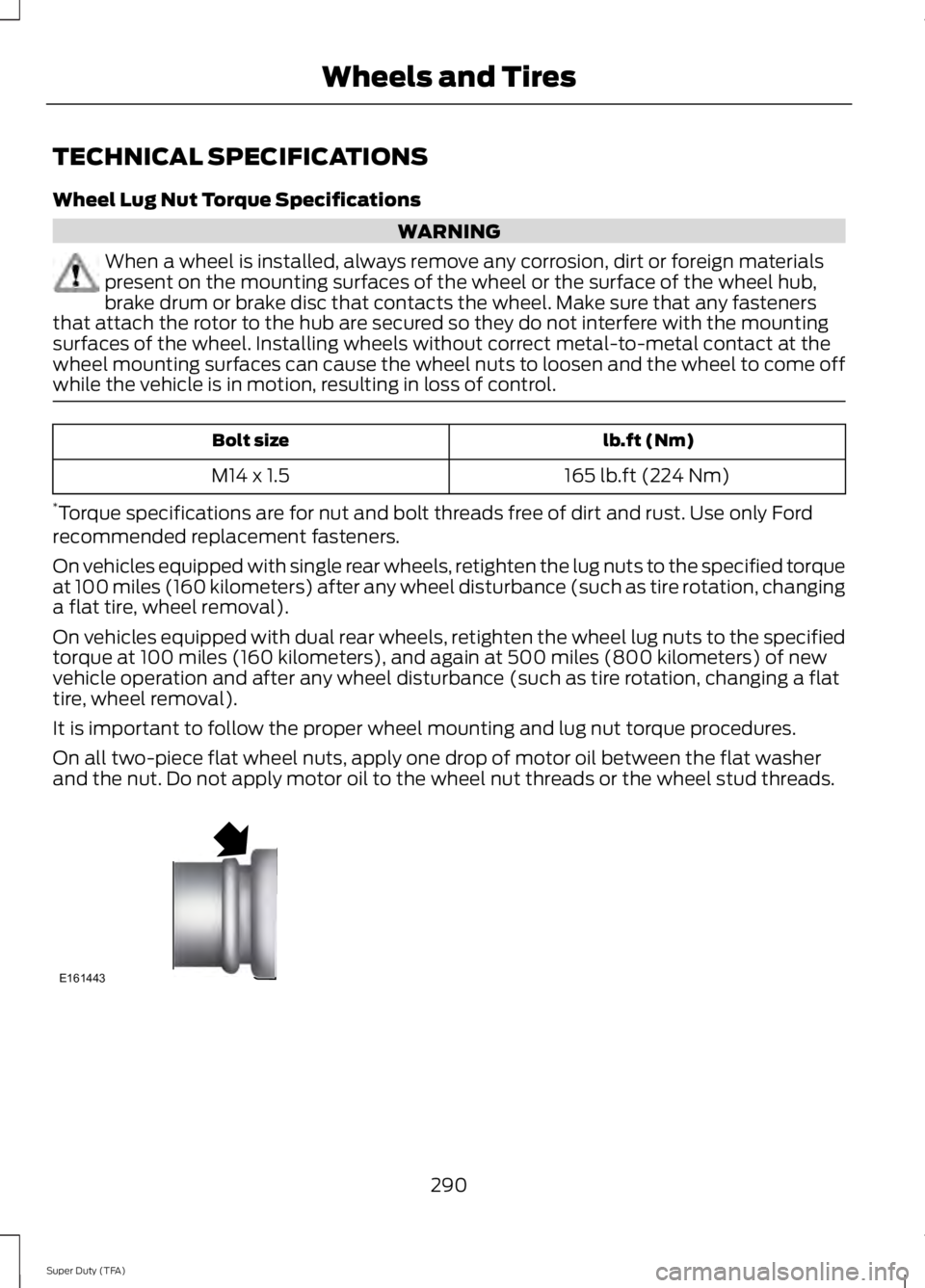
On all two-piece flat wheel nuts, apply one drop of motor oil between the flat washer
and the nut. Do not apply motor oil to the wheel nut threads or the wheel stud threads. 290
Super Duty (TFA) Wheels and TiresE161443
Page 294 of 460
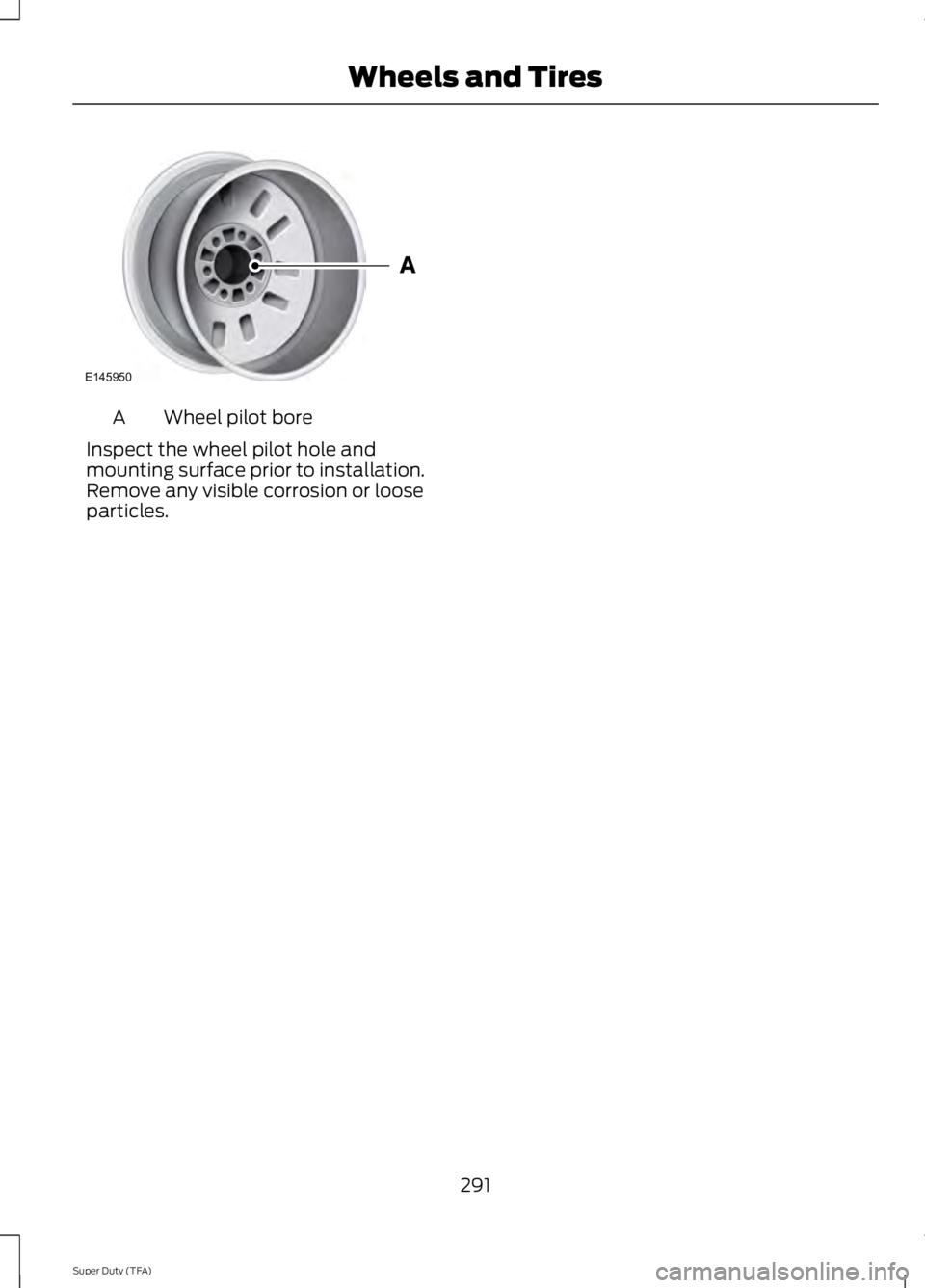
Wheel pilot bore
A
Inspect the wheel pilot hole and
mounting surface prior to installation.
Remove any visible corrosion or loose
particles.
291
Super Duty (TFA) Wheels and TiresE145950
Page 434 of 460
Ford Motor Company has recommended
maintenance intervals for various parts
and component systems based upon
engineering testing. Ford Motor Company
relies upon this testing to determine the
most appropriate mileage for replacement
of oils and fluids to protect your vehicle at
the lowest overall cost to you and
recommends against maintenance
schedules that deviate from the scheduled
maintenance information.
We strongly recommend the use of only
genuine Ford, Motorcraft or
Ford-authorized re-manufactured
replacement parts engineered for your
vehicle.
Additives and Chemicals
This owner's manual and the Ford
Workshop Manual list the recommended
additives and chemicals for your vehicle.
We do not recommend using chemicals or
additives not approved by us as part of
your vehicle
’s normal maintenance. Please
consult your warranty information. Oils, Fluids and Flushing
In many cases, fluid discoloration is a
normal operating characteristic and, by
itself, does not necessarily indicate a
concern or that the fluid needs to be
changed. However, a qualified expert, such
as the factory-trained technicians at your
dealership, should inspect discolored fluids
that also show signs of overheating or
foreign material contamination
immediately.
Make sure to change your vehicle
’s oils and
fluids at the specified intervals or in
conjunction with a repair. Flushing is a
viable way to change fluid for many vehicle
sub-systems during scheduled
maintenance. It is critical that systems are
flushed only with new fluid that is the same
as that required to fill and operate the
system or using a Ford-approved flushing
chemical.
Owner Checks and Services
Make sure you perform the following basic
maintenance checks and inspections every
month or at six-month intervals. Check every month
Engine oil level.
Function of all interior and exterior lights.
Tires (including spare) for wear and proper pressure. Windshield washer fluid level. Check every six months
Battery connections. Clean if necessary.
Body and door drain holes for obstructions. Clean if necessary. Cooling system fluid level and coolant strength.
Door weatherstrips for wear. Lubricate if necessary.
431
Super Duty (TFA) Scheduled Maintenance
Page 435 of 460
Check every six months
Hinges, latches and outside locks for proper operation. Lubricate if necessary. Parking brake for proper operation.
Safety belts and seat latches for wear and function.
Safety warning lamps (brake, ABS, airbag and safety belt) for operation.
Washer spray and wiper operation. Clean or replace blades as necessary.
Multi-point Inspection
In order to keep your vehicle running right,
it is important to have the systems on your
vehicle checked regularly. This can help
identify potential issues and prevent major
problems. We recommend having the
following multi-point inspection performed
at every scheduled maintenance interval
to help make sure your vehicle keeps
running great. Multi-point inspection
Horn operation
Accessory drive belt(s)
Radiator, cooler, heater and A/C hoses
Battery performance
Suspension component for leaks ordamage
Engine air filter
Steering and linkage
Exhaust system
Tires (including spare) for wear and properpressure**
Exterior lamps and hazard warning system
operation
Windshield for cracks, chips or pits
Fluid levels *
; fill if necessary
Washer spray and wiper operation
For oil and fluid leaks
* Brake, coolant recovery reservoir, automatic transmission, power steering and window
washer.
** If your vehicle is equipped with a temporary mobility kit, check the tire sealant expiration
Use By date on the canister. Replace as needed.
432
Super Duty (TFA) Scheduled Maintenance
Page 436 of 460
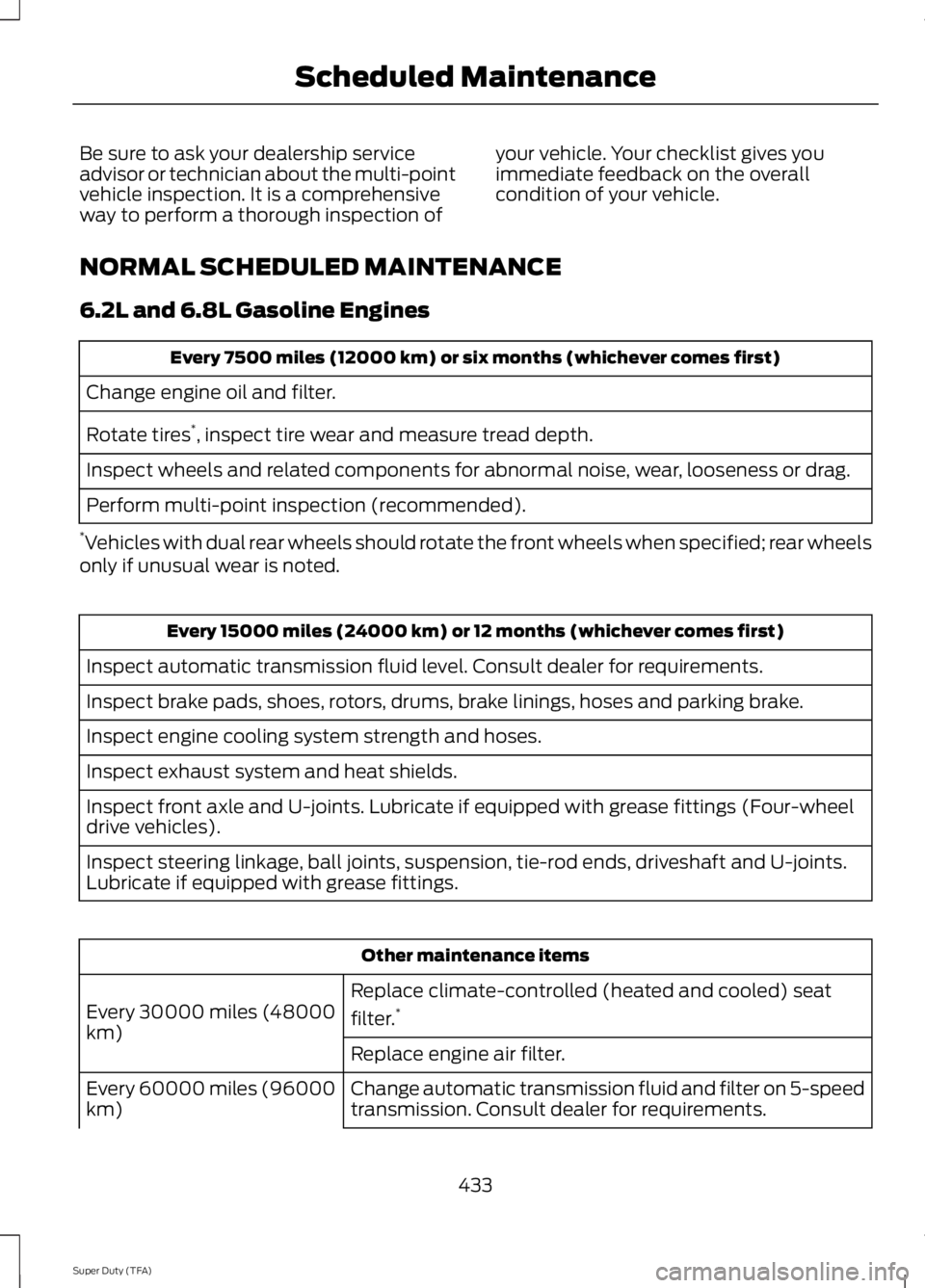
Be sure to ask your dealership service
advisor or technician about the multi-point
vehicle inspection. It is a comprehensive
way to perform a thorough inspection of
your vehicle. Your checklist gives you
immediate feedback on the overall
condition of your vehicle.
NORMAL SCHEDULED MAINTENANCE
6.2L and 6.8L Gasoline Engines Every 7500 miles (12000 km) or six months (whichever comes first)
Change engine oil and filter.
Rotate tires *
, inspect tire wear and measure tread depth.
Inspect wheels and related components for abnormal noise, wear, looseness or drag.
Perform multi-point inspection (recommended).
* Vehicles with dual rear wheels should rotate the front wheels when specified; rear wheels
only if unusual wear is noted. Every 15000 miles (24000 km) or 12 months (whichever comes first)
Inspect automatic transmission fluid level. Consult dealer for requirements.
Inspect brake pads, shoes, rotors, drums, brake linings, hoses and parking brake.
Inspect engine cooling system strength and hoses.
Inspect exhaust system and heat shields.
Inspect front axle and U-joints. Lubricate if equipped with grease fittings (Four-wheel
drive vehicles).
Inspect steering linkage, ball joints, suspension, tie-rod ends, driveshaft and U-joints.
Lubricate if equipped with grease fittings. Other maintenance items
Replace climate-controlled (heated and cooled) seat
filter. *
Every 30000 miles (48000
km)
Replace engine air filter.
Change automatic transmission fluid and filter on 5-speed
transmission. Consult dealer for requirements.
Every 60000 miles (96000
km)
433
Super Duty (TFA) Scheduled Maintenance
Page 438 of 460
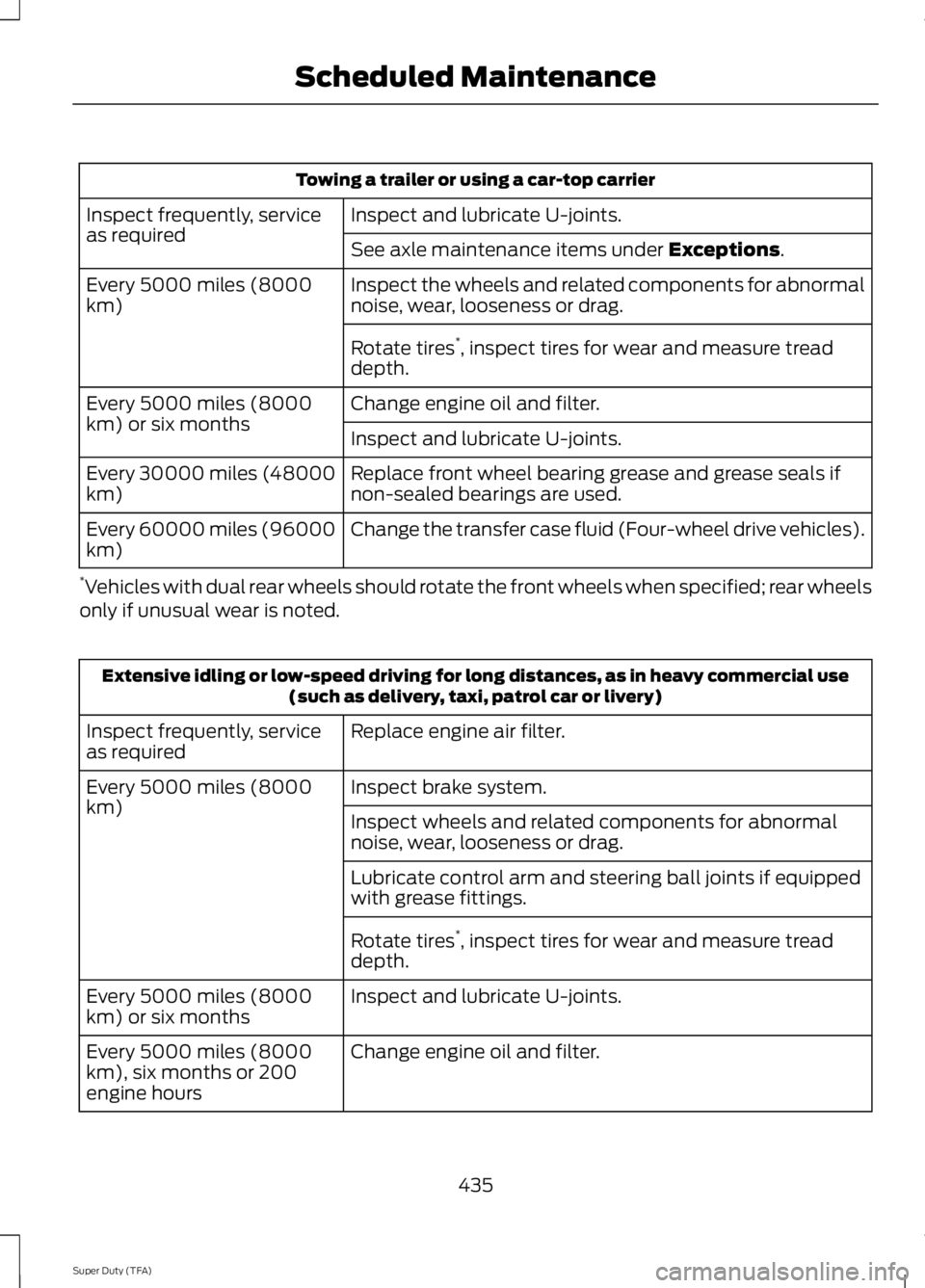
Towing a trailer or using a car-top carrier
Inspect and lubricate U-joints.
Inspect frequently, service
as required
See axle maintenance items under Exceptions.
Inspect the wheels and related components for abnormal
noise, wear, looseness or drag.
Every 5000 miles (8000
km)
Rotate tires*
, inspect tires for wear and measure tread
depth.
Change engine oil and filter.
Every 5000 miles (8000
km) or six months
Inspect and lubricate U-joints.
Replace front wheel bearing grease and grease seals if
non-sealed bearings are used.
Every 30000 miles (48000
km)
Change the transfer case fluid (Four-wheel drive vehicles).
Every 60000 miles (96000
km)
* Vehicles with dual rear wheels should rotate the front wheels when specified; rear wheels
only if unusual wear is noted. Extensive idling or low-speed driving for long distances, as in heavy commercial use
(such as delivery, taxi, patrol car or livery)
Replace engine air filter.
Inspect frequently, service
as required
Inspect brake system.
Every 5000 miles (8000
km)
Inspect wheels and related components for abnormal
noise, wear, looseness or drag.
Lubricate control arm and steering ball joints if equipped
with grease fittings.
Rotate tires*
, inspect tires for wear and measure tread
depth.
Inspect and lubricate U-joints.
Every 5000 miles (8000
km) or six months
Change engine oil and filter.
Every 5000 miles (8000
km), six months or 200
engine hours
435
Super Duty (TFA) Scheduled Maintenance
Page 439 of 460
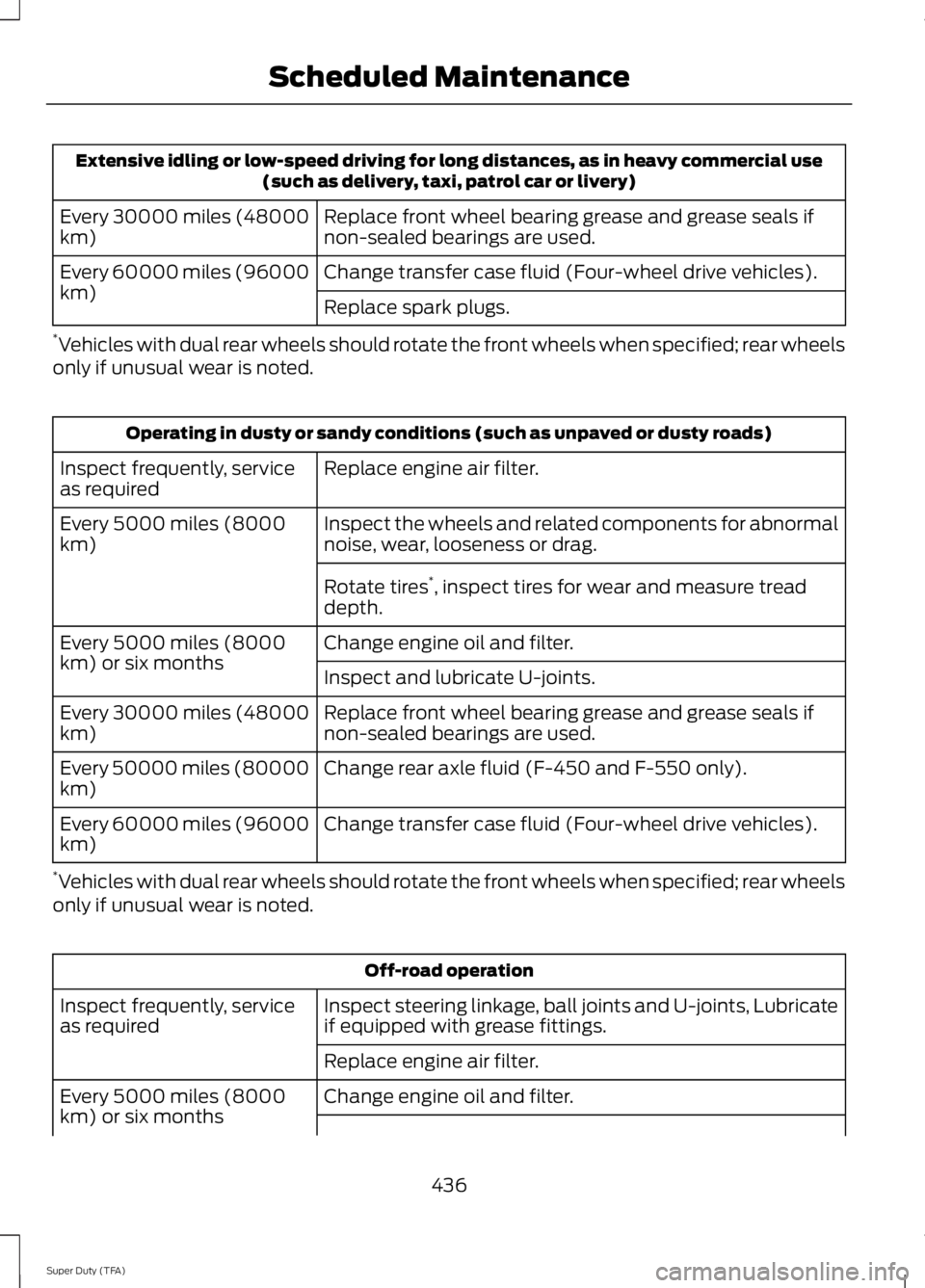
Extensive idling or low-speed driving for long distances, as in heavy commercial use
(such as delivery, taxi, patrol car or livery)
Replace front wheel bearing grease and grease seals if
non-sealed bearings are used.
Every 30000 miles (48000
km)
Change transfer case fluid (Four-wheel drive vehicles).
Every 60000 miles (96000
km)
Replace spark plugs.
* Vehicles with dual rear wheels should rotate the front wheels when specified; rear wheels
only if unusual wear is noted. Operating in dusty or sandy conditions (such as unpaved or dusty roads)
Replace engine air filter.
Inspect frequently, service
as required
Inspect the wheels and related components for abnormal
noise, wear, looseness or drag.
Every 5000 miles (8000
km)
Rotate tires*
, inspect tires for wear and measure tread
depth.
Change engine oil and filter.
Every 5000 miles (8000
km) or six months
Inspect and lubricate U-joints.
Replace front wheel bearing grease and grease seals if
non-sealed bearings are used.
Every 30000 miles (48000
km)
Change rear axle fluid (F-450 and F-550 only).
Every 50000 miles (80000
km)
Change transfer case fluid (Four-wheel drive vehicles).
Every 60000 miles (96000
km)
* Vehicles with dual rear wheels should rotate the front wheels when specified; rear wheels
only if unusual wear is noted. Off-road operation
Inspect steering linkage, ball joints and U-joints, Lubricate
if equipped with grease fittings.
Inspect frequently, service
as required
Replace engine air filter.
Change engine oil and filter.
Every 5000 miles (8000
km) or six months
436
Super Duty (TFA) Scheduled Maintenance
Page 440 of 460
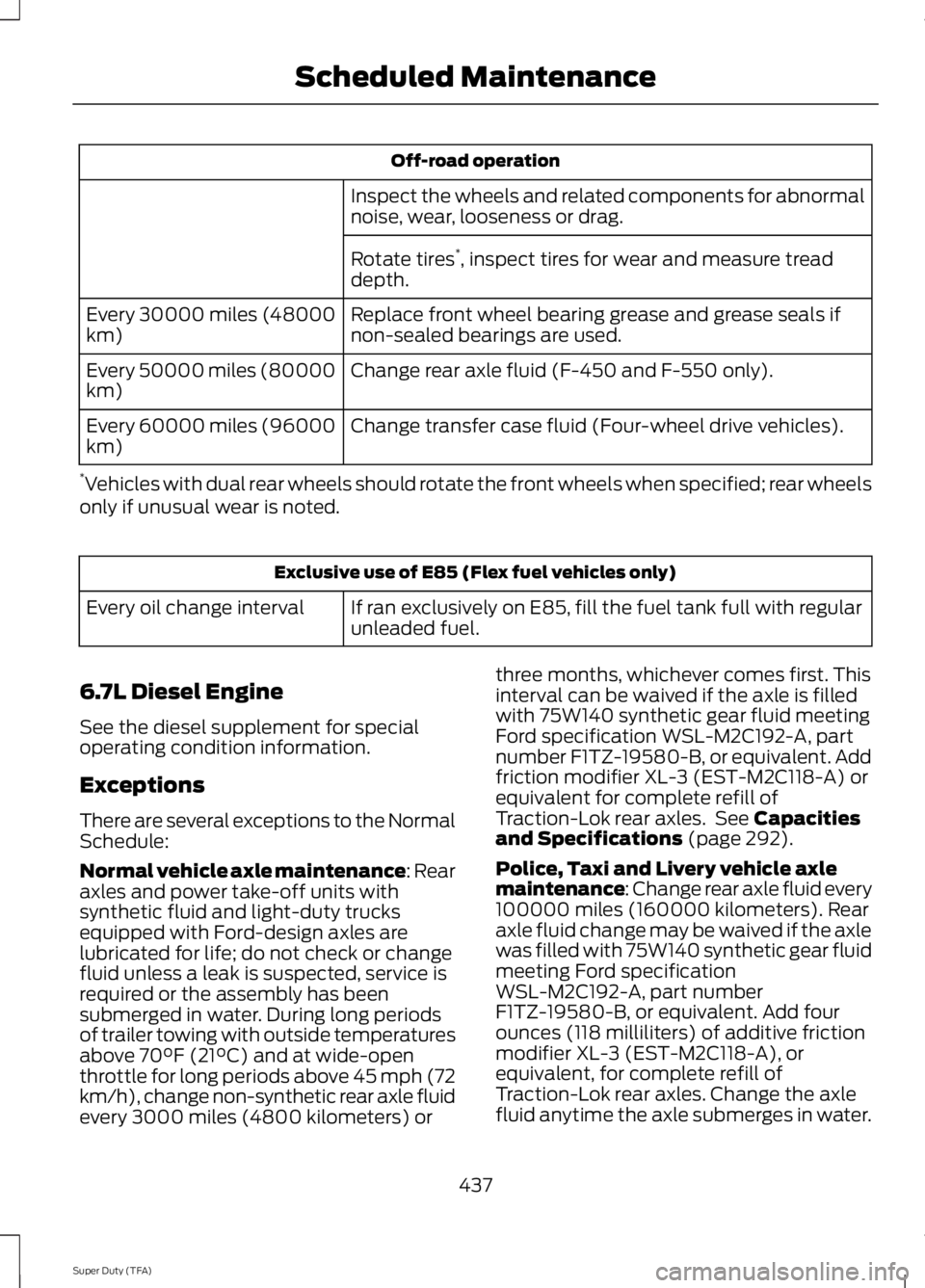
Off-road operation
Inspect the wheels and related components for abnormal
noise, wear, looseness or drag.
Rotate tires *
, inspect tires for wear and measure tread
depth.
Replace front wheel bearing grease and grease seals if
non-sealed bearings are used.
Every 30000 miles (48000
km)
Change rear axle fluid (F-450 and F-550 only).
Every 50000 miles (80000
km)
Change transfer case fluid (Four-wheel drive vehicles).
Every 60000 miles (96000
km)
* Vehicles with dual rear wheels should rotate the front wheels when specified; rear wheels
only if unusual wear is noted. Exclusive use of E85 (Flex fuel vehicles only)
If ran exclusively on E85, fill the fuel tank full with regular
unleaded fuel.
Every oil change interval
6.7L Diesel Engine
See the diesel supplement for special
operating condition information.
Exceptions
There are several exceptions to the Normal
Schedule:
Normal vehicle axle maintenance: Rear
axles and power take-off units with
synthetic fluid and light-duty trucks
equipped with Ford-design axles are
lubricated for life; do not check or change
fluid unless a leak is suspected, service is
required or the assembly has been
submerged in water. During long periods
of trailer towing with outside temperatures
above 70°F (21°C) and at wide-open
throttle for long periods above 45 mph (72
km/h), change non-synthetic rear axle fluid
every 3000 miles (4800 kilometers) or three months, whichever comes first. This
interval can be waived if the axle is filled
with 75W140 synthetic gear fluid meeting
Ford specification WSL-M2C192-A, part
number F1TZ-19580-B, or equivalent. Add
friction modifier XL-3 (EST-M2C118-A) or
equivalent for complete refill of
Traction-Lok rear axles. See Capacities
and Specifications (page 292).
Police, Taxi and Livery vehicle axle
maintenance: Change rear axle fluid every
100000 miles (160000 kilometers). Rear
axle fluid change may be waived if the axle
was filled with 75W140 synthetic gear fluid
meeting Ford specification
WSL-M2C192-A, part number
F1TZ-19580-B, or equivalent. Add four
ounces (118 milliliters) of additive friction
modifier XL-3 (EST-M2C118-A), or
equivalent, for complete refill of
Traction-Lok rear axles. Change the axle
fluid anytime the axle submerges in water.
437
Super Duty (TFA) Scheduled Maintenance
Page 457 of 460
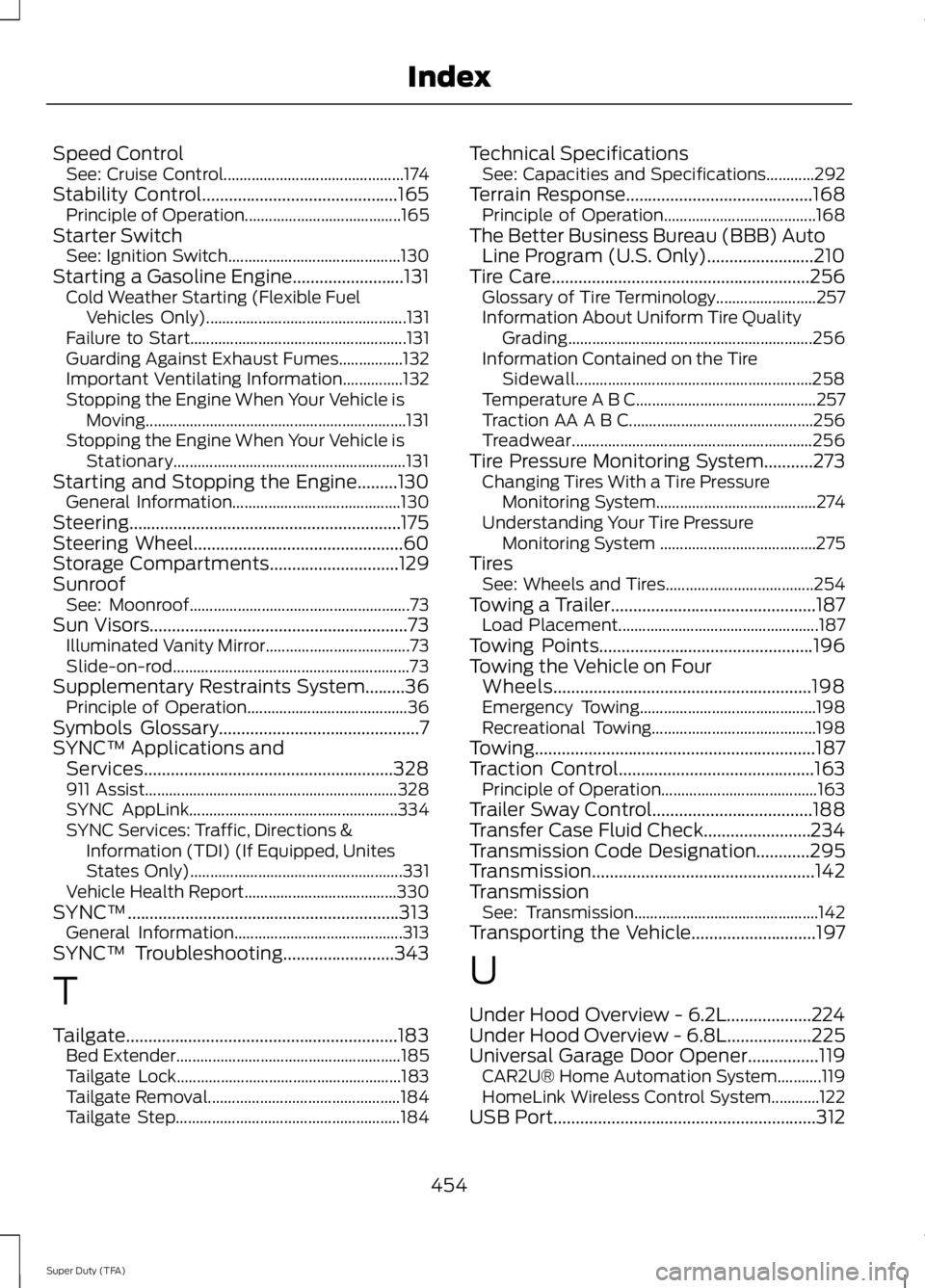
Speed Control
See: Cruise Control............................................. 174
Stability Control............................................165 Principle of Operation....................................... 165
Starter Switch See: Ignition Switch........................................... 130
Starting a Gasoline Engine.........................131 Cold Weather Starting (Flexible Fuel
Vehicles Only).................................................. 131
Failure to Start...................................................... 131
Guarding Against Exhaust Fumes................132
Important Ventilating Information...............132
Stopping the Engine When Your Vehicle is Moving................................................................. 131
Stopping the Engine When Your Vehicle is Stationary.......................................................... 131
Starting and Stopping the Engine.........130
General Information.......................................... 130
Steering.............................................................175
Steering Wheel
...............................................60
Storage Compartments.............................129
Sunroof See: Moonroof....................................................... 73
Sun Visors
..........................................................73
Illuminated Vanity Mirror.................................... 73
Slide-on-rod........................................................... 73
Supplementary Restraints System.........36 Principle of Operation........................................ 36
Symbols Glossary
.............................................7
SYNC™ Applications and Services........................................................328
911 Assist............................................................... 328
SYNC AppLink.................................................... 334
SYNC Services: Traffic, Directions & Information (TDI) (If Equipped, Unites
States Only)..................................................... 331
Vehicle Health Report...................................... 330
SYNC™.............................................................313 General Information.......................................... 313
SYNC™ Troubleshooting
.........................343
T
Tailgate.............................................................183 Bed Extender........................................................ 185
Tailgate Lock........................................................ 183
Tailgate Removal................................................ 184
Tailgate Step........................................................ 184Technical Specifications
See: Capacities and Specifications............292
Terrain Response
..........................................168
Principle of Operation...................................... 168
The Better Business Bureau (BBB) Auto Line Program (U.S. Only)........................210
Tire Care
..........................................................256
Glossary of Tire Terminology......................... 257
Information About Uniform Tire Quality Grading............................................................. 256
Information Contained on the Tire Sidewall........................................................... 258
Temperature A B C............................................. 257
Traction AA A B C.............................................. 256
Treadwear............................................................ 256
Tire Pressure Monitoring System...........273 Changing Tires With a Tire Pressure
Monitoring System........................................ 274
Understanding Your Tire Pressure Monitoring System ....................................... 275
Tires See: Wheels and Tires..................................... 254
Towing a Trailer..............................................187 Load Placement.................................................. 187
Towing Points
................................................196
Towing the Vehicle on Four Wheels..........................................................198
Emergency Towing............................................ 198
Recreational Towing......................................... 198
Towing...............................................................187
Traction Control
............................................163
Principle of Operation....................................... 163
Trailer Sway Control....................................188
Transfer Case Fluid Check........................234
Transmission Code Designation............295
Transmission..................................................142
Transmission See: Transmission.............................................. 142
Transporting the Vehicle............................197
U
Under Hood Overview - 6.2L...................224
Under Hood Overview - 6.8L...................225
Universal Garage Door Opener
................119
CAR2U® Home Automation System...........119
HomeLink Wireless Control System............122
USB Port
...........................................................312
454
Super Duty (TFA) Index
Page 458 of 460
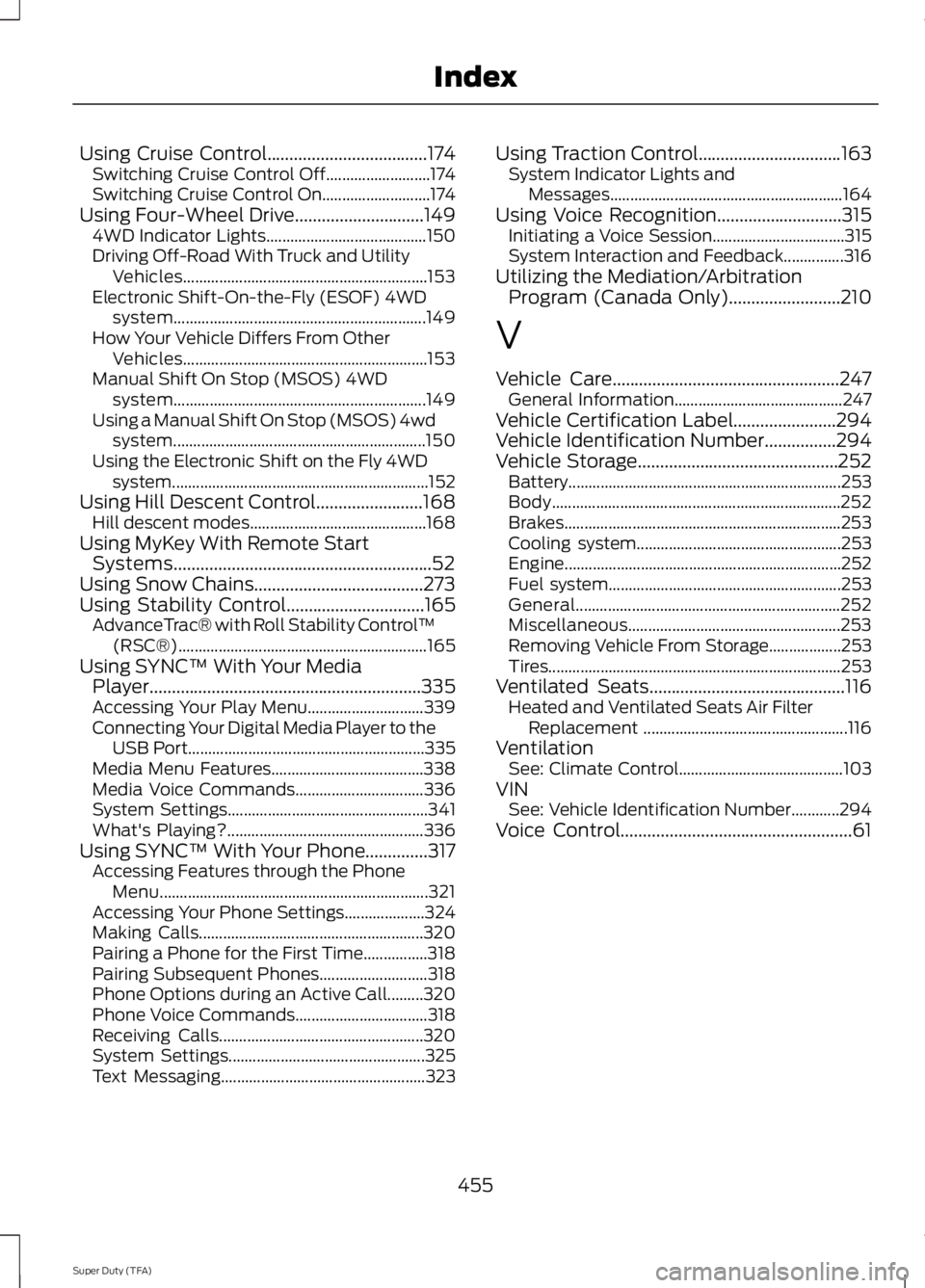
Using Cruise Control....................................174
Switching Cruise Control Off.......................... 174
Switching Cruise Control On........................... 174
Using Four-Wheel Drive.............................149 4WD Indicator Lights........................................ 150
Driving Off-Road With Truck and Utility Vehicles............................................................. 153
Electronic Shift-On-the-Fly (ESOF) 4WD system............................................................... 149
How Your Vehicle Differs From Other Vehicles............................................................. 153
Manual Shift On Stop (MSOS) 4WD system............................................................... 149
Using a Manual Shift On Stop (MSOS) 4wd system............................................................... 150
Using the Electronic Shift on the Fly 4WD system................................................................ 152
Using Hill Descent Control........................168 Hill descent modes............................................ 168
Using MyKey With Remote Start Systems..........................................................52
Using Snow Chains......................................273
Using Stability Control...............................165
AdvanceTrac® with Roll Stability Control ™
(RSC®).............................................................. 165
Using SYNC™ With Your Media Player.............................................................335
Accessing Your Play Menu............................. 339
Connecting Your Digital Media Player to the USB Port........................................................... 335
Media Menu Features...................................... 338
Media Voice Commands................................ 336
System Settings.................................................. 341
What's Playing?................................................. 336
Using SYNC™ With Your Phone..............317 Accessing Features through the Phone
Menu................................................................... 321
Accessing Your Phone Settings.................... 324
Making Calls........................................................ 320
Pairing a Phone for the First Time................318
Pairing Subsequent Phones........................... 318
Phone Options during an Active Call.........320
Phone Voice Commands................................. 318
Receiving Calls................................................... 320
System Settings................................................. 325
Text Messaging................................................... 323Using Traction Control
................................163
System Indicator Lights and
Messages.......................................................... 164
Using Voice Recognition
............................315
Initiating a Voice Session................................. 315
System Interaction and Feedback...............316
Utilizing the Mediation/Arbitration Program (Canada Only).........................210
V
Vehicle Care
...................................................247
General Information.......................................... 247
Vehicle Certification Label
.......................294
Vehicle Identification Number................294
Vehicle Storage.............................................252 Battery.................................................................... 253
Body........................................................................\
252
Brakes..................................................................... 253
Cooling system................................................... 253
Engine..................................................................... 252
Fuel system.......................................................... 253
General.................................................................. 252
Miscellaneous..................................................... 253
Removing Vehicle From Storage.................. 253
Tires........................................................................\
. 253
Ventilated Seats
............................................116
Heated and Ventilated Seats Air Filter
Replacement ................................................... 116
Ventilation See: Climate Control......................................... 103
VIN See: Vehicle Identification Number............294
Voice Control....................................................61
455
Super Duty (TFA) Index