lock FORD F350 1999 Owner's Guide
[x] Cancel search | Manufacturer: FORD, Model Year: 1999, Model line: F350, Model: FORD F350 1999Pages: 248, PDF Size: 1.72 MB
Page 119 of 248
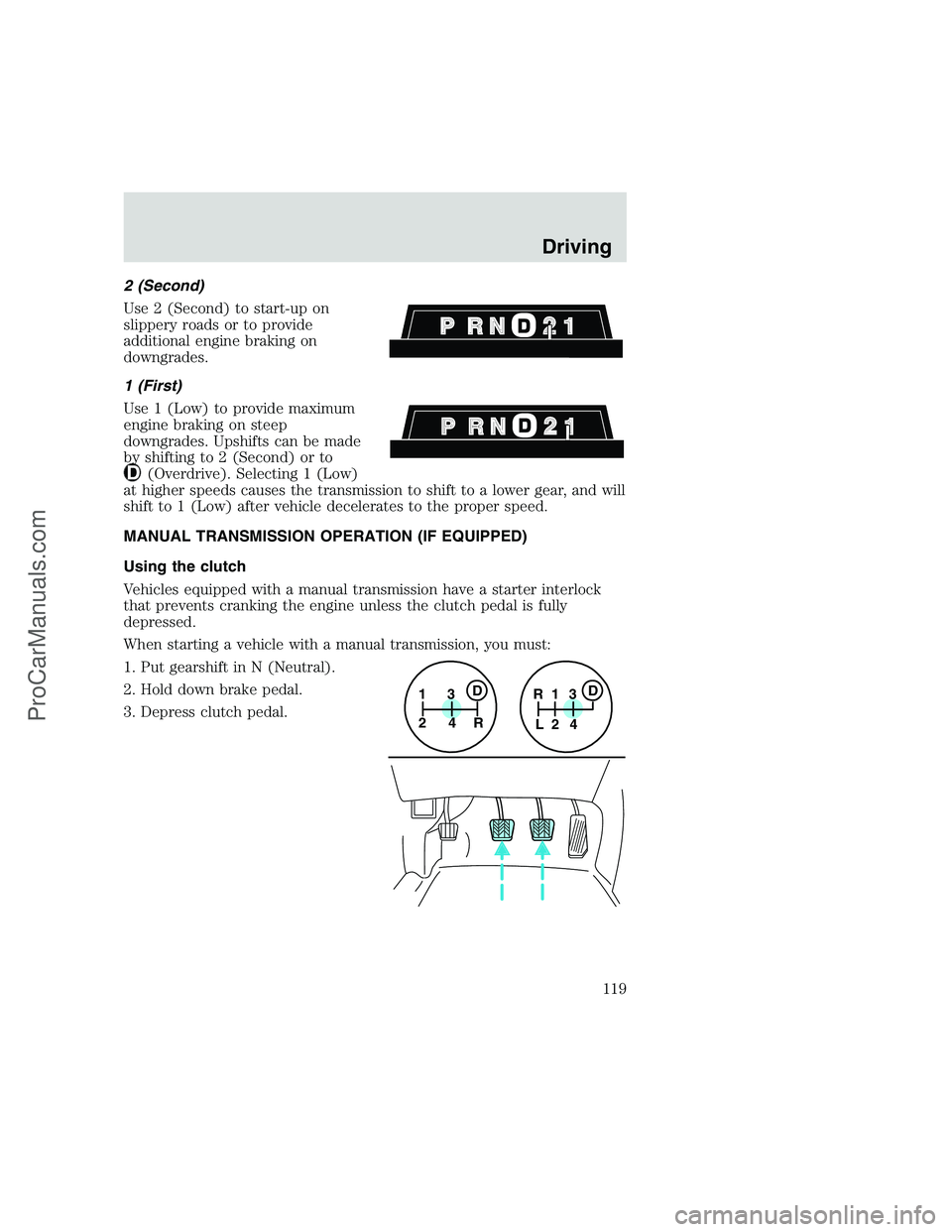
2 (Second)
Use 2 (Second) to start-up on
slippery roads or to provide
additional engine braking on
downgrades.
1 (First)
Use 1 (Low) to provide maximum
engine braking on steep
downgrades. Upshifts can be made
by shifting to 2 (Second) or to
(Overdrive). Selecting 1 (Low)
at higher speeds causes the transmission to shift to a lower gear, and will
shift to 1 (Low) after vehicle decelerates to the proper speed.
MANUAL TRANSMISSION OPERATION (IF EQUIPPED)
Using the clutch
Vehicles equipped with a manual transmission have a starter interlock
that prevents cranking the engine unless the clutch pedal is fully
depressed.
When starting a vehicle with a manual transmission, you must:
1. Put gearshift in N (Neutral).
2. Hold down brake pedal.
3. Depress clutch pedal.
1
24R3D1
24 R
L3D
Driving
119
ProCarManuals.com
Page 123 of 248
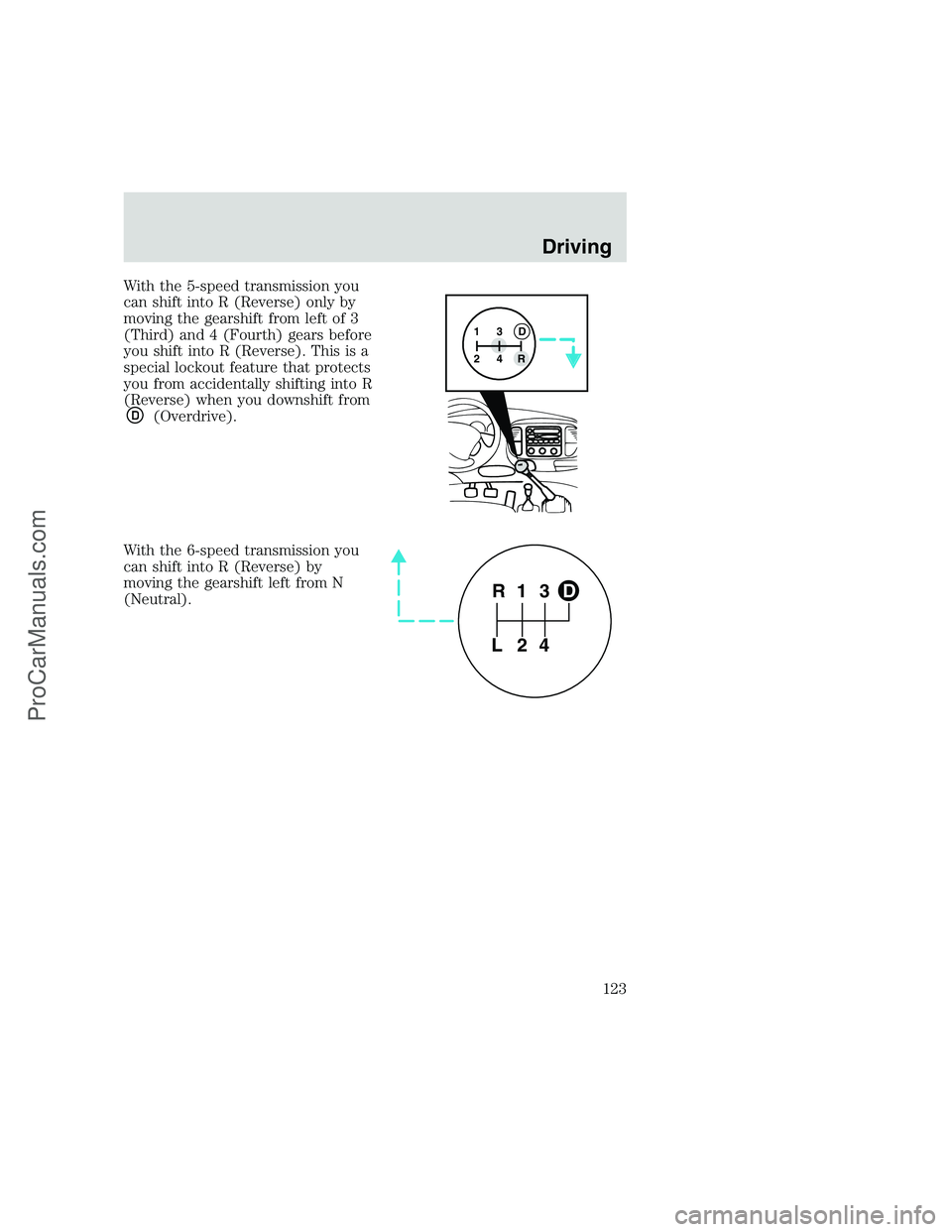
With the 5-speed transmission you
can shift into R (Reverse) only by
moving the gearshift from left of 3
(Third) and 4 (Fourth) gears before
you shift into R (Reverse). This is a
special lockout feature that protects
you from accidentally shifting into R
(Reverse) when you downshift from
D(Overdrive).
With the 6-speed transmission you
can shift into R (Reverse) by
moving the gearshift left from N
(Neutral).
13
24RD
R1
L3
4 2D
Driving
123
ProCarManuals.com
Page 125 of 248
FOUR-WHEEL DRIVE (4WD) OPERATION (IF EQUIPPED)
When Four–wheel drive (4WD) is engaged, power is supplied to all four
wheels through a transfer case. 4WD power can be selected when
additional driving power is desired.
If equipped with the Electronic Shift 4WD System, and the
instrument panel control is moved to 4WD Low while the vehicle
is moving, the system will not engage and no damage will occur to
the 4WD system.
All utility-type vehicles and 4WD vehicles have special design and
equipment features to make them capable of performing in a wide
variety of off-road applications. Specific design characteristics give them
higher centers of gravity than ordinary passenger cars.
Utility and four-wheel drive vehicles arenotdesigned for
cornering at speeds as high as passenger cars any more than
low-slung sports cars are designed to perform satisfactorily under
off-road conditions. Avoid sharp turns or abrupt maneuvers in these
vehicles.
4WD operation is not recommended on dry pavement. Doing so could
result in difficult disengagement of the transfer case, increased tire wear
and decreased fuel economy.
Electronic shift on the fly (ESOF) 4x4 system (if equipped)
The 4WD system:
•provides 4x4 High engagement and disengagement while the vehicle is
moving.
•is operated by a rotary control located on the instrument panel that
allows you select 2WD, 4x4 High or 4x4 Low operation.
•uses hub locks that can be engaged and disengaged automatically by
using a rotary control located on the instrument panel.
Driving
125
ProCarManuals.com
Page 126 of 248
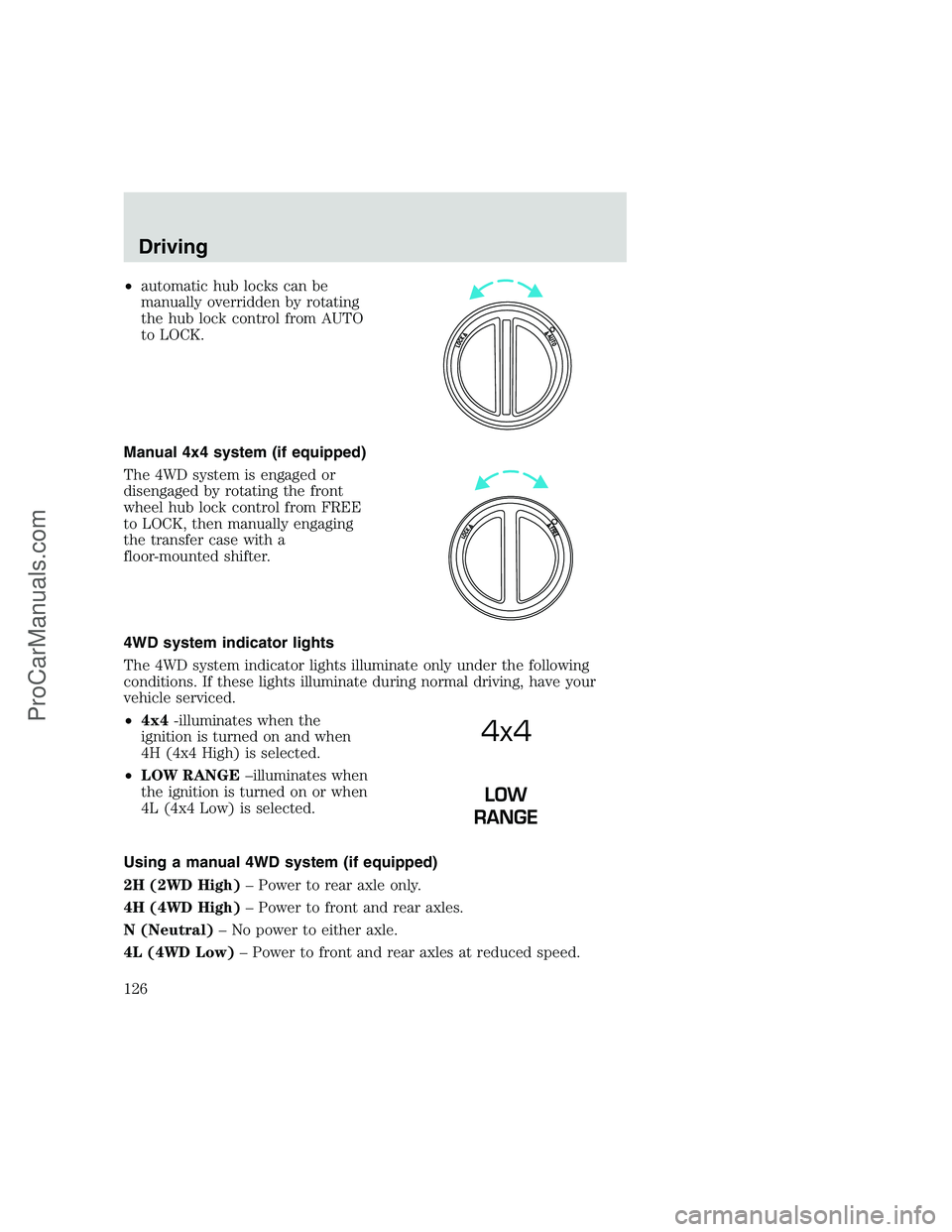
•automatic hub locks can be
manually overridden by rotating
the hub lock control from AUTO
to LOCK.
Manual 4x4 system (if equipped)
The 4WD system is engaged or
disengaged by rotating the front
wheel hub lock control from FREE
to LOCK, then manually engaging
the transfer case with a
floor-mounted shifter.
4WD system indicator lights
The 4WD system indicator lights illuminate only under the following
conditions. If these lights illuminate during normal driving, have your
vehicle serviced.
•4x4-illuminates when the
ignition is turned on and when
4H (4x4 High) is selected.
•LOW RANGE–illuminates when
the ignition is turned on or when
4L (4x4 Low) is selected.
Using a manual 4WD system (if equipped)
2H (2WD High)– Power to rear axle only.
4H (4WD High)– Power to front and rear axles.
N (Neutral)– No power to either axle.
4L (4WD Low)– Power to front and rear axles at reduced speed.
4x4
Driving
126
ProCarManuals.com
Page 127 of 248
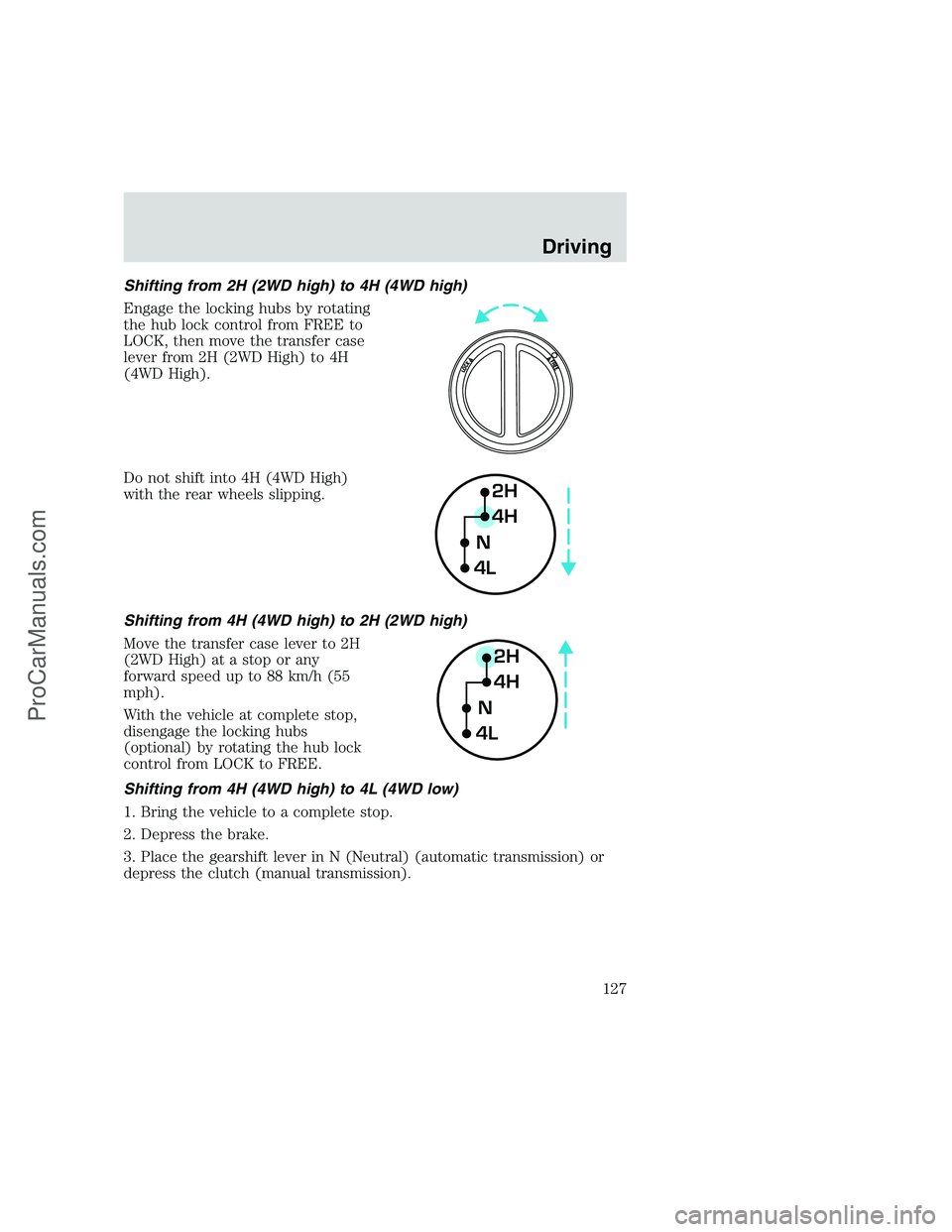
Shifting from 2H (2WD high) to 4H (4WD high)
Engage the locking hubs by rotating
the hub lock control from FREE to
LOCK, then move the transfer case
lever from 2H (2WD High) to 4H
(4WD High).
Do not shift into 4H (4WD High)
with the rear wheels slipping.
Shifting from 4H (4WD high) to 2H (2WD high)
Move the transfer case lever to 2H
(2WD High) at a stop or any
forward speed up to 88 km/h (55
mph).
With the vehicle at complete stop,
disengage the locking hubs
(optional) by rotating the hub lock
control from LOCK to FREE.
Shifting from 4H (4WD high) to 4L (4WD low)
1. Bring the vehicle to a complete stop.
2. Depress the brake.
3. Place the gearshift lever in N (Neutral) (automatic transmission) or
depress the clutch (manual transmission).
2H
4H
4LN
2H
4H
4LN
Driving
127
ProCarManuals.com
Page 132 of 248
If vehicle speed drops more than 16 km/h (10 mph), the speed control
will cancel automatically. Resume speed with accelerator pedal.
If speed control cancels after climbing the hill, reset speed by pressing
and holding the SET ACCEL button to resume speeds over 50 km/h
(30 mph).
Automatic transmissions may shift frequently while driving up steep
grades. Eliminate frequent shifting by shifting out of
(Overdrive) into
a lower gear.
Driving on snow and ice
A 4WD vehicle has advantages over 2WD vehicles in snow and ice but
can skid like any other vehicle.
Avoid sudden applications of power and quick changes of direction on
snow and ice. Apply the accelerator slowly and steadily when starting
from a full stop.
If your vehicle is equipped with a Rear Anti-lock Brake System (RABS),
you should be careful when braking. Front brake lock-up, on any surface,
causes loss of steering control.
If your vehicle is equipped with a Four Wheel Anti-lock Brake System
(ABS), apply the brakes as you normally would. In order to allow the
ABS to operate properly, keep steady pressure on the brake pedal.
When driving on snow or ice with either braking system, allow more
stopping distance and drive slower than usual. Consider using one of the
lower gears.
VEHICLE LOADING
Before loading a vehicle, familiarize yourself with the following terms:
•Base Curb Weight: Weight of the vehicle including any standard
equipment, fluids, lubricants, etc. It does not include passengers or
aftermarket equipment.
•Payload: Combined maximum allowable weight of cargo, passengers
and optional equipment. The payload equals the gross vehicle weight
rating minus base curb weight.
•GVW (Gross Vehicle Weight): Base curb weight plus payload
weight. The GVW is not a limit or a specification.
Driving
132
ProCarManuals.com
Page 146 of 248
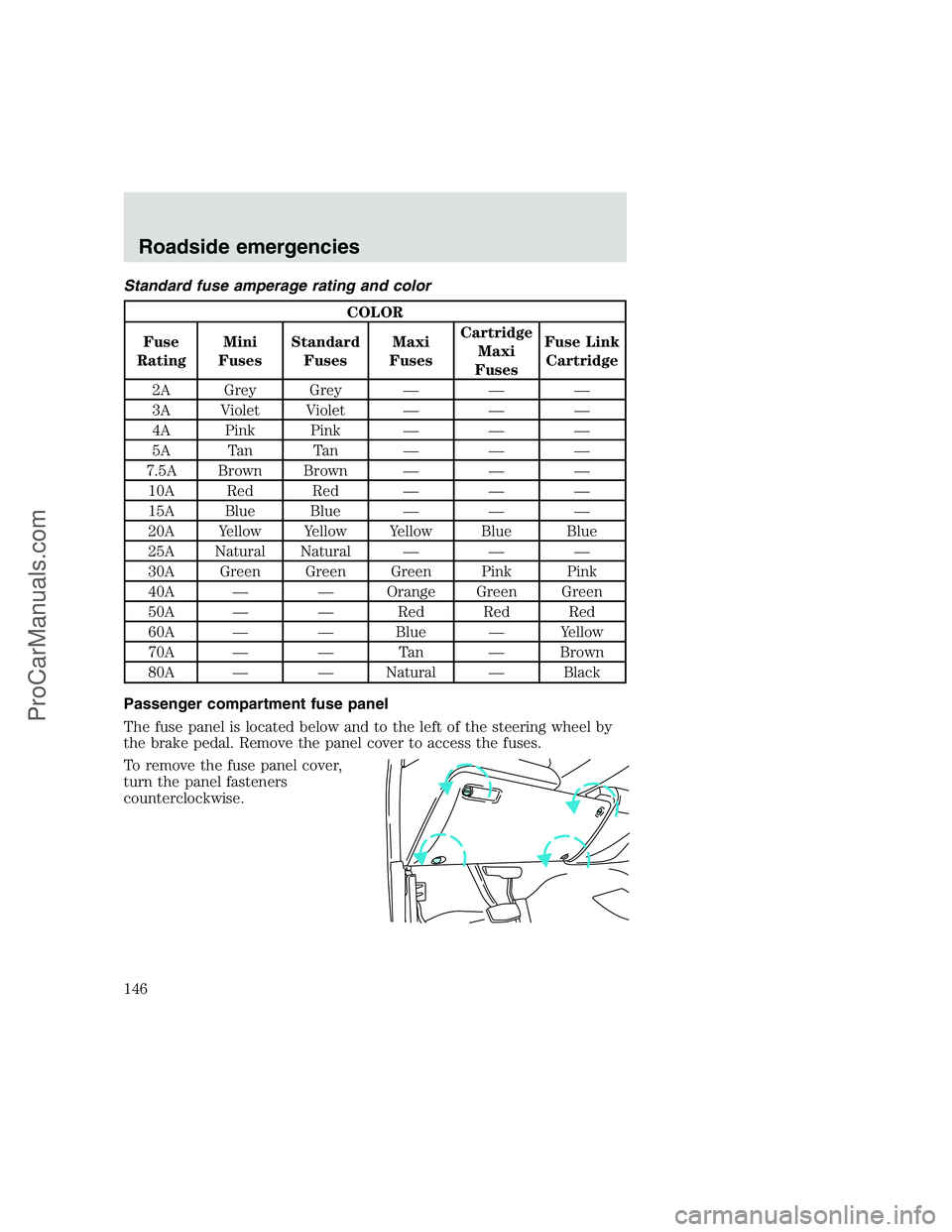
Standard fuse amperage rating and color
COLOR
Fuse
RatingMini
FusesStandard
FusesMaxi
FusesCartridge
Maxi
FusesFuse Link
Cartridge
2A Grey Grey — — —
3A Violet Violet — — —
4A Pink Pink — — —
5A Tan Tan — — —
7.5A Brown Brown — — —
10A Red Red — — —
15A Blue Blue — — —
20A Yellow Yellow Yellow Blue Blue
25A Natural Natural — — —
30A Green Green Green Pink Pink
40A — — Orange Green Green
50A — — Red Red Red
60A — — Blue — Yellow
70A — — Tan — Brown
80A — — Natural — Black
Passenger compartment fuse panel
The fuse panel is located below and to the left of the steering wheel by
the brake pedal. Remove the panel cover to access the fuses.
To remove the fuse panel cover,
turn the panel fasteners
counterclockwise.
Roadside emergencies
146
ProCarManuals.com
Page 147 of 248
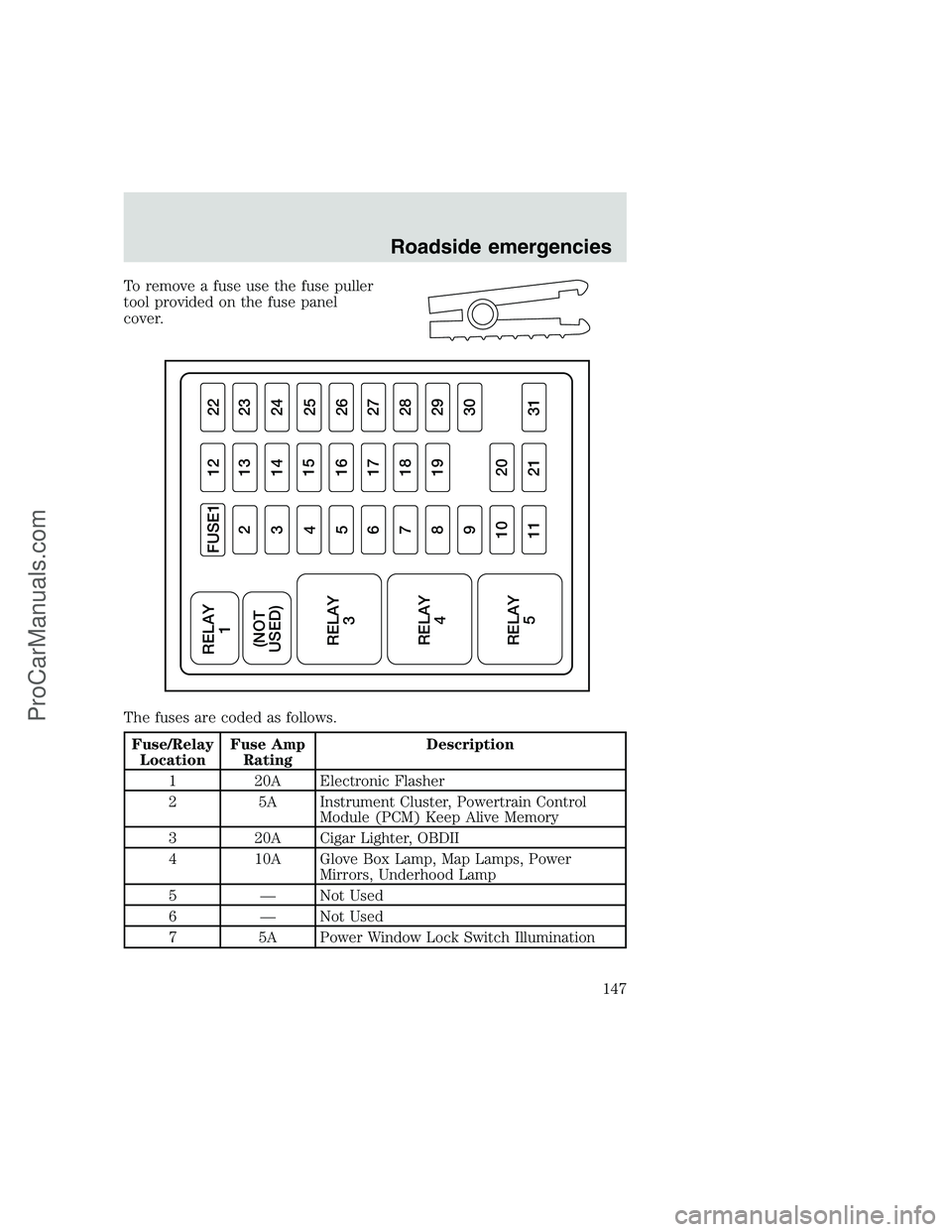
To remove a fuse use the fuse puller
tool provided on the fuse panel
cover.
The fuses are coded as follows.
Fuse/Relay
LocationFuse Amp
RatingDescription
1 20A Electronic Flasher
2 5A Instrument Cluster, Powertrain Control
Module (PCM) Keep Alive Memory
3 20A Cigar Lighter, OBDII
4 10A Glove Box Lamp, Map Lamps, Power
Mirrors, Underhood Lamp
5 — Not Used
6 — Not Used
7 5A Power Window Lock Switch Illumination
FUSE1 RELAY
1
RELAY
3 (NOT
USED)
RELAY
4
RELAY
512 22
21323
31424
4
16 15
25
526
61727
71828
81929
11 21 31930
10 20
Roadside emergencies
147
ProCarManuals.com
Page 148 of 248
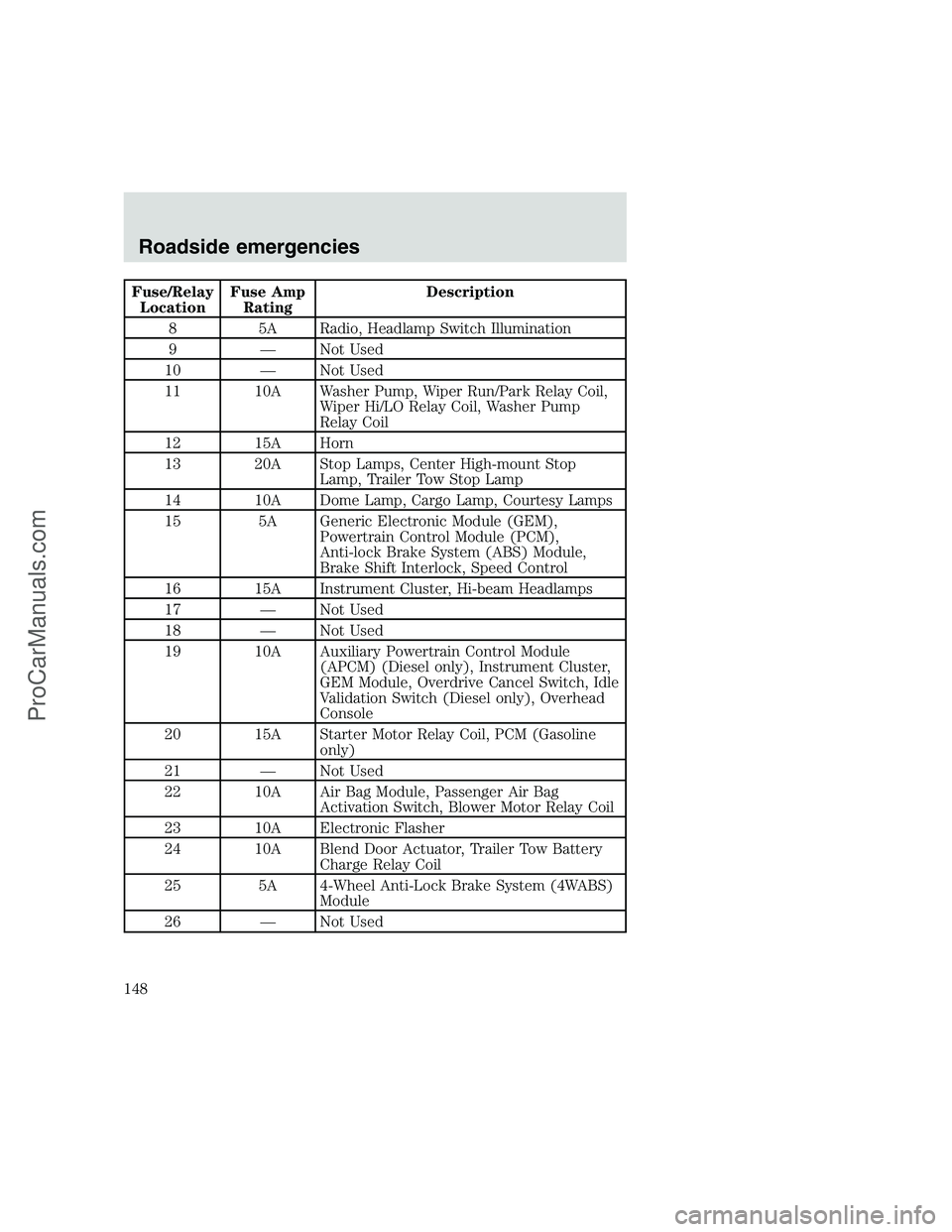
Fuse/Relay
LocationFuse Amp
RatingDescription
8 5A Radio, Headlamp Switch Illumination
9 — Not Used
10 — Not Used
11 10A Washer Pump, Wiper Run/Park Relay Coil,
Wiper Hi/LO Relay Coil, Washer Pump
Relay Coil
12 15A Horn
13 20A Stop Lamps, Center High-mount Stop
Lamp, Trailer Tow Stop Lamp
14 10A Dome Lamp, Cargo Lamp, Courtesy Lamps
15 5A Generic Electronic Module (GEM),
Powertrain Control Module (PCM),
Anti-lock Brake System (ABS) Module,
Brake Shift Interlock, Speed Control
16 15A Instrument Cluster, Hi-beam Headlamps
17 — Not Used
18 — Not Used
19 10A Auxiliary Powertrain Control Module
(APCM) (Diesel only), Instrument Cluster,
GEM Module, Overdrive Cancel Switch, Idle
Validation Switch (Diesel only), Overhead
Console
20 15A Starter Motor Relay Coil, PCM (Gasoline
only)
21 — Not Used
22 10A Air Bag Module, Passenger Air Bag
Activation Switch, Blower Motor Relay Coil
23 10A Electronic Flasher
24 10A Blend Door Actuator, Trailer Tow Battery
Charge Relay Coil
25 5A 4-Wheel Anti-Lock Brake System (4WABS)
Module
26 — Not Used
Roadside emergencies
148
ProCarManuals.com
Page 149 of 248
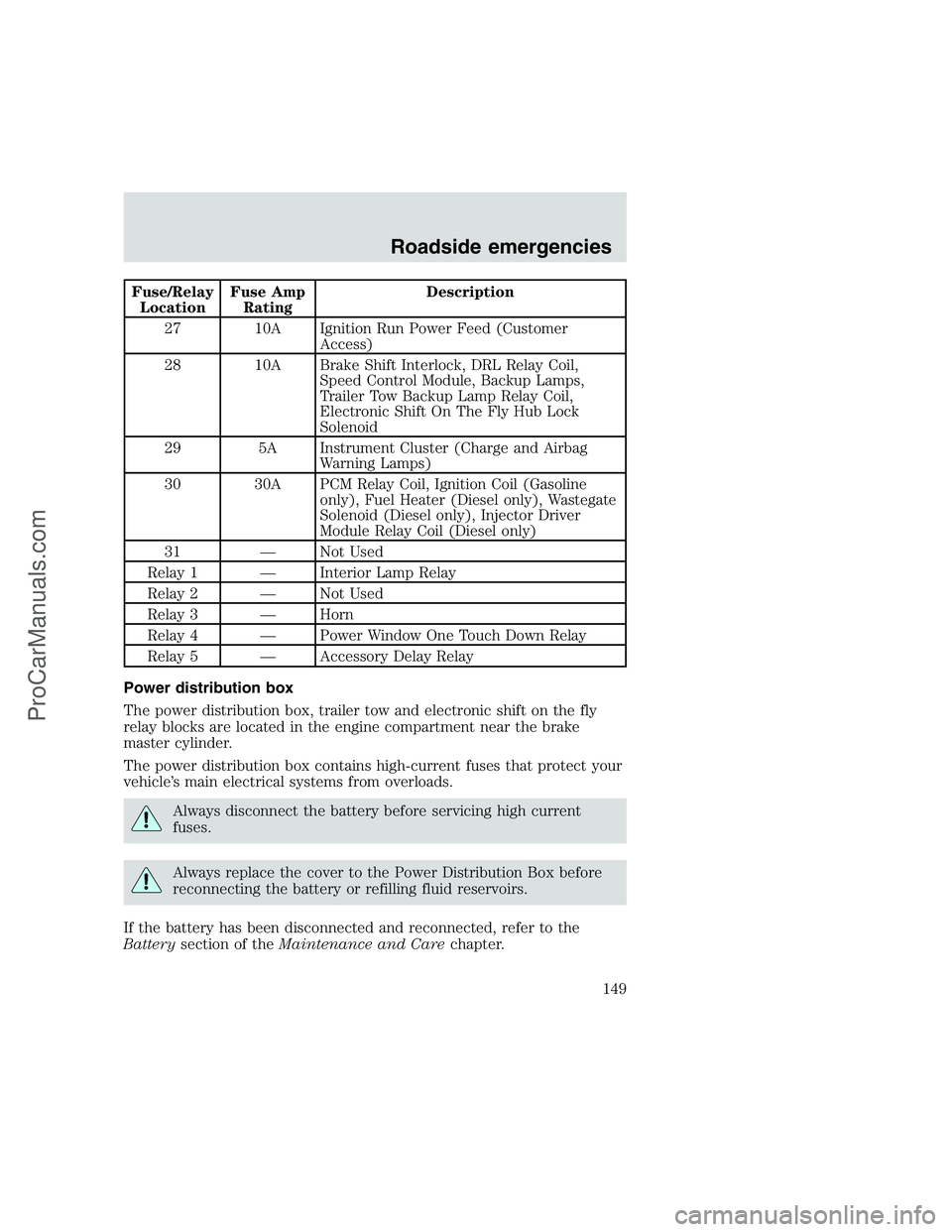
Fuse/Relay
LocationFuse Amp
RatingDescription
27 10A Ignition Run Power Feed (Customer
Access)
28 10A Brake Shift Interlock, DRL Relay Coil,
Speed Control Module, Backup Lamps,
Trailer Tow Backup Lamp Relay Coil,
Electronic Shift On The Fly Hub Lock
Solenoid
29 5A Instrument Cluster (Charge and Airbag
Warning Lamps)
30 30A PCM Relay Coil, Ignition Coil (Gasoline
only), Fuel Heater (Diesel only), Wastegate
Solenoid (Diesel only), Injector Driver
Module Relay Coil (Diesel only)
31 — Not Used
Relay 1 — Interior Lamp Relay
Relay 2 — Not Used
Relay 3 — Horn
Relay 4 — Power Window One Touch Down Relay
Relay 5 — Accessory Delay Relay
Power distribution box
The power distribution box, trailer tow and electronic shift on the fly
relay blocks are located in the engine compartment near the brake
master cylinder.
The power distribution box contains high-current fuses that protect your
vehicle’s main electrical systems from overloads.
Always disconnect the battery before servicing high current
fuses.
Always replace the cover to the Power Distribution Box before
reconnecting the battery or refilling fluid reservoirs.
If the battery has been disconnected and reconnected, refer to the
Batterysection of theMaintenance and Carechapter.
Roadside emergencies
149
ProCarManuals.com