brakes FORD F350 2002 User Guide
[x] Cancel search | Manufacturer: FORD, Model Year: 2002, Model line: F350, Model: FORD F350 2002Pages: 264, PDF Size: 2.37 MB
Page 130 of 264
Special loading instructions for owners of pickup trucks and
utility-type vehicles
For important information regarding safe operation of this type
of vehicle, see thePreparing to drive your vehiclesection in
this chapter.
Loaded vehicles may handle differently than unloaded vehicles.
Extra precautions, such as slower speeds and increased stopping
distance, should be taken when driving a heavily loaded vehicle.
Your vehicle can haul more cargo and people than most passenger cars.
Depending upon the type and placement of the load, hauling cargo and
people may raise the center of gravity of the vehicle.
Calculating the load your vehicle can carry/tow
1. Use the appropriate maximum GCWR chart (in theTrailer Towing
section in this chapter) for your type of engine and rear axle ratio.
2. Weigh your vehicle without cargo. To obtain correct weights, take your
vehicle to a shipping company or an inspection station for trucks.
3. Subtract your loaded weight from the maximum GCWR in the chart.
This is the maximum trailer weight your vehicle can tow. It must be
below the maximum trailer weight shown in the chart.
TRAILER TOWING
Your vehicle may tow a Conventional/Class IV trailer or fifth wheel trailer
provided the maximum trailer weight is less than or equal to the
maximum trailer weight listed for your engine and rear axle ratio on the
following charts.
2nd unit bodies are not included in maximum trailer weight ratings. The
weight of the additional “body” must be subtracted from the maximum
trailer weight.
Your vehicle’s load capacity is designated by weight, not by volume, so
you cannot necessarily use all available space when loading a vehicle.
Towing a trailer places an additional load on your vehicle’s engine,
transmission, axle, brakes, tires and suspension. Inspect these
components carefully prior to and after any towing operation. The
following trailer towing charts apply to vehicles equipped with gasoline
engines; for Diesel engines, refer to the7.3 Liter Power Stroke Direct
Injection Turbo Diesel Supplement.
Driving
130
ProCarManuals.com
Page 151 of 264
Preparing to tow
Use the proper equipment for towing a trailer and make sure it is
properly attached to your vehicle. See your dealer or a reliable trailer
dealer if you require assistance.
Hitches
Do not use hitches that clamp onto the vehicle’s bumper or attach to the
axle. You must distribute the load in your trailer so that 10%–15% of the
total weight of the trailer is on the tongue.
Load equalizing hitch
When hooking up a trailer using a load equalizing hitch, always use the
following procedure:
1. Park the unloaded vehicle on a level surface. With the ignition on and
all doors closed, allow the vehicle to stand for several minutes so that it
can level.
2. Measure the height of a reference point on the front and rear bumpers
at the center of the vehicle.
3. Attach the trailer to the vehicle and adjust the hitch equalizers so that
the front bumper height is within 0–13 mm (0.5 in) of the reference
point. After proper adjustment, the rear bumper should be no higher
than in Step 2.
Note:Adjusting an equalizing hitch so the rear bumper of the vehicle is
higher than it was unloaded will defeat the function of the load
equalizing hitch and may cause unpredictable handling.
Safety chains
Always connect the trailer’s safety chains to the frame or hook retainers
of the vehicle hitch. To connect the trailer’s safety chains, cross the
chains under the trailer tongue and allow slack for turning corners.
If you use a rental trailer, follow the instructions that the rental agency
gives to you.
Do not attach safety chains to the bumper.
Trailer brakes
Electric brakes and manual, automatic or surge-type trailer brakes are
safe if installed properly and adjusted to the manufacturer’s
specifications. The trailer brakes must meet local and Federal
regulations.
Driving
151
ProCarManuals.com
Page 221 of 264
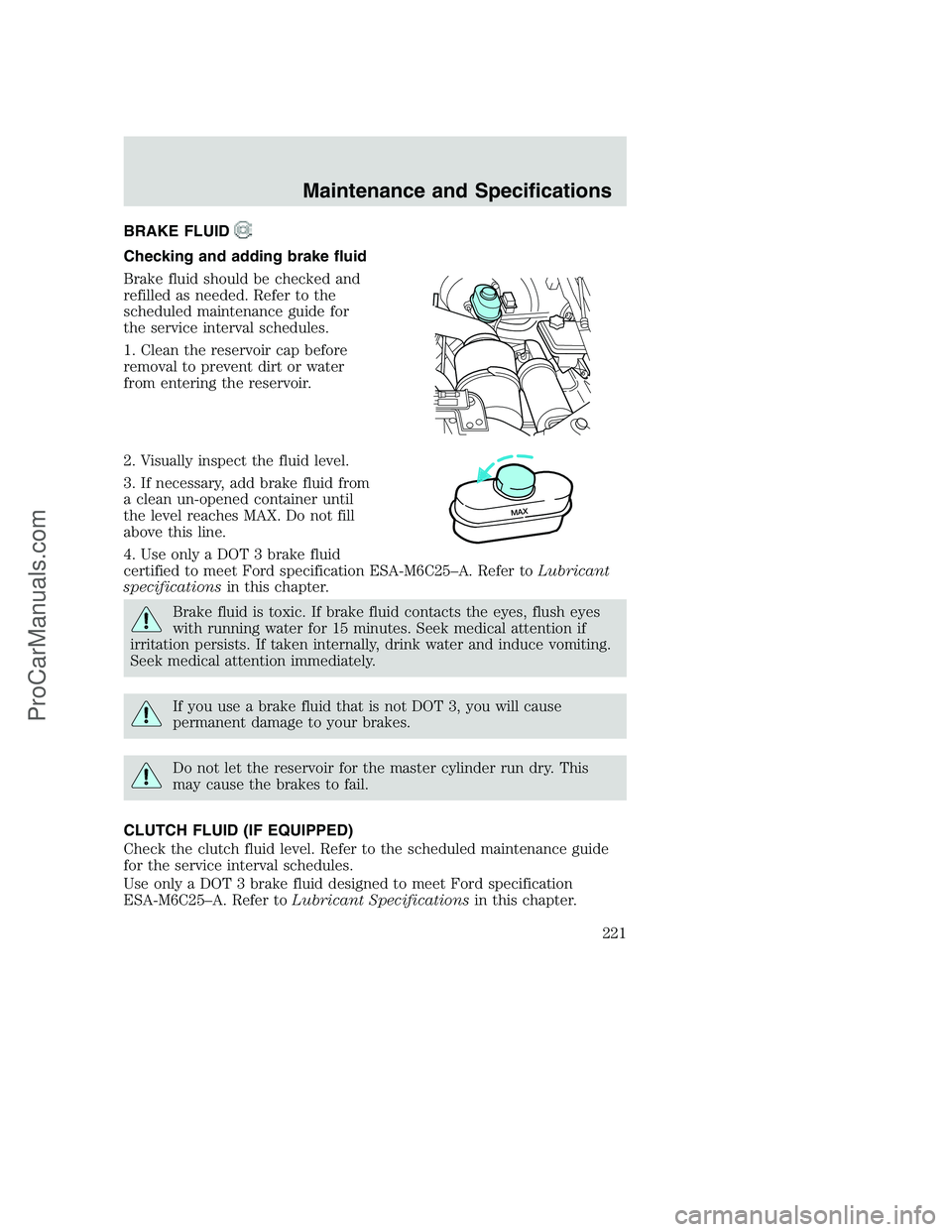
BRAKE FLUID
Checking and adding brake fluid
Brake fluid should be checked and
refilled as needed. Refer to the
scheduled maintenance guide for
the service interval schedules.
1. Clean the reservoir cap before
removal to prevent dirt or water
from entering the reservoir.
2. Visually inspect the fluid level.
3. If necessary, add brake fluid from
a clean un-opened container until
the level reaches MAX. Do not fill
above this line.
4. Use only a DOT 3 brake fluid
certified to meet Ford specification ESA-M6C25–A. Refer toLubricant
specificationsin this chapter.
Brake fluid is toxic. If brake fluid contacts the eyes, flush eyes
with running water for 15 minutes. Seek medical attention if
irritation persists. If taken internally, drink water and induce vomiting.
Seek medical attention immediately.
If you use a brake fluid that is not DOT 3, you will cause
permanent damage to your brakes.
Do not let the reservoir for the master cylinder run dry. This
may cause the brakes to fail.
CLUTCH FLUID (IF EQUIPPED)
Check the clutch fluid level. Refer to the scheduled maintenance guide
for the service interval schedules.
Use only a DOT 3 brake fluid designed to meet Ford specification
ESA-M6C25–A. Refer toLubricant Specificationsin this chapter.
M
A
X
Maintenance and Specifications
221
ProCarManuals.com
Page 255 of 264
A
Accessory delay ..........................48
Air bag supplemental restraint
system ..........................................82
and child safety seats ..............83
description ................................82
disposal ......................................86
driver air bag ............................84
indicator light ...........................85
operation ...................................84
passenger air bag .....................84
passenger deactivation
switch ........................................86
Air cleaner filter .......226–227, 234
Ambulance packages ....................6
Antifreeze
(see Engine coolant) ................204
Anti-lock brake system
(see Brakes) ......................106–107
Audio system
(see Radio) ................17, 19, 22, 26
Automatic transmission ............109
driving an automatic
overdrive .................................110
fluid, adding ............................222
fluid, checking ........................222
fluid, refill capacities ..............234
fluid, specification ..................240
Auxiliary power point .................47
Axle
lubricant specifications ..237, 240
refill capacities ........................234
traction lok ..............................108
B
Battery .......................................202
acid, treating emergencies .....202jumping a disabled battery ....174
maintenance-free ....................202
replacement, specifications ...234
servicing ..................................202
BeltMinder ...................................77
Brakes ........................................105
anti-lock ...........................105–107
anti-lock brake system (ABS)
warning light ...........................106
fluid, checking and adding ....221
fluid, refill capacities ..............234
fluid, specifications .........237, 240
lubricant specifications ..237, 240
parking ....................................107
pedals (see Power adjustable
foot pedals) ...............................49
shift interlock ..........................109
Break-in period .............................4
Bulbs ............................................39
C
Capacities for refilling fluids ....234
Cassette tape player ...................26
CD changer .................................28
CD-single premium .........17, 19, 22
Certification Label ....................249
Child safety restraints ................91
child safety belts ......................91
Child safety seats ........................93
attaching with tether straps ....97
in front seat ..............................95
in rear seat ................................95
Cleaning your vehicle
engine compartment ..............191
instrument panel ....................193
interior .....................................193
plastic parts ............................192
Index
255
ProCarManuals.com
Page 258 of 264
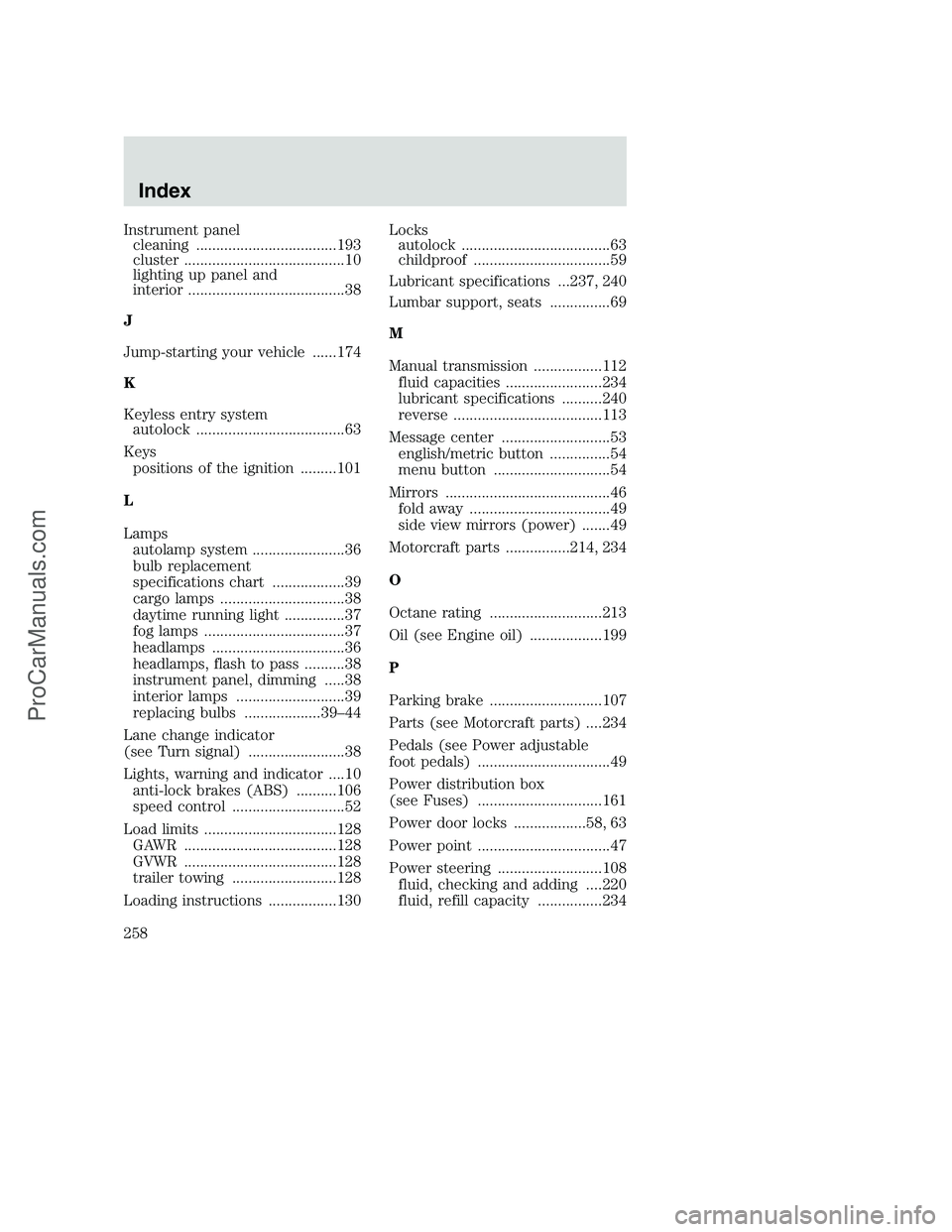
Instrument panel
cleaning ...................................193
cluster ........................................10
lighting up panel and
interior .......................................38
J
Jump-starting your vehicle ......174
K
Keyless entry system
autolock .....................................63
Keys
positions of the ignition .........101
L
Lamps
autolamp system .......................36
bulb replacement
specifications chart ..................39
cargo lamps ...............................38
daytime running light ...............37
fog lamps ...................................37
headlamps .................................36
headlamps, flash to pass ..........38
instrument panel, dimming .....38
interior lamps ...........................39
replacing bulbs ...................39–44
Lane change indicator
(see Turn signal) ........................38
Lights, warning and indicator ....10
anti-lock brakes (ABS) ..........106
speed control ............................52
Load limits .................................128
GAWR ......................................128
GVWR ......................................128
trailer towing ..........................128
Loading instructions .................130Locks
autolock .....................................63
childproof ..................................59
Lubricant specifications ...237, 240
Lumbar support, seats ...............69
M
Manual transmission .................112
fluid capacities ........................234
lubricant specifications ..........240
reverse .....................................113
Message center ...........................53
english/metric button ...............54
menu button .............................54
Mirrors .........................................46
fold away ...................................49
side view mirrors (power) .......49
Motorcraft parts ................214, 234
O
Octane rating ............................213
Oil (see Engine oil) ..................199
P
Parking brake ............................107
Parts (see Motorcraft parts) ....234
Pedals (see Power adjustable
foot pedals) .................................49
Power distribution box
(see Fuses) ...............................161
Power door locks ..................58, 63
Power point .................................47
Power steering ..........................108
fluid, checking and adding ....220
fluid, refill capacity ................234
Index
258
ProCarManuals.com