tires FORD F350 2003 Owner's Manual
[x] Cancel search | Manufacturer: FORD, Model Year: 2003, Model line: F350, Model: FORD F350 2003Pages: 280, PDF Size: 4.18 MB
Page 250 of 280
Tire inflation information
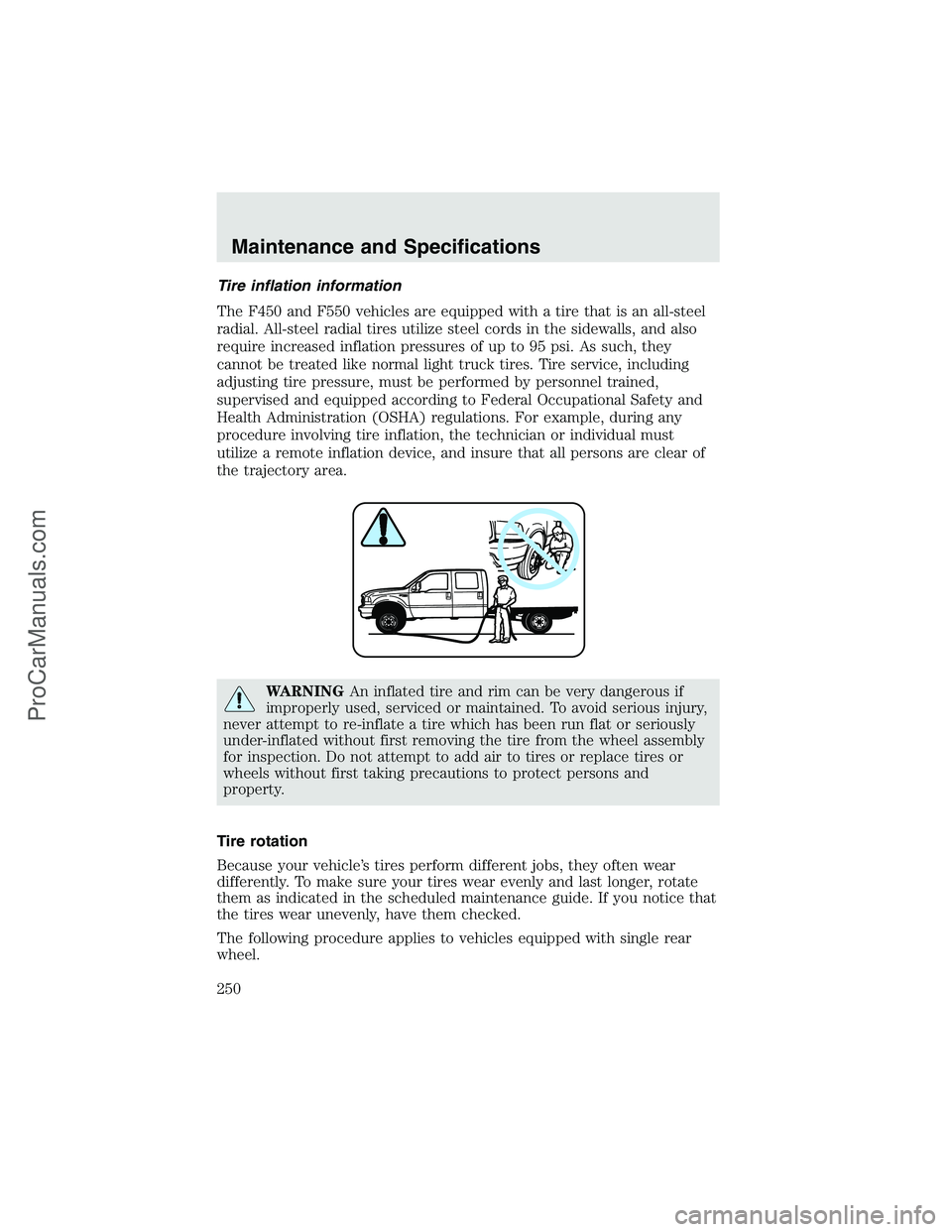
The F450 and F550 vehicles are equipped with a tire that is an all-steel
radial. All-steel radial tires utilize steel cords in the sidewalls, and also
require increased inflation pressures of up to 95 psi. As such, they
cannot be treated like normal light truck tires. Tire service, including
adjusting tire pressure, must be performed by personnel trained,
supervised and equipped according to Federal Occupational Safety and
Health Administration (OSHA) regulations. For example, during any
procedure involving tire inflation, the technician or individual must
utilize a remote inflation device, and insure that all persons are clear of
the trajectory area.
WARNINGAn inflated tire and rim can be very dangerous if
improperly used, serviced or maintained. To avoid serious injury,
never attempt to re-inflate a tire which has been run flat or seriously
under-inflated without first removing the tire from the wheel assembly
for inspection. Do not attempt to add air to tires or replace tires or
wheels without first taking precautions to protect persons and
property.
Tire rotation
Because your vehicle’s tires perform different jobs, they often wear
differently. To make sure your tires wear evenly and last longer, rotate
them as indicated in the scheduled maintenance guide. If you notice that
the tires wear unevenly, have them checked.
The following procedure applies to vehicles equipped with single rear
wheel.
Maintenance and Specifications
250
ProCarManuals.com
Page 252 of 280
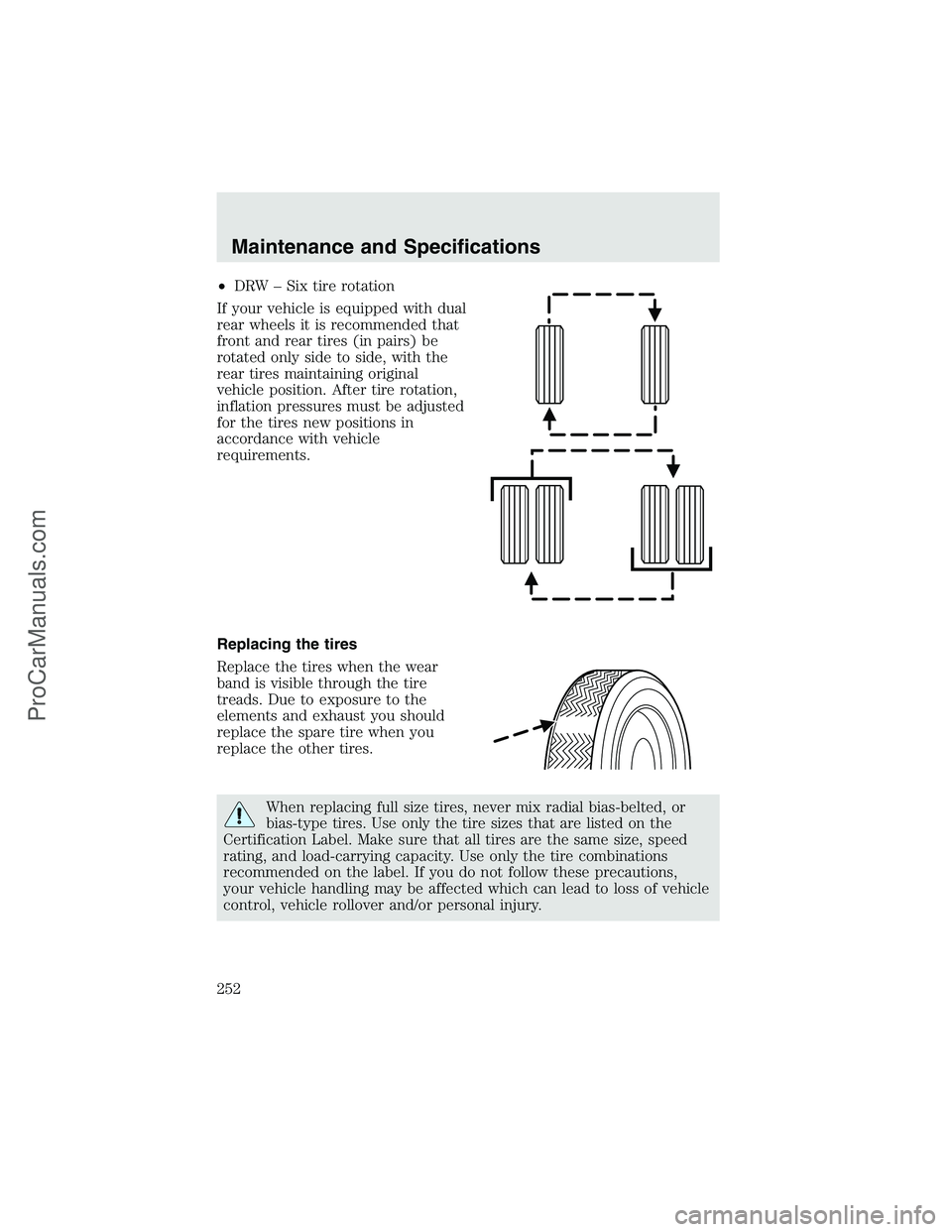
•DRW–Six tire rotation
If your vehicle is equipped with dual
rear wheels it is recommended that
front and rear tires (in pairs) be
rotated only side to side, with the
rear tires maintaining original
vehicle position. After tire rotation,
inflation pressures must be adjusted
for the tires new positions in
accordance with vehicle
requirements.
Replacing the tires
Replace the tires when the wear
band is visible through the tire
treads. Due to exposure to the
elements and exhaust you should
replace the spare tire when you
replace the other tires.
When replacing full size tires, never mix radial bias-belted, or
bias-type tires. Use only the tire sizes that are listed on the
Certification Label. Make sure that all tires are the same size, speed
rating, and load-carrying capacity. Use only the tire combinations
recommended on the label. If you do not follow these precautions,
your vehicle handling may be affected which can lead to loss of vehicle
control, vehicle rollover and/or personal injury.
Maintenance and Specifications
252
ProCarManuals.com
Page 253 of 280
Make sure that all replacement tires are of the same size, type,
speed rating, load-carrying capacity and tread design (e.g.,“All
Terrain”,“Touring”, etc.), as originally offered by Ford.
Do not replace your tires with“high performance”tires or larger
size tires.
Failure to follow these precautions may adversely affect the
handling of the vehicle, and increase the risk of loss of vehicle
control, vehicle rollover and/or personal injury.
Tires that are larger or smaller than your vehicle’s original tires may also
affect the accuracy of your speedometer.
SNOW TIRES AND CHAINS
Snow tires must be the same size and grade as the tires you
currently have on your vehicle.
The tires on your vehicle have all weather treads to provide traction in
rain and snow. However, in some climates, you may need to use snow
tires and chains. If you need to use chains, it is recommended that steel
wheels (of the same size and specifications) be used, as chains may chip
aluminum wheels.
Follow these guidelines when using snow tires and chains:
•Use only SAE Class S chains.
•Install chains securely, verifying that the chains do not touch any
wiring, brake lines or fuel lines.
•Drive cautiously. If you hear the chains rub or bang against your
vehicle, stop and re-tighten the chains. If this does not work, remove
the chains to prevent damage to your vehicle.
•If possible, avoid fully loading your vehicle.
•Remove the tire chains when they are no longer needed. Do not use
tire chains on dry roads.
•The suspension insulation and bumpers will help prevent vehicle
damage. Do not remove these components from your vehicle when
using snow tires and chains.
Maintenance and Specifications
253
ProCarManuals.com
Page 279 of 280
Power distribution box
(see Fuses) ...............................178
Power door locks ..................65, 70
Power point .................................53
Power steering ..........................117
fluid, checking and adding ....240
fluid, refill capacity ................254
fluid, specifications .........258, 261
Power Windows ...........................53
Preparing to drive your
vehicle ........................................117
R
Radio ..........................20, 22, 25, 29
Relays ........................................177
Remote entry system .................67
illuminated entry ......................70
locking/unlocking doors ...........65
Reverse sensing system ...........126
Roadside assistance ..................175
S
Safety belts (see Safety
restraints) ........................77–81, 83
Safety defects, reporting ..........208
Safety restraints ....................77–83
belt minder ...............................85
cleaning the safety belts ..........89
extension assembly ..................89
for adults .............................78–81
for children ...............................99
lap belt ......................................84
warning light and chime ..........85
Safety seats for children ..........102
Seat belts (see Safety
restraints) ....................................77Seats ............................................72
child safety seats ....................102
cleaning ...................................213
Servicing your vehicle ..............216
Snowplowing .................8, 171–173
Spare tire
(see Changing the Tire) ...........182
Spark plugs,
specifications .....................254, 261
Special notice ................................9
ambulance conversions ..............8
diesel-powered vehicles .............8
four-wheel drive
vehicles ............................173–174
utility-type vehicles ....................8
Specification chart,
lubricants ...........................258, 261
Speed control ..............................57
Starting your
vehicle ........................110–111, 113
jump starting ..........................193
Steering wheel
tilting .........................................50
T
Tailgate ........................................64
Tires ...................................247–249
changing ..........................182, 185
checking the pressure ............249
replacing ..................................252
rotating ....................................250
snow tires and chains ............253
tire grades ...............................248
treadwear ................................248
Towing .......................................145
trailer towing ..........................145
wrecker ....................................198
Index
279
ProCarManuals.com