weight FORD F350 2004 Owner's Guide
[x] Cancel search | Manufacturer: FORD, Model Year: 2004, Model line: F350, Model: FORD F350 2004Pages: 312, PDF Size: 2.89 MB
Page 189 of 312
•The Total Accessory Reserve Capacity (TARC) is shown on the lower
right side of the vehicle’s Safety Certification Label. This applies to
Ford-completed vehicles of 10,000 lb. GVWR or less. This is the
weight of permanently-attached auxiliary equipment, such as
snowplow frame-mounting hardware, that can be added to the vehicle
and satisfy Ford compliance certification to FMVSS. Exceeding this
weight may require the auxiliary equipment installer additional safety
certification responsibility. The Front Accessory Reserve Capacity
(FARC) is added for customer convenience.
•Rear ballast weight behind the rear axle may be required to prevent
exceeding the FGAWR, and provide front-to-rear weight balance for
proper braking and steering.
•Front wheel toe may require re-adjustment to prevent premature
uneven tire wear. Specifications are found in the FordWorkshop
Manual.
•Headlight aim may require re-adjustment.
•The tire air pressures recommended for general driving are found on
the vehicle’s Safety Certification Label. The maximum cold inflation
pressure for the tire and associated load rating is imprinted on the tire
sidewall. Tire air pressure may require re-adjustment within these
pressure limits to accommodate the additional weight of the snowplow
installation.
•Federal and some local regulations require additional exterior lamps
for snowplow-equipped vehicles. Consult your dealer for additional
information.
Operating the vehicle with the snowplow attached
Do not use your vehicle for snow removal until it has been driven at
least 500 miles (800 km).
The attached snowplow blade restricts airflow to the radiator, and may
cause the engine to run at a higher temperature:
•If you are driving more than 15 miles (24 km) where outside air
temperatures are above freezing, then angle the plow blade to full left
or right to maximize airflow to the radiator.
•If you are driving less than 15 miles (24 km) at speeds up to 40 mph
(64 km/h) in cold weather you will not need to adjust blade position
Follow the severe duty schedule in yourScheduled Maintenance Guide
for engine oil and transmission fluid change intervals.
Snowplowing with your air bag-equipped vehicle
Your vehicle is equipped with a driver and passenger air bag
Supplemental Restraint System (SRS) The SRS is designed to activate in
2004 F250/350/450/550(f23)
Owners Guide (post-2002-fmt)
USA English(fus)
Driving
189
ProCarManuals.com
Page 257 of 312
•Use recommended engine oil. Refer toLubricant specificationsin
this chapter.
•Perform all regularly scheduled maintenance items. Follow the
recommended maintenance schedule and owner maintenance checks
found in your vehicle scheduled maintenance guide.
Conditions
•Heavily loading a vehicle or towing a trailer may reduce fuel economy
at any speed.
•Carrying unnecessary weight may reduce fuel economy (approximately
0.4 km/L [1 mpg] is lost for every 180 kg [400 lb] of weight carried).
•Adding certain accessories to your vehicle (for example bug
deflectors, rollbars/light bars, running boards, ski/luggage racks) may
reduce fuel economy.
•Using fuel blended with alcohol may lower fuel economy.
•Fuel economy may decrease with lower temperatures during the first
12–16 km (8–10 miles) of driving.
•Driving on flat terrain offers improved fuel economy as compared to
driving on hilly terrain.
•Transmissions give their best fuel economy when operated in the top
cruise gear and with steady pressure on the gas pedal.
•Four-wheel-drive operation (if equipped) is less fuel efficient than
two-wheel-drive operation.
•Close windows for high speed driving.
EPA window sticker
Every new vehicle should have the EPA window sticker. Contact your
dealer if the window sticker is not supplied with your vehicle. The EPA
window sticker should be your guide for the fuel economy comparisons
with other vehicles.
It is important to note the box in the lower left corner of the window
sticker. These numbers represent the Range of L/100 km (MPG)
expected on the vehicle under optimum conditions. Your fuel economy
may vary depending upon the method of operation and conditions.
2004 F250/350/450/550(f23)
Owners Guide (post-2002-fmt)
USA English(fus)
Maintenance and Specifications
257
ProCarManuals.com
Page 269 of 312
The traction grade assigned to this tire is based on
straight-ahead braking traction tests, and does not include
acceleration, cornering, hydroplaning or peak traction characteristics.
Temperature A B C
The temperature grades are A (the highest), B and C, representing the
tire’s resistance to the generation of heat and its ability to dissipate heat
when tested under controlled conditions on a specified indoor laboratory
test wheel. Sustained high temperature can cause the material of the tire
to degenerate and reduce tire life, and excessive temperature can lead to
sudden tire failure. The grade C corresponds to a level of performance
which all passenger car tires must meet under the Federal Motor Vehicle
Safety Standard No. 109. Grades B and A represent higher levels of
performance on the laboratory test wheel than the minimum required by
law.
The temperature grade for this tire is established for a tire that
is properly inflated and not overloaded. Excessive speed,
underinflation, or excessive loading, either separately or in
combination, can cause heat buildup and possible tire failure.
TIRES
Tires are designed to give many thousands of miles of service, but they
must be maintained in order to get the maximum benefit from them.
Glossary of tire terminology
•Tire label:A label showing the OE (Original Equipment) tire sizes,
recommended inflation pressure and the maximum weight the vehicle
can carry.
•Tire Identification Number (TIN):A number on the sidewall of
each tire providing information about the tire brand and
manufacturing plant, tire size and date of manufacture.
•Inflation pressure:A measure of the amount of air in a tire.
•Standard load:A class of P-metric or Metric tires designed to carry a
maximum load at 35 psi [37 psi (2.5 bar) for Metric tires]. Increasing
the inflation pressure beyond this pressure will not increase the tire’s
load carrying capability.
2004 F250/350/450/550(f23)
Owners Guide (post-2002-fmt)
USA English(fus)
Maintenance and Specifications
269
ProCarManuals.com
Page 271 of 312
2.215:Indicates the nominal width of the tire in millimeters from sidewall
edge to sidewall edge. In general, the larger the number, the wider the tire.
3.65:Indicates the aspect ratio which gives the tire’s ratio of height to
width.
4.R:Indicates a“radial”type tire.
5.15:Indicates the wheel or rim diameter in inches. If you change your
wheel size, you will have to purchase new tires to match the new wheel
diameter.
6.95:Indicates the tire’s load index. It is an index that relates to how
much weight a tire can carry. You may find this information in your
owner’s guide. If not, contact a local tire dealer.
Note:You may not find this information on all tires because it is not
required by federal law.
7.H:Indicates the tire’s speed rating. The speed rating denotes the
speed at which a tire is designed to be driven for extended periods of
time under a standard condition of load and inflation pressure. The tires
on your vehicle may operate at different conditions for load and inflation
pressure. These speed ratings may need to be adjusted for the difference
in conditions. The ratings range from 99 mph (159 km/h) to 186 mph
(299 km/h). These ratings are listed in the following chart.
Note:You may not find this information on all tires because it is not
required by federal law.
Letter rating Speed rating - mph (km/h)
Q 99 mph (159 km/h)
R 106 mph (171 km/h)
S 112 mph (180 km/h)
T 118 mph (190 km/h)
U 124 mph (200 km/h)
H 130 mph (210 km/h)
V 149 mph (240 km/h)
W 168 mph (270 km/h)
Y 186 mph (299 km/h)
Note:For tires with a maximum speed capability over 149 mph (240 km/h),
tire manufacturers sometimes use the letters ZR. For those with a maximum
speed capability over 186 mph (299 km/h), tire manufacturers always use the
letters ZR.
2004 F250/350/450/550(f23)
Owners Guide (post-2002-fmt)
USA English(fus)
Maintenance and Specifications
271
ProCarManuals.com
Page 299 of 312
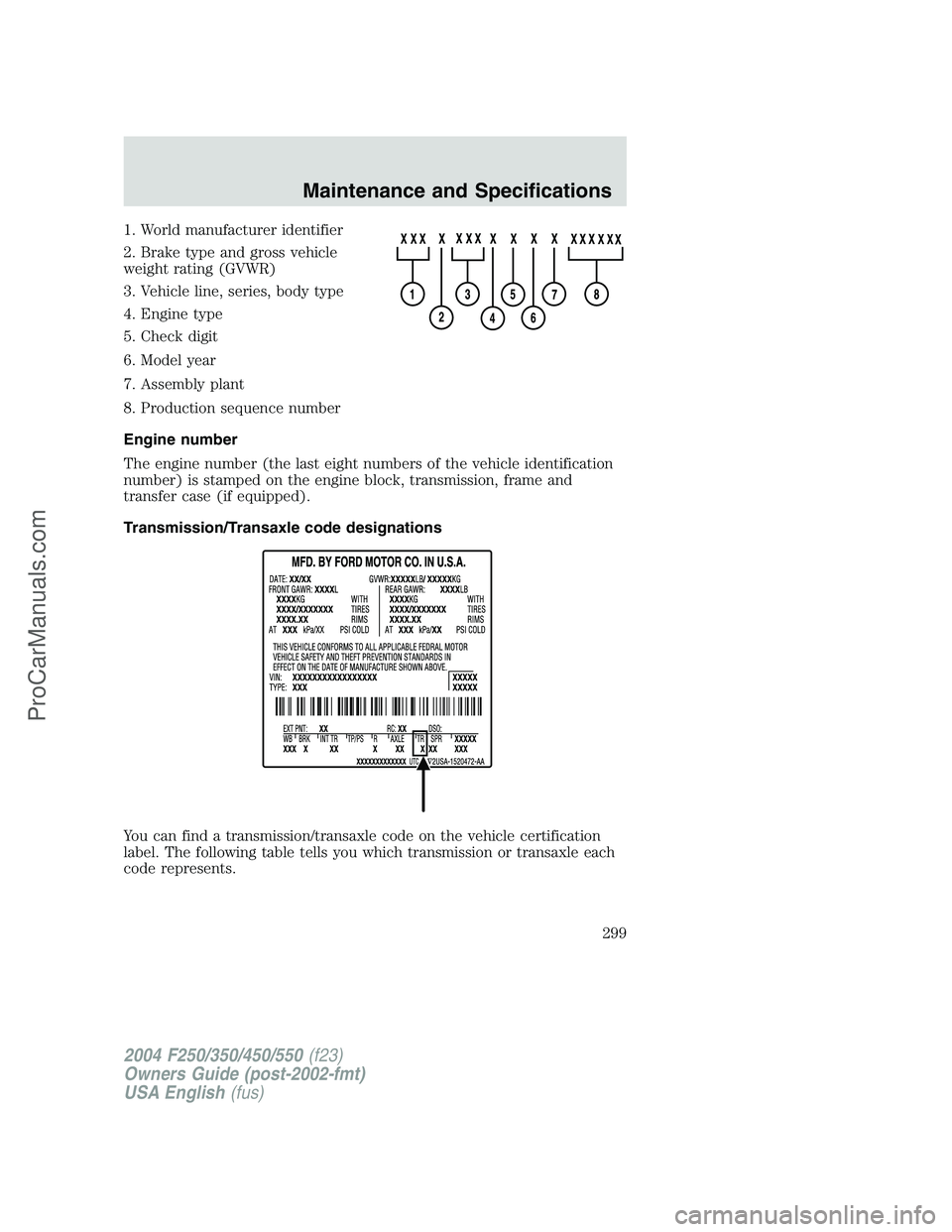
1. World manufacturer identifier
2. Brake type and gross vehicle
weight rating (GVWR)
3. Vehicle line, series, body type
4. Engine type
5. Check digit
6. Model year
7. Assembly plant
8. Production sequence number
Engine number
The engine number (the last eight numbers of the vehicle identification
number) is stamped on the engine block, transmission, frame and
transfer case (if equipped).
Transmission/Transaxle code designations
You can find a transmission/transaxle code on the vehicle certification
label. The following table tells you which transmission or transaxle each
code represents.
2004 F250/350/450/550(f23)
Owners Guide (post-2002-fmt)
USA English(fus)
Maintenance and Specifications
299
ProCarManuals.com
Page 304 of 312
Peace of mind
Airbag anti-theft locks
First aid and safety kits
Full vehicle covers
Locking gas cap
Navigation systems
Remote start
Vehicle security systems
For maximum vehicle performance, keep the following information in
mind when adding accessories or equipment to your vehicle:
•When adding accessories, equipment, passengers and luggage to your
vehicle, do not exceed the total weight capacity of the vehicle or of
the front or rear axle (GVWR or GAWR as indicated on the Safety
Compliance Certification label). Consult your dealer for specific weight
information.
•The Federal Communications Commission (FCC) and Canadian Radio
Telecommunications Commission (CRTC) regulate the use of mobile
communications systems—such as two-way radios, telephones and
theft alarms - that are equipped with radio transmitters. Any such
equipment installed in your vehicle should comply with FCC or CRTC
regulations and should be installed only by a qualified service
technician.
•Mobile communications systems may harm the operation of your
vehicle, particularly if they are not properly designed for automotive
use.
2004 F250/350/450/550(f23)
Owners Guide (post-2002-fmt)
USA English(fus)
Accessories
304
ProCarManuals.com
Page 307 of 312
filter, specifications ........241, 283
recommendations ...................241
refill capacities ........................284
specifications ..................287, 291
Exhaust fumes ..........................129
F
Fail safe cooling ........................248
Fluid capacities .........................284
Foglamps .....................................42
Four-Wheel Drive vehicles .......144
description ..............................149
driving off road .......................151
electronic shift ................145, 149
indicator light .........................146
lever operated shift ................146
manual locking hubs ..............144
preparing to drive your
vehicle .....................................132
Fuel ............................................250
calculating fuel economy .......254
cap ...........................................252
capacity ...................................284
choosing the right fuel ...........252
comparisons with EPA fuel
economy estimates .................257
detergent in fuel .....................254
filling your vehicle with
fuel ...........................250, 252, 254
filter, specifications ........254, 283
fuel pump shut-off switch .....193
improving fuel economy ........254
octane rating ...................253, 291
quality ......................................253
running out of fuel .................254
safety information relating to
automotive fuels .....................250
Fuel pump shut-off switch .......193
Fuses ..................................194–195G
Garage door opener ....................55
Garage Door Opener
(see Homelink wireless control
system) ........................................64
Gas cap (see Fuel cap) ............252
Gas mileage
(see Fuel economy) .................254
Gauges .........................................16
transmission fluid
temperature gauge ...................20
GAWR (Gross Axle Weight
Rating)
calculating ...............................164
GVWR (Gross Vehicle Weight
Rating)
calculating ...............................164
H
Hazard flashers .........................193
Head restraints ...........................85
Headlamps ...................................41
aiming ........................................43
autolamp system .......................41
daytime running lights .............42
flash to pass ..............................43
high beam .................................43
replacing bulbs ...................46–47
turning on and off ....................41
Heating
heating and air conditioning
system .................................38–39
Homelink wireless control
system ..........................................64
Hood ..........................................237
I
Ignition ...............................125, 291
2004 F250/350/450/550(f23)
Owners Guide (post-2002-fmt)
USA English(fus)
Index
307
ProCarManuals.com