tow FORD F350 2008 Manual PDF
[x] Cancel search | Manufacturer: FORD, Model Year: 2008, Model line: F350, Model: FORD F350 2008Pages: 400, PDF Size: 3.83 MB
Page 341 of 400
•Be certain to wash or wipe your hands clean if you have been in
contact with certain products such as insect repellent and suntan
lotion in order to avoid possible damage to the interior painted
surfaces.
•Do not use household or glass cleaners as these may damage the
finish of the instrument panel, interior trim and cluster lens.
Do not use chemical solvents or strong detergents when cleaning
the steering wheel or instrument panel to avoid contamination of
the airbag system.
If a staining liquid like coffee/juice has been spilled on the instrument
panel or on interior trim surfaces, clean as follows:
1. Wipe up spilled liquid using a clean white cotton cloth.
2. Apply Motorcraft Deluxe Leather and Vinyl Cleaner (ZC-11-A) [In
Canada use Motorcraft Multi-Purpose Cleaner (CXC-101)] to the wiped
area and spread around evenly.
3. Apply more Motorcraft cleaner to a clean white cotton cloth and press
the cloth onto the soiled area–allow this to set at room temperature for
30 minutes.
4. Remove the soaked cloth, and if it is not soiled badly, use this cloth to
clean the area by using a rubbing motion for 60 seconds.
5. Following this, wipe area dry with a clean white cotton cloth.
INSTRUMENT PANEL AND CONSOLE (HARLEY-DAVIDSON ONLY)
Your vehicle’s instrument panel and console are uniquely painted with both
high and low gloss paints that require special care. The high gloss area is
similar to that of the vehicle’s exterior; the low gloss area is designed to
help protect the driver from undesirable windshield reflection.
High gloss paint area
In order to maintain the finish of the instrument panel and console, the
high gloss areas should be treated similar to the that of exterior paint or
glossy plastic surfaces. When cleaning the high gloss areas:
•Do not usepaper towels or newspaper.
•Do not usesilicone or Teflont (PTFE)-based products.
Dust the high gloss areas with a clean, dry cloth, or use Motorcraft Dusting
Cloth (ZC-24 or ZC-25) or Motorcraft Dusting Cloth Mitts (ZC-47).
For general cleaning, use mild, soapy water and a soft, damp cloth, then
dry with a clean, dry cloth, or use or use Motorcraft Dash & Vinyl Cleaner
(ZC-38-A) or Motorcraft Ultra-Clear Spray Glass Cleaner (ZC-23).
2008 F-250/350/450/550(f23)
Owners Guide (post-2002-fmt)
USA(fus)
Cleaning
341
ProCarManuals.com
Page 342 of 400
For removal of fine scuffs and scratches, use Scotch-Britet Microfiber
Cloth or cheese cloth along with Motorcraft Premium Liquid Wax
(ZC-53-A), Motorcraft Paint Sealant (ZC-45), or Motorcraft Custom Clear
Coat Polish (ZC-8-A). Note: Removal of deep scuffs and scratches should
be performed by an authorized dealer or an experienced repair facility.
Low gloss paint area
The low gloss area of the instrument panel’s upper dash should be
cleaned with mild, soapy water and a soft, damp cloth, or Motorcraft
Dash & Vinyl Cleaner (ZC-38-A), then dried with a clean, dry cloth.
When cleaning the low gloss areas:
•Do not usepaper towels or newspaper.
•Do not usesilicone or Teflont (PTFE)-based products.
•Do not useexterior paint waxes or sealants.
Dust the low gloss areas with a clean, dry cloth, or use Motorcraft
Dusting Cloth (ZC-24 or ZC-25) or Motorcraft Dusting Cloth Mitts
(ZC-47).
INTERIOR
For fabric, carpets, cloth seats and safety belts:
•Remove dust and loose dirt with a vacuum cleaner.
•Remove light stains and soil with Motorcraft Professional Strength
Carpet & Upholstery Cleaner (ZC-54).
•If grease or tar is present on the material, spot-clean the area first
with Motorcraft Spot and Stain Remover (ZC-14).
•If a ring forms on the fabric after spot cleaning, clean the entire area
immediately (but do not oversaturate) or the ring will set.
•Do not use household cleaning products or glass cleaners, which can
stain and discolor the fabric and affect the flame retardant abilities of
the seat materials.
Do not use cleaning solvents, bleach or dye on the vehicle’s
seatbelts, as these actions may weaken the belt webbing.
2008 F-250/350/450/550(f23)
Owners Guide (post-2002-fmt)
USA(fus)
Cleaning
342
ProCarManuals.com
Page 350 of 400
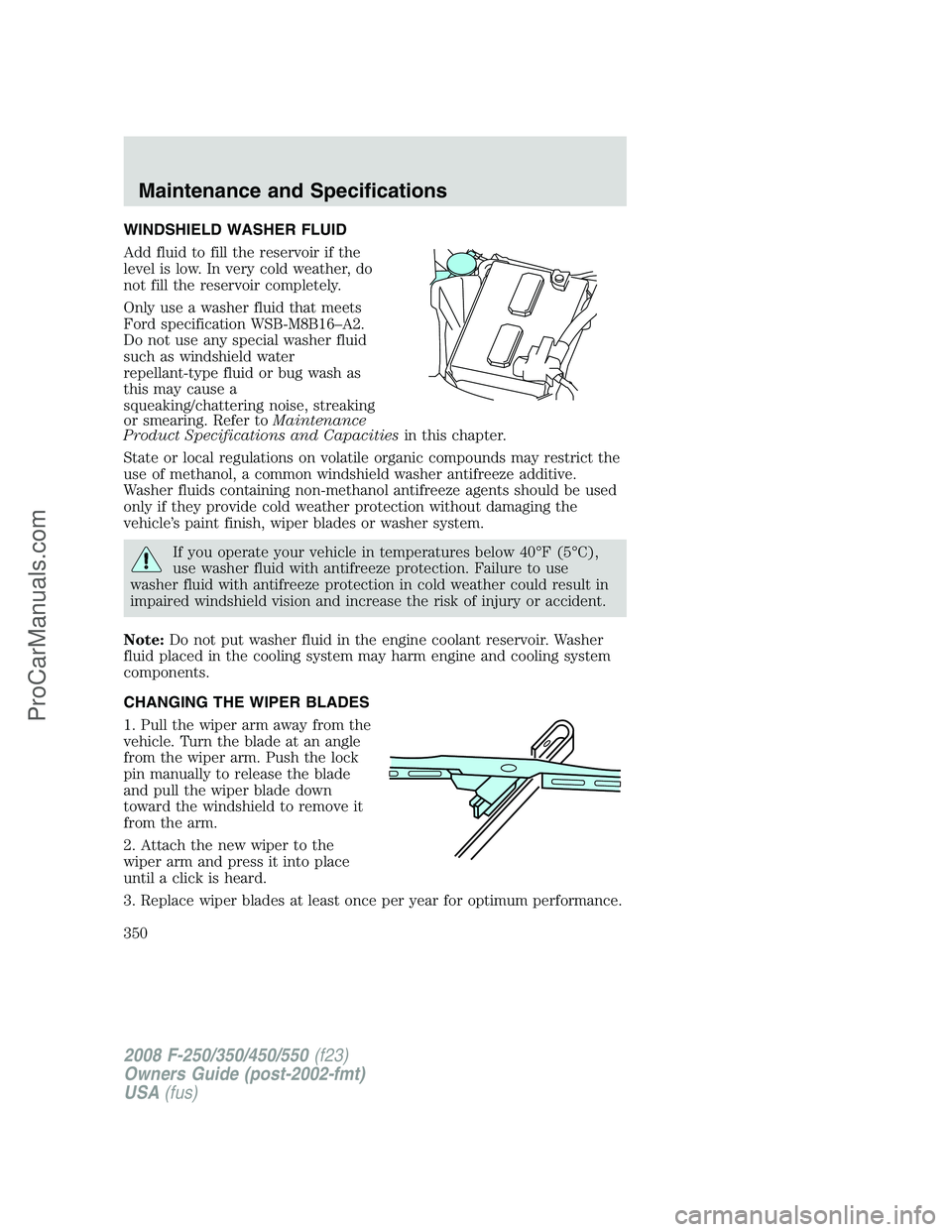
WINDSHIELD WASHER FLUID
Add fluid to fill the reservoir if the
level is low. In very cold weather, do
not fill the reservoir completely.
Only use a washer fluid that meets
Ford specification WSB-M8B16–A2.
Do not use any special washer fluid
such as windshield water
repellant-type fluid or bug wash as
this may cause a
squeaking/chattering noise, streaking
or smearing. Refer toMaintenance
Product Specifications and Capacitiesin this chapter.
State or local regulations on volatile organic compounds may restrict the
use of methanol, a common windshield washer antifreeze additive.
Washer fluids containing non-methanol antifreeze agents should be used
only if they provide cold weather protection without damaging the
vehicle’s paint finish, wiper blades or washer system.
If you operate your vehicle in temperatures below 40°F (5°C),
use washer fluid with antifreeze protection. Failure to use
washer fluid with antifreeze protection in cold weather could result in
impaired windshield vision and increase the risk of injury or accident.
Note:Do not put washer fluid in the engine coolant reservoir. Washer
fluid placed in the cooling system may harm engine and cooling system
components.
CHANGING THE WIPER BLADES
1. Pull the wiper arm away from the
vehicle. Turn the blade at an angle
from the wiper arm. Push the lock
pin manually to release the blade
and pull the wiper blade down
toward the windshield to remove it
from the arm.
2. Attach the new wiper to the
wiper arm and press it into place
until a click is heard.
3. Replace wiper blades at least once per year for optimum performance.
2008 F-250/350/450/550(f23)
Owners Guide (post-2002-fmt)
USA(fus)
Maintenance and Specifications
350
ProCarManuals.com
Page 351 of 400
Note:Poor wiper quality can be improved by cleaning the wiper blades
and the windshield; refer toWindows and wiper bladesin the
Cleaningchapter.
Note:To prolong the life of the wiper blades, it is highly recommended
to scrape off the ice on the windshield before turning on the wipers. The
layer of ice has many sharp edges and can damage the micro edge of the
wiper rubber element.
ENGINE OIL
Checking the engine oil
Refer to thescheduled maintenance informationfor the appropriate
intervals for checking the engine oil.
1. Make sure the vehicle is on level ground.
2. Turn the engine off and wait a few minutes for the oil to drain into the
oil pan.
3. Set the parking brake and ensure the gearshift is securely latched in P
(Park) (automatic transmission) or 1 (First) (manual transmission).
4. Open the hood. Protect yourself from engine heat.
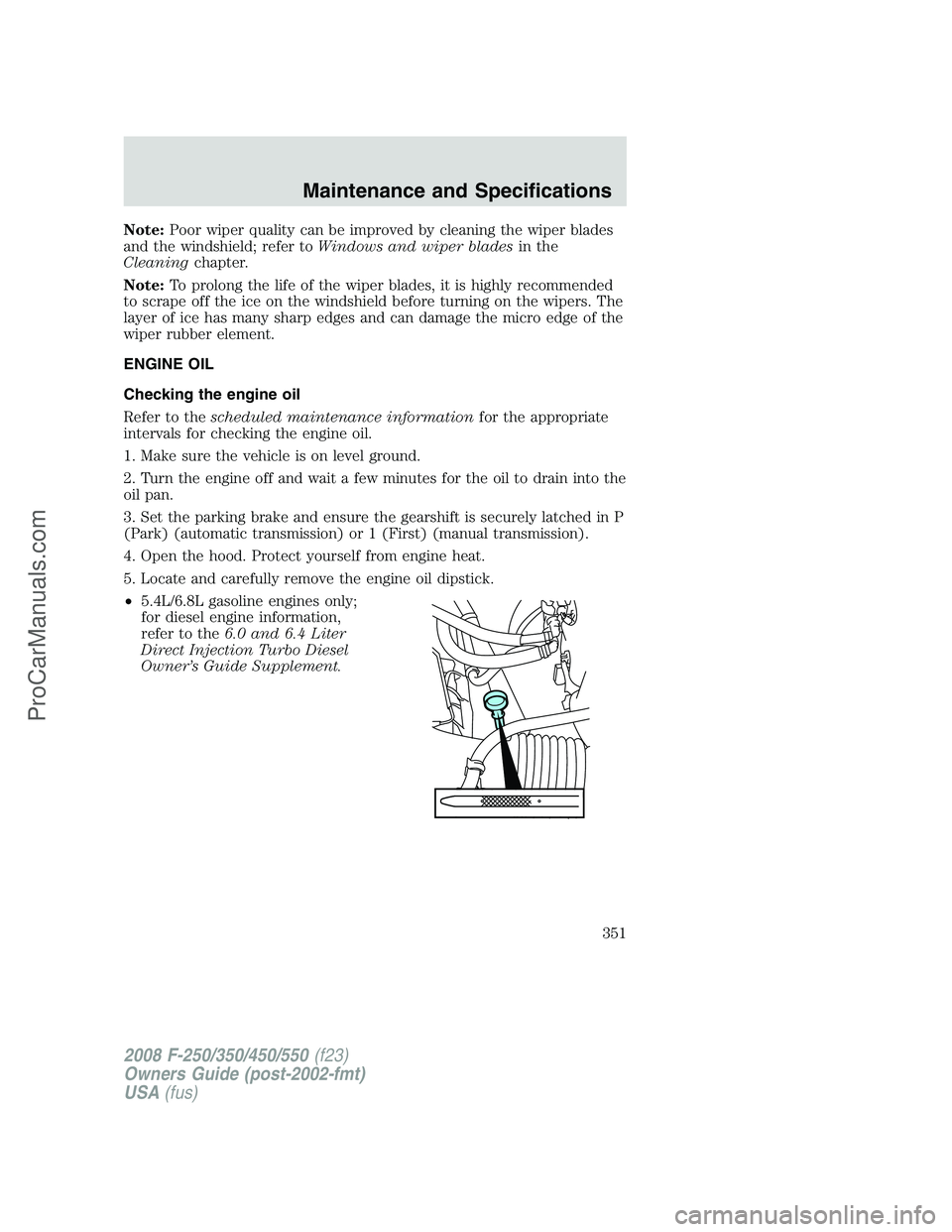
5. Locate and carefully remove the engine oil dipstick.
•5.4L/6.8L gasoline engines only;
for diesel engine information,
refer to the6.0 and 6.4 Liter
Direct Injection Turbo Diesel
Owner’s Guide Supplement.
2008 F-250/350/450/550(f23)
Owners Guide (post-2002-fmt)
USA(fus)
Maintenance and Specifications
351
ProCarManuals.com
Page 369 of 400
•Idling for long periods of time (greater than one minute) may waste
fuel.
•Anticipate stopping; slowing down may eliminate the need to stop.
•Sudden or hard accelerations may reduce fuel economy.
•Slow down gradually.
•Driving at reasonable speeds (traveling at 55 mph [88 km/h] uses 15%
less fuel than traveling at 65 mph [105 km/h]).
•Revving the engine before turning it off may reduce fuel economy.
•Using the air conditioner or defroster may reduce fuel economy.
•You may want to turn off the speed control in hilly terrain if
unnecessary shifting between third and fourth gear occurs.
Unnecessary shifting of this type could result in reduced fuel
economy.
•Warming up a vehicle on cold mornings is not required and may
reduce fuel economy.
•Resting your foot on the brake pedal while driving may reduce fuel
economy.
•Combine errands and minimize stop-and-go driving.
Maintenance
•Keep tires properly inflated and use only recommended size.
•Operating a vehicle with the wheels out of alignment will reduce fuel
economy.
•Use recommended engine oil. Refer toMaintenance Product
Specifications and Capacitiesin this chapter.
•Perform all regularly scheduled maintenance items. Follow the
recommended maintenance schedule and owner maintenance checks
found in your vehicle’sscheduled maintenance information.
Conditions
•Heavily loading a vehicle or towing a trailer may reduce fuel economy
at any speed.
•Carrying unnecessary weight may reduce fuel economy (approximately
1 mpg [0.4 km/L] is lost for every 400 lb [180 kg] of weight carried).
•Adding certain accessories to your vehicle (for example bug
deflectors, rollbars/light bars, running boards, ski/luggage racks) may
reduce fuel economy.
2008 F-250/350/450/550(f23)
Owners Guide (post-2002-fmt)
USA(fus)
Maintenance and Specifications
369
ProCarManuals.com
Page 381 of 400
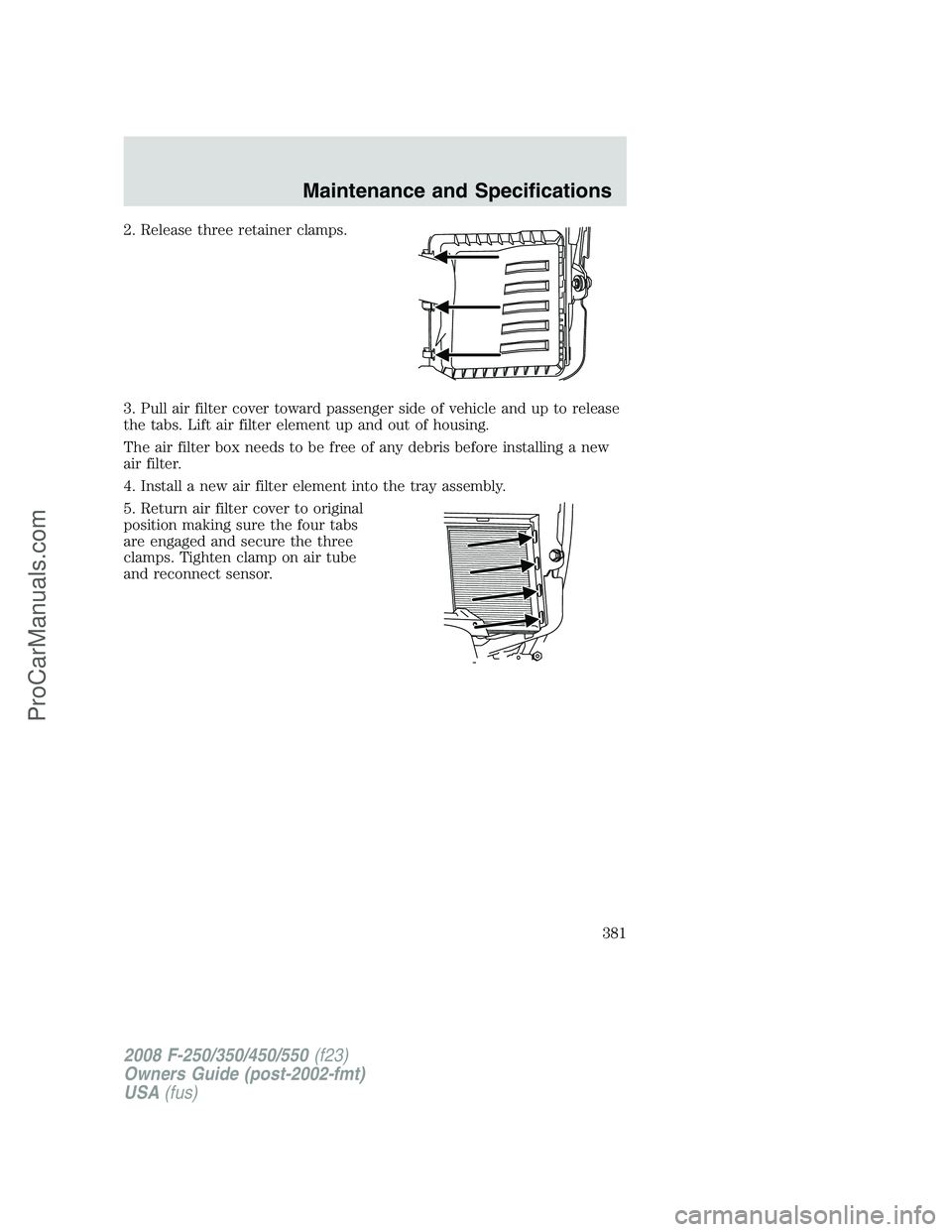
2. Release three retainer clamps.
3. Pull air filter cover toward passenger side of vehicle and up to release
the tabs. Lift air filter element up and out of housing.
The air filter box needs to be free of any debris before installing a new
air filter.
4. Install a new air filter element into the tray assembly.
5. Return air filter cover to original
position making sure the four tabs
are engaged and secure the three
clamps. Tighten clamp on air tube
and reconnect sensor.
2008 F-250/350/450/550(f23)
Owners Guide (post-2002-fmt)
USA(fus)
Maintenance and Specifications
381
ProCarManuals.com
Page 391 of 400
Lifestyle
Ash cup / smoker’s package
Bedliners and bedmats
Cargo organization and management
Towing mirrors
Trailer hitches, wiring harnesses and accessories
Peace of mind
Mobile-Ease™ hands-free communication system
Remote start
Vehicle security systems
Wheel locks
Not all accessories are available for all models.
For maximum vehicle performance, keep the following information in
mind when adding accessories or equipment to your vehicle:
•When adding accessories, equipment, passengers and luggage to your
vehicle, do not exceed the total weight capacity of the vehicle or of
the front or rear axle (GVWR or GAWR as indicated on the Safety
Compliance Certification Label). Consult your authorized dealer for
specific weight information.
•The Federal Communications Commission (FCC) and Canadian Radio
Telecommunications Commission (CRTC) regulate the use of mobile
communications systems — such as two-way radios, telephones and
theft alarms - that are equipped with radio transmitters. Any such
equipment installed in your vehicle should comply with FCC or CRTC
regulations and should be installed only by your authorized dealer.
•Mobile communications systems may harm the operation of your
vehicle, particularly if they are not properly designed for automotive
use.
•To avoid interference with other vehicle functions, such as anti-lock
braking systems, amateur radio users who install radios and antennas
onto their vehicle should not locate the Amateur Radio Antennas in
the area of the driver’s side hood.
•Electrical or electronic accessories or components that are added to
the vehicle by the authorized dealer or the owner may adversely affect
battery performance and durability.
2008 F-250/350/450/550(f23)
Owners Guide (post-2002-fmt)
USA(fus)
Accessories
391
ProCarManuals.com
Page 397 of 400
snow tires and chains ............235
spare tire .........................308–309
terminology .............................208
tire grades ...............................207
treadwear ........................207, 213
Towing .......................................242
recreational towing .................253
Trailer Brake
Controller-Integrated ..............246
trailer towing ..........................242
wrecker ....................................327
Traction control ........................262
Traction-lok rear axle ...............264
Trailer Brake
Controller-Integrated ................246
Transfer case
fluid checking .........................379
Transmission
automatic operation .........99, 265
brake-shift interlock (BSI) ....265
fluid, checking and adding
(automatic) .............................375
fluid, checking and adding
(manual) .................................378
fluid, refill capacities ..............383manual operation ....................269
Turn signal ..................................90
U
Upfitter controls .......................114
V
Vehicle Identification Number
(VIN) ..........................................388
Vehicle loading ..........................236
Ventilating your vehicle ...........258
W
Warning lights (see Lights) .......12
Washer fluid ..............................350
Water, Driving through .............290
Windows
power .......................................102
Windshield washer fluid and
wipers ..........................................98
checking and adding fluid .....350
replacing wiper blades ...........350
Wrecker towing .........................327
2008 F-250/350/450/550(f23)
Owners Guide (post-2002-fmt)
USA(fus)
Index
397
ProCarManuals.com