cooling FORD F450 2012 User Guide
[x] Cancel search | Manufacturer: FORD, Model Year: 2012, Model line: F450, Model: FORD F450 2012Pages: 448, PDF Size: 6.01 MB
Page 315 of 448
VEHICLE USED AS A STATIONARY POWER SOURCE
Auxiliary equipment called power take-off, or PTO, is often added to the
engine or transmission to operate utility equipment. Examples include a
wheel-lift for tow trucks, cranes, tools for construction or tire service,
and pumping fluids. PTO applications draw auxiliary horsepower from
the powertrain, often while the vehicle is stationary. In this condition,
there is limited cooling air flow through the radiator and around the
vehicle that normally occurs when a vehicle is moving. The aftermarket
PTO system installer, having the most knowledge of the final application,
is responsible for determining whether additional chassis heat protection
or powertrain cooling is required, and alerting the user to the safe and
proper operation.
Ford Super Duty Vehicles are approved for use as a stationary (including
split shaft capability) or mobile power source, within limits and operating
guidelines detailed in the Ford Truck Body Builders Layout Book,
found at www.fleet.ford.com/truckbbas, and through the Ford Truck
Body Builders Advisory Service.
DRIVING THROUGH WATER
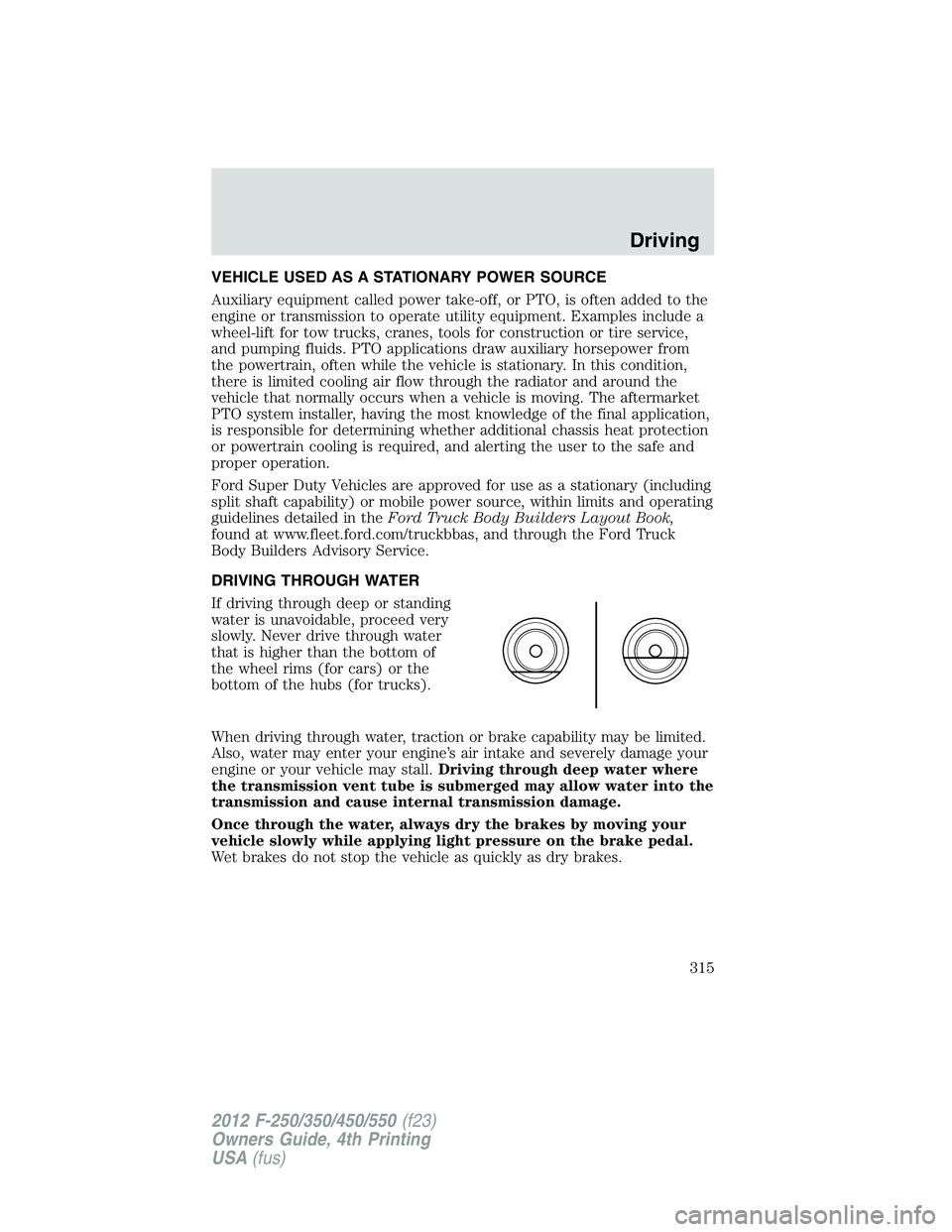
If driving through deep or standing
water is unavoidable, proceed very
slowly. Never drive through water
that is higher than the bottom of
the wheel rims (for cars) or the
bottom of the hubs (for trucks).
When driving through water, traction or brake capability may be limited.
Also, water may enter your engine’s air intake and severely damage your
engine or your vehicle may stall. Driving through deep water where
the transmission vent tube is submerged may allow water into the
transmission and cause internal transmission damage.
Once through the water, always dry the brakes by moving your
vehicle slowly while applying light pressure on the brake pedal.
Wet brakes do not stop the vehicle as quickly as dry brakes. Driving
315
2012 F-250/350/450/550 (f23)
Owners Guide, 4th Printing
USA (fus)
Page 349 of 448
3. Park the booster vehicle close to the hood of the disabled vehicle
making sure the two vehicles do not touch. Set the parking brake on
both vehicles and stay clear of the engine cooling fan and other moving
parts.
4. Check all battery terminals and remove any excessive corrosion before
you attach the battery cables. Ensure that vent caps are tight and level.
5. Turn the heater fan on in both vehicles to protect from any electrical
surges. Turn all other accessories off.
Connecting the jumper cables
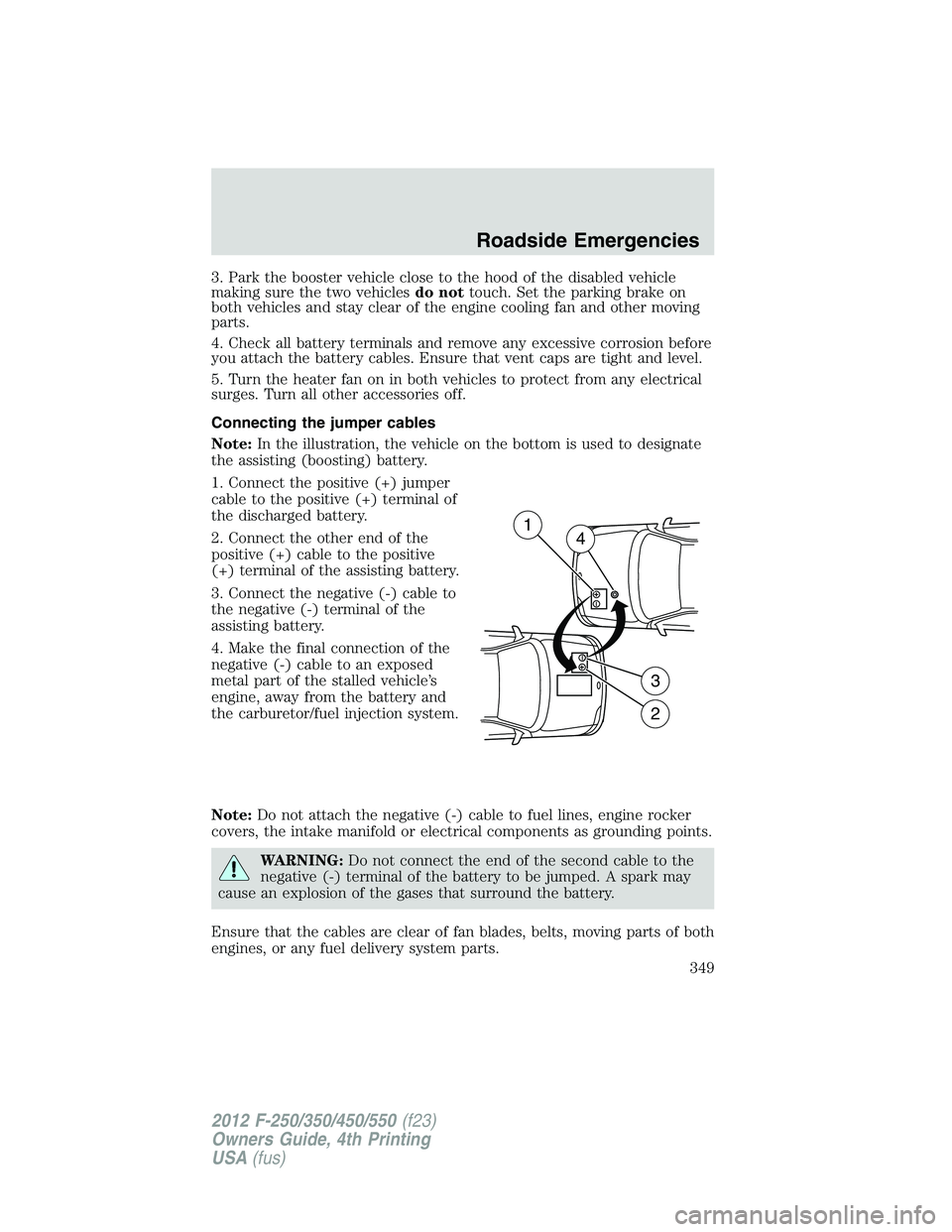
Note: In the illustration, the vehicle on the bottom is used to designate
the assisting (boosting) battery.
1. Connect the positive (+) jumper
cable to the positive (+) terminal of
the discharged battery.
2. Connect the other end of the
positive (+) cable to the positive
(+) terminal of the assisting battery.
3. Connect the negative (-) cable to
the negative (-) terminal of the
assisting battery.
4. Make the final connection of the
negative (-) cable to an exposed
metal part of the stalled vehicle’s
engine, away from the battery and
the carburetor/fuel injection system.
Note: Do not attach the negative (-) cable to fuel lines, engine rocker
covers, the intake manifold or electrical components as grounding points.
WARNING: Do not connect the end of the second cable to the
negative (-) terminal of the battery to be jumped. A spark may
cause an explosion of the gases that surround the battery.
Ensure that the cables are clear of fan blades, belts, moving parts of both
engines, or any fuel delivery system parts. +
–
+
–231
4Roadside Emergencies
349
2012 F-250/350/450/550 (f23)
Owners Guide, 4th Printing
USA (fus)
Page 380 of 448
Note: For best results, coolant concentration should be tested with a
refractometer such as Rotunda tool ROB75240 available from your
dealer. Ford does not recommend the use of hydrometers or coolant test
strips for measuring coolant concentrations.
Note: The engine coolant should be at the FULL COLD level, or between
the MIN and MAX marks, or within the COLD FILL RANGE, as listed on
the engine coolant reservoir (depending upon the application).
Note: Coolant expands when it is hot. The level may extend beyond the
FULL COLD level, or the MAX mark, or the COLD FILL RANGE.
If the level is below the FULL COLD level, at or below the MIN mark, or
below the COLD FILL RANGE, add coolant immediately per the Adding
engine coolant instructions in this chapter.
Note: Automotive fluids are not interchangeable; do not use engine
coolant/antifreeze or windshield washer fluid outside of its specified
function and vehicle location.
Adding engine coolant
WARNING: Do not add engine coolant when the engine is hot.
Steam and scalding liquids released from a hot cooling system
can burn you badly. Also, you can be burned if you spill coolant on hot
engine parts.
WARNING: Do not put engine coolant in the windshield washer
fluid container. If sprayed on the windshield, engine coolant
could make it difficult to see through the windshield.
WARNING: To reduce the risk of personal injury, make sure the
engine is cool before unscrewing the coolant pressure relief cap.
The cooling system is under pressure; steam and hot liquid can come
out forcefully when the cap is loosened slightly.
WARNING: Do not add coolant further than the MAX mark.
Note: Do not use stop leak pellets, cooling system sealants, or unapproved
additives as they can cause damage to the engine cooling or heating
systems. This damage would not be covered under your vehicle’s warranty.Maintenance and Specifications
380
2012 F-250/350/450/550 (f23)
Owners Guide, 4th Printing
USA (fus)
Page 381 of 448
Note: During normal vehicle operation, the engine coolant may change
color from orange to pink or light red. As long as the engine coolant is
clear and uncontaminated, this color change does not indicate the engine
coolant has degraded nor does it require the engine coolant to be
drained, the system to be flushed, or the engine coolant to be replaced.
• DO NOT MIX different colors or types of coolant in your vehicle.
Mixing of engine coolants may harm your engine’s cooling system.
Only use engine coolant that meets the Ford specification. Generic
coolants for all makes and models may not meet the Ford
specification. The use of an improper coolant may harm engine and
cooling system components and may void the warranty. See
Capacities and Specifications for more information.
• In case of emergency, a large amount of water without engine coolant
may be added in order to reach a vehicle service location. In this
instance, the cooling system must be drained, chemically cleaned, and
refilled with prediluted engine coolant as soon as possible per the
instructions in the Workshop Manual. Water alone (without engine
coolant) can cause engine damage from corrosion, overheating or
freezing.
• Do not use alcohol, methanol, brine or any engine coolants mixed with
alcohol or methanol antifreeze (coolant). Alcohol and other liquids can
cause engine damage from overheating or freezing.
• Do not add extra inhibitors or additives to the coolant. These can be
harmful and compromise the corrosion protection of the engine coolant.
For vehicles with overflow coolant systems and a non-pressurized
cap on the coolant recovery system, add prediluted engine coolant to
the FULL COLD level on the coolant recovery reservoir when the engine
is cool.
For vehicles with overflow coolant systems and a pressure relief
cap on the radiator, follow these steps to add engine coolant:
1. Turn off the engine and let it cool.
2. When the engine is cool, wrap a thick cloth around the coolant
pressure relief cap on the radiator.
3. Slowly turn the coolant pressure relief cap counterclockwise until
pressure begins to release.
4. Step back while the pressure releases.
5. When you are sure that all the pressure has been released, use the
cloth to turn it counterclockwise and remove the cap. Maintenance and Specifications
381
2012 F-250/350/450/550 (f23)
Owners Guide, 4th Printing
USA (fus)
Page 382 of 448
6. Remove the cap from the engine coolant reservoir.
7. Fill the coolant reservoir slowly with prediluted engine coolant to the
FULL COLD level, or between the MIN and MAX marks, or the COLD
FILL RANGE, as listed on the engine coolant reservoir (depending upon
application).
8. Add prediluted engine coolant to the radiator until the coolant is
visible and the radiator is almost full.
9. Install the cap to the engine coolant reservoir. Tighten the cap in
order to prevent coolant loss.
10. Install the pressure relief cap to the radiator. Tighten the cap in
order to prevent coolant loss.
For vehicles which have a coolant degas system with a
pressurized cap on the coolant reservoir, follow these steps to add
engine coolant:
1. Turn off the engine and let it cool.
2. When the engine is cool, wrap a thick cloth around the coolant
pressure relief cap on the coolant reservoir.
3. Slowly turn the coolant pressure relief cap counterclockwise until
pressure begins to release.
4. Step back while the pressure releases.
5. When you are sure that all the pressure has been released, use the
cloth to turn it counterclockwise and remove the cap.
6. Fill the coolant reservoir slowly with prediluted engine coolant to
within the FULL COLD level, or between the MIN and MAX marks, or
the COLD FILL RANGE, as listed on the engine coolant reservoir
(depending upon application).
Whenever you add coolant, check the coolant concentration. See
Checking the engine coolant in this chapter. If the concentration is not
50%, drain some coolant and adjust the concentration. It may take
several drains and additions to obtain a 50% coolant concentration.
The next few times you drive the vehicle, check the coolant level in the
coolant reservoir. If necessary, add enough prediluted engine coolant to
bring the coolant level to the proper level.
If you have to add more than 1.0 quart (1.0 liter) of engine coolant per
month, have your authorized dealer check the engine cooling system. Your
cooling system may have a leak. Operating an engine with a low level of
coolant can result in engine overheating and possible engine damage.Maintenance and Specifications
382
2012 F-250/350/450/550 (f23)
Owners Guide, 4th Printing
USA (fus)
Page 383 of 448
Recycled engine coolant
Ford Motor Company does not recommend the use of recycled engine
coolant since a Ford-approved recycling process is not yet available.
Always dispose of used automotive fluids in a responsible manner.
Follow your community’s regulations and standards for recycling and
disposing of automotive fluids.
Coolant refill capacity
To find out how much fluid your vehicle’s cooling system can hold, refer
to Maintenance product specifications and capacities in this chapter.
If your vehicle is equipped with a diesel engine, refer to the
Maintenance product specifications and capacities section of your
diesel supplement.
Fill your engine coolant reservoir as outlined previously in the Adding
engine coolant section.
Severe climates
If you drive in extremely cold climates:
• It may be necessary to have a Ford authorized dealer increase the
coolant concentration above 50%.
• A coolant concentration of 60% will provide improved freeze point
protection. Engine coolant concentrations above 60% will decrease the
overheat protection characteristics of the engine coolant and may
cause engine damage.
If you drive in extremely hot climates:
• It may be necessary to have a Ford authorized dealer decrease the
coolant concentration to 40%.
• A coolant concentration of 40% will provide improved overheat
protection. Engine coolant concentrations below 40% will decrease the
corrosion/freeze protection characteristics of the engine coolant and
may cause engine damage.
Vehicles driven year-round in non-extreme climates should use
prediluted engine coolant for optimum cooling system and engine
protection. Maintenance and Specifications
383
2012 F-250/350/450/550 (f23)
Owners Guide, 4th Printing
USA (fus)
Page 384 of 448
What you should know about fail-safe cooling (if equipped)
If the engine coolant supply is depleted, this feature allows the vehicle to
be driven temporarily before incremental component damage is incurred.
The “fail-safe” distance depends on ambient temperatures, vehicle load
and terrain.
WARNING: If fail-safe cooling activates, pull off the road as
soon as safely possible and turn the engine off. The engine may
automatically shut off while driving without further indication.
How fail-safe cooling works
If the engine begins to overheat:
• The engine coolant temperature gauge will move to the red (hot)
area.
• The message center will indicate the engine is overheating.
• The service engine soon indicator will illuminate.
If the engine reaches a preset over-temperature condition, the engine
will automatically switch to alternating cylinder operation. Each disabled
cylinder acts as an air pump and cools the engine.
When this occurs the vehicle will still operate. However:
• The engine power will be limited.
• The air conditioning system will be disabled.
Continued operation will increase the engine temperature and the engine
will completely shut down, causing steering and braking effort to
increase.
Once the engine temperature cools, the engine can be restarted. Take
your vehicle to an authorized dealer as soon as possible to minimize
engine damage.
When fail-safe mode is activated
You have limited engine power when in the fail-safe mode, so drive the
vehicle with caution. The vehicle will not be able to maintain high-speed
operation and the engine will run rough. Remember that the engine is
capable of completely shutting down automatically to prevent engine
damage; therefore:
1. Pull off the road as soon as safely possible and turn off the engine.
2. Arrange for the vehicle to be taken to an authorized dealer.Maintenance and Specifications
384
2012 F-250/350/450/550 (f23)
Owners Guide, 4th Printing
USA (fus)
Page 386 of 448
• the service engine soon indicator illuminates
1. Pull off the road as soon as safely possible and place the vehicle in P
(Park).
2. Leave the engine running until the coolant temperature gauge needle
moves away from the H range. After several minutes, if this does not
happen, follow the remaining steps.
3. Turn the engine off and wait for it to cool before checking the coolant
level.
WARNING: Never remove the coolant reservoir cap while the
engine is running or hot.
4. If the coolant level is normal, you may restart your engine and
continue on.
5. If the coolant is low, add coolant, restart the engine and take your
vehicle to an authorized dealer. See Adding engine coolant in this
chapter for more information.
Refer to fail-safe cooling for additional information.
FUEL FILTER
Your vehicle is equipped with a lifetime fuel filter (gasoline vehicles only)
that is integrated with the fuel tank. Regular maintenance or
replacement is not needed. For diesel engine information, refer to the
diesel supplement.
WHAT YOU SHOULD KNOW ABOUT AUTOMOTIVE FUELS
Important safety precautions
WARNING: Do not overfill the fuel tank. The pressure in an
overfilled tank may cause leakage and lead to fuel spray and fire.
WARNING: The fuel system may be under pressure. If the fuel
filler cap is venting vapor or if you hear a hissing sound, wait
until it stops before completely removing the fuel filler cap. Otherwise,
fuel may spray out and injure you or others.Maintenance and Specifications
386
2012 F-250/350/450/550 (f23)
Owners Guide, 4th Printing
USA (fus)
Page 408 of 448
• Lubricate all hood, door and trunk lid hinges, and latches with a light
grade oil. See the Cleaning chapter for more information.
• Cover interior trim to prevent fading.
• Keep all rubber parts free from oil and solvents.
Engine
• The engine oil and filter should be changed prior to storage, as used
engine oil contain contaminates that may cause engine damage.
• Start the engine every 15 days. Run at fast idle until it reaches normal
operating temperature.
• With your foot on the brake, shift through all the gears while the
engine is running.
Fuel system
• Fill the fuel tank with high-quality fuel until the first automatic shutoff
of the fuel pump nozzle.
Note: During extended periods of vehicle storage (30 days or more),
fuel may deteriorate due to oxidation. Add a quality gas stabilizer
product to the vehicle fuel system whenever actual or expected storage
periods exceed 30 days. Follow the instructions on the additive label.
The vehicle should then be operated at idle speed to circulate the
additive throughout the fuel system.
Cooling system
• Protect against freezing temperatures.
• When removing vehicle from storage, check coolant fluid level.
Confirm there are no cooling system leaks, and fluid is at the
recommended level.
Battery
• Check and recharge as necessary. Keep connections clean.
• If storing your vehicle for more than 30 days without recharging the
battery, it may be advisable to disconnect the battery cables to ensure
battery charge is maintained for quick starting.
Note: If battery cables are disconnected, it will be necessary to reset
memory features.Maintenance and Specifications
408
2012 F-250/350/450/550 (f23)
Owners Guide, 4th Printing
USA (fus)
Page 426 of 448
Value Shopping for Your Vehicle’s Maintenance Needs
Your dealership recognizes the competitive landscape of maintenance and
light repair automotive services. With factory-trained technicians, and
one-stop service from routine maintenance like oil changes and tire
rotations to repairs like brake service, check out the value your dealers
can offer.
Owner checks and services
Certain basic maintenance checks and inspections should be performed
by the owner or a service technician at the intervals indicated. Service
information and supporting specifications are provided in this owner’s
guide.
Any adverse condition should be brought to the attention of your dealer
or qualified service technician as soon as possible for the proper service
advice. The owner maintenance service checks are generally not covered
by warranties so you may be charged for labor, parts or fluids used.
Engine oil/coolant change intervals
Engine oil (6.2L/6.8L)* 6 months or 7,500 miles (12,000 km)
(whichever comes first)
Engine coolant, initial
change 6 years or 105,000 miles (168,000 km)
(whichever comes first)
Engine coolant, after
initial change Every 3 years or 45,000 miles (72,000 km)
*If your vehicle is equipped with a diesel engine, refer to the diesel
supplement for engine oil/coolant change schedules
Check every month
Engine oil level
Function of all interior and exterior lights
Tires for wear and proper pressure, including spare
Windshield washer fluid level
Check every six months
Battery connections; clean if necessary
Body and door drain holes for obstructions; clean if necessary
Cooling system fluid level and coolant strength
Door weatherstrips for wear; lubricate if necessary
Hinges/latches/outside locks for proper operation; lubricate if necessaryScheduled Maintenance
426
2012 F-250/350/450/550 (f23)
Owners Guide, 4th Printing
USA (fus)