oil FORD F450 2012 User Guide
[x] Cancel search | Manufacturer: FORD, Model Year: 2012, Model line: F450, Model: FORD F450 2012Pages: 448, PDF Size: 6.01 MB
Page 46 of 448
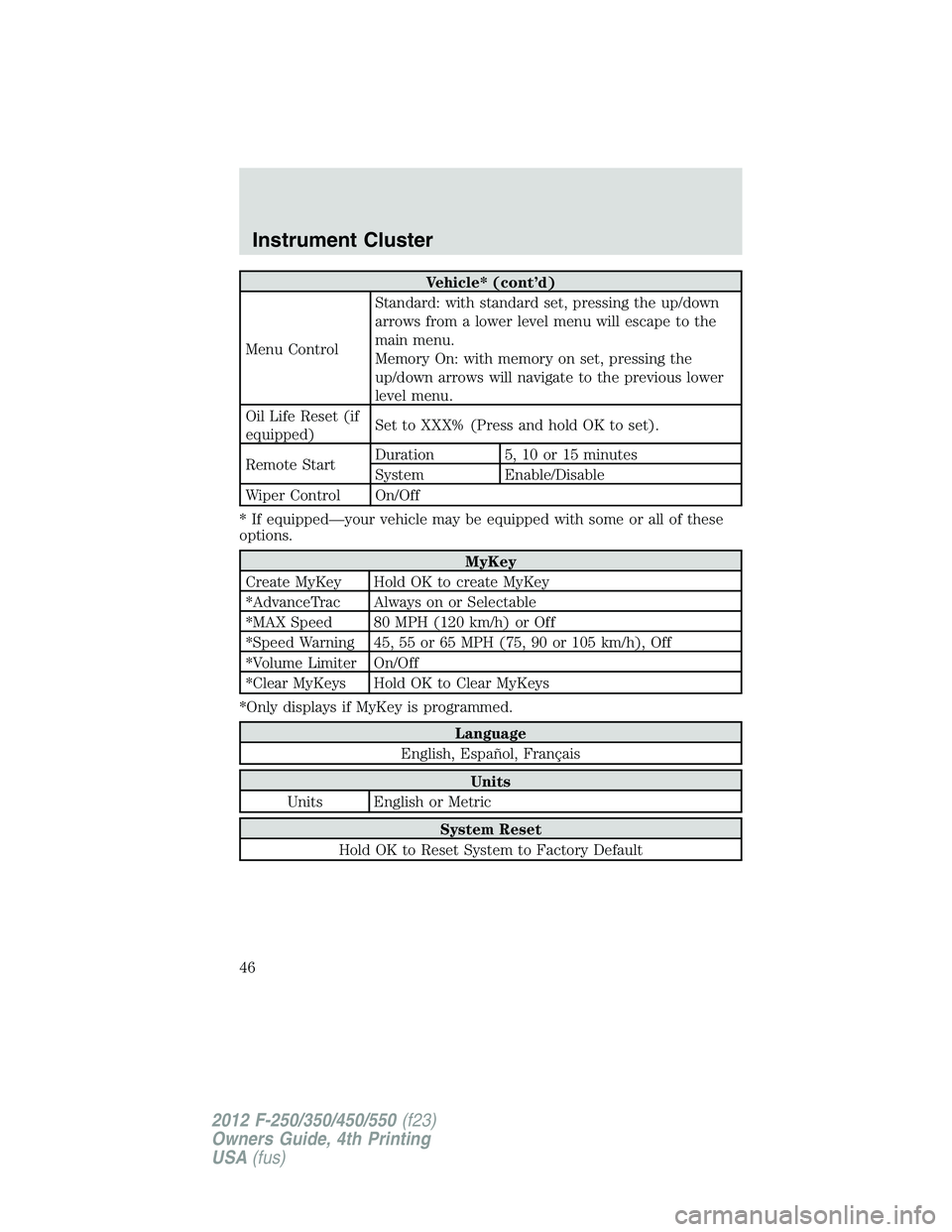
Vehicle* (cont’d)
Menu Control Standard: with standard set, pressing the up/down
arrows from a lower level menu will escape to the
main menu.
Memory On: with memory on set, pressing the
up/down arrows will navigate to the previous lower
level menu.
Oil Life Reset (if
equipped) Set to XXX% (Press and hold OK to set).
Remote Start Duration 5, 10 or 15 minutes
System Enable/Disable
Wiper Control On/Off
* If equipped—your vehicle may be equipped with some or all of these
options.
MyKey
Create MyKey Hold OK to create MyKey
*AdvanceTrac Always on or Selectable
*MAX Speed 80 MPH (120 km/h) or Off
*Speed Warning 45, 55 or 65 MPH (75, 90 or 105 km/h), Off
*Volume Limiter On/Off
*Clear MyKeys Hold OK to Clear MyKeys
*Only displays if MyKey is programmed.
Language
English, Español, Français
Units
Units English or Metric
System Reset
Hold OK to Reset System to Factory DefaultInstrument Cluster
46
2012 F-250/350/450/550 (f23)
Owners Guide, 4th Printing
USA (fus)
Page 47 of 448
Information
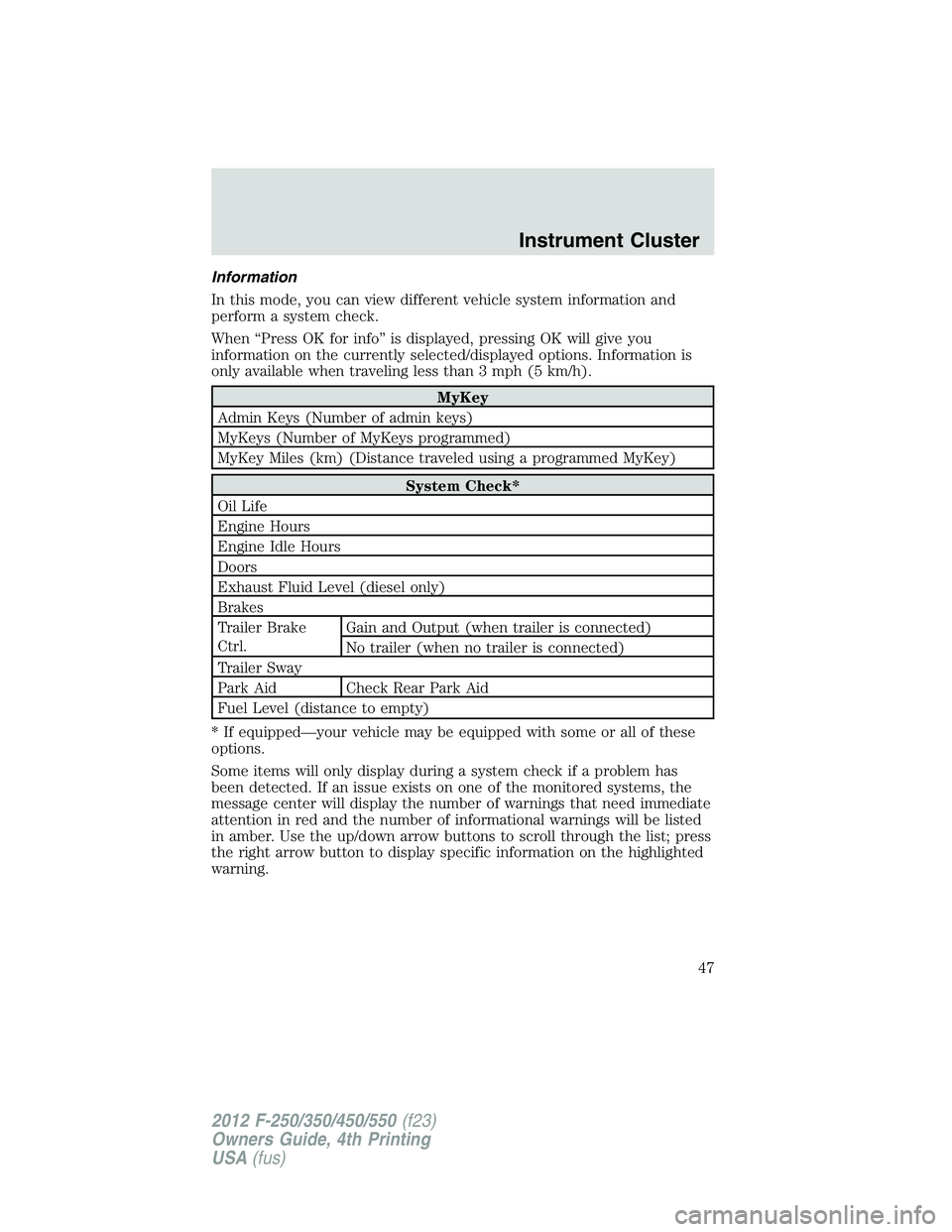
In this mode, you can view different vehicle system information and
perform a system check.
When “Press OK for info” is displayed, pressing OK will give you
information on the currently selected/displayed options. Information is
only available when traveling less than 3 mph (5 km/h).
MyKey
Admin Keys (Number of admin keys)
MyKeys (Number of MyKeys programmed)
MyKey Miles (km) (Distance traveled using a programmed MyKey)
System Check*
Oil Life
Engine Hours
Engine Idle Hours
Doors
Exhaust Fluid Level (diesel only)
Brakes
Trailer Brake
Ctrl. Gain and Output (when trailer is connected)
No trailer (when no trailer is connected)
Trailer Sway
Park Aid Check Rear Park Aid
Fuel Level (distance to empty)
* If equipped—your vehicle may be equipped with some or all of these
options.
Some items will only display during a system check if a problem has
been detected. If an issue exists on one of the monitored systems, the
message center will display the number of warnings that need immediate
attention in red and the number of informational warnings will be listed
in amber. Use the up/down arrow buttons to scroll through the list; press
the right arrow button to display specific information on the highlighted
warning. Instrument Cluster
47
2012 F-250/350/450/550 (f23)
Owners Guide, 4th Printing
USA (fus)
Page 50 of 448
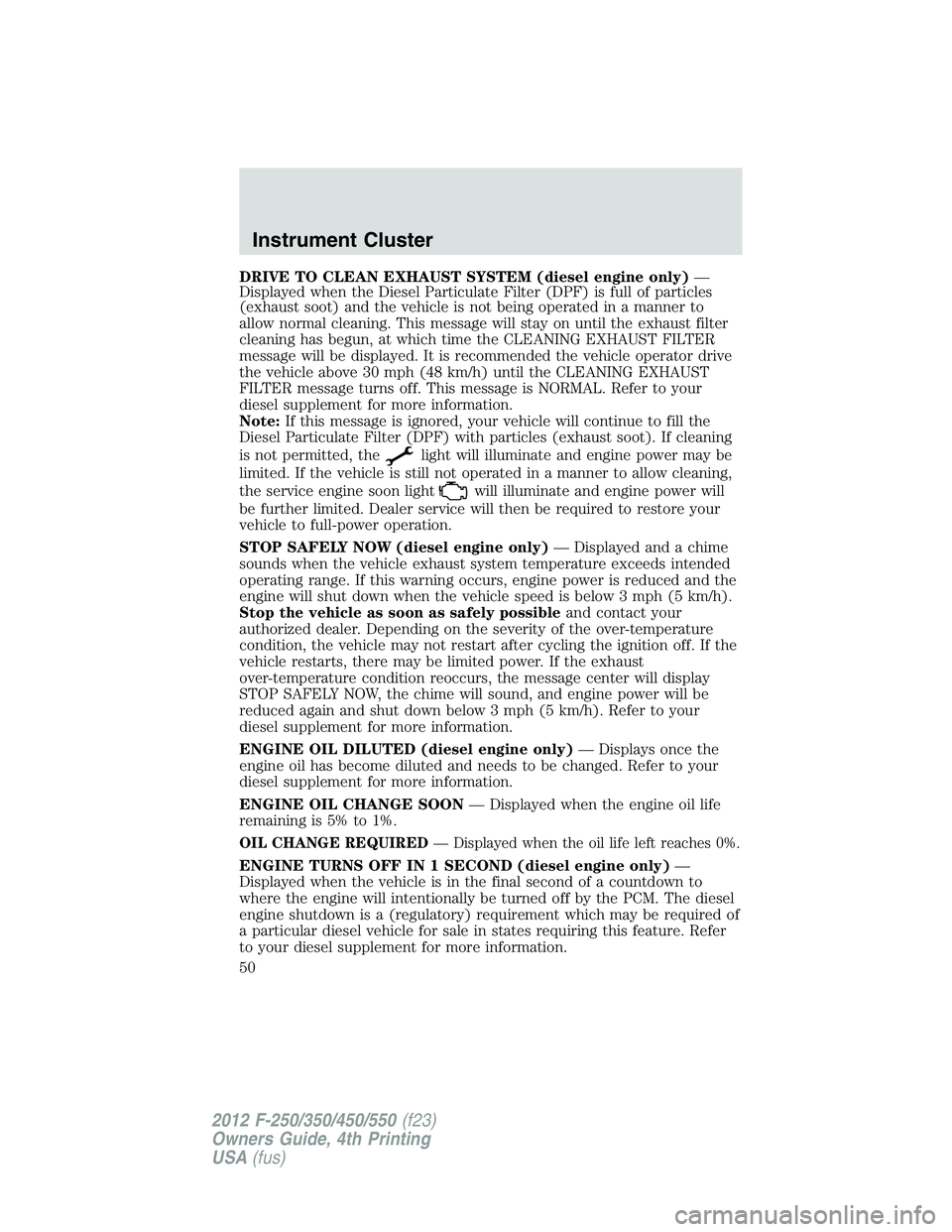
DRIVE TO CLEAN EXHAUST SYSTEM (diesel engine only) —
Displayed when the Diesel Particulate Filter (DPF) is full of particles
(exhaust soot) and the vehicle is not being operated in a manner to
allow normal cleaning. This message will stay on until the exhaust filter
cleaning has begun, at which time the CLEANING EXHAUST FILTER
message will be displayed. It is recommended the vehicle operator drive
the vehicle above 30 mph (48 km/h) until the CLEANING EXHAUST
FILTER message turns off. This message is NORMAL. Refer to your
diesel supplement for more information.
Note: If this message is ignored, your vehicle will continue to fill the
Diesel Particulate Filter (DPF) with particles (exhaust soot). If cleaning
is not permitted, the light will illuminate and engine power may be
limited. If the vehicle is still not operated in a manner to allow cleaning,
the service engine soon light will illuminate and engine power will
be further limited. Dealer service will then be required to restore your
vehicle to full-power operation.
STOP SAFELY NOW (diesel engine only) — Displayed and a chime
sounds when the vehicle exhaust system temperature exceeds intended
operating range. If this warning occurs, engine power is reduced and the
engine will shut down when the vehicle speed is below 3 mph (5 km/h).
Stop the vehicle as soon as safely possible and contact your
authorized dealer. Depending on the severity of the over-temperature
condition, the vehicle may not restart after cycling the ignition off. If the
vehicle restarts, there may be limited power. If the exhaust
over-temperature condition reoccurs, the message center will display
STOP SAFELY NOW, the chime will sound, and engine power will be
reduced again and shut down below 3 mph (5 km/h). Refer to your
diesel supplement for more information.
ENGINE OIL DILUTED (diesel engine only) — Displays once the
engine oil has become diluted and needs to be changed. Refer to your
diesel supplement for more information.
ENGINE OIL CHANGE SOON — Displayed when the engine oil life
remaining is 5% to 1%.
OIL CHANGE REQUIRED — Displayed when the oil life left reaches 0%.
ENGINE TURNS OFF IN 1 SECOND (diesel engine only) —
Displayed when the vehicle is in the final second of a countdown to
where the engine will intentionally be turned off by the PCM. The diesel
engine shutdown is a (regulatory) requirement which may be required of
a particular diesel vehicle for sale in states requiring this feature. Refer
to your diesel supplement for more information.Instrument Cluster
50
2012 F-250/350/450/550 (f23)
Owners Guide, 4th Printing
USA (fus)
Page 51 of 448
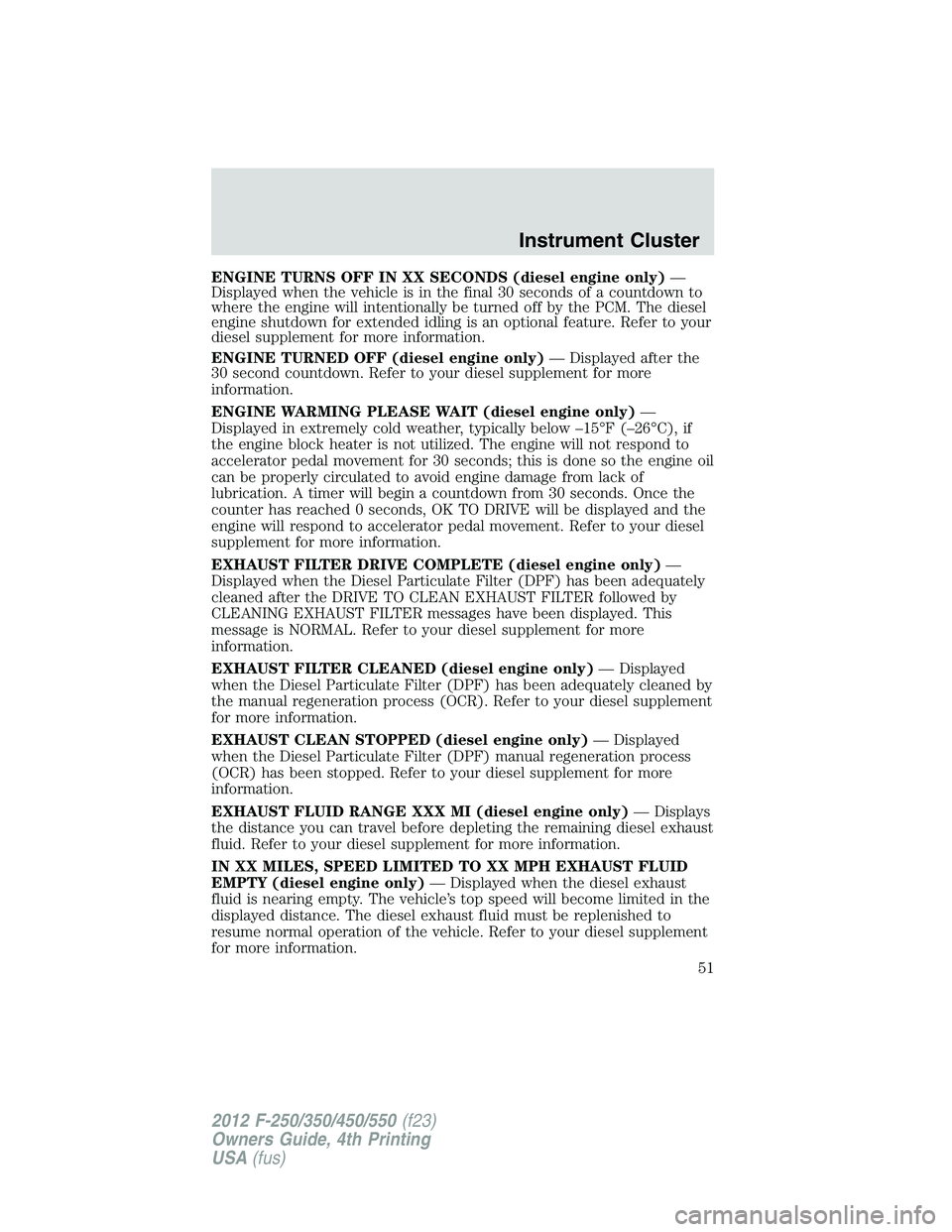
ENGINE TURNS OFF IN XX SECONDS (diesel engine only) —
Displayed when the vehicle is in the final 30 seconds of a countdown to
where the engine will intentionally be turned off by the PCM. The diesel
engine shutdown for extended idling is an optional feature. Refer to your
diesel supplement for more information.
ENGINE TURNED OFF (diesel engine only) — Displayed after the
30 second countdown. Refer to your diesel supplement for more
information.
ENGINE WARMING PLEASE WAIT (diesel engine only) —
Displayed in extremely cold weather, typically below –15°F (–26°C), if
the engine block heater is not utilized. The engine will not respond to
accelerator pedal movement for 30 seconds; this is done so the engine oil
can be properly circulated to avoid engine damage from lack of
lubrication. A timer will begin a countdown from 30 seconds. Once the
counter has reached 0 seconds, OK TO DRIVE will be displayed and the
engine will respond to accelerator pedal movement. Refer to your diesel
supplement for more information.
EXHAUST FILTER DRIVE COMPLETE (diesel engine only) —
Displayed when the Diesel Particulate Filter (DPF) has been adequately
cleaned after the DRIVE TO CLEAN EXHAUST FILTER followed by
CLEANING EXHAUST FILTER messages have been displayed. This
message is NORMAL. Refer to your diesel supplement for more
information.
EXHAUST FILTER CLEANED (diesel engine only) — Displayed
when the Diesel Particulate Filter (DPF) has been adequately cleaned by
the manual regeneration process (OCR). Refer to your diesel supplement
for more information.
EXHAUST CLEAN STOPPED (diesel engine only) — Displayed
when the Diesel Particulate Filter (DPF) manual regeneration process
(OCR) has been stopped. Refer to your diesel supplement for more
information.
EXHAUST FLUID RANGE XXX MI (diesel engine only) — Displays
the distance you can travel before depleting the remaining diesel exhaust
fluid. Refer to your diesel supplement for more information.
IN XX MILES, SPEED LIMITED TO XX MPH EXHAUST FLUID
EMPTY (diesel engine only) — Displayed when the diesel exhaust
fluid is nearing empty. The vehicle’s top speed will become limited in the
displayed distance. The diesel exhaust fluid must be replenished to
resume normal operation of the vehicle. Refer to your diesel supplement
for more information. Instrument Cluster
51
2012 F-250/350/450/550 (f23)
Owners Guide, 4th Printing
USA (fus)
Page 95 of 448
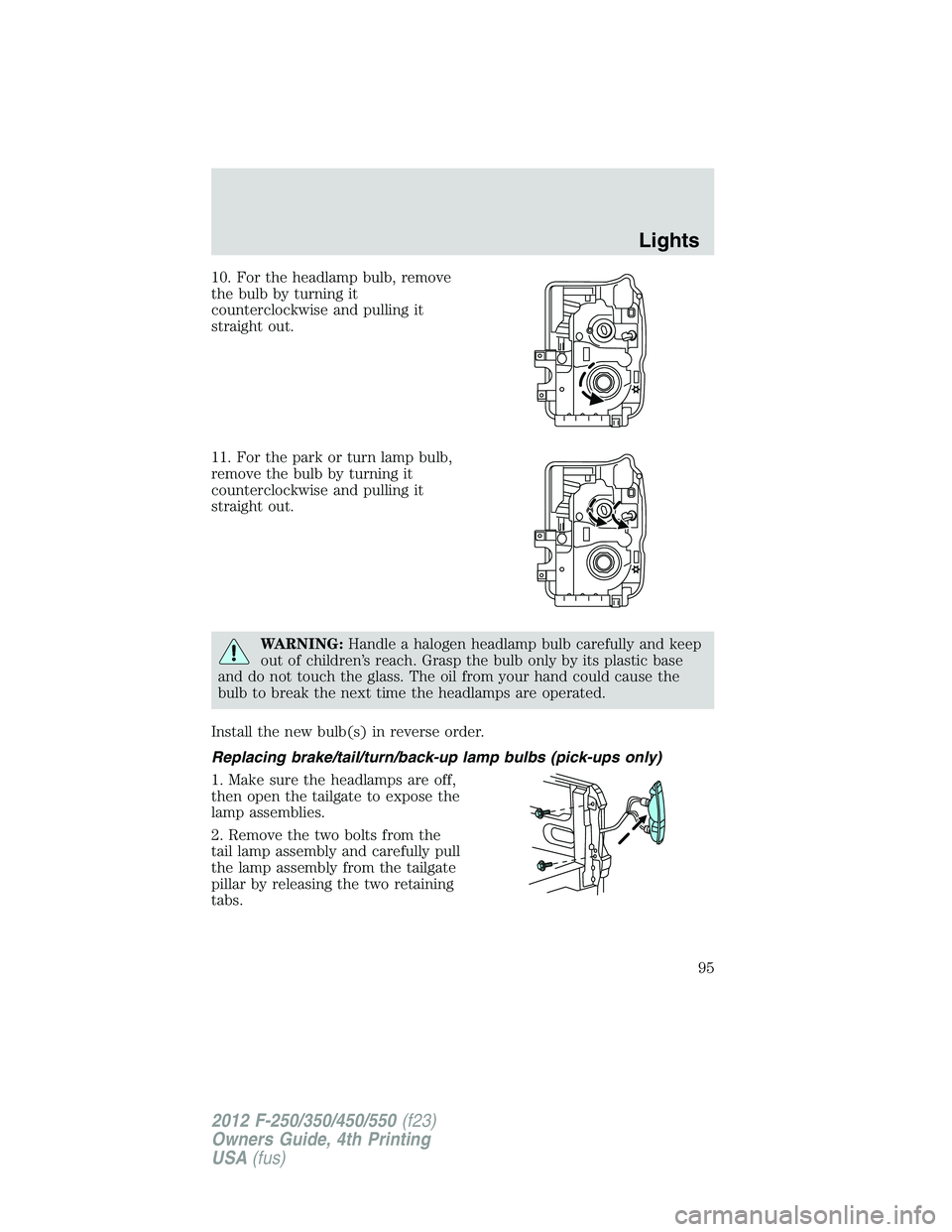
10. For the headlamp bulb, remove
the bulb by turning it
counterclockwise and pulling it
straight out.
11. For the park or turn lamp bulb,
remove the bulb by turning it
counterclockwise and pulling it
straight out.
WARNING: Handle a halogen headlamp bulb carefully and keep
out of children’s reach. Grasp the bulb only by its plastic base
and do not touch the glass. The oil from your hand could cause the
bulb to break the next time the headlamps are operated.
Install the new bulb(s) in reverse order.
Replacing brake/tail/turn/back-up lamp bulbs (pick-ups only)
1. Make sure the headlamps are off,
then open the tailgate to expose the
lamp assemblies.
2. Remove the two bolts from the
tail lamp assembly and carefully pull
the lamp assembly from the tailgate
pillar by releasing the two retaining
tabs. Lights
95
2012 F-250/350/450/550 (f23)
Owners Guide, 4th Printing
USA (fus)
Page 215 of 448
Follow all instructions provided by the manufacturer of the booster seat.
WARNING: Never place, or allow a child to place, the shoulder
belt under a child’s arm or behind the back because it reduces
the protection for the upper part of the body and may increase the risk
of injury or death in a collision.
Child restraint and safety belt maintenance
Inspect the vehicle safety belts and child safety seat systems periodically
to make sure they work properly and are not damaged. Inspect the
vehicle and child seat safety belts to make sure there are no nicks, tears
or cuts. Replace if necessary. All vehicle safety belt assemblies, including
retractors, buckles, front safety belt buckle assemblies, buckle support
assemblies (slide bar-if equipped), shoulder belt height adjusters (if
equipped), shoulder belt guide on seatback (if equipped), child safety
seat LATCH and tether anchors, and attaching hardware, should be
inspected after a collision. Refer to the child restraint manufacturer’s
instructions for additional inspection and maintenance information
specific to the child restraint. Ford Motor Company recommends that all
safety belt assemblies in use in vehicles involved in a collision be
replaced. However, if the collision was minor and an authorized dealer
finds that the belts do not show damage and continue to operate
properly, they do not need to be replaced. Safety belt assemblies not in
use during a collision should also be inspected and replaced if either
damage or improper operation is noted.
For proper care of soiled safety belts, refer to Interior in the Cleaning
chapter.
WARNING: Failure to inspect and if necessary replace the
safety belt assembly or child restraint system under the above
conditions could result in severe personal injuries in the event of a
collision. Seating and Safety Restraints
215
2012 F-250/350/450/550 (f23)
Owners Guide, 4th Printing
USA (fus)
Page 317 of 448
Operating the vehicle with the snowplow attached
Do not use your vehicle for snow removal until it has been driven at
least 500 miles (800 km).
The attached snowplow blade restricts airflow to the radiator, and may
cause the engine to run at a higher temperature: Attention to engine
temperature is especially important when outside temperatures are
above freezing. Angle the blade to maximize airflow to the radiator and
monitor engine temperature to determine whether a left or right angle
provides the best performance.
Follow the severe duty schedule in your scheduled maintenance
information for engine oil and transmission fluid change intervals.
Snowplowing with your airbag-equipped vehicle
Your vehicle is equipped with a driver and passenger airbag
Supplemental Restraint System (SRS) The SRS is designed to activate in
certain frontal and offset frontal collisions when the vehicle sustains
sufficient longitudinal deceleration.
Careless or high speed driving while plowing snow which results in
sufficient vehicle decelerations can deploy the airbag. Such driving also
increases the risk of accidents.
WARNING: All occupants of the vehicle, including the driver,
should always properly wear their safety belts, even when an air
bag supplemental restraint system (SRS) is provided.
Never remove or defeat the “tripping mechanisms” designed into the
snow removal equipment by its manufacturer. Doing so may cause
damage to the vehicle and the snow removal equipment as well as
possible airbag deployment.
WARNING: Do not attempt to service, repair, or modify the air
bag supplemental restraint system (SRS) or its fuses. See your
Ford or Lincoln Mercury dealer.
WARNING: Additional equipment such as snowplow equipment
may effect the performance of the airbag sensors increasing the
risk of injury. Please refer to the Body Builders Layout Book for
instructions about the appropriate installation of additional equipment. Driving
317
2012 F-250/350/450/550 (f23)
Owners Guide, 4th Printing
USA (fus)
Page 329 of 448
Fuse/Relay
Location Fuse Amp
Rating Protected Circuits
38 Relay Powertrain control module
(PCM) (diesel engine),
Electronic control module (ECM)
(gas engine)
39 10A** 4x4 hub lock
40 15A** 4x4 electronic lock
41 — Not used
42 — Not used
43 — Not used
44 — Not used
45 10A** Run/start relay coil
46 10A** Transmission control module
(TCM) keep-alive power (diesel
engine)
47 10A** A/C clutch feed
48 Relay Run/start
49 10A** Rearview camera system
50 10A** Blower motor relay coil
51 — Not used
52 10A** PCM/ECM/TCM run/start
53 10A** 4x4 module
54 10A** Anti-lock brake system (ABS)
run/start
55 10A** Rear window defroster coil,
Battery charge coil
56 20A** Passenger compartment fuse
panel run/start feed
57 Relay Fuel pump
58 — Not used
59 — Not used
60 — Not used
61 — Not used Roadside Emergencies
329
2012 F-250/350/450/550 (f23)
Owners Guide, 4th Printing
USA (fus)
Page 330 of 448
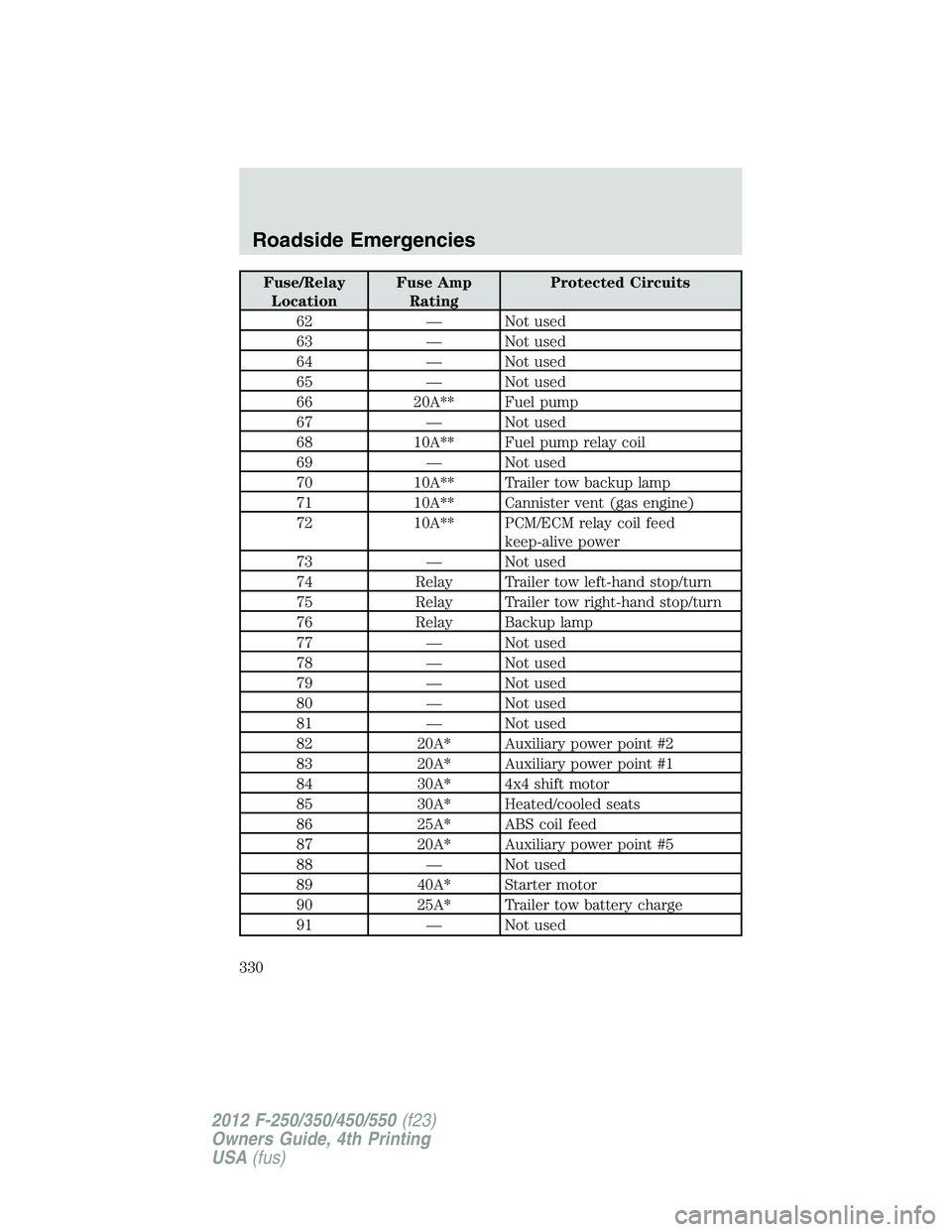
Fuse/Relay
Location Fuse Amp
Rating Protected Circuits
62 — Not used
63 — Not used
64 — Not used
65 — Not used
66 20A** Fuel pump
67 — Not used
68 10A** Fuel pump relay coil
69 — Not used
70 10A** Trailer tow backup lamp
71 10A** Cannister vent (gas engine)
72 10A** PCM/ECM relay coil feed
keep-alive power
73 — Not used
74 Relay Trailer tow left-hand stop/turn
75 Relay Trailer tow right-hand stop/turn
76 Relay Backup lamp
77 — Not used
78 — Not used
79 — Not used
80 — Not used
81 — Not used
82 20A* Auxiliary power point #2
83 20A* Auxiliary power point #1
84 30A* 4x4 shift motor
85 30A* Heated/cooled seats
86 25A* ABS coil feed
87 20A* Auxiliary power point #5
88 — Not used
89 40A* Starter motor
90 25A* Trailer tow battery charge
91 — Not usedRoadside Emergencies
330
2012 F-250/350/450/550 (f23)
Owners Guide, 4th Printing
USA (fus)
Page 347 of 448
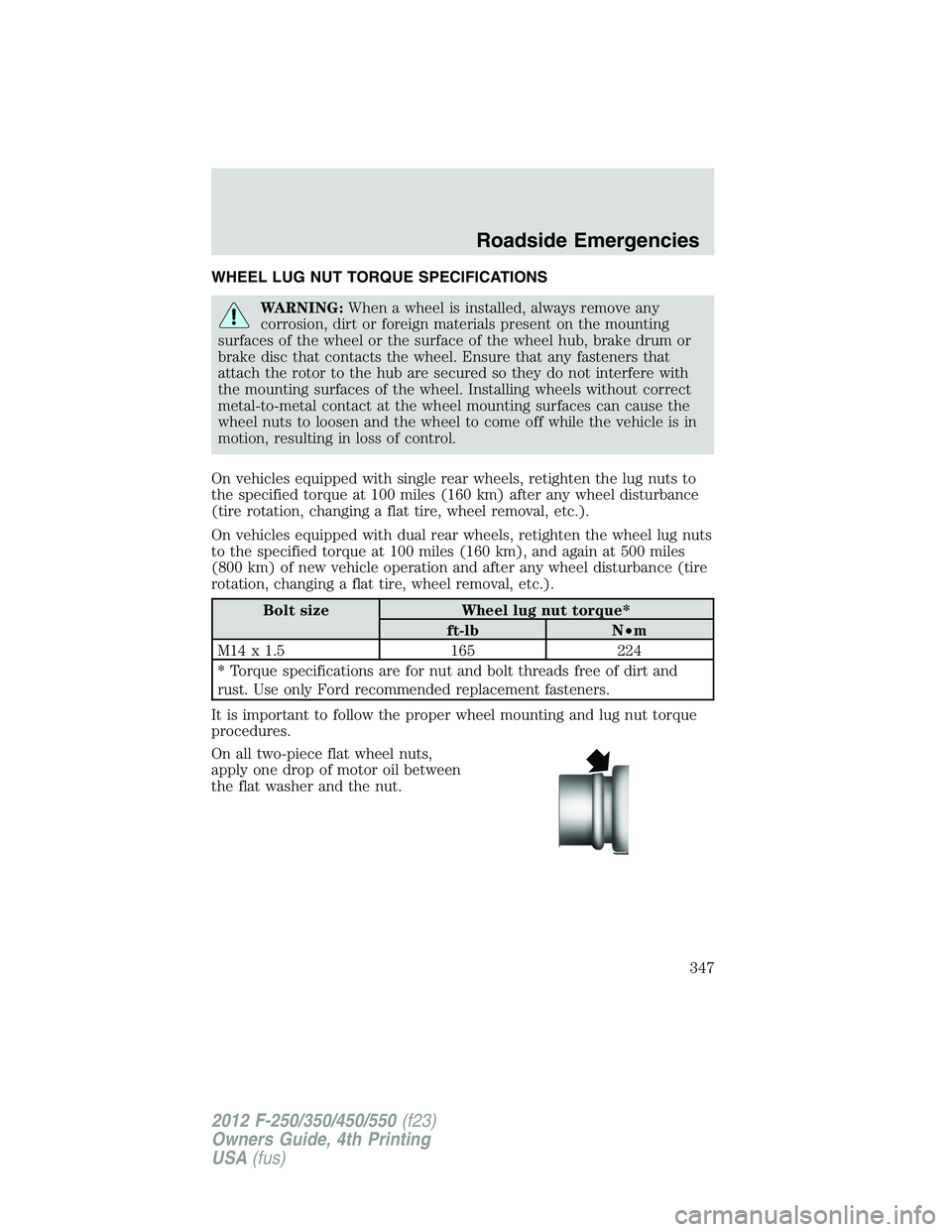
WHEEL LUG NUT TORQUE SPECIFICATIONS
WARNING: When a wheel is installed, always remove any
corrosion, dirt or foreign materials present on the mounting
surfaces of the wheel or the surface of the wheel hub, brake drum or
brake disc that contacts the wheel. Ensure that any fasteners that
attach the rotor to the hub are secured so they do not interfere with
the mounting surfaces of the wheel. Installing wheels without correct
metal-to-metal contact at the wheel mounting surfaces can cause the
wheel nuts to loosen and the wheel to come off while the vehicle is in
motion, resulting in loss of control.
On vehicles equipped with single rear wheels, retighten the lug nuts to
the specified torque at 100 miles (160 km) after any wheel disturbance
(tire rotation, changing a flat tire, wheel removal, etc.).
On vehicles equipped with dual rear wheels, retighten the wheel lug nuts
to the specified torque at 100 miles (160 km), and again at 500 miles
(800 km) of new vehicle operation and after any wheel disturbance (tire
rotation, changing a flat tire, wheel removal, etc.).
Bolt size Wheel lug nut torque*
ft-lb N • m
M14 x 1.5 165 224
* Torque specifications are for nut and bolt threads free of dirt and
rust. Use only Ford recommended replacement fasteners.
It is important to follow the proper wheel mounting and lug nut torque
procedures.
On all two-piece flat wheel nuts,
apply one drop of motor oil between
the flat washer and the nut. Roadside Emergencies
347
2012 F-250/350/450/550 (f23)
Owners Guide, 4th Printing
USA (fus)