check engine FORD F450 SUPER DUTY 2017 User Guide
[x] Cancel search | Manufacturer: FORD, Model Year: 2017, Model line: F450 SUPER DUTY, Model: FORD F450 SUPER DUTY 2017Pages: 642, PDF Size: 12.35 MB
Page 137 of 642
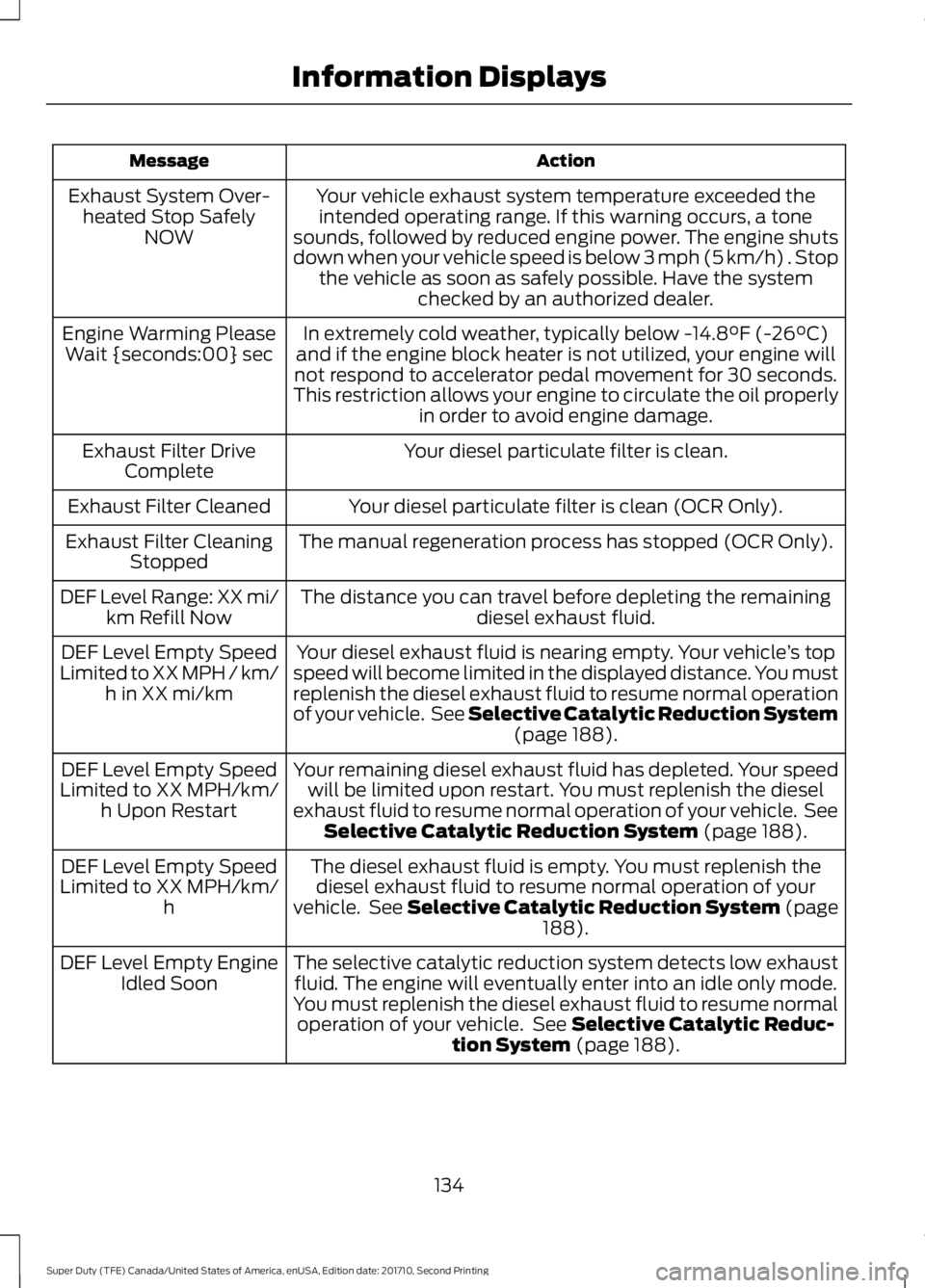
ActionMessage
Your vehicle exhaust system temperature exceeded theintended operating range. If this warning occurs, a tonesounds, followed by reduced engine power. The engine shutsdown when your vehicle speed is below 3 mph (5 km/h) . Stopthe vehicle as soon as safely possible. Have the systemchecked by an authorized dealer.
Exhaust System Over-heated Stop SafelyNOW
In extremely cold weather, typically below -14.8°F (-26°C)and if the engine block heater is not utilized, your engine willnot respond to accelerator pedal movement for 30 seconds.This restriction allows your engine to circulate the oil properlyin order to avoid engine damage.
Engine Warming PleaseWait {seconds:00} sec
Your diesel particulate filter is clean.Exhaust Filter DriveComplete
Your diesel particulate filter is clean (OCR Only).Exhaust Filter Cleaned
The manual regeneration process has stopped (OCR Only).Exhaust Filter CleaningStopped
The distance you can travel before depleting the remainingdiesel exhaust fluid.DEF Level Range: XX mi/km Refill Now
Your diesel exhaust fluid is nearing empty. Your vehicle’s topspeed will become limited in the displayed distance. You mustreplenish the diesel exhaust fluid to resume normal operationof your vehicle. See Selective Catalytic Reduction System(page 188).
DEF Level Empty SpeedLimited to XX MPH / km/h in XX mi/km
Your remaining diesel exhaust fluid has depleted. Your speedwill be limited upon restart. You must replenish the dieselexhaust fluid to resume normal operation of your vehicle. SeeSelective Catalytic Reduction System (page 188).
DEF Level Empty SpeedLimited to XX MPH/km/h Upon Restart
The diesel exhaust fluid is empty. You must replenish thediesel exhaust fluid to resume normal operation of yourvehicle. See Selective Catalytic Reduction System (page188).
DEF Level Empty SpeedLimited to XX MPH/km/h
The selective catalytic reduction system detects low exhaustfluid. The engine will eventually enter into an idle only mode.You must replenish the diesel exhaust fluid to resume normaloperation of your vehicle. See Selective Catalytic Reduc-tion System (page 188).
DEF Level Empty EngineIdled Soon
134
Super Duty (TFE) Canada/United States of America, enUSA, Edition date: 201710, Second Printing
Information Displays
Page 138 of 642
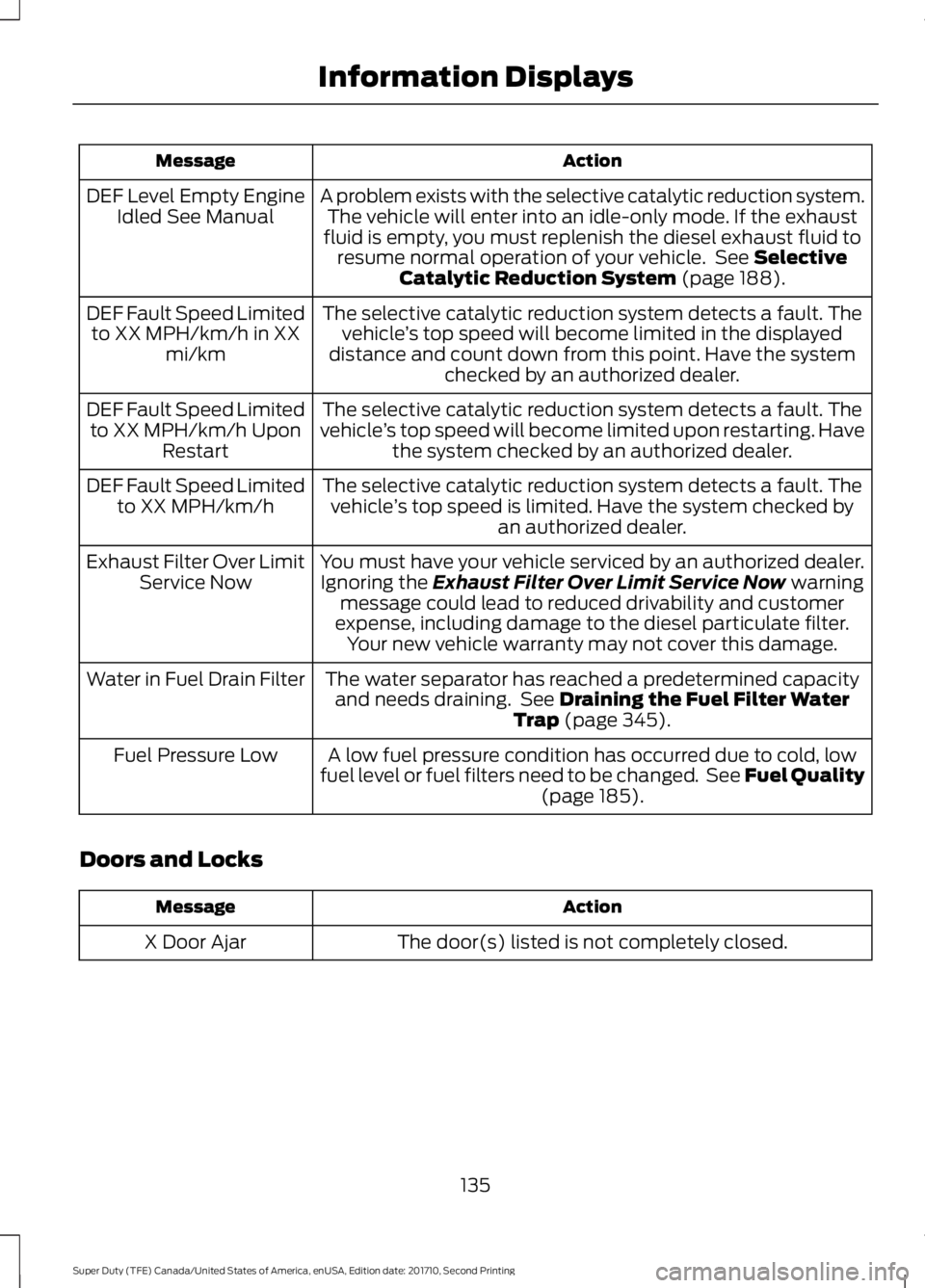
ActionMessage
A problem exists with the selective catalytic reduction system.The vehicle will enter into an idle-only mode. If the exhaustfluid is empty, you must replenish the diesel exhaust fluid toresume normal operation of your vehicle. See SelectiveCatalytic Reduction System (page 188).
DEF Level Empty EngineIdled See Manual
The selective catalytic reduction system detects a fault. Thevehicle’s top speed will become limited in the displayeddistance and count down from this point. Have the systemchecked by an authorized dealer.
DEF Fault Speed Limitedto XX MPH/km/h in XXmi/km
The selective catalytic reduction system detects a fault. Thevehicle’s top speed will become limited upon restarting. Havethe system checked by an authorized dealer.
DEF Fault Speed Limitedto XX MPH/km/h UponRestart
The selective catalytic reduction system detects a fault. Thevehicle’s top speed is limited. Have the system checked byan authorized dealer.
DEF Fault Speed Limitedto XX MPH/km/h
You must have your vehicle serviced by an authorized dealer.Ignoring the Exhaust Filter Over Limit Service Now warningmessage could lead to reduced drivability and customerexpense, including damage to the diesel particulate filter.Your new vehicle warranty may not cover this damage.
Exhaust Filter Over LimitService Now
The water separator has reached a predetermined capacityand needs draining. See Draining the Fuel Filter WaterTrap (page 345).
Water in Fuel Drain Filter
A low fuel pressure condition has occurred due to cold, lowfuel level or fuel filters need to be changed. See Fuel Quality(page 185).
Fuel Pressure Low
Doors and Locks
ActionMessage
The door(s) listed is not completely closed.X Door Ajar
135
Super Duty (TFE) Canada/United States of America, enUSA, Edition date: 201710, Second Printing
Information Displays
Page 139 of 642
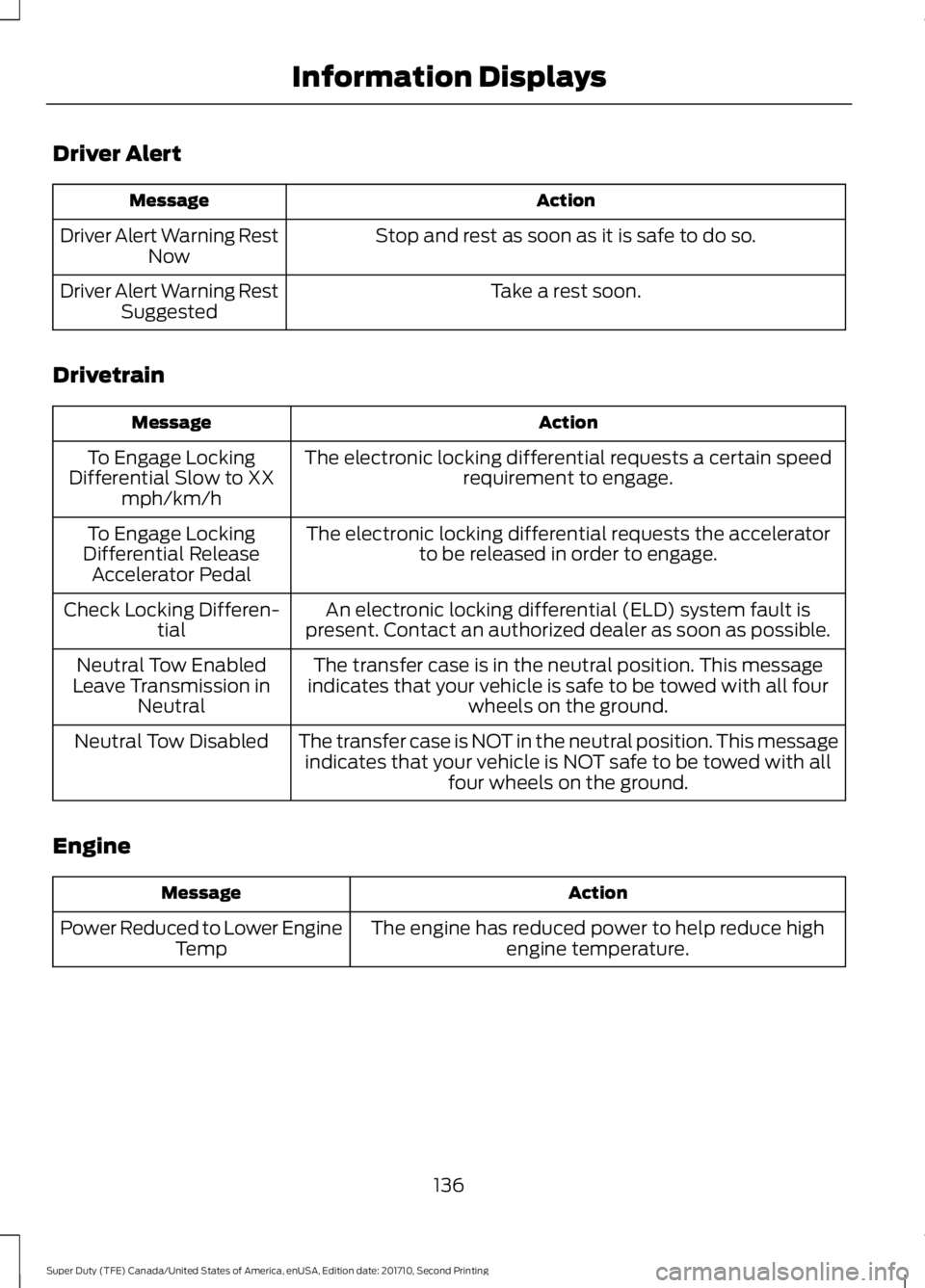
Driver Alert
ActionMessage
Stop and rest as soon as it is safe to do so.Driver Alert Warning RestNow
Take a rest soon.Driver Alert Warning RestSuggested
Drivetrain
ActionMessage
The electronic locking differential requests a certain speedrequirement to engage.To Engage LockingDifferential Slow to XXmph/km/h
The electronic locking differential requests the acceleratorto be released in order to engage.To Engage LockingDifferential ReleaseAccelerator Pedal
An electronic locking differential (ELD) system fault ispresent. Contact an authorized dealer as soon as possible.Check Locking Differen-tial
The transfer case is in the neutral position. This messageindicates that your vehicle is safe to be towed with all fourwheels on the ground.
Neutral Tow EnabledLeave Transmission inNeutral
The transfer case is NOT in the neutral position. This messageindicates that your vehicle is NOT safe to be towed with allfour wheels on the ground.
Neutral Tow Disabled
Engine
ActionMessage
The engine has reduced power to help reduce highengine temperature.Power Reduced to Lower EngineTemp
136
Super Duty (TFE) Canada/United States of America, enUSA, Edition date: 201710, Second Printing
Information Displays
Page 140 of 642
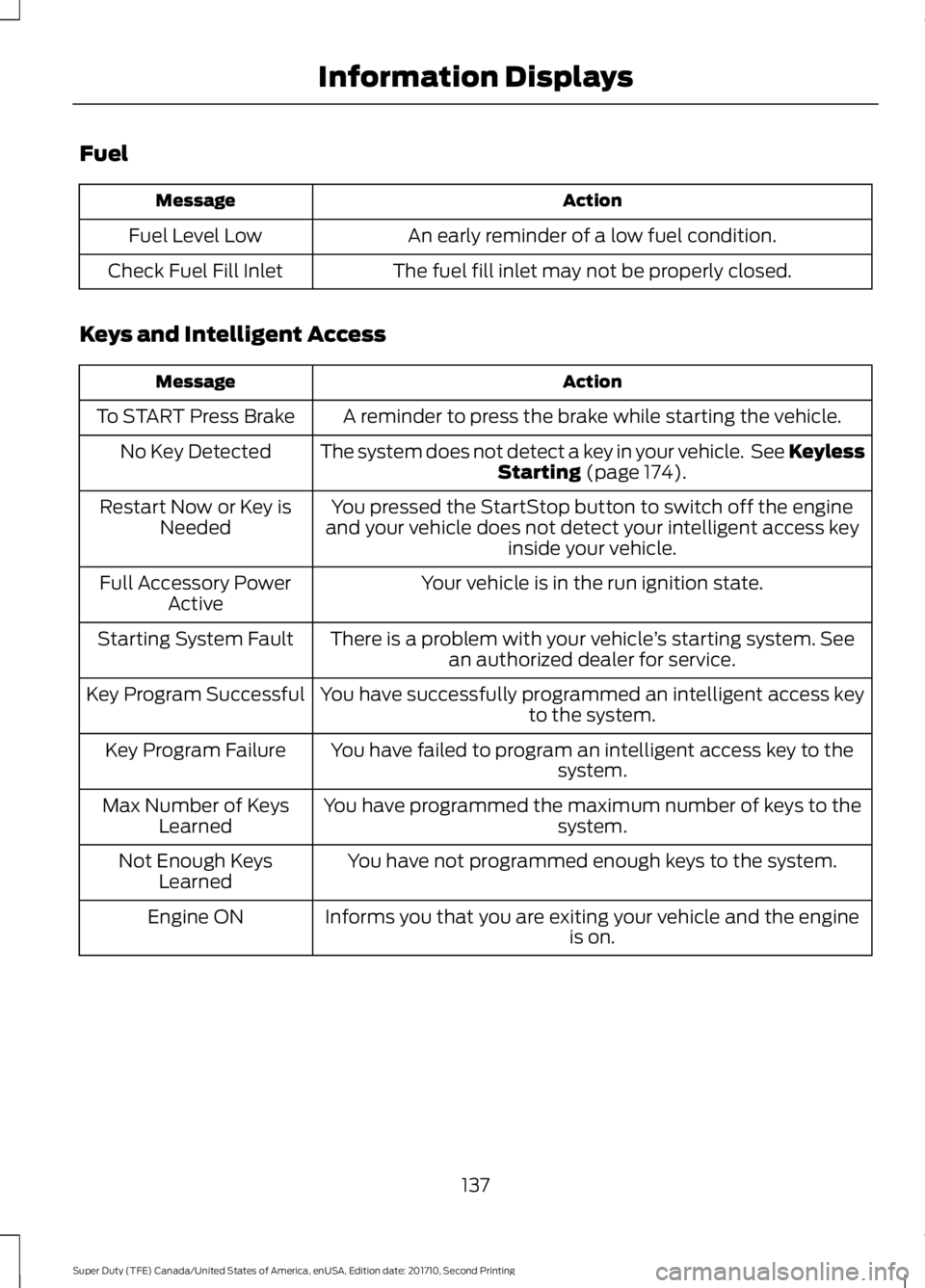
Fuel
ActionMessage
An early reminder of a low fuel condition.Fuel Level Low
The fuel fill inlet may not be properly closed.Check Fuel Fill Inlet
Keys and Intelligent Access
ActionMessage
A reminder to press the brake while starting the vehicle.To START Press Brake
The system does not detect a key in your vehicle. See KeylessStarting (page 174).No Key Detected
You pressed the StartStop button to switch off the engineand your vehicle does not detect your intelligent access keyinside your vehicle.
Restart Now or Key isNeeded
Your vehicle is in the run ignition state.Full Accessory PowerActive
There is a problem with your vehicle’s starting system. Seean authorized dealer for service.Starting System Fault
You have successfully programmed an intelligent access keyto the system.Key Program Successful
You have failed to program an intelligent access key to thesystem.Key Program Failure
You have programmed the maximum number of keys to thesystem.Max Number of KeysLearned
You have not programmed enough keys to the system.Not Enough KeysLearned
Informs you that you are exiting your vehicle and the engineis on.Engine ON
137
Super Duty (TFE) Canada/United States of America, enUSA, Edition date: 201710, Second Printing
Information Displays
Page 141 of 642
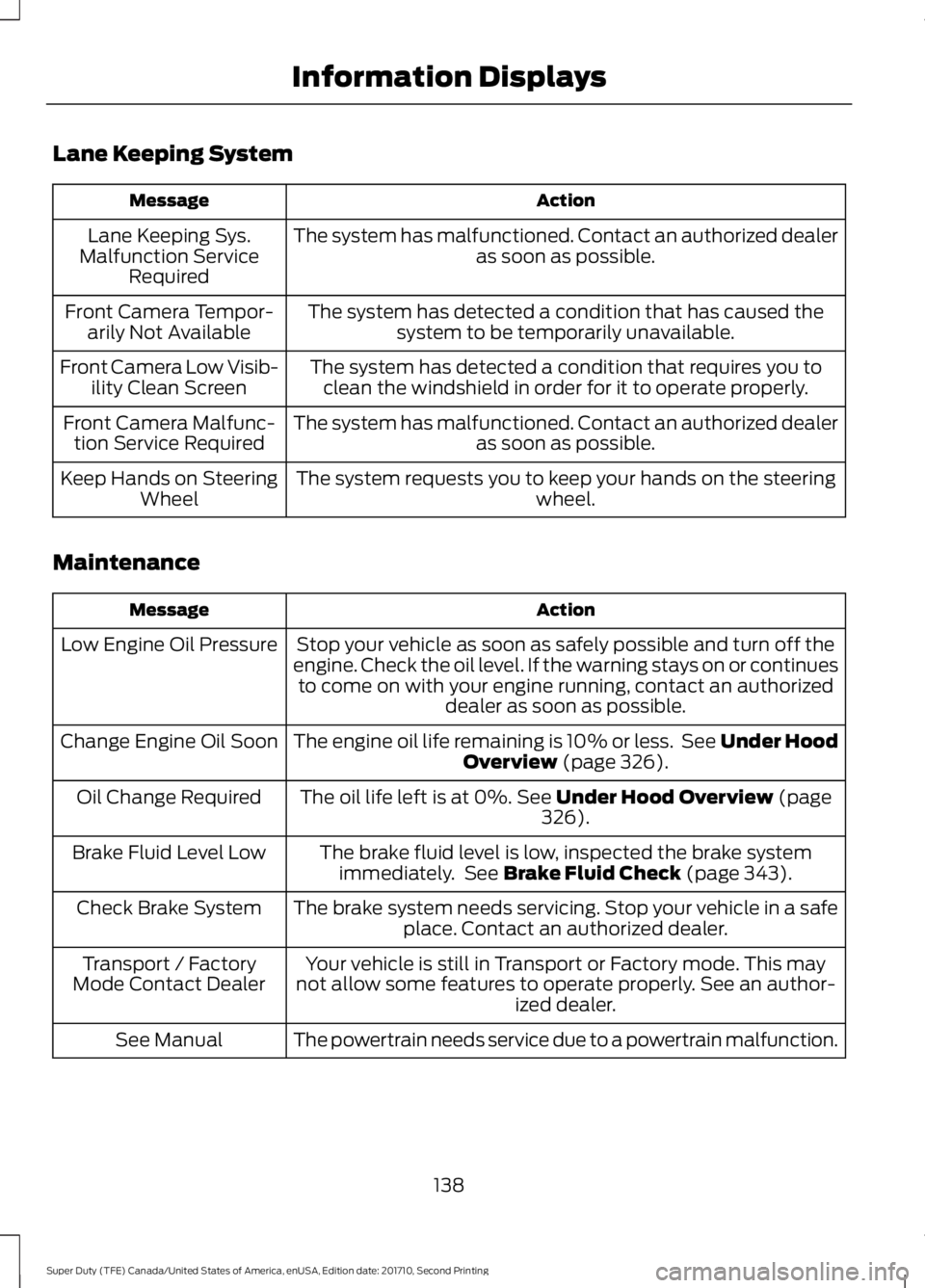
Lane Keeping System
ActionMessage
The system has malfunctioned. Contact an authorized dealeras soon as possible.Lane Keeping Sys.Malfunction ServiceRequired
The system has detected a condition that has caused thesystem to be temporarily unavailable.Front Camera Tempor-arily Not Available
The system has detected a condition that requires you toclean the windshield in order for it to operate properly.Front Camera Low Visib-ility Clean Screen
The system has malfunctioned. Contact an authorized dealeras soon as possible.Front Camera Malfunc-tion Service Required
The system requests you to keep your hands on the steeringwheel.Keep Hands on SteeringWheel
Maintenance
ActionMessage
Stop your vehicle as soon as safely possible and turn off theengine. Check the oil level. If the warning stays on or continuesto come on with your engine running, contact an authorizeddealer as soon as possible.
Low Engine Oil Pressure
The engine oil life remaining is 10% or less. See Under HoodOverview (page 326).Change Engine Oil Soon
The oil life left is at 0%. See Under Hood Overview (page326).Oil Change Required
The brake fluid level is low, inspected the brake systemimmediately. See Brake Fluid Check (page 343).Brake Fluid Level Low
The brake system needs servicing. Stop your vehicle in a safeplace. Contact an authorized dealer.Check Brake System
Your vehicle is still in Transport or Factory mode. This maynot allow some features to operate properly. See an author-ized dealer.
Transport / FactoryMode Contact Dealer
The powertrain needs service due to a powertrain malfunction.See Manual
138
Super Duty (TFE) Canada/United States of America, enUSA, Edition date: 201710, Second Printing
Information Displays
Page 176 of 642
GENERAL INFORMATION
WARNINGS
Extended idling at high enginespeeds can produce very hightemperatures in the engine andexhaust system, creating the risk of fire orother damage.
Do not park, idle or drive your vehicleon dry grass or other dry groundcover. The emission system heats upthe engine compartment and exhaustsystem, creating the risk of fire.
Do not start the engine in a closedgarage or in other enclosed areas.Exhaust fumes can be toxic. Alwaysopen the garage door before you start theengine.
If you smell exhaust fumes insideyour vehicle, have your vehiclechecked by your authorized dealerimmediately. Do not drive your vehicle ifyou smell exhaust fumes.
If you disconnect the battery, your vehiclemay exhibit some unusual drivingcharacteristics for approximately 5 miles(8 kilometers) after you reconnect it. Thisis because the engine management systemmust realign itself with the engine. You candisregard any unusual drivingcharacteristics during this period.
The powertrain control system meets allCanadian interference-causing equipmentstandard requirements regulating theimpulse electrical field or radio noise.
When you start the engine, avoid pressingthe accelerator pedal before and duringoperation. Only use the accelerator pedalwhen you have difficulty starting theengine.
If your vehicle is operated in a heavy snowstorm or blowing snow conditions, theengine air induction may become partiallyclogged with snow and ice. If this occurs,the engine may experience a significantreduction in power output. At the earliestopportunity, clear all the snow and iceaway from the air induction inlet.
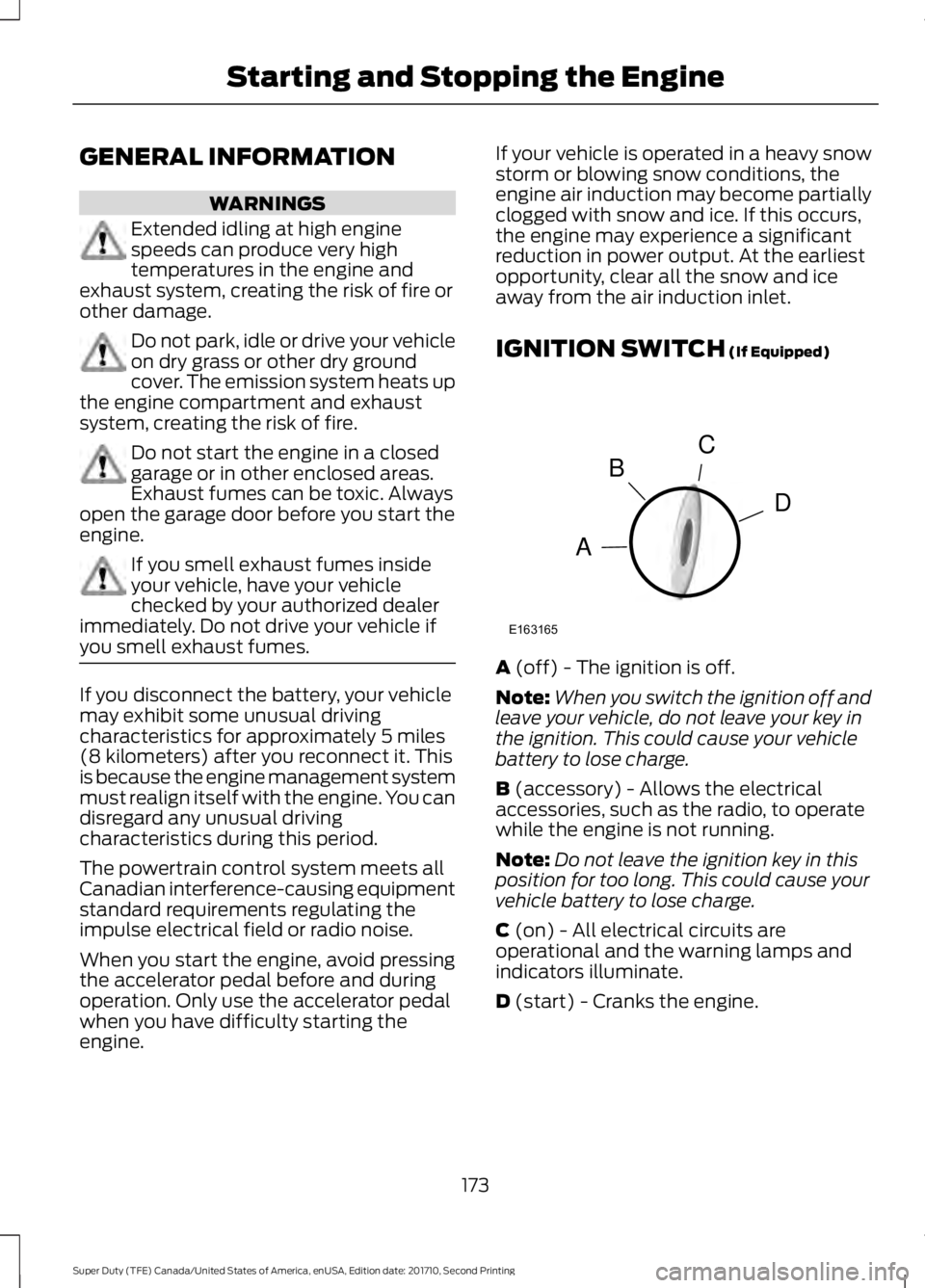
IGNITION SWITCH (If Equipped)
A (off) - The ignition is off.
Note:When you switch the ignition off andleave your vehicle, do not leave your key inthe ignition. This could cause your vehiclebattery to lose charge.
B (accessory) - Allows the electricalaccessories, such as the radio, to operatewhile the engine is not running.
Note:Do not leave the ignition key in thisposition for too long. This could cause yourvehicle battery to lose charge.
C (on) - All electrical circuits areoperational and the warning lamps andindicators illuminate.
D (start) - Cranks the engine.
173
Super Duty (TFE) Canada/United States of America, enUSA, Edition date: 201710, Second Printing
Starting and Stopping the EngineC
D
B
A
E163165
Page 177 of 642
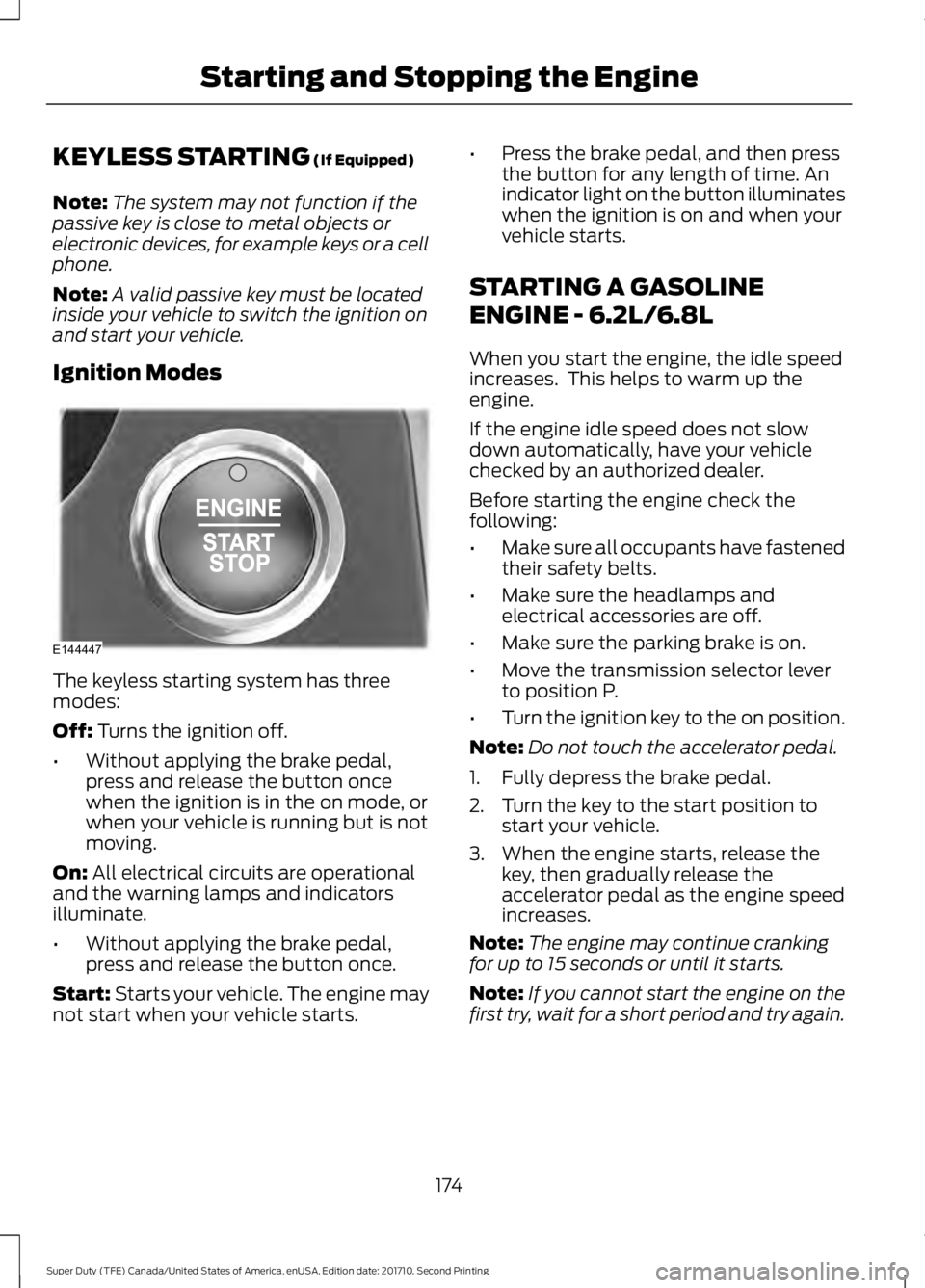
KEYLESS STARTING (If Equipped)
Note:The system may not function if thepassive key is close to metal objects orelectronic devices, for example keys or a cellphone.
Note:A valid passive key must be locatedinside your vehicle to switch the ignition onand start your vehicle.
Ignition Modes
The keyless starting system has threemodes:
Off: Turns the ignition off.
•Without applying the brake pedal,press and release the button oncewhen the ignition is in the on mode, orwhen your vehicle is running but is notmoving.
On: All electrical circuits are operationaland the warning lamps and indicatorsilluminate.
•Without applying the brake pedal,press and release the button once.
Start: Starts your vehicle. The engine maynot start when your vehicle starts.
•Press the brake pedal, and then pressthe button for any length of time. Anindicator light on the button illuminateswhen the ignition is on and when yourvehicle starts.
STARTING A GASOLINE
ENGINE - 6.2L/6.8L
When you start the engine, the idle speedincreases. This helps to warm up theengine.
If the engine idle speed does not slowdown automatically, have your vehiclechecked by an authorized dealer.
Before starting the engine check thefollowing:
•Make sure all occupants have fastenedtheir safety belts.
•Make sure the headlamps andelectrical accessories are off.
•Make sure the parking brake is on.
•Move the transmission selector leverto position P.
•Turn the ignition key to the on position.
Note:Do not touch the accelerator pedal.
1. Fully depress the brake pedal.
2. Turn the key to the start position tostart your vehicle.
3. When the engine starts, release thekey, then gradually release theaccelerator pedal as the engine speedincreases.
Note:The engine may continue crankingfor up to 15 seconds or until it starts.
Note:If you cannot start the engine on thefirst try, wait for a short period and try again.
174
Super Duty (TFE) Canada/United States of America, enUSA, Edition date: 201710, Second Printing
Starting and Stopping the EngineE144447
Page 179 of 642
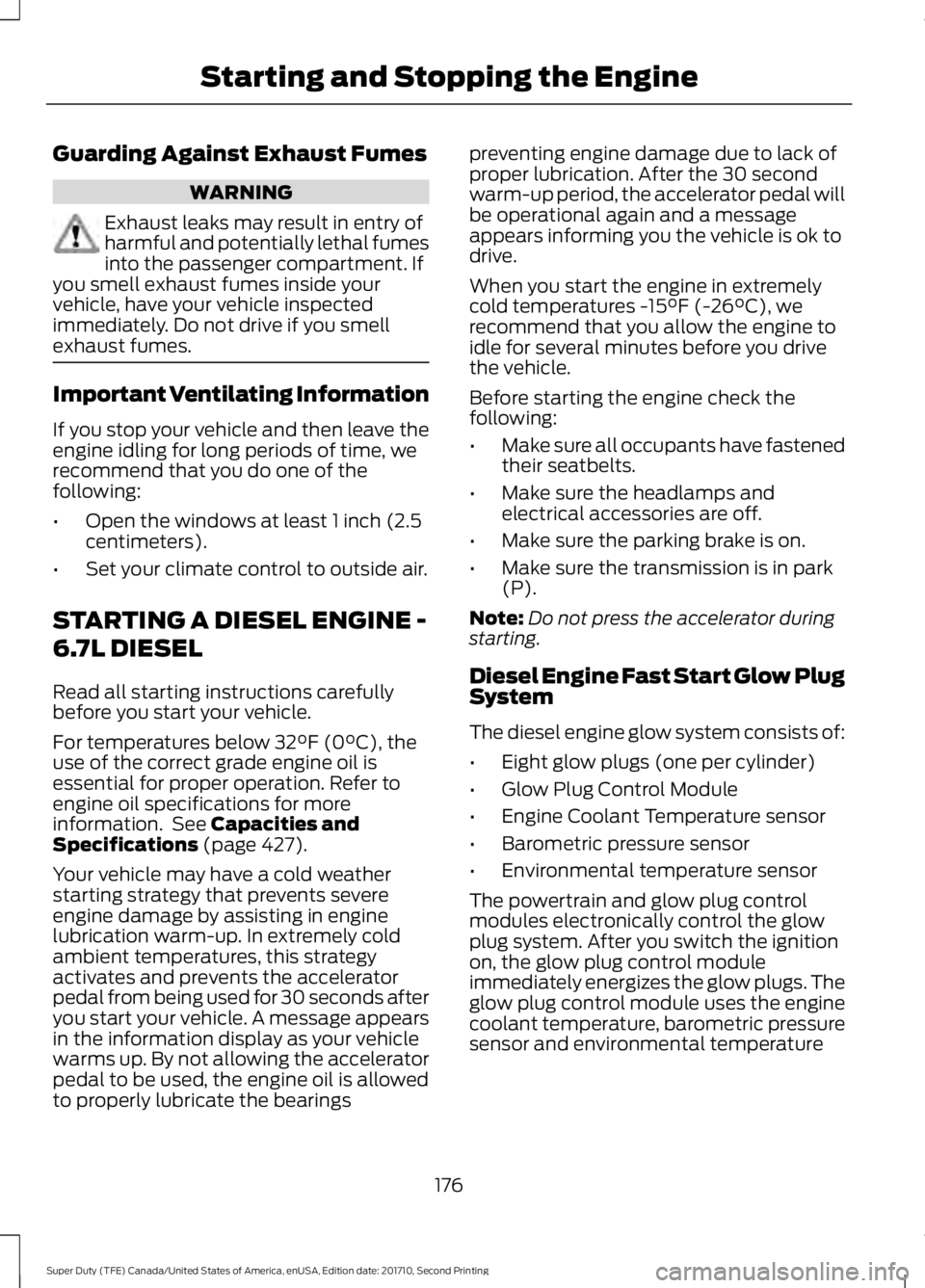
Guarding Against Exhaust Fumes
WARNING
Exhaust leaks may result in entry ofharmful and potentially lethal fumesinto the passenger compartment. Ifyou smell exhaust fumes inside yourvehicle, have your vehicle inspectedimmediately. Do not drive if you smellexhaust fumes.
Important Ventilating Information
If you stop your vehicle and then leave theengine idling for long periods of time, werecommend that you do one of thefollowing:
•Open the windows at least 1 inch (2.5centimeters).
•Set your climate control to outside air.
STARTING A DIESEL ENGINE -
6.7L DIESEL
Read all starting instructions carefullybefore you start your vehicle.
For temperatures below 32°F (0°C), theuse of the correct grade engine oil isessential for proper operation. Refer toengine oil specifications for moreinformation. See Capacities andSpecifications (page 427).
Your vehicle may have a cold weatherstarting strategy that prevents severeengine damage by assisting in enginelubrication warm-up. In extremely coldambient temperatures, this strategyactivates and prevents the acceleratorpedal from being used for 30 seconds afteryou start your vehicle. A message appearsin the information display as your vehiclewarms up. By not allowing the acceleratorpedal to be used, the engine oil is allowedto properly lubricate the bearings
preventing engine damage due to lack ofproper lubrication. After the 30 secondwarm-up period, the accelerator pedal willbe operational again and a messageappears informing you the vehicle is ok todrive.
When you start the engine in extremelycold temperatures -15°F (-26°C), werecommend that you allow the engine toidle for several minutes before you drivethe vehicle.
Before starting the engine check thefollowing:
•Make sure all occupants have fastenedtheir seatbelts.
•Make sure the headlamps andelectrical accessories are off.
•Make sure the parking brake is on.
•Make sure the transmission is in park(P).
Note:Do not press the accelerator duringstarting.
Diesel Engine Fast Start Glow PlugSystem
The diesel engine glow system consists of:
•Eight glow plugs (one per cylinder)
•Glow Plug Control Module
•Engine Coolant Temperature sensor
•Barometric pressure sensor
•Environmental temperature sensor
The powertrain and glow plug controlmodules electronically control the glowplug system. After you switch the ignitionon, the glow plug control moduleimmediately energizes the glow plugs. Theglow plug control module uses the enginecoolant temperature, barometric pressuresensor and environmental temperature
176
Super Duty (TFE) Canada/United States of America, enUSA, Edition date: 201710, Second Printing
Starting and Stopping the Engine
Page 181 of 642
Your vehicle has a fuel and water separatorthat recirculates fuel from the engine tohelp prevent fuel filter clogging. To avoidengine fuel starvation during cold weatheroperation of 32°F (0°C) or below, werecommend that the fuel level in your tankshould not drop below ¼ full. This helpsprevent air from entering the fuel systemand stalling the engine.
Your vehicle has a selective catalyticreduction system that uses Diesel ExhaustFluid (DEF) to operate properly. You needto replenish your vehicle’s DEF at certainintervals. When filling your vehicle’s DEFtank in cold weather, take special care toprevent damage to the tank. SeeSelective Catalytic Reduction System(page 188).
In cold weather below 32°F (0°C), theengine may slowly increase to a higher idlespeed if you leave it idling in park (P). Asthe engine warms-up, the engine soundlevel decreases due to the activation ofPCM-controlled sound reduction features.
If you operate your vehicle in a heavysnowstorm or blowing snow conditions,snow and ice can clog the engine airinduction. If this occurs, the engine mayexperience a significant reduction in poweroutput. At the earliest opportunity, clearall the snow and ice away from inside theair filter assembly. Remove the air cleanercover and the air filter and remove anysnow or ice. Remove any debris, snow orice, on the foam filter by brushing thesurface with a soft brush. Once you havecleared all of the debris, reinstall the airfilter and cover.
Do not use water, solvents, or a hard brushfor cleaning the foam filter.
WARNING
To reduce the risk of vehicle damageand personal burn injuries, do notstart your engine with the air cleanerremoved and do not remove it while theengine is running.
In order to operate the engine intemperatures of 32°F (0°C) or lower, readthe following instructions:
•Make sure that the batteries are ofsufficient size and are fully charged.Check other electrical components tomake sure they are in optimumcondition.
•Use the proper coolant solution at theconcentration recommendedprotecting the engine against damagefrom freezing.
•Try to keep the fuel tank full as muchas possible at the end of operation toprevent condensation in the fuelsystem.
•Make sure you use proper cold weatherengine oil and that it is at its properlevel. Also, if necessary, make sure tofollow the engine oil and filter changeschedule found under the Specialoperating conditions section listed inthe scheduled maintenanceinformation.
•At temperatures of -9°F (-23°C) orbelow, it is recommended that you usean engine block heater to improve coldengine starting.
•If operating in arctic temperatures of-20°F (-29°C) or lower, consult yourtruck dealer for information aboutspecial cold weather equipment andprecautions.
178
Super Duty (TFE) Canada/United States of America, enUSA, Edition date: 201710, Second Printing
Starting and Stopping the Engine
Page 185 of 642
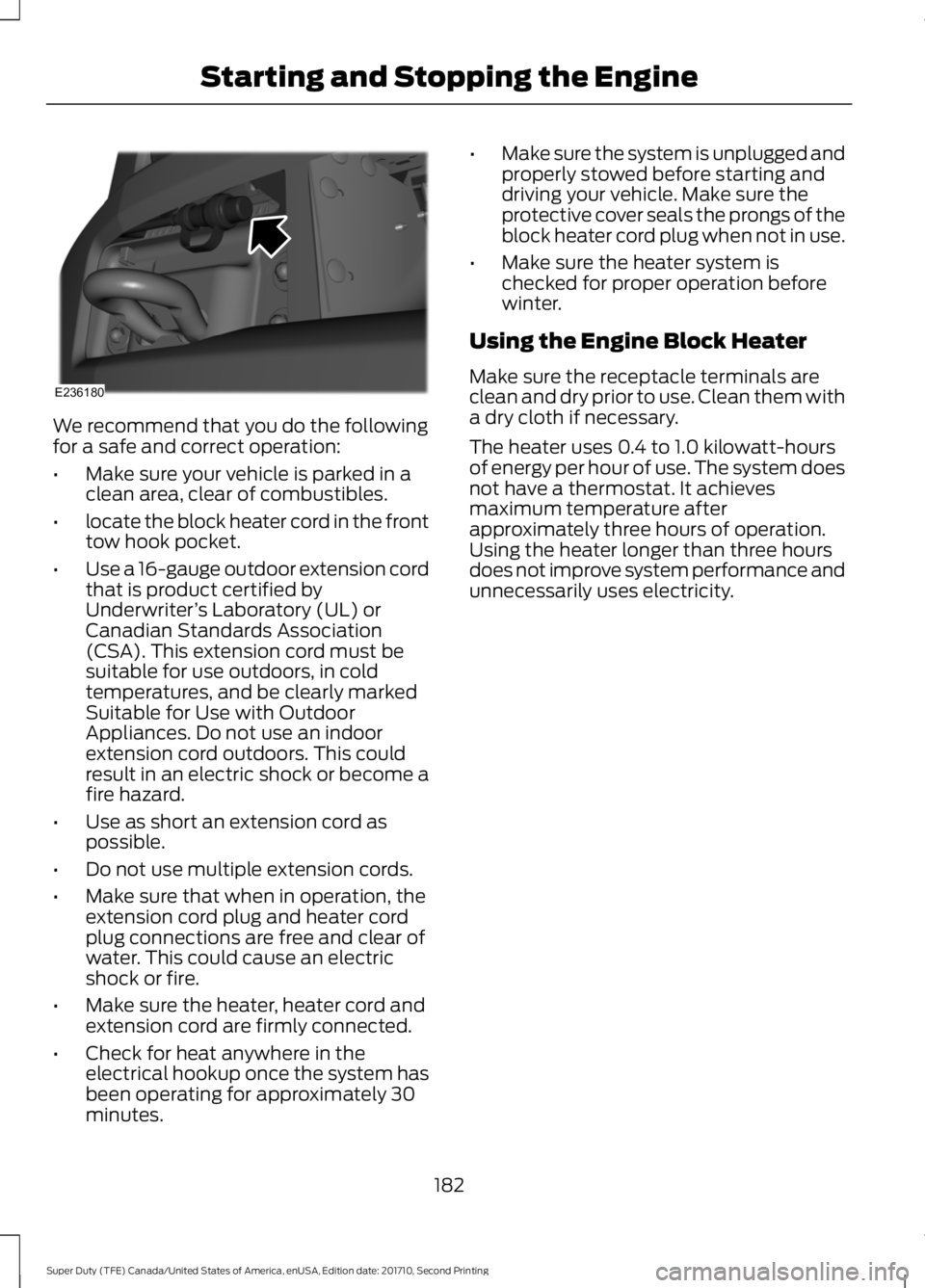
We recommend that you do the followingfor a safe and correct operation:
•Make sure your vehicle is parked in aclean area, clear of combustibles.
•locate the block heater cord in the fronttow hook pocket.
•Use a 16-gauge outdoor extension cordthat is product certified byUnderwriter’s Laboratory (UL) orCanadian Standards Association(CSA). This extension cord must besuitable for use outdoors, in coldtemperatures, and be clearly markedSuitable for Use with OutdoorAppliances. Do not use an indoorextension cord outdoors. This couldresult in an electric shock or become afire hazard.
•Use as short an extension cord aspossible.
•Do not use multiple extension cords.
•Make sure that when in operation, theextension cord plug and heater cordplug connections are free and clear ofwater. This could cause an electricshock or fire.
•Make sure the heater, heater cord andextension cord are firmly connected.
•Check for heat anywhere in theelectrical hookup once the system hasbeen operating for approximately 30minutes.
•Make sure the system is unplugged andproperly stowed before starting anddriving your vehicle. Make sure theprotective cover seals the prongs of theblock heater cord plug when not in use.
•Make sure the heater system ischecked for proper operation beforewinter.
Using the Engine Block Heater
Make sure the receptacle terminals areclean and dry prior to use. Clean them witha dry cloth if necessary.
The heater uses 0.4 to 1.0 kilowatt-hoursof energy per hour of use. The system doesnot have a thermostat. It achievesmaximum temperature afterapproximately three hours of operation.Using the heater longer than three hoursdoes not improve system performance andunnecessarily uses electricity.
182
Super Duty (TFE) Canada/United States of America, enUSA, Edition date: 201710, Second Printing
Starting and Stopping the EngineE236180