battery FORD F53 2017 User Guide
[x] Cancel search | Manufacturer: FORD, Model Year: 2017, Model line: F53, Model: FORD F53 2017Pages: 164, PDF Size: 2.57 MB
Page 58 of 164
WARNINGS
Use only adequately sized cables
with insulated clamps.
Preparing Your Vehicle
Do not attempt to push-start your
automatic transmission vehicle.
Note:
Attempting to push-start a vehicle
with an automatic transmission may cause
transmission damage.
Note: Use only a 12-volt supply to start your
vehicle.
Note: Do not disconnect the battery of the
disabled vehicle as this could damage the
vehicle electrical system.
Park the booster vehicle close to the hood
of the disabled vehicle, making sure the
two vehicles do not touch.
Connecting the Jumper Cables WARNINGS
Do not attach the cables to fuel lines,
engine rocker covers, the intake
manifold or electrical components
as grounding points. Stay clear of moving
parts. To avoid reverse polarity
connections, make sure that you correctly
identify the positive (+) and negative (-)
terminals on both the disabled and booster
vehicles before connecting the cables. Do not attach the end of the positive
cable to the studs or L-shaped eyelet
located above the positive (+)
terminal of your vehicle ’s battery. High
current may flow through and cause
damage to the fuses. Do not connect the end of the
second cable to the negative (-)
terminal of the battery to be jumped.
A spark may cause an explosion of the
gases that surround the battery. Note:
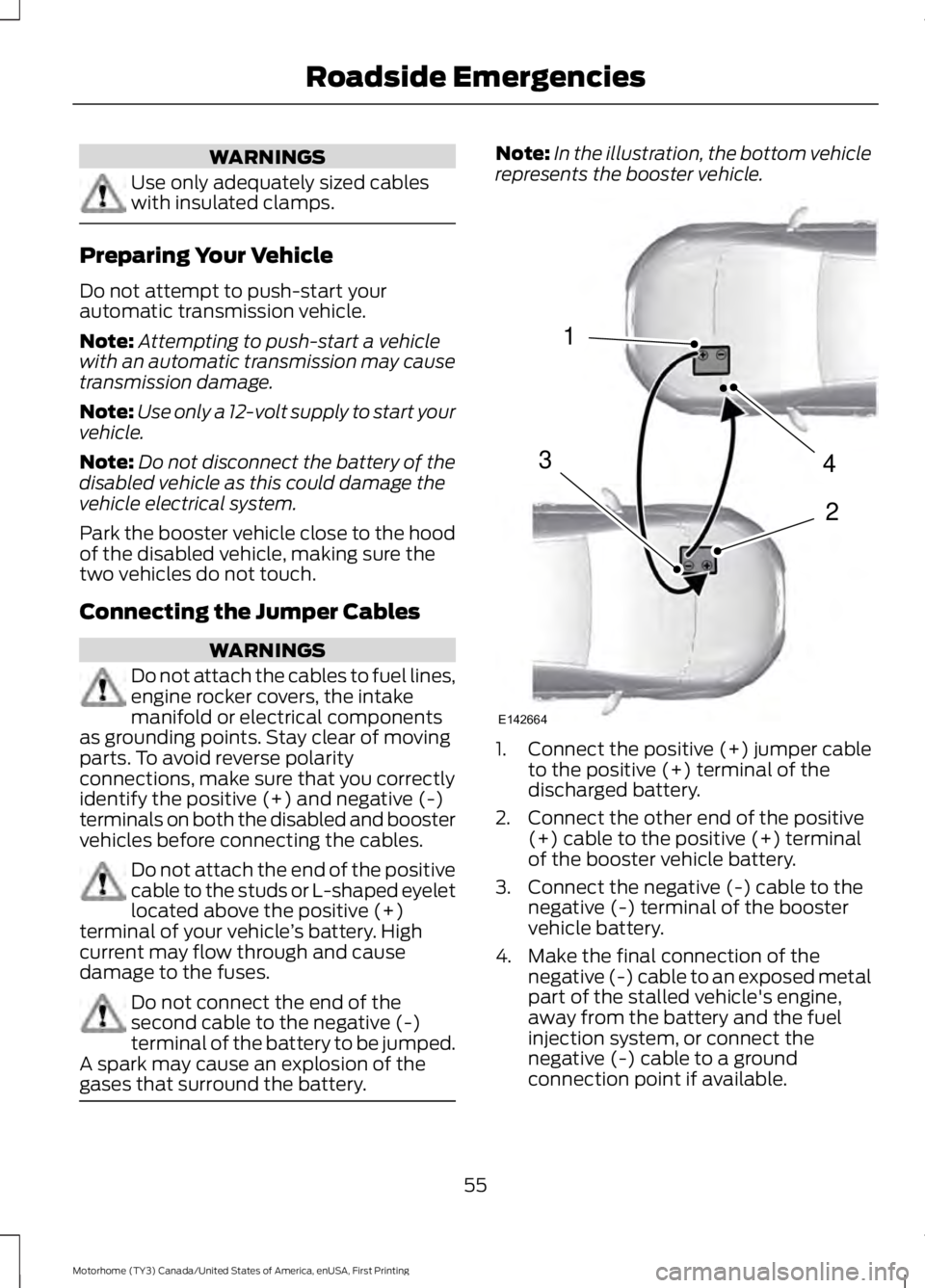
In the illustration, the bottom vehicle
represents the booster vehicle. 1.
Connect the positive (+) jumper cable
to the positive (+) terminal of the
discharged battery.
2. Connect the other end of the positive (+) cable to the positive (+) terminal
of the booster vehicle battery.
3. Connect the negative (-) cable to the negative (-) terminal of the booster
vehicle battery.
4. Make the final connection of the negative (-) cable to an exposed metal
part of the stalled vehicle's engine,
away from the battery and the fuel
injection system, or connect the
negative (-) cable to a ground
connection point if available.
55
Motorhome (TY3) Canada/United States of America, enUSA, First Printing Roadside Emergencies4
2
1
3
E142664
Page 59 of 164
Jump Starting
1.
Start the engine of the booster vehicle
and rev the engine moderately, or press
the accelerator gently to keep your
engine speed between 2000 and 3000
RPM, as shown in your tachometer.
2. Start the engine of the disabled vehicle.
3. Once the disabled vehicle has been started, run both vehicle engines for an
additional three minutes before
disconnecting the jumper cables.
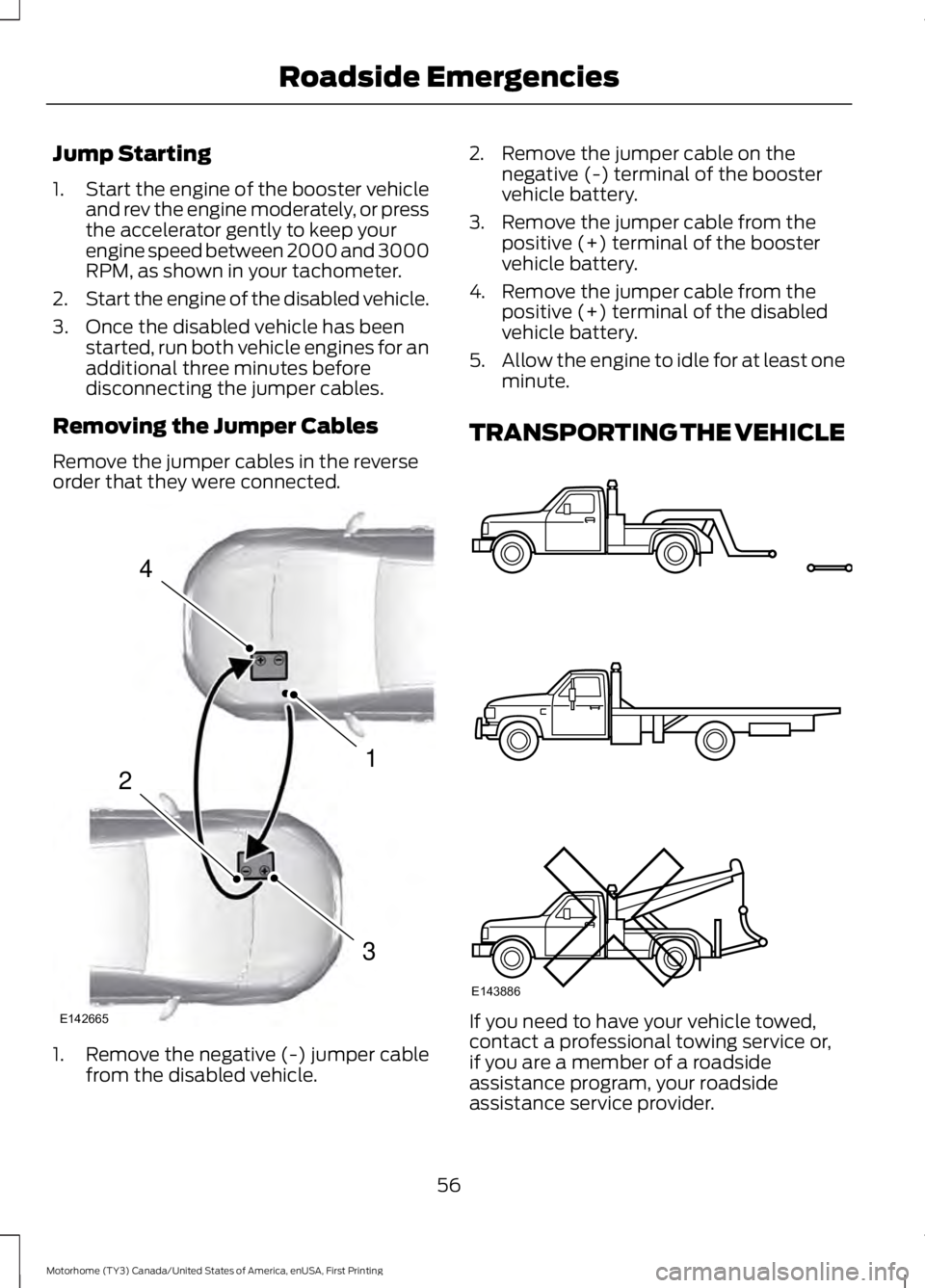
Removing the Jumper Cables
Remove the jumper cables in the reverse
order that they were connected. 1. Remove the negative (-) jumper cable
from the disabled vehicle. 2. Remove the jumper cable on the
negative (-) terminal of the booster
vehicle battery.
3. Remove the jumper cable from the positive (+) terminal of the booster
vehicle battery.
4. Remove the jumper cable from the positive (+) terminal of the disabled
vehicle battery.
5. Allow the engine to idle for at least one
minute.
TRANSPORTING THE VEHICLE If you need to have your vehicle towed,
contact a professional towing service or,
if you are a member of a roadside
assistance program, your roadside
assistance service provider.
56
Motorhome (TY3) Canada/United States of America, enUSA, First Printing Roadside Emergencies4
1
3
2
E142665 E143886
Page 68 of 164
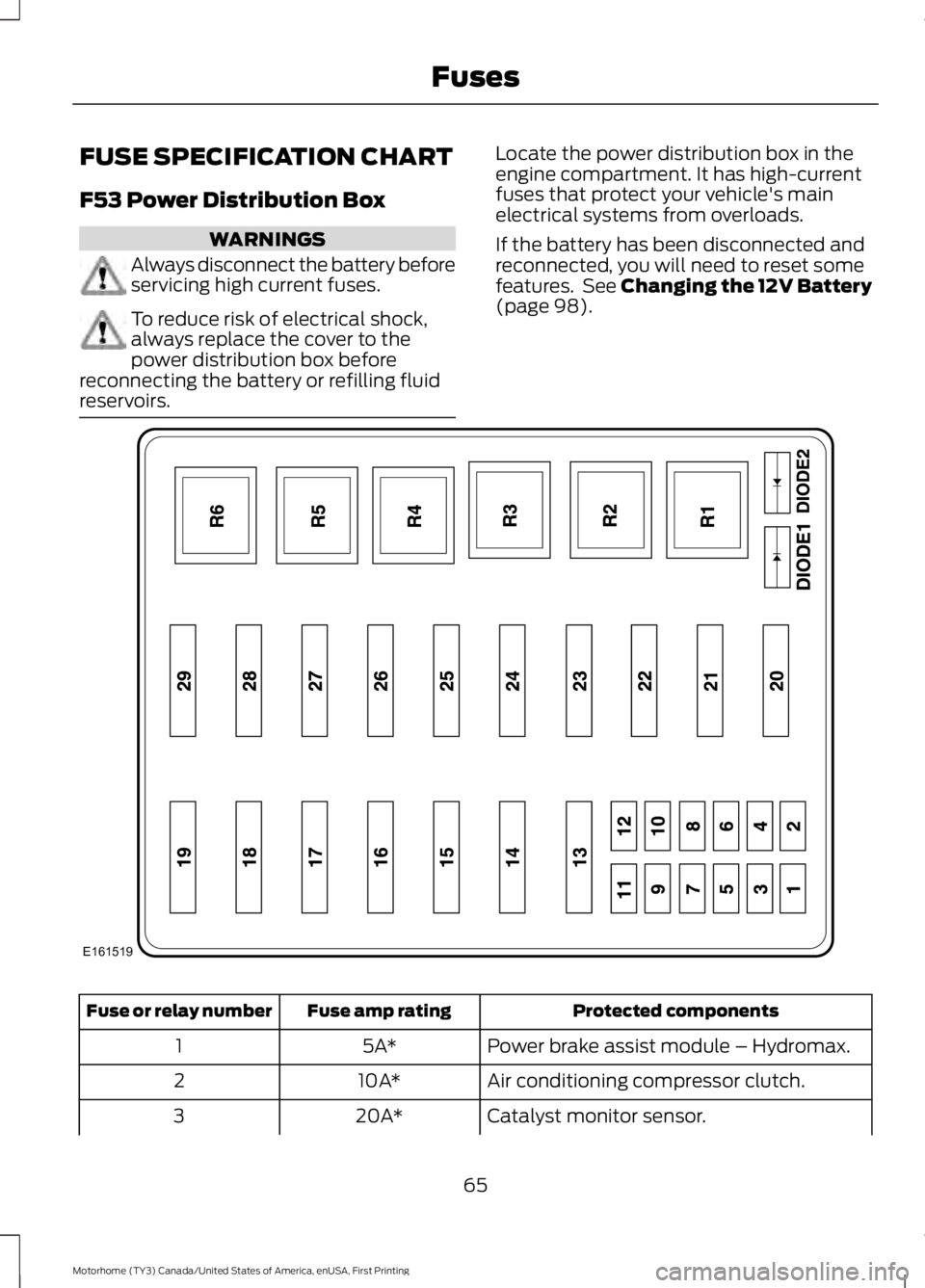
FUSE SPECIFICATION CHART
F53 Power Distribution Box
WARNINGS
Always disconnect the battery before
servicing high current fuses.
To reduce risk of electrical shock,
always replace the cover to the
power distribution box before
reconnecting the battery or refilling fluid
reservoirs. Locate the power distribution box in the
engine compartment. It has high-current
fuses that protect your vehicle's main
electrical systems from overloads.
If the battery has been disconnected and
reconnected, you will need to reset some
features. See Changing the 12V Battery
(page 98).
Protected components
Fuse amp rating
Fuse or relay number
Power brake assist module – Hydromax.
5A*
1
Air conditioning compressor clutch.
10A*
2
Catalyst monitor sensor.
20A*
3
65
Motorhome (TY3) Canada/United States of America, enUSA, First Printing FusesE161519
Page 69 of 164
Protected components
Fuse amp rating
Fuse or relay number
Engine heated exhaust gas oxygen sensor
#11 and #21.
Vapor management valve.
Powertrain control module relay coil.
5A*
4
Powertrain control module keep alive
memory.
Powertrain control module power.
20A*
5
Instrument panel dimmer module.
20A*
6
Park lamp feeds.
Trailer tow running lamp relay coil.
Ignition coils.
20A*
7
Radio capacitors.
Hydromax – Anti-lock brake system
module.
30A*
8
Powertrain control module.
10A*
9
Daytime running lamps.
20A*
10
Fuel pump relay coil.
20A*
11
Powertrain control module.
Fuel pump diode.
Instrument panel - backup lamp feed.
25A*
12
Trailer tow backup lamps feed.
Trailer tow electric brake controller feed.
30A**
13
Instrument panel battery feed (fuse #15,
21).
60A**
14
Lighting primary fuse.
Power distribution box fuse #19.
Trailer tow park lamps.
20A**
15
Anti-lock brake system module –
Hydromax.
60A**
16
Anti-lock brake system module – Hydro-
boost.
40A**
Horn feed.
20A**
17
Backup lamp relay coil.
20A**
18
A/C clutch coil.
66
Motorhome (TY3) Canada/United States of America, enUSA, First Printing Fuses
Page 70 of 164
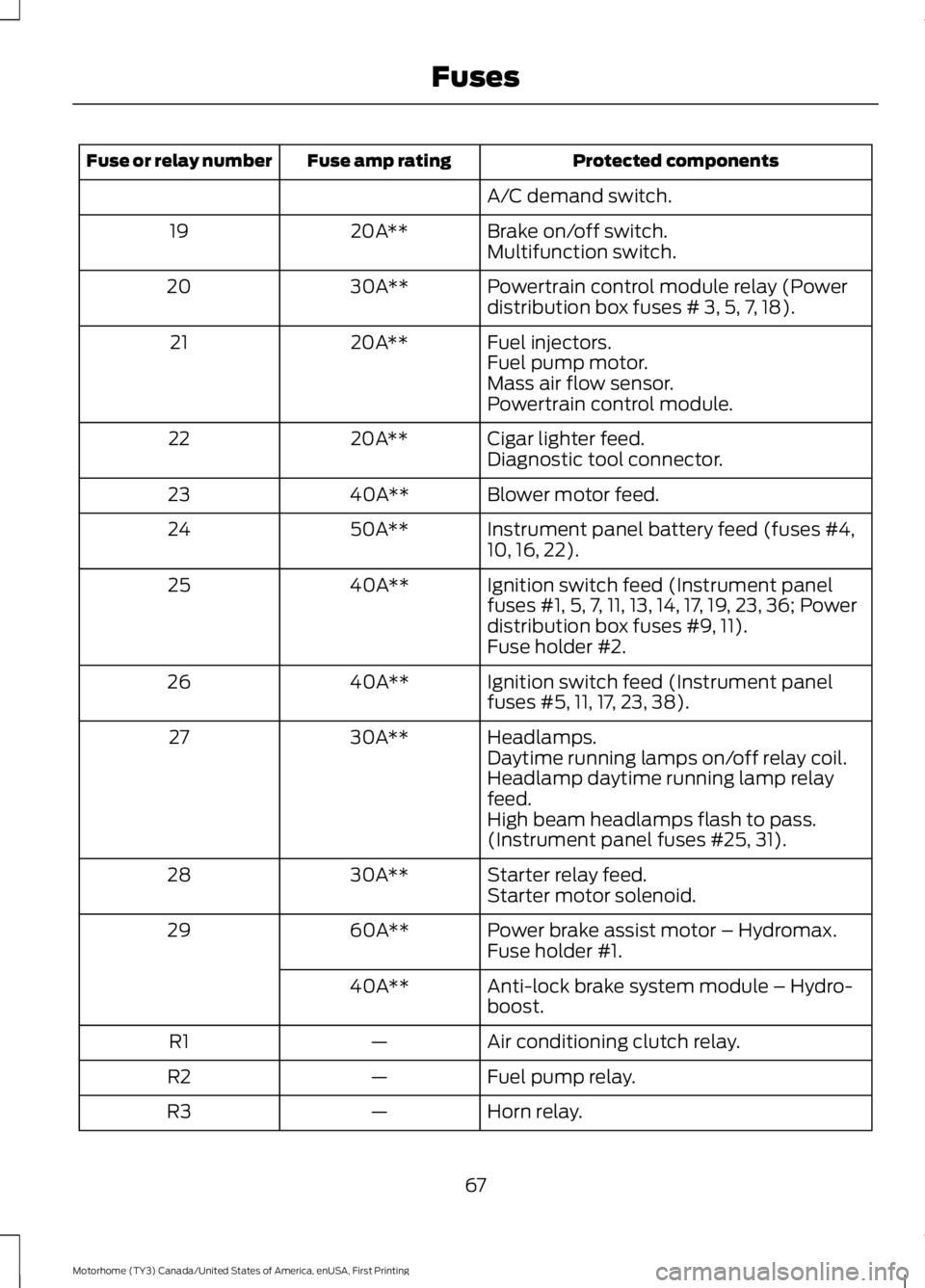
Protected components
Fuse amp rating
Fuse or relay number
A/C demand switch.
Brake on/off switch.
20A**
19
Multifunction switch.
Powertrain control module relay (Power
distribution box fuses # 3, 5, 7, 18).
30A**
20
Fuel injectors.
20A**
21
Fuel pump motor.
Mass air flow sensor.
Powertrain control module.
Cigar lighter feed.
20A**
22
Diagnostic tool connector.
Blower motor feed.
40A**
23
Instrument panel battery feed (fuses #4,
10, 16, 22).
50A**
24
Ignition switch feed (Instrument panel
fuses #1, 5, 7, 11, 13, 14, 17, 19, 23, 36; Power
distribution box fuses #9, 11).
40A**
25
Fuse holder #2.
Ignition switch feed (Instrument panel
fuses #5, 11, 17, 23, 38).
40A**
26
Headlamps.
30A**
27
Daytime running lamps on/off relay coil.
Headlamp daytime running lamp relay
feed.
High beam headlamps flash to pass.
(Instrument panel fuses #25, 31).
Starter relay feed.
30A**
28
Starter motor solenoid.
Power brake assist motor – Hydromax.
60A**
29
Fuse holder #1.
Anti-lock brake system module – Hydro-
boost.
40A**
Air conditioning clutch relay.
—
R1
Fuel pump relay.
—
R2
Horn relay.
—
R3
67
Motorhome (TY3) Canada/United States of America, enUSA, First Printing Fuses
Page 74 of 164
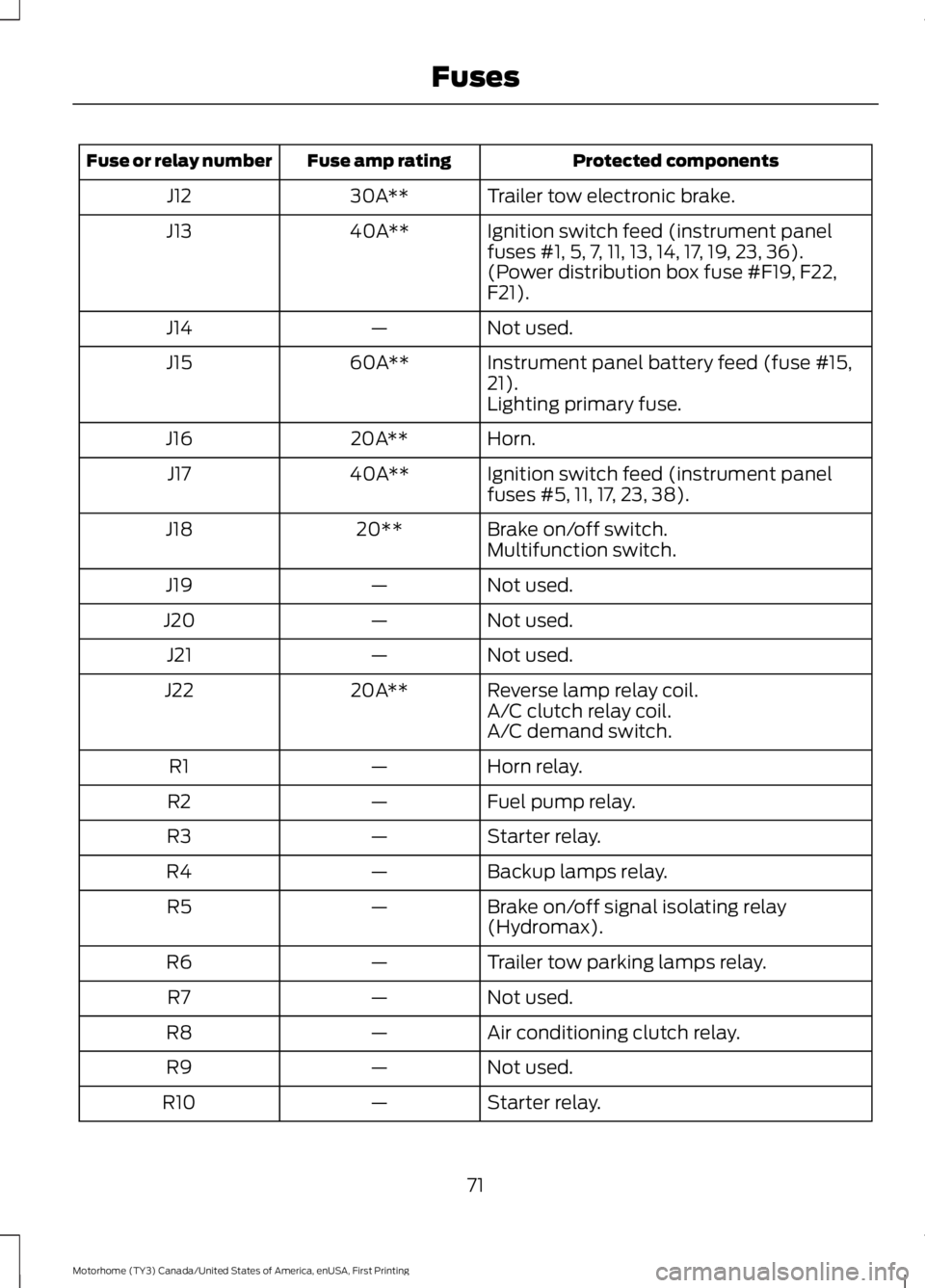
Protected components
Fuse amp rating
Fuse or relay number
Trailer tow electronic brake.
30A**
J12
Ignition switch feed (instrument panel
fuses #1, 5, 7, 11, 13, 14, 17, 19, 23, 36).
40A**
J13
(Power distribution box fuse #F19, F22,
F21).
Not used.
—
J14
Instrument panel battery feed (fuse #15,
21).
60A**
J15
Lighting primary fuse.
Horn.
20A**
J16
Ignition switch feed (instrument panel
fuses #5, 11, 17, 23, 38).
40A**
J17
Brake on/off switch.
20**
J18
Multifunction switch.
Not used.
—
J19
Not used.
—
J20
Not used.
—
J21
Reverse lamp relay coil.
20A**
J22
A/C clutch relay coil.
A/C demand switch.
Horn relay.
—
R1
Fuel pump relay.
—
R2
Starter relay.
—
R3
Backup lamps relay.
—
R4
Brake on/off signal isolating relay
(Hydromax).
—
R5
Trailer tow parking lamps relay.
—
R6
Not used.
—
R7
Air conditioning clutch relay.
—
R8
Not used.
—
R9
Starter relay.
—
R10
71
Motorhome (TY3) Canada/United States of America, enUSA, First Printing Fuses
Page 81 of 164
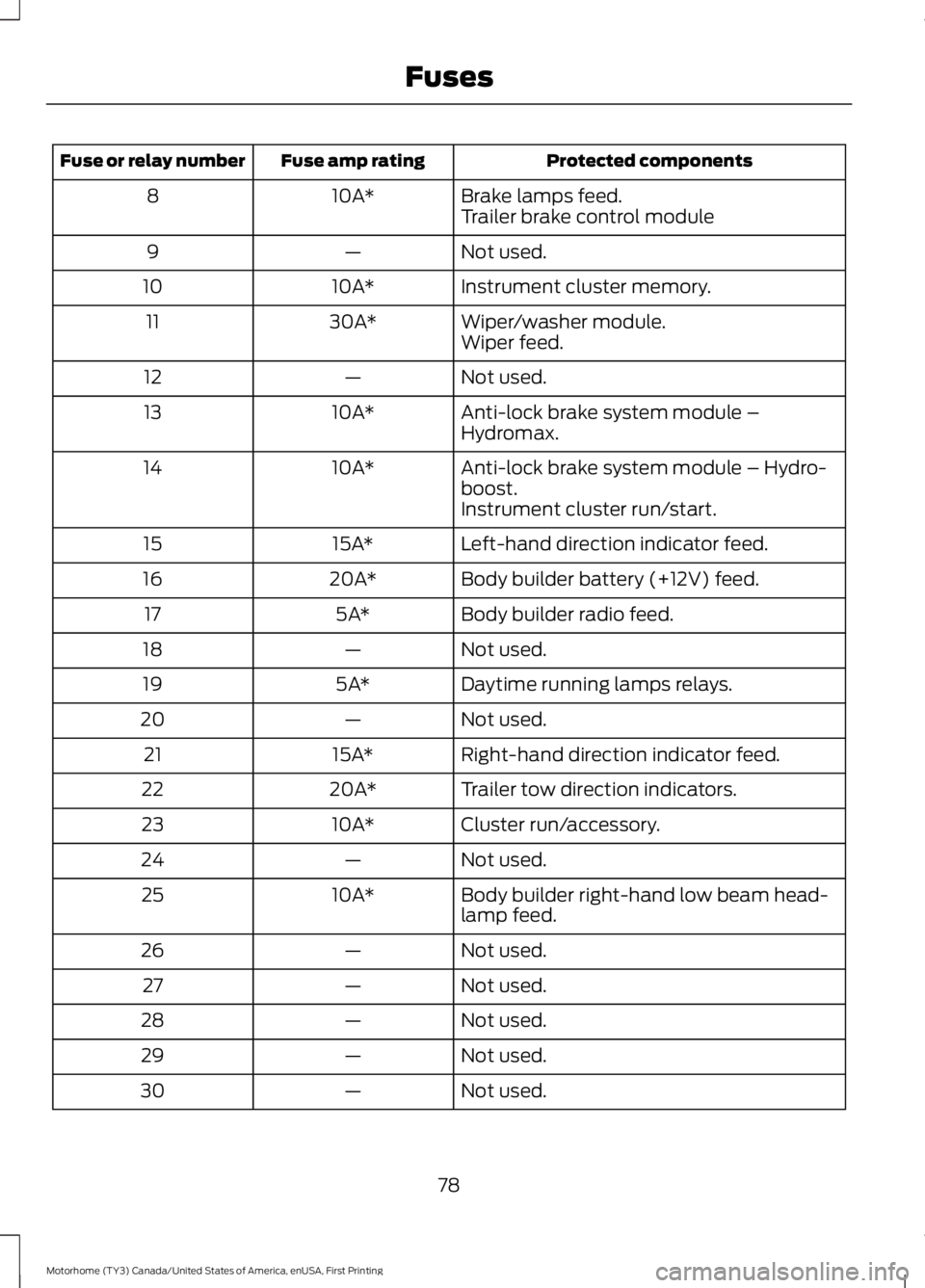
Protected components
Fuse amp rating
Fuse or relay number
Brake lamps feed.
10A*
8
Trailer brake control module
Not used.
—
9
Instrument cluster memory.
10A*
10
Wiper/washer module.
30A*
11
Wiper feed.
Not used.
—
12
Anti-lock brake system module –
Hydromax.
10A*
13
Anti-lock brake system module – Hydro-
boost.
10A*
14
Instrument cluster run/start.
Left-hand direction indicator feed.
15A*
15
Body builder battery (+12V) feed.
20A*
16
Body builder radio feed.
5A*
17
Not used.
—
18
Daytime running lamps relays.
5A*
19
Not used.
—
20
Right-hand direction indicator feed.
15A*
21
Trailer tow direction indicators.
20A*
22
Cluster run/accessory.
10A*
23
Not used.
—
24
Body builder right-hand low beam head-
lamp feed.
10A*
25
Not used.
—
26
Not used.
—
27
Not used.
—
28
Not used.
—
29
Not used.
—
30
78
Motorhome (TY3) Canada/United States of America, enUSA, First Printing Fuses
Page 85 of 164
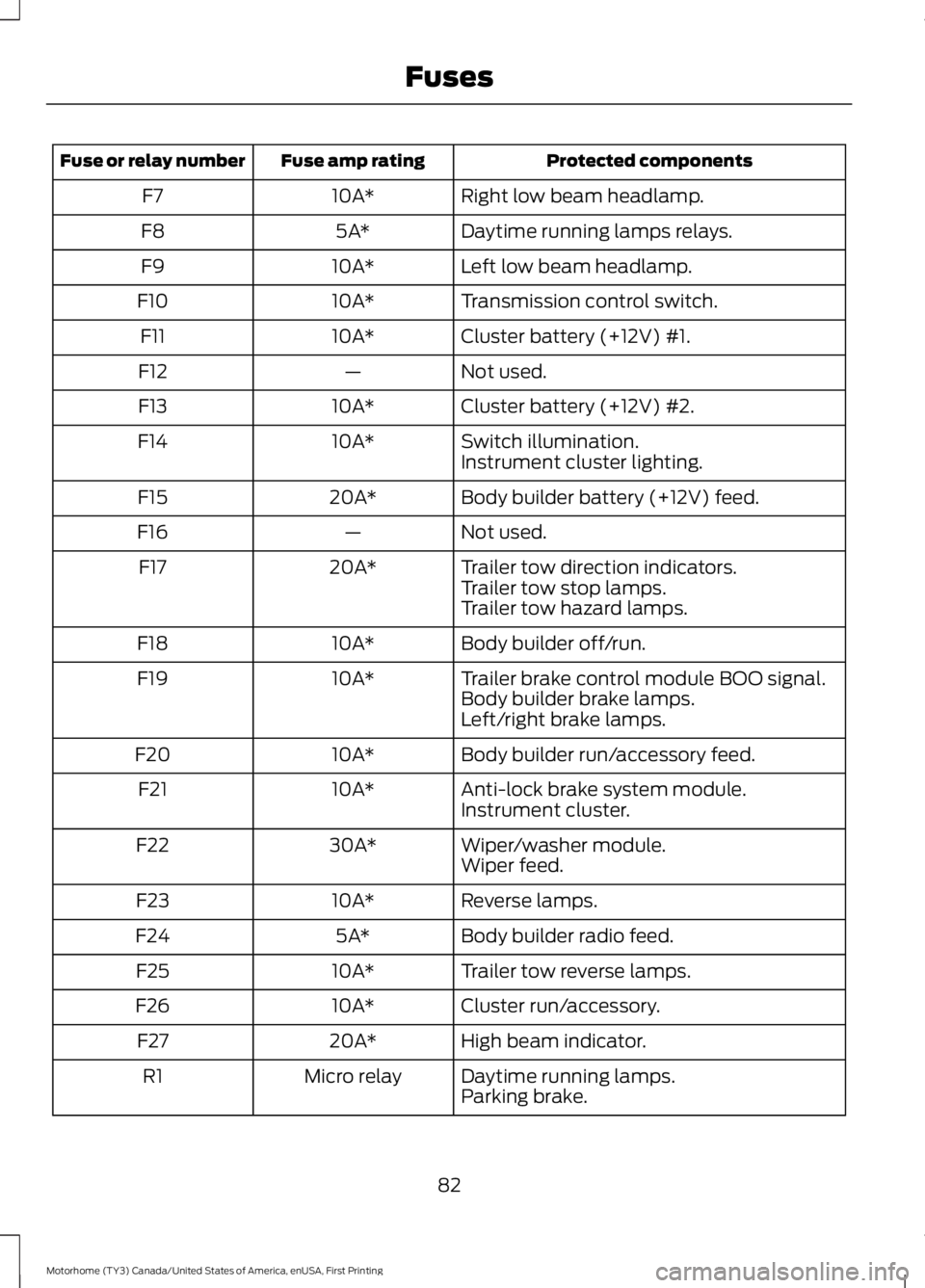
Protected components
Fuse amp rating
Fuse or relay number
Right low beam headlamp.
10A*
F7
Daytime running lamps relays.
5A*
F8
Left low beam headlamp.
10A*
F9
Transmission control switch.
10A*
F10
Cluster battery (+12V) #1.
10A*
F11
Not used.
—
F12
Cluster battery (+12V) #2.
10A*
F13
Switch illumination.
10A*
F14
Instrument cluster lighting.
Body builder battery (+12V) feed.
20A*
F15
Not used.
—
F16
Trailer tow direction indicators.
20A*
F17
Trailer tow stop lamps.
Trailer tow hazard lamps.
Body builder off/run.
10A*
F18
Trailer brake control module BOO signal.
10A*
F19
Body builder brake lamps.
Left/right brake lamps.
Body builder run/accessory feed.
10A*
F20
Anti-lock brake system module.
10A*
F21
Instrument cluster.
Wiper/washer module.
30A*
F22
Wiper feed.
Reverse lamps.
10A*
F23
Body builder radio feed.
5A*
F24
Trailer tow reverse lamps.
10A*
F25
Cluster run/accessory.
10A*
F26
High beam indicator.
20A*
F27
Daytime running lamps.
Micro relay
R1
Parking brake.
82
Motorhome (TY3) Canada/United States of America, enUSA, First Printing Fuses
Page 88 of 164
GENERAL INFORMATION
Have your vehicle serviced regularly to help
maintain its roadworthiness and resale
value. There is a large network of
authorized dealers that are there to help
you with their professional servicing
expertise. We believe that their specially
trained technicians are best qualified to
service your vehicle properly and expertly.
They are supported by a wide range of
highly specialized tools developed
specifically for servicing your vehicle.
If your vehicle requires professional service,
an authorized dealer can provide the
necessary parts and service. Check your
warranty information to find out which
parts and services are covered.
Use only recommended fuels, lubricants,
fluids and service parts conforming to
specifications. Motorcraft® parts are
designed and built to provide the best
performance in your vehicle.
Precautions
•
Do not work on a hot engine.
• Make sure that nothing gets caught in
moving parts. •
Do not work on a vehicle with the
engine running in an enclosed space,
unless you are sure you have enough
ventilation.
• Keep all open flames and other burning
material (such as cigarettes) away
from the battery and all fuel related
parts.
Working with the Engine Off
1. Set the parking brake and shift to park
(P).
2. Switch off the engine.
3. Block the wheels.
Working with the Engine On WARNING
To reduce the risk of vehicle damage
and/or personal burn injuries, do not
start your engine with the air cleaner
removed and do not remove it while the
engine is running. 1.
Set the parking brake and shift to park
(P).
2. Block the wheels.
85
Motorhome (TY3) Canada/United States of America, enUSA, First Printing Maintenance
Page 101 of 164
•
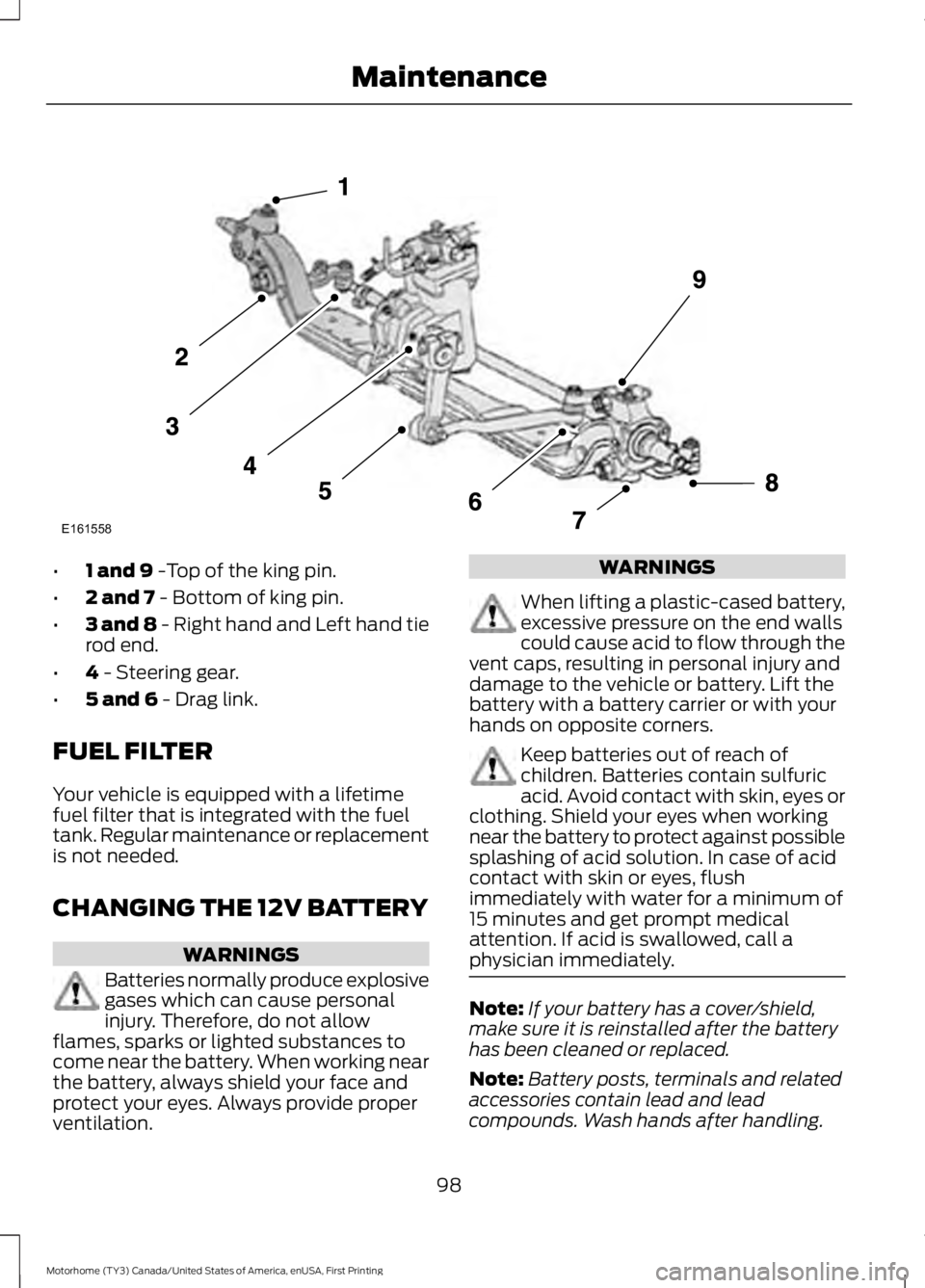
1 and 9 -Top of the king pin.
• 2 and 7
- Bottom of king pin.
• 3 and 8 - Right hand and Left hand tie
rod end.
• 4
- Steering gear.
• 5 and 6
- Drag link.
FUEL FILTER
Your vehicle is equipped with a lifetime
fuel filter that is integrated with the fuel
tank. Regular maintenance or replacement
is not needed.
CHANGING THE 12V BATTERY WARNINGS
Batteries normally produce explosive
gases which can cause personal
injury. Therefore, do not allow
flames, sparks or lighted substances to
come near the battery. When working near
the battery, always shield your face and
protect your eyes. Always provide proper
ventilation. WARNINGS
When lifting a plastic-cased battery,
excessive pressure on the end walls
could cause acid to flow through the
vent caps, resulting in personal injury and
damage to the vehicle or battery. Lift the
battery with a battery carrier or with your
hands on opposite corners. Keep batteries out of reach of
children. Batteries contain sulfuric
acid. Avoid contact with skin, eyes or
clothing. Shield your eyes when working
near the battery to protect against possible
splashing of acid solution. In case of acid
contact with skin or eyes, flush
immediately with water for a minimum of
15 minutes and get prompt medical
attention. If acid is swallowed, call a
physician immediately. Note:
If your battery has a cover/shield,
make sure it is reinstalled after the battery
has been cleaned or replaced.
Note: Battery posts, terminals and related
accessories contain lead and lead
compounds. Wash hands after handling.
98
Motorhome (TY3) Canada/United States of America, enUSA, First Printing MaintenanceE161558