exhaust system FORD F53 2017 Owners Manual
[x] Cancel search | Manufacturer: FORD, Model Year: 2017, Model line: F53, Model: FORD F53 2017Pages: 164, PDF Size: 2.57 MB
Page 21 of 164
If the light is blinking, engine misfire is
occurring which could damage your
catalytic converter. Drive in a moderate
fashion (avoid heavy acceleration and
deceleration) and have your vehicle
serviced immediately.
WARNING
Under engine misfire conditions,
excessive exhaust temperatures
could damage the catalytic
converter, the fuel system, interior floor
coverings or other vehicle components,
possibly causing a fire. Have your vehicle
serviced immediately. The service engine soon indicator light
illuminates when the ignition is first turned
on prior to engine start to check the bulb
and to indicate whether the vehicle is ready
for Inspection/Maintenance (I/M) testing.
Normally, the service engine soon light will
stay on until the engine is cranked, then
turn itself off if no malfunctions are
present. However, if after 15 seconds the
service engine soon light blinks eight times,
it means that the vehicle is not ready for
I/M testing. See Emission Control
System (page 30).
Transmission Tow/Haul
(If Equipped) Illuminates when the tow/haul
feature has been activated. If the
light flashes steadily, have the
system serviced immediately, damage to
the transmission could occur.
AUDIBLE WARNINGS AND
INDICATORS
Fail-Safe Cooling Warning Chime
Sounds when the coolant gauge pointer
has moved to hot. There are three stages
of chimes: •
Stage 1 is a single chime when the
engine temperature begins to overheat.
• Stage 2 is multiple chimes and engine
power becomes limited in order to help
cool the engine.
• Stage 3 is multiple chimes and the
engine will shut down.
Headlamps On Warning Chime
Sounds when you remove the key from the
ignition and open the driver's door and you
have left the headlamps or parking lamps
on.
Key in Ignition Warning Chime
Sounds when you open the driver's door
and you have left the key in the ignition.
Parking Brake On Warning Chime
Sounds when you have left the parking
brake on and drive your vehicle. If the
warning chime remains on after you have
released the parking brake, have the
system checked by your authorized dealer
immediately.
Shift to Park Warning Chime
Sounds when you open the driver's door
and your vehicle is not in park.
18
Motorhome (TY3) Canada/United States of America, enUSA, First Printing Instrument ClusterE161509
Page 26 of 164
GENERAL INFORMATION
WARNINGS
Extended idling at high engine
speeds can produce very high
temperatures in the engine and
exhaust system, creating the risk of fire or
other damage. Do not park, idle or drive your vehicle
on dry grass or other dry ground
cover. The emission system heats up
the engine compartment and exhaust
system, creating the risk of fire. Do not start the engine in a closed
garage or in other enclosed areas.
Exhaust fumes can be toxic. Always
open the garage door before you start the
engine. If you smell exhaust fumes inside
your vehicle, have your vehicle
checked by an authorized dealer
immediately. Do not drive your vehicle if
you smell exhaust fumes. If you disconnect the battery, your vehicle
may exhibit some unusual driving
characteristics for approximately 5 miles
(8 kilometers) after you reconnect it. This
is because the engine management system
must realign itself with the engine. You can
disregard any unusual driving
characteristics during this period.
The powertrain control system meets all
Canadian interference-causing equipment
standard requirements regulating the
impulse electrical field or radio noise.
When you start the engine, avoid pressing
the accelerator pedal before and during
operation. Only use the accelerator pedal
when you have difficulty starting the
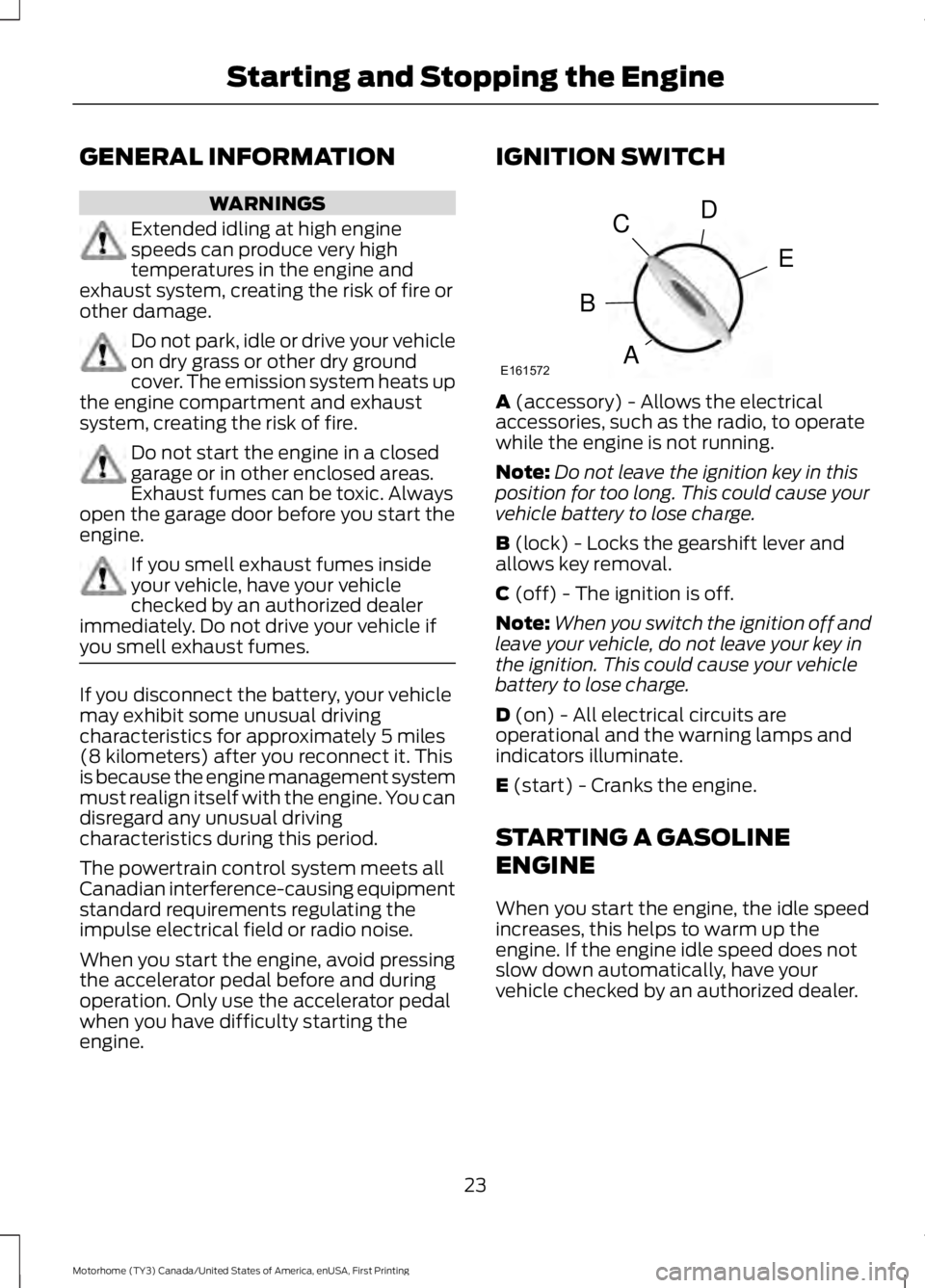
engine. IGNITION SWITCH
A (accessory) - Allows the electrical
accessories, such as the radio, to operate
while the engine is not running.
Note: Do not leave the ignition key in this
position for too long. This could cause your
vehicle battery to lose charge.
B
(lock) - Locks the gearshift lever and
allows key removal.
C
(off) - The ignition is off.
Note: When you switch the ignition off and
leave your vehicle, do not leave your key in
the ignition. This could cause your vehicle
battery to lose charge.
D
(on) - All electrical circuits are
operational and the warning lamps and
indicators illuminate.
E
(start) - Cranks the engine.
STARTING A GASOLINE
ENGINE
When you start the engine, the idle speed
increases, this helps to warm up the
engine. If the engine idle speed does not
slow down automatically, have your
vehicle checked by an authorized dealer.
23
Motorhome (TY3) Canada/United States of America, enUSA, First Printing Starting and Stopping the EngineE161572
D
E
C
B
A
Page 33 of 164
Keep a record for at least one month and
record the type of driving (city or highway).
This provides an accurate estimate of your
vehicle
’s fuel economy under current
driving conditions. Keeping records during
summer and winter will show how
temperature impacts fuel economy.
Conditions
• Heavily loading your vehicle reduces
fuel economy.
• Carrying unnecessary weight in your
vehicle may reduce fuel economy.
• Adding certain accessories to your
vehicle such as bug deflectors, rollbars
or light bars, running boards and ski
racks may reduce fuel economy.
• Using fuel blended with alcohol may
lower fuel economy.
• Fuel economy may decrease with lower
temperatures.
• Fuel economy may decrease when
driving short distances.
• You will get better fuel economy when
driving on flat terrain than when driving
on hilly terrain.
EMISSION CONTROL SYSTEM WARNINGS
Do not park, idle or drive your vehicle
on dry grass or other dry ground
cover. The emission system heats up
the engine compartment and exhaust
system, creating the risk of fire. Exhaust leaks may result in entry of
harmful and potentially lethal fumes
into the passenger compartment. If
you smell exhaust fumes inside your
vehicle, have your vehicle inspected
immediately. Do not drive if you smell
exhaust fumes. Your vehicle has various emission control
components and a catalytic converter that
enables it to comply with applicable
exhaust emission standards.
To make sure that the catalytic converter
and other emission control components
continue to work properly:
•
Use only the specified fuel listed.
• Avoid running out of fuel.
• Do not turn off the ignition while your
vehicle is moving, especially at high
speeds.
• Have the items listed in scheduled
maintenance information performed
according to the specified schedule.
The scheduled maintenance items listed
in scheduled maintenance information are
essential to the life and performance of
your vehicle and to its emissions system.
If you use anything other than Ford,
Motorcraft or Ford-authorized parts for
maintenance replacements or for service
of components affecting emission control,
such non-Ford parts should be equivalent
to genuine Ford Motor Company parts in
performance and durability.
Illumination of the service engine soon
indicator, charging system warning light or
the temperature warning light, fluid leaks,
strange odors, smoke or loss of engine
power could indicate that the emission
control system is not working properly.
An improperly operating or damaged
exhaust system may allow exhaust to
enter the vehicle. Have a damaged or
improperly operating exhaust system
inspected and repaired immediately.
Do not make any unauthorized changes to
your vehicle or engine. By law, vehicle
owners and anyone who manufactures,
repairs, services, sells, leases, trades
vehicles, or supervises a fleet of vehicles
are not permitted to intentionally remove
30
Motorhome (TY3) Canada/United States of America, enUSA, First Printing Fuel and Refueling
Page 69 of 164
Protected components
Fuse amp rating
Fuse or relay number
Engine heated exhaust gas oxygen sensor
#11 and #21.
Vapor management valve.
Powertrain control module relay coil.
5A*
4
Powertrain control module keep alive
memory.
Powertrain control module power.
20A*
5
Instrument panel dimmer module.
20A*
6
Park lamp feeds.
Trailer tow running lamp relay coil.
Ignition coils.
20A*
7
Radio capacitors.
Hydromax – Anti-lock brake system
module.
30A*
8
Powertrain control module.
10A*
9
Daytime running lamps.
20A*
10
Fuel pump relay coil.
20A*
11
Powertrain control module.
Fuel pump diode.
Instrument panel - backup lamp feed.
25A*
12
Trailer tow backup lamps feed.
Trailer tow electric brake controller feed.
30A**
13
Instrument panel battery feed (fuse #15,
21).
60A**
14
Lighting primary fuse.
Power distribution box fuse #19.
Trailer tow park lamps.
20A**
15
Anti-lock brake system module –
Hydromax.
60A**
16
Anti-lock brake system module – Hydro-
boost.
40A**
Horn feed.
20A**
17
Backup lamp relay coil.
20A**
18
A/C clutch coil.
66
Motorhome (TY3) Canada/United States of America, enUSA, First Printing Fuses
Page 72 of 164
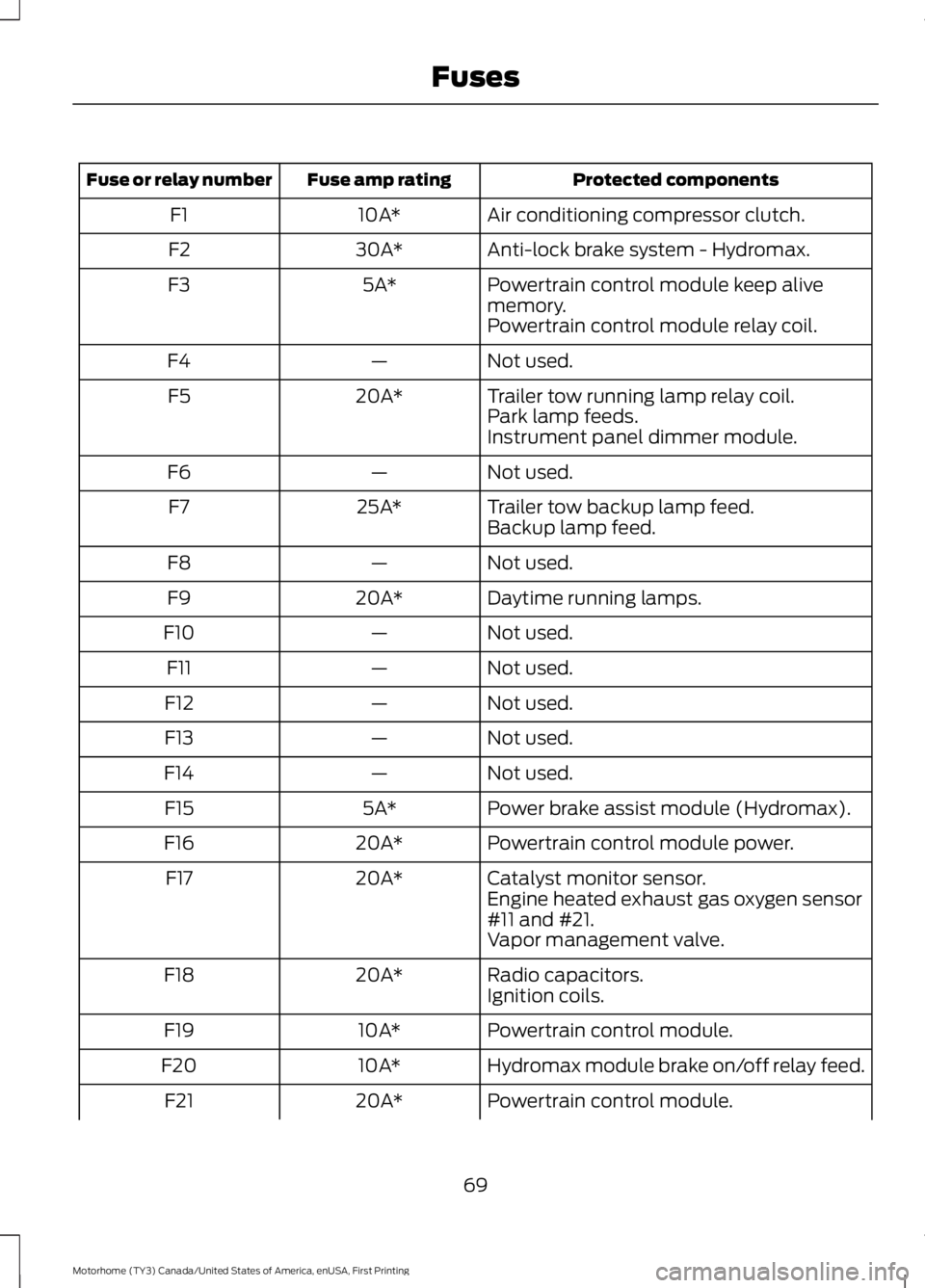
Protected components
Fuse amp rating
Fuse or relay number
Air conditioning compressor clutch.
10A*
F1
Anti-lock brake system - Hydromax.
30A*
F2
Powertrain control module keep alive
memory.
5A*
F3
Powertrain control module relay coil.
Not used.
—
F4
Trailer tow running lamp relay coil.
20A*
F5
Park lamp feeds.
Instrument panel dimmer module.
Not used.
—
F6
Trailer tow backup lamp feed.
25A*
F7
Backup lamp feed.
Not used.
—
F8
Daytime running lamps.
20A*
F9
Not used.
—
F10
Not used.
—
F11
Not used.
—
F12
Not used.
—
F13
Not used.
—
F14
Power brake assist module (Hydromax).
5A*
F15
Powertrain control module power.
20A*
F16
Catalyst monitor sensor.
20A*
F17
Engine heated exhaust gas oxygen sensor
#11 and #21.
Vapor management valve.
Radio capacitors.
20A*
F18
Ignition coils.
Powertrain control module.
10A*
F19
Hydromax module brake on/off relay feed.
10A*
F20
Powertrain control module.
20A*
F21
69
Motorhome (TY3) Canada/United States of America, enUSA, First Printing Fuses
Page 141 of 164
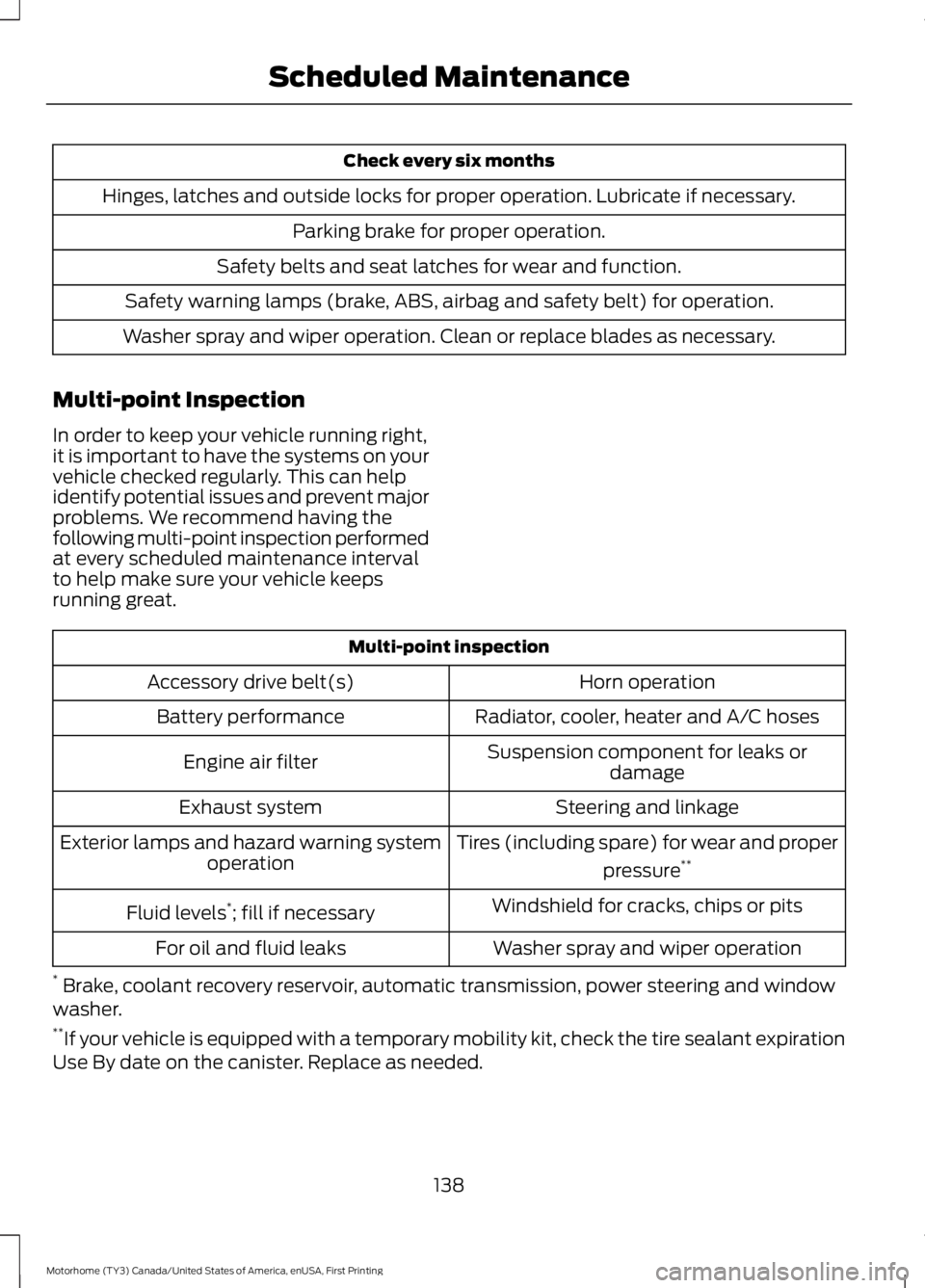
Check every six months
Hinges, latches and outside locks for proper operation. Lubricate if necessary. Parking brake for proper operation.
Safety belts and seat latches for wear and function.
Safety warning lamps (brake, ABS, airbag and safety belt) for operation.
Washer spray and wiper operation. Clean or replace blades as necessary.
Multi-point Inspection
In order to keep your vehicle running right,
it is important to have the systems on your
vehicle checked regularly. This can help
identify potential issues and prevent major
problems. We recommend having the
following multi-point inspection performed
at every scheduled maintenance interval
to help make sure your vehicle keeps
running great. Multi-point inspection
Horn operation
Accessory drive belt(s)
Radiator, cooler, heater and A/C hoses
Battery performance
Suspension component for leaks ordamage
Engine air filter
Steering and linkage
Exhaust system
Tires (including spare) for wear and properpressure**
Exterior lamps and hazard warning system
operation
Windshield for cracks, chips or pits
Fluid levels *
; fill if necessary
Washer spray and wiper operation
For oil and fluid leaks
* Brake, coolant recovery reservoir, automatic transmission, power steering and window
washer.
** If your vehicle is equipped with a temporary mobility kit, check the tire sealant expiration
Use By date on the canister. Replace as needed.
138
Motorhome (TY3) Canada/United States of America, enUSA, First Printing Scheduled Maintenance
Page 142 of 164
Be sure to ask your dealership service
advisor or technician about the multi-point
vehicle inspection. It is a comprehensive
way to perform a thorough inspection of
your vehicle. Your checklist gives you
immediate feedback on the overall
condition of your vehicle.
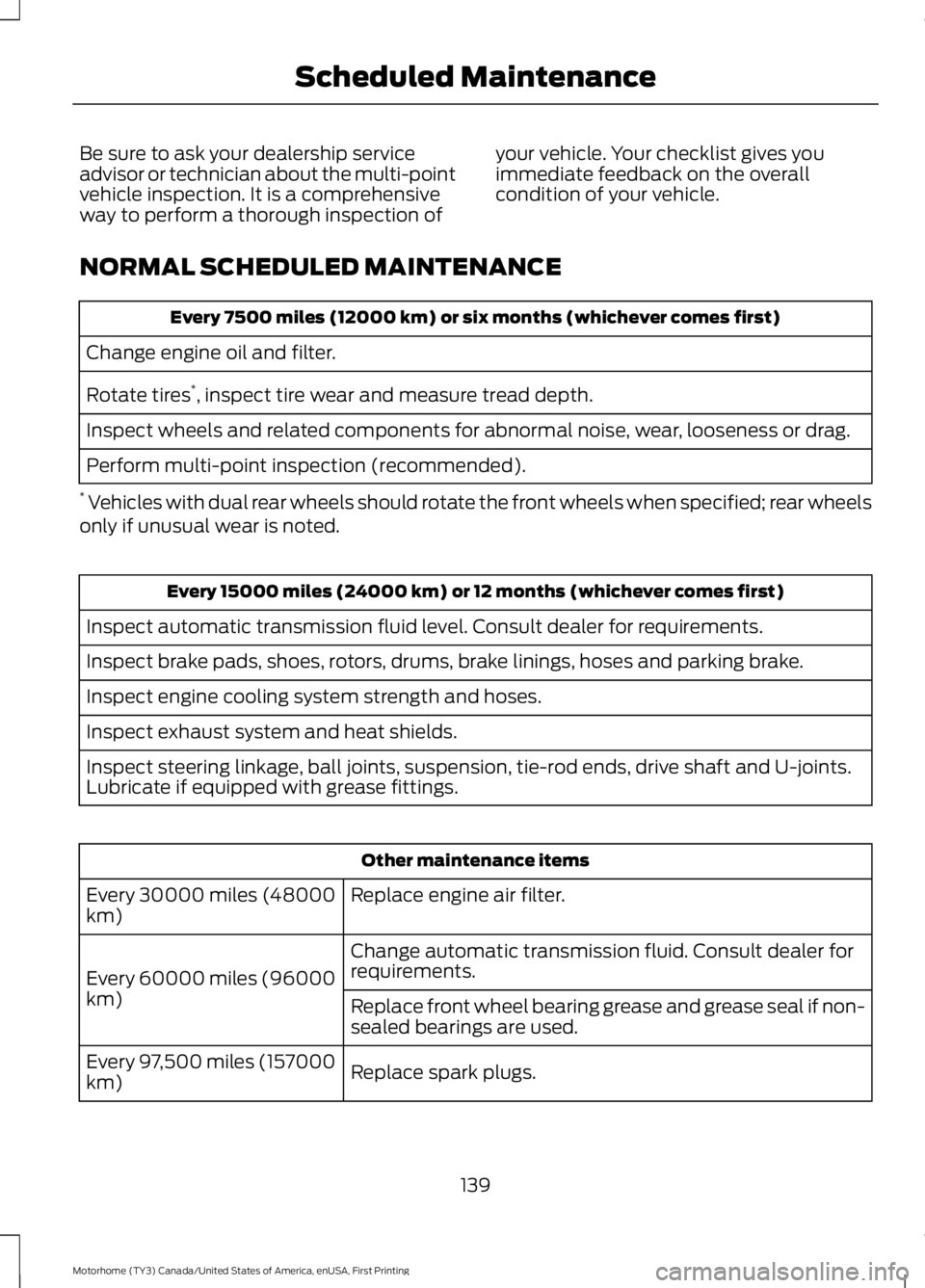
NORMAL SCHEDULED MAINTENANCE Every 7500 miles (12000 km) or six months (whichever comes first)
Change engine oil and filter.
Rotate tires *
, inspect tire wear and measure tread depth.
Inspect wheels and related components for abnormal noise, wear, looseness or drag.
Perform multi-point inspection (recommended).
* Vehicles with dual rear wheels should rotate the front wheels when specified; rear wheels
only if unusual wear is noted. Every 15000 miles (24000 km) or 12 months (whichever comes first)
Inspect automatic transmission fluid level. Consult dealer for requirements.
Inspect brake pads, shoes, rotors, drums, brake linings, hoses and parking brake.
Inspect engine cooling system strength and hoses.
Inspect exhaust system and heat shields.
Inspect steering linkage, ball joints, suspension, tie-rod ends, drive shaft and U-joints.
Lubricate if equipped with grease fittings. Other maintenance items
Replace engine air filter.
Every 30000 miles (48000
km)
Change automatic transmission fluid. Consult dealer for
requirements.
Every 60000 miles (96000
km) Replace front wheel bearing grease and grease seal if non-
sealed bearings are used.
Replace spark plugs.
Every 97,500 miles (157000
km)
139
Motorhome (TY3) Canada/United States of America, enUSA, First Printing Scheduled Maintenance
Page 163 of 164
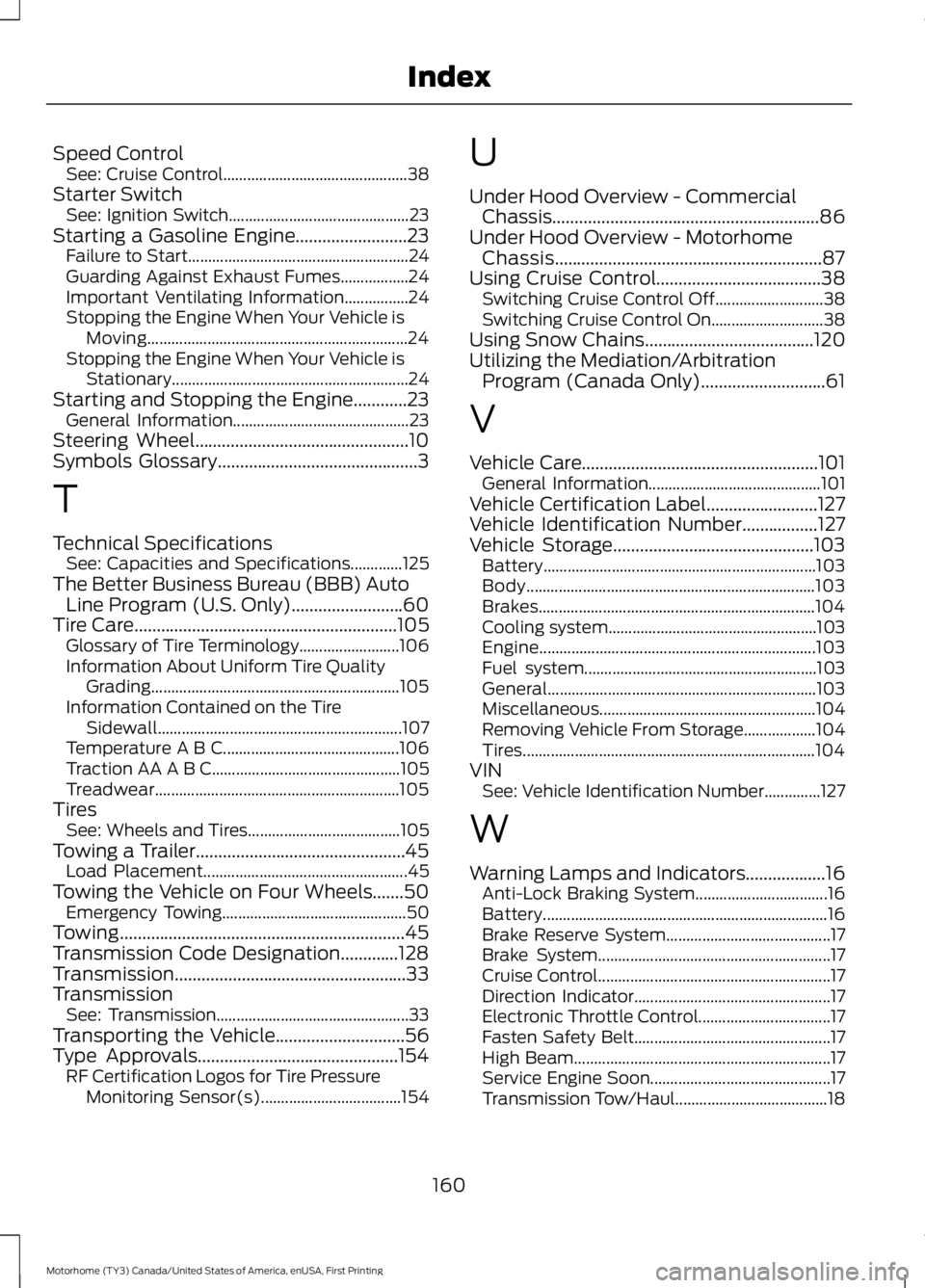
Speed Control
See: Cruise Control.............................................. 38
Starter Switch See: Ignition Switch............................................. 23
Starting a Gasoline Engine.........................23 Failure to Start....................................................... 24
Guarding Against Exhaust Fumes.................24
Important Ventilating Information................24
Stopping the Engine When Your Vehicle is Moving................................................................. 24
Stopping the Engine When Your Vehicle is Stationary........................................................... 24
Starting and Stopping the Engine............23 General Information............................................ 23
Steering Wheel................................................10
Symbols Glossary.............................................3
T
Technical Specifications See: Capacities and Specifications.............125
The Better Business Bureau (BBB) Auto Line Program (U.S. Only).........................60
Tire Care
...........................................................105
Glossary of Tire Terminology......................... 106
Information About Uniform Tire Quality Grading.............................................................. 105
Information Contained on the Tire Sidewall............................................................. 107
Temperature A B C............................................ 106
Traction AA A B C............................................... 105
Treadwear............................................................. 105
Tires See: Wheels and Tires...................................... 105
Towing a Trailer...............................................45 Load Placement................................................... 45
Towing the Vehicle on Four Wheels.......50 Emergency Towing.............................................. 50
Towing................................................................45
Transmission Code Designation.............128
Transmission....................................................33
Transmission See: Transmission................................................ 33
Transporting the Vehicle
.............................56
Type Approvals.............................................154
RF Certification Logos for Tire Pressure
Monitoring Sensor(s)................................... 154U
Under Hood Overview - Commercial
Chassis............................................................86
Under Hood Overview - Motorhome Chassis............................................................87
Using Cruise Control.....................................38 Switching Cruise Control Off........................... 38
Switching Cruise Control On............................ 38
Using Snow Chains
......................................120
Utilizing the Mediation/Arbitration Program (Canada Only)............................61
V
Vehicle Care.....................................................101 General Information........................................... 101
Vehicle Certification Label.........................127
Vehicle Identification Number
.................127
Vehicle Storage.............................................103 Battery.................................................................... 103
Body........................................................................\
103
Brakes..................................................................... 104
Cooling system.................................................... 103
Engine..................................................................... 103
Fuel system.......................................................... 103
General................................................................... 103
Miscellaneous...................................................... 104
Removing Vehicle From Storage.................. 104
Tires........................................................................\
. 104
VIN See: Vehicle Identification Number..............127
W
Warning Lamps and Indicators..................16 Anti-Lock Braking System................................. 16
Battery....................................................................... 16
Brake Reserve System......................................... 17
Brake System.......................................................... 17
Cruise Control.......................................................... 17
Direction Indicator................................................. 17
Electronic Throttle Control................................. 17
Fasten Safety Belt................................................. 17
High Beam................................................................ 17
Service Engine Soon............................................. 17
Transmission Tow/Haul...................................... 18
160
Motorhome (TY3) Canada/United States of America, enUSA, First Printing Index