Hub FORD F650 2002 10.G Owners Manual
[x] Cancel search | Manufacturer: FORD, Model Year: 2002, Model line: F650, Model: FORD F650 2002 10.GPages: 256, PDF Size: 1.75 MB
Page 55 of 256

CASSETTE AND CASSETTE PLAYER CARE
²Use only cassettes that are 90 minutes long or less.
²Do not expose tapes to direct sunlight, high humidity, extreme heat or
extreme cold. Allow tapes that may have been exposed to extreme
temperatures to reach a moderate temperature before playing.
²Tighten very loose tapes by inserting a finger or pencil into the hole
and turning the hub.
²Remove loose labels before inserting tapes.
²Do not leave tapes in the cassette player for a long time when not
being played.
RADIO FREQUENCY INFORMATION
The Federal Communications Commission (FCC) and the Canadian Radio
and Telecommunications Commission(CRTC) establish the frequencies
AM and FM stations may use for their broadcasts. Allowable frequencies
are:
AM 530, 540±1600, 1610 kHz
FM 87.7, 87.9±107.7, 107.9 MHz
Not all frequencies are used in a given area.
RADIO RECEPTION FACTORS
Three factors can affect radio reception:
²Distance/strength.The further an FM signal travels, the weaker it is.
The listenable range of the average FM station is approximately 40 km
(24 miles). This range can be affected by ªsignal modulation.º Signal
modulation is a process radio stations use to increase their
strength/volume relative to other stations.
²Terrain.Hills, mountains and tall buildings between your vehicle's
antenna and the radio station signal can cause FM reception problems.
Static can be caused on AM stations by power lines, electric fences,
traffic lights and thunderstorms. Moving away from an interfering
structure (out of its ªshadowº) returns your reception to normal.
²Station overload.Weak signals are sometimes captured by stronger
signals when you pass a broadcast tower. A stronger signal may
temporarily overtake a weaker signal and play while the weak station
frequency is displayed.
Entertainment Systems
55
Page 149 of 256
hubs (for trucks) or the bottom of the wheel rims (for cars).
Once through the water, always try the brakes. Wet brakes do not stop
the vehicle as effectively as dry brakes. Drying can be improved by
moving your vehicle slowly while applying light pressure on the brake
pedal.
Driving through deep water where the transmission vent tube is
submerged may allow water into the transmission and cause
internal transmission damage.
MAXIMUM VEHICLE LOADING
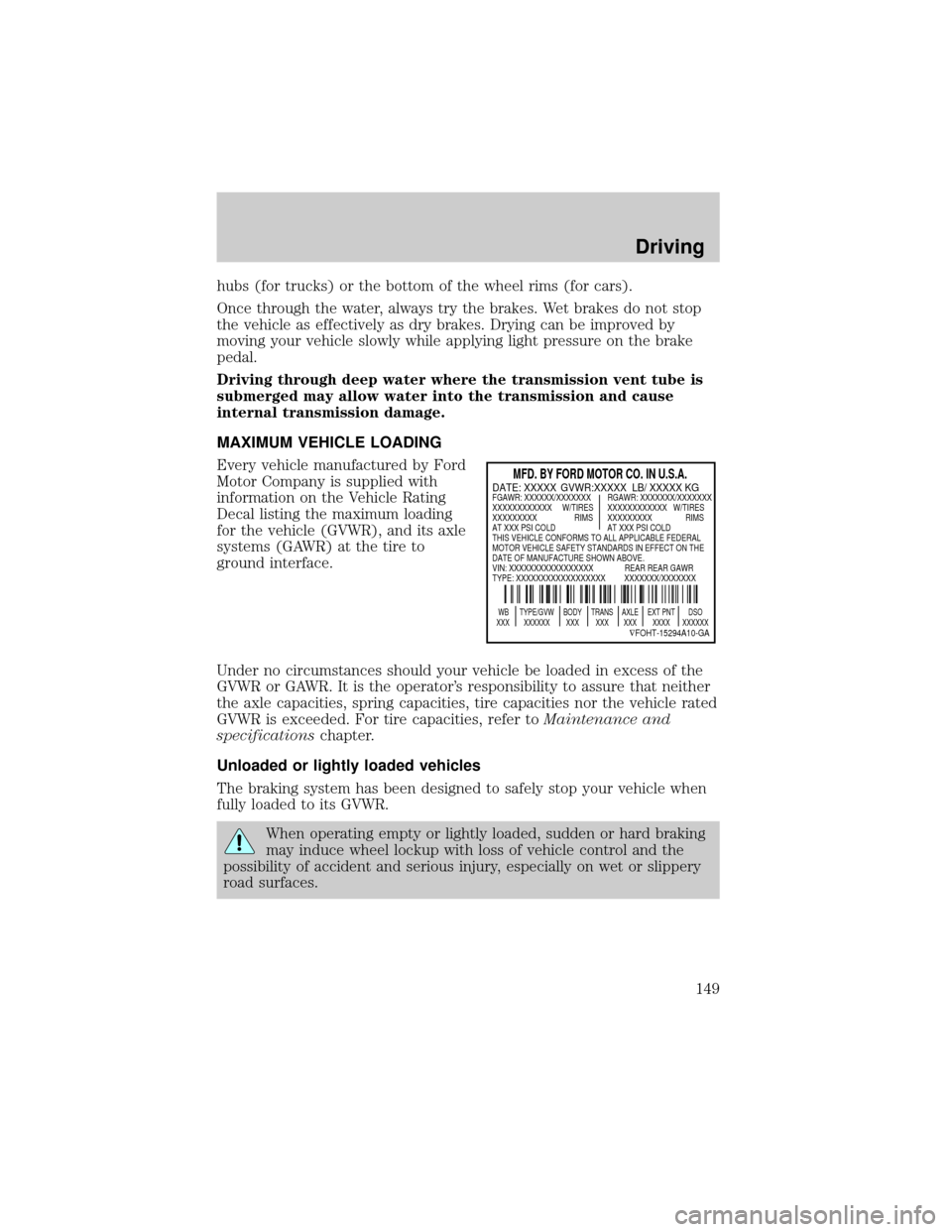
Every vehicle manufactured by Ford
Motor Company is supplied with
information on the Vehicle Rating
Decal listing the maximum loading
for the vehicle (GVWR), and its axle
systems (GAWR) at the tire to
ground interface.
Under no circumstances should your vehicle be loaded in excess of the
GVWR or GAWR. It is the operator's responsibility to assure that neither
the axle capacities, spring capacities, tire capacities nor the vehicle rated
GVWR is exceeded. For tire capacities, refer toMaintenance and
specificationschapter.
Unloaded or lightly loaded vehicles
The braking system has been designed to safely stop your vehicle when
fully loaded to its GVWR.
When operating empty or lightly loaded, sudden or hard braking
may induce wheel lockup with loss of vehicle control and the
possibility of accident and serious injury, especially on wet or slippery
road surfaces.
MFD. BY FORD MOTOR CO. IN U.S.A.
WB TYPE/GVW BODY TRANS AXLE EXT PNT DSO
XXX XXXXXX XXX XXX XXX XXXX XXXXXX
ÑFOHT-15294A10-GA
DATE: XXXXX GVWR:XXXXX LB/ XXXXX KGFGAWR: XXXXXX/XXXXXXX RGAWR: XXXXXXX/XXXXXXX
XXXXXXXXXXXX W/TIRES XXXXXXXXXXXX W/TIRES
XXXXXXXXX RIMS XXXXXXXXX RIMS
AT XXX PSI COLD AT XXX PSI COLD
THIS VEHICLE CONFORMS TO ALL APPLICABLE FEDERAL
MOTOR VEHICLE SAFETY STANDARDS IN EFFECT ON THE
DATE OF MANUFACTURE SHOWN ABOVE.
VIN: XXXXXXXXXXXXXXXXX REAR REAR GAWR
TYPE: XXXXXXXXXXXXXXXXXX XXXXXXX/XXXXXXX
Driving
149
Page 215 of 256
10. Reset the air filter restriction indicator.
11. Inspect the air induction system for loose fitting, damaged or missing
components and repair as necessary.
SERVICING YOUR WHEELS AND TIRES
Wheel assembly
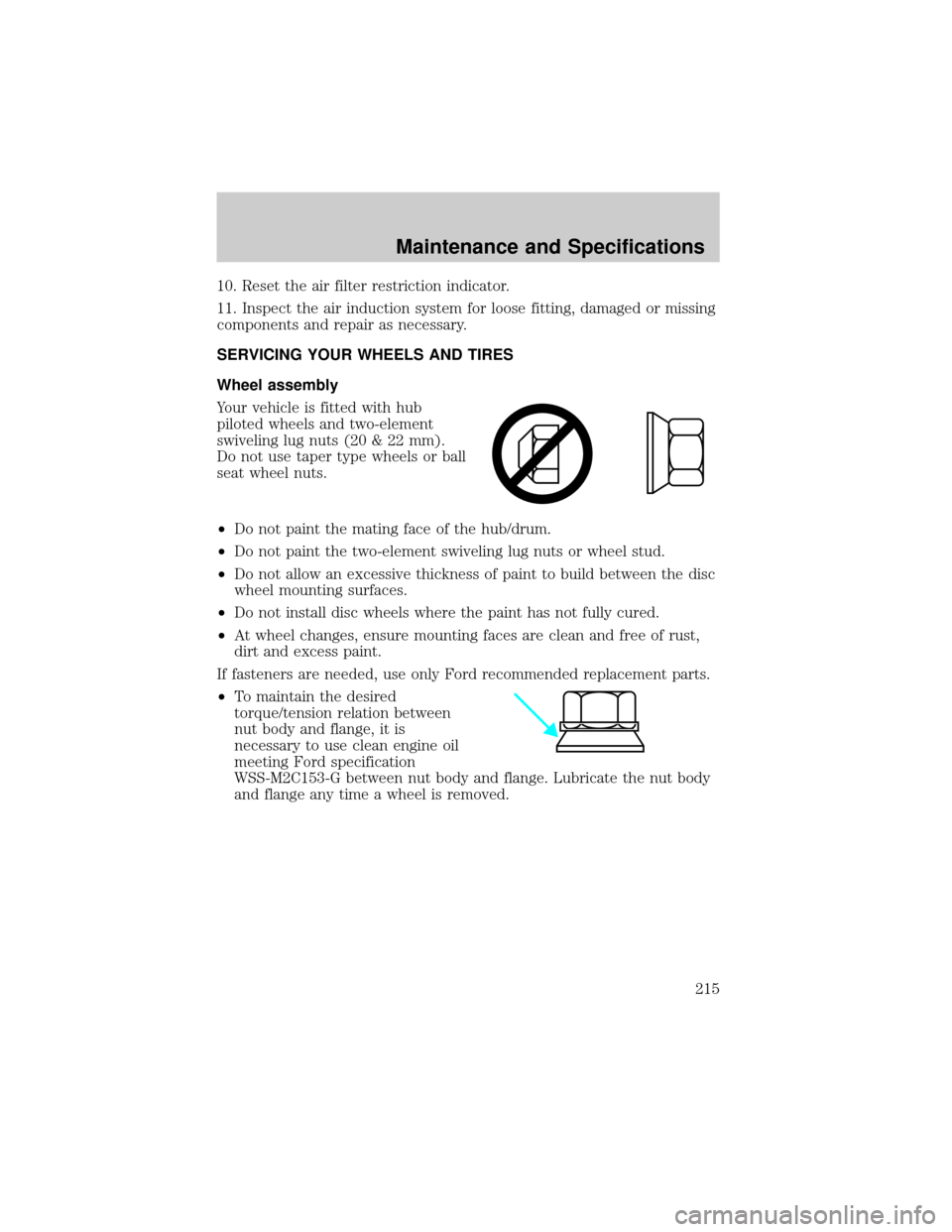
Your vehicle is fitted with hub
piloted wheels and two-element
swiveling lug nuts (20 & 22 mm).
Do not use taper type wheels or ball
seat wheel nuts.
²Do not paint the mating face of the hub/drum.
²Do not paint the two-element swiveling lug nuts or wheel stud.
²Do not allow an excessive thickness of paint to build between the disc
wheel mounting surfaces.
²Do not install disc wheels where the paint has not fully cured.
²At wheel changes, ensure mounting faces are clean and free of rust,
dirt and excess paint.
If fasteners are needed, use only Ford recommended replacement parts.
²To maintain the desired
torque/tension relation between
nut body and flange, it is
necessary to use clean engine oil
meeting Ford specification
WSS-M2C153-G between nut body and flange. Lubricate the nut body
and flange any time a wheel is removed.
Maintenance and Specifications
215
Page 217 of 256
A wheel or tire of the wrong size or type may adversely affect
such things as load carrying capacity, wheel and bearing life,
brake cooling, speedometer/odometer calibration, stopping ability,
headlight aim, bumper height, vehicle ground clearance and tire or tire
chain clearance to the body and chassis.
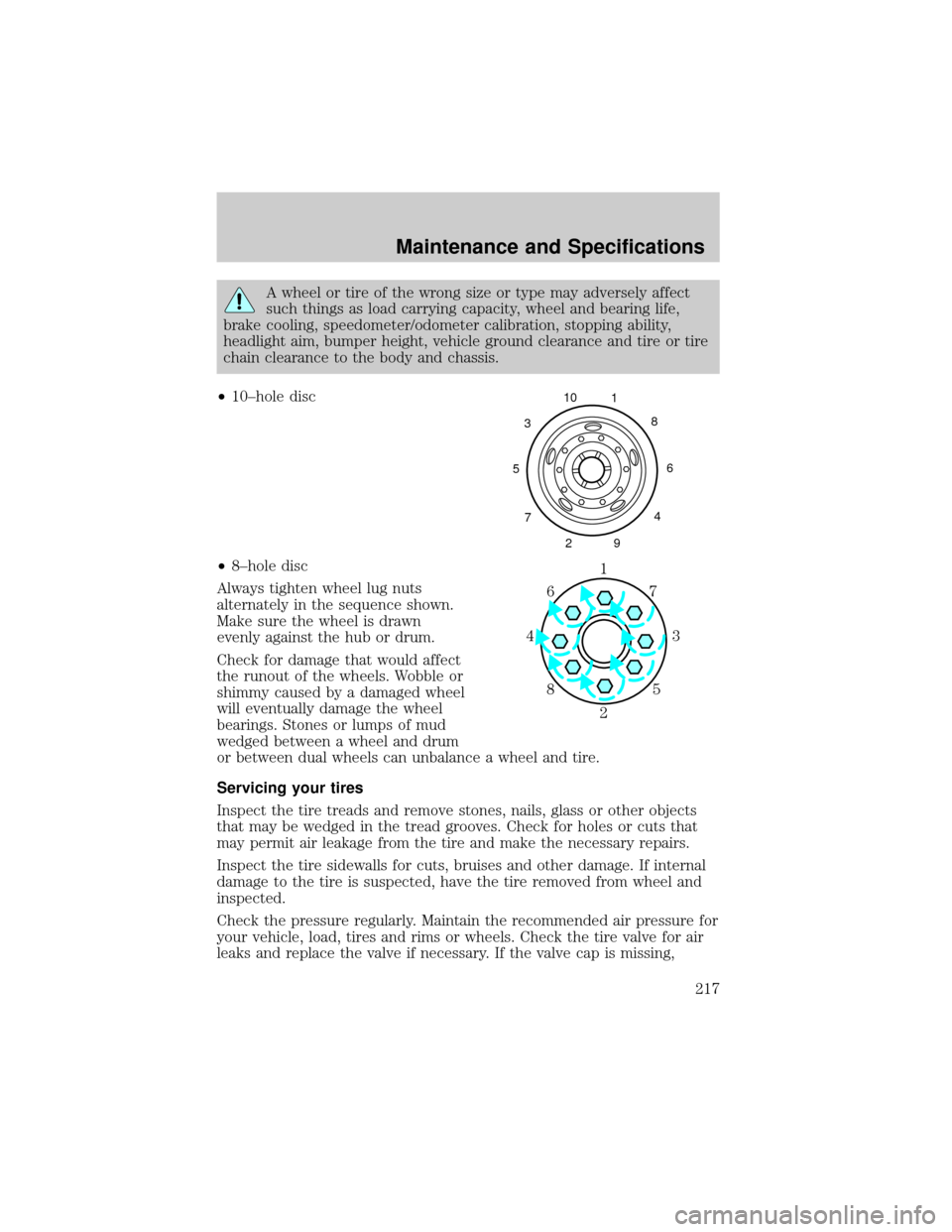
²10±hole disc
²8±hole disc
Always tighten wheel lug nuts
alternately in the sequence shown.
Make sure the wheel is drawn
evenly against the hub or drum.
Check for damage that would affect
the runout of the wheels. Wobble or
shimmy caused by a damaged wheel
will eventually damage the wheel
bearings. Stones or lumps of mud
wedged between a wheel and drum
or between dual wheels can unbalance a wheel and tire.
Servicing your tires
Inspect the tire treads and remove stones, nails, glass or other objects
that may be wedged in the tread grooves. Check for holes or cuts that
may permit air leakage from the tire and make the necessary repairs.
Inspect the tire sidewalls for cuts, bruises and other damage. If internal
damage to the tire is suspected, have the tire removed from wheel and
inspected.
Check the pressure regularly. Maintain the recommended air pressure for
your vehicle, load, tires and rims or wheels. Check the tire valve for air
leaks and replace the valve if necessary. If the valve cap is missing,
5310
1
8
6
4
9 2 7
1
3 4
27 6
5 8
Maintenance and Specifications
217
Page 219 of 256
Refer to the Ford Service Manual applicable to your vehicle for proper
tightening procedures and torque specifications.
Periodically check the oil level on oil filled front bearing hubs. If
necessary, add oil through the filler plug so the oil level is between the
ADD and FULL marks indicated on the hub. Do not overfill. Overfilling
can result in oil on brake linings.
Refer to your Scheduled Maintenance Guide for fluid level checks and
change intervals for the front hubs.
Your front hubs may be filled with an optional synthetic fluid which
allows use of the extended service intervals. A green colored filler plug
identifies use of the synthetic fluid.
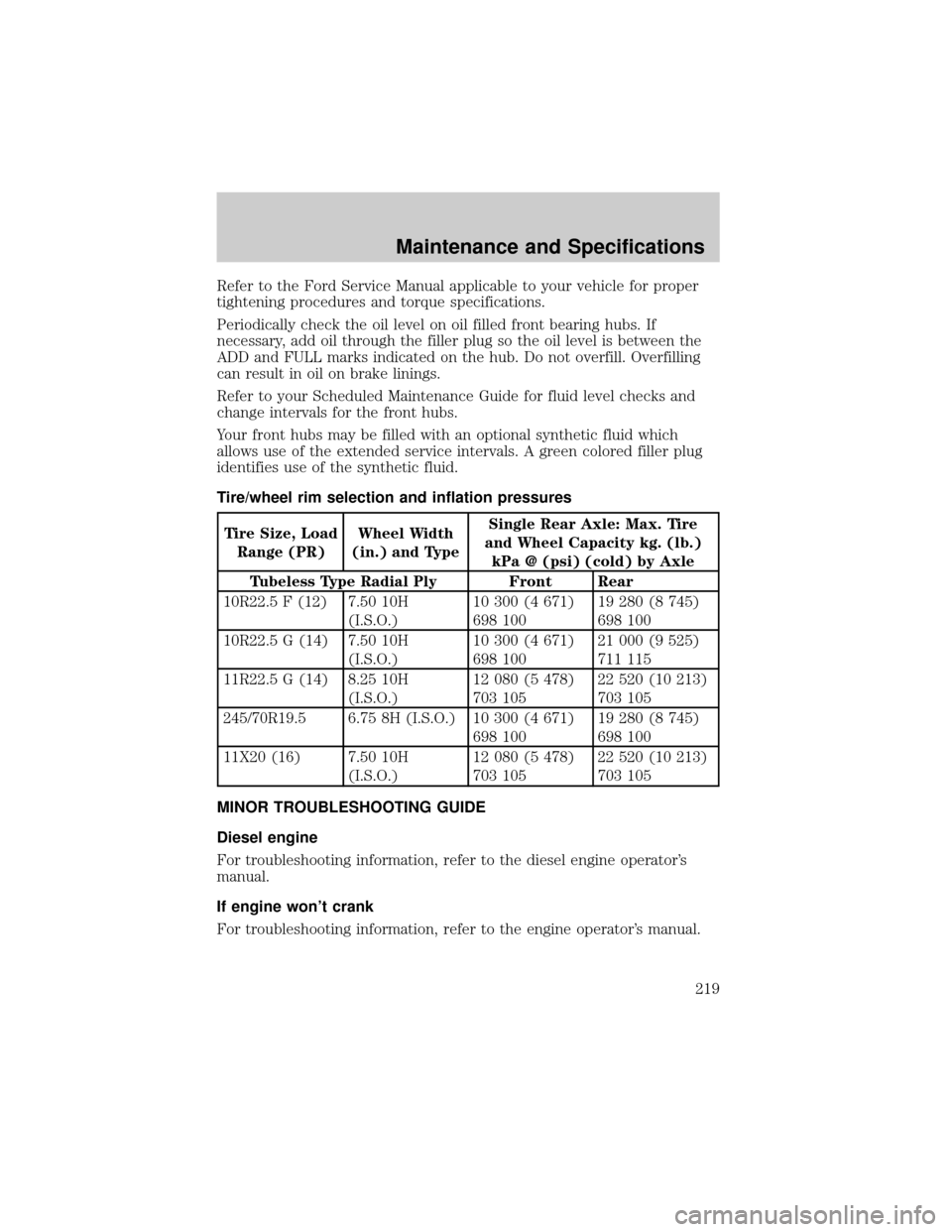
Tire/wheel rim selection and inflation pressures
Tire Size, Load
Range (PR)Wheel Width
(in.) and TypeSingle Rear Axle: Max. Tire
and Wheel Capacity kg. (lb.)
kPa @ (psi) (cold) by Axle
Tubeless Type Radial Ply Front Rear
10R22.5 F (12) 7.50 10H
(I.S.O.)10 300 (4 671)
698 10019 280 (8 745)
698 100
10R22.5 G (14) 7.50 10H
(I.S.O.)10 300 (4 671)
698 10021 000 (9 525)
711 115
11R22.5 G (14) 8.25 10H
(I.S.O.)12 080 (5 478)
703 10522 520 (10 213)
703 105
245/70R19.5 6.75 8H (I.S.O.) 10 300 (4 671)
698 10019 280 (8 745)
698 100
11X20 (16) 7.50 10H
(I.S.O.)12 080 (5 478)
703 10522 520 (10 213)
703 105
MINOR TROUBLESHOOTING GUIDE
Diesel engine
For troubleshooting information, refer to the diesel engine operator's
manual.
If engine won't crank
For troubleshooting information, refer to the engine operator's manual.
Maintenance and Specifications
219
Page 222 of 256
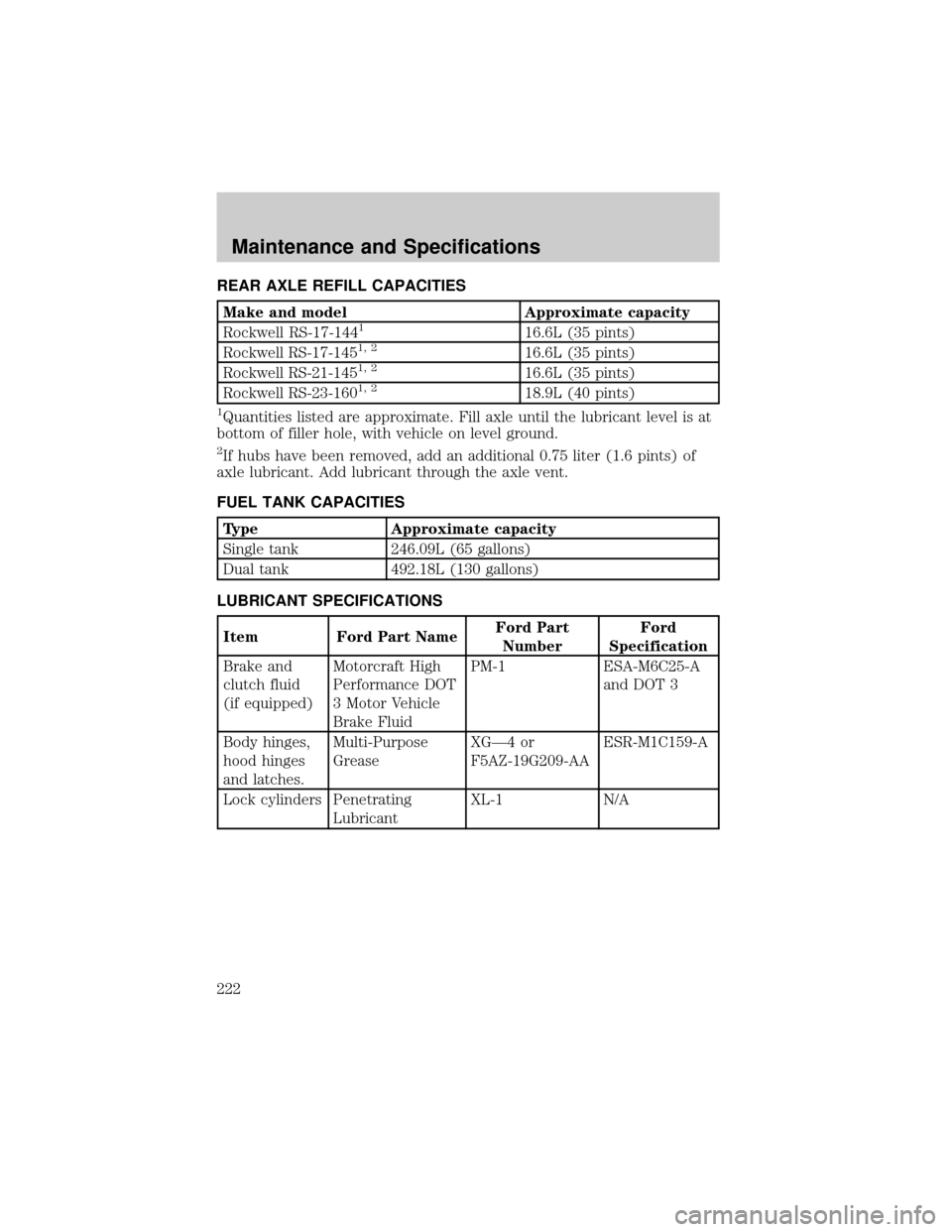
REAR AXLE REFILL CAPACITIES
Make and model Approximate capacity
Rockwell RS-17-144116.6L (35 pints)
Rockwell RS-17-1451, 216.6L (35 pints)
Rockwell RS-21-1451, 216.6L (35 pints)
Rockwell RS-23-1601, 218.9L (40 pints)
1Quantities listed are approximate. Fill axle until the lubricant level is at
bottom of filler hole, with vehicle on level ground.
2If hubs have been removed, add an additional 0.75 liter (1.6 pints) of
axle lubricant. Add lubricant through the axle vent.
FUEL TANK CAPACITIES
Type Approximate capacity
Single tank 246.09L (65 gallons)
Dual tank 492.18L (130 gallons)
LUBRICANT SPECIFICATIONS
Item Ford Part NameFord Part
NumberFord
Specification
Brake and
clutch fluid
(if equipped)Motorcraft High
Performance DOT
3 Motor Vehicle
Brake FluidPM-1 ESA-M6C25-A
and DOT 3
Body hinges,
hood hinges
and latches.Multi-Purpose
GreaseXGÐ4 or
F5AZ-19G209-AAESR-M1C159-A
Lock cylinders Penetrating
LubricantXL-1 N/A
Maintenance and Specifications
222
Page 224 of 256
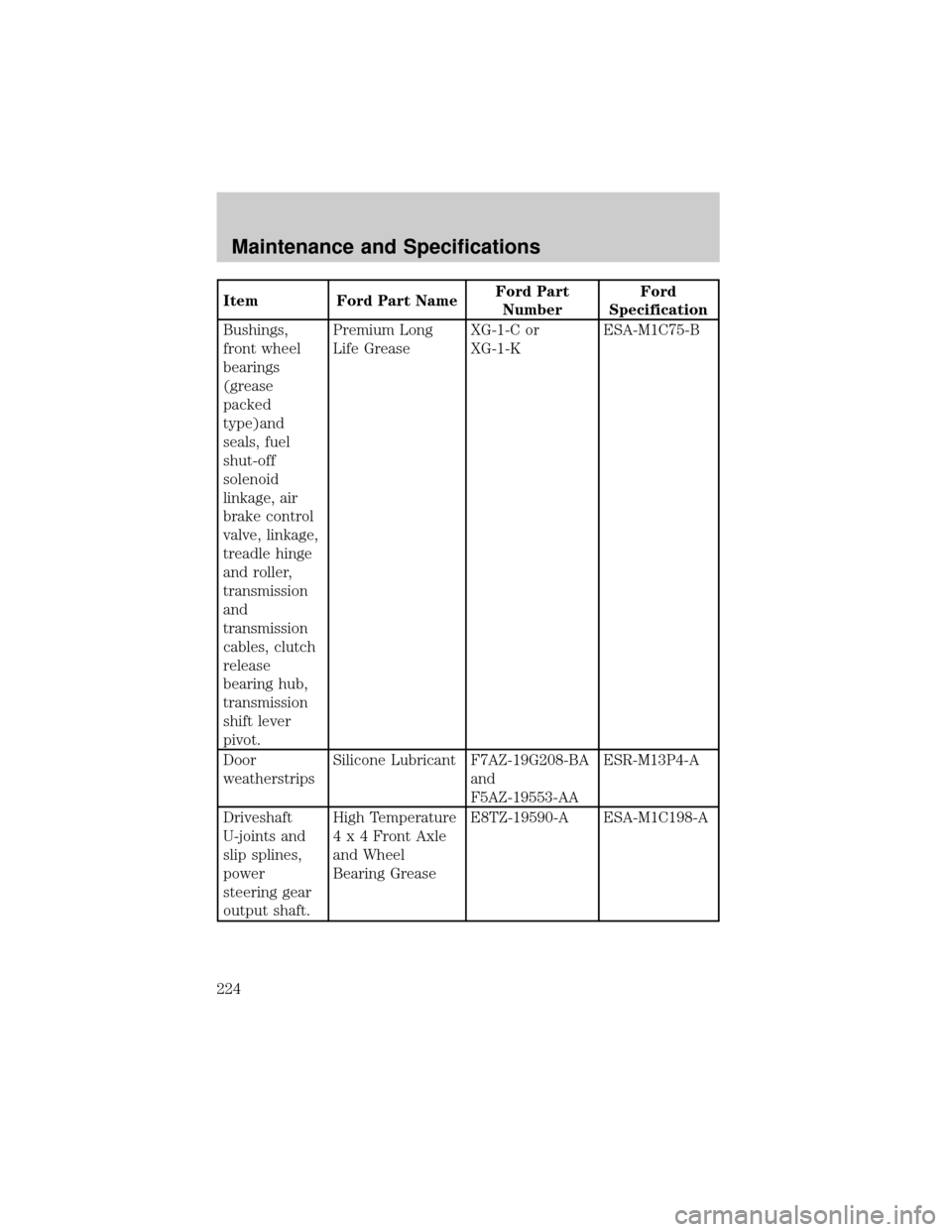
Item Ford Part NameFord Part
NumberFord
Specification
Bushings,
front wheel
bearings
(grease
packed
type)and
seals, fuel
shut-off
solenoid
linkage, air
brake control
valve, linkage,
treadle hinge
and roller,
transmission
and
transmission
cables, clutch
release
bearing hub,
transmission
shift lever
pivot.Premium Long
Life GreaseXG-1-C or
XG-1-KESA-M1C75-B
Door
weatherstripsSilicone Lubricant F7AZ-19G208-BA
and
F5AZ-19553-AAESR-M13P4-A
Driveshaft
U-joints and
slip splines,
power
steering gear
output shaft.High Temperature
4 x 4 Front Axle
and Wheel
Bearing GreaseE8TZ-19590-A ESA-M1C198-A
Maintenance and Specifications
224
Page 239 of 256
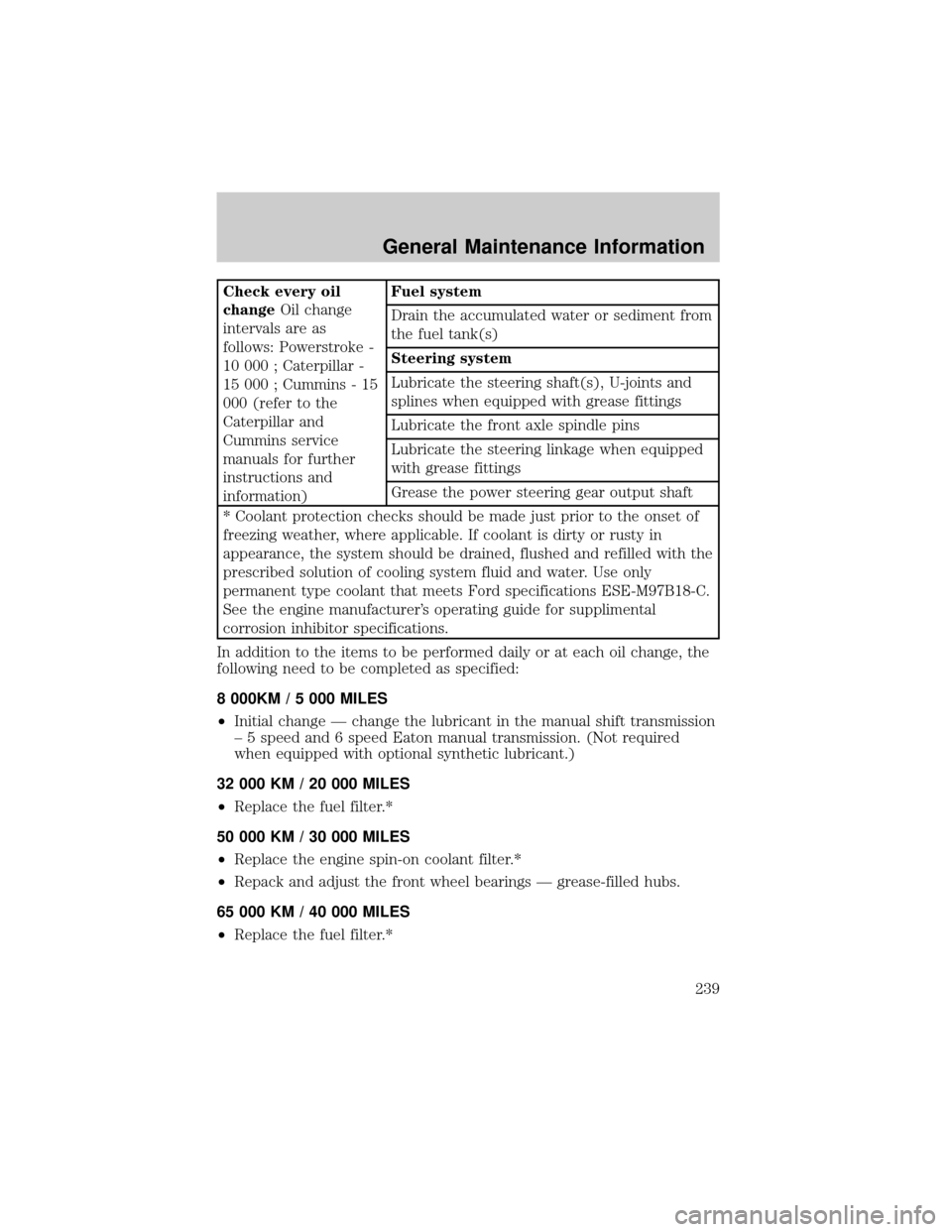
Check every oil
changeOil change
intervals are as
follows: Powerstroke -
10 000 ; Caterpillar -
15 000 ; Cummins - 15
000 (refer to the
Caterpillar and
Cummins service
manuals for further
instructions and
information)Fuel system
Drain the accumulated water or sediment from
the fuel tank(s)
Steering system
Lubricate the steering shaft(s), U-joints and
splines when equipped with grease fittings
Lubricate the front axle spindle pins
Lubricate the steering linkage when equipped
with grease fittings
Grease the power steering gear output shaft
* Coolant protection checks should be made just prior to the onset of
freezing weather, where applicable. If coolant is dirty or rusty in
appearance, the system should be drained, flushed and refilled with the
prescribed solution of cooling system fluid and water. Use only
permanent type coolant that meets Ford specifications ESE-M97B18-C.
See the engine manufacturer's operating guide for supplimental
corrosion inhibitor specifications.
In addition to the items to be performed daily or at each oil change, the
following need to be completed as specified:
8 000KM / 5 000 MILES
²Initial change Ð change the lubricant in the manual shift transmission
± 5 speed and 6 speed Eaton manual transmission. (Not required
when equipped with optional synthetic lubricant.)
32 000 KM / 20 000 MILES
²Replace the fuel filter.*
50 000 KM / 30 000 MILES
²Replace the engine spin-on coolant filter.*
²Repack and adjust the front wheel bearings Ð grease-filled hubs.
65 000 KM / 40 000 MILES
²Replace the fuel filter.*
General Maintenance Information
239
Page 240 of 256

80 000 KM / 50 000 MILES
²Disassemble the single check valve (SC-2) and the automatic drain
valve (DB±2) Ð clean and inspect the valve for wear and
deterioration.
100 000 KM / 60 000 MILES
²Replace the engine spin-on coolant filter.*
²Oil filled front hubsÐ drain oil, adjust bearings and refill the front
hubs with oil. (Not required when equipped with optional synthetic
lubricant.)
²Drain the oil, adjust the bearing and refill with axle lubricant Ð oil
filled hubs.
²Replace the fuel filter.*
²Change the manual transmission oil Ð Eaton 5 and 6 speeds only.
(Not required when equipped with optional synthetic lubricant.)
110 000 KM / 70 000 MILES
²Replace the engine spin-on coolant filter.*
²Replace the engine coolant.* See the engine manufacturer's operating
guide for supplemental corrosion inhibitor specifications.
130 000 KM / 80 000 MILES
²Replace the fuel filter.*
150 000 KM / 90 000 MILES
²Replace the engine spin-on coolant filter*.
²Repack and adjust the front wheel bearings Ð grease-filled hubs.
²Change the lubricant in the manual shift transmission ± 7 speed
Spicer. (Not required when equipped with optional synthetic
lubricant.)
²Change the power steering fluid and filter.
General Maintenance Information
240