clutch FORD F650 2002 10.G Owners Manual
[x] Cancel search | Manufacturer: FORD, Model Year: 2002, Model line: F650, Model: FORD F650 2002 10.GPages: 256, PDF Size: 1.75 MB
Page 82 of 256
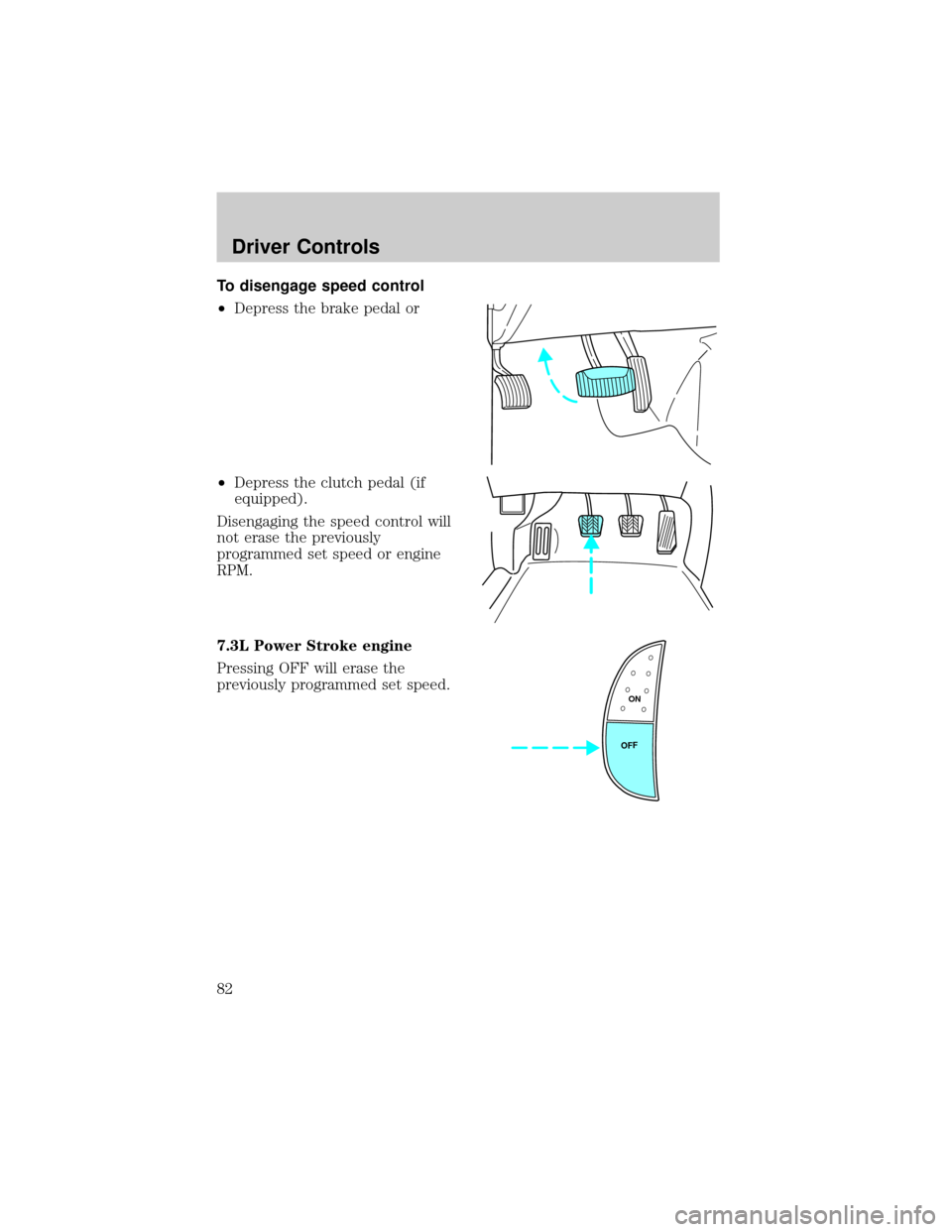
To disengage speed control
²Depress the brake pedal or
²Depress the clutch pedal (if
equipped).
Disengaging the speed control will
not erase the previously
programmed set speed or engine
RPM.
7.3L Power Stroke engine
Pressing OFF will erase the
previously programmed set speed.
ON
OFF
Driver Controls
82
Page 127 of 256
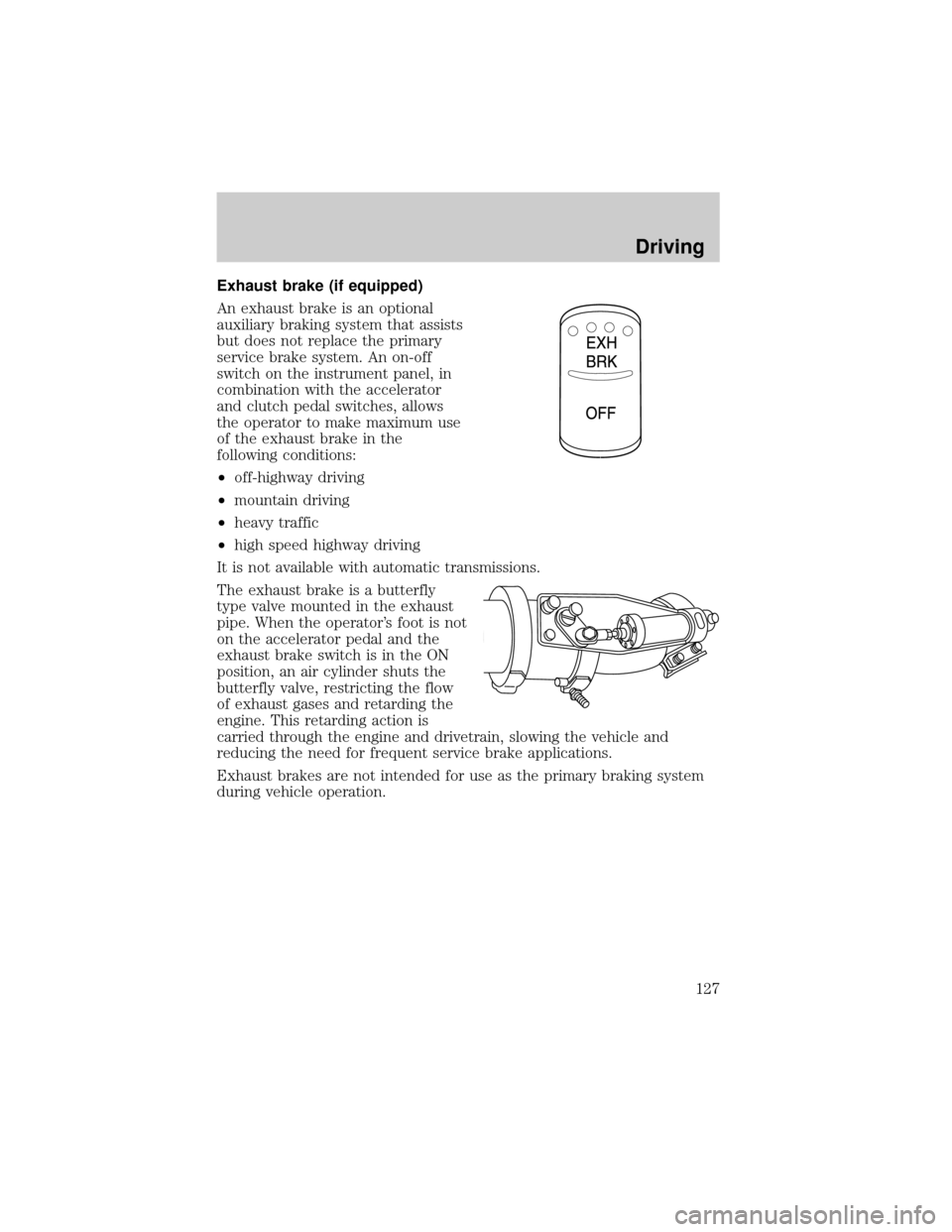
Exhaust brake (if equipped)
An exhaust brake is an optional
auxiliary braking system that assists
but does not replace the primary
service brake system. An on-off
switch on the instrument panel, in
combination with the accelerator
and clutch pedal switches, allows
the operator to make maximum use
of the exhaust brake in the
following conditions:
²off-highway driving
²mountain driving
²heavy traffic
²high speed highway driving
It is not available with automatic transmissions.
The exhaust brake is a butterfly
type valve mounted in the exhaust
pipe. When the operator's foot is not
on the accelerator pedal and the
exhaust brake switch is in the ON
position, an air cylinder shuts the
butterfly valve, restricting the flow
of exhaust gases and retarding the
engine. This retarding action is
carried through the engine and drivetrain, slowing the vehicle and
reducing the need for frequent service brake applications.
Exhaust brakes are not intended for use as the primary braking system
during vehicle operation.
Driving
127
Page 129 of 256
Exhaust brake operating characteristics
When you remove your feet from both the accelerator and clutch pedals
and the exhaust brake switch is in the ON position, the exhaust brake is
activated. The following conditions should exist if the brake is operating
properly:
²A slight change in the sound of the engine when the exhaust brake is
activated.
²Exhaust smoke appears normal.
²Engine temperature remains in the normal operating range.
²Road speed usually decreases when the exhaust brake is applied
during a descent, except when the vehicle is carrying a heavy load or
the grade is extremely steep. In these instances, you may need to
apply the service brakes occasionally.
²During a descent, the tachometer usually shows a drop in RPM
depending on the grade and the vehicle load.
²Do not expect a retarding effect similar to sudden hard application of
the service brakes. The exhaust brake retards the vehicle with a
smooth braking effect.
²Depending on the grade and vehicle load, you may or may not feel the
retarding force acting against your body when the brake is applied.
The brake's retarding force is actually preventing the vehicle from
going much faster.
Make sure the exhaust brake is turned off before shutting off the engine.
Installing an exhaust or auxiliary brake should never allow the
engine to exceed maximum governed speeds under any
conditions.
Air brake reservoir draining
Failure to drain air brake reservoirs can result in a reduction or
loss of braking ability due to fluid accumulation in the reservoir
and/or possible freeze-up during cold weather.
Driving
129
Page 140 of 256
engaged by clashing the gear teeth. This may damage the PTO unit and
the transmission PTO drive gear teeth. This could result in further
damage to the transmission and PTO.
PTO operation with vehicle stationary
To operate the power take-off, stop the vehicle, idle the engine and set
the parking brake. Make sure the gear selector is in any forward drive
range, then engage the PTO. After the PTO is engaged for stationary
vehicle operation, move the range selector to N (Neutral). Increase the
engine speed until the desired power take-off operation speed is
obtained. To disengage the PTO after operation with the vehicle
standing, release the throttle, allow the drive equipment to come to a
stop, and then disengage the PTO.
When the PTO is operated with the vehicle stationary, the
transmission must be placed in N (Neutral). If the transmission
is not in N (Neutral) and is equipped with a remote throttle control, an
increase in engine speed can overpower the parking brake and cause
the vehicle to move, possibly resulting in personal and/or property
damage.
PTO operation while vehicle is moving
After the PTO is engaged for driven vehicle operation, shift to the
desired range and drive the vehicle. The speed of the PTO, during this
period of operation, will always maintain direct relation to vehicle speed.
PTO speed will decrease in relation to vehicle (transmission output)
speed as shifts to a higher gear occur. When operating the PTO while the
vehicle is moving, the PTO may be disengaged whenever it is no longer
required. When there is no load on the PTO gear, it can be pulled out of
engagement.
Power take-off (PTO) operation with an Allison automatic
transmission (MD applications)
The PTO drive gear is engine driven and provides direct engine power.
The PTO can be operated when the vehicle is either stationary or
moving.
The PTO gear is in constant mesh with the drive gear in the torque
converter housing. A friction clutch or constant drive is used to transmit
power to the PTO.
Driving
140
Page 141 of 256
Power take-off (PTO) operation on vehicles equipped with a
Caterpillar 3126E engine
If your vehicle is equipped with a Caterpillar 3126E engine, the PTO will
only operate if the vehicle is in Neutral. This feature can be overriden by
a special service tool; see your dealer or service representative for more
information.
DRIVING WITH A MANUAL TRANSMISSION (IF EQUIPPED)
Continued use of a damaged or worn clutch, prolonged clutch
slippage or downshifting at excessive speeds can result in a
failure of the engine, transmission or clutch components.
To avoid premature clutch wear and failure, do not drive with
your foot resting on the clutch pedal or use it to hold the vehicle
at a standstill on an upgrade as when waiting for a traffic light.
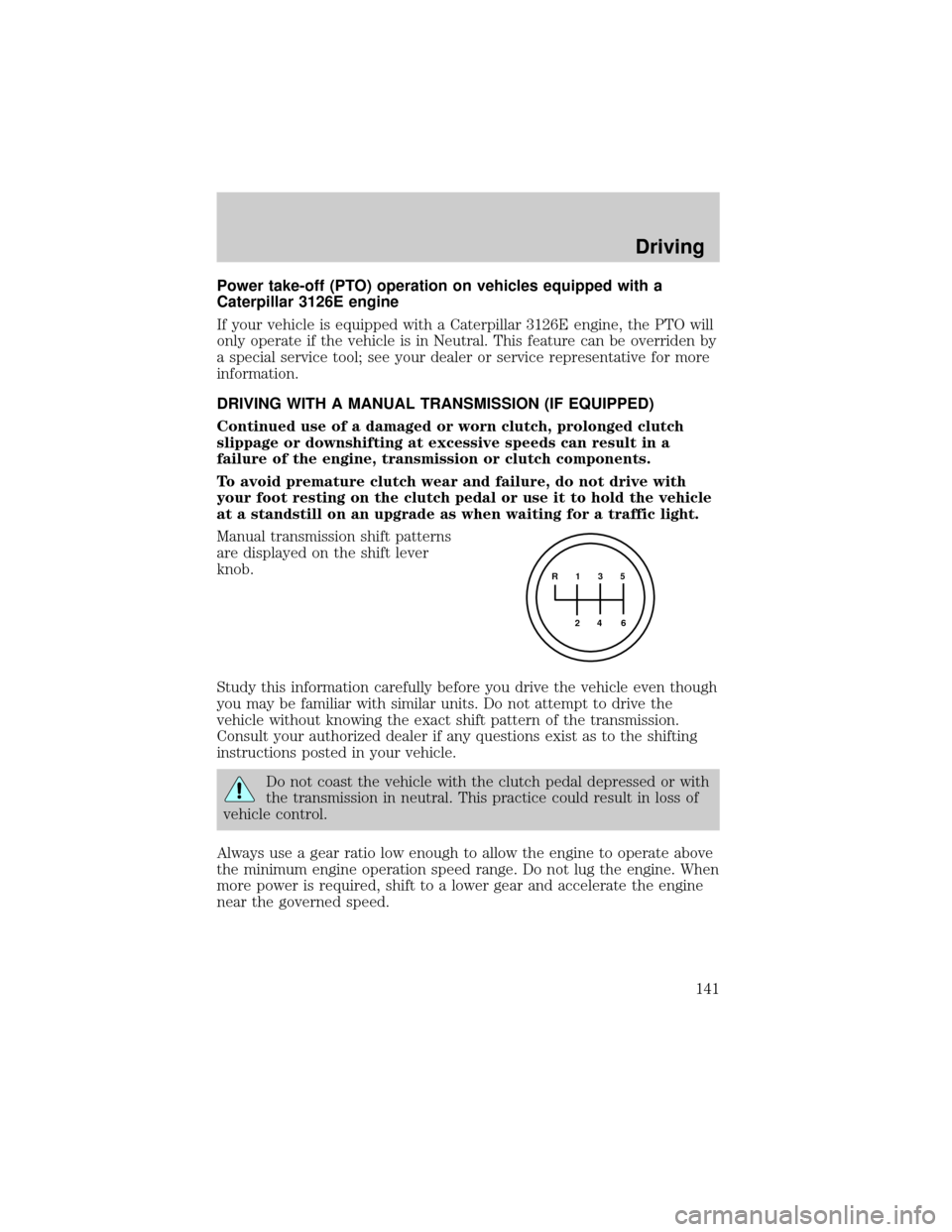
Manual transmission shift patterns
are displayed on the shift lever
knob.
Study this information carefully before you drive the vehicle even though
you may be familiar with similar units. Do not attempt to drive the
vehicle without knowing the exact shift pattern of the transmission.
Consult your authorized dealer if any questions exist as to the shifting
instructions posted in your vehicle.
Do not coast the vehicle with the clutch pedal depressed or with
the transmission in neutral. This practice could result in loss of
vehicle control.
Always use a gear ratio low enough to allow the engine to operate above
the minimum engine operation speed range. Do not lug the engine. When
more power is required, shift to a lower gear and accelerate the engine
near the governed speed.
R 1 3 5
4
6 2
Driving
141
Page 142 of 256
Driving hints
The following driving hints are provided as a brief, general guide in
operating the different manual transmissions used in your vehicle.
²Always use the lowest gear to start the vehicle.
²Do not slam or jerk lever into gear.
²When shifting into 1 (First) or R (Reverse) with vehicle standing still,
quickly release and depress the clutch pedal (if necessary to complete
gear engagement).
Operating the Eaton FS-4205A and FS-5205A 5±speed
transmissions
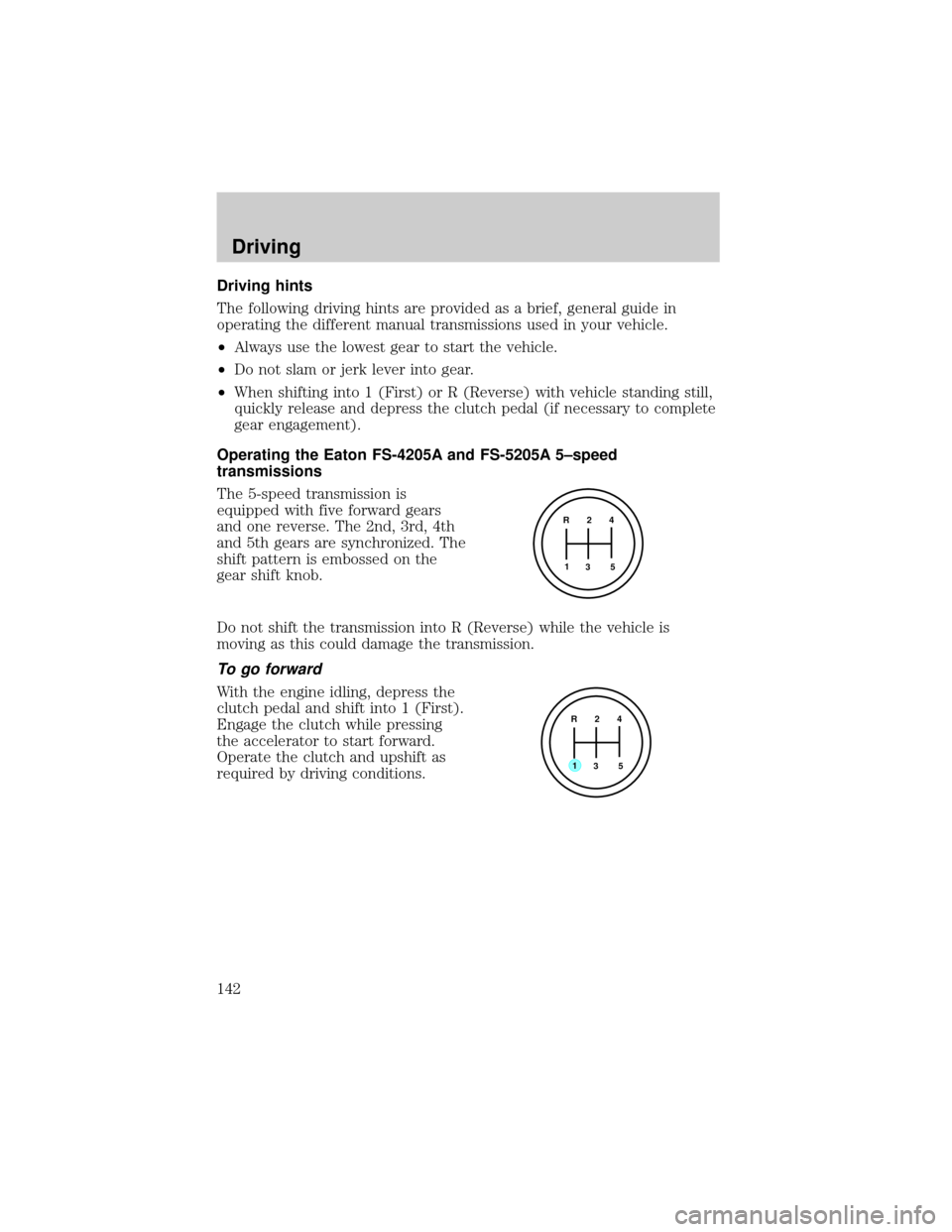
The 5-speed transmission is
equipped with five forward gears
and one reverse. The 2nd, 3rd, 4th
and 5th gears are synchronized. The
shift pattern is embossed on the
gear shift knob.
Do not shift the transmission into R (Reverse) while the vehicle is
moving as this could damage the transmission.
To go forward
With the engine idling, depress the
clutch pedal and shift into 1 (First).
Engage the clutch while pressing
the accelerator to start forward.
Operate the clutch and upshift as
required by driving conditions.
R 2 4
3 5 1
R 2 4
3 5
1
Driving
142
Page 143 of 256
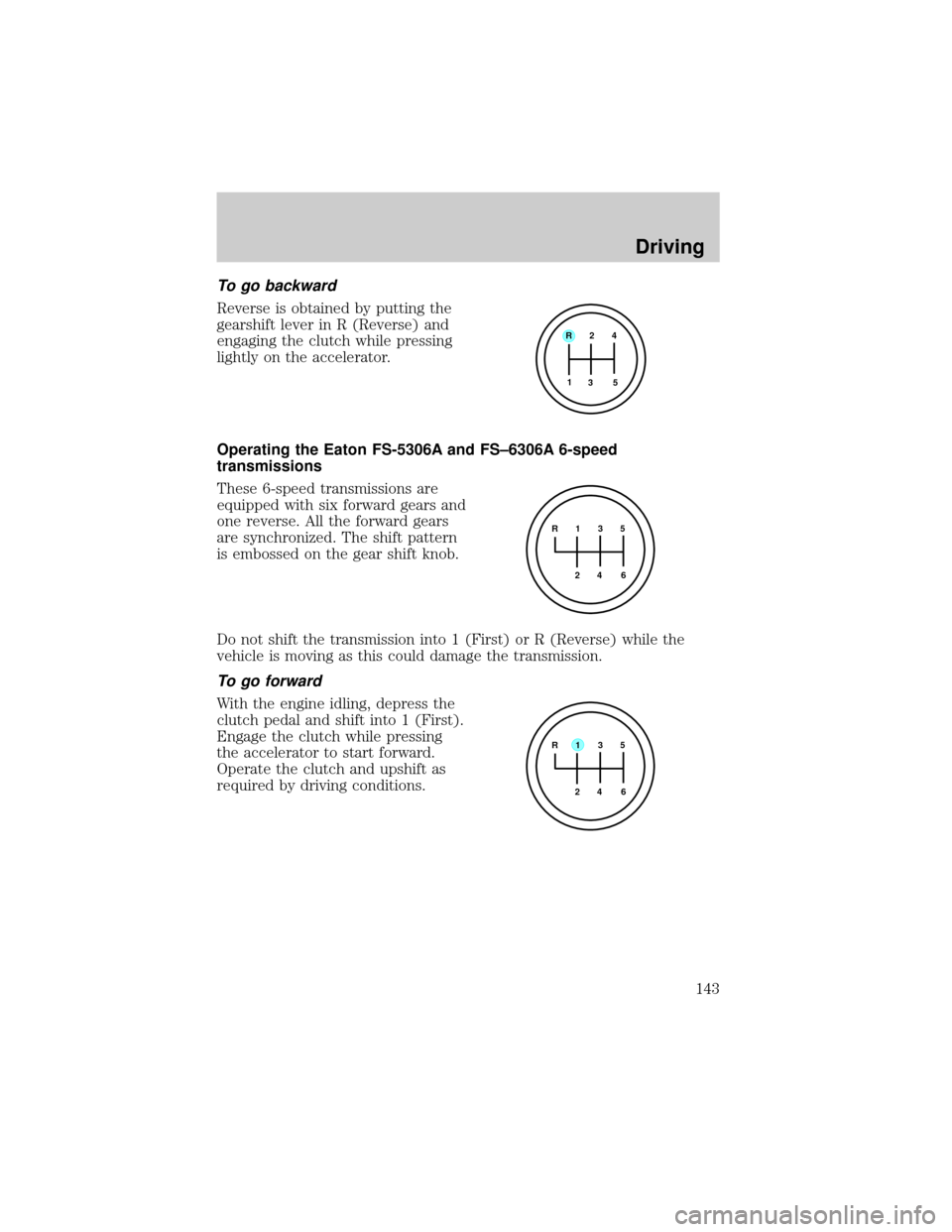
To go backward
Reverse is obtained by putting the
gearshift lever in R (Reverse) and
engaging the clutch while pressing
lightly on the accelerator.
Operating the Eaton FS-5306A and FS±6306A 6-speed
transmissions
These 6-speed transmissions are
equipped with six forward gears and
one reverse. All the forward gears
are synchronized. The shift pattern
is embossed on the gear shift knob.
Do not shift the transmission into 1 (First) or R (Reverse) while the
vehicle is moving as this could damage the transmission.
To go forward
With the engine idling, depress the
clutch pedal and shift into 1 (First).
Engage the clutch while pressing
the accelerator to start forward.
Operate the clutch and upshift as
required by driving conditions.
R 2 4
3 5 1
R 1 3 5
4
6 2
R 1 3 5
4
6 2
Driving
143
Page 144 of 256
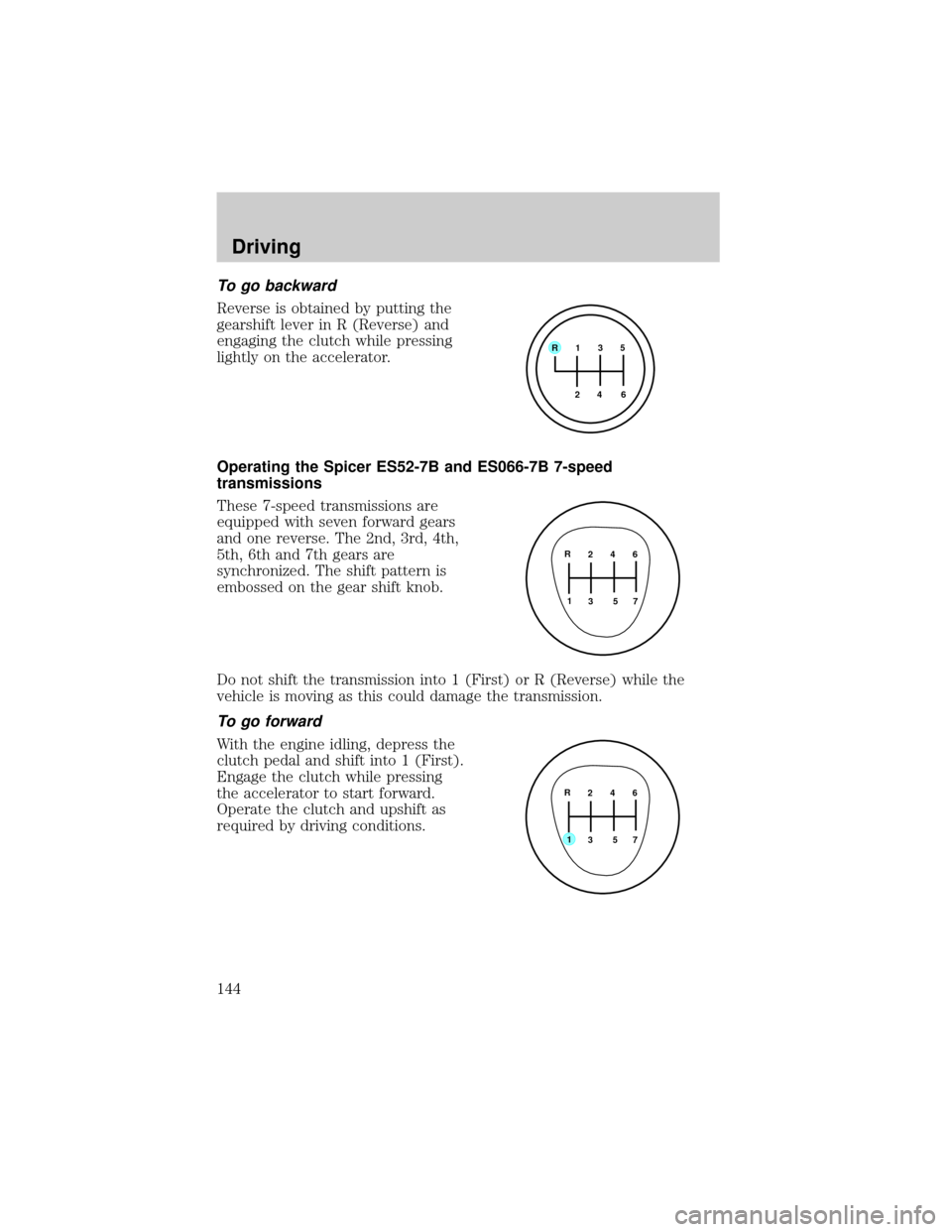
To go backward
Reverse is obtained by putting the
gearshift lever in R (Reverse) and
engaging the clutch while pressing
lightly on the accelerator.
Operating the Spicer ES52-7B and ES066-7B 7-speed
transmissions
These 7-speed transmissions are
equipped with seven forward gears
and one reverse. The 2nd, 3rd, 4th,
5th, 6th and 7th gears are
synchronized. The shift pattern is
embossed on the gear shift knob.
Do not shift the transmission into 1 (First) or R (Reverse) while the
vehicle is moving as this could damage the transmission.
To go forward
With the engine idling, depress the
clutch pedal and shift into 1 (First).
Engage the clutch while pressing
the accelerator to start forward.
Operate the clutch and upshift as
required by driving conditions.
R 1 3 5
4
6 2
2 4 6
3 5 71 R
2 4 6
3 5 7
1 R
Driving
144
Page 145 of 256
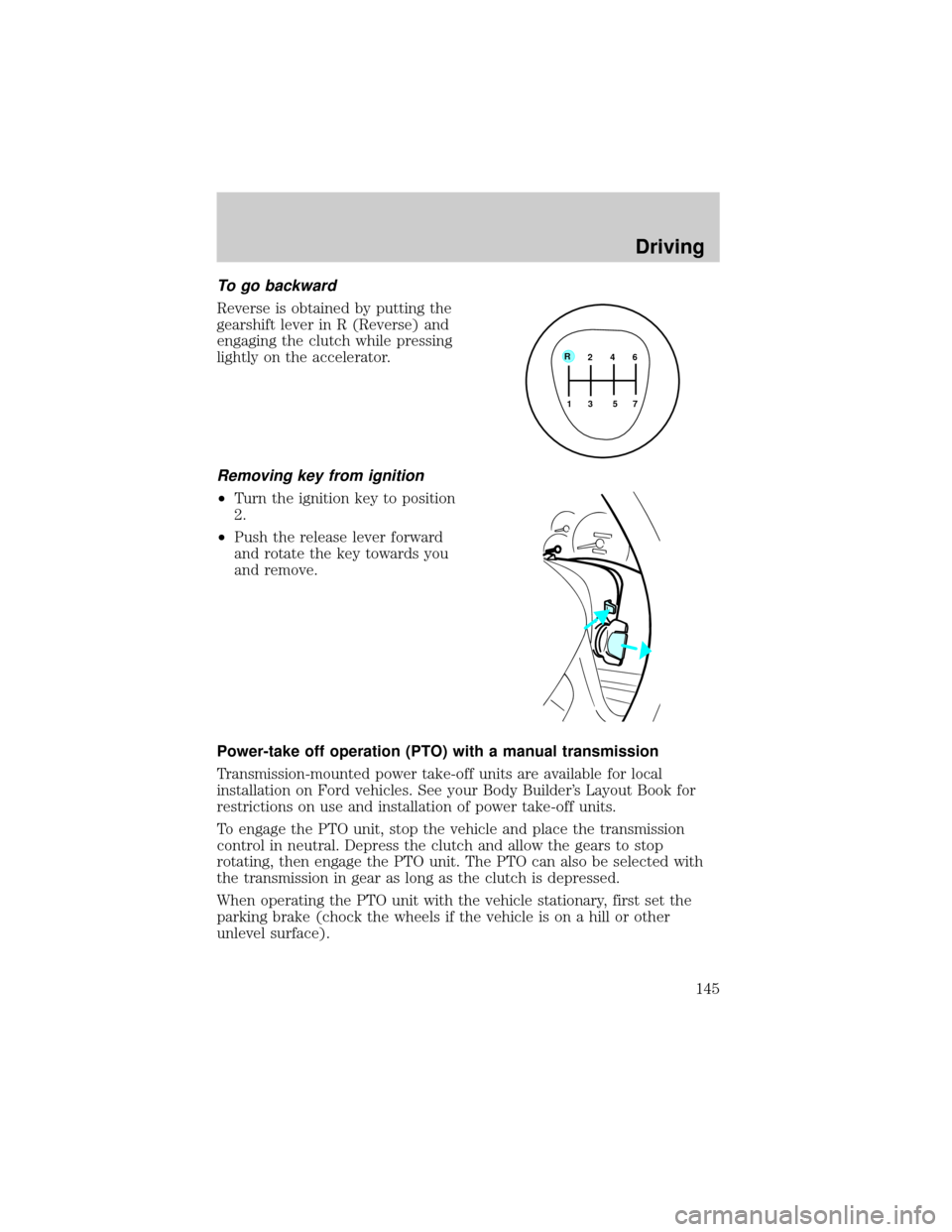
To go backward
Reverse is obtained by putting the
gearshift lever in R (Reverse) and
engaging the clutch while pressing
lightly on the accelerator.
Removing key from ignition
²Turn the ignition key to position
2.
²Push the release lever forward
and rotate the key towards you
and remove.
Power-take off operation (PTO) with a manual transmission
Transmission-mounted power take-off units are available for local
installation on Ford vehicles. See your Body Builder's Layout Book for
restrictions on use and installation of power take-off units.
To engage the PTO unit, stop the vehicle and place the transmission
control in neutral. Depress the clutch and allow the gears to stop
rotating, then engage the PTO unit. The PTO can also be selected with
the transmission in gear as long as the clutch is depressed.
When operating the PTO unit with the vehicle stationary, first set the
parking brake (chock the wheels if the vehicle is on a hill or other
unlevel surface).
2 4 6
3 5 7
1 R
Driving
145
Page 146 of 256

BACKING UP
To avoid the possibility of personal injury while backing the
vehicle, always be sure your vehicle's path is clear.
Before backing your vehicle, be sure you can do so safely. If anything
behind the cab limits your view, do not rely on mirrors alone to assure
that your intended path is clear. If other persons are in the vicinity, have
someone standing well behind the vehicle and outside your intended
path - visible through an exterior mirror - guide you as you back up.
Although OSHA or other governmental regulations may require use of an
electrical or mechanical back-up alarm to warn bystanders, such an
alarm does not assure that the intended path is clear.
An electrical back-up alarm, if installed, is connected to the back-up
lamp circuit.
TWO SPEED REAR AXLE
General Information
A 2±speed axle allows the vehicle operator to selectLow Rangefor good
starting and pulling power. The operator may also selectHigh Range
which allows for greater road speed and economy.
High or Low Range can also be used to provide additional steps between
transmission gear ratios when either gradeability or economy are a
driving factor.
Axle upshift
Brake Torque
In any type of shift, you must brake torque your vehicle. This is done by
releasing the accelerator, because torque creates a binding action on the
sliding clutch gear. This binding must be relieved in order for the shift to
take place.
Axle upshifts transmission gears may be abrupt, causing the truck to
jerk. Using the clutch with the accelerator will smooth the shift.
In order to shift from LOW to HIGH,
²Pull the axle shift accelerator up.
²Release the accelerator.
Driving
146